Tag Archives: India

China’s Military Strategy White Paper 2015: Far Seas Operations and the Indian Ocean Region

The Security Environment

On 26 May 2015, China released its first ever White Paper focusing exclusively on military strategy. China’s economic rise propelled by an extensive growth strategy has caused its integration with the global economy. It has consequently developed expansive interests linking its fate with that of the global system, most notably its access to African and Persian Gulf resources. China’s transition from the ‘near coast defence’ maritime doctrine in the 1980’s (product of a maritime strategy that was seen only as an extension to the continental strategy) to the ‘near seas control’ doctrine till 2004 calling for China to exercise control up to the first island chain has mirrored China’s increasing integration in the global economy. The conferment of historical missions upon the Chinese Navy post 2004 required it to focus on the distant seas as well. That was symptomatic of the increased stakes China had in influencing the events in the maritime commons, and was a trend that has continued unabated. The document acknowledges this, noting that:

In the new circumstances, the national security issues facing China encompass far more subjects, extend over a greater range, and cover a longer time span than at any time in the country’s history. Internally and externally, the factors at play are more complex than ever before.”

Taiwan’s reunification and safeguarding its territorial claims in the ‘near seas’ remain important to China. However, the emphasis accorded to safeguarding of China’s overseas interests is notable, as observed in the section on National Security Overview which says:

With the growth of China’s national interests, its national security is more vulnerable to international and regional turmoil, terrorism, piracy, serious natural disasters and epidemics, and the security of overseas interests concerning energy and resources, strategic sea lines of communication (SLOCs), as well as institutions, personnel and assets abroad, has become an imminent issue.”

A Blue Water Force

The most revealing part of the strategy indicating China’s aim to build a globe spanning blue water navy says:

“..the PLA Navy (PLAN) will gradually shift its focus from “offshore waters defense” to the combination of “offshore waters defense” with “open seas protection,” and build a combined, multi-functional and efficient marine combat force structure.

The section on force development goes on to say:

The seas and oceans bear on the enduring peace, lasting stability and sustainable development of China. The traditional mentality that land outweighs sea must be abandoned, and great importance has to be attached to managing the seas and oceans and protecting maritime rights and interests. It is necessary for China to develop a modern maritime military force structure commensurate with its national security and development interests, safeguard its national sovereignty and maritime rights and interests, protect the security of strategic SLOCs and overseas interests, and participate in international maritime cooperation, so as to provide strategic support for building itself into a maritime power.”
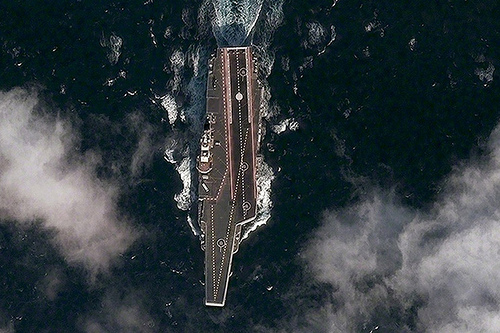
An overhead view of China’s carrier, the Liaoning.

Far Seas Operations

The strategic guideline of active defence is prescribed for the military with a focus on winning local wars in conditions of modern technology and informationisation (with the maritime military struggle aspect being highlighted).

In the section about Preparation for Military Struggle, however a reference is made to the need to strengthen strategic prepositioning. Limited logistical support severely constrains the PLAN’s ability to operate beyond East Asia; and in context of the Indian Ocean, this could be interpreted to refer to the strengthening of a Chinese policy popularly dubbed as the ‘String of Pearls’. Recent talks between China and Djibouti aimed at enhancing Chinese naval operations in the region is part of a Chinese effort to establish a variety of access points in the Indian Ocean Region in the upcoming years.

Further (as seen in the U.S. Office of Naval Intelligence 2015 Report on the PLAN) it is clear that the Chinese naval order of battle is undergoing qualitative improvements as legacy combatants are giving way to larger multi-mission ships capable of undertaking a broader spectrum of missions. The PLAN’s involvement in diversified missions in the far seas is mirrored in both its acquisition patterns and far seas training patterns (as routine deployments in the Philippines, operations in the Mediterranean and increasing incursions in the Indian Ocean indicate).

Looking to the Future

China has enhanced overseas interests, is building a blue water fleet to conduct far seas operations and the Indian Ocean is slated to become an active area of operations for the PLAN. Should this set alarm bells ringing in India? The answer is that it’s too early to tell.

The Chinese fleet is currently optimized for anti-surface warfare and has made substantial investments and developments in advanced Anti-Ship Cruise Missiles and Over the Horizon Targeting systems in pursuit of the same. Proficient as it may be in Anti Surface Warfare and increasingly Anti Air Warfare (shipboard air defences having witnessed dramatic improvements of late) Anti-Submarine Warfare and power projection in contested environments remain weaknesses for China. Given PLAN’s priorities closer to home, the pace at which aircraft carriers, large deck amphibious ships (power projection tools) and its anti-submarine capabilities are bolstered will be indicating the priority PLAN places on being able to sustain far seas operations that can involve high intensity combat operations.

Just as important as adapting to these developments militarily though would be closely mirroring Chinese diplomatic approaches not just in the Indian Ocean region but within China’s backyard as well. Whether or not such an approach is considered feasible depends in large part on whether it is the pursuit of simply a reactive or a pro-active strategy that is being considered. Either way policy must be formulated keeping in mind the fact that China has growing global interests and this is occurring simultaneously with the loosening of its historic reticence for using its military forces in far seas operations.

This piece was originally published as a Viewpoint at the National Maritime Foundation. The author (Himanil Raina) can be reached at himanilraina@gmail.com.
INS Vikrant Makes Progress at Cochin Shipyard

Guest Post by Chris B.

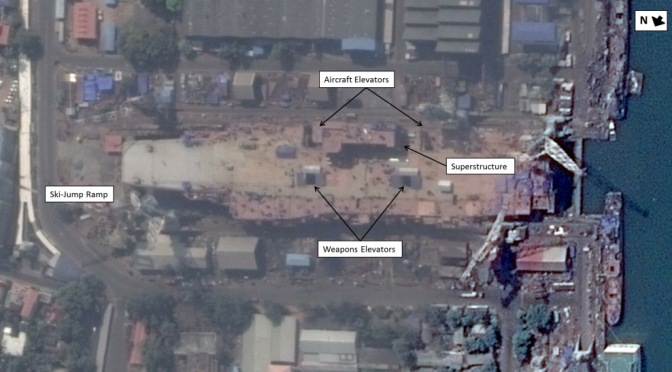
New satellite imagery shows that India’s first indigenous aircraft carrier has made significant progress since it was launched in August 2013, helping India inch towards the goal of a two carrier battle group.

Imagery acquired by commercial satellite firm DigitalGlobe in February 2015 shows further assembly of INS Vikrant, a 40,000 ton aircraft carrier and India’s soon-to-be largest vessel once commissioned. Additional ship modules now welded to the hull have enlarged the deck width — measuring almost 60 meters. The erection of the superstructure reported last November was also confirmed. India’s first domestically produced carrier is currently under construction at state-owned Cochin Shipyard Limited, the country’s largest shipbuilding and maintenance facility located in Kerala on the west coast.

Like other vessels built in India, significant cost overruns and delays have hampered shipbuilding progress. The South Asian country is already four years behind schedule on the project with the latests estimates pushing an operational date closer to December 2018, if not beyond. However, the Indian Navy expects that the vessel will “undock” sometime this month after mounting the propellers on the engine shafts, according to an April statement from Vice Admiral Ashok Subedar. Afterward, the shipyard will continue with the fitting out process.

Originally, India was to have fielded her carrier by 2014, eleven years after the government approved the build. Last July, the Cabinet Committee on Security released an additional Rs 19,000 crore (approx USD 3.18 billion), the lion’s share, to complete the vessel’s construction — on top the USD 585 million already spent. Due to India’s extensive bureaucracy, the funds languished for almost a year halting progress on the project.

“As much as 95 per cent of its hull is complete as is 22,000 tons of [its] steel structure,” Subedar went on to say. That’s 3,500 tons heavier than its August 2013 launch weight though significantly less than its planned 40,000 tons. Of course, much of the that weight will be comprised of two fixed wing squadrons (12 x fighters each) of Russian-built MIG-29K and Indian-built Tejas Light Combat Aircraft, 10 x Ka-31 ASW helicopters as well as necessary ammo, fuel, and other supplies.

Vikrant

Indian Navy Computer Model of INS Vikrant

Featuring a STOBAR (short take-off but arrested recovery) configuration with a ski-jump, India’s indigenous carrier will push naval pilots to master a new launch and recovery system, one very different from its existing STOVL (short take-off and vertical landing). Luckily, Russia helped India build a shore-based testing facility which became operational early last year. Imagery shows that Indian pilots are already hard at work. (INS Vikramaditya also features a STOBAR configuration).

Aircraft aside, India’s latest carrier will be powered by four General Electric LM2500 gas turbines capable of cruising speeds around 18 knots. With an endurance of 7,500 nautical miles the Navy should have few problems projecting force throughout the Indian Ocean region, especially given India’s previous proficiency in carrier operations.

But if issues do arise, the United States has proposed a joint working group to help support Indian ops, share best practices and even possibly, technology. All of which may lead observers to conclude that India’s naval capability has become increasingly important. Prime Minister Modi made that clear while visiting Mauritius in March: “India is becoming more integrated globally. We will be more dependent than before on the ocean and the surrounding regions. We must also assume our responsibility to shape its future. So, [the] Indian Ocean region is at the top of our policy priorities.”

As perhaps it should be. India is already advantaged by its unique geography, jutting out in the Indian Ocean with its 7,500km coastline and island territories. Given India has short distances to travel to manage any regional conflict or rivalry, it only makes sense that India would focus resources on protecting national interests in its own backyard.

DG (11MAR15) PLAN Salalah

Satellite Imagery of PLAN Vessel at Oman’s Salalah port (DigitalGlobe 11MAR15)

However, few regional contenders are making a splash in the maritime space, though emerging challenges from China are certainly on India’s radar. China’s People’s Liberation Army Navy (PLAN) commissioned its first aircraft carrier, the Liaoning, in 2012 and has already started construction on a second. With recent infrastructure established in the South China Sea and additional PLAN deployments in the Indian Ocean region, China appears poised to take a more aggressive maritime stance, a clear departure from India’s Cold War experience.

In response, India is planning a 160-plus-ship navy as it seeks to constrain what it sees as a Chinese incursion into its sphere of influence. Unfortunately for the navy, India is still predominately a land force with the Army maintaining the biggest share of the defense budget. Regardless, India expects that its homegrown carrier program will eventually allow it to maintain two carrier battle groups supporting its respective Eastern and Western Naval Commands.

Named after India’s first aircraft carrier recently scrapped, the INS Vikrant is one of two homegrown carriers planned for the Indian Navy. The second carrier, INS Vishal is currently being fast-tracked—though it’s unknown what this means for Vishal’s construction timeline. In the meantime, India’s lack of experience building carriers and the uncertainty of outside assistance may impede India’s pressing strategic goals, probably pushing the operation of its second carrier to 2025 or beyond.

This article can be found in its original form at Offiziere.ch

China’s South China Sea Strategy: Simply Brilliant

This article can be found in its original form at ASPI here, and was republished with permission.

In the past 12 months, China has provoked considerable attention with its reclamation activities in the South China Sea, particularly in the Spratlys where it controls seven maritime features.

China’s history of salami-slicing presents a dilemma to regional countries as well as external powers with regional interests: do they escalate an incident each time China slices the salami and risk open conflict, or stand down and allow China to augment its territorial claims.

The million-dollar question remains: who or what will freeze China’s reclamation in the South China Sea? The answer: nothing, really.

It has been proposed, for example, that like-minded states carve out a ‘code of practice’ that would stress the rule of law and mirror the 2002 Declaration on the Conduct of Parties in the South China Sea. Another option being considered by the Pentagon is to send US aircraft and ships within 12 nautical miles of the Chinese-built reefs in the Spratlys, to challenge its influence there.

While useful, such proposals won’t freeze or rollback China’s attempts to change the facts on the ground (or the high sea). China’s reclamation seeks to pre-empt any decision that would come from the Philippines’ challenge in the International Tribunal for the Law of the Sea over China’s nine-dash line claim to the South China Sea.

It’s noteworthy that China hasn’t only engaged in salami slicing; it has sought to use the attraction of its economy, trade and aid to offset its high-risk behaviour.

Following the 2012 Scarborough Shoal incident with the Philippines, China launched a charm offensive in 2013, wooing ASEAN with a treaty of friendship and cooperation, stressing that it intended to take China–ASEAN relations from a ‘golden decade’ to a ‘diamond decade’.

This year, when concerns about China’s reclamation have intensified, China has offered a carrot: US and other countries would be welcome to use civilian facilities it’s building in the South China Sea for search and rescue and weather forecasting, when ‘conditions are right’.

China has also used its economic weight to deftly tilt the balance (of influence, at least) in its favor. Its Asian Infrastructure Investment Bank (AIIB) is attracting long-standing American allies such as Great Britain, Australia and South Korea. China has stolen a march on the US in the battle to win friends and influence people.

And the economic offensive doesn’t end with the AIIB. The Regional Comprehensive Economic Partnership—a free trade agreement that would involve ASEAN, Australia, China, India, Japan, New Zealand and South Korea—is seen as a rival to the US-led Trans-Pacific Partnership. China’s Silk Road Economic Belt is also another lure for peripheral countries keen on leveraging on China’s economic ascent.

Concerted and effective opposition to China’s fait accompli in the South China Sea requires an astute mix of diplomacy and deterrence. It might take the form of a regional effort to get China to clarify its nine-dashed line claims based on UNCLOS principles, an ASEAN ultimatum for China to at least freeze its reclamation activities, and joint ASEAN–US patrols near the reefs being reclaimed by China. This looks unlikely to emerge anytime soon.

ASEAN was damaged in 2012, when it failed—for the first time in its 45-year history—to issue a communiqué due to differing views over the South China Sea. ASEAN has recently upped its game by underscoring the dangers of China’s reclamation, but there’s little the group can do apart from pushing for a formal Code of Conduct. A successful conclusion of the code isn’t assured; China dangles the carrot of code negotiations to buy time even as its carries out reclamation.

For all its rhetoric about the need to uphold international law and the freedom of navigation, the US is conflicted when it comes to China. It all boils down to this: will the US risk its extensive relationship with China over a few rocks in the South China Sea? As Hillary Clinton once said: how does the US ‘deal toughly’ toward its banker?

To get a sense of the effect of China’s creeping invasion of the South China Sea, one only need look at Vietnam. Faced with China’s challenge to its claims to the Paracel Islands, Vietnam has purchased Kilo-class submarines, reportedly armed with sub-launched land-attack Klub missiles that could threaten Chinese coastal targets. But Vietnam didn’t fire a shot when China towed a US$1b oil rig into waters claimed by Vietnam last year. On a recent trip to Hanoi, Vietnamese scholars told me that Vietnamese military officers urged sterner action, such as firing on Chinese ships, but senior leaders vetoed them, instead deciding to sit back and let China incur ‘reputational damage’.

Not many people in Asia would agree with what China is doing in the South China Sea. But as it stands, China’s strategy—salami slicing, using offsets to soften risky behavior and accelerating its reclamation activities in the absence of significant opposition—can be summed up in two words: simply brilliant.

William Choong is a Shangri-La Dialogue senior fellow for Asia-Pacific Security at the International Institute for Strategic Studies.

Members’ Roundup Part 18

Welcome back to another edition of the Roundup! After a brief hiatus we are back to share with you more of our members’ works. There are plenty of articles to share, ranging from maritime infrastructure development to thoughts on the new maritime strategy.

Back in February Miha Hribernik wrote a piece for The Diplomat regarding piracy in Southeast Asia. Although this presents a significant and worrying problem, it is manageable. Miha presents some suggestions for regional States on how to resolve this issue. You can access the article here. 

To surpass China in Sri Lanka, India needs to pursue proactive and dynamic diplomacy. Nilanthi Samaranayake explains, over at The Diplomat, that the key to reaffirming India’s presence in the region is through infrastructure investment. More specifically, the focus should be on public-private partnership and government to government investment in the maritime domain. You can access Nilanthi’s article here.

Screen Shot 2015-03-20 at 1.53.03 pmJerry Hendrix, from the Center for a New American Security, published a report in February called ‘Avoiding Trivia: A Strategy for Sustainment and Fiscal Security’. In it, he argues that the United States has strayed from its historic and cultural approach to the world, leaving behind its traditional maritime-focused, technologically innovative, free-trade based strategy. The solution to this, according to Hendrix, is a more clear eyed strategy that seeks to avoid trivia and address the US’ current weaknesses in order to shore up its long term strategic position.

Over at War on the Rocks David Wise shares with us an article titled ‘Blowback as National Policy.’ Many of the current security threats that the Western world faces today are a result of those decisions made in years past. Before making the foray into the geostrategic game, which is more than just a big game of Risk, first have a look at David’s cogent words on what we face today.

Mira Rapp-Hooper writes on the Lawfare Institute’s blog a post examining the impact of China’s increased military spending (and the US’ relative decline in spending) on neighbouring countries. You can access her post here.

Following the trend of AMTI posts, Bryan McGrath shares his analysis on how China might view the United States’ revised Maritime Strategy. Given that Bryan was heavily involved in the development of the 2007 strategy, you will certainly find his views on the matter very insightful. You can access his piece here.

Vice Admiral Robert Thomas, commander of the US 7th Fleet, proposed the creation of joint maritime patrols in the South China Sea by ASEAN member nations – this was quickly met with mix reactions. Scott Cheney-Peters provides some solutions to challenge the arguments presented by the ‘nay-sayers’ and suggests that the presence of the “white hulls” of the U.S. Coast Guard could mitigate many of the perceived drawbacks. You can find out more by accessing his article on the AMTI’s website, here.

Harry Kazianis, on The National Interest, shares an analysis of the core reasons behind China’s ‘massive’ military buildup. He explains the historical roots of the Chinese military psyche due to subjugation at the hands of external powers. The solution to this is to employ an asymmetrical strategy  to defeat, in battle, forces that are superior to its own. You can access his article here.

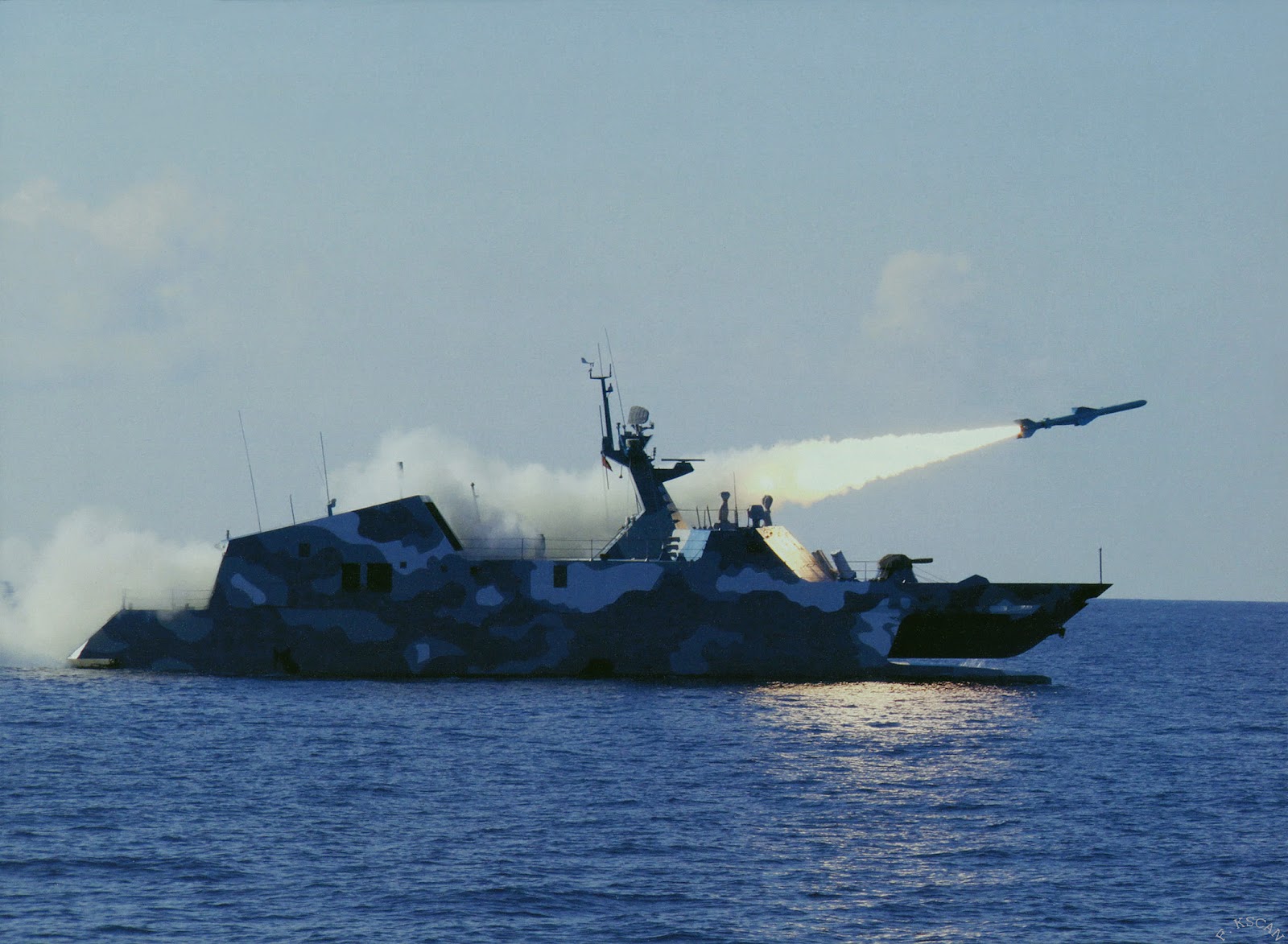
Long range anti-ship missiles contribute to an essential element of China's deterrence.
Anti-Ship Missiles contribute to an essential element of China’s deterrence.

On the National Defense Magazine’s online blog, Sandra Erwin reports that the current pace of shipbuilding and funding will not be able to meet the future demands of the Navy. Given that is an annual obligation of the Navy to tell Congress how many ships it will need and how much they will cost, it should certainly raise some alarm bells for decision-makers in Washington. For more on this, you can access Sandra’s post here.

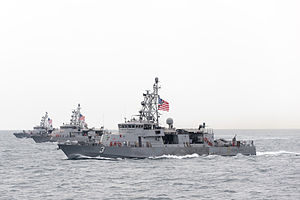
U.S. Navy Cyclone-class coastal patrol ships assigned to Patrol Coastal Squadron 1 (PCRON 1), USS Hurricane (PC-3), USS Chinook (PC-9) and USS Typhoon (PC-5), transit in formation during a divisional tactics exercise in the Persian Gulf.

Bringing the theme of this Roundup to the naval profession, Matthew Hipple in a joint article with Dan Follet and James Davenport, remind us the important role of patrol coastal ships in securing the seas. In this edition of Proceedings, the authors suggest that patrol coastal ships are an “incredible platform for both mission execution and cultivating war fighting.” To read more about why this is the case, you can access their article here.

Over at War on the Rocks, CIMSECian Emil Maine (and company) provide some critique of Congressman Mac Thornberry’s ‘Defense Acquisition Reform’ initiative. Defence acquisition is a necessity, but the question is whether political momentum can be sustained long enough to overcome the usual barriers to wholesale reform. More on this topic here.

Finally we conclude this edition with a shameless plug for my own work. The first is an article featured in the March-April edition of the Australian Defence Force Journal. Titled ‘Evolution of the Battlefield’, I examine existing strategic and legal challenges to developing an effective cyber warfare policy for military planners. My second piece is a brief analysis of the Australian Department of Defence’s new First Priniciples Reviewthis will hopefully provide an insight into some of the organisational challenges faced by the ADF and Department of Defence. Perhaps some of the US readers can find some similarities and provide suggestions for the Australian context. You can access each of the above articles here and here.

At CIMSEC we encourage members to continue writing, either here on the NextWar blog or through other means. You can assist us by emailing your works to dmp@cimsec.org.