Tag Archives: NATO

Russia’s Strategic Brown Water Capabilities: A NATO Blind Spot?

By Helge Adrians

Russia is working to integrate inland waterways more deeply into its deterrence and defense posture. In Western contexts, this area of maritime geography is usually termed the brown water zone.’ A harbinger of that development was the October 2015 strike against positions of Islamist groups in Syria, carried out by small warships in the Caspian Sea using land-attack cruise missiles (LACMs). Russia not only demonstrated a new level of operational reach (of over1 1,500 kilometers), but also revealed a singular capability that remains unmatched to this day – executing deep precision strikes (DPS) from inland waters.2

Indications that the Russian Navy could carry out such an operation from lakes and possibly even rivers had emerged a few years prior. As part of the State Armaments Program for 2007-2015, Russia started outfitting many of its naval vessels with a new, long-awaited universal vertical launch system (VLS). Like the US MK 41 VLS — which has been in use since 1986— the Russian 3S14 VLS is designed to accommodate different types of missiles (rather than using specialized tubes for each missile type, as was previously the case on Soviet and Russian warships)3. The outfitting included river-capable Buyan-class corvettes, of which a modified batch with an eight-cell VLS was built from 2010—the Buyan-M class, sometimes also called Sviyazhsk-class.4 Two years later, the 3M14 LACM—a variant of the Kalibr family of missiles—was introduced on surface warships. One of the first units was the Gepard-class frigate Dagestan, which is part of the Caspian Flotilla. The formation also received the first three Buyan-M class corvettes, commissioned in 2013.

The reinforcement of the Caspian Flotilla was no coincidence. It was closely linked to the naval build-up of the three former Soviet republics Azerbaijan, Kazakhstan, and Turkmenistan from the mid-2000s. The motivations behind this trend were twofold – a growing interest amongst the littoral states in exploiting the Caspian Sea’s economic potential, and the ambiguity surrounding its legal status at that time, particularly concerning maritime borders and access rights. Despite its scale resembling a marginal sea, the Caspian Sea is in practical terms an inland lake.5

Russia’s military port of Kaspiysk on the Caspian Sea. (Google Earth image via TWZ.com)

Although Western observers were aware of these two developments — ‘Kalibrization’ of the Russian Fleet and strengthening the combat power of forces of an inland water body — it seems they failed to derive the correct insights. For example, the Intermediate-Range Nuclear Forces (INF) Treaty, concluded with the United States in 1987, prohibited land-based medium-range missiles, but not sea-based ones. This explains why Russia’s strike in October 2015 caused such significant surprise. As is often the case with such events, many of the subsequent analyses focused on the political implications and the technologies used, while paying less attention to the underlying conceptual framework.

New strategic importance of Russia’s inland waters

Russia’s inland waterways hold strategic significance. This is due to three reasons: first, the country has a large number of rivers spread across its entire territory; second, many of them are long and wide, well-suited for transporting cargo; and third, most of the rivers lie entirely within Russian borders, making them less accessible to Western intelligence. That may have been one of the reasons why the Soviet Union connected the waters west of the Urals in the mid-20th century. At the center is the Volga River, which flows into the Caspian Sea. Through the construction of canals, the Volga was also linked to the Baltic Sea and the White Sea in the North, and to the Black Sea in the South.6 This network is most commonly referred to as the Unified Deep Water System of European Russia (UDWS).

Map of the United Deep Waterway System of Russia. (Graphic via Wikimedia Commons)

From the earliest days of the Cold War, there were discussions within NATO about the military utilization of the UDWS. However, this was more about the possibility of moving single warships, especially submarines, between the northern and the southern flank covertly and thus protected from NATO attacks. To this day, Russia maintains naval shipbuilding at several shipyards along the Volga River. Until the 1990s, even Kilo-class submarines were constructed at a facility there.

Fitting river-capable corvettes with 3M14 LACMs and using them from the Caspian Sea has fundamentally altered strategic assessments of the UDWS, from a useful logistical corridor to an inland naval bastion. However, the capability to carry out DPS from such an unexpected location seems less the outcome of deliberate planning. It was more a consequence of budgetary limitations as a result of the collapse of the Soviet Union in 1991 and the Russian financial crisis in 1998.7 Faced with the need to maintain its nuclear-powered ballistic missile submarines (SSBNs), Russia was forced to make cuts in surface fleet development. Enhancing the operational reach of so-called third-rank combatants like corvettes, traditionally used for operations in the littoral ‘green water,’ or as they say in the Russian Navy – ‘near sea’ zone – emerged as a pragmatic and creative compromise, particularly against the backdrop of the INF Treaty, which was in effect until 2019.8,9 Amongst these are the aforementioned Buyan-M class and its more advanced successor, the Karakurt-class, of which several examples have been commissioned since 2018. 

Searching for safe spaces

Following Russia’s full-scale invasion of Ukraine in February 2022, naval platforms became part of the ground campaign through the use of 3M14 LACMs. Initially, such strikes were launched from the Black Sea. By end of December 2022, the Caspian Sea—far away from the frontlines—had also become a launch area for these operations. As Ukraine gradually managed to keep the Black Sea Fleet at distance through a combination of shore-based anti-ship missiles, sea mines, and later—with growing intensity since summer 2023 at the latest—uncrewed surface vessels (USVs), the strategic relevance of the Caspian Sea grew. It not only served as a safe space for continued DPS but also as a hub for repairing and replacing damaged ships.

The expanded use of uncrewed systems in the war against Ukraine plus Western intentions to acquire such platforms have made secure maritime areas increasingly vital for the Russian Navy. However, those are scarce. During the Cold War, Soviet fleets relied on an ‘area denial’-strategy (AD),10 also known as the ‘Bastion’-concept with regard to the defense of the bases of the Northern and the Pacific Fleet where Russia continues to concentrate its SSBNs. The extended defense of this protected space can be described as an ‘anti-access’-approach (A2). Long before the term ‘A2/AD’ was coined by Western analysts in 2003 and became a buzz word from 2014, Moscow had already developed the necessary capabilities as a lesson learnt from World War II (mainly a large long-range aviation and submarine force).11,12 These platforms threatened opposing surface warships, which could be detected and targeted before reaching Soviet positions. Even fleets in marginal seas were enabled to perform A2/AD. A renaissance came with the introduction of various land-based long-range missile systems from around 2012.13 For a long time, Western nations appeared to have little means to counter these A2/AD capabilities. Unmanned systems may offer a solution, as the Ukrainian armed forces have repeatedly demonstrated in the air and in the maritime domain. Due to their small size and design, uncrewed systems have low signatures. Consequently, they are frequently able to penetrate Russian defense layers unrecognized. As a result, the retreat of warships into protected areas under full Russian control—including the UDWS—appears to be the only viable option to safeguard against new asymmetric threats such as USVs and uncrewed underwater vehicles (UUVs).

In light of this, the Russian Navy has adapted for better protection, starting with the creation of a new naval district for the Sea of Azov in July 2023. Situated north of the Black Sea, it is a shallow shelf sea accessible primarily via the Kerch Strait, which Russia has controlled since annexing Crimea in March 2014. In the early stages of the invasion of Ukraine in 2022, Russian forces succeeded in closing the gap between Donbas and Crimea. Since then, Russia has gained full control over the Sea of Azov. One of the main reasons for this approach may have been that there is access to the UDWS via the Don River, which flows into the north-west. In the Sea of Azov, Russian warships are less exposed to Ukrainian attacks than in the Black Sea. This made the maritime enclave appear suitable, amongst other things, as a launch area for corvettes with LACMs.

Efforts to identify secure maritime spaces were also observed in other regions: in the east of the Baltic Sea, the Russian Navy appears to be planning to open up Lake Ladoga—situated north of St. Petersburg—as a fallback area for small warships. Covering nearly 18,000 square kilometers, it is the largest inland body of water in Europe. Since Finland’s defeat in the Second World War, it has been completely surrounded by Russian territory14 and became part of the UDWS. During the Cold War, the lake’s remoteness made it a strategically valuable site for naval testing, playing a role comparable to that of the Caspian Sea. Now, according to Russian media, it is set to become a component of Moscow’s deterrence and defense posture vis-à-vis NATO. For this, two Karakurt-class corvettes of the Baltic Fleet were deployed to Lake Ladoga for several days in September 2023, followed by two Buyan-M class vessels for a similar duration in September 2024.15 While in the first year the focus lay on navigation training and surveying former naval mooring sites repurposed by Russian state-owned defense companies, the second year was reportedly marked by notional launches of 3M14 LACMs as part of the major naval exercise Okean 2024.16

In Russian media, there have been discussions about bolstering forces for brown water operations. This was sparked by a March 2024 announcement from the then Russian Minister of Defense, stating plans to reconstitute a Dnieper Flotilla by the end of the year—intended to take over riverine combat duties from the ground forces. Such formations have existed intermittently since the 18th century, most recently until 1951. The Soviet Union also operated similar groupings on other major rivers. Russia has taken over some of them. The last major command was the Amur Flotilla at the Russian-Chinese border in the Far East: it was transferred to the Border Service in 1995 and formally disbanded in 1998. Apart from that, a sizable shipyard still exists on the Amur River, which also builds Karakurt-class corvettes. However, it is not yet known to what degree these will be deployed from there and whether Russia intends to build up further riverine units.

Amur River basin. (Graphic via Wikimedia Commons)

Decisive, complementary impact without salvos

The extent to which the Russian Navy attributes a strategic role to inland waters is currently connected to the deployment of Buyan-M and Karakurt-class corvettes. Nevertheless, the presence of these vessels beyond the usual duration of a transit is better understood as a sign that changes might be underway, rather than definitive evidence that a change has already taken place. This is because, although the corvettes can strike far-off targets using 3M14 LACMs, they are limited to carrying just eight per ship. However, in conjunction with long-range and decoy UAVs that could saturate air defenses, these assets enable surgical strikes or DPS, respectively, against select targets, particularly critical infrastructure. This reflects the ‘Strategic Operation for the Destruction of Critically Important Targets’-approach outlined in Russian military theory around 2010. The concept is to discourage an adversary from escalating or continuing a conflict by selectively destroying high-value targets, aiming to impact political or societal morale without causing mass casualties. This behavior has been repeatedly demonstrated in Russia’s war against Ukraine.

Such effects could also be achieved through ground- or air-based systems. In this context, warships should be seen as a supplement — particularly when other assets are absent or limited. One example is the Russian part of Karelia, an area east of Lake Ladoga, where Moscow only recently began expanding its ground force presence in 2024, following Finland’s accession to NATO in 2023, leaving the area initially lacking adequate deterrence capabilities.17 Even though Lake Ladoga is seasonally unusable due to ice cover, it can nonetheless be utilized temporarily for defensive or deterrent purposes.

The potential use of LACMs also serves to demonstrate the Russian Navy’s relevance in land operations—an aspect that should not be underestimated. Here, the focus is less on quantity but more on quality; internally, this reinforces the Navy’s standing within the Russian armed forces and political leadership, while externally, it contributes to strategic ambiguity by signaling that all branches of the military are capable of delivering long-range effects.

Closing NATO’s blindspot

Striking land targets from lakes offers several advantages. In addition to the protection against asymmetric threats, it also provides cover from reconnaissance and targeting by enemy missile systems. This is due to the stealthy design of the Buyan-M and Karakurt-class corvettes. When moving or hiding near shorelines, spotting, tracking, and targeting them becomes difficult. Moreover, engaging warships requires different types of munitions than those used against land-based systems like rocket launchers—specifically, warheads capable of penetrating hulls or superstructures to cause significant damage or achieve a kill. Most Western anti-ship missiles have limited range, typically only a few hundred kilometers, and travel at subsonic speeds over longer distances, making them easier to detect and intercept. Additionally, some anti-ship missiles designed for blue-water targets may struggle with targets amongst the cluttered shorelines of lakes and rivers.

While NATO may not prioritize countering Russian warships on lakes in a broader conflict scenario, the risk remains significant. Ukraine’s response offers a blueprint of what can be done. On the one hand, obstructing passage through chokepoints such as straits or locks can effectively trap warships or prevent them from entering. Since the start of the war, Ukraine has sought to block the Kerch Strait; for example, in July 2024, it targeted the nearby ferry terminal at Kavkaz from the air. According to the Ukrainian Navy, Moscow has withdrawn all warships from the Sea of Azov as a result.

On the other hand, the destruction of port infrastructure can disrupt the resupply of naval forces, particularly the reloading of missiles, which can only be done pier-side. Ukraine successfully struck Russian warships in the captured port of Berdiansk on the Sea of Azov in March 2022 as well as in the naval base at Kaspiysk on the Caspian Sea in November 2024. In the latter, both Gepard-class frigates and a Buyan-M class corvette would have been affected.

Ukrainian drones strike the naval base of the Russian Caspian Flotilla in November 2024. (Footage via Twitter/OSINT Technical)

There are also lessons to be learned from Russia’s tactics: in August 2025, it launched an attack on a Ukrainian reconnaissance vessel deep in a tributary of the Danube River. The vessel was reportedly underway in Ukrainian waters, just meters away from the opposite Romanian bank. Remarkably, Russia succeeded in covertly deploying a USV about 40 kilometers into the Danube to conduct the kamikaze strike, while coordinating a UAV to monitor the mission from the air (which could also have fired on the ship).

In principle, it seems possible that the Russian Navy may seek to enhance the strategic role of inland waters. The deployment of Kilo II-class submarines or the loading of 3M14 LACMs in the containerized Club-K version18 onto civilian riverboats are both conceivable, though unlikely due to the logistical complexity involved (because of, for example, river depths19 and currents20 as well as satellite connections). Instead, Russia is more likely to focus on better protecting its Buyan-M and growing Karakurt-class corvettes. Increasing their numbers and distributing them when at sea or over several supporting sites make detection significantly more difficult. This would allow Russia to maintain a strategic reserve for DPS.

Conclusion

NATO should not underestimate Russia’s strategic brown water capabilities. The same applies to Japan and South Korea in the event that Moscow, contrary to current indications, intends to use the Amur as a launch area to defend the Sea of Japan and the Sea of Okhotsk. Therefore, it is essential to prepare doctrinally, enhance surveillance techniques, and develop effective countermeasures. This will require more unconventional thinking—for example, the dropping of sea mines, USVs and UUVs from the air or the arming of partisans with portable anti-ship missiles such as the Swedish RBS-17. New doctrine and capabilities can effectively account for this important yet underappreciated dimension of Russian naval influence.

Commander Helge Adrians, German Navy, M.A., is a Visiting Fellow at the German Institute for International and Security Affairs.

References

1. 3M14 should be able to fly up to 2,500 kilometers, according to [U.S.] State Department, Bureau of Arms Control, Verification and Compliance (2020): 2020 Adherence to and Compliance with Arms Control, Nonproliferation, and Disarmament Agreements and Commitments (Compliance Report), online in: https://2017-2021.state.gov/wp-content/uploads/2020/06/2020-Adherence-to-and-Compliance-with-Arms-Control-Nonproliferation-and-Disarmament-Agreements-and-Commitments-Compliance-Report-1.pdf (PDF file), June 2020 (accessed: 26.12.2024), p. 14 and 16.

2. The distance from the Caspian Sea to the targets in Syria was given by the official Russian side as ‘nearly 1,500 kilometers’, cf. TASS (2015): Caspian Flotilla ships fire 26 cruise missiles on IS targets in Syria — Defense Minister [sic!], online in: https://tass.com/defense/826919, 07.10.2015 (accessed: 18.12.2024).

3. Cf. Bogdanov/Kramnik (2018), p. 6.

4.  Cf. Office of Naval Intelligence (2015): The Russian Navy. Historic Transition, Washington: N.p., p. 20.

5. For decades, the Soviet Union and Iran—the Caspian’s only littoral states until 1991—neglected to define its legal status. Only in 2018 did the five current coastal states reach an initial agreement (i.e., the Convention on the Legal Status of the Caspian Sea, also known as ‘Teheran Convention’), concluding that the Caspian Sea should be treated as neither a sea nor a lake in legal terms.

6. Cf. Jaghdani, Tinoush Jamali/Ketabchy, Mehdi (2023): The Strategic Significance of the Russian Volga River System, in: Russian Analytical Digest, Vol. 304, pp. 22-27, here: p. 22.

7. Cf. Mommsen, Klaus A. R. (2020): The Russian Navy. “Russia’s pride, strength, and asset”, in: Routledge Handbook of Naval Strategy and Security, edited by Krause, Joachim/Bruns, Sebastian (2018), Abingdon/New York: Routledge, pp. 305-314,
here: p. 307.

8. Cf. Kofman, Michael (2023): Evolution of Russian naval strategy, in: The sea in Russian strategy, edited by Monaghan, Andrew/ Connolly, Richard (2023), Manchester: Manchester University Press, pp. 94-123, here: p. 109.

9. For example, the delays in delivering the first two Admiral Grigorovich-class frigates in 2015 prompted a shift in focus toward building Karakurt-class corvettes instead, cf. РИА Новости (2015): Минобороны заявило, что ОПК “немножко сорвал” срок сдачи двух фрегатов, online in: https://ria.ru/20151224/1348076684.html, 24.12.2015 (accessed: 19.08.2025).

10. Cf. Ushirogata, Keitaro (2025 in English; 2019 in Japanese): Global Maritime Military Strategy. 1980-2023, Singapore: Springer, p. 128 ff.

11. This was related to the fact that the US developed a new strategy to deprive Chinese A2/AD-capabilities. Russia and Iran were also credited with such capabilities, making the issue more relevant for European NATO members, especially as there were fears after the occupation and annexation of Crimea that Russia could do the same with the Baltic states and make defence more difficult by activating A2/AD-systems, cf. Simón, Luis (2016): A European Perspective on Anti-Access/Area Denial and the Third Offset Strategy, online in: https://warontherocks.com/2016/05/a-european-perspective-on-anti-accessarea-denial-and-the-third-offset-strategy/, 03.05.2016 (accessed: 27.08.2025).

12. Cf. Gorschkow, Sergej (1976): Seemacht Sowjetunion, edited by Opitz, Eckardt (1978), Hamburg: Hoffmann & Campe, p. 266.

13. In 2012, the S400 air defence system, which entered service in 2007, was stationed in Kaliningrad—the first of the three missile systems primarily linked to A2/AD, cf. Dalsjö, Robert/Berglund, Christofer/Jonsson, Michael (2019): Bursting the Bubble. Russian A2/AD in the Baltic Sea Region. Capabilities, Countermeasures, and Implications (FOI-R–4651–SE), p. 27. The other two systems are Iskander (both the -M and -K version) against land targets, and Bastion-P against sea targets, cf. ibid., p. 10.

14. In late 1939, the Soviet Union demanded territory from Finland, citing the security of Leningrad (now Saint Petersburg) as a primary justification. After Finland refused, the Soviet Union invaded in November. The war ended in March 1940 with the Moscow Peace Treaty and the formerly shared Lake Ladoga became entirely surrounded by Soviet territory. Though contested during the 1941–1944 war, this control held. This outcome was formally recognized in 1947 with the Paris Peace Treaty that formally established Lake Ladoga as a Soviet inland lake under international law.

15. It was the Sovetsk (hull number: 252) and the Odintsovo (252), see the report ‘Baltic Fleet on Ladoga’ in: https://vpk.name/en/ 784930_baltic-fleet-on-ladoga.html 16.10.2023 (accessed: 24.11.2024). This is the English translation of the original Russian article by Timur Gainutdinov, published on Krasnaya Zvezda. The original text was published online but is not accessible from within Germany, cf. http://redstar.ru/na-sedoj-ladoge/. However, the Norwegian military blogger Thore Are Iversen uploaded the article and another English translation to X; see corresponding images at https://x.com/The_Lookout_N/status/ 1714640171176493411, 18.10.2023 (accessed: 27.12.2024).

16. One them could be the former naval base Lakhdenpokhya in the north west of the lake, cf. Ryabov, Kirill (2023): “Karakurt” on Lake Ladoga, online in: https://en.topwar.ru/228351-karakurty-na-ladozhskom-ozere.html, 19.10.2023 (accessed: 24.11.2024). Otherwise, the corvettes were moored at the floating bridge in Priozersk, as satellite images showed, see the Tweet by Thore Are Iversen in: https://x.com/The_Lookout_N/status/1833800057469952169, 11.09.2024 (accessed: 28.12.2024).

17. It was only in April 2024 that Russia announced its intention to station three missile artillery battalions equipped with the Iskander-M system in Karelia, see report ‘В Карелии сформирована отдельная ракетная бригада с ОТК «Искандер-М»0‘, in: https://iz.ru/1684603/2024-04-19/v-karelii-sformirovana-otdelnaia-raketnaia-brigada-s-otk-iskander-m, 19.04.2024 (accessed: 12.01.2025).

18. However, ‘[t]he current status of the Club-K system is unclear, and there is no public evidence that russia [sic!] has commenced serial production of this system’, cf. Syngaivska, Sofiia (2024): New Icebreaker Showcases russia’s [sic!] Advanced Naval Technology, Allegedly Suitable for the Kalibr Missiles, online in: https://en.defence-ua.com/weapon_and_tech/new_icebreaker_ showcases_russias_advanced_naval_technology_allegedly_suitable_for_the_kalibr_missiles-10743.html, 05.06.2024 (accessed: 26.08.2025).

19. Kilo-class submarines were usually deployed on barges across rivers, see the following undated photo in https://imgur.com/a/ lYRJeAO, 12.12.2023 (accessed: 04.01.2025). The link was shared in a discussion on Reddit, see https://www.reddit.com/r/ submarines/comments/18g02tl/how_submarines_built_in_nizhny_novgorod_were/, n.d. (presumably 2024; accessed: 04.01.2025). In 2021, a decommissioned November-class nuclear submarine was even transported via the White Sea-Baltic Sea Canal, see https://paluba.media/news/11667, 21.09.2021 (accessed: 16.01.2025).

20. Even smaller warships are therefore accompanied by tugs, as can be seen in a video showing the Karakurt-class corvette Taifun (805) on its way to Lake Ladoga in 2019, see https://www.youtube.com/watch?v=jZ7uYoh-hXg&t=1s, 20.05.2019 (accessed: 03.01.2025).

Featured Image: Buyan-M-class corvette of the Russian fleet, December 2022. Russia. (Photo via Ministry of Defense of the Russian Federation)

Small Craft, Big Impact: Ukraine’s Naval War and the Rise of New-Tech Warships

By David Kirichenko

Russia’s full-scale invasion of Ukraine in 2022 shocked the international order. What surprised the world even more was Ukraine’s ability to resist. While many in the West believed Ukraine would only hold out for a few weeks, the war has now entered its fourth year. Ukraine has relied on agility and innovation – especially in its use of drones and battlefield technology – to fend off Russian forces. This technological edge has extended beyond land warfare to the sea.

Over the past few years, Ukraine’s growing use of naval drones has pushed both sides to rapidly adapt, accelerating the race for countermeasures and maritime innovation. NATO would do well to study Ukraine’s approach as it prepares for the future of warfare at sea. Rear Admiral James Parkin, the Royal Navy’s director of development, notes that in 28 maritime battles, the larger fleet won all but three. Parkin believed that larger fleets win, but Ukraine has changed that paradigm, for now. The future of naval warfare is here and Ukraine is demonstrating what the future looks like.

Valerii Zaluzhnyi, Ukraine’s former commander-in-chief and current ambassador to the U.K., stated, “I have repeated many times that the nature of modern warfare has changed and continues to change.” Zaluzhnyi added, “The nature of modern warfare is far from what NATO is now operating.”

Ukraine’s Naval Lessons

At the outset of the war, Ukraine’s navy was virtually nonexistent, having lost most of its fleet when Russia annexed Crimea in 2014. Its only major warship, the frigate Hetman Sahaidachny, was scuttled by Ukrainian forces in February 2022 to prevent its capture. Yet through asymmetric tactics – naval drones, coastal missile strikes, and aerial attacks – Ukraine has transformed the Black Sea battlefield, forcing Russia into retreat and reclaiming strategic control of key waters around Ukraine’s coast.

Serhii Kuzan, chair of the think tank Ukrainian Security and Cooperation Center and a former adviser to Ukraine’s Ministry of Defense, explained that even before the full-scale invasion, Ukraine understood it could not match Russia in conventional naval strength.1 As a result, it adopted an asymmetric strategy focused on coastal missile systems, small vessels, and air support. After 2022, sea drones were added to this concept and have since become the navy’s primary strike weapon at sea. These unmanned systems emerged out of necessity, filling the gap left by the absence of a traditional fleet.

Ukraine is now rebuilding its navy around a fleet of unmanned surface vehicles (USVs), making sea drones central to its maritime strategy. When Russia attempted to blockade Ukrainian shipping, Kyiv responded swiftly with sea drone strikes. Even after the Russian Navy retreated from occupied Crimea to the safety of its mainland ports, Ukrainian USVs continued to harass and damage its fleet.

Following the sea drone offensive in 2023, Former US Navy Admiral James George Stavridis noted, “We’re at a juncture in military evolution akin to the game-changers like Agincourt or Pearl Harbor. Expensive manned surface warships now face existential threats from affordable drones.” The Ukrainians issued a warning in August 2023 that “There are no more safe waters or peaceful harbors for you in the Black and Azov Seas.” The Russians eventually learned to heed that warning and hid from Ukraine’s sea drones. According to Roy Gardiner, an open source weapons researcher and former Canadian Armed Forces officer, “These asymmetric victories have forced the relocation of the Russian Fleet to the eastern Black Sea, and broke the blockade to reopen the vital grain export routes.”

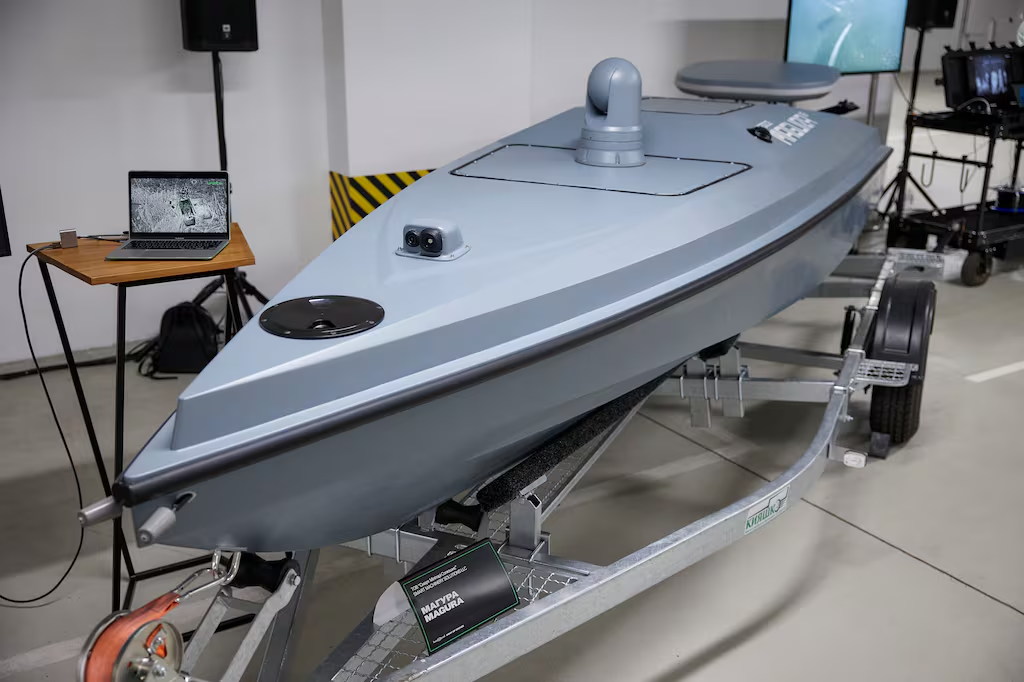
Ukraine’s drones have even achieved the unprecedented. By January 2025, modified Magura V5 sea drones armed with heat-seeking missiles shot down two Russian Mi-8 helicopters and damaged a third off the coast of Crimea – marking the first time a naval drone successfully downed enemy aircraft. In May 2025, Ukraine stunned the world by using sea drones equipped with AIM-9 Sidewinder missiles, each worth about $300,000 to shoot down two Russian fighter jets, each worth $50 million. The Ukrainian sea drones themselves are worth only several hundred thousand dollars. HI Sutton, a naval warfare expert wrote, “The success of Ukraine’s uncrewed surface drones (USVs) cannot be overstated. They are rewriting the rules of naval warfare.”

A Magura V5 maritime drone. (Photo by Daniyar Sarsenov/Ministry of Digital Transformation of Ukraine)

Ukrainian forces are increasingly adapting these drones for multi-role capabilities, equipping them with missile launchers and advanced payloads. Ukraine has effectively turned its USVs into robotic drone carriers capable of launching explosive FPV drones at Russian coastal targets. One of Ukraine’s latest sea drones, can launch up to four quadcopter First-Person View (FPV) drones and may carry naval mines, enabling complex multi-phase attacks. Ukrainian intelligence recently announced that their sea drones have been upgraded to carry over a ton of explosives and can now operate across distances exceeding 1,000 kilometers (about 621 miles), significantly expanding their strike range and lethality across the Black Sea. “We completely blocked the Russian Black Sea fleet in the water area near the port of Novorossiysk,” said Kyrylo Budanov, the head of Ukraine’s defense intelligence (HUR). He added that said the Russian fleet can no longer come out to the open waters.

“The cost of USVs such as Magura V5 and Sea Baby is about $250,000, which is inexpensive relative to their significant tactical and strategic success,” said Gardiner. “With naval targets gone from the western Black Sea, some Ukrainian USVs have transitioned to FPV carriers and launched successful attacks on multiple radars and air defense systems in Crimea.”

According to Kuzan, sea drones have emerged as one of Ukraine’s most effective tools against the Russian fleet. Ukrainian unmanned systems have struck Russian ships and boats 21 times, with 10 vessels confirmed destroyed and several others severely damaged. As a result, Russian naval forces have lost the initiative at sea and are now largely confined to operating near the ports of Sevastopol in occupied Crimea and Novorossiysk on the Russian mainland. Kuzan highlighted that these drone strikes have also enabled Ukraine to reopen the grain corridor despite Russia’s withdrawal from the agreement, effectively restoring maritime trade.

Despite Ukraine’s impressive string of successes at sea, Russia has begun mounting a more effective defense. According to Ukrainian Navy Commander Oleksiy Neizhpapa, Moscow has built a multi-layered system around key locations like Sevastopol Bay, including long-, medium-, and short-range detection zones designed to identify and destroy incoming sea drones. “In the past, we could easily enter Sevastopol Bay with our drones,” Neizhpapa said.

“Now it’s not so simple because the enemy has established a tiered defense system.” In response, Ukraine is working to upgrade its unmanned systems with more advanced weaponry and modular designs that can adapt to rapidly evolving threats. Russia has adapted but by bringing out its ships into the open sea, meaning that the success rate of Ukraine’s sea drones has also dropped. According to Gardiner, “Naval vessels have been equipped with thermal vision systems to better combat Ukrainian USV nighttime attacks.” 

The naval drone war is also becoming more symmetric: Russian forces are beginning to deploy their own sea drones. “They are gearing up for it,” Neizhpapa warned, “so we are preparing not only to deploy drones against the enemy but also to defend against them.” 

Gregory Falco, an autonomous systems and cybersecurity expert at Cornell University, commented on the design balance between sophistication and scale. According to Falco,

“The sea is a highly dynamic environment so it has been a more difficult domain to design robust and reliable systems for. Given Ukraine’s people-constrained navy, they have relied on unmanned systems which Ukraine has adeptly made cost efficiently and therefore largely disposable. The sophistication of this technology right now is less important than its scale and cost. Scale for drones is what will help win wars.”

The war in the Black Sea shows how asymmetric innovation can shift the balance of power. Despite having no traditional fleet, Ukraine has dealt major blows to a superior naval force using low-cost, adaptable technology. Dmitry Gorenburg, a researcher with the Center for Naval Analyses, remarked that,

“Russia has been forced to erect barriers for harbor protection, which have been relatively effective. But Ukraine showed that it could still damage Russian ships at sea. In the future, the cost asymmetry between cheap drones and expensive ships will mean that even a low success rate will prove highly damaging to naval forces, including Russia. The advantage of having a powerful navy will thus be somewhat decreased.”

However, Kuzan stresses that drones alone cannot provide full control over maritime space. A balanced navy remains essential. Looking ahead, Ukraine’s future fleet will likely combine Ada-class corvettes, missile boats, and coastal defense systems, with sea drones continuing to serve as the main offensive force.

Adaptability and Technology

Moreover, both China and Russia “are surging ahead in the realm of small drones, while the United States moves at a relatively glacial pace,” the Modern War Institute at West Point noted in a March 2024 report. Deborah Fairlamb, founding partner of Ukraine-focused venture capital firm Green Flag Ventures said, “I still believe that the West really does not understand how much warfare has changed.” Fairlamb pointed out the rapid technological advancements on the battlefield, increased mass production, and the decreasing cost of effective weaponry – such as $500 drones that can take out a $5m tank, a $30m radar system.”

Now, the U.S. Navy is embracing unmanned systems with urgency, spurred by lessons from Ukraine’s naval drone success and asymmetrical threats like the Houthis in the Red Sea. Ukraine is already working closely with artificial intelligence (AI) and is rapidly reshaping modern warfare, particularly through machine vision in drones and ground platforms, allowing for autonomous targeting. Ukraine is at the forefront of this transformation, with over 90 percent of AI military technologies coming from domestic developers, including swarming drone systems.

​​Ukraine is placing innovation at the heart of its defense strategy, leveraging homegrown technologies to stay ahead on the battlefield. Mykhailo Fedorov, the country’s minister of digital transformation, emphasized this approach in a speech at the The NATO-Ukraine Defense Innovators Forum:

“In Ukraine, we fight with innovations made in Ukraine. It is a constant work, a continuous R&D process, solving logistical problems with components and looking for solutions five steps ahead. Ukraine is already the best R&D center for any innovation. Today we get a technology for testing, and tomorrow we will scale it hundreds of times.”

Ukraine’s defense tech sector is accelerating rapidly under the pressure of war, driving battlefield innovation in drones, robotics, AI, electronic warfare, and demining systems. Platforms like the government-backed Brave1 fast-track promising technologies – by providing funding, testing, and streamlined certification, bypassing the slow procurement systems common in the West. “I always tell our American and other international partners: if your drone hasn’t been tested in Ukraine, it’s still just a toy,” said Oleksandra Ustinova, a Ukrainian member of parliament.

Economics of War

Modern warfare is now a battle of economics and scale, where the key metric is no longer troop numbers, but the cost and quantity of systems deployed. Cheap, one-way drones costing under $1,000 have become central to the fighting in Ukraine and elsewhere, capable of destroying far more expensive targets. As Christian Brose noted in The Kill Chain, U.S. military dominance has long relied on costly platforms like tanks, stealth fighters, and aircraft carriers. First-person view drones invert that model, using cheap, smart, networked machines to challenge the traditional military-industrial complex. As the U.S. continues to rely on high-cost systems, adversaries like China, Russia, and even non-state actors are leveraging mass-produced, inexpensive drones and missiles to inflict outsized damage at a fraction of the cost.

Andy Yakulis, a former Army special operations commander, highlighted how expensive the USS Gerald R. Ford aircraft carrier is at $13 billion, with other platforms, “such as the F-35, costing between $80m to $100m per aircraft. While the U.S. was building such systems, China has been focused on cheaper systems that, in mass, can destroy these large systems.” Yakulis further pointed out that in the Red Sea, the U.S. Navy has been using two $1 million missiles to shoot down Houthi drones that cost just $40,000 each. That means the cost of the drone is only about two percent of the price of the missiles needed to destroy it.

“Our adversaries use $10,000 one-way drones that we shoot down with $2 million missiles,” said Army Gen. Bryan P. Fenton. “That cost benefit curve is upside down.” The Houthis in under two months were also able to shoot down $200 million worth of U.S. drones in the Yemen conflict.

Taiwan is Taking Note

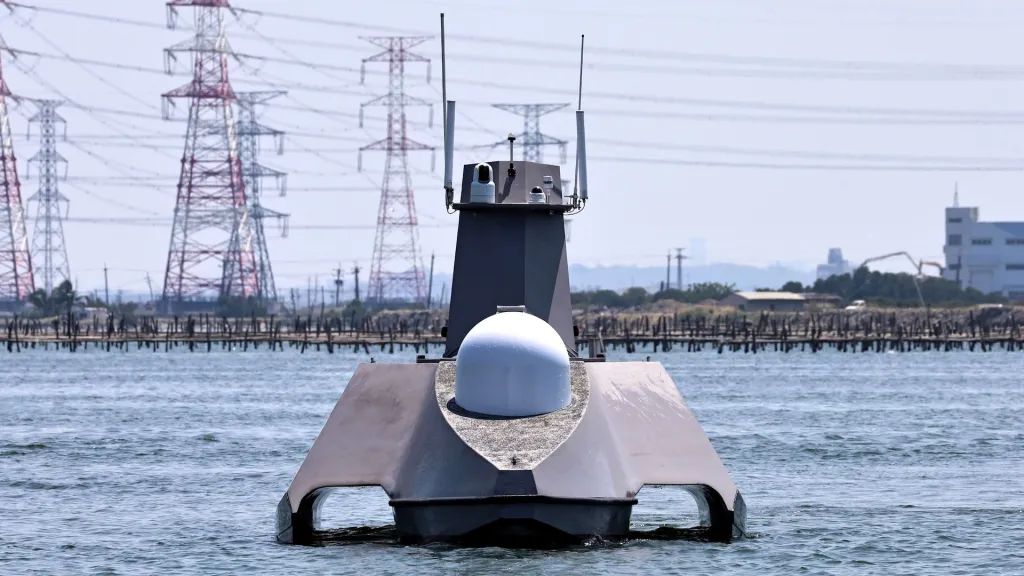
Taiwan has also recently unveiled its first uncrewed surface vessel (USV), the Endeavor Manta, developed specifically for naval defense in the Taiwan Strait. Built by CSBC Corporation, the vessel is designed for swarm operations, can carry light torpedoes and a warhead for kamikaze-style strikes, and includes autonomous navigation, AI target recognition, and anti-hijacking features. Inspired by Ukraine’s use of naval drones, the Manta is part of Taiwan’s broader strategy to counter Chinese military superiority through low-cost, asymmetric warfare, joining a growing global trend of using drones as force multipliers in modern conflicts. Alessio Patalano, Professor of War and Strategy at King’s College, London, noted that relying on weapons that are cheaper and easier to acquire will be critical to helping Taiwan defend itself against a potential Chinese invasion.

The Endeavor Manta USV during the launch event held in the port of Kaohsiung in southern Taiwan. (Photo via Taiwan Ministry of National Defense)

Rather than attempting to match China’s drone production, Hunter Keeley of the U.S. Marine Corps suggested Taiwan should adopt Ukraine’s targeted approach: deploying naval drones and missiles in focused, intelligence-led strikes near expected landing zones. A limited, layered Hellscape – centered on drones, jammers, and mobile sensors – could significantly disrupt PLA amphibious operations and buy Taiwan critical time in the opening stages of a conflict.

According to Kuzan, “Taiwan already benefits from U.S. support and has its own advanced defense industry, which is testing both surface and underwater maritime drones. For example, Taiwan’s Smart Dragon underwater drone is reportedly armed with torpedo systems.” He believes that incorporating torpedoes into Ukrainian sea drones could be the next step in their development. Kuzan remarked that, “If the opportunity and necessity arise, Ukraine could potentially sell or exchange its military technologies with Taiwan. This would be mutually beneficial, allowing both countries to enhance their capabilities.”

China and Russia Prepare

Russia is also taking notes. While it has significantly lagged behind Ukraine in naval drone warfare, it is now preparing for the future at sea. At the Army-2024 defense show, Russia unveiled the Murena-300S, a new naval drone resembling Ukraine’s successful sea drones. With a 500 km range, the fast and compact USV is built for coastal missions such as reconnaissance, mine-laying, and strike operations, possibly with a large explosive payload. The Murena appears to feature a Starlink antenna, suggesting Russia is seeking to match Ukraine’s real-time drone control capabilities.

The Russians have learned hard lessons from Ukraine’s asymmetric warfare and are now applying those insights more rapidly. Russia is creating unmanned systems regiments within its Navy that will integrate aerial, ground, and maritime drones to carry out reconnaissance and strike missions across all fleets. These new units, equipped with systems like Orlans, Lancets, FPVs, and USVs, are expected to form the backbone of the Navy’s unmanned component, with deployments planned across the European, Pacific, Caspian, and Dnieper naval forces.

At the same time, Russia is steadily advancing toward the development of AI-enabled autonomous drone swarms. It is investing heavily in AI research, both domestically and through partnerships with countries like Iran and China. Russia is focusing its efforts on leveraging cheap, scalable drone technology to overwhelm adversaries. This can be applied to the battle at sea as well. If the U.S. aims to deploy large expensive ships across the Asia-Pacific, we could see our adversaries working together to deploy cheap drones to destroy the ships.

China has also unveiled the Feiyi drone earlier this year, the world’s first known aerial and underwater drone capable of launching from a submarine, transitioning between air and sea multiple times, and returning to its original platform.

Preparing NATO for the Future

In a February 2025 interview, Anduril founder Palmer Luckey laid out bold ideas for revitalizing the U.S. defense industry and countering China’s growing military threat. He argued that the U.S. should shift from “world police” to “world’s gun store,” prioritizing mass production of weapons over elite, slow-to-build systems. Citing China’s massive manufacturing capacity and militarized civilian infrastructure, Luckey warned that Beijing is preparing for full-scale war, including repurposing commercial ships and producing cruise missiles far faster than the U.S.

Warfare is rapidly evolving into a battle of algorithms and adaptability. If the West clings to its old-school model of building massive, slow-to-deploy systems, it risks a harsh wake-up call – where billion-dollar warships are struck down by sea drones costing a fraction of that. In this new era, speed, scale, and software will determine who dominates the battlefield. When Russia invaded Ukraine in 2022, it was unprepared for how quickly warfare would evolve, and how drones would come to dominate the skies.

Now Ukraine has amassed a massive war-time video dataset, over 2 million hours of drone footage through its OCHI system, which collects and analyzes feeds from 15,000 frontline drone crews. This data is being used to train AI for battlefield applications such as target recognition, weapon effectiveness analysis, and autonomous drone tactics.

Kuzan believes that Ukraine is already working on building AI technologies for its sea drones as well. “Notably, during the successful maritime drone attack on December 31, 2024, which resulted in the destruction of Russian helicopters, many researchers speculated that AI was used to enhance target identification and missile guidance,” said Kuzan.

NATO should work closely with Ukraine on the development of these models to prepare its own autonomous sea drones to deploy them in future conflicts. The UK-built Kraken3, inspired by Ukraine’s battlefield innovations, was recently unveiled, showcasing AI-powered swarming capabilities, kamikaze drone launches, and GPS-free navigation, reflecting how Ukrainian success is already influencing NATO procurement.

NATO itself has begun expanding its unmanned maritime capabilities, recently demonstrating autonomous surface vessels in the Baltic Sea through Task Force X, an initiative designed to deter sabotage and fill surveillance gaps. But these sea drones are focused on addressing the threat of Russian sabotage. More practical drones are needed to help disable enemy warships, such as in the event of a Chinese blockade of Taiwan. Expensive systems will no longer do the job. Cheap and scalable solutions are what is needed for NATO. Some in the U.S. are already thinking about how naval warfare is being transformed. For example, the U.S.-based Anduril has unveiled the Seabed Sentry – a network of AI-powered mobile undersea sensor nodes designed for persistent monitoring and undersea kill chains.

Lithuania is leading by example as it is moving toward shared sea drone production with Ukraine under a “1+1” model, where one Magura-class sea drone would be retained for Lithuania’s defense and the other delivered to Ukraine. “Whether you want to believe it or not, whether you have or are about to sign contracts for tanks and helicopters for the next 10 years, the nature of military power has already changed,” said Zaluzhnyi.

Today, Ukraine’s sea drones control a significant extent of the Black Sea. In a future conflict over the Arctic or the Asia-Pacific, we can expect an even greater surge – a true sea of drones. As Ukraine’s navy chief put it, “After the war we will certainly write a textbook and we’ll send it to all the NATO military academies.”

David Kirichenko is an Associate Research Fellow at the Henry Jackson Society. His work on warfare has been featured in the Atlantic Council, Center for European Policy Analysis, and the Modern Warfare Institute, among many others. He can be found on X/Twitter @DVKirichenko.

References

1. This article draws on interviews conducted by the author from the period of March-April 2025.

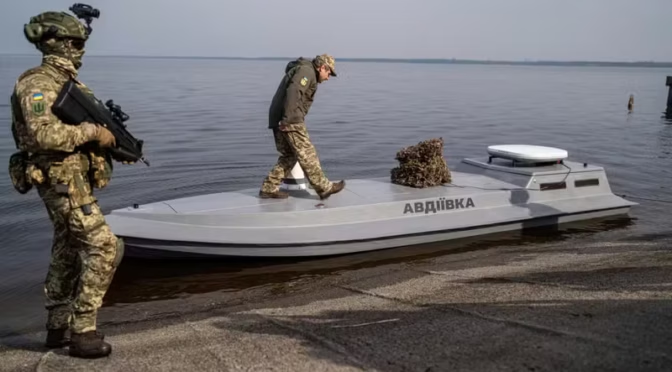
Featured Image: A Ukrainian military counterintelligence brigadier general walks on a new Sea Baby “Avdiivka” naval drone, during its presentation by the Ukrainian security service, in the Kyiv region, on March 5, 2024. (Photo by Evgenniy Maloletka/AP)

A Post-Mortem of the Red Sea Crisis: NATO versus the European Union

NATO Naval Power Week

By Anna Matilde Bassoli

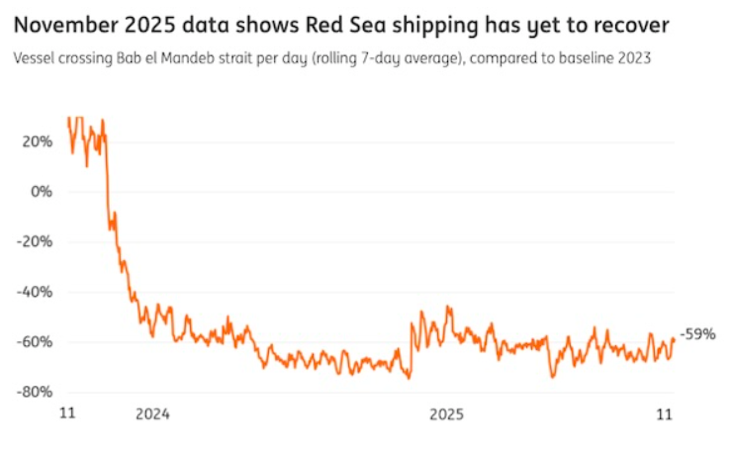
After more than a year of disrupted global trade, the Red Sea Crisis appears to have no end in sight. Rather, in a series of leaked messages, senior U.S. officials have cast doubts over U.S. involvement and “having to bail Europe out again.” However, while frustration on each side of the pond is understandable, emotions fail to address the root causes of growing transatlantic distrust. The disjointed approach of the U.S. and the European Union to the Red Sea Crisis deserves thorough analysis as a critical yet overlooked cause of transatlantic distress. Indeed, the issue between the transatlantic allies is not who has to bail out whom. Instead, the emergence of the European Union (EU) as a security actor in the maritime domain has weakened the U.S. grip on NATO’s naval strategy. A coherent NATO naval strategy requires the United States and its European allies to align their postures, without the EU as the third wheel.

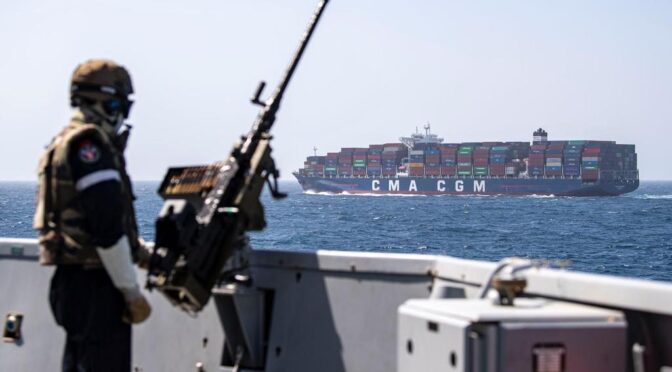
On December 18, 2023, the United States called upon allies to respond to the Houthi attacks on global shipping with the US-led Operation Prosperity Guardian. This multinational coalition was intended to include the United Kingdom (UK), Canada, France, Italy, the Netherlands, Norway, Spain, and others. However, only the UK, Canada, and Norway upheld their commitment. A few days after this announcement, most European navies withdrew to join the EU-led Operation Aspides, an overlapping defensive mission. Specifically, European navies explicitly rejected US leadership and command in an unprecedented transatlantic schism. The establishment of the EU-led Operation Aspides has resulted in a divided naval commitment and undermined efforts in the Red Sea Crisis in three crucial ways.

First, this divided effort has effectively deprived Prosperity Guardian of European naval assets over the past year. The Italian Navy has committed two destroyers and two frigates to Aspides, contrary to the single frigate initially announced in support of Prosperity Guardian. The French Navy has provided three frigates to Aspides, while it remains unclear what role they would have played in Prosperity Guardian. Similarly, the German and Belgian navies each contributed a frigate. Other European navies have divided their limited commitments between both missions, although it is unclear under which command. For example, the Hellenic Navy provided two frigates to Aspides, while the Royal Netherlands Navy contributed one frigate, a joint support ship, and aviation assets. Even the newest members of NATO, Sweden and Finland, have shown inconsistent commitment, with both countries providing only limited personnel. Despite its initial commitment to the US-led effort, Spain made no contributions. Interestingly, however, Spain’s ports benefited from the crisis, placing the country in an ambiguous position.

These commitments – or lack thereof – contrast sharply with the United Kingdom’s contribution to Prosperity Guardian during the same timeframe. In addition to the destroyers HMS Diamond and HMS Duncan, the Royal Navy provided two frigates and critical air support. While this still pales compared to the US show of force, it demonstrates the UK’s consistency in its transatlantic commitment. The other European powers cannot claim to have done similarly. The Danish Navy, for instance, sent the HDMS Iver Huitfeldt, but ship malfunctions plagued its performance, resulting in the dismissal of the Danish chief of defense. Furthermore, the French Navy has prioritized French-linked vessels, indicating that national interests rather than transatlantic ones drive their participation.

Second, the European decision to withdraw from participation in Prosperity Guardian shows how Europe was already veering towards strategic autonomy before the Trump administration came to the White House. Upon announcement, the Italian Ministers of Foreign Affairs and Defense specified that Italy, France, and Germany were pushing for an EU-only operation of a purely defensive nature, without land strikes. This European insistence on going solo deserves a deep dive. For starters, Europeans have criticized the Trump administration’s stance on transatlantic relations in recent weeks, calling for renewed unity. However, the lack of European support for the US-led effort demonstrates that European conduct has been inconsistent with their leaders’ rhetoric and parallel maritime commitments. For instance, Europeans have been eager to participate in Indo-Pacific exercises and showcase these efforts as a sign of strong friendship. In the same breath, Spain has actively participated in NATO exercises in the Mediterranean. However, a key question arises: how can the United States truly trust its European allies if they only show up to train and not to engage?

In this respect, the US offensive approach against the European defensive posture demonstrates that the transatlantic allies could not be more distant. By the time European navies were rotating their naval forces in the summer of 2024, some commentators had already started casting doubts on the effectiveness of Prosperity Guardian as a purely defensive mission. In response to this lack of results, the United States doubled down on eliminating the Houthi threat and deterring further attacks with strikes on Houthi positions in Yemen under Operation Poseidon Archer. Once again, however, European commitment has been limited, and preference has been given to the defensive posture of Operation Aspides. The problem plagues transatlantic relations is not the Trump administration’s aggressive stance towards Europe. Rather, the lack of entente between the US’s forward-leaning posture and the EU’s defense posture has eroded trust and partnership across the Atlantic.

Third, the US’s lack of acknowledgment of the EU as a security actor has undermined its efforts. Most recently, Michael C. DiCianna has argued that “Europe needs to fight the Houthis.” However, his analysis focuses only on Prosperity Guardian, as if it were the only ongoing operation in the Red Sea, incorrectly accounting for the European contribution. Similarly, Doug Livermore acknowledges European contributions but employs a US-only perspective to make the case for using force in the Red Sea Crisis. Neither of these authors seems to grasp the actual problem. It is not that Europe does not fight – from the European perspective, they are protecting sea lines of communication (SLOCs). Rather, the European and US perspectives on transatlantic security and interests do not align.

This analytical bias highlights two major problems in the US debate. First, it shows that the United States only views Europe through NATO lenses, while Europeans increasingly look to the EU to bolster their security needs. Operation Prosperity Guardian and Operation Aspides began while transatlantic relations were still good. So, why did the Europeans part ways with the United States? The most evident answer points to European strategic autonomy, meaning a European defensive approach for European interests within the EU.

As evident in the Red Sea, none of this concerns the United States. Rather, Aspides attempts to demonstrate that Europe could rely on the EU as a security actor. The strong push behind an EU-led, European-only defense, particularly regarding defense spending and the primary US request since the first Trump administration, is not the result of a sudden storm. Instead, renewed US aggressiveness has further nudged the Europeans towards strategic autonomy. Indeed, Europeans have been most vocal and proactive regarding their security, not within NATO, but in the EU. The EU will never fight for US interests or in the US way. This is not what the EU was created for. On the contrary, this was why NATO was established, making it an organization suited to defend US and European interests in the American way.

This also highlights the second major problem in the US debate. Because the United States ignores the EU as a security actor, it fails to recognize that the EU and NATO rely on two opposite perspectives. Misunderstanding the difference between the EU’s inward-focused posture and the US’s forward-leaning one undermines US attempts to reset transatlantic relations. While US commentators correctly ask Europeans to contribute more, they overlook their counterparts’ perspective. From the US point of view, fighting the Houthis means not only preventing attacks on the seas but also bombing their positions on land. For Europeans, this is excessive, rendering US complaints about their conduct dangerously pointless.

In no other domain has this mistaken approach had more consequences than in the naval domain. The US viewpoint is forward-leaning – hence, offensive – towards protecting SLOCs, involving heavy military force. On the other hand, the European perspective is reactive, building convoy-like defenses around commercial ships. In short, Americans prefer to charge ahead, whereas Europeans tend to build trenches. The Red Sea Crisis exemplifies this dynamic.

The Euro-American split has resulted in two overlapping operations acting from different perspectives without a common end goal. While the EU-led Operation Aspides focuses solely on protecting commerce, US-led efforts have multilayered strategic goals: protecting SLOCs, demonstrating maritime strength on the global seas, and eroding Iran’s influence in the Middle East by striking its proxies. From the US viewpoint, these goals are not isolated but interconnected ends on a dynamic maritime chessboard, where the ultimate objective is to checkmate China. From the European perspective, China is not even on the board.

Indeed, contrary to popular US belief, the Red Sea Crisis is not about European trade; rather, it is about US sea power. The United States is not fighting the Houthis to bail out freeloading Europeans. This view is contrary to US interests and damaging to US strategy. The United States is taking charge of a maritime crisis because it can still be the premier global maritime power. This demonstration of maritime strength sends two messages. First, the United States still dominates the seas. Second, the United States is not a dead sea power to China. Underestimating the value of these messages in the context of strategic competition with China is a fatal mistake for the US.

To be fair, concerns about straining US naval forces are valid and must be addressed. However, once again, these concerns must be addressed in accordance with US naval strategy, not against it. Indeed, an increased European commitment should not continue on the premise of split naval strength. This is an open subversion of all the basic principles of US naval strategy: overwhelming naval power, control of the sea lines of communications, and maritime dominance. If the United States concedes any of these to either friend or foe, the sea power that has supported US freedom and prosperity will crumble.

The United States must leverage NATO to align transatlantic allies. This will require two key steps. First, the United States must tone down its anger towards its transatlantic allies. Autonomy-seeking Europeans might be more incentivized to maintain their defensive posture if they view the United States as an adversary. So far, this trend has been evident, and there is no reason for the United States to make Europeans even less inclined to contribute to transatlantic efforts.

The second step could involve a more structured division of labor in the Red Sea. Throughout history, very few maritime crises involving land-based attacks on commercial shipping have ended without a major deployment of strength. While the United States has a strong interest in striking the Houthis to keep Iran in check, the Europeans have an interest in keeping SLOCs open. The current approach – the United States striking the Houthis from the sea while the Europeans continue their convoy-like missions – is a good starting point. However, the split command and lack of matching European resources must cease. To make this work, the Europeans should reduce their commitments in the Indo-Pacific until the Red Sea Crisis is resolved. This would allow the United States to allocate resources effectively between the two connected theaters. Likewise, the United States should clarify that a unified command is crucial to bring this crisis to a halt.

A better understanding of expectations and goals in the Red Sea could generate premises to mend transatlantic fences. Presently, no one has the perfect recipe to bring this crisis to a halt, and a split approach has likely extended the crisis. Not only have the Houthis taken the lead in messaging victory, but the first true victim of this crisis – the Israeli port of Eilat – has fallen under financial pressure. Time has run out for the United States to complain about Europe without a plan. Likewise, time has proven that the European Union is still not a reliable security actor. An integrated NATO strategy that accounts for both US and European perspectives is the only choice for victory. The alternative option spells defeat.

Anna Matilde Bassoli holds a M.A. in Security Studies from Georgetown University’s Security Studies Program and a MLitt in Strategic Studies from the University of St Andrews. She also earned a B.A. in Political Science and International Relations from Catholic University of the Sacred Heart in Milan, Italy. She currently works in the think tank industry, focusing on tech policy and security.

Featured Image: The UK Royal Navy (RN) Type 23 frigate HMS Richmond (foreground) and Type 45 destroyer HMS Diamond hand over on station as the RN vessel contributing to Operation Prosperity Guardian. (Photo by UK Ministry of Defence)

Strengthening Unity of Effort in the Atlantic: Lessons from Wargaming

NATO Naval Power Week

By Walter Berbrick and Terence Nicholas 

Based on our experience designing and analyzing recent Naval War College wargames in the Euro-Atlantic theater, U.S. and NATO maritime forces face several challenges in maintaining readiness, enhancing lethality, and accelerating decision-making—core priorities underscored by U.S. Defense Secretary Pete Hegseth. The North Atlantic and High North are increasingly contested, as Russian submarine operations and grey zone activities intensify and China extends its influence deeper into strategically critical Atlantic corridors.

There are several areas where greater alignment between U.S. and NATO maritime forces could enhance warfighting readiness and crisis response. These include streamlining command relationships, enhancing maritime domain awareness, harmonizing rules of engagement, strengthening maritime logistics, integrating NATO into North American defense planning, and improving amphibious force employment. While NATO navies bring significant capability to bear, optimizing these areas will ensure that the alliance is positioned to deter aggression, enhance decision advantage, and maintain maritime superiority in an increasingly complex and contested security environment.

This article offers insights and recommendations based on our wargaming experience to help U.S. and NATO naval leaders strengthen operational integration, refine force employment, and better prepare for future maritime challenges in the Euro-Atlantic theater.

Streamline Unity of Effort in the Atlantic and High North

With multiple U.S. and NATO maritime commands operating across the Atlantic and High North, there is a valuable opportunity to enhance unity of effort by refining command relationships, synchronizing force employment, and accelerating decision-making. Effective coordination among U.S. Naval Forces North (NAVNORTH), U.S. Naval Forces Europe (NAVEUR), NATO Maritime Command (MARCOM), and Striking Forces NATO (SFN) ensures that Allied maritime forces can operate seamlessly in a contested environment. Wargame insights consistently emphasize the importance of shared mission awareness, mission command, and persistent training to reinforce operational alignment and clarify multinational naval task force responsibilities.

Recent initiatives have bolstered deterrence in the Euro-Atlantic theater, such as the establishment of a second maneuver fleet under NAVEUR’s temporary control and a forward deployed expeditionary Maritime Operations Center (MOC) in Europe. These efforts have improved multi-echelon coordination and operational flexibility between U.S. and NATO maritime forces, demonstrating the benefits of closer integration. Additionally, refining command integration between SFN and MARCOM—two key NATO maritime components—presents a further opportunity to strengthen transatlantic force employment. SFN, responsible for high-end maritime strike capabilities, reports directly to SACEUR, while MARCOM serves as both NATO’s Combined Force Maritime Component Commander (CFMCC) and the Maritime Component Commander for multiple Joint Force Commands (JFCs). Ensuring secure communications, clear command authorities, and persistent joint training will enhance NATO’s ability to employ maritime forces rapidly and effectively at the task force and task group levels.

Another key step toward greater unity of effort is elevating JFC Norfolk to a 4-star command. As NATO’s only transatlantic operational command, JFC Norfolk serves a vital role in linking U.S. and NATO maritime operations, yet its current structure requires balancing U.S. and Allied priorities across multiple echelons. Elevating JFC Norfolk would enhance command focus on transatlantic operations, improve decision-making agility, and better align command relationships within NATO’s maritime architecture. Most importantly, structuring Allied maritime commands for crises and conflict—rather than peacetime—will ensure standing U.S. and NATO maritime forces and planners are ready and integrated to deter aggression and respond decisively in the Atlantic and High North.

Enhancing Maritime Domain Awareness and Situational Awareness

U.S. and NATO maritime forces have a unique opportunity to sharpen their maritime domain awareness (MDA) and situational awareness by strengthening intelligence-sharing and coordination across the Atlantic and High North. Both forces field some of the world’s most advanced intelligence, surveillance, and reconnaissance (ISR) and anti-submarine warfare (ASW) capabilities, but their full potential can only be realized through seamless integration of policies, technologies, and operational procedures. Enhancing coordination between key commands—NAVEUR, NAVNORTH, MARCOM, and SFN—will create a more comprehensive and real-time picture of the maritime battlespace, enabling faster threat detection, more agile decision-making, and greater operational effectiveness in contested environments.

A critical step toward this goal is developing a federated Common Operating Picture (COP) that integrates multi-domain sensor data from both U.S. and NATO maritime forces. This approach would reduce ISR fragmentation, allowing commanders to detect, track, and respond to threats with greater speed and precision. Whether countering adversary submarine movements, grey-zone activities, or long-range maritime threats, a more connected ISR network would enhance decision-making, improve force employment, and reinforce deterrence, ensuring NATO and U.S. maritime forces maintain a strategic advantage in dynamic operational theaters.

However, technology alone is not the answer. Persistent joint training, operational scenario-driven wargames, and multinational staff exchanges will be essential to refining intelligence-sharing processes and breaking down procedural barriers. Regular stress-testing of ISR coordination in realistic threat conditions will enhance interoperability, clarify authorities, and increase confidence across the alliance. By taking these steps, U.S. and NATO maritime forces will build a more unified, resilient, and responsive transatlantic naval force—one that can anticipate, deter, and decisively respond to emerging threats in an increasingly contested maritime security environment.

Maximizing Authorities and Rules of Engagement 

In fast-moving maritime operations, commanders need the ability to act swiftly and in sync with their allies. U.S. and NATO forces operate under different Rules of Engagement (ROE) and authorities, but instead of seeing this as a constraint, there’s an opportunity to leverage these differences to enhance operational agility. A deeper understanding of how each nation’s approval processes work—who can authorize what and when—can reduce delays, increase interoperability, and open the door to more flexible force employment. When commanders operate with shared awareness of authorities, they are better equipped to act decisively and prevent adversaries from exploiting procedural gaps.

Expanding this understanding is a practical step toward greater coordination and combat effectiveness. If commanders know when and how NATO and U.S. assets can operate under each other’s authorities, they can more effectively integrate forces in real time. For example, U.S. and NATO surface and submarine forces could be tasked interchangeably in a crisis, making force posture more dynamic and responsive. Instead of working around bureaucratic seams, commanders could focus on maximizing the collective strength of the alliance to deter and respond to threats with greater speed and cohesion.

To further streamline decision-making, establishing pre-approved Crisis Response Options and real-time coordination cells would allow forces to act immediately when needed. Setting clear engagement triggers across all warfare domains—surface, subsurface, air, cyber, and electronic warfare—would synchronize responses across NATO and U.S. maritime forces, closing decision-making gaps that adversaries might otherwise exploit. Aligning ROE where possible, increasing transparency of authorities, and enabling faster approvals will ensure that U.S. and NATO maritime forces can operate as a unified force, projecting deterrence and strength in an increasingly complex security environment.

Enhancing Operational Resilience

Sustaining maritime operations in the Atlantic and High North is not just about moving fuel, munitions, and supplies—it’s about ensuring forces can stay in the fight when and where they’re needed most. The ability to rapidly resupply ships at sea, repair battle damage, and sustain operations away from fixed infrastructure is what separates an agile, combat-ready force from one that risks being sidelined when it matters most. Wargaming has provided a valuable way to stress-test sustainment strategies, identify weak points before they become real-world problems, and explore new ways to keep fleets operational in contested environments.

A major takeaway from these efforts is the importance of stronger coordination between key sustainment commands like NAVNORTH, NAVEUR, MARCOM, and SFN. In fast-moving operations, small misalignments in logistics planning can lead to big problems. Establishing dedicated logistics coordination cells and integrating sustainment planning more deeply into operational decision-making can help ensure the right resources are available at the right time. The more aligned NATO and U.S. sustainment efforts become, the better prepared forces will be to sustain prolonged operations across the Atlantic.

Another critical piece is expeditionary logistics—the ability to keep ships on station without having to pull back to port for resupply and repairs. While the U.S. has made significant advances in vertical replenishment (VERTREP) and at-sea rearming, many NATO warships still rely on fixed facilities, which limits flexibility. Expanding interoperability in afloat logistics, forward-deploying repair capabilities, and developing mobile resupply facilities will keep ships in the fight longer. Additionally, prepositioning sustainment stockpiles across North America and Europe will help reduce dependence on major ports and ensure forces remain operational regardless of access challenges. Logistics isn’t just a support function—it’s a warfighting necessity. The ability to sustain combat operations anytime, anywhere will be a decisive factor in maintaining maritime superiority in the Atlantic.

Expanding U.S.-NATO Naval Integration for North American Defense

As security dynamics in the Atlantic and High North continue to evolve, there is a growing opportunity to strengthen U.S.-NATO naval integration and expand cooperation in North American defense. Traditionally, NATO’s maritime forces have focused on collective defense under Article 5, while homeland defense responsibilities have remained largely within national command structures. However, as adversaries increase activity across the Atlantic, greater alignment between U.S. and NATO maritime forces can enhance deterrence, improve crisis response, and provide more flexible force employment options.

One way to achieve this is by better integrating NATO maritime forces into existing U.S. defense planning and operations. Coordination among NAVNORTH, MARCOM, and SFN has often been episodic rather than institutionalized, making it more reactive than proactive. By establishing routine collaboration, expanding NATO’s operational footprint in the Western Atlantic and Arctic, and refining joint maritime situational awareness, NATO and U.S. commanders alike can improve force synchronization and enhance maritime domain awareness. This approach would allow for faster response times, increased interoperability, and a stronger deterrent posture in the event of a crisis.

There are several practical steps that could further this integration. Embedding NATO liaison officers within NAVNORTH and NORTHCOM would improve real-time coordination, intelligence sharing, and joint maritime-air defense planning. Additionally, posturing NATO naval and air assets for homeland defense missions in the North Atlantic and Arctic would provide an immediate and credible deterrent while ensuring NATO forces are better aligned with U.S. homeland defense efforts. Expanding NATO’s ISR capabilities—such as maritime patrol aircraft, submarines, and early warning systems—into NAVNORTH’s defense networks would significantly strengthen Maritime Domain Awareness (MDA) and Integrated Air and Missile Defense (IAMD), reducing strategic surprise and improving early threat detection.

Looking ahead, the current rotation of Standing NATO Maritime Groups (SNMGs) between JFC Brunssum and JFC Naples means that JFC Norfolk lacks dedicated forces assigned during competition, limiting its ability to establish a continuous deterrent presence and provide a rapid response in the Atlantic and High North. Given the operational demands in both European and transatlantic theaters, relying solely on the existing SNMG rotation is insufficient to maintain persistent maritime presence and readiness. To address this, SACEUR should consider establishing an additional SNMG and a dedicated Maritime Patrol and Reconnaissance Aircraft (MPRA) detachment under JFC Norfolk. This would ensure a standing force capable of sustained ASW, surface warfare, and air defense operations in the Western Atlantic and Arctic, reinforcing NATO’s ability to deter aggression and respond swiftly to emerging threats.

Strengthening U.S.-NATO Amphibious Integration

As maritime security threats evolve, U.S. and NATO amphibious forces have a unique opportunity to enhance integration, ensuring they are prepared for rapid employment in contested littorals. NATO fields highly capable amphibious units—including the U.S. Marine Corps, UK Royal Marines, Dutch Korps Mariners, and French, Italian, and Spanish Marine forces—yet their combined employment under NATO command remains a work in progress. Without a standardized framework for command relationships, questions around operational and tactical control can arise, creating opportunities to refine how these forces are assigned, tasked, and employed in competition, crisis, and conflict.

With near-peer competitors and regional actors expanding anti-access/area-denial (A2/AD) capabilities, the ability to project power and secure key maritime terrain is becoming more critical. Wargame insights have highlighted how U.S. and NATO amphibious forces could serve as a key element of deterrence, enabling fleet maneuver while limiting adversary freedom of action. At the same time, the current NATO command structure—where Striking Forces NATO (SFN) oversees high-end strike capabilities and MARCOM serves as the Combined Force Maritime Component Commander (CFMCC)—presents an opportunity to clarify how amphibious forces integrate into larger NATO maritime operations. Further alignment with Joint Force Commanders in Norfolk, Naples, and Brunssum will ensure these forces are positioned for effective and decisive employment.

To strengthen interoperability and readiness, aligning amphibious operations within a cohesive U.S.-NATO framework will be essential. This includes refining mission requirements across the continuum of competition, crisis, and conflict, as well as integrating these forces into routine joint planning, training, and execution cycles. Regular multinational exercises, wargames, and professional military education programs will reinforce interoperability, build familiarity between U.S. and NATO amphibious units, and enhance their ability to respond rapidly when called upon. By institutionalizing these efforts, NATO’s amphibious forces will be better prepared to operate as a unified, combat-ready force capable of deterring aggression and securing key maritime terrain in crises and conflict.

Way Ahead

Wargaming has long been a powerful tool for refining strategy, testing assumptions, and strengthening operational effectiveness. Over the past several years, we’ve seen firsthand how it can shape real-world planning and decision-making. By stress-testing command structures, exploring new approaches to force employment, and fostering greater integration between U.S. and NATO maritime forces, wargames have directly informed adjustments that enhance unity of effort across the Atlantic. These insights have helped refine coordination among key commands, sharpen deterrence, and improve readiness to respond to emerging threats in an increasingly complex security environment.

Looking ahead, there is an opportunity to build on this momentum by further aligning command structures, intelligence-sharing, sustainment networks, and amphibious operations. As the maritime domain becomes more contested, ensuring seamless coordination between U.S. and NATO forces will be essential for maintaining freedom of movement, deterring aggression, and preparing for high-end conflict. Strengthening transatlantic maritime integration will not only enhance crisis response but also enable a more agile and lethal force, ready to operate across the spectrum of competition and conflict.

To sustain maritime superiority, the focus must remain on proactive planning, persistent training, and continued investment in warfighting capabilities. As adversaries seek to exploit operational seams, U.S. and NATO forces must stay ahead by reinforcing their deterrent posture and refining how they fight together. Through deliberate efforts to streamline command relationships, improve operational integration, and expand warfighting capabilities, the alliance will ensure it is ready—not just to compete, but to prevail in any future conflict.

Dr. Walter Berbrick is a senior military analyst with Netsimco, a Saalex Company, and the Lead Analyst of Euro-Atlantic Wargame Series for Commander, Naval Forces Europe & Africa. He served 15 years on the Naval War College’s faculty, leading the research design and analysis for the Trans-Atlantic Maritime Command and Control (TAMC2) wargame series from 2019 to 2024.

Dr. Terence Nicholas is an Assistant Professor in the Wargaming Department of the Center for Naval Warfare Studies at the U.S. Naval War College. He currently serves as the Lead Designer of Euro-Atlantic Wargame Series for Commander, Naval Forces Europe & Africa.

The views expressed in this article are solely those of the authors and do not represent the official positions of the U.S. Naval War College, the Department of the Navy, or any other U.S. government organization. Wargames, including the TAMC2 series described here, are not predictive and do not forecast future events; they serve as independent analytical research events intended to provide insights and inform decision-making.

Featured Image: HMS Prince of Wales and the embarked Air Wing leads NATO maritime forces as part of Joint Warrior 24-1, part of NATO’s Steadfast Defender exercise series. (Photo by UK Ministry of Defence)