By Captain Kevin Eyer, USN (Ret.)
Amphibious Command Reform
In an April 24, 2026 directive, Chief of Naval Operations Daryl Caudle ordered that, beginning in Fiscal Year 2028, command of all amphibious warships will be assigned exclusively to Surface Warfare Officers (SWOs). This includes Landing Helicopter Assault (LHA), Landing Helicopter Dock (LHD), Amphibious Transport Dock (LPD), and Dock Landing Ship (LSD) classes.
The decision represents a significant institutional realignment in naval command structure, ending a long-standing dual-community model in which both aviators and Surface Warfare Officers (SWOs) were eligible for amphibious command. The CNO’s rationale is grounded in sustained concerns over amphibious readiness, maintenance execution, engineering discipline, and material condition—areas that have remained below Navy standards for an extended period.
As articulated in the directive, effective amphibious command requires “exquisite knowledge of readiness, maintenance procedures, component design and failure modes, damage control, and operational procedures,” as well as the ability to remain in command long enough to impose sustained correction. The conclusion is clear: Surface Warfare Officers are purpose-built for that responsibility.
Resistance from the Aviation community was immediate and significant, including among senior aviators within U.S. Pacific Fleet and U.S. Fleet Forces Command. While concerns centered publicly on career progression and institutional balance, the debate also reflected disagreement with the premise that aviator command contributed materially to amphibious readiness shortfalls.
Still, beneath the institutional friction lies a broader reality. This is, at least in significant part, a fight over major command billets—assignments understood as essential for any officer hoping to achieve flag rank. The change will unquestionably reduce command and major command opportunities available to aviators. At the same time, the Navy’s inventory of traditional SWO major command ships continues to shrink. As these opportunities contract across the fleet, in both communities, institutional pressure over how remaining billets are allocated was inevitable. Something ultimately had to give.
Yet beyond these parochial issues, the Navy appears to have reached a larger operational conclusion which renders that argument moot: the amphibious force is too important to the Marine Corps’ warfighting capability to continue treating these ships as shared command territory.
The Amphibious Force and Its Operational Role
The U.S. Navy operates approximately 31 amphibious warfare ships, including nine large-deck amphibious assault ships that form the backbone of the Expeditionary Strike Group construct.
These platforms are essential to the Marine Corps’ core mission: the ability to project combat power from the sea. Amphibious ships transport embarked Marines, vehicles, landing craft, and aviation assets into contested environments where shore-based infrastructure is unavailable, degraded, or denied. Additionally, amphibious ships serve as floating expeditionary bases capable of command and control, medical support, logistics sustainment, and crisis-response missions.
Depending upon the class, modern U.S. amphibious warfare ships routinely employ the Landing Craft Air Cushion (LCAC), Ship-to-Shore Connector (SSC), Landing Craft Utility (LCU), Landing Craft Mechanized (LCM-8), and Combat Rubber Raiding Craft (CRRC) to transport Marines, vehicles, equipment, and supplies from ship to shore during amphibious operations. In addition, and especially relevant to this discussion, they also embark MV-22B Ospreys, CH-53K heavy-lift helicopters, AH-1Z/UH-1Y rotary-wing aircraft, and F-35B short takeoff/vertical landing fighters to support expeditionary operations ashore. Together, these systems enable distributed maneuver, vertical assault, close air support, and sustained operations in contested environments.
There are, however, substantial operational differences among amphibious ship classes, particularly with respect to aviation operations. The large-deck LHA and LHD classes conduct highly complex fixed-wing and tiltrotor aviation operations involving F-35Bs and MV-22s, including high-tempo launch and recovery cycles, advanced aviation fueling and weapons handling, and the integration of tactical air operations with expeditionary objectives. As for the LPD, while the class does not currently support F-35Bs, it does carry MV-22s. Amongst the “amphibs,” the single class that embarks only traditional helicopters, whose operation is significantly less complex than sustained fixed-wing and tiltrotor aviation operations, is the LSD class.
This distinction explains why LHA, LHD, and LPD classes are categorized as “major command” ships commanded by Captains on their second at-sea command tour, while LSDs are “Commander command” ships led by Commanders during their first command tour at sea.
These ships are the Navy’s most important fleet assets supporting Marine Corps operations. Consequently, the material readiness of amphibious ships directly affects Marine Corps operational effectiveness. Degraded ship availability constrains embarkation, delays deployment cycles, and reduces the Marine Corps’ ability to execute its expeditionary mission set. Amphibious readiness is therefore not solely a naval concern—it is foundational to the Marine Corps’ warfighting capability.
The Marines’ Perspective
At the 2026 Sea-Air-Space Conference, the Commandant of the Marine Corps, Gen. Eric Smith, indicated that the Navy and Marine Corps were determined to work together with a “unified sense of purpose” to increase the size and availability of the U.S. amphibious fleet:
“We’re in complete agreement that our current inventory of 31 amphibious ships is not sufficient to meet our new presence that our combatant commanders are requesting and requiring.”
In 2025, amphibious ships’ readiness rate dropped to 41 percent, according to Navy Times. This metric is derived from a lack of ships deployable that caused a five-month delay in Marine Expeditionary Unit (MEU) deployments —critically impacting the Marine Corps’ ability to execute its mission.
To address this, General Smith spoke to optimizing maintenance schedules, as well as investing in service life extensions for a number of ships. Moreover, he stated that the Navy-Marine Corps team is moving forward with the procurement of new and more capable ships. While the form that these new ships takes, beyond perhaps the now-planned Landing Ship Medium (LSM), remains to be seen, what is plain is that the Marines are keenly interested in the sustainability of the amphibious fleet, and specifically, availability of these ships when called upon.
What is an Air Boss?
Aviation-capable amphibious ships have an Air Department Head or “Air Boss” assigned to them. This officer serves as the Commanding Officer’s principal aviation authority and senior manager of all flight operations.
Operating through Primary Flight Control (“PriFly”), the Air Boss oversees launch and recovery operations, flight deck sequencing, aircraft movement, fueling and arming cycles, sortie generation, airspace coordination, and aviation safety enforcement.
The Air Boss integrates continuously with the bridge, Combat Information Center, Marine aviation elements, and embarked air traffic control personnel to ensure safe and efficient aviation operations. He or she translates the Commanding Officer’s intent into executable aviation activity while maintaining strict control of flight deck risk and safety. This structure ensures that aviation expertise remains continuously embedded within the ship’s command organization at the Department Head level.
This is central to the Navy’s revised command logic: aviation execution aboard amphibious ships is already fully professionalized and continuously managed. The Air Boss construct therefore provides the operational depth and specialization required without necessitating an aviator in command.
In practical terms, aviation is not removed from command—it is delegated to a dedicated expert authority within a now SWO-led command structure. For this reason, it is imperative to the success of this new construct that the Aviation community assign only its best and brightest post-command aviators to this billet going forward. To do other is to court failure of the Marine mission.
In short, the Air Boss position effectively obviates the need for a uniquely assigned Aviator as commanding officer of the ship. This is analogous to the Reactor Department Head aboard an aircraft carrier being a nuclear-trained SWO. In that case, the SWO responsible for overseeing the carrier’s immensely complex nuclear propulsion plant eliminates the need for a SWO Commanding Officer solely to provide engineering and reactor expertise. Extending the analogy further, while every CVN Commanding Officer is nuclear-qualified, every SWO Commanding Officer has likewise spent an entire career intimately involved with the operations of helicopters from the decks of surface combatants across the fleet.
How Aviators Got to Amphibs
Over time, aviators were increasingly assigned to amphibious ship command primarily as part of the Aviation community’s officer development pipeline.
As the Navy’s largest unrestricted line community among SWOs, submariners, and aviators, the Aviation community has long relied upon amphibious ship command opportunities—both at the Commander and Captain level—to provide upward career progression for its most promising officers.
Squadron command is the standard Commander-level milestone for Naval Aviators. Officers selected for further operational command may proceed into major aviation leadership billets or into deep-draft command pipelines. aviators — particularly rotary-wing and tiltrotor officers associated with amphibious operations — have commonly served as Executive Officer/Commanding Officer (XO/CO) of LHAs and LHDs via the fleet-up process, while tactical jet aviators have more often followed the aircraft carrier and carrier strike group command track. However, there is considerable overlap and flexibility depending on community, timing, and Navy needs.
At the same time, LHA and LHD ships increasingly evolved toward aviation-centric operations, particularly with the introduction of the F-35B and expanded MV-22 integration. This has, with time, strengthened the Aviation community’s argument for continued command of large-deck amphibious ships.
The bottom line is that amphibious ships became an important career-development mechanism within the Aviation community, while the increasing sophistication of the aircraft embarked on some amphibs justified these assignments.
Still, it is important to distinguish between the aviation complexity of LHA and LHD operations and that of the remainder of the amphibious fleet. Commanding Officers aboard LHAs and LHDs oversee high-tempo fixed-wing and tilt-rotor flight operations in densely congested deck environments, including the integration of F-35B and MV-22 operations into expeditionary combat missions. By contrast, LPDs and LSDs, while fully aviation capable, conduct comparatively limited helicopter operations and do not execute sustained tactical fixed-wing aviation missions.
The Navy now appears to have concluded that while aviation expertise remains indispensable aboard amphibious ships, the commanding officer’s foremost responsibility is the sustained readiness and fighting condition of the ship itself. That responsibility aligns more naturally with the professional orientation and career-long preparation of the Surface Warfare community. As for the increasing complexity of air operations in major command amphibs, high-grade Air Bosses will ensure the safety and effectivity of those.
Carrier Command: A Structural Distinction
This naturally raises the question of why SWOs are not permitted to command aircraft carriers.
Unlike amphibious ships, command of nuclear aircraft carriers is restricted exclusively to Naval Aviators who are also nuclear-qualified. This is not simply a matter of tradition. It reflects the carrier’s unique identity as both a nuclear-powered warship and a floating aviation combat platform. More than that, it is the law.
Since the Act of June 24, 1926, federal law has required that officers commanding U.S. Navy aircraft carriers be qualified naval aviators. The original provision, enacted as part of early naval aviation legislation and formerly codified at 34 U.S.C. § 735, was intended in part to ensure that naval aviators had a viable path to senior operational command within the fleet. Through later recodifications of federal military law, the requirement became 10 U.S.C. § 5942 and is now codified at 10 U.S.C. § 8162. The current statute provides that, to be eligible to command an aircraft carrier, an officer must be “an officer in the line of the Navy who is designated as a naval aviator or naval flight officer and who is otherwise qualified.” As a result, non-aviator Surface Warfare Officers are legally barred from commanding active U.S. aircraft carriers. In the case of nuclear-powered carriers (CVNs), Commanding Officers must additionally meet nuclear propulsion qualification requirements established under Executive Order 12344 and subsequent statutory authorities governing the Naval Reactors program.
In order to command a carrier, an officer must understand nuclear propulsion operations, ship-wide engineering integration, reactor safety oversight, navigation, combat systems, and full-spectrum warship command responsibilities. Aviators selected for carrier command therefore undergo nuclear power training, complete demanding XO tours aboard carriers, and typically command another ship at sea before assuming CVN command.
Yet the technical explanation alone does not fully answer the question. A Surface Warfare Officer can be trained to understand aviation operations to the level necessary for safe ship command. What a SWO can never fully possess, however, is the lived cockpit perspective that defines naval aviation.
That distinction matters because, unlike the amphibious ship, the entire purpose of the aircraft carrier is the launch and recovery of aircraft and the projection of aviation combat power. Every major operational function aboard the carrier ultimately serves the air wing. The commanding officer must therefore possess not only technical competence as a warship commander and nuclear operator, but also an instinctive appreciation for what is occurring in the cockpit during launch, recovery, tanker operations, bolters, emergency procedures, and combat tasking.
Carrier aviation involves judgment about risk, weather, fatigue, deck cycles, aircraft performance margins, and human decision-making under extreme operational pressure. Those realities cannot be fully learned from outside the Aviation community.
Accordingly, the Navy’s judgment has long been that while a SWO can learn enough about aviation to safely command a carrier, only an aviator can fully understand the operational and human dimensions of carrier aviation combat operations. For that reason, aircraft carrier command remains restricted to aviators who are also nuclear-qualified through specialized training and career preparation.
The amphibious force is different. Aviation aboard these ships is critically important, but the ship itself exists primarily to deliver and sustain Marine combat power ashore. Aviation supports that mission; it does not wholly define it in the way aviation defines the aircraft carrier.
The Flight III DDG Issue
Today, with the retirement of the Ticonderoga-class cruisers, there is a sudden shortage of major command opportunities available for SWOs.
While the assignment of major command is being experimented with using Flight III destroyers, significant questions remain regarding whether those ships possess the capability and capacity to meaningfully fill the role once occupied by Aegis cruisers. The cruiser was not only larger and possessed greater magazine depth, but was also specifically designed to support the commanding officer’s duties as Air Warfare Commander (AWC) for a Carrier Strike Group (CSG) or Area Air Defense Commander (AADC) for a joint force. In an era of rapidly evolving air and missile threats, AWC/AADC remains the most critical warfare commander function within the CSG for the Surface Warfare community.
To fulfill those responsibilities, the Ticonderoga-class cruiser was built with an especially large combat information center and extensive command-and-control systems. Flight III DDGs remain highly capable warships, but they do not fully replicate the cruiser’s command-and-control capacity. Compounding the issue, destroyer production rates remain too slow to offset the loss of cruiser major command billets.
Amphibious command under SWO leadership therefore also serves to preserve leadership depth and major command opportunities within the Surface Warfare community. Critics will reasonably argue that this institutional reality influenced the decision. They are likely correct.
Yet this does not invalidate the operational logic behind the reform. If anything, it reinforces a broader truth: these are surface warships, and the Navy increasingly believes they should be commanded by officers whose professional expertise centers on sustaining and fighting surface ships.
Implications for the Aviation Community
For naval aviation, the policy reduces at-sea major command opportunities outside the carrier force.
Rotary-wing, and to a lesser extent Patrol Squadron (MPA) Aviators are most directly affected, as amphibious ships historically represented a key pathway for MPA, helicopter and tiltrotor officers to achieve major command.
The situation for aviators was already worsening prior to the loss of amphibious ship command opportunities for aviators. A major blow came earlier with the Navy’s transfer of its auxiliary fleet—including oilers and replenishment ships—to Military Sealift Command control, a transition completed in 2010. Since then, nearly the entire Combat Logistics Force has been operated by MSC rather than by commissioned Navy crews, eliminating a significant number of traditional command billets for aviators. Today, the only auxiliary-type vessels still under direct Navy Sailor command are a small number of highly specialized ships, such as submarine tenders and command ships.
To offset this, aviators will continue to be assigned to command selected platforms such as Amphibious Command Ships (LCCs), Expeditionary Sea Bases (ESBs), which were shifted from MSC control to Navy commands in 2019, and selected auxiliary ships. These assignments preserve meaningful at-sea command experience, particularly for aviators selected for future carrier command.
The objective is to ensure that aviators selected for carrier command possess not only aviation expertise, but also a comprehensive understanding of ship operations prior to assuming command of a nuclear-powered warship. Having said that, in any decision of this sort, there are winners and losers, and the plain losers in this, in terms of major command billets, are helicopter aviators.
Conclusion
It is worthy of note that the Navy has tried this before. In the post–Cold War period, particularly during the 1990s and early 2000s, the Navy effectively attempted to phase aviators out of amphibious ship command by increasingly favoring Surface Warfare Officers as amphibious platforms became more maintenance-intensive and aligned with surface warfare competencies. The intent was to concentrate command responsibility with SWOs who were viewed as better suited to long-term material readiness and ship stewardship. However, the effort did not fully take hold because amphibious ships simultaneously evolved into increasingly aviation-centric platforms, especially with the growth of MV-22 and F-35B operations. As a result, the dual-path command structure persisted, and aviators remained integral to amphibious leadership rather than being fully displaced.
This of course begs the question as to whether this effort will be fully and persistently implemented. Nevertheless, from the perspective of the Navy’s interest in aligning command authority with the primary determinants of amphibious ship readiness and operational availability, it appears to be the right decision for the health of the ships and ability of the Marines to accomplish their mission.
Amphibious ships are to be increasingly treated as surface warfare commands in which long-term material condition, engineering discipline, maintenance execution, and readiness management are the Commanding Officer’s central responsibilities. Aviation remains fully integrated, but is professionally executed through the Air Boss structure, ensuring operational effectiveness without requiring aviator command authority.
The change carries real and acknowledged costs for the Aviation community, particularly among rotary-wing aviators whose command opportunities are reduced. It also reshapes long-standing cross-community pathways at sea.
At the same time, the policy does not diminish the importance of aviation expertise. Rather, it concentrates that expertise where it is operationally most valuable. On aircraft carriers, the Commanding Officer must possess a deep appreciation of what occurs in the cockpit because the carrier exists fundamentally to enable aviation combat power. That is why only aviators command aircraft carriers.
Within the amphibious force, meanwhile, the Air Boss becomes even more important under this new command structure. Particularly aboard LHA and LHD platforms conducting complex MV-22 and F-35B operations, the Air Boss is not a secondary billet but a central warfighting function. The Aviation community must therefore ensure that only top-tier, post-command aviators are assigned to these positions. They must be fully capable of advising—and when necessary, forcefully challenging—a commanding officer who will not inherently possess cockpit-level understanding of aviation timing, risk, and execution.
The Surface Fleet must help maximize the Marine Corps’ ability to execute its mission from the sea. That mission remains the foundation of the amphibious force, and every institutional decision surrounding amphibious command must be judged—without stint or reference to parochialism—against that standard.
Captain Kevin Eyer is a retired Surface Warfare Officer who served on active duty for 27 years. He deployed in seven cruisers and commanded three Aegis cruisers—the USS Thomas S. Gates (CG-51), Shiloh (CG-67), and Chancellorsville (CG-62). He completed tours on both the Navy Staff and Joint Staff and attained a Master of Arts from the Fletcher School of Law and Diplomacy at Tufts University. He was the U.S. Naval Institute Proceedings Author of the Year in 2017, and three-time winner of the Surface Navy Association’s Literary Award.
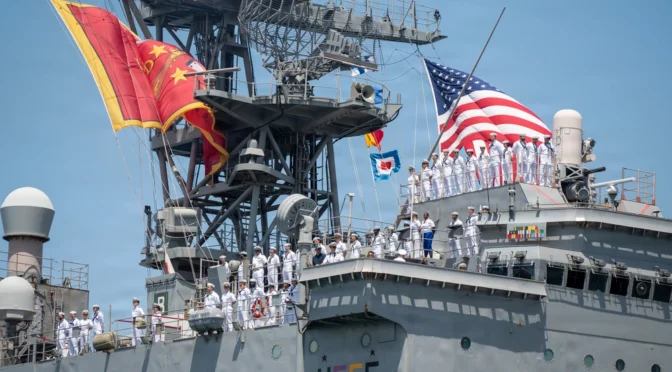
Featured image: USS Ashland Returns to Naval Base San Diego,” 01 June 2026. (U.S. Navy photo by Petty Officer 2nd Class Aja Campbell)