Tag Archives: shipbuilding

Design, Decide, Forget: Why the Navy Needs a Lessons-Learned Center for Shipbuilding

By Marcus Jones

In March 2025 testimony before the House Armed Services Committee’s Seapower and Projection Forces Subcommittee, Ronald O’Rourke, naval analyst for the Congressional Research Service since 1984, sharpened an excellent recommendation he has raised over more than a decade: the U.S. Navy should establish a dedicated institutional mechanism for systematically capturing, analyzing, and transmitting lessons learned from its shipbuilding programs.1

Although the U.S. Navy has accumulated an extraordinary body of experience in ship design and construction over more than two centuries, it continues to make avoidable mistakes in major acquisition programs such as proceeding into construction with incomplete designs, integrating immature technologies, projecting unrealistic cost and schedule estimates, and eroding accountability structures once a program becomes politically or industrially “too big to fail.” These errors are not unique to the Navy, but they are particularly consequential in the context of shipbuilding, where program timelines are long, platforms are few and expensive, and consequences are measured in strategic as well as fiscal terms.

O’Rourke’s solution is a “lessons-learned center” for naval shipbuilding: a dedicated, continuous, and institutionalized effort to capture knowledge from past programs, distill it into accessible form, and ensure it informs future design, acquisition, and oversight decisions. The value of such an entity, he argues, would lie in its ability to prevent repeated mistakes, reduce waste, improve program outcomes, and help sustain the Navy’s long-term force design and industrial base goals. It addresses key features of the Navy’s acquisition environment: the discontinuous and generational nature of major shipbuilding programs; the structural fragmentation of knowledge across commands, contractors, and government agencies; and the absence of an educational or doctrinal home for critical institutional memory.

Unlike weapons or aircraft programs, which may see dozens or hundreds of iterations within a single career, major ship classes are often designed and constructed once every 20 or 30 years. The effect of this long cycle time is that most individuals involved in a new class of ships – whether program managers, naval architects, flag officers, or congressional staffers – may have had no direct role in the last one. What should be institutional memory therefore becomes diffuse personal recollection, vulnerable to retirement, reassignment, or obsolescence. Moreover, the knowledge necessary to understand past program outcomes is distributed across a complex web of organizations: Program Executive Offices, NAVSEA and its affiliated labs and centers, shipyards and primes and sub-tier contractors, OPNAV resource sponsors, the Office of the Secretary of Defense, and various congressional committees and watchdogs. Each retains only partial and often incompatible records, and there is little incentive or mechanism for aggregating these into a unified analytic understanding. While internal program reviews, GAO reports, and RAND studies may document lessons after the fact, there has never been an entity within the Navy tasked with curating, synthesizing, or teaching these insights.

Interestingly, O’Rourke does not propose a narrowly bureaucratic mechanism but envisions a range of possible instantiations, from a structured repository of documents to a more active, curriculum- and wargame-integrated enterprise. But what matters in his framing is not form but function: the institutionalization of a reflective capacity for learning from experience and applying that learning prospectively in ways that materially improve outcomes.

Such a capability, if properly implemented, would amount to a kind of strategic memory for the Navy, one able to withstand changes in leadership, budget, and political context, while enabling the service to treat shipbuilding not as a sequence of isolated procurements but as a continuous and evolving system of practice. It is not, therefore, a technocratic fix for acquisition inefficiencies, but a cultural transformation within the Navy’s approach to its own history of design, development, and production. It holds out the prospect that the Navy would not only save money and avoid failure, but reaffirm its preferred identity as a thinking, adaptive, and strategically serious organization. It is this deeper institutional value – far beyond process improvement – that makes O’Rourke’s proposal for a naval shipbuilding lessons-learned center important and long overdue.

Joint Lessons on Lessons Learned

The idea has modest precedent and ample justification. One of the most robust models of institutional learning in the defense sector is the U.S. Army’s Center for Army Lessons Learned (CALL), established in 1985 in response to the operational shortcomings revealed during Operation Urgent Fury in Grenada. CALL’s mission was to systematically collect, analyze, and disseminate operational and tactical lessons. Over time, it became fully integrated into Army doctrine and planning, fielding collection teams, producing analytic bulletins, and shaping professional military education. But of particular relevance to the Navy’s shipbuilding enterprise is a less widely known but equally instructive initiative: the Center for Army Acquisition Lessons Learned (CAALL), housed within the Army Materiel Systems Analysis Activity.2

Established following the 2010 Army Acquisition Review, which cited the absence of a centralized mechanism for analyzing acquisition successes and failures, CAALL provides an authoritative source for acquisition-specific lessons across the Army’s program offices. It operates a web-enabled Acquisition Lessons Learned Portal (ALLP) through which project teams submit concise, structured, and searchable lessons, each tagged by acquisition phase, milestone, cost and schedule impact, and functional category.

These are not vague observations, but distilled from real program experience and embedded in metadata-rich formats that support both searchability and trend analysis. CAALL analysts conduct deep-dive studies of recurring issues, such as documentation burden, Earned Value Management failures, or test duplication, and prepare “just-in-time” lesson packages for project managers entering specific acquisition phases. The Center also engages in outreach, publishes bulletins, curates spotlight topic zones, and supports internal Army decision-making with synthesized data on the top five systemic challenges facing Army programs. It demonstrates that institutional learning is within reach but requires structured data, a deliberate submission pipeline, professional analytical support, and educational integration. It also shows how lessons can be transformed from static reflections into dynamic inputs for decision support, policy revision, and curriculum development. Most importantly, CAALL demonstrates that such a capability can be sustained over time, through leadership endorsement, modest staffing, and the aggressive use of digital tools.

A shipbuilding-focused counterpart – scaled appropriately to the Navy’s size, resourced modestly, and empowered to draw insight from both current and historical programs – would not need to reinvent the wheel. It would only need to learn how others have made their institutions learn.

Other models further underscore the feasibility and necessity of such a capability. The Joint Lessons Learned Program (JLLP) applies a five-phase process – discovery, validation, resolution, evaluation, and dissemination – to lessons arising from joint exercises, operations, and experiments. Its information system, JLLIS, acts as a system of record for tracking, archiving, and analyzing lessons that affect force development and joint capability planning.3

A more technical and directly relevant precedent is found in NASA’s Lessons Learned Information System (LLIS).4 NASA’s LLIS arose from the hard-won awareness, following the Challenger and Columbia disasters, that high-stakes engineering efforts demand not only risk management tools but a durable culture of reflection and improvement. NASA’s system integrates lessons into program planning and design reviews and allows for long-term traceability of decisions and failures. The agency’s approach, emphasizing root cause analysis, organizational memory, and education, aligns with the intended mission of an NSLLC to translate the history of naval shipbuilding experience into anticipatory guidance for future programs. Like NASA, the Navy deals with one-off, bespoke, high-cost platforms with life cycles spanning decades. The discipline required to learn systematically from such endeavors is the same.

Even in the commercial sector, complex system integrators such as Boeing, Airbus, and multinational energy firms have turned to lessons-learned systems, both formal and ad hoc, to analyze catastrophic failures and to course-correct future programs. The Construction Industry Institute’s lessons-learned repositories, used by engineering and construction firms to improve execution of large-scale infrastructure projects, is still another model for post-project analysis and feedback. These efforts are often grounded in shared technical taxonomies, design decision trees, and “causal maps” that allow construction organizations to relate performance outcomes to earlier architectural or managerial choices. The Navy’s shipbuilding community, which is distinguished by even greater system and technological complexities and similar exposure to path-dependent design choices, lacks such a coherent and systematized mechanism. An NSLLC would hold out the promise of that capability.

Of course, these precedents cannot simply be imitated wholesale, but they offer essential lessons in form, function, and value. Each succeeds not by relying on passive documentation and informal processes, but by embedding structured learning into the decision cycles and professional cultures of their organizations. What an NSLLC must do is adapt this logic to the particularities of U.S. naval shipbuilding: its long timelines, institutional fragmentation, industrial dependencies, and strategic visibility. It must provide an analytic and educational platform that helps naval leaders and engineers reason more effectively about cost, capability, risk, and design. It must produce continuity across ship classes and across generations of acquisition professionals. And it must do so not as a retrospective archive alone, but as a living resource embedded in professional education, program governance, and future planning.

Over the past several decades, the U.S. Navy has been the subject of repeated and increasingly urgent calls to establish a formal mechanism for doing just that, all of which have, time and again, failed to take root. While the service has often acknowledged the recurrence of major programmatic mistakes – most notably in high-profile acquisition efforts such as the Littoral Combat Ship, the Zumwalt-class destroyer, and the Ford-class aircraft carrier – it has not developed a durable, institutionalized capacity for engineering and acquisition-oriented organizational learning. This failure has not gone unremarked. A lineage of initiatives, proposals, and critiques – some internal, some external, some aspirational, others postmortem – has identified the absence of such a capacity as a root contributor to the Navy’s persistent shipbuilding troubles.

Perhaps the most compelling of these efforts is a 2022 MIT thesis by naval engineer Elliot Collins, which deserves attention not only for its technical sophistication but for its diagnosis of a deep institutional shortcoming.5 Collins, a Navy officer serving in the DDG(X) design program, observed firsthand what he describes as a structural absence of organizational memory in Navy ship design and acquisition. His thesis, written under the auspices of MIT’s Naval Construction and Engineering program, proposes the creation of a Navy Design Notebook System (NDNS): a digital, structured, and lifecycle-aware framework for recording and organizing design decisions, assumptions, lessons, and engineering rationale across a ship’s development. Drawing inspiration from both Toyota’s engineering notebook practice and the best traditions of systems engineering, Collins lays out a clear taxonomy and architecture for capturing knowledge in real time and rendering it useful across multiple programs and decades. Crucially, the NDNS is not just a data storage concept, but a model for how design reasoning can be institutionalized so that the lessons of one generation are accessible and intelligible to the next.

The significance of Collins’s proposal lies in the lineage of failed or underdeveloped efforts that it implicitly seeks to redeem. As far back as the 1970s, the Navy undertook an informal initiative known as the REEF POINTS series, pamphlet-style reflections on acquisition experience intended to help incoming program officers.6 But the REEF POINTS effort lacked formal backing, consistent authorship, or archival permanence, and it quickly faded as personnel rotated out and no office assumed responsibility for sustaining it. Later assessments, including a 1993 Department of Defense Inspector General report, found that the Navy lacked a centralized system for capturing acquisition lessons learned, and more critically, that it made little practical use of the systems it did possess. Data were gathered, but not applied; observations made, but not preserved; patterns noted, but not internalized.7 The diagnosis repeated itself in a 2002 analytical review commissioned by the Army’s War College, which found that across the Department of Defense, lessons-learned programs often failed not for lack of insight but for lack of organizational stewardship, cultural support, and procedural integration.8

Why, then, despite these longstanding recognitions, has the Navy failed to institutionalize a lasting lessons-learned capability in its shipbuilding enterprise? The reasons are multiple and reflect a misalignment between the operational culture of the Navy and the administrative and engineering demands of ship design. Unlike the tactical communities of naval aviation or undersea warfare – where debriefing, checklist revisions, and iterative training are ingrained – the acquisition enterprise lacks a comparable feedback loop. Moreover, the Navy’s engineering education pathways, from undergraduate technical training to postgraduate systems curricula, have not systematically incorporated acquisition case studies or design failures into their pedagogy. There is no consistent mechanism to bring shipbuilding experience into the classroom, the wargame, or the design studio. Lessons remain tacit, siloed, and anecdotal.

That the Navy has lacked such a capacity for so long is a failure of imagination and institutional design, but it not an irremediable one. The architecture of such a capability already exists in other domains, from NASA to the Army to the commercial nuclear sector. The Navy does not need to invent a solution from whole cloth; it needs to adapt proven models to its own technical and cultural context. What is required is not another ad hoc study or retrospective review, but the establishment of a permanent Naval Shipbuilding Lessons-Learned Center, a durable institutional home where technical memory, engineering reasoning, and acquisition insight can be collected, structured, and applied. The central question, then, is not whether such a center is needed, but what it should consist of, how it should function, and where it should reside.

The Devil in the Details

To be more than a bureaucratic corrective or another forgotten archive, a shipbuilding lessons-learned program must fulfill a set of core functions as intellectually rigorous as the failures it seeks to prevent and not just catalog what has gone wrong in previous programs or indulge in generalities about process improvement. The first and most essential function is to identify and preserve actual lessons: not loose observations or platitudes, but knowledge with clear causal content, derived from real program experience, and supported by traceable evidence.

To qualify as such, a lesson must demonstrate causal specificity: what precisely caused the outcome it describes, and why. It must be replicable or at least transferable across contexts, suggesting how it might inform other ship types or acquisition models. It must be traceable to primary sources – engineering drawings, test data, milestone reviews – so that its logic can be reconstructed and its authority verified. It must be actionable, capable of informing future decisions, whether at the level of design margin, contract structure, or policy architecture. And ideally, it should possess counterfactual depth: the ability to show not only what happened, but what might have happened differently under other choices.

When filtered through this lens, the lessons that matter and that a center must preserve fall broadly into five categories. First are design integration lessons, insights into how complex systems interact within the hull, and how early design assumptions or immature technologies can generate cascading failures, as in the DDG-1000’s power system or the Ford-class’s EMALS launch mechanism. Second are construction and manufacturing lessons, which speak to the translation of design into physical product: the timing of block assembly, the thresholds at which digital coordination outperforms paper-based workflows, the effects of workforce experience on productivity. Third are program management and acquisition lessons (perhaps the most politically fraught) concerning contract type selection, milestone pacing, and the dangers of concurrency. Fourth are industrial base and supply chain lessons, which trace how changes in the broader defense industrial ecosystem—supplier attrition, workforce bottlenecks, fragility in the materials base—constrain program execution in ways the Navy and its private shipbuilders often fail to anticipate. And finally, there are historical, strategic, and doctrinal lessons, which reveal how misalignments between strategic ambition and industrial reality (fleet design concepts that outpace build capacity, for instance) can derail even well-managed programs.

Still, it is not enough just to identify them; lessons must be preserved and organized within a structure that allows them to be used. Here, the Navy can draw on models such as that proposed by Collins in his thesis: a digital, lifecycle-aware knowledge framework that tags and stores design decisions, assumptions, and lessons in a manner that makes them accessible not only to current program staff but to future generations. Such a system would form the backbone of the NSLLC’s information architecture: structured, searchable, phase-referenced, and durable. It would allow engineers working on SSN(X) to understand not just that the Virginia-class succeeded or stumbled in certain areas, but why, under what constraints, and according to which tradeoffs. It would enable program sponsors to distinguish between lessons that were context-specific and those that reflect deeper structural patterns.

Ultimately, the most critical function of the NSLLC, however, is not archival but pedagogical. Lessons, to be meaningful, must be taught as part of a living curriculum, and not simply as dry memoranda or summary slides. The center must work directly with educational institutions to embed lessons into the professional formation of officers, policy officials, engineers, and acquisition professionals. This means developing decision-forcing cases that place students in the shoes of historical program leaders, confronting them with the actual dilemmas and constraints those leaders faced. It means designing wargames and exercises that test tradeoffs in acquisition, industrial surge, and fleet composition. It means seeding capstone projects, research initiatives, and faculty development efforts with questions drawn from real program history. And it means, above all, creating a culture in which experience is not simply remembered but used as a guide to reasoning, as a check against institutional hubris or forgetfulness, and as a source of comparative advantage in a strategic environment where time and resources are finite. Finally, the Center must function diagnostically on behalf of Navy decision-makers, as a resource for the review of future program plans, bringing to bear its corpus of structured knowledge to identify early warning signs of known failure modes, or to highlight opportunities for constructive borrowing across ship classes. This is not a matter of punitive oversight, but of anticipatory guidance and bringing past reasoning to bear on present decisions in a way that deepens accountability and reduces risk.

What this amounts to is a knowledge institution, not in the narrow academic sense but in the most operationally vital sense of the term. The NSLLC would exist to ensure that the U.S. Navy no longer builds its ships without memory. It would translate past pain into future prudence, and costly failure into usable foresight. And it would mark, at last, the point at which naval shipbuilding began to behave not just as a procurement function, but as a learning system worthy of the stakes it bears.

The Way Ahead

What would such a center look like in practice? If the value of a Naval Shipbuilding Lessons-Learned Center lies in the integrity and usability of its knowledge, then its organizational structure must be equally deliberate. It should not replicate the diffuse and stovepiped landscape of existing program oversight offices, but rather bridge engineering, acquisition, policy, and education communities. And in keeping with the realities of today’s defense fiscal environment, it must be lean, digitally enabled, and architected from the start to minimize overhead. The NSLLC should be organized as a small, hybrid analytical and educational unit with as small a group of affiliated personnel as circumstances permit, including naval engineers with experience in major design and production programs; acquisition professionals familiar with contracting and program management dynamics; historians of technology and naval policy who can trace institutional lineages and doctrinal consequences; and digital knowledge architects to manage its structured repository and analytic tools. Core activities would be augmented by short-term fellows – rotating billets for officers, civilians, or academics on sabbatical or detail – who would conduct targeted case studies, contribute to curriculum development, or lead diagnostic reviews of current programs. Rather than attempt to recreate or replace existing program data flows, the Center should connect to them and draw from NAVSEA, PEO Ships and Submarines, CRS, GAO, and DoD IG reports, but synthesize across them with the purpose of creating pedagogically and analytically coherent insights.

To reduce cost and footprint, the Center must leverage digital tools aggressively. A cloud-based digital architecture, modeled in part on the NDNS framework, would form the heart of the operation: a searchable, metadata-tagged, phase-referenced archive of lessons that supports analysis, instruction, and red-teaming of future programs. Visualization tools like interactive timelines, decision trees, and traceability matrices should be prioritized over staff-intensive publishing or editorial operations. Whenever possible, the Center’s materials should be reusable across formats: a single case study might underpin a midshipman seminar, an acquisition wargame, and a policy memo to ASN(RDA). In this sense, the Center is less a physical institute than a virtual and modular capability: one that enables reflection, instruction, and anticipatory decision support wherever shipbuilding is debated or taught.

As to its location, the author will admit to a conflict-of-interest, being a longtime member of the U.S. Naval Academy faculty. It may, therefore, sound parochial to suggest that the NSLLC be housed at Annapolis. That said, there are good reasons, symbolic and practical, why the Naval Academy may be a fitting institutional home. The Academy is the Navy’s enduring schoolhouse, the place where generations of officers are introduced not just to the fleet, but to the long arc of naval experience. It offers a rare confluence of technical education, historical reflection, and leadership formation.

Moreover, it sits proximate to the Washington-area institutions with which the NSLLC would regularly interact – NAVSEA, the Navy labs and warfare centers, OPNAV and the Secretariat organization, and the various acquisition and oversight bodies headquartered in the capital region. Perhaps most importantly, the Academy is a place not just of training, but of memory. To locate the Center there would signal that lessons are not just compliance artifacts or after-action musings, but a core component of professional identity. It would allow the Center’s work to be integrated directly into engineering coursework, capstone design, fleet seminars, and acquisition electives. And it would give midshipmen, from the beginning of their careers, access to a body of knowledge that has existed until now only in fragments.

But what matters is not the administrative chain but the Center’s function: to make memory usable, to make learning permanent, and to help the Navy move from a culture of crisis improvisation to one of cumulative, adaptive competence. Wherever it is housed, a Naval Shipbuilding Lessons-Learned Center should embody the values it seeks to cultivate: frugality, clarity, and strategic discipline. And in doing so, it may just help the Navy build not only better ships, but a better institution.

Dr. Marcus Jones is an associate professor in the history department at the United States Naval Academy

Endnotes

1. Ronald O’Rourke (11 March 2025), “Statement before the Armed Services Committee Seapower and Projection Forces Subcommittee, U.S. House of Representatives, Hearing on ‘The State of U.S. Shipbuilding’” (Congressional Research Service Report 7-5700) pp.1-3.

2. Iracki, Jill, 2014. “Army acquisition lessons learned,” Defense AT&L (September–October 2014) pp.36-40.

3. Thomas, J.T. and Schultz, D.L. (2015), “Lessons about Lessons: Growing the Joint Lessons Learned Program.” Joint Forces Quarterly 79, pp.113-120.

4. Ganopol, A., Oglietti, M., Ambrosino, A., Patt, F., Scott, A., Hong, L. and Feldman, G., 2017. “Lessons learned: an effective approach to avoid repeating the same old mistakes.” Journal of Aerospace Information Systems14(9), pp.483-492; Also Miller, S.B., 2005. “Lessons Learned or Lessons Noted: Knowledge Management in NASA.” In ASTD 2005 Research-to-Practice Conference Proceedings (p. 140).

5. Collins, E.J., 2022. “A Method for Organized Institutional Learning in the Navy Shipbuilding Community” (Doctoral dissertation, Massachusetts Institute of Technology).

6. Wellborn Jr, R.M., 1976. “Formulation and Use of Lessons Learned in NAVSEASYSCOM Acquisition Programs” (Project Report, Defense Systems Management College)

7. Reed, D.E., Gimble, T.F., Koloshey, J.L., Ward, E.J. and Alejandro, J.K., 1993. “Acquisition-Type Lessons-Learned Programs Within the Military Departments” (No. IG-DOD-93173).

8. Snider, K.F., Barrett, F.J. and Tenkasi, R., 2002. “Considerations in acquisition lessons-learned system design.” Acquisition Review Quarterly9(1), pp.67-84.

Featured Image: The USS Harvey C. Barnum Jr. under construction at Bath Iron Works in July 2023. (Photo via Bath Iron Works)

Navy Force Planning with a Pertinacious Marine Corps

By Bruce Stubbs

“A requirement is a requirement, pure and simple.”
—Lieutenant General Karsten Heckl, USMC 

“One man’s requirement is like another man’s wish.”
—Admiral Frank B. Kelso II, USN (retired)

A Team of Rivals

The United States Marine Corps has an outsized effect on Navy force planning. While the Navy and the Marines exhibit a sincere and genuine single team spirit conducting global naval operations, they are a fierce team of rivals when determining the requirements for amphibious ships (also known as “amphibs”), which the Navy funds for their construction and operation.

Soon after becoming Marine Corps Commandant, General David H. Berger announced a headline-grabbing transformation of the Corps in his July 2019 Commandant’s Planning Guidance. In its new role, the Marines would operate inside actively contested maritime spaces to conduct sea denial and assured access missions with a particular focus on the Indo-Pacific theater. In March 2020 Berger further explained his concept in Force Design 2030. Berger’s guidance declared that the Navy’s large amphibs were too vulnerable and too expensive to risk in combat, the Marines’ requirement for 38 or 34 large amphibs was no longer valid, and the Marines had a new requirement for small, agile amphibs.

His unprecedented, if not historic, transformational initiative sparked a yearslong controversy over two inter-related issues. First, Force Design 2030 punctured the Corps’ rationale for Navy’s large amphibs, which the two sea services refer to as either “big deck” or “small deck ships. Second, the initiative handed the Navy a multi-billion dollar bill to construct and operate a new class of amphibs designated eventually as the Medium Landing Ship

Issue#1: Number of Large Amphibious Ships

Shifting Requirements

From Berger’s determination that large amphibs were too vulnerable and too expensive, it logically followed what Mark Cancian, an analyst at the Center for Security and International Studies and a retired colonel of Marines, concluded. If the Marines believed their “future lay in small amphibious ships, then the Pentagon should limit the building of large amphibious ships. The Cost Assessment and Program Evaluation office—a powerful analytical office reporting directly to the Secretary of Defense—took notice of this contradiction in the Marines’ transformation planning.

Since the end of the Cold War, the Marines’ requirement for large amphibs has been an issue for the Navy. Former Secretary of Defense Robert M. Gates (2006-2011) in May 2010 explained why: “We have to take a hard look at where it would be necessary or sensible to launch another major amphibious landing again – especially as advances in anti-ship systems keep pushing the potential launch point further from shore.… what kind of amphibious capability do we really need to deal with the most likely scenarios, and then how much?”

Echoing Gates’ arguments, Jerry Hendrix, a senior fellow at the Sagamore Institute and a retired Navy captain, stated that the Marine Corps has “been less than convincing on the role of amphibs in the future fight” and the need for joint forcible entry and amphibious assault. He observed, ” … outside of beaches on the Korean Peninsula … where [are they] going to be doing amphibious assault … what [is] the argument” for this capability? According to Cancian, the Marines have not “offered a strong wartime rationale for 31 large amphibious ships.”

Trump’s Defense Secretary Wants Fewer Large Amphibious Ships

By early 2020, it appeared Secretary of Defense Mark Esper had determined that the requirement for opposed amphibious landings was diminishing. He wanted a warfighting strategy to drive amphibious force planning, not a peacetime forward presence strategy. So, Esper directed his staff to conduct a new amphib study as a component of a larger study on the Navy’s total ship requirements. Completed in October 2020, the Future Navy Force Study served as the basis for the first Trump administration’s last Navy shipbuilding plan, submitted to Congress in December 2020. Esper’s unprecedented tasking of his staff to conduct this study resulted in the Navy losing control over its force planning efforts for about eight months.

This plan had dire consequences for the Marines. It reduced the number of large amphibs by calling for a range of 9 to 10 “big deck” ships and a range of 52 to 57 for all other amphibs. Ronald O’Rourke, the respected Congressional Research Service analyst, suggested that this range could be divided into 19 or fewer “small deck” ships and 28 to 30 of the new Light Amphibious Warship. The combined total of “big deck” and “small deck” ships would be well under 30, which was unacceptable to the Marines. 

Biden’s Navy Secretary Also Wanted Fewer Large Amphibious Ships and Another Study

On June 17, 2021, new Secretary of the Navy Carlos Del Toro released the fiscal year 2022 shipbuilding plan. It called for 8 to 9 “big deck” amphibs, 16 to 19 “small deck” amphibs, and 24 to 35 new Light Amphibious Warships, which in 2024 the Navy redesignated the Medium Landing Ship. Also in June, the Navy and the Marines completed another amphib study which determined a requirement for 28 to 31 large amphibs. For the Marines, “31-amphibs” became their red-line for large amphibs, contradicting the Secretary’s range of 24 to 29 in the fiscal year 2022 shipbuilding plan.

In September 2021 Del Toro directed another evaluation of amphibious ship requirements called the Amphibious Force Requirement Study for delivery by March 2022. (Del Toro delayed submitting this study to Congress until December 2022.) By February 2022, Admiral Michael Gilday, the Chief of Naval Operations, publicly stated that the fiscal year 2023 shipbuilding plan would include, “probably nine big deck amphibs and another 19 or 20 [“small deck” ships] to support them.” Gilday’s numbers indicated a range of 28 to 29 for the large amphibs. A few months later, Del Toro released the fiscal year 2023 shipbuilding plan in April, presenting an unhelpful package of three alternative plans for a range of 7 to 9 “big deck” ships and 15 to 26 “small deck” ships for a total between 22 to 26 by fiscal year 2045. The reduction in large amphibs would prevent the Marines from simultaneously deploying three Marine Expeditionary Units.

While the Biden administration signaled it did not fully support the Marines’ requirements, some in Congress did. Representative Joe Courtney (D-Conn.) and Representative Rob Wittman (R-Va.) introduced a bill to maintain 31 large ships. In late July 2022, Gilday released his Navigation Plan 2022 which called for 31 large amphibious ships and 18 Light Amphibious Warships.

Congress Is Incensed and Supports the Marines

By April 2022, Congress still had not received Del Toro’s Amphibious Force Requirements Study. A dispute, which became a stand-off between the Cost Assessment and Program Evaluation office and the Navy, caused the delay. This office wanted the Navy to reconsider portions of the report, but the Navy declined, and so the study languished. By December, Congress had had enough and passed the National Defense Authorization Act for Fiscal Year 2023 with a statutory requirement for not less than 31 large amphibs, including 10 “big deck” and 21 “small deck” ships. This Act also required the Navy Secretary to ensure that the Commandant’s views are given appropriate consideration before a major decision is made by an element of the Navy Department outside the Marine Corps on a matter that directly concerns amphibious force structure and capability. In addition, the Act assigned directed responsibility to the Commandant for developing the requirements relating to amphibs. Del Toro finally sent the classified Amphibious Force Requirements Study to Congress in late December 2022. No sooner than Congress received this study, Secretary of Defense Lloyd Austin directed a “redo” with little Navy objection, which according to Politico, increased the Marines’ frustration.

Navy Secretary Announces an Amphibious Strategic Pause

Del Toro publicly stated in February 2023 that the Navy was taking a “strategic pause” from buying the “small deck” ships. He explained that the Navy needed additional time to determine the mix and number of amphibs before resuming procurement. The Secretary’s announcement was somewhat disingenuous as the Secretary had already initiated a de facto strategic pause in his April 2022 submission of the fiscal year 2023 shipbuilding plan and the fiscal year 2030 budget. According to Politico, the Marines were furious over this outcome. Gilday explained that lack of funding was the “driving issue” for the decision not to fund any more of these $1.8 billion “small deck” ships.

Congress Intervenes Again for the Marines

By April 2023, Del Toro’s strategic pause not to buy “small deck” amphibs had greatly annoyed the Senate Armed Services Committee. A month later the Committee reproached Del Toro in a June 13th letter for not responding to its questions regarding the Navy’s non-compliance with the statutory requirement to maintain 31 large amphibious ships. The senators saw no planning in the Navy’s fiscal year 2024 shipbuilding plan to achieve this force-level goal. Co-signed by 14 Democratic and Republican senators, the letter stated, “The Navy’s current plan not only violates the statutory requirement, but also jeopardizes the future effectiveness of the joint force, especially as we consider national security threats in the Indo-Pacific.” The letter continued that the Del Toro had until June 19th to respond with an updated shipbuilding plan for fiscal year 2024, and a pointed reminder that the 31-ship requirement “is not a suggestion but a requirement based on the assessed needs of the Navy and the Marine Corps.” In early August USNI News reported that the strategic pause was still in effect. At her September 2023 confirmation hearings to become the 33rd Chief of Naval Operations, Admiral Lisa Franchetti endorsed the Marines’ requirement for 31 large amphibious ships.

Congress Helps Thwart an “Existential Threat” from the Navy Secretary

As the Marines entered 2024, the debate over the number of large amphibious ships remained unresolved. Lieutenant General Karsten Heckl, Deputy Commandant for Combat Development and Integration, called the amphib shortage the Marines’ “single biggest existential threat.” In March, the Defense and Navy Departments eliminated this threat by ending the two-year “strategic pause” for procuring “small deck” amphibs. The Navy’s budget submission for fiscal year 2025 and its fiscal year 2025 shipbuilding plan, both approved by the Defense and Navy Departments, included the procurement of “small deck” ships. In addition, these documents commenced the procurement of a new class of Medium Landing Ships. The Biden Administration had caved to Congress and ended the almost two-year strategic pause.

Issue #2: The Unaffordable and Unsurvivable Ship

Marines Give The Navy A Shipbuilding Bill

Berger’s guidance called for a new class of Navy amphibious ships that were “smaller, more lethal, and more risk-worthy platforms to shuttle Marines around archipelagic islands. The Marines would “shoot” anti-ship cruise missiles from one island and then “scoot” to another island using the new amphibs as “water taxis” to “shoot” once more. In 2020 the Navy designated this new amphib as the Light Amphibious Warship. The Navy anticipated procuring a class of 28 to 30 ships with a crew of “no more than 40 Navy Sailors” at a “unit procurement cost of less than $100 million.”

Almost immediately the Navy and the Marine Corps clashed over the ship’s capabilities and costs. The Navy wanted a “survivable ship,” while the Marines wanted an operational ship as fast as possible, as well as one built to civilian standards and not military standards to reduce construction costs. Their disagreement delayed the delivery of first ship to “fiscal year 2023 and then to fiscal year 2025.” By January 2024, the Navy released its request for proposals for the first six of these new class of ships for delivery in 2029. The Navy asked for a ship that could lift 75 Marines and 600 tons of equipment with a “cargo area of about 8,000 square feet, a helicopter pad, a 70-person crew, spots for six .50-caliber guns and two 30mm guns.” The Navy also wanted the ship to be under 400 feet long, a draft of no more than 12 feet, a 14-knot endurance speed, and roll on/roll off beaching capability.

By April 2024, the Navy had re-designated the ship as a Medium Landing Ship with an increased estimated unit procurement cost of roughly $150 million in constant fiscal year 2024 dollars for the first 8 ships and a class size of 35 ships by 2043. The Navy estimated that 55 of these ships would “cost less than $200 million per ship, on average.” The Congressional Budget Office, however, projected the average cost at $350 million per ship.

In December 2024, the Navy received industries’ responses to its January 2024 request for proposals. After seeing the costs, the Navy immediately canceled its request. Gobsmacked, Nickolas Guertin, the assistant secretary of the navy for research, development and acquisition, stated the request for bids, “came back with a much higher price tag. … we had to pull that solicitation back and drop back and punt.” In January 2025, the Navy punted and began looking for “existing, private-sector designs” requiring minor modifications for conversion at a small cost.

In 2025, Unanswered Questions Remain About the New Amphibious Ship

The central issue about the procurement of the Medium Landing Ship remains its construction cost, which is dependent on whether the Navy builds the ship to commercial or naval warfare standards, which is, in turn, dependent on the ship’s final operational concept. Building to commercial standards lowers construction costs. The operational concept remains unclear whether these ships will operate in a benign environment. Will they only operate in the pre-crisis phase or after hostilities have commenced and these ships find themselves in contested waters? Moreover, if the Marines intend to resupply its forces as well to relocate them during the conflict, it is highly likely that these ships would be vulnerable to detection and attack.

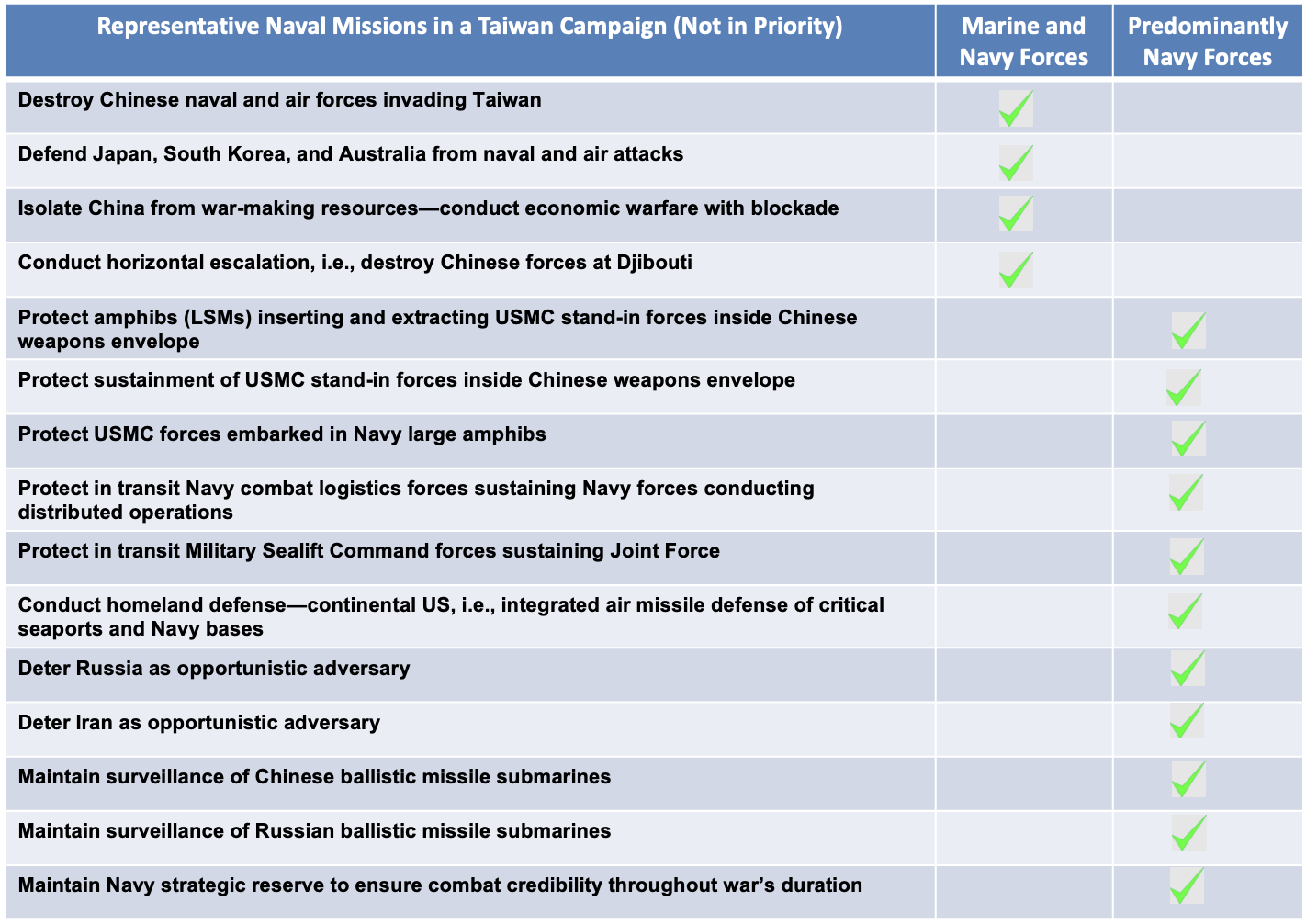
Consequently, the Navy will have a mission requirement to protect and sustain the Marines operating as stand-in forces, placing another demand on the Navy to provide forces while also conducting other high priority missions (see Table 1). In April 2024 the Congressional Budget Office reported that “A ship that is not expected to face enemy fire in a conflict could be built to a lesser survivability standard, with fewer defensive systems than a ship that would sail in contested waters during a conflict.”

Table 1: A comparison of potential missions for the Department of the Navy during a conflict over Taiwan, divided into missions shared by the Navy and Marine Corps and missions that would be assigned to predominantly Navy forces. (Author graphic)

Perhaps in an attempt to strengthen the argument that the Navy should construct these ships to commercial standards, the fiscal year 2025 shipbuilding plan did not classify the Medium Landing Ship as an “amphibious warfare ship.” Instead, in a puzzling decision it was categorized as a “command and support” vessel, despite its requirement to land Marines on beaches to conduct kinetic operations.

Wrap-Up

The Navy and Marine Corps Have Different Priorities and Agendas

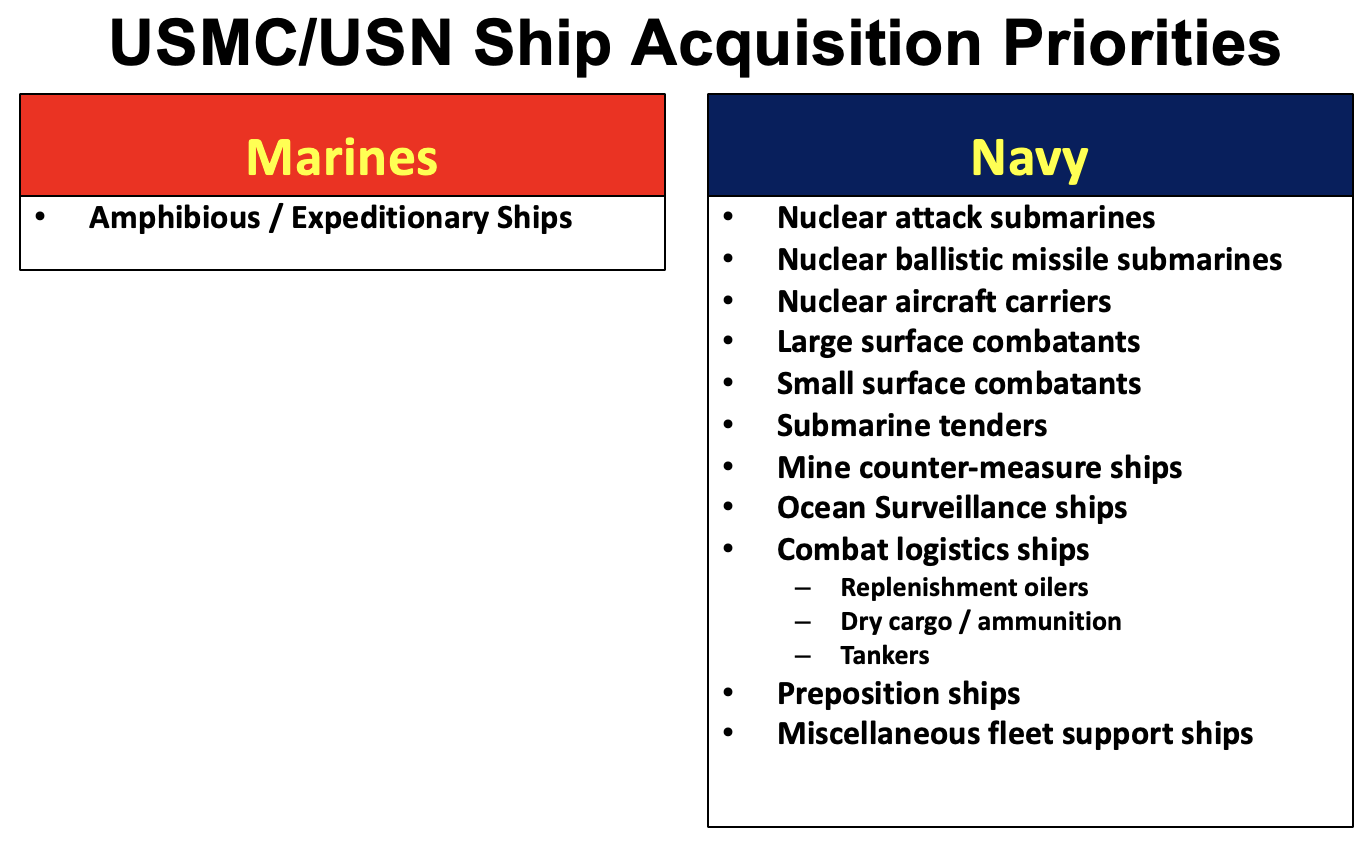
The Navy and the Marine Corps co-exist on some important core common tasks and viewpoints, reinforced by established historical, political, legal, and bureaucratic frameworks. The Marine focus on forward presence, forcible entry, and expeditionary warfare employing the Navy’s amphibs. Whereas for the Navy, expeditionary warfare is merely one among many Navy warfare functions to include anti-air warfare, anti-surface ship warfare, anti-submarine warfare, strike warfare, special operations warfare, mine and countermine warfare, electronic and information warfare, strategic deterrence, combat logistics, and sealift for Joint Force logistic sustainment. For the Marines, amphibs are a priority. For the Navy, however, ballistic missile submarines, attack submarines, aircraft carriers, large surface combatants, small surface combatants, auxiliary ships, logistics ships, oilers, and minesweepers are all priorities as well as amphibs (see Table 2). 

Table 2: A comparison of ship acquisition priorities between the Navy and Marine Corps. (Author graphic)

The Navy does not get to focus on just one type of ship and it is responsible for a wide range of warfighting functions. In contrast, the Marine Corps has a much narrower set of responsibilities. When force structure priorities differ between the Navy and Marines, the Navy finds itself in an awkward position between one side—composed of the Office of Management and Budget, the Department of Defense, and the Department of the Navy—and the other side comprised of the Marines and Congress. Such triangulation can lead to an almost unmanageable situation whereby the Navy loses control of the planning for its future, which actually occurred in 2019

Gilday noted that the Navy “must prioritize programs most relevant” to a conflict with China. What can be more relevant to a conflict with China than logistics, especially with a U.S. Navy conducting distributed operations, likely without the availability of Guam. Lines of communication will stretch for thousands of miles from the U.S. homeland to the operating areas. These sea lines of communication, as well as U.S. ports, will require protection because China has the means and the will to interdict and sever these lines to isolate U.S. fighting forces and prevent their sustainment. Logistics ships to sustain combat operations, submarine tenders to rearm submarines, and oilers to refuel the Navy’s distributed forces across the vast Pacific distances may be more needed by the Navy than a new class of 35 amphibs. In February 2024 Admiral Samuel J. Paparo, Jr., then the Commander of the U.S. Pacific Fleet, stated that the Navy’s Combat Logistics Force, which supports and sustains the Navy’s distributed maritime operations with “beans, bullets, and black oil” is operating on “narrow margins” with insufficient ships for a war with China. He specifically cited inadequate numbers of oilers. Admiral Paparo also noted that the Chinese consider the U.S. Navy’s logistics capabilities a critical vulnerability with his statement that “When we run [war]games, the red team goes for the Combat Logistics Force every single time.” The Navy’s lack of strategic guidance hindered a comprehensive understanding of this and other thorny force planning issues, consequently strategic force priorities were often set on the fly.

The differences between the two sea services are real, and relations about Department of the Navy funding priorities have often been fractious and kept in-house. A major exception underscoring this sometime discordant relationship occurred in December 1995. General Carl E. Mundy, Jr., U.S. Marine Corps (retired), who served as Commandant, fired a salvo at the Navy for allegedly short-changing the Marine Corps for its fair share of the Navy Department’s budget. Admiral Frank B. Kelso, II, U.S. Navy (retired), Chief of Naval Operations (1990-1994), reminded Mundy that the Marines cannot ignore the “total requirements of the Navy” beside supporting the Marines in the “littorals.”

Conclusion

When the Marines believe their future is in jeopardy, which certainly was the case with this confrontation over 31-large amphibs and the fight for 35 new smaller amphibs, the Marines do not hesitate to seek Congress’ intervention on their behalf. Besides calling the reduction in large amphibs an existential threat to the Marines’ existence, General Heckl thundered, “Our identity is elemental to who we are as Marines. We are soldiers of the sea. We are the nation’s naval expeditionary force. And we just can’t lose that.” His statements reflected the Marine Corps’ laser focus on its own force structure, rather an appreciation of the bigger picture.

Advocates for any of the services can sometimes believe so passionately in the potential effectiveness of their particular service with its “unique” weapon systems, ships, or aircraft that “they find it difficult to appreciate the fuller pattern of a future war and the unforgiving priorities dictating resource allocation.” Their degree of identification with their service may “discourage viewpoints and thinking oriented toward the best interests” of the Joint Force as a whole. The Marines’ success in setting the goal of 31 large amphibs and a new class of amphibs illustrates the powerful influence the Marines can and will exert over the Navy’s force planning process to achieve their objectives. The nation can only hope that the recent outcomes in amphib numbers that the Marines have achieved in coordination and cooperation with congressional and industrial influence will produce the desired benefit to America’s national defense, and not shortchange other high-priority requirements.

The Marine Corps has a well-deserved special place in the hearts of Congress and the American people—a sentiment that can defy the logic of Navy force planning, and the intentions of any administration to prioritize the nation’s defense requirements. The Marines—thanks to Congress—have a big vote in Navy force planning. Short of the Marine Corps becoming an independent armed service outside the Department of the Navy, the Navy, as best as it can, just has to live with a pertinacious Marine Corps — or it can borrow a page from the Marine Corps’ playbook. 

Prior to his full retirement as a member of the U.S. senior executive service, Bruce Stubbs had assignments on the staffs of the secretary of the Navy and the chief of naval operations from 2009 to 2022. He was a former director of Strategy and Strategic Concepts in the OPNAV N3N5 and N7 directorates. As a career U.S. Coast Guard officer, he had a posting as the Assistant Commandant for Capability (current title) in Headquarters, served on the staff of the National Security Council, taught at the Naval War College, commanded a major cutter, and served a combat tour with the U.S. Navy in Vietnam during the 1972 Easter Offensive. The author drew upon his forthcoming publication, Cold Iron: The Demise of Navy Strategy Development and Force Planning, to compose portions of this commentary.

Featured Image: Ships of the Kearsarge Amphibious Ready Group sail in formation.  (U.S. Navy photo by Mass Communication Specialist 2nd Class Corbin J. Shea/Released)

Made in Latin America: Domestically Manufactured Ecuadorian and Peruvian Ships Meet in the Pacific

The Southern Tide

Written by Wilder Alejandro Sanchez, The Southern Tide addresses maritime security issues throughout Latin America and the Caribbean. It discusses the challenges regional navies face including limited defense budgets, inter-state tensions, and transnational crimes. It also examines how these challenges influence current and future defense strategies, platform acquisitions, and relations with global powers.

“We focus on partnerships…Our partners want to work with us. They want the advantage of the United States education, training, exercises and military equipment. It’s the best in the world. And so it’s up to us to deliver that in a way that’s relevant and also provides a return on investment for American taxpayer. So that is our focus.” –Navy Adm. Craig S. Faller, commander of U.S. Southern Command, before the Senate Armed Services Committee July 9, 2019.

By Wilder Alejandro Sánchez

The Ecuadorian coast guard vessel Isla Santa Cruz escorted the Peruvian training vessel BAP Unión while the latter sailed through Ecuadorian waters as part of a training mission in mid-May. While cordial encounters at sea between ships belonging to friendly navies are quite common, a curious fact about this meeting is that both vessels were manufactured domestically by local state-run shipyards.

https://gfycat.com/messynimblecentipede

Isla Santa Cruz escorts the Peruvian training vessel BAP Unión (Ecuadorian Navy photo)

The significance of this encounter cannot be overstated. The navies of Ecuador and Peru, in addition to other Latin American fleets, will certainly continue to acquire vessels and submarines from extra-regional suppliers for the foreseeable future. But the era of “Made in Latin America” ships is here.

Made in Ecuador, Made in Peru

Isla Santa Cruz (LG 43) is one of four coastal patrol boats, class LP-AST-2606, produced by the Ecuadorian state-run shipyard ASTINAVE. The vessel and its sister ships, Isla Marchena (LG 42), Isla Pinta (LG 44), and Isla Balta (LG 45), are based on a Damen’s Stan Patrol 2606 model. The vessels are operated by the coast guard, a part of the navy, and operate in Ecuadorian waters, which include protecting the maritime biodiversity of the Galapagos Islands, listed on the UNESCO World Heritage list. Isla Santa Cruz was commissioned in 2012.

As for training vessel Unión, the ship was commissioned in 2016. Built by the Peruvian state-run shipyard SIMA’s main facilities in Callao, the ship measures 115 meters in length, displaces 3,200 tons, has a maximum speed of 12 knots and can transport up to 250 officers, crew and trainees. Unión, named after a Peruvian warship that fought in the 19th century War of the Pacific, is the largest training vessel in Latin America. As part of training missions with future naval officers, Unión has also participated in international sailing competitions. For example, in 2017 Unión participated in Rendez-Vous 2017 Tall Ships Regatta, where the vessel won the race from Boston, Massachusetts to Charlottetown, Canada.

How Often Do Such Meetings Happen?

It is unclear how often locally built vessels meet in Latin American waters. Such meetings can occur via passing exercises (PASSEX), one vessel escorting the other as it voyages through territorial waters, working together in counter-narcotic operations, or via multinational exercises like PANAMAX or UNITAS.

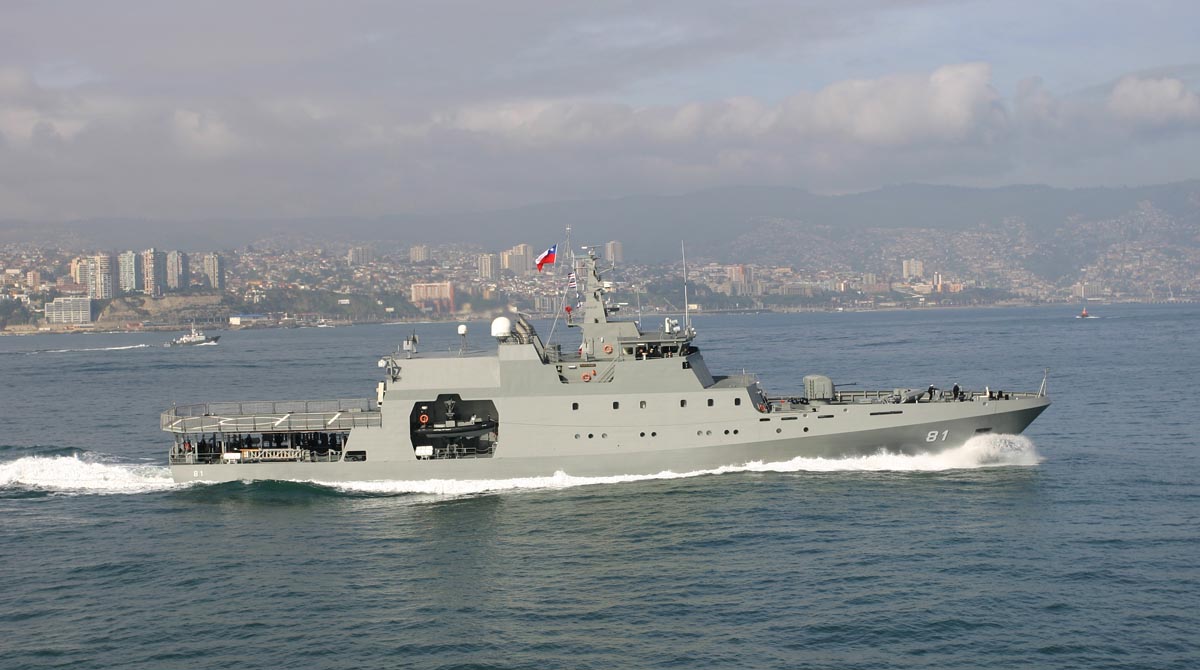
For example, for UNITAS LIX (2018), held in Colombia, the host’s patrol vessel ARC 20 de Julio (PZE-46), manufactured by the Colombian shipbuilding corporation COTECMAR, and the Chilean OPV Piloto Pardo (OPV-81), built by the Chilean shipyard ASMAR, were deployed together. Similarly, UNITAS LVII (2017), held in Peru, included the participation of patrol boats BAP Río Pativilca (PM 204) and BAP Río Cañete (PM 205), built by SIMA, and the Chilean OPV Comandante Toro (OPV 82), built by ASMAR. This author has not been able to find confirmation that these locally-built vessels directly interacted in these exercises, but it is plausible.

Chilean OPV Piloto Pardo (OPV-81). (Chilean Navy photo)

Interestingly, even though there are a plethora of analyses in Spanish and Portuguese about what regional shipyards are producing and the status of regional navies, this author has not found previous research that discusses other instances of locally built vessels meeting at sea in Latin America. Figuring out how often these meetings occur would require exhaustive research through various news sources, including press releases and statements by regional navies, to keep track of when this type of meeting at sea occurs, and researching where each ship was built.

A Look at Ongoing Projects

In various analyses for CIMSEC (see the 2016 commentary “The Rise of the Latin American Shipyard”) this author has discussed the rise of Latin American shipyards, several of which are currently engaged in major construction projects.

Brazil is building four conventional submarines and one nuclear-powered submarine via the PROSUB program, in cooperation with the French shipyard Naval Group; the Chilean shipyard ASMAR is building an icebreaker and plans to construct at least two transport vessels, a project called Escotillón IV; and the Colombian shipbuilding corporation COTECMAR has manufactured a fleet of amphibious vessels (Buques de Apoyo Logistico y de Cabotage) for the local navy, while two units were sold to Honduras (FNH 1611 Gracias a Dios) and Guatemala (BL 1601 Quetzal). COTECMAR has also manufactured several patrol vessels based on a design by the German shipyard Fassmer. COTECMAR’s most recent project was the launch this past September of ARC Isla Albuquerque for the country’s Dirección General Marítima, commonly known as DIMAR, a part of the navy. 

Both Colombia’s COTECMAR and Chile’s ASMAR have ambitious projects for the near future as well, namely the construction of frigates. The Colombian Navy wants to domestically manufacture frigates (a project called Plataformas Estratégicas de Superficie or PES for short) via COTECMAR to replace its aging Almirante Padilla-class frigates, but the project has been delayed. Similarly, the Chilean Navy’s high command aims to also domestically manufacture frigates by 2030.

Even the internationally sanctioned and economically crippled Venezuela is building domestic vessels. Case in point, a 24 April tweet by a Venezuelan military Twitter account shows a video of Centinela, a locally-manufactured speedboat which will be utilized by the national guard (Guardia Nacional Bolivariana) for coastal operations. At the time of writing, the Iranian forward-basing ship IRINS Makra, formerly an oil tanker, is transporting seven fast attack craft, apparently to be transferred to Venezuela. If this happens, it would be the first time in years that the Venezuelan Navy obtains foreign-made vessels, and highlights the service’s current status in which international suppliers of new ships are very limited in number (this author ahs discussed the status of the Venezuelan navy in a May 10 commentary for Strife, The Venezuelan Navy: The Kraken of the Caribbean?”).

Both Ecuador and Peru have ongoing shipbuilding projects as well. ASTINAVE has teamed up with a German shipyard to build a multipurpose combat vessel. Even though the construction of the MPV70 MKII vessel has been delayed due to the COVID-19 pandemic, the Ecuadorian shipyard is upgrading and expanding its infrastructure. Specifically, the shipyard’s main facilities in Planta Centro will be expanded to cope with the new project as the combat ship will be manufactured and assembled in sections.

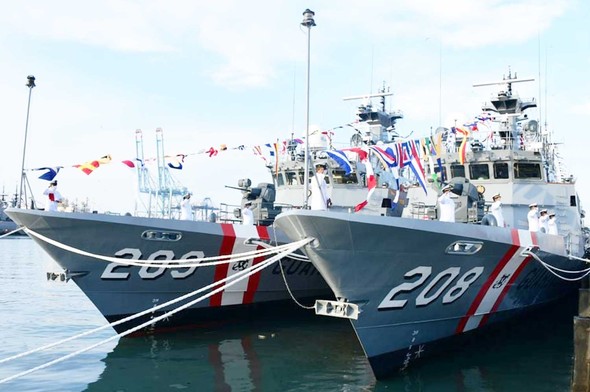
Similarly, Peru’s SIMA is building BAP Paita, a second landing platform dock (the first one, BAP Pisco, is already operational); while two coastal patrol vessels, BAP Río Tumbes and BAP Río Locumba, were commissioned this past March. SIMA’s facilities in Iquitos, in the Peruvian Amazon, also build vessels for the army’s and navy’s riverine operations.

BAP Río Tumbes and BAP Río Locumba (Peruvian Navy photo)

The Bad News: Argentina and Mexico

Unfortunately, there are shipyards in two countries that have been unable to move forward with new projects. After much fanfare, Mexico’s long range oceanic patrol project (Patrulla Oceánica de Largo Alcance or POLA) is not moving forward, as President Andres Manuel Lopez Obrador is not interested in having the local state-run shipyard ASTIMAR construct new units in partnership with Damen. Only one of this class has been built, the POLA ARM-101 “Benito Juárez.* On June 1, as part of the celebrations for the Mexican navy’s anniversary, the patrol vessel ARM Tabasco (PO-168) was commissioned. But this ship was originally launched in 2019 and it is unclear when ASTIMAR will receive orders for new ships (See Christian J. Ehlirch’s “The Evolution of the Mexican Navy Since 1980” analysis in Strife for more information about the status of the fleet.)

POLA ARM-101 “Benito Juárez. (Photo via Damen Shipyards Group)

Similarly, Argentine shipyards like Rio Santiago and Tandanor are in limbo due to a lack of funds. Two outstanding projects include the construction of two training boats to train cadets (Lanchas de Instrucción de Cadetes or LICA), and one Small Waterplane Area Twin Hull (SWATH) hydrographic ship for the Argentine Navy. The Alberto Fernández administration is reportedly providing funds to finish both projects, however it is unclear when they will be launched.

Why Build at Home?

Navies and shipyards routinely advocate for the domestic construction of vessels, highlighting the advantages of such projects as compared to purchasing from international suppliers. The primary advantage is that domestically manufacturing ships, or submarines in the case of Brazil, means direct and indirect jobs for the citizens of the country where the shipyard is located. SIMA, for example has three facilities across Peru: Callao and Chimbote in the coast, and Iquitos in the Amazon. Similarly, ASTINAVE is preparing to expand its main assembly facility. More shipbuilding orders and new facilities mean more jobs.

For navies, building at home is also preferable as the naval officers and sailors can observe first-hand how a new vessel is built, from the keel laying to the launching of the ship. Shipyard employees are also more intimately aware of the technical aspects of new ships, which can considerately quicken maintenance and repair operations.

Moreover, building at home decreases a dependency on extra-regional suppliers. For example, a navy without a local functioning shipyard that plans to acquire new vessels in order to replace old units may have to settle for what is available on the international market (e.g. used or decommissioned vessels) depending on budgetary issues.

Finally, it is important to keep in mind that building new vessels involves a learning curve. By building at home, technicians and the leadership of navies and shipyards will become more ambitious and will aim to build more complex platforms. A quick summary of ASTINAVE’s and SIMA’s projects in the past decade exemplify this learning curve, and also what one could call an “ambition curve.”

ASTINAVE built Isla Santa Cruz and three other small coastal patrol craft in the first half of the 2010s, then two 50 meter offshore patrol vessels (Isla San Cristóbal and Isla Santa Isabel, delivered in 2017), and now is preparing to build a multipurpose combat vessel. Similarly, in recent years, SIMA’s facilities in Callao and Chimbote have built six coastal patrol vessels, a training vessel, and now two complex landing platform docks (this list does not include riverine vessels built by SIMA-Iquitos).

Without a doubt, there is a level of technological capability and expertise that many shipyards do not possess. Hence it is highly implausible to assume that Latin American navies will stop relying on extra-regional suppliers for warships, submarines, coastal patrol vessels or transport ships in the near future. Even a second-hand warship from an “A-class” navy is more technologically advanced than what some regional navies currently operate or can hope to build domestically. Nevertheless, as has been demonstrated in this commentary, many shipyards have the ambition which, if financially supported by their respective governments, will translate into more complex vessels being built in regional shipyards in the near future.

The Ambition for More “Made in Latin America” Ships

Nowadays, occasional tensions and some border disputes notwithstanding, the possibility of inter-state warfare in Latin America and the Caribbean is quite low. Nevertheless, navies must possess minimum deterrent capabilities. Moreover, they have other non-defense tasks, such as combating maritime crimes like illegal, unreported, and unregulated fishing; drug smuggling; participating in search and rescue; and HA/DR operations.

To carry out these numerous missions, navies must operate modern vessels with different capabilities. While many navies are acquiring brand new vessels – Argentina is acquiring four offshore patrol vessels manufactured by French shipyard Naval Group– due to budgetary issues or what is available in the international market, some services are sometimes forced to acquire decommissioned vessels or ships that do not exactly match the service’s requirements. The result are Frankenstein’s monster-type fleets, with ships of various origins. Over the past decade, Latin American shipyards like Ecuador’s ASTINAVE and Peru’s SIMA have provided an important alternative regarding the procurement of new ships.

The meeting of Ecuador’s patrol vessel Isla Santa Cruz and Peru’s training vessel Unión in Ecuadorian waters was not solely a standard encounter of two friendly navies. It highlights the current status and trajectory of many Latin American shipyards, which are building more technologically complex ships for their respective navies. By the time the young Peruvian cadets aboard Unión become senior officers, this type of meeting on the high seas may become the norm across Latin American waters.

Wilder Alejandro Sánchez is an analyst who focuses on international security and geopolitics. The views expressed in this article belong to the author alone and do not necessarily reflect those of any institutions with which the author is associated.

*The ARM Reformador (POLA-101) was renamed to POLA ARM-101 Benito Juárez.

Featured Image: March 2017 – COTECMAR delivers OPV ARC Victoria to the Colombian Navy (COTECMAR photo)

Breaking the Mold: How to Build a 355-Ship Navy Today, Pt. 2

Read Part One here.

“It shall be the policy of the United States to have available, as soon as practicable, not fewer than 355 battle force ships.”

-Section 1025, Para (A) of the National Defense Authorization Act for FY2018 (FY18 NDAA)

“Battle force ships are commissioned United States Ship (USS) warships capable of contributing to combat operations, or a United States Naval Ship that contributes directly to Navy warfighting or support missions, and shall be maintained in the Naval Vessel Register” –SECNAVINST 5030.8C

By Keith Patton

Flotillas and Ants Versus the Elephant

Current shipbuilding plans expand the fleet, but no consideration is given to mass producing a warship smaller than the “small surface combatant” role filled by the LCS and new frigates, which are larger than World War II destroyers. The Navy could consider even smaller vessels, less than 100m. These would be of a few different designs, or perhaps one design that can be optimized when constructed for different mission areas. One variant could be an armed replacement for the T-AGOs as they age out of service and to expand their numbers. Another could be a close-in ASW escort for ships. A third would be a surface strike platform with either or both land-attack and anti-ship missiles. The main goals would be ship designs that are compact, can be built in additional shipyards besides the current ones supporting the U.S. fleet, and provide needed niche capabilities. A flotilla of smaller vessels can be in more places at once to show the flag, be part of the deterrence force suggested as an alternative operating concept, and any losses in combat are more easily tolerated compared to large, multi-role vessels. Training would be streamlined as each crew would only have a few missions to focus on. Being able to use more shipyards to produce them would also allow reaching a 355 ship force sooner. However, this would break the mold of building most U.S. surface combatants as multi-mission platforms.

A more radical idea to save costs and accomplish the above is to stop carrier production after the last Ford on order. The existing carrier fleet would still exist, in dwindling numbers, for decades to come and still outnumber any projected rival carrier fleet in size and capability. The Navy has already floated the idea of cancelling the refueling of the carrier Truman as a cost savings measure. By block buying the last two Fords and retiring Truman early, a significant savings is achieved. SECDEF Mattis wanted the savings rolled into unmanned systems (discussed below) and other new capabilities. Additionally, the USN does not have sufficient air wings to equip all its carriers today. For the cost of a Ford class, including crew, multiple DDGs or perhaps a score of small combatants could be procured. They would likely also be produced much faster. However, while this idea would help expand the size of the U.S. fleet quickly, it would not do it within the next decade because the existing Fords are already on the way within that timeframe. This would simply allow a bigger fleet, more economically, in future decades. As such, it might be a pressure release against decisions that expand the fleet sooner but less economically. However, considering  the House Armed Services Seapower Subcomitteee Chairman announced the idea of retiring a carrier early is a non-starter, the political obstacles to early retirement or cancelling future carrier production are enormous.

The Ghost Fleet

The critical first step in a naval war is locating targets – the battle of Intelligence, Surveillance and Reconnaissance (ISR) and Counter-ISR (C-ISR). You cannot hit what you can’t find. The submarine is the pinnacle of this concept, but modern combatants are becoming stealthier in an attempt to reduce the ranges they can be detected from. An example is the Zumwalt destroyers, which reportedly have such a small radar cross-section they are likely to be seen visually before being detected on radar.

However, there is another and perhaps cheaper approach to not being detected – flooding the adversaries ISR network. While jamming systems can deny an adversary information, they also provide it by making it clear that something is producing the jamming. Since high power jamming systems are located on warships and aircraft, the source of the jamming is a worthwhile target, and jamming is itself an active emission. Decoy systems, however, produce a false target. If there are ten contacts, and only one is a warship worthy of expending weapons against, the adversary must sort through all of the decoys to ensure they target the correct contact. This takes time and energy, allowing the warship to gain the upper hand. Alternatively, the adversary could attack all ten contacts. However, they might not have the resources available to attack all of them effectively, and may be expending great effort for low returns.

Does a battle force ship need to be manned? It is not listed in the definition as a requirement. Since a battle force ship must contribute “directly to Navy warfighting,” small, minimally manned or unmanned decoy and jamming vessels would count. DARPA’s Sea Hunter anti-submarine warfare continuous trail unmanned vessel (ACTUV) cold serve as a prototype example. Instead of following an adversary submarine, it could have signal arrays and deployable decoy payloads that could produce radar or radio emissions to mimic a warship. If sufficient power was available, it could also produce high power radar or jamming signals to attract an adversary’s attention. If the Sea Hunter is not cost effective enough, basic merchant hulls could be procured for the same purpose. They could be visually altered to resemble Navy logistics vessels, have noisemakers to better mimic high-value targets, and even periodically launch a drone helicopter to simulate manned flight operations. If not completely unmanned due to feasibility issues of command and control, they could be minimally manned with crew mostly living and working in an armored citadel-like structure, and if the decoy ship succeeds in its mission and draws fire, they are at reduced risk. In some ways this is like the Q-ships that were designed to lure in a submarine and survive torpedo damage to fight back. Procuring 50-100 civilian construction “Ghost Ships” to stretch an adversary’s ISR network with numerous false or less valuable contacts would raise the battle force count, increase fleet resilience, and help protect traditional warships.

Armed Merchantmen

The idea of armed merchant ships is not new. While the 1856 Treaty of Paris continued a prohibition on privateering (privately owned ships permitted by its government to wage war), as noted above military crews were placed in command of armed merchants (Q-ships) designed to lure in U-boats and the U.S. placed the U.S. Navy Armed Guard detachments on civilian ships to operate defensive weapons. During the Cold War, the United States armed its supply and auxiliary vessels with defensive weapons. This practice was stopped as a cost savings measure. Transferring auxiliaries from regular Navy to Maritime Sealift Command and civilian mariners saved hundreds of millions of dollars annually, never mind the cost savings of not having to equip them with expensive weapons and train personnel in their use. Such policy decisions could be reversed and the auxiliaries placed under military command, and then armed again to provide basic self-defense capability. However, this does not increase the count of battle force ships.

Mass-produced commercial hulls could provide a way to quickly increase battle force ship numbers, particularly as escorts or strike platforms. Container ships can carry thousands of twenty-foot equivalent unit (TEU) standardized cargo containers. 100 TEUs could contain the combat system and power requirements equivalent to a modern frigate. Israel has demonstrated a containerized ballistic missile launched from a cargo vessel, and Russia has advertised containerized versions of its Club-K missile family. Containerized U.S. missiles have been suggested by a former Dean of the U.S. Naval War College. It has also been suggested that commercial ships could form the basis of a naval surface fire support platform. Another way of looking at this is that the combat system would be independent of the hull. The cargo vessel would be carrying a capability akin to AEGIS ashore, manned by NAVY personnel or a modern equivalent of the U.S. Navy Armed Guard. These would not be true “arsenal ships” as conceived of in the 90s. They might only carry 32-64 missiles (standard Mk.41 VLS configurations) rather than 500. However, a mix of defensive or long-range strike weapons would free traditional warships of some missions. The slower design speed of commercial vessels would not make them valuable carrier escorts, and they may not be as capable and certainly not as stealthy as modern U.S. surface combatants, but a number of these vessels could augment capabilities like long-range strike, ballistic missile defense, or act as escorts for similarly large and slow logistics vessels. Also, these hulls could be produced very quickly and probably would require lower manning than traditional warships. The 2018 GAO Shipbuilding report showed that the T-EPF and T-ESD designs, largely commercial in nature, were the only Navy shipbuilding programs of the last decade to come in under budget.1

Warship Equivalents

Another line of thought is considering when a Battle Force Ship is not a ship. Can the Navy “break the mold” in the definition of a ship and provide a 355-battle force ship equivalent fleet without 355 actual vessels?

Coastal Artillery Corps

The U.S. Army used to have a prestigious coastal artillery corps. The coasts of the United States have many examples of old, fixed fortifications operated by the U.S. Army for harbor defense. As airpower developed, these defenses became casemented to protect against air attack, or mobile to complicate an adversary’s ability to locate and target them. A modern Army (or USMC) Coastal Defense Corps would have to employ mobile systems. This would not just be to increase their survivability but to allow them to be forward deployed or surged in a crisis or war. The anti-ship capability of the land-based HIMARs rocket was tested during RIMPAC 2018 and future ATACMs rounds are planned to have much longer range and an anti-ship seeker capability. The venerable Harpoon anti-ship missile is already used as a coastal defense cruise missile (CDCM) by many nations and is being considered for U.S. Army and USMC use. The Norwegian Strike Missile or LRASM missile are also potential contenders for a CDCM, as would be the planned Maritime Strike Tomahawk now that the U.S. announced plans to withdraw from the Intermediate Range Nuclear Forces Treaty. Tomahawk had a land-based variant until that treaty was signed, and the 2017 NDA authorized funds to study a new long-range ground-launched cruise missile. Could a battery of mobile CDCM’s be a “warship equivalent”?

The advantage of these land-based weapons is they could be deployed to allied territory and dispersed to avoid targeting. Their range rings could cover a significant amount of water space, and a camouflaged and mobile land-based weapon would be more survivable than a ship, as well as being more cost effective overall and faster to transport to a theater by air should speed be needed. Batteries of land based CDCM, possibly with their own SAM capabilities as well, could provide a ship equivalent asset for sea denial missions.

Patrol Bombers

The U.S. Navy’s shipbuilding plan to reach a 355 ship Navy (or 335 by FY48), doesn’t address naval aviation specifically. It can be assumed sufficient helicopters and air wings are acquired to support the aviation capable ships in the fleet. However, can the return of a Navy bomber force act as a ship equivalent?  The Navy did field bombers for patrol and strike in WWII – VB squadrons.

This move would both break the mold of a 355-ship navy being composed of ships, and infringe somewhat on the U.S. Air Force mission area. However, USAF bombers are generally optimized for strike against land targets and tasked for such a long-range power projection missions. While USAF bombers can employ anti-ship missiles and drop sea mines, these capabilities were allowed to atrophy for decades and such missions would pull USAF bomber resources away from other traditional USAF missions. A naval bomber would not need deep penetration capability. A naval bomber would be a simpler missile truck to get into position to launch long-range anti-ship missiles or mine a chokepoint that was not protected by adversary air defenses. While the P-8 is capable of these missions, it is more a reconnaissance, sub hunting and patrol aircraft with a relatively limited weapons load compared to a true bomber.

Dedicated VB squadrons, either manned or perhaps as a large armed drone, could provide a long-range maritime strike capability similar to Russia or Chinese maritime bomber squadrons. They could greatly augment the firepower of a surface action group or even a carrier air wing. Their long-range would allow them to rapidly shift missions across an AOR in a way surface vessels cannot. Additionally, unlike surface vessels, they can quickly rearm. While warships provide presence, sustained ISR, and other critical naval capabilities, VB (or VUB) squadrons would provide maritime strike capabilities and deterrent capabilities when actual ship hulls are not available. While USAF bombers could also do this, aircraft directly manned, trained, and equipped by the Navy and optimized for the maritime domain would seem more efficient and in keeping with increasing fleet power to a 355-ship equivalent on a quicker timeline.

License or Purchase Foreign Designs

If current United State battle force shipbuilding cannot produce the required quantity of vessels, could foreign designs be licensed or outright purchased to meet the needs of a 355 ship Navy?  Some options would require a rethinking of U.S. procurement policy and laws. 41 USC 8302, amended most recently by H.R.904, is a U.S. law, more commonly called the “Buy American Act” that requires anything the U.S. government buys be made in the United States. The Presidential Executive Order of 18 April 2017 directed government agencies to minimize exemptions to 41 USC 8302. The law does have two exceptions that could allow purchase of foreign battle force ships. One is that items procured for use outside the United States are exempt. It can be argued warships, and indeed most of the U.S. military, is intended for use outside the United States. Under the concept of regionally designed ships, covered earlier, these warships could be procured from the countries they are forward based in and intended for the defense of. The second is when there is insufficient U.S. production capacity. Since U.S. shipbuilding cannot ramp up to produce a 355 ship navy in a few years, this criteria is met.

The Royal Navy’s Queen Elizabeth-class carrier, while not as capable as a U.S. nuclear-powered carrier, still provides a significant aviation capability at a significant cost savings compared to U.S. nuclear carriers. Procurement of a third hull, before the line goes completely cold, would allow an increase in the Navy carrier fleet faster than if domestic carrier building was the sole source. For a time, the Queen Elizabeth class was planned to have catapults and arresting gear like U.S. carriers, a capability which would make them significantly more capable, at increased cost. In either short take off, vertical landing (STOVL) or Catapult Assisted Takeoff and Barrier Arrested Recover (CATOBAR) configuration, a Queen Elizabeth-class would add to Navy capabilities and battle force ships count.

While an additional aircraft carrier would increase the battle force ship count, it would require appropriate escort and supporting vessels. Additionally, as noted above, the Navy seems to have a greater need for escorts and smaller combatants that can be geographically dispersed for presence, shadowing, or ISR missions, or used in surface action groups (SAG). The new Navy frigate program will eventually produce some ships of this nature, but to rapidly achieve a 355 ship navy, already available foreign designs should be considered. The Israeli Sa’ar V and VI corvettes are 1,000-2,000 thousand tons, have small crew sizes, deck guns, and 32 defensive VLS missiles as well as deck-mounted anti-ship missiles. The Sa’ar V ships were even built in the United States by Huntington Ingalls. A U.S. corvette built to these designs would be well-suited for operations in the 5th Fleet or 6th Fleet AORs and possibly as part of an offensive SAG in PACOM. Both Korea and Japan produce Arleigh-Burke-like warships, and there are multiple solid frigate designs available in allied countries. Using foreign builders would allow a rapid buildup and shield U.S. industry from a boom-bust impact. However, it would be politically challenging. There are also fewer options for nuclear submarines.

Diesel AIP

Accelerated U.S. shipbuilding plans do not reach the requested number of SSNs in the fleet until 2042. Indeed, under current shipbuilding plans, the Navy is looking at a valley in attack submarine strength between FY25 and FY36, reaching a low of 41 SSNs in FY30.2 This is a 20 percent decrease in SSN strength as the Navy attempts to reach a congressionally-mandated goal for a 20 percent increase. There appears to be no way for the U.S. to achieve desired submarine numbers for a 355 ship fleet, with current levels of U.S. production.

Several allies produce extremely effective conventional submarines, or conventional diesel submarines (SSP) augmented with Air Independent Propulsion (AIP). These submarines are significantly smaller and cheaper than U.S. nuclear powered submarines. The U.S. has long preferred nuclear submarines due to their higher sustained speeds for transit to a theater, on station times only limited by consumables, and no need to raise a snorkel above the water for a period every few days. However, if forward deployed and perhaps built in the countries they are deployed in, some of these limitations can be mitigated. Soryu-class AIP subs built and operated from Japan would be able to arrive rapidly on station in Asian waters and contribute to the battle force. German Type 212 could provide a similar option in Europe. Both provide critical capabilities in their respective areas, and multiple SSPs can be built and manned for cost of a single U.S. SSN while also being available far sooner than any potential acceleration of U.S. submarine shipbuilding.

The Truly Radical

A final, truly radical idea, is the establishment of a U.S. Navy Foreign Legion. Two different options could be considered. One would be a mercenary, small boat operations force akin to Chinese Maritime Militia, but more overtly armed and associated with the U.S. military. These could be locals recruited into service, or contractors from the United States. Like the French Foreign Legion, they would have to be an official part of the U.S. military despite their foreign status. This would allow them to operate ships counted as battle force ships and under the laws of armed conflict. The small craft, while perhaps useful for some lower end missions, would not count as battle force ships. This idea seems to help more with the manning requirements of a 355 ship navy than with actually achieving the ship count sooner.

An alternate method would to procure foreign warships, as discussed above, and crew them with the US Navy Foreign Legion crews. These would take the form of non-citizens, but under U.S. command and control. In some ways it would be like the Japanese building a submarine or warship, crewing it, and then seconding it to the U.S. Navy. This would both raise battle force ship count and solve the man power problem simultaneously. However, it would also be very “mold breaking” in that the U.S. hasn’t done such a thing with its Navy before, and use of foreign citizens as full crews would be controversial aside from the controversy of non-U.S. built warships. Foreign nationals already serve in the U.S. military, but not a dedicated formations.

Conclusion

This has been an attempt to capture some of the interesting thoughts, from two separate working groups, on how the U.S. Navy could achieve a 355 battle force ship Navy sooner than current plans predict. Several of the ideas above could increase the battle force size, but come at significant economic or political risk to achieving them, like using older or reactivated ships or buying foreign warships possibly with foreign crews. Others challenge Navy established practices by phasing out carriers, giving up SSBNs, or focusing on smaller combatants. Some challenge the idea of what a warship is, what can be counted and what should count as a warship. Is 355 correct? Or is the equivalent capability of 355 ships desired? 

Right now, the Navy has presented a plan to Congress. There may be no need for the above. But the global political situation is rapidly changing, especially with worsening relations with increasingly assertive great power rivals, and the urgent need for a 355-ship Navy could very well come sooner rather than later.

CDR Patton is deputy chairman for the U.S. Naval War College’s Strategic and Operational Research (SORD) Department.  SORD produces innovative strategic research and analysis for the U.S. Navy, the Department of Defense, and the broader national security community.  CDR Patton was commissioned in 1995 from Tufts University NROTC, with degrees in history and political science and has served four tours conducting airborne nuclear command and control missions aboard the US Navy E-6B Mercury aircraft, and two tours as Tactical Action Officer (TAO) and Combat Direction Center Officer (CDCO) aboard the carriers USS KITTY HAWK and USS NIMITZ. 

The opinions and ideas above do not necessarily represent those of the Department of Defense, U.S. Navy, or the Naval War College. The ideas expressed here do not necessarily reflect those of the principal author either. They were drawn from the Breaking the Mold II workshop held at the U.S. Naval War College with invited participants from military, industry, government and academic institutions. The workshop was held under the Chatham House Rule, so these ideas will not be attributed to their originator. Some ideas were specific enough that they are not included here because the idea itself might identify the originator and violate the Chatham House rule.

References

1. “Navy Shipbuilding,” June 2018, pg. 8

2. Ronald O’Rourke, “Options and Considerations for Achieving a 355-Ship Navy” July 25, 2017. Pg. 6

Featured Image: ATLANTIC OCEAN (Dec. 23, 2018) MV-22 Ospreys assigned to Marine Medium Tiltrotor Squadron (VMM) 264 (Reinforced) prepare to launch from the flight deck of the Wasp-class amphibious assault ship USS Kearsarge (LHD 3) during night flight operations. (U.S. Navy photo by Mass Communication Specialist 1st Class Mike DiMestico/Released) 181223-N-UP035-0011