
By Greg Malandrino and Aaron Marchant
Operation Epic Fury raises many questions about how well the U.S. military is prepared for the character of a 21st-century great-power war against the People’s Republic of China. While it appears too early to assess the results of this latest war or the effectiveness of the U.S. naval blockade on Iranian shipping, President Trump’s willingness to employ economic warfare in this conflict should raise questions about how well the U.S. military is postured to conduct such operations against a great power adversary. Now is the time to consider how the U.S. military – and the U.S. Navy in particular – should prepare for waging a prolonged great-power war via economic punishment.
Three factors make maritime punishment a potentially effective U.S. option against China. First, threats from China’s reconnaissance strike network potentially push the U.S. Navy’s aircraft carriers and destroyers, its high-end platforms, hundreds of miles from the Chinese mainland, suggesting the need to consider alternative approaches for these units. Second, over the past two decades, Beijing has developed a globe-spanning array of infrastructure, assets, and dependencies, while its military strength, to date, has remained regional. This creates a vulnerability that the United States can exploit given its ability to concentrate force globally. Third, it is plausible that low-cost autonomous systems and stealth platforms, such as submarines, may allow the U.S. Navy to achieve sea denial without relying on traditional surface platforms. If the U.S. Navy fields a customized denial force of submarines and inexpensive autonomous systems, it would relieve its carrier strike groups and surface action groups from this mission, freeing them for global punishment operations.
The U.S. Navy remains intent on using its high-end platforms for sea denial. To its credit, it is developing the kinds of unmanned systems that are ideally suited for this mission, but only at too slow a pace. To optimize its force structure and accelerate the development of technology, the U.S. Navy should instead commit to a strategy of customized, low-end sea denial coupled with high-end global maritime punishment, and then tailor its doctrine, tactics, and weapons systems to each mission.
Why Singular Emphasis on Denial Is Problematic
For years, Taiwan has been a decisive point of Washington’s security approach to the Pacific, and as a result, one of the U.S. Navy’s current foci is denying China the ability to seize the island nation by maritime invasion. The 2026 National Defense Strategy states that the U.S. joint force must be postured to ensure aggression against U.S. interests in the western Pacific fails, a deterrence by denial strategy. Commander, U.S. Indo-Pacific Command, Adm. Samuel Paparo, has likewise testified that the Joint Force’s mandate is to “thwart an invasion of Taiwan” in the Indo-Pacific.
Senior leaders’ emphasis on sea denial implies that U.S Navy high-value, multi-mission platforms will participate in these operations, possibly within range of China’s reconnaissance strike network. For example, U.S. Pacific Fleet Commander Adm. Steve Koehler has emphasized operating within range of China’s anti-ship missiles, arguing for U.S. Navy persistence within China’s weapons engagement zones.
Using high-end U.S. naval platforms to deny the Chinese comes with enormous risks. Per naval combat theory, an engagement’s outcome depends on scouting, setting up screening forces, and firing effectively first. China has an expansive anti-ship missile arsenal, interior lines of communication, and operates close to its own shores. Thus, in a war over Taiwan, particularly the opening phase, China will likely have significant scouting and fires advantages over the U.S. military. These disadvantages pose great risks to carrier strike groups, and in a worst-case scenario, the Navy may lose several.
Given the extreme risks from operating deep within China’s weapons engagement zones, U.S. Navy commanders would likely seek to reduce the risk to force by operating high-end combatants farther from Taiwan. This could significantly reduce the effectiveness of high-end, multi-mission warships during sea denial operations. These platforms are most effective when they are closer to their targets, allowing them to deliver concentrated, decisive attack waves. As an aircraft carrier’s range from the battlefield increases, the number of carrier-based attack waves and the number of munitions per wave decreases exponentially. This results in the synergistic reduction of a carrier fleet’s combat effectiveness compared to when it operates in more permissive environments.
Additionally, a singular emphasis on denial could leave the U.S. military prepared for a situation that might never materialize, limiting high-end unit flexibility to respond to other contingencies. The focus is on defending Taiwan because this is the pacing scenario, with the implied assumption that a high-end maritime force capable of denying an invasion of Taiwan can handle all lesser included cases. This assumption may fail, however, if Beijing seizes Taiwan using other methods, such as an air and maritime blockade coordinated with cyber and sabotage attacks on Taiwan and elsewhere.
Punishment as a Force Employment Option for High-End Platforms
More than just denial, U.S. military planners should offer decision-makers a fuller spectrum of options, specifically maritime punishment, to better prepare for a great power war. In practice, punishment includes deliberate actions designed to diminish an adversary’s defense industrial output and harm its economy to impose costs. These could take the form of kinetic and non-kinetic strikes and blockades that attrit portions of the Chinese economy, curtail its military production capacity, and hold its global infrastructure at risk. The U.S. Navy has historically executed these kinds of operations. It did so during the Second World War when the service executed an unrestricted air and submarine warfare campaign designed to hobble Imperial Japan, and during the Vietnam War, when it offensively mined Haiphong Harbor. The Navy is assuming that role again today in its current blockade of Iranian shipping in support of Operation Epic Fury.
China appears especially vulnerable to global U.S. punitive operations. Since 2013, Beijing’s Belt and Road Initiative has expanded the scope of Chinese global investments, including infrastructure projects in Latin America, the Caribbean, Africa, and across South Asia. Components of China’s economy depend heavily on hydrocarbon shipments, which must pass through some of the world’s most vulnerable choke points. Its merchant fleet is one of the world’s largest, providing a target-rich environment on the high seas for a navy willing to pursue a strategy of systematic commerce raiding.
The U.S. Navy’s unrivaled blue-water experience conducting sustained carrier strike group and large surface combatant operations makes it uniquely capable of holding Chinese vulnerabilities at risk worldwide. In contrast, the People’s Liberation Army lacks the capability and capacity to defend China’s assets across the globe. This is an asymmetry that represents a potential U.S. advantage. However, maximizing the effectiveness of these forces for economic warfare requires rethinking operational concepts. Elucidating the details of what makes an effective maritime punishment force component is critical.
Global reach, multi-mission flexibility, and persistence are necessary characteristics of a maritime punishment force, because such a force must be able to hold targets at risk regardless of where they are in the world, using a wide range of capabilities, and operate independently for extended periods. These traits describe the Navy’s contemporary high-end, multi-mission platforms, such as the nuclear-powered aircraft carriers at the center of the Navy’s carrier strike groups and the Aegis-guided missile destroyers that support them. Most importantly, the U.S. Navy has decades of experience operating these platforms globally, from the high seas to the littorals. This combination of traits makes the carrier strike group a high-end, mobile U.S. base capable of independently attacking targets and defending itself, an invaluable maritime punishment tool.
Dialing in To Defend Taiwan: Customized Denial
While punishing China globally offers promise, denying a Chinese assault remains an essential component of Washington’s deterrence strategy. For multiple reasons, the U.S. military requires the capability to deny Beijing its objectives, even if these denial operations are not equated with decisive battle. Unmanned attack systems in development operating in conjunction with undersea assets can serve as a customized denial force to prevent an invasion of Taiwan. By optimizing the sea denial component of its naval force, the U.S. Navy can then lean into global punishment.
Defeating a Chinese amphibious assault requires destroying many targets, some of which will be well defended; thus, an ideal denial force must be able to generate large weapon salvos while concentrating its fires. Perhaps a decade ago, the only U.S. naval units that could do this were multi-mission platforms massed in carrier strike group formations. Today, however, there are alternatives to high-end platforms for denial-specific naval forces. One of these is the one-way attack unmanned surface vessel, like those used by Ukraine to significant effect in the Black Sea. These systems are hybrids, both vessels and munitions, and as their maximum range improves and resilient command-and-control methods are fielded, they are quickly becoming viable options for holding naval forces, particularly amphibious ships, at risk. Massed, attritable aerial systems like the Low-cost, Uncrewed Combat Attack System could add additional short-range and immediate mass to a denial force component. At the high-end in the undersea, U.S. attack submarines will continue to offer an exquisite, stealthy option for sea denial because they are impervious to China’s anti-ship missiles.
The customized denial force we envision would have less striking power than a force that includes carrier strike group assets, but it could still be enough to make it difficult for the Chinese navy to operate freely around Taiwan. Low-cost sea denial systems have proven remarkably effective recently at stifling maritime traffic in the Black Sea and the Strait of Hormuz, and the U.S. submarine force still retains a qualitative quieting advantage that would allow it to hold high-value surface targets at risk. These capabilities would still sow significant doubt about the success of an invasion operation in the minds of Chinese decisionmakers, which is the hallmark of a deterrence by denial strategy. This keeps the customized denial force we propose in-line with U.S. policymakers’ priorities. With high-end assets preserved for simultaneously conducting economic warfare where China is most vulnerable, Chinese leaders would be even less likely to stomach the potential loss that could result from a decision to invade Taiwan.
Worldwide Maritime Cost Imposition and Customized Regional Denial
A naval strategy of global maritime punishment combined with customized denial aligns well with the U.S. Navy’s latest initiatives. Chief of Naval Operations Adm. Daryl Caudle’s Fighting Instructions drives toward tailored naval “hedge” forces whose functions are optimized for given threat scenarios. Tasking naval forces as we propose is compatible with this intent. Additionally, the Navy’s proposed Golden Fleet envisions new platforms that pair well with a maritime punishment and customized denial concept.
Even with such future forces, however, the U.S. Navy faces several barriers to shifting its thinking toward a maritime punishment-customized denial concept. The first is an acquisition barrier, as the equipment required for customized sea denial does not yet exist. While the U.S. military is employing low-cost aerial systems and the Navy is investing in attritable vessels capable of one-way attacks, the service still has a ways to go before it fields and bases enough assets in theater to deny a Chinese amphibious landing. The Navy must accelerate its efforts to build the doctrine, organization, personnel pipelines, facilities, and equipment required for operating these systems at the scale required for effective sea denial operations. While this will be challenging, it is possible, given Ukraine’s success at using similar systems with an austere budget.
A second barrier to adopting this concept is cultural resistance. Some in the U.S. Navy will shirk at the idea of prioritizing force preservation because it means the service could be deterred from operating in specific theaters. Yet balancing risk to force with risk to mission is a constant necessity, as recent combat against the Houthis and Iran highlights. Appreciating a fuller spectrum of risk and opportunity could help the Navy balance between risk and opportunity and avoid losing irreplaceable naval assets in extreme risk conditions.
There is also a cultural barrier to the idea of punishment itself. The American way of war has excluded punishment operations for some time, as the U.S. military has perfected stunning precision counterforce strikes, shifting away from deliberately targeting its adversaries’ defense industry and economic arteries. But as the conflict in Iran has shown, precision counterforce has its limits. This, plus the fact that the stakes and potential costs in a great power war are enormous, highlights economic warfare’s potential for inflicting pain on China.
Finally, fear of unintended consequences, particularly nuclear escalation and economic blowback, could deter planners from developing the maritime punishment concept for great power war. Eliminating all escalation risk is impossible, but T. X. Hammes points out that deliberate, transparent escalation in conflict is more likely to reduce the risk of nuclear escalation, and maritime punishment can be calibrated and signaled to ensure it does not come as a surprise that could trigger nuclear use. Concurrently, China’s ongoing nuclear modernization may increase strategic nuclear stability between Beijing and Washington, which potentially reduces concerns about Chinese escalation following conventional attacks against military and economic targets.
Targeting Chinese economic assets abroad would indeed have ripple effects on the world economy, as the crisis today around the Strait of Hormuz demonstrates, and neutral states and U.S. allies that trade with Beijing will certainly bear economic pain from U.S. maritime punishment against China. However, information sharing and close coordination between U.S., allied, and perhaps neutral military planners, diplomats, and economists could help limit the unintended secondary economic impacts. This is why it is crucial that the U.S. military establishment articulate a coherent maritime punishment strategy now as opposed to after a great power conflict erupts, so that allies and partners can understand and anticipate U.S. military action and plan accordingly.
While barriers exist and the risks of escalation are real, combined maritime punishment and denial could strengthen Washington’s deterrent. If China perceives the threat of broad punishment, including via blockade, against a host of its worldwide vulnerabilities as graver than the comparatively limited denial of amphibious operations directly against only Chinese military forces, U.S. naval punishment may bolster deterrence.
Conclusion
A great power war against China represents a stark contrast to decades of U.S. conflict experience fighting for limited aims, with partial means, over marginal interests. Considering a fuller set of options focused on economic punishment offers promise for meeting the unprecedentedly high stakes and likely existential nature of great-power war.
As events in Iran and Ukraine have shown, 21st-century war is likely to be protracted, dirty, and attritional rather than quick, precise, and decisive. Over-optimizing for denial in the western Pacific risks winning a battle only to lose the war, especially if the U.S. Navy defeats an initial amphibious invasion but at a great cost. If U.S. planners fail to consider maritime punishment as a viable option in protracted conflict, it is leaving its most dominant advantage—its global reach—on the table and risking long-term strategic failure. Instead, maritime punishment and customized denial should form the two pillars of U.S. maritime strategy. A U.S. Navy able to impose customized denial, while inflicting protracted punishment on the pacing threat, asymmetrically applies U.S. strengths to Chinese weaknesses.
Greg Malandrino is a senior fellow at the Center for Strategic and Budgetary Assessments and is a retired naval aviator.
Aaron Marchant is an active-duty submarine officer in the U.S. Navy. He is currently serving as the U.S. Navy federal executive fellow at the Center for Strategic and Budgetary Assessments.
The opinions expressed are those of the authors and do not reflect the views or policy of the U.S. Defense Department, the Department of the Navy, nor the U.S. government. No federal endorsement is implied or intended.
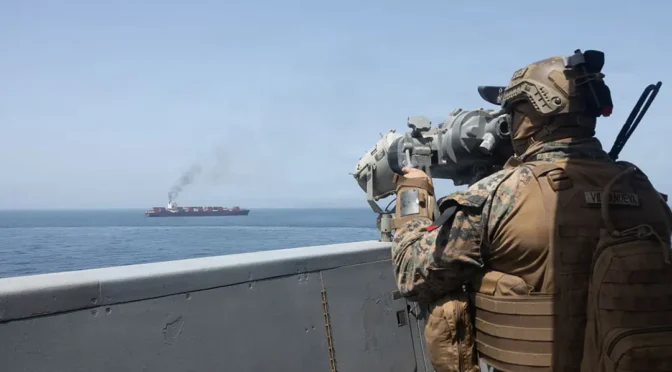
Featured image: U.S. forces patrol the Arabian Sea near M/V Touska on April 20, 2026, after firing upon the Iranian-flagged vessel that the U.S. accused of attempting to violate the U.S. naval blockade of Iranian ports near the Strait of Hormuz. (U.S. Navy photo)
Discover more from Center for International Maritime Security
Subscribe to get the latest posts sent to your email.
I think it’s important to recognize that Taiwan is an active participant in its own defense. See:
** Taiwan’s USV Development and Strategic Learning from Ukraine – Center for Maritime Strategy https://share.google/IfVMsEsVx8eyCjODR
** Taiwan Moves Toward Autonomous Coastal Denial Network with Shield AI Hivemind-Powered Thunder Tiger Sea Drones https://share.google/XtxyUYG34HGJGWGws
** Taiwan Receives First U.S. MQ-9 SkyGuardian Drones – USNI News https://share.google/MkmIBmrqob4RGnFzy
“For years, Taiwan has been a decisive point of Washington’s security approach to the Pacific, and as a result, one of the U.S. Navy’s current foci is denying China the ability to seize the island nation by maritime invasion.”
It should be remembered that Taiwan is an island, part of the Republic of China whose government has never signed a peace treaty with the CPC, a necessary step to ending their civil war over the political control of China. That government has enshrined in their constitution the area of governance that they see as China, which includes all of the mainland (today’s PRC). To use the name Taiwan as if it were a recognised state or anything other than a geographical entity is to ignore legal fact, just as it is to ignore the civil war as inconclusive and without an actual ending under international law.