
By Kevin Eyer
Between January 13 and 15, the 38th Annual Surface Navy Symposium convened in Crystal City, Virginia, offering a detailed look at the state of the surface fleet. Senior leaders—from the Secretary of the Navy to the Chief of Naval Operations and the Commander of Fleet Forces Command—delivered formal presentations outlining priorities and challenges.
On the final morning, a closed session was held exclusively for active-duty and retired captains and commanders. The premise was clear: a room limited to officers who had commanded at sea would allow for a more candid, less scripted discussion. Four senior captains from the Office of the Chief of Naval Operations delivered brief, upbeat remarks before opening the floor.
Soon, a retired captain stepped to the microphone and asked:
“What is the difference between the Littoral Combat Ship and the ‘Future Frigate’ now under development?”
It was, upon consideration, a troubling question. The Littoral Combat Ship program has become, in many respects, a relic—originally planned for 55 ships, later reduced to 35, and widely viewed as misaligned with the Navy’s operational needs. The program endures largely through institutional momentum and the absence of ready alternatives.
By contrast, the Future Frigate—the FF(X) —is presented as the way ahead. A central element of President Trump’s “Golden Fleet” modernization initiative announced in December 2025, it is intended to contribute to a faster, more capable Navy and sustain maritime superiority. The frigate represents an effort to correct decades of uneven performance in designing smaller surface combatants and to expand a segment of the fleet long criticized as both undersized and underpowered—the Small Surface Combatant (SSC) element.
The relationship between the two ship classes had, in fact, been addressed earlier in the symposium by Rear Admiral Derek Trinque, Director of the Surface Warfare Division in the Office of the Chief of Naval Operations. He distinguished the Littoral Combat Ship’s mission-module concept from the frigate’s proposed approach. One of the Littoral Combat Ship’s program difficulties, he explained, was attempting to integrate systems that did not yet exist with a hull still under construction—an ambitious concept that proved harder in practice than in theory. The Future Frigate, by contrast, will incorporate existing systems packaged with defined interfaces to the ship’s combat system, allowing more reliable and rapid changes in capability.
In essence, according to Rear Admiral Trinque, the Future Frigate—like the Littoral Combat Ship—will rely to some extent on modular mission packages. The difference lies in execution: a more disciplined, technically mature integration model.
Yet the retired captain’s question reached beyond a simply question of architectural integration. The deeper issues he posed with his question remained unaddressed: What missions are assigned—or will ultimately be assigned to the Littoral Combat Ship? Will the Future Frigate assume those same roles? What is the envisioned division of labor between these two small surface combatants? What, if any, differences exist in their limitations—and how should those limits shape the missions they are given?
Perhaps most importantly, what can these ships do or not do?
The Future Frigate and the Golden Fleet
On 19 December 2025, Secretary of the Navy John C. Phelan stated: “To deliver at speed and scale, I’ve directed the acquisition of a new frigate class based on HII’s Legend-Class National Security Cutter design: a proven, American-built ship that has been protecting US interests at home and abroad. President Trump and the Secretary of Defense have signed off on this as part of the Golden Fleet. Our goal is clear: launch the first hull in the water in 2028. To expand capacity and production across our maritime industrial base, we will acquire these ships using a lead yard and competitive follow-on strategy for multi-yard construction. Shipyards will be measured against one outcome: delivering combat power to the Fleet as fast as possible.”
As part of the President’s recently advertised “Golden Fleet,” the Navy plans a “high/low” mix of ships, featuring several new classes in addition to combatant classes already in the fleet. On the “high” end, the Navy intends to maintain a Large Surface inventory, including a new guided missile battleship class, supported by both existing and planned Arleigh Burke-class guided missile destroyers, which have been and continue to be built in multiple “Flights.” According to Issues for Congress, the goal is to maintain approximately 87 large combatants. These large combatants are intended for assignment to complex mission sets, potentially involving multiple warfare areas in the most heavily contested waters. For example, an Arleigh Burke-class guided missile destroyer operating in the Red Sea is fully capable of simultaneously escorting merchant ships, providing on-call Tomahawk land-strike capability, and offering the most-sophisticated air defense umbrella for an entire region of the battlespace.
On the “low” end of the spectrum are Small Surface Combatants which include the Navy’s frigates, like the Future Frigate, and the Littoral Combat Ships, as well as mine warfare ships. With the retirement of the Avenger-class there are no more dedicated mine warfare ships in the Navy These ships are smaller, less expensive, manned by smaller crews, and less capable than Large Surface Combatants. While they can operate in conjunction with Large Surface Combatants and other Navy vessels, particularly in higher-threat environments, they are also designed to operate independently in lower-threat settings.
As specified at the Symposium, missions assigned to Small Surface Combatants – including both the LCS and the FF(X) – may include Anti-Surface Warfare (ASuW), Anti-Submarine Warfare (ASW) and Mine Countermeasure Operations (MCM). According to the briefings, these ships will enable a significant expansion of the Navy’s worldwide footprint while increasing fleet capacity in areas of active combat operations. To fill the ranks of these small combatants, the Navy plans to rely on a combination of existing Littoral Combat Ships and the now-planned Future Frigate class.
So, how many Small Surface Combatants does the Navy plan on fielding?
The Navy’s Fiscal Year 2025 30-year shipbuilding plan calls for a future force of 381 manned battle force ships, including 73 Small Surface Combatants. Of these, 15 are Littoral Combat Ships capable of conducting mine warfare operations, while 58 are designated as guided missile frigates — meaning frigates built to either the original or a modified Flight II design. (A Flight II FFG was, until recently cancelled, the Constellation-class). Under its 2025 budget submission, the Navy proposed maintaining a force of 25 Littoral Combat Ships instead of 15. This adjustment would imply a total of 48 frigates, rather than 58.
However, the Navy has reportedly prepared a new ship force-level objective which will succeed the existing plan. This new objective is predicated upon the requirements outlined for the “Golden Fleet.” As of late December 2025, the force composition of this new objective had not been announced. Still, considering that multiple speakers at the Symposium firmly indicated the Navy intends to maintain 35 Littoral Combat Ships while building perhaps as many as 50 Future Frigates, one might sensibly suppose that the small and large combat fleets will be roughly equal in size – somewhere around 85 hulls for each.
Unclear Missions
It is curious that the Symposium suggested that the ships of the SSC classes may…may…contribute to ASuW, ASW, and MCM. While that seems worthy, RADM Trinque also outlined another, entirely more nebulous, role for the Future Frigate: That ship, he said, is explicitly intended to help alleviate the workload on Arleigh Burke-class destroyers. He framed this need within the perspective of Chief of Naval Operations, Admiral Daryl Caudle, as outlined in his “Fighting Instructions.”
Published after the Symposium, on February 9, the Fighting Instructions introduce the “Hedge Strategy,” which calls for a balanced, scalable force mix rather than reliance solely on expensive, high-end formations like carrier strike groups. The strategy emphasizes tailored forces—combinations of ships, aircraft, unmanned systems, and other capabilities—that can be adapted for specific missions and crises, instead of a brittle model optimized only for high-end conflict but with capabilities underutilized in day-to-day operations.
Problematically, the Fighting Instructions are more strategic philosophy than technical manual. They do not prescribe specific weapons, sensors, or deployments, but rather articulate principles for how the fleet should organize, operate, and fight in a complex global environment. While the guidance supports a shift away from using Arleigh Burke-class destroyers as the default solution for every mission – favoring distributed, purpose-built packages – the Littoral Combat Ship and the Future Frigate are not mentioned as relieving the overburdened Burkes.
This raises a key question: where is the Future Frigate’s role—and particularly with regard to relieving the burden on Large Surface Combatants—explicitly defined? Where is this requirement laid down?
The answer is that it is not, which begs the question, what is the real purpose of the ship? Is it ASuW, ASW, or MCM? Is it there to relieve the Arleigh Burke-class? Of what? Or is it something else, as of yet unspecified?
Ambition Beyond Need?
The Navy appears to be aiming for roughly 85 small surface combatants. What is the origin of this number? More important, is that number the correct one to ease pressure on the Arleigh Burkes, and how will that relief be operationalized?
Determining deployable force size requires the application of the Navy’s standard availability model: at any given time, roughly one-third of ships are deployed, one-third are in training and certification cycles, and one-third are in maintenance or modernization.
Applied to an 85-ship Small Surface Combatant fleet, that model would yield approximately 28 ships deployed at any given time. That is a striking figure. Some estimates put the total number of active destroyers in the future at 94.
Ninety-four destroyers and 85 frigates would create an essentially one-for-one situation. Granted: such comparisons are inherently imprecise; however, the implication is notable and suggest a strategic ambition that goes well beyond merely alleviating pressure on the destroyer force.
And, while small combatants may be able to execute ASuW, ASW, and MCM, they are absolutely not a one-for-one replacement for a Large Surface Combatant.
So, what does the term “relief” actually mean, and how does that square with other mission sets mentioned for these ships at the Symposium? And why so many FF(X)s?
The Unexpected Future Frigate Mission
Curiously, at least one slide presented during the Captain/Commander session suggested that the Future Frigate might eventually assume “Anti-Air Warfare Mission Sets.” This raises a significant issue. Neither the Littoral Combat Ship nor the Future Frigate possesses—nor are planned to possess—an organic air defense capability beyond point defense.
Point defense protects only the ship itself. Area-air-defense, by contrast, protects groups of ships or an entire task force.
The proposed baseline armament for the Future Frigate includes a 57mm main gun, a 30mm auxiliary gun, and a Mk-49 launcher carrying 21 Rolling Airframe Missiles, supported by AN/SLQ-32(V)6 electronic warfare systems and Nulka decoy launchers. The ship is expected to carry an AN/SPS-77 air and surface search radar. Mission modules may include containerized weapons such as Naval Strike Missiles or Hellfire missiles installed in a stern payload space. As of now, no specific Combat Management System has been identified.
This configuration essentially mirrors the air-defense capability of the Littoral Combat Ship: 21 Rolling Airframe Missiles, and a surveillance radar. It is important to note here that while Rolling Airframe Missiles provide effective self-defense, they cannot perform area air defense. The system is effective only at ranges out to 10km, and for threats below Mach 2. It is not, for example, capable against several classes of air threats, including ballistic missiles, Hypersonic Glide Vehicles, and high and medium altitude aircraft. Further, low magazine depth means that the system may be overwhelmed by saturation.
Modern area defense requires Standard Missiles, a vertical launch system, and a powerful radar integrated with a combat system such as Aegis and AN/SPY-6 radar. Without these elements, a ship cannot reliably counter the full range of modern aerial threats. These are the facts, and they are not in dispute.
Nor is such an upgrade feasible. The Littoral Combat Ship already operates near the limits of its stability, while the Future Frigate is derived from the Legend-class National Security Cutter, a design of roughly 4,500 tons displacement. By comparison, the now-canceled Constellation-class guided-missile frigate, the smallest modern Navy design intended to carry an area-air-defense system, displaced over 7,000 tons. The radar, launch systems, missiles, and supporting equipment required for area defense simply exceed the weight and space margins of a 3,500-ton Littoral Combat Ship or a roughly 4,700-ton Future Frigate.
This reality matters. In U.S. Navy classification, the “G” designation—as in guided missile destroyers or frigates—indicates a ship capable of guided-missile . Suggestion that the Future Frigate can perform Anti-Air warfare missions without such capability is therefore misleading.
Historically, frigates served as ocean escorts, but ships equipped only with point defense cannot safely escort other vessels where air attack is possible. They can defend themselves, but not the ships around them. For the Small Surface Combatants, this obviates escort of merchant shipping or amphibious forces. That mission must fall to the Large Surface Combatants—Arleigh Burkes.
The importance of this distinction—point and area defense capability—is growing as air and missile threats proliferate. A decade ago, it would have seemed implausible that the Houthis in Yemen could challenge shipping with anti-ship ballistic missiles—yet that has been reality since 2023. Meanwhile, advanced systems such as Russia’s Tsirkon and China’s DF-21D anti-ship missiles continue to expand the threat environment in genuinely
The conclusion is unavoidable: Small Surface Combatants cannot operate independently against peer adversaries in high air threat environments. As for missions like Anti-Submarine or Anti-Air Warfare, those missions can only be carried out under the area-air-defense umbrella provided by guided missile destroyers.
Which raises the central question, yet again: if Arleigh Burke destroyers remain the only ships capable of protecting the fleet from the air, what does it truly mean to “relieve the burden” on the destroyer force?
The One True Mission
A major problem for the Navy today is a reliance on sledgehammer solutions for problems that may only require a tack hammer. For example, in 2009, USS Bainbridge (DDG 96) was assigned to anti-piracy operations off Somalia. In March 2025, USS Gravely (DDG 107) was sent to the Gulf of Mexico for a maritime border mission under US Northern Command, helping to deter illegal sea crossings and drug trafficking. Simultaneously, USS Stockdale (DDG 106) deployed off the US–Mexico Pacific coast to support the same operation, with a Coast Guard detachment embarked.
It is troubling that these ships—the critical core of the Navy’s Large Surface Combatant power for the next 50 years—are being expended on missions more appropriately suited to smaller, lightly armed and manned ships. Ships can only accumulate so many operational miles; once Arleigh Burke-class guided missile destroyer miles are used for counter-drug or other low-end tasks, they cannot be reclaimed.
Rear Admiral Trinque touched upon this critical dynamic. According to Trinque, with destroyers focusing on “high-end” missions, there’s room for the Littoral Combat Ship to do the less involved work of countering narcotics trafficking, which has shot to the top of national security priorities in the past year. “If it’s defending the territorial integrity of the United States against illegal trafficking, counter-narcotics, if it’s controlling sea lanes in a lower threat environment, then a small surface combatant should be in your toolkit.”
Rear Admiral Trinque was referring to a mission set known as Maritime Interdiction Operations. However, today, and as noted above, maritime interdictions is not a mission exclusively assigned to Littoral Combat Ships
So, what specific missions should these Small Surface Combatants perform? How can they relieve the Arleigh Burke-class? The answer lies in straightforward yet fundamental Navy tasks that lie below the heavy combat requirements assigned to the destroyers:
Maritime Interdiction Operations: This includes interdiction of drugs, weapons, and human smuggling; enforcement of sanctions and embargoes; counter-piracy; interdiction of terrorist movements and logistics; and prevention of Weapons of Mass Destruction (WMD) proliferation.
Mine Countermeasure Operations: With the retirement of the Avenger-class, there are no purpose-built mine warfare ships in the fleet. For years, the Navy has relied on NATO to provide these capabilities. However, any fight in the Western Pacific cannot be assumed to be mine-free, nor can NATO be expected to supply mine warfare ships. Arleigh Burke-class guided missile destroyers have no such capability; this gap must be filled elsewhere to ensure access for operations such as the defense of Taiwan or Korea.
Multinational and Presence Operations: The Navy routinely operates with allied navies in exercises such as BALTOPS (Baltic), UNITAS (South Ameria), CUTLASS EXPRESS (East Africa/Western Indian Ocean), and FOAL EAGLE/FREEDOM SHIELD (Korean Peninsula). These missions involve dozens of ships annually. Assigning Arleigh Burke-class guided missile destroyers to such low-threat demonstrations is equivalent to sending a sledgehammer to perform tack-hammer work.
of these missions require sophisticated combat systems, larger size, or large and complex crews. Except for Mine Countermeasure Operations, none require operations in high-threat waters. Yet these missions remain core Navy responsibilities. This is not to say that the inclusion of a Large Surface Combatant would not have the value of sending a powerful message to both allies and adversary; however, that choice should be optional.
Three critical missions to ease the burden on the Large Surface Combatants. While these small ships can augment that force in combat areas, without area air capability, they absolutely cannot relieve a single Large Surface Combatant of its duties.
Is This About Shipbuilding?
What stands behind the Secretary of the Navy’s push get the first of very many Future Frigates into the water by 2028 – an extraordinary number since the shortest time recorded for a Littoral Combat to go from keel laying to commission was 36 months.
Is it the need for a significant small combatant force?
In truth, this rush may well be more connected to national shipbuilding concerns that it is to the specific force structure needs of the Navy. The president has repeatedly emphasized the need to revitalize US shipbuilding, which is critical to national security. During World War II, the US outbuilt adversaries and achieved naval dominance; today, fewer than two Arleigh Burke-class guided missile destroyers are delivered per year. The United States has arguably lost the ability to build ships in numbers, and that may tell in a war situation with a peer competitor, like China.
This is not to say that an American ability to build ships and submarines in number is not a national imperative—it is. It is, in fact, a key element of the National Security Strategy. The published document makes clear that cultivating a strong American industrial base—including critical production capacity – is fundamental to national power and security. This implies that building the capacity to produce ships and other systems is part of national strategy, not just defense programs.
But is building the Future Frigate, at least in part, to stimulate this industrial imperative enough. It is not. The Navy needs to build the right ship, not just a ship. With respect to fleet needs, 85, point defense-equipped frigates is many more than required to either execute the destroyer-relieving missions of Presence, Mine Warfare, Maritime Interdiction, or even combat augmentation.
While building the Future Frigate may be an indispensable win for US shipbuilding, the cost —in money, resources, fleet coherence, and the opportunity to build the next, right warship —remains significant.
What are we Doing and Why?
The central point is this: the Future Frigate is being pursued less as a decisive warfighting innovation than as a means to stabilize a shipbuilding enterprise in distress. Its secondary purpose is to relieve the operational burden on the Arleigh Burke–class destroyers. Beyond that, it functions as a stopgap—bridging the gap until the Navy can define and build the “next” truly capable surface combatant. That ship is not the Future Frigate.
As for the cancelled Constellation-class, which the Secretary of the Navy deemed too expensive, too far behind schedule, and abutting the fleet space occupied by the Arleigh Burke-class guided missile destroyer, that ship most likely would have filled the need for a modern, area air defense capable frigate. The net result of the cancellation is a faster, cheaper solution which can be quickly built in numbers—the Future Frigate—even if that solution is far less capable than the Constellation. But then, this appears to be more about stimulating the industrial base than it is about the warfighting mission.
In the near term, the Navy should take practical steps to maximize the utility of its existing and planned Small Surface Combatants. This is not to argue against making these ships as capable as possible within clearly defined limits. The strategic environment is increasingly unpredictable; even a vessel assigned to counter-piracy could find itself drawn into a broader conflict. Small combatants can and must contribute meaningfully to high-end warfare—but only if their limitations are clearly understood and accepted.
With respect to the Littoral Combat Ship classes, two viable paths present themselves. First, the Independence-class should be rationalized into a single-mission platform focused on mine countermeasures. These ships should be forward-deployed to the Arabian Gulf and Western Pacific—Japan or Guam—along with the necessary shore infrastructure. There, they would provide a credible and responsive mine warfare capability in the theater of greatest risk. While the mine countermeasures module remains immature, the absence of alternative dedicated capability in the fleet makes these ships indispensable. Further, their large flight decks and speed also make them well suited to operate unmanned aerial systems, extending surveillance, reconnaissance, and limited strike capacity across the battlespace, albeit not concurrently with mine operations.
The Freedom-class, by contrast, should be based on the U.S. East Coast and tasked with maritime interdiction operations that currently consume high-end assets. These missions—ranging from counter-narcotics to presence operations—do not require robust air defense and are ill-suited to Arleigh Burke–class destroyers. In peacetime, the forward-deployed Independence-class could supplement these roles as needed. While both Littoral Combat Ship variants are more complex and manpower-intensive than ideal for such missions, they are available and sufficient.
As for the Future Frigate, the Navy must resist the temptation to expand its mission beyond its inherent limits. It will not be, and cannot be, a “pocket destroyer” capable of full-spectrum air warfare. That kind of mission creep—allowing requirements to exceed the physical and power constraints of the hull—was a central factor in the Littoral Combat Ship program’s difficulties.
Anti-Submarine Warfare capability remains particularly uncertain. Senior officials have suggested that more advanced Anti-Submarine Warfare systems may be deferred to later increments, leaving early ships reliant primarily on embarked helicopters. Proposed modular solutions—containerized towed arrays or unmanned systems—remain undefined. Given the cancellation of the Littoral Combat Ship Anti-Submarine module, following years of delay, expectations for a near-term frigate-based solution should be tempered
Consequently, the Future Frigate, with limited point-defense air warfare capability and no clearly defined organic Anti-Submarine Warfare suite, will not be suited to escort duties in contested environments. Missions such as convoy escort, amphibious protection, and area air defense will remain the responsibility of the destroyer force.
Instead, the Future Frigate should be designed to replace the Littoral Combat Ship fleet over time while sustaining the industrial base and maintaining hull numbers for low- to – medium intensity missions. Conceptually, it should resemble an enhanced Coast Guard cutter: equipped with a medium-caliber gun, point-defense missile systems, modest Anti-Submarine Warfare capability, and possibly an over-the-horizon strike weapon, but nothing more ambitious. These ships can augment deployed forces—but only under the protective umbrella of destroyer-provided air defense.
Ultimately, the restoration of U.S. shipbuilding capacity may itself justify the program, even if the resulting force structure exceeds the strict requirements of the Small Surface Combatant mission set. This industrial imperative likely explains the urgency behind the 2028 timeline, despite the lack of fully defined requirements.
The Navy’s enthusiasm for the broader fleet expansion, and for the Future Frigate in particular, appears driven in large part by the need to relieve the unsustainable operational tempo imposed on the Arleigh Burke force—tasked with everything from high-end combat to routine patrol duties.
In that sense, the current leadership has been charged with addressing the cumulative consequences of several troubled acquisition efforts, including the Littoral Combat Ship and the Zumwalt-class destroyer. Yet it is essential to recognize the Future Frigate for what it is: an interim solution, intended as much to sustain shipbuilding as to enhance combat capability.
The real challenge remains the development of the next-generation surface combatant—a ship with the size, power, and growth margin to accommodate future weapons and sensors. That search has eluded the Navy for decades. The Future Frigate is not that answer. Achieving it will require a clean-sheet design, sustained discipline, and a willingness to align ambition with technical reality. Until then, the frigate program represents not a destination, but a holding action.
Captain Kevin Eyer is a retired Surface Warfare Officer who served on active duty for 27 years. He deployed in seven cruisers and commanded three Aegis cruisers; USS Thomas S. Gates (CG 51), USS Shiloh (CG 67), and USS Chancellorsville (CG 62). Captain Eyer completed tours on both the Navy Staff and Joint Staff and attained a master’s from the Fletcher School of Law and Diplomacy at Tuft’s University. He was the US Naval Institute Proceedings Author of the Year in 2017, and three-time winner of the Surface Navy Literary Award.
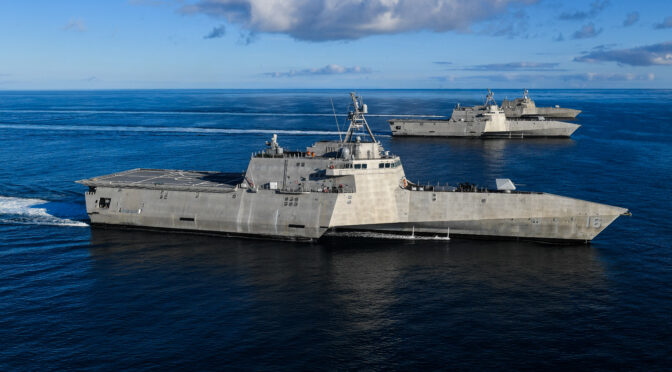
Featured Image: PACIFIC OCEAN (Feb. 27, 2019) The Independence variant littoral combat ships USS Tulsa (LCS 16), right, USS Manchester (LCS 14), center, and USS Independence (LCS 2), left, sail in formation in the eastern Pacific. (U.S. Navy photo by Chief Mass Communication Specialist Shannon Renfroe/Released).
Discover more from Center for International Maritime Security
Subscribe to get the latest posts sent to your email.
That’s a really interesting perspective on the challenges facing smaller ships. It’s easy to get lost in the big picture discussions.
1. The US Navy needs to get out of Law Enforcement. That is the job of the Coast Guard. If they need additional ships, then funding should be provided to build the appropriate interdiction type ships. Using Navy vessels is extremely inappropriate.
2. We need to build multiple mine counter-measure ships including drone support vessels. We are underestimating the impact of mine warfare and far too dependent on foreign countries to provide that task.
3. The new Frigate design will prove to be a “LCS” debacle as a ship without a mission or the tools to accomplished any assigned task. No Navy ship should be built without area missile defense that can absorb missile and drone saturation attacks. Frigates should be “convoy escorts” capable of defending against both air and submarine attacks while transiting to WestPac.
4. People seem to forget that Sailors man these ships. We have a responsibility to ensure they have the necessary tools in hand to fight our wars.
21 RAM, 48 Hellfire, Mk 110, hopefully 2 Mk 38 mod IV, plus 1 or 2 MH-60 with 8 Hellfire or even more APKWS. I would assume flight II adds at least 32 ESSM. It can make a defensive bubble, just not a larger bubble for 2-4 billion a ship.
Quick question from a civilian: A few years ago, TKMS took a K-130 design, and a joint German and Israeli engineering team supercharged it with: 40 Iron Dome defense missiles; 32 Barak AA missiles (basically ESSM) ; 16 Gabriel V anti-ship missiles; a 76mm gun; and torpedoes. It also holds an MH-60 helicopter. The Sa’ar 6 missile boat displaces 1900 tons and is 90m long.
So, why can’t the US put similar weapons in a 4500-ton FF(X), which is 40% longer than the Sa’ar 6?
Its actually 8 Harpoon not 16 Gabriel and 16 Barak 8 not 32. The ship is short ranged, designed for the waters in the med and red sea. The weapon weight really isn’t much diffent than the German corvettes they are based on with 4 ASMs and 2 RAM launchers.
Good points by the author, but we really need to consider building more than one option to quickly grow the fleet.
The NSC turned FFX primary advantage is endurance and seakeeping. 60 days provisions and the range to cruise that long at 8-10 knots. The other key words missing her are CUAS and CUSV. 48 Hellfires on the stern can help this ship do that. We also need confirmation the ship will have 2 not 1 Mk 38 mod IV. This ship should never grow a large, expensive, heavy, power hungry radar for SM size missiles. If we get 8-16 VLS on the stern, they should only be tactical length and focused on quad packed munitions like ESSM, new VLA based on 6.75″ torpedo, and possibly ER-GMLRS, The planned stern munitions can eventually include 16 PRSM Blk II or clear the deck for a modular CAPTAS-4. The ship should also see the return of the ASIST haul down and traversing system. This ship’s ability we grow primarily by playing quarterback for MUSVs along with being the military end of law and choke point enforcement. How badly do we need these right now, working under the Burke’s umbrella near the Strait of Hormuz.
We shouldn’t walk away from the LCS lineage either, although the ships need changes. LCS-1 in an Americanized version of the Saudi MMSC could do much of what the FFX could do in certain areas where range and endurance weren’t as crucial. LCS-2 could also evolve, switching to all diesel, launching boats via side davits for redundancy, and planning the ship for a 2 H-60 detachment with flight deck that can lilly pad all VTOL types. It could even potentially be reworked as a more APD-like EPF. Even the new hospital ship EPF versions could evolve into a better replacement to the gen 1 EPFs and could be navy crewed. They could certainly do some of these same missions. We could get to 85 small surface combatants fast rather than slow.
The author wonders through a number of issues without being able to boil down to some simple truths. NAVSEA seems to suffer from the same problem.
All Navy assets must be viewed through the prism of war fighting and finite, procurement dollars. Yes, there are many peacetime and low threat jobs the Navy must prosecute, but ultimately, the Navy’s primary calling is fighting war against near peer threats.
Building 40-50 frigates for 1 billion per copy that offer minimal utility in fighting an advanced enemy, is asinine. There is no other way to describe it.
Can we not procure and build a ship somewhere between a 418 ft cutter and 495 ft, overweight frigate that can conduct shipboard asw and medium range air defense for under 1.5 billion? The answer is yes, of course, but apparently lack the leadership to recognize exact needed specifications, cost drivers and and wherewithal to prevent project creep.
Btw, to take make the Legend class workable, would require a 20 ft section, amidship, a slightly more powerful radar, 24 cell vls, upgraded propulsion (power and driveline) and acoustic quieting.
The Navy is unironically retreading the path that they once took in the Cold War in regards to Frigate development (although the challenges are different).
And the AAW mission could be done right now if they just take a modified Mk.70 PDS with the folding mechanism removed and replaced with another 4 Mk.41