
By Bruce Stubbs
I. Introduction
“Whether you build a Navy for high consequence, low probability or low consequence, high probability scenarios — in either case you’re left with an over or undersubscribed force that’s sub-optimized to address specific use cases which may never come to bear.” —Admiral Daryl Caudle, Chief of Naval Operations, 2026
Professor Derek Reveron’s March 2026 CIMSEC essay, “Why America Needs a Four-Ocean Navy,” is the kind of grand strategic thinking the naval profession needs more of — clear, historically grounded, and bracingly ambitious. His diagnosis of the Navy’s central problem is essentially correct: a globally dispersed force trying to do everything with a shrinking number of expensive multi-mission ships is a formula for strategic incoherence and operational exhaustion. On that point, there is little to dispute.
Reveron’s prescription is a two-part proposal: a command and control (C2) organizational redesign and a tailored forces program. On the organizational side, he proposes replacing the Navy’s current theater-oriented fleet structure with four ocean-based fleet commands — the Atlantic Ocean Fleet Command, Pacific Ocean Fleet Command, Arctic Ocean Fleet Command, and Indian Ocean Fleet Command — each with its own commander, budget, and procurement priorities. On the forces side, he proposes tailoring each fleet’s composition to its specific threat environment: frigates, destroyers, attack submarines, maritime patrol aircraft, small surface combatants, unmanned systems, and diesel-electric submarines sourced from allied yards for the Atlantic and Arctic; logistics ships, replenishment oilers, mobile bases, amphibious ships, destroyers, and patrol craft for the Indian Ocean Fleet Command; and the Navy’s most advanced combat-ready platforms — aircraft carriers, nuclear attack submarines, and Aegis-equipped destroyers interoperable with Japan and South Korea — for the Pacific Ocean Fleet Command. To authorize and fund this differentiated structure, he invokes the Two-Ocean Navy Act of 1940 as his legislative model, proposing a Four-Ocean Navy Act of 2026.
The organizational and forces logic is strategically intuitive. But both elements of Reveron’s proposal rest on a foundation that is missing its first and most essential element: a strategy that disciplines the demand for naval forces before it designs the force to meet that demand. Without that prior strategic work, force design becomes institutional preference rather than strategic requirement — and no organizational architecture survives contact with a political system that treats naval power as its primary instrument of coercive statecraft. Five arguments establish why. Before examining those arguments, however, it is worth establishing what Reveron gets right — because he gets a great deal right, and the critique that follows is stronger for acknowledging it.
II. What Reveron Gets Right — The Strategic Case for Differentiation
In World War II, the Navy that fought in the Pacific was structurally different from the Navy that fought in the Atlantic — not accidentally, but by deliberate strategic design. The Pacific Fleet was organized around fast carriers, submarines, and amphibious assault capability, sustained by a massive mobile logistics force — Service Squadron Ten and its predecessors — across the vast distances of the Pacific. The Atlantic Fleet was organized principally around escort destroyers, anti-submarine warfare vessels, and convoy protection against the German U-boat threat, though it also mounted major amphibious operations in North Africa, Sicily, Salerno, Southern France, and Normandy. One strategy and one force design did not fit both theaters.
It is worth being precise about what the Two-Ocean Navy Act of 1940 was and was not. Congress authorized an unprecedented industrial expansion to build enough warships for two oceans. It was the strategic situation — the fall of France, the prospect of fighting Germany and Japan simultaneously without European allies — and the Roosevelt administration’s Germany-first policy that determined the different force compositions each theater required. The Act was the industrial means to execute a prior strategic judgment; it was not the strategic judgment itself.
That historical lesson translates directly to Reveron’s present argument. In the Pacific, China’s navy — now the world’s largest by hull count — operates along interior lines within its near seas, supported by land-based anti-ship missiles, a sophisticated air defense envelope, and a clear strategic objective: controlling the first island chain and deterring or defeating American intervention over Taiwan. The tyranny of distance favors China in its own near seas; the United States must project power across thousands of miles of open ocean to contest it. In the Atlantic, Russia’s rebuilt and modernized submarine fleet represents the most capable undersea threat the NATO alliance has faced since the 1980s — and Russian submarines can also launch long-range precision cruise missiles against targets in Europe and against critical military infrastructure along the American eastern seaboard, raising important questions about whether the Atlantic Ocean Fleet Command’s operational concept should be containment in the Greenland-Iceland-United Kingdom (GIUK) Gap or forward operations in the Barents Sea. In the Indian Ocean, China’s port access agreements stretching from Sri Lanka to Djibouti and Iran’s threats to critical chokepoints create distinct maritime competition and security challenges. In the Western Hemisphere and Caribbean, the challenge is lower-end maritime security that demands small combatants and unmanned systems rather than Arleigh Burke-class destroyers.
CNO Caudle confirmed the operational consequence of failing to match force to threat at the Paris Naval Conference in February 2026: “What I find now is I end up having to use carrier strike groups and amphibious readiness groups in places where I believe I could tailor a force package and be more suited to the threat.” The structural mismatch Reveron identifies is real, and his geographic and threat analysis is sound. The question is not whether his diagnosis is correct. It is. The question is whether his C2 organizational redesign and tailored forces program can be built and sustained without the prior strategic work that makes force design accountable rather than aspirational.
III. Five Arguments Against the Prescription
1. A Strategy-Free Force Design
“While the right organization might not guarantee success, the wrong one will likely guarantee failure.”—President Dwight D. Eisenhower
Reveron’s proposal is a strategy-free force design. He identifies what each ocean fleet would do — anti-submarine warfare and escort in the Atlantic, sea lines of communication protection in the Indian Ocean, power projection in the Pacific. He does not identify what winning looks like against a named adversary, by when, under what theory of victory, or how his proposed C2 structure and tailored forces connect to a national strategy for prevailing. Without those answers, force design becomes preference rather than requirement.
The prime criteria for designing any C2 organization require a clearly defined mission and a stated objective before force design, geographic assignment, or threat analysis can follow. Reveron’s proposal begins with the latter and leaves the former unstated.
Consider the Atlantic Ocean Fleet Command. Reveron proposes diesel-electric submarines sourced from allied yards — a reasonable inference from the Russian submarine threat in the North Atlantic. But Russian submarines can also threaten Europe and the American eastern seaboard with precision cruise missiles. Does the Atlantic Ocean Fleet Command’s mission require containment in the GIUK Gap or offensive operations in the Barents Sea to threaten Russia’s submarine bastions, as the 1980s Maritime Strategy proposed? The answer determines whether the right submarine is a diesel-electric boat, a nuclear attack submarine, or both. Reveron’s proposal cannot answer this question because it has not asked it. The same gap exists in the Pacific: whether the objective is deterrence, denial, or decisive defeat of China’s naval forces determines fleet size, composition, and basing in ways his mission lists do not resolve.
Reveron’s Four-Ocean Navy Act invokes the legislative mechanism of the 1940 Two-Ocean Navy Act without supplying its prerequisite: the strategic assessment that determined what needed to be built and why. Without that assessment, the four constraints that follow cannot be resolved. They can only be compounded.
2. The Demand Signal Is Politically Irresistible
“In case we don’t make a deal, we’ll need it.”— President Donald Trump, on ordering the USS Gerald R. Ford Carrier Strike Group to the Middle East, February 2026
Reveron’s organizational redesign assumes that assigning specific forces to specific ocean fleet commands will concentrate those forces on their assigned missions. This assumption has never survived contact with the actual source of naval demand. The demand signal for naval forces is not generated by fleet commanders or strategic plans. It is generated by a President who reaches for his most powerful coercive instrument when a crisis erupts, by combatant commanders who request forces with no incentive to be sparing and no accountability for the readiness costs their requests impose, and by secretaries of defense who approve those requests because the political cost of not having a carrier forward is always calculated as higher than the readiness cost of deploying one. The only person in the chain who understands what saying yes does to long-term readiness is the CNO — and the CNO has no authority to refuse.
Former Deputy Secretary of Defense Robert Work documented this pathology in a 2021 USNI Proceedings essay: after the Cold War, the Navy adopted forward presence as its strategic concept and its budget justification, combatant commanders began generating unconstrained demands the Navy felt compelled to satisfy, and the result was a shift from a readiness-centric to a deployment-centric culture and the beginning of a long, inexorable decline in material readiness. Work cited Mackenzie Eaglen’s finding that in 2015 the Navy met only 44 percent of combatant commander requests — and would have needed 150 more ships to satisfy all of them. The Center for Naval Analyses’ 2010 Tipping Point study documented that despite an 18 percent reduction in battle force ships between 1999 and 2009, the number of ships on deployment remained essentially constant, sustained by longer deployments and a doubling of the forward-deployed naval force. The consequence was not abstract: the relentless forward presence tempo contributed to four Seventh Fleet accidents in 2017 that claimed the lives of 17 sailors.
The current administration has demonstrated this dynamic with unusual clarity. The 2025 National Security Strategy explicitly warned against overcommitment and overextension, declaring that prior administrations had defined national interests too broadly. Within fifteen months of that declaration, President Trump had ordered major carrier strike group deployments to four contingencies: Operation Rough Rider against the Houthis in early 2025, at a cost exceeding $1 billion and the loss of two fighter aircraft at sea; Operation Southern Spear in the Caribbean, consuming 38 percent of available Navy warships; the Ford Carrier Strike Group pulled directly from the Caribbean to the Middle East for operations against Iran in February 2026; and as of this writing, a third carrier strike group ordered to enforce a presidential blockade of the Strait of Hormuz. That is the demand signal in its purest form — not a combatant commander’s request, not a strategic plan, but a president reaching for his most powerful coercive instrument because it is available and because the political cost of not having it forward is always higher than the readiness cost of deploying it.
Reveron’s Four-Ocean Navy gives each ocean fleet commander a theater, a headquarters, forces, and — inevitably — a stream of presence requirements with genuine strategic justification behind every one. It does not give the CNO the authority to say no to the combatant commander requests and presidential orders that consume fleet readiness. It does not constrain a president who views carriers as instruments of coercive diplomacy. The Navy today already has numbered fleet commanders generating competing presence demands — and still cannot satisfy them. Reveron’s Four-Ocean Navy replaces them with four ocean fleet commanders, each with broader geographic scope, deeper strategic justification, and stronger institutional standing to press their requirements. The demand does not decrease. Its strategic defensibility increases. As retired Navy Commander Phillip Pournelle documented in a 2017 War on the Rocks analysis, the average gap between consecutive U.S. Navy ship presence periods in the South China Sea ran between 95 and 105 days — and sometimes up to 164 days — illustrating that even in the Pacific, persistent global demand prevents the Navy from maintaining the continuous presence its own strategy requires. The pattern has not merely resisted organizational remedies. It has survived them, grown in spite of them, and exacted lethal costs in the process.
3. Optimization in Peace Creates Rigidity in War
“If the Navy hoped that reductions in the demand signal would give it breathing room to reset the force, its hopes have proved to be false.”— Center for Naval Analyses, The Navy at a Tipping Point, 2010.
Forces optimized for specific theaters in peacetime cannot be rapidly reallocated in general war. The Navy fights globally when it matters most, not theater by theater in neat sequence. Theater-bound forces reduce strategic flexibility precisely when that flexibility is most needed.
The World War II model Reveron invokes illustrates both sides of this argument. Theater differentiation worked because the industrial base produced ships in quantities sufficient to fully equip both fleets simultaneously and retain surplus for redeployment as the strategic situation evolved. The nation produced 1,051 destroyer escorts for the Battle of the Atlantic — enough to equip the U.S. Atlantic Fleet and transfer significant numbers to the U.S. Pacific Fleet as the German threat diminished. Both fleets, though differently optimized, were built to standards that allowed cross-theater redeployment when the strategic situation demanded.
Today, neither condition exists. The threats are no longer geographically bounded: China operates in the Pacific and the Indian Ocean simultaneously; Russia’s submarines operate in the North Atlantic, the Arctic, and the Mediterranean; Iran threatens the Indian Ocean and the Red Sea. A strategy that has thought through the redeployment problem — which theaters are primary, which are economy of force, how forces shift as the situation evolves — is the prerequisite for theater-specific optimization. Without it, optimization in peace becomes rigidity in war. Diesel-electric submarines, optimized for the acoustic conditions of the North Atlantic and the GIUK Gap, lack the range and endurance to sustain operations across the Indo-Pacific. If a Pacific Ocean Fleet Command crisis requires every available submarine, the Atlantic Ocean Fleet Command’s diesel boats contribute little. As August Cole and Peter Singer documented in a March 2026 Proceedings analysis, a Pacific conflict risks being lost in part because theater-specialized forces arrive too late, run short of fuel when allied port access is denied, and fail to simultaneously cover the GIUK Gap and surge to the Indo-Pacific. Reveron’s proposal institutionalizes exactly this rigidity. It is, in its operational reality, the Shrinking Status Quo with a new organizational framework — it does not add ships, money, or industrial capacity. It reorganizes existing and insufficient assets into four specialized formations, each weaker than a coherent two-theater strategy requires.
4. You Cannot Build the Fleet You Imagine
“When we run wargames, the red team goes for the Combat Logistics Force every single time.”—Admiral Samuel Paparo, Commander, U.S. Pacific Fleet, February 2024
The United States lacks the shipbuilding capacity, workforce, and sustained funding to build multiple differentiated fleets given that it is already unable to produce a single adequate one. This is not a marginal constraint. On current trajectories, it is the defining industrial reality of American naval power.
The Heritage Foundation’s 2026 Index of U.S. Military Strength found the Navy operating with more than $1.32 trillion in deferred investment, a fleet rated “weak,” and a force 110 ships below the 400-ship two-war standard. The International Institute for Strategic Studies December 2025 Strategic Comments found that 37 of the 45 battle-force ships under construction face delays, and in 2024 only 41 percent of surface-ship maintenance was completed on time. The GAO documents that despite nearly doubling its shipbuilding budget over two decades, the Navy has not increased its number of ships. Virginia-class submarine Block V production runs at 60 percent of its two-per-year goal. The Columbia-class first boat will be at least a year late. The Pentagon appointed its first-ever submarine “czar” — Vice Admiral Robert Gaucher — in February 2026 specifically to manage those delays. The Navy is managing an industrial crisis in its existing programs. Reveron’s proposal adds new ones.
In fiscal year 2023 the Navy delivered only 7 of the 13 ships required to maintain its annual force structure objective — a failure the GAO attributes to cost overruns, design changes during construction, and immature program baselines that have persisted across multiple ship classes and multiple administrations. The shipbuilding budget has nearly doubled over two decades; the fleet has not grown. Reveron’s Four-Ocean Navy requires adding new ship types on top of a procurement system that cannot deliver the ships it is already contracted to build.
Stephen Biddle and Eric Labs documented in Foreign Affairs in March 2025 that China’s shipbuilding capacity exceeds that of the United States by a factor of more than 200 — and that it now takes eleven years to build an aircraft carrier and nine years to build a nuclear attack submarine or destroyer in the United States. During World War II, an aircraft carrier could be built in just over a year and a submarine in a matter of months; the U.S. fleet grew more than twenty times during that war. Those conditions no longer exist. As Biddle and Labs concluded, if an aircraft carrier were lost in battle today, it may not be replaced for decades — or ever. China, by contrast, is now building carriers and nuclear submarines in roughly half the time American yards require. Reveron’s Four-Ocean Navy requires building new ship types — among them diesel-electric submarines not produced by an American yard since World War II — on top of a shipbuilding base already failing to meet existing commitments.
The industrial base needed to execute this program has been contracting, not expanding. Over the past fifty years, seventeen private shipyards that built ships for the defense industry have either closed or left the sector entirely — leaving the Navy dependent on a handful of yards at precisely the moment demand is rising. Reveron’s proposal requires standing up diesel-electric submarine production at an American yard for the first time since World War II. There is no yard equipped to stand up.
What his Four-Ocean Navy would require on top of this crisis is substantial and, in key respects, cannot realistically be delivered on any strategically relevant timeline. Arctic icebreakers remain Coast Guard multi-mission cutters, not Navy combat vessels, and the lead ship of that program is already six years behind schedule. No administration since President Ronald Reagan has sustained naval investment at the levels the Navy’s own planning documents require. A Four-Ocean Navy Act can be legislated. The appropriations to build it, in a nation that has not sustained naval investment for three decades and lacks a public strategy establishing clear priorities, cannot be assumed.
The Combat Logistics Force (CLF) compounds every other industrial constraint. Secretary Phelan stated the problem plainly in January 2026: “Logistics and auxiliaries form the backbone that sustains operations across distance. A world-class combat fleet without a modern auxiliary force is a fleet that cannot stay in the fight. The logistics tail wags the operational dog and right now our tail is too short for our ambitions.” The Heritage Foundation’s January 2026 Tidal Wave Project found that the entire CLF can sustain a maximum at-sea fuel delivery throughput of approximately 265,000 to 280,000 barrels per day to naval end-users in the Western Pacific — a figure that would degrade rapidly under sustained Chinese strikes.
While twenty John Lewis-class replacement oilers were planned, only four had been delivered as of late 2024 at unit costs exceeding $900 million each. Reveron adds logistics ships as a line item for the Indian Ocean Fleet Command. He does not address the systemic CLF recapitalization that must precede any serious differentiated fleet strategy. As Rear Admiral L.D. McCormick observed in 1944, “Logistics is all of war-making except shooting the guns, releasing the bombs, and firing the torpedoes.” China already knows where that seam is — and in Admiral Paparo’s wargames, they exploit it every time.
5. The Navy Will Over-Specify the Fleet You Design
“We are first and foremost a fighting, sea-going service.”—Admiral Mike Mullen, Chief of Naval Operations, CNO Guidance for 2006.
The Navy’s institutional culture drives every platform toward high-end, multi-mission capability. This dynamic has defeated similar efforts repeatedly — the Littoral Combat Ship (LCS), the Constellation-class frigate — and it will override any Four-Ocean construct. The reason is worth stating precisely: the Navy pursues exquisite capabilities because it — not Congress, not the Secretary — carries the operational risk when its ships prove inadequate in combat. That logic is not irrational. It is, however, incompatible with the affordable, differentiated fleet Reveron envisions.
The documented pattern is consistent. The LCS was conceived as fast, agile, and modular — affordable in quantity and flexible in mission. Its mission modules never matured, its survivability was questioned, and procurement was truncated. The Constellation-class was based on the proven Fregata Europea Multi-Missione hull — already built, already proven, already affordable. Five years of Navy-driven requirement additions produced a ship with only approximately 15 percent commonality with its predecessor, approaching destroyer cost. It was cancelled in November 2025. Secretary Phelan’s selection of the Legend-class FF(X) — a hull that already exists, from yards that already build it — represents the most honest acknowledgment in a generation that the Navy must accept what the industrial base can produce rather than specify what strategists wish it could. As Phelan stated at the Reagan National Defense Forum: “We are going to take our warfighters’ requirements, translate them into stable, producible designs, and stick with them once they’re set.”
Reveron’s four ocean fleet structures would each face a real and distinct threat environment providing genuine strategic justification for the most capable ships available. The Pacific Ocean Fleet Command faces China’s advanced surface combatants and submarines. The Atlantic Ocean Fleet Command faces Russia’s modernized submarine force. Unlike the Constellation-class, where the strategic justification was always somewhat arguable, each ocean fleet’s requirement growth would be strategically defensible — which makes it harder to stop, not easier.
What stopped it with the Constellation-class was not a change in institutional culture. It was a Secretary of the Navy who intervened personally, cancelled the program, selected the Legend-class, named it a “low-end workhorse” without apology, and reserved Fridays at 5:00 p.m. for change-order accountability. That kind of top-down override is the only thing that has ever worked. It is difficult with one procurement pipeline. With four ocean fleet pipelines — each backed by genuine strategic requirements and championed by a fleet commander carrying real operational risk — it becomes structurally improbable.
The arithmetic is unsparing: U.S. surface combatants currently field roughly 1,344 vertical launch system cells against China’s Type 055 cruisers and Type 052D destroyers alone, which provide approximately 2,944 — a ratio of better than two-to-one before counting PLA Rocket Force land-based anti-ship missiles. Four ocean fleets do not solve this firepower disadvantage. They distribute an already insufficient force across four commands, each demanding the most capable platforms available, none able to close the gap.
IV. Conclusion
Professor Reveron has identified a genuine strategic problem and proposed a historically grounded solution. His geographic differentiation is the correct starting point for the analysis the nation needs. The problem is that he skips that analysis and proceeds directly to organizational and industrial solutions — giving us the Four-Ocean Navy Act before the strategy that would justify it.
The historical model he invokes teaches a different lesson than he draws from it. The Two-Ocean Navy Act of 1940 did not create the strategy. It funded one. The Roosevelt administration’s Germany-first decision, the fall of France, and the prospect of simultaneous war against Germany and Japan — those were the prior strategic judgments that determined what each theater needed and what could move between them. The Act was the industrial means to execute that judgment. Four decades later, the Reagan-era Maritime Strategy worked the same way: it named the adversary, defined a theory of victory — taking the fight to Soviet home waters, threatening Soviet ballistic missile submarines, collapsing the Soviet defensive perimeter — and derived the force requirements from that analysis. The 600-ship Navy followed the strategy. Reveron wants to reverse the sequence. He proposes a Four-Ocean Navy Act first and leaves the strategy that would justify it for later. It has never worked in that order.
Reveron is solving the wrong problem at the wrong level. His diagnosis is correct: a globally dispersed force trying to do everything with a shrinking number of expensive multi-mission ships cannot be sustained — but his organizational and industrial prescription does not address why it is being asked to. The causation is a political system in which no President, no Secretary of Defense, and no combatant commander wants to carry the risk of not having a carrier strike group available when a crisis erupts — and in which the CNO, the one person who understands what saying yes does to long-term readiness, has no authority to say no. No force design has ever solved a demand problem where the demand is generated by actors with no incentive to restrain themselves and no accountability for the costs they impose.
The right answer is to first do the strategic work the Maritime Strategy did: name the adversaries in priority order, define the end states in each theater, state the theory of victory, and derive force requirements from that analysis. Until that work is done, no fleet architecture — two oceans or four — can be evaluated as right or wrong. It can only be attempted. And no force design, however well-organized and however well-funded, has ever survived contact with a political system that treats naval power as its primary coercive instrument without first establishing the strategic discipline to govern its use.
Prior to his full retirement as a member of the U.S. senior executive service, Bruce Stubbs had assignments on the staffs of the Secretary of the Navy and the Chief of Naval Operations from 2009 to 2022. He was a former director of Strategy and Strategic Concepts in the OPNAV N3N5 and N7 directorates. As a career U.S. Coast Guard officer, he had a posting as the Assistant Commandant for Capability (current title) in Headquarters, served on the staff of the National Security Council, taught at the Naval War College, commanded a major cutter, and served a combat tour with the U.S. Navy in Vietnam during the 1972 Easter Offensive.
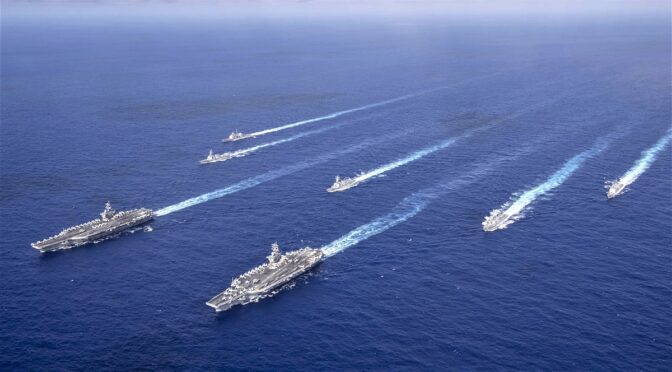
Featured Image: PHILIPPINE SEA (June 23, 2020) The Theodore Roosevelt Carrier Strike Group transits in formation with the Nimitz Carrier Strike Group while conducting dual carrier and airwing operations in the Philippine Sea. (U.S. Navy photo)
Discover more from Center for International Maritime Security
Subscribe to get the latest posts sent to your email.
Bruce Stubbs has it almost right; strategic analysis and thinking should preceed fleet architecture. But there is a piece that should proceed strategy development: institutional embrace of the concept of command of the sea. There is an inherent logic connected with the geographic fact of a single world ocean of massive extent and the physical realities of ships. That logic produces the relationships among nations and their navies. Any approach to strategy must be conditioned by those relationships, which can only be understood and managed via the concept of command of the sea. The US has possessed such unchallenged command since WWII that it has faded into the background, becoming a tacit assumption, replaced by the tactical concept of sea control. Unless command of the sea is resurrected as a pivotal concept, strategy development will be nothing more than a shot in the dark.
Great to see Bruce Stubbs still writing.
We need four fleets, only if there is a major conflict, not just limited conflict, simultaneously in all four area. It is unlikely.
A conflict in the Arctic, against Russia, would use assets from both the Atlantic and Pacific, primarily submarines and aircraft. If we wanted to attack the Northern Fleet in port, we would need to concentrate Atlantic Fleet assets.
Worst case in the Indian Ocean would be a sideshow of conflict with China that inevitably centered in the Pacific. What the Indian Navy might do would strongly influence requirements.
We need to determine the most demanding worst case scenario, say a world war against both China and Russia, and build the Navy required to defeat them both. Then we can look to see if there are unique requirements for other scenarios that we might need.
The great advantage of naval power is the ability to quickly concentrate overwhelming power. Forces have to be moved amount the theaters, but that does not mean every unit must have the ability to survive unescorted inside the first island chain.
The Pacific is so vast there are areas where the primary threat will be submarines and even in those areas, the Logistics ships will need protection. Can they be escorted by maritime patrol aircraft alone?