The frequency and intensity of natural disasters that beset the Indian Ocean region is rising, owing to both natural and man-made causes. The sectarian and geopolitical complications undermining the stability of West Asia is also bearing direct economic and security problems for this region. The incapacity of least developed countries like Bangladesh, Myanmar, Nepal etc. at responding effectively to these disasters compounds the problem.
India is playing a decidedly critical role in this context. Its geographic position in the Indian Ocean, diasporic relations and energy dependence on West Asia, economic interdependence with East Asia, requisite for a stable and developing neighborhood, and the availability of a dedicated navy are key natural imperatives for the country to assume responsibility during Humanitarian Assistance and Disaster Relief (HA/DR) contingencies.
Prompt and efficient HA/DR relief across this vast region is best guaranteed through the deployment of naval assets owing to their global reach via the maritime global commons. Naval ships of various countries deployed for routine goodwill, flag-showing and trade protection tasks on the high seas can immediately be called upon to provide relief. India’s Operation Sukoon is a case in point where naval ships returning from a goodwill visit to the Mediterranean were redeployed to evacuate civilians from the 2006 Lebanon crisis.
Immediate requirements such as communications, airlift logistics, search and rescue, and command and control can be secured with minimum delay as shipboard weather and communication posts are resilient and have secure access to space-based assets. More importantly, the personnel are trained to serve under pressing circumstances.
The promptresponse by the American aircraft carrier USS Carl Vinson ordered to relieve Haiti devastated by a 7.0 magnitude earthquake in 2010 and theresilience of Australian patrol boats HMAS Advance, HMAS Assail, and the submarine HMS Odin in relieving the city of Darwin after it was struck by cyclone Tracy stand as two key examples. Theteamwork of US airmen, Pakistani soldiers, and Ukrainian aid workers unloading relief supplies from a Russian military transport plane marks the optimism in coordination and communication that can be achieved between rival militaries during natural disasters.
The relief operations undertaken by the Indian Navy (IN) during the 2004 Indian Ocean tsunami is a watershed moment for both the service and the country. Although itself a victim, India simultaneously mounted three external relief operations sending naval ships with medical supplies, food and water, and electric generators towards Sri Lanka, Maldives and Indonesia.
These operations earned India international recognition and opened new avenues for cooperation. India was invited to join the United States, Japan and Australia forming a ‘core group’ for relieving the tsunami disaster. Its recovery efforts have been praised as “reversing historic patterns of vulnerability and discrimination.” As such, India’s capabilities and HA/DR management proved its emerging reliability in handling such contingencies across the region.
The unique capabilities of a naval ship once again came to light when the water generation plant in the Maldivian capital became dysfunctional in December 2014 affecting over 100,000 people. Indiadispatched the large fleet tanker INS Deepak with 900 tons of packed water and provided the capability of producing 100 tons of water every day using onboard reverse osmosis equipment. It joined INS Sukanya which had already been rushed to Male with 35 tons of packed water. While the Maldives issued distress calls to the US, China, and Sri Lanka, prompt response from New Delhi was vital. A statement from the Ministry of External Affairs highlights India’s proactive attitude towards relieving HA/DR problems in its immediate neighborhood.
In 2008, when the military rulers of Myanmar refused permission for the American warship USS Essex and a host of international aid agencies during cyclone Nargis, India managed to send two naval ships INS Rana and INS Kirpan which braved rough seas to provide relief. Thereafter, India was able to impress upon Myanmar’s military administration the need to accept international aid. This highlights India’s growing confidence in utilizing diplomacy for securing the trust of its extended neighborhood.
West Asia is one broader geographic realm that preoccupies India’s HA/DR resources. India has experience in evacuating citizens amid armed conflicts where local governments could have been overthrown as well as negotiating transport corridors such as in Kuwait in 1990, Lebanon in 2006, and Libya in 2011. India has mounted proactive relief operations, exemplified by Operation Raahat.
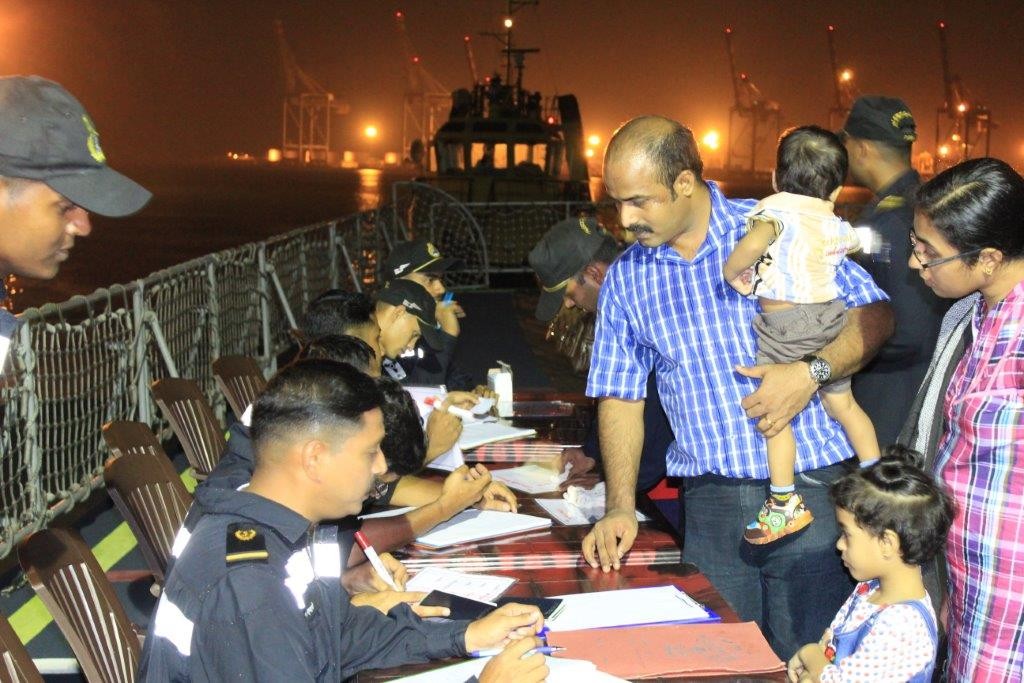
The IN ships Mumbai, Tarkash and Sumitra were the front-line platforms that braved shelling to evacuate civiliansand escort other ships reaching safe zones from war-torn Yemen during March-April 2015. India also deployed the Minister of State for External Affairs, Gen. V. K. Singh, to Djibouti for coordinating the operations. Along with 4,748 Indians, 1,962 foreign nationals from 26 countries including Bangladesh, Nepal, Pakistan, Myanmar, the United Kingdom, Germany, France and the US were also rescued. Although possessing a large forward deployed fleet and other assets in the region, the US urged its citizens to approach the Indian officials for safe evacuation. This mission won hearts and minds of many countries across the world for India.The successful conclusion of this operation is also a graduation for the country marking its ability to offer assistance even for the developed world in such dire humanitarian situations.
Indian Navy personnel registering Indian citizens evacuating from Yemen. Source: Indian Navy.
While these operations have already been conceptualized into the ‘benign role’ to be performed by the IN, its leadership is taking proactive, region-wide measures in this realm. India’s chief of naval staff attended the recent Indian Ocean Naval Symposium (IONS) in Bangladesh and presented a guideline document for setting up a framework for coordinating HA/DR activities in the Indian Ocean region. This is in line with the principle objective of IONS for developing interoperability between member navies in terms of capabilities and operational procedures.
IN ships routinely participate in HA/DR simulations conducted within the services as well as bilateral and multilateral exercises like Varuna, Milan, ASEAN Regional Forum Disaster Relief Exercise, and RIMPAC for proving readiness. The IN could respond to disasters in landlocked circumstances by flying in experienced medical teams, divers, and salvage experts who have fought the 2013 Uttarakhand floods, 2014 Kashmir floods, 2015 Nepal earthquake, and the recent floods in southern India.
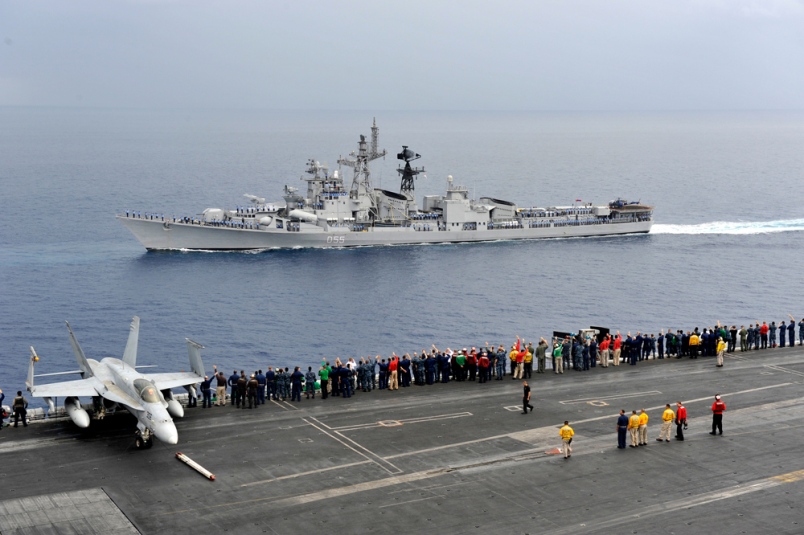
Sailors aboard the USS Carl Vinson aircraft carrier wave to the Indian Navy destroyer INS Ranvijay during the annual Exercise Malabar, April 16, 2012. LORI D. BENT/U.S. NAVY.
India’s image has been elevated from an aid recipient country to that of an international donor owing to these developments. However, the most impressive achievements can only be perceived at home. The political class in New Delhi is willing to assign the IN for HA/DR response across the Indian Ocean region and the bureaucracy has become comfortable with executing these operations. The IN continues to exercise a high level of joint readiness with sister services and relevant civilian organizations in this domain.
India’s success at breaking through rigid political barriers during critical periods can certainly be attributed to its altruistic ideology of peace and friendship, and by respecting territorial sovereignty of other countries, a common source of contention during HA/DR operations. The IN’s operating mindset and responsibility has made it a dependable partner for ensuring peaceful development, bolstering regional stability, and enhancing the international prestige of India.
Vidya Sagar Reddy is a researcher at the Observer Research Foundation, New Delhi.
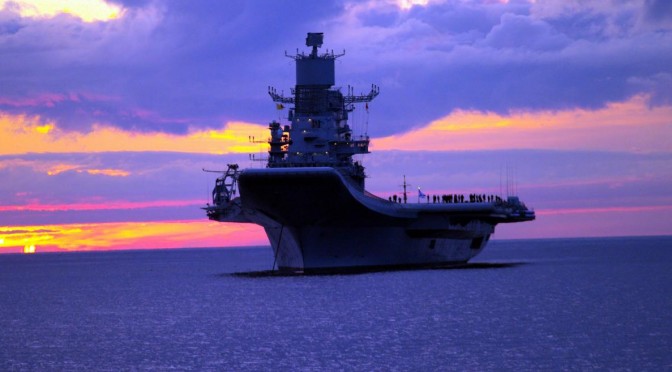
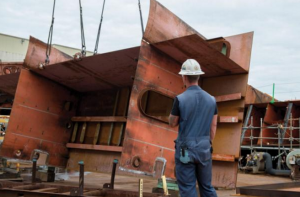
Featured image: INS Vikramaditya in Baltic Sea during her trials in 2013. Source: Indian Navy.
CDA Institute Security & Defence Blogger Adam MacDonald, an independent scholar on Canadian foreign policy and Asia-Pacific security, looks at China’s approach to the Arctic.
China’s increasing Arctic engagements overall have been welcomed by the region’s stakeholders. There are, however, arguments in the media and some academic quarters that China’s growing involvement threatens to destabilize the region. Beijing, despite the absence of Arctic territory, is unilaterally asserting itself into the regional institutional architecture, challenging the pre-eminent role of the Arctic states and their sovereign rights, while their ‘Arctic envy’ to secure regional shipping lanes and resources currently is manifested through political and economic manoeuvring. In the future China may become more forceful in these endeavours, including possible military deployments in the North.
Much of these commentaries are imprecise and speculating at best, largely ignoring the pathways and processes China’s Arctic endeavours have evolved. Lack of specifics on how and why China constitutes a threat to the region, also, demonstrate these arguments derive from the more generalized (yet still problematic) ‘Assertive China’ narratives which have become dominate in Western analyses of Chinese foreign policy. Clearly, China is actively trying to alter the power dynamics in its immediate environment of East Asia. But it is premature to talk of a revisionist challenge to the international system writ large guiding the entirety of Beijing’s foreign engagements. Before assigning China’s Arctic activities to an underlying revisionist agenda, therefore, it is important to further analyze the lines of engagement Beijing is actually pursuing.
China does not have an official Arctic Policy due to the low importance of the region within their broader foreign policy strategy, which is focused on immediate access to resources. The Arctic, though, is an area of long-term interest motivating Chinese leaders to begin a ‘nascent stage of formulation’ in terms of constructing a regional strategy. Chinese academia, media and the military, also, have become more vocal and engaged in this process.
China’s Arctic engagements originate from and are still dominated by scientific research projects, specifically pertaining to climatic and regional weather phenomenon. These endeavours have increased significantly over the past decade including the 2004 establishment of the Yellow River Station in Spitsbergen, Norway; the creation of the China-Nordic Research Center in Shanghai in 2013; and the construction of an Aurora Station in Iceland. China, as well, is looking to establish an Arctic research centre in Canada and is building a second scientific icebreaker in conjunction with Finland. Some commentators are quick to dismiss Beijing’s scientific endeavours as camouflaging other more malign political goals, but one should not dismiss the fact that China faces massive environmental and climate change challenges, which motivates much of their scientific and climate work internationally.
Bilateral economic relations is the second line of China’s Arctic engagements. Central Asia, the Middle East, and Africa remain Beijing prioritized regions for resource acquisition but the Arctic states, particularly the Nordic countries, have developed robust resource development projects with China. The strongest of these relationships is with Iceland, where China signed a Free Trade Agreement in 2013 and was awarded its first exploration license in the region for oil in the Dreki area. Chinese companies, as well, have invested billions into mineral-rich Greenland, a protectorate of Denmark. These relations, however, have not been entirely unproblematic. Iceland’s parliament blocked a land-purchase deal of a Chinese developer due to concerns over what the land would be used for and investments in Greenland have caused local anxieties over Chinese dominance in the economy, including the possible (but overhyped) importation of thousands of Chinese workers. China has also made inroads into the Canadian and particularly Russian energy markets, the latter following the post-Crimea sanctions régime that left Moscow short of capital and partners for Arctic resource development. But Ottawa and Moscow, more so than the Nordic states, are wary of the consequences of Chinese economic activities in the North. China’s ability and willingness, however, to invest significantly in these remote areas (particularly Greenland), requiring possibly decades of development before profitable returns are generated, motivates many Arctic stakeholders to engage Chinese companies despite concerns about their government ties and overall environmental and labour standards.
China, finally, has been energetic in gaining entry into the Arctic governance structure and acceptance as a legitimate and non-threatening stakeholder. After two failed attempts, in 2013 China (along with a host of other Asian countries) were accepted by the Arctic Council, the pre-eminent regional organization, as Permanent Observers. Despite having no voting rights, Permanent Observers are allowed to take part in seminar discussions and participate in the organization’s working groups. One of the major conditions China (and other applicants) had to meet was acceptance of the Nuuk Criteria which includes acknowledging the pre-eminent role and responsibility of Arctic states in regional affairs; their sovereignty and sovereign rights; and recognizing the United Nations Convention on the Law of the Sea as the legal régime governing the Arctic. This measure alleviated concerns associated with a more active China by showing their willingness to abide by the rules and conditions of the regional régime.
Chinese leaders, nevertheless, do assert that the Arctic possess certain trans-regional characteristics which necessitate the involvement of non-Arctic states (a position held by a number of other Asian states) and as a ‘Near Arctic State’ has a legitimate role to play. Despite some frictions, including over issues of extended maritime zoning claims by the Arctic coastal states which China sees a possibly marginalizing non-Arctic states access to the North, Beijing has decided to become part of the regional structure and not attempt to create parallel organizations and mechanisms to pursue its interests.
Contrary to portrayals of China as an assertive and bellicose outsider, Beijing’s actions have been conducted through legal and accepted channels, including participating at a low and non-intrusive level in the regional political architecture. Acknowledging the differences between Beijing and some Arctic actors over issues of maritime rights and the role of non-Arctic states in regional governance, there is very little evidence of China becoming more aggressive in these pursuits. The Arctic, furthermore, is a stable region characterized by an ever evolving rule-bound régime populated by developed states, including the world’s two nuclear superpowers, and the absence of war and failed states: conditions which heavily influence the pathways and processes China is and will pursue their interests in the future.
China’s interests in the Arctic, furthermore, align with their broader foreign policy goals of diversifying energy and resources suppliers, securing trade routes and becoming more active in global and regional governance instruments commensurate with their growing great power status and role. Speculations of China’s ‘aggressive’ posturing in the Arctic, however, will undoubtedly continue to inaccurately colour any discussion of the rising power’s actions in the Arctic; far more than any other Non-Arctic, and particularly Asian, state involved in the region.
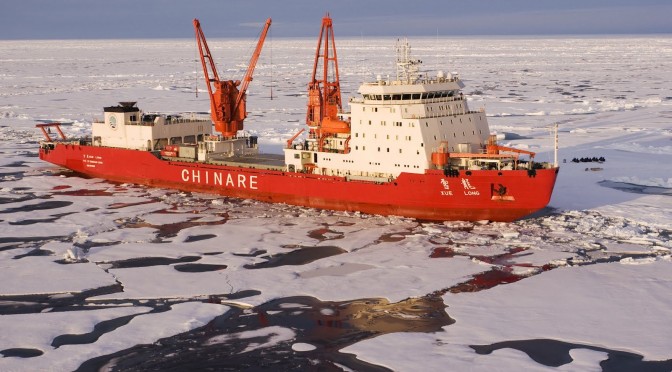
Adam P. MacDonald is an independent academic whose work focuses on Canadian foreign policy in Asia, Chinese naval developments, and the ongoing political transition in Myanmar. He can be reached at adampmacdonald@gmail.com. (Image courtesy: alexshakun.blogspot.com.)
Traditionally the junior service, operating in the Army’s shadow and receiving a ten percent share of the 2015 defence budget of $6.6 billion, Pakistan’s Navy personnel numbers more than 22,000 active, plus 5,000 in the reserve. This secondary role stands in contrast with the economy’s dependence on the sea, with the port city of Karachi contributing 25 percent of GDP and the proposed China Pakistan Economic Corridor (CPEC) raising the country’s maritime profile even further.
Much of the Navy’s backbone, including its seven submarines, five French-made ‘Khalid’ class conventional hunter-killer (SSKs) acquired in the 1990s plus two ‘Hashmat’ class SSKs from the 1970s, is nearing retirement. The Navy is working to acquire new surface and undersea combatants, boosting domestic shipbuilding in the process and in cooperation with Beijing.
Plans include procuring an additional four 3000-ton F-22P/’Zulfiqar’ (Sword) class frigates with improved sensors and weapons (including HQ-17 surface-to-air missiles, developed from Russia’s Tor 1/SA-N-9), as well as six Type-022 Houbei stealth catamaran missile boats. State-owned shipbuilder Karachi Shipyard and Engineering Works (KSEW) is responsible for these programs, and is expanding its facilities with a new foundry, manufacturing areas, and two dry docks of 26,000 and 18,000 dead weight tons, spread over 71 acres. Islamabad had been hoping to procure six Perry-class frigates from the US on easy terms, but congressional hostility has prompted greater reliance on China, a country heavily committed at all levels to Pakistan, being a key to Beijing’s strategy of securing access to the Indian Ocean and keeping New Delhi distracted by a regional rival.
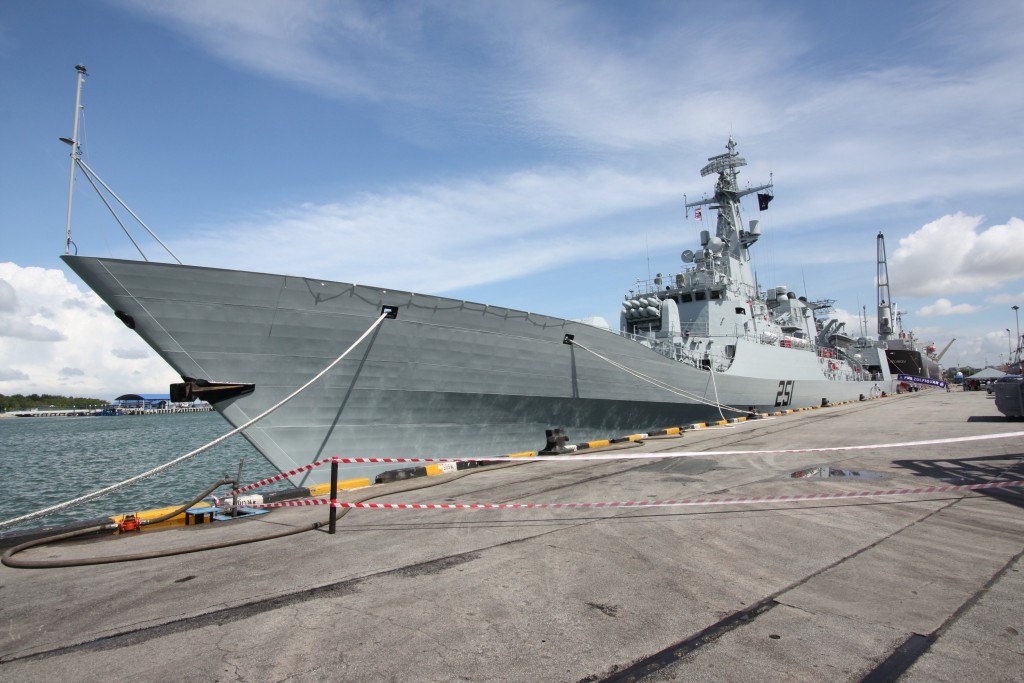
Sword class frigate of the Pakistani Navy.
Karachi is the traditional home of the Pakistani Navy, and remains of the utmost importance, despite diversification into other bases, among them PNS Siddique (in Turbat, in the south-west, close to the strategic deepwater port of Gwadar and the border with Iran), Pasni, and Jinnah Naval Base (also in the south-west). Asked whether security is considered by the Pakistani Navy as a reason to push for further diversification away from the city, Zoha Waseem (PhD Candidate at King’s College London and an expert in Pakistani security and policing) explains that “the situation in Karachi in terms of the ongoing operation is linked with the need of the military to keep investing in Karachi. The construction of military bases, infrastructure, and training centres and accommodation does not appear to be decreasing. Karachi is an ATM machine, and a prime location for any stakeholder to have its assets here.”
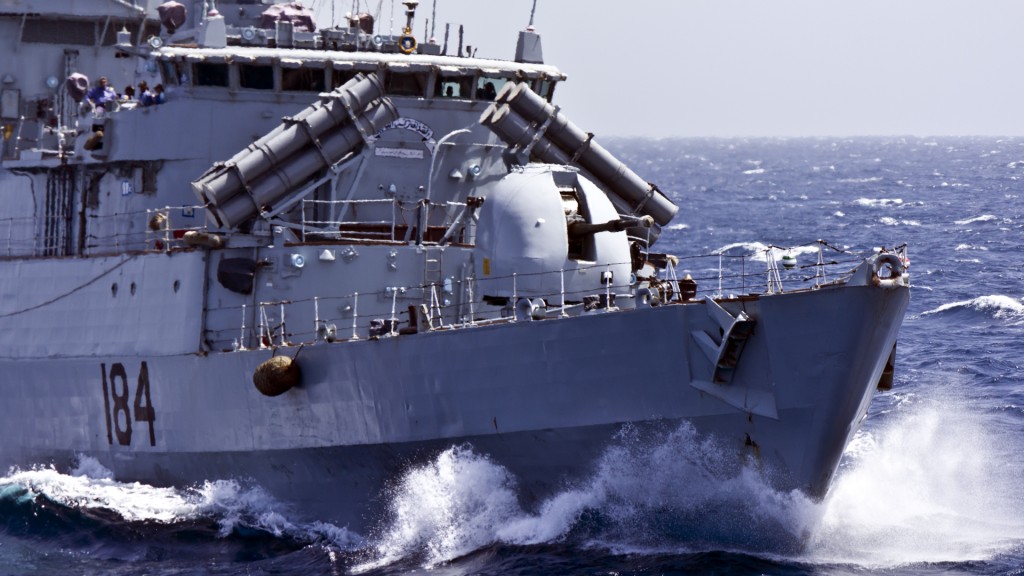
PNS Badr, a British-built Type-21 frigate, was decommissioned in 2014. Despite being the junior service and the country facing a difficult fiscal position, Pakistan’s Navy has been pushing for ambitious plans in terms of both surface and undersea combatants. Source Flickr.
While new ships are seen as essential in terms of maritime security and the fight against piracy, it is Pakistani plans to acquire new submarines that have met with the greatest concern in New Delhi. In March 2015, Islamabad announced plans to procure eight new Chinese submarines, and in October 2015 confirmed that four would be purchased from Beijing and four built at KSEW. The package includes a training centre in Karachi and probably includes access to China’s Beidou-II (BDS-2) satellite navigation network. Thanks to similar designs, Beijing, in turn, gets to enjoy the necessary maintenance personnel and facilities enabling her to operate her own submarines much more efficiently in the Indian Ocean, home to vital SLOCs (sea lanes of communication) for China. Ideally the Navy would like a total of 12 new boats. These Chinese-designed submarines will probably be based on the air independent propulsion (AIP) equipped Type 39B Yuan SSK (known as S-20 in its export version). Displacing 2,300 tons, they can fire both cruise missiles and 533 mm torpedoes, and can also deploy mines and special forces. Pakistan, already working on a version of the National Defence Complex Babur missile capable of launch from her old Khalid submarines, sees the S-20 as more than a conventional platform, although preventing an Indian blockade is certainly a major goal in and by itself. A sea-based deterrent would provide Islamabad with a second strike capability, while avoiding perceptions of falling behind India in the nuclear sphere. The resulting improvement in survivability is seen by Mansoor Ahmed (Stanton Nuclear Security junior faculty fellow at the Harvard Kennedy School’s Belfer Center), as providing greater strategic stability to South Asia, given that India could not be sure of completely destroying Pakistani nuclear forces and thus escape unacceptable damage herself.
Work on a sea-based deterrent may also be closely linked to the Navy’s status within the military. According to Scott Cheney-Peters (US Navy reserve officer and CIMSEC founder) “Unless Pakistan’s Navy can develop an at-sea strategic nuclear deterrent it is likely to remain the ‘junior service.’ This means it has a strong institutional incentive to pursue an SLBM second-strike capability. But just as this incentive may not be enough to bring the capability to fruition any time soon, so the second-capability may not be enough to remove the perception of the Navy as a junior partner in the nation’s armed forces.”
Alex Calvo is a guest professor at Nagoya University (Japan) focusing on security and defence policy, international law, and military history in the Indian-Pacific Ocean Region. A member of the Center for International Maritime Security (CIMSEC) and Taiwan’s South China Sea Think-Tank, he is currently writing a book about Asia’s role and contribution to the Allied victory in the Great War. He tweets @Alex__Calvo and his work can be foundhere.
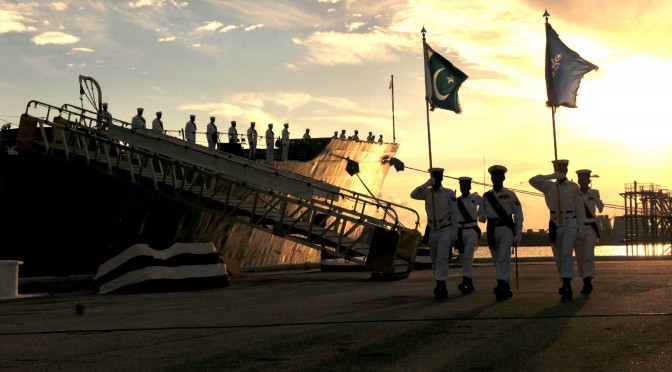
Featured Image: MAYPORT, Fla. (Aug. 31, 2010) Pakistan sailors parade their country’s colors during the decommissioning ceremony of the guided-missile frigate USS McInerney (FFG 8) at Naval Station Mayport. During the ceremony, McInerney was commissioned into the Pakistan navy as PNS Alamgir (F 260). (U.S. Navy photo by Mass Communication Specialist 2nd Class Gary Granger Jr./Released).
This piece was originally published by the US Naval Institute. It is republished here with permission. Read it in its original form here.
By Eric J. Labs
The Navy released its latest 30-year shipbuilding plan to Congress in April 2015. 1 The document (hereinafter referred to as the 2016 plan) described the purchases, retirements, costs, and projected inventory of the fleet the Navy says it will need from now through 2045. Critically, the plan outlines the fact that the Navy will need substantially more money than what Congress has allocated to shipbuilding in recent decades. The tyranny of time, the stubbornness of high shipbuilding costs, and competing fiscal priorities will put pressure on the size and capability of the future fleet. In short, over the next 30 years the Navy faces a slowly unfolding fiscal Pearl Harbor.
In recent years, the Navy has changed the tone of the annual shipbuilding report it sends to the Congress. It used to be that those documents were full of bureaucratic optimism and rosy scenarios. But over the last three years in particular, the Navy has offered a frank discussion of the challenges it faces in implementing its shipbuilding plan. In my view, a document that was once disregarded by many on Capitol Hill has now become one of the more valuable reports that is sent to the Congress. It warns that hard choices are coming and the Congress and the nation must be prepared to make them.
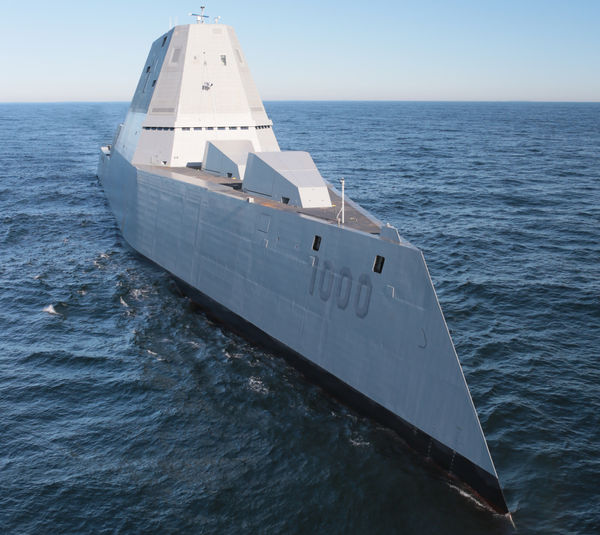
U.S. Navy – The future USS Zumwalt (DDG-1000) conducts sea trials in December. Such a revolutionary vessel reflects both the aspirations and the daunting challenges of tomorrow’s fleet, for such “alternative ship designs and fleet architecture take a long time to implement,” notes the author, pointing out that the DDG-1000 “has been in development, design, and construction for 20 years. . . .”
Between now and 2045, the Navy proposes buying 264 ships and retiring 244 ships in order to maintain a fleet of 300 ships or more. Officially, the Navy’s goal is 308 ships but under the 2016 plan, the schedule of commissioning new ships and decommissioning old ones yields a fleet of 300 or more beyond 2019 and 308 or more for 12 of the next 30 years. (If 12 littoral combat ships are cut from the program as directed by Secretary of Defense Ashton Carter, then the Navy’s fleet will exceed 300 ships only between 2019 and 2030.) The Navy states directly that without a large increase in its shipbuilding budget, it cannot afford to buy the 264 ships in its shipbuilding plan and would not be able to sustain a fleet of 308 or more ships for very long, if it is reached at all.
I will focus more of this discussion on the first 20 years of the Navy’s plan, covering the years 2016 through 2035, because the third decade of the Navy’s plan is necessarily quite speculative. Nevertheless, keeping an eye on the longer, 30-year perspective is important. While it is true that the nature of warfare, technology, and costs cannot be predicted decades into the future, it is today’s decisions that are most important for the long-run perspective. The President proposes a budget and Congress makes appropriations year-to-year. The Department of Defense provides Congress with a five-year Future Years Defense Program (FYDP), but without the presence of the 30-year plan, the long-range effect on the Navy of the incremental decisions made in each year’s budget cycle would not be understood. For example, in the 1990s, the service built an average of one submarine every other year, and that low rate of construction had no effect on the existing inventory, because coming off the boon years of the 1980s, the attack submarine force was young. Submarine procurement could be reduced during the 1990s without affecting the existing force structure at all. But in the next decade those decisions would manifest themselves in a declining SSN force in a world that today looks like it will get more dangerous and more competitive, not less, and for which some observers of international and naval affairs think having more submarines would be a valuable asset for the Navy.
What to Buy and at What Cost?
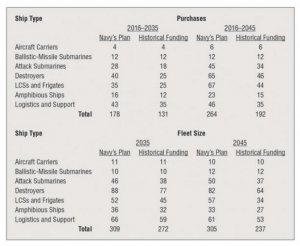
Between 2016 and 2035, the Navy plans to buy 178 ships, including 12 expensive Ohio -class replacement ballistic-missile submarines. The rest of those purchases comprise 4 aircraft carriers, 28 attack submarines, 40 large surface combatants, 35 littoral combat ships (LCSs) and frigates, 16 amphibious ships, and 43 combat logistics and support ships.
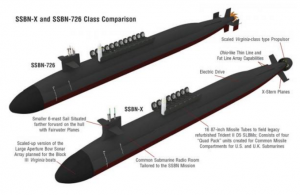
J. M. Caiella – The Ohio-class sub replacement (SSBN – X) is “the 800-pound gorilla in the room” when it comes to the Navy’s shipbuilding ledger. “At around $6 billion apiece, buying those new boomers poses a substantial fiscal and budgetary challenge to the Navy.”
The Congressional Budget Office, in a report that I authored, estimates the cost of building those ships at an average $18.7 billion per year in Fiscal Year 2015 dollars. 2 But that amount is for new construction only. It does not include all of the other activities that the Navy must fund from its shipbuilding account, such as refueling aircraft carriers, outfitting and post-delivery, and other items. They add another $2 billion to the Navy’s funding requirements, resulting in an average shipbuilding budget of $20.8 billion per year for the next two decades.
The dilemma the Navy faces is that in recent decades shipbuilding budgets have been much lower. Since 1986, the Navy has received an average of only $15.8 billion per year, after adjusting for inflation, for all of its shipbuilding activities. And in the most recent decade, 2006–2015, it was even less—$15 billion. Thus, in order to fund the Navy’s plan, the shipbuilding budget will need to increase by an average of 40 percent compared to the past ten years, or about $6 billion per year.
As readers of Proceedings will know, the 800-pound gorilla in the room is the Ohio Replacement Program. The Navy plans to replace its aging force of 14 Ohio -class ballistic-missile submarines with a new, as-yet unnamed class of 12 boats, with procurement funding starting in 2017 and continuing through 2035. At around $6 billion apiece, buying those new boomers poses a substantial fiscal and budgetary challenge to the Navy. Declared to be the Navy’s top budgetary priority, the question, in the view of some members of Congress, is not whether the Ohio replacements will be funded, but rather how they will be funded. Will the Navy receive increases in its shipbuilding budget to pay for the new submarines, or will the Navy have to buy those submarines from a budget that is not increasing? If so, what happens to the rest of the fleet?
Future Fleet, Historical Funding Level
In the 2014 National Defense Authorization Act, Congress directed the Navy to assess what would happen to its shipbuilding plan if, on average, future shipbuilding budgets matched historical budgets. So far, the Navy has not responded to that congressional directive.
The CBO’s analysis shows that constraining future shipbuilding budgets to an average of $16 billion per year results in a much smaller fleet over time. The assumptions that were made in doing such an assessment were as follows:
• The Navy builds all 12 Ohio replacement submarines.
• Production of aircraft carriers is not cut, because Congress mandates the 11-ship force level in law.
• All other ship programs are cut roughly proportionately.
With those assumptions and applying the budgetary constraint, the Navy would purchase 131 ships over the next 20 years, instead of the 178 in the 2016 shipbuilding plan. Specifically, those purchases would include:
• 4 aircraft carriers
• 12 ballistic-missile submarines
• 18 attack submarines
• 25 destroyers
• 25 LCSs and frigates
• 12 amphibious-warfare ships
• 35 combat logistics and support ships.
Reducing the shipbuilding program by 47 ships over 20 years results in a fleet no larger than today’s by 2035. Over the entire 30 years of the Navy’s plan, the fleet would drift down to 237 ships if the historical funding level does not budge much from $16 billion. (See the accompanying table). That is a reduction of 13 percent compared to today’s Navy and 22 percent compared to the fleet of 2045 projected under the 2016 plan.
Our future fleet.
Is There a Solution?
What are the alternatives to a decline of the Navy’s fleet? Are the alternatives viable? Let us consider each one in turn.
Increase the shipbuilding budget. The first and immediately obvious solution would be to increase the size of the Navy’s shipbuilding budget. Shipbuilding represents about 3 percent of the overall defense budget, a relatively small fraction. As my counterpart at the Congressional Research Service, Ron O’Rourke, has noted in his work, increasing ship construction by $5 billion per year would represent less than 1 percent of defense spending. Yet, even such a small increase faces three powerful headwinds—one short-term, one long-term, and one that is a constant—that are political and budgetary in nature. In the near term, any increase in the defense budget faces the caps imposed by the Budget Control Act (BCA) of 2011 and the various amendments, including the Bipartisan Budget Act of 2015. While the BCA says nothing about how much of the DOD budget may be spent on any particular account, the fact that the BCA caps defense spending below the President’s 2016 FYDP makes it extremely difficult to find the money to increase any category of spending, including shipbuilding. The 2016 FYDP allocated $121 billion more for defense spending over the years 2016 to 2020 than the amounts allowed under the revised caps of the BCA. Thus, widespread cuts are the order of the day, not funding increases.
Although the BCA is set to expire in 2021, presumably making it easier to increase the defense budget in the long term, the large fiscal challenges facing the United States will not. Between now and 2040, the CBO projects that the demands by a growing older population and rising medical costs will increase spending on Social Security and Medicare by 27 percent and 80 percent respectively. But the dedicated revenues that support those programs will remain nearly flat. 3 Because federal deficits over that period will persist and increase the national debt, the CBO also projects that spending on interest will increase by 230 percent; at the same time, revenues from federal income taxes will increase by only 25 percent. Stiff competition for federal resources will remain a fact of our budget debates for decades to come, and the Navy will not be immune.
Finally, within the defense budget itself are the competing demands and priorities of the services and their supporters. If the military branches were unified in the perspective that naval shipbuilding, including the Ohio replacement, should be the nation’s first military priority—or at least the first acquisition priority—it might be a relatively simple thing to shift 1 percent of the defense budget in its favor. But that is not a universally held view. As the threats to U.S. national security become more varied in this emerging new strategic era, the competing demands of all parts of the military for more resources make shifting even a small amount of the defense budget a difficult proposition, especially with the demands on federal resources continuing to grow. 4
Adopt alternative ship designs and fleet architecture. If more money does not flow into the Navy’s shipbuilding accounts, what are the other alternatives? Are there ways to squeeze more out of the current budget? Can you keep ships around longer and modernize them? Does the Navy really need to buy the fleet it is proposing, or would an alternative be better? These are large, wide-ranging questions that deserve serious attention and debate. My purpose in raising and discussing them briefly in this article is to show that even if such suggestions were adopted, they would have little effect on the fleet over the next 10 years and only a marginal effect over the next 20 years.
Let us very briefly consider two examples of alternative fleet architectures proposed by two knowledgeable and experienced men in the business of fleet design: Captain Arthur “Trip” Barber and Captain Wayne Hughes. 5Both are retired Navy officers who then spent many more years thinking about alternative fleet architectures and ship designs. They still do.
In a 2014 Proceedings article, Captain Barber recommends that the Navy do a number of things differently in what he sees as an unending period of federal fiscal constraint. He suggests changing the capabilities of existing ship platforms as well as changing the ways the Navy deploys or stations ships in order to get more deployed time out of these expensive capital assets. However, he also recommends exploring several alternative ship designs that, he argues, would reduce shipbuilding costs, including using a single new ship design for both aircraft carriers and large-deck amphibious-assault ships, developing several classes of surface combatant that perform different missions but share a common hull, and repeating that common-hull approach for various support-ship missions.
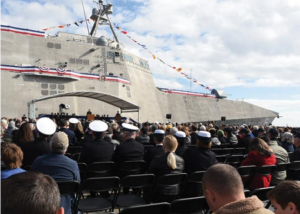
U.S. Navy (Sam Shavers) – Secretary of the Navy Ray Mabus delivers remarks at the christening of the USS Jackson (LCS-6) in December. The Secretary of Defense recently called for cuts to the LCS shipbuilding program, which might be said to have experienced its share of setbacks and controversy.
Captain Hughes equally reimagines the future fleet, although he believes his plan is affordable within existing shipbuilding budgets. The New Navy Fighting Machine, as Captain Hughes describes it, would develop even more new ship types than would Captain Barber’s. Specifically, Captain Hughes envisions new conventionally powered submarines, light aircraft carriers, small land-attack arsenal ships, and a substantial green-water force, as well as continuing to build numerous ship types that are already part of the Navy’s 2016 plan.
Nevertheless, however thought-provoking the suggestions offered by both men, making such major changes to the fleet will not be easy or quick. Alternative ship designs and fleet architectures take a long time to implement. For example, the LCS was first proposed in 2001. Fifteen years later the Navy has commissioned six of those small, relatively inexpensive 3,000-ton ships. A large all-new ship design, such as the DDG-1000 Zumwalt -class destroyer, has been in development, design, and construction for 20 years and won’t commission into the fleet until later this year. The same is true for the new Ford -class aircraft carrier. Under the Navy’s shipbuilding plan, in 15 years—2031—the Navy will have only eight new combat ships of entirely new design: three Ford -class carriers, three Zumwalt -class destroyers, and two Ohio replacement ballistic-missile submarines. Another 48 combat ships will be commissioned that have a modified design of existing warships: 21 Arleigh Burke –class Flight III destroyers, 20 frigates based on the LCS (or just 12 under Secretary Carter’s directive), and seven LX-R amphibious ships based on the existing LPD-17 hull. The Navy will also have another 28 combat logistics and support ships of some new type. Overall, in 2031 at least three-quarters of the fleet will still be composed of ships with designs that are in service today.
Thus, unless the ship-acquisition process can be changed such that it dramatically speeds up the introduction of new ship designs into the fleet, most of the suggestions by Captains Barber and Hughes would not have a meaningful effect on the composition of the fleet until, coincidentally, the Ohio Replacement Program is essentially completed in 2035. This is a point that Captain Hughes explicitly acknowledges and addresses (and one that Captain Barber recognizes but does not address), but, based on the Navy’s acquisition history, the former may be optimistic about what is achievable in 10–20 years. 6
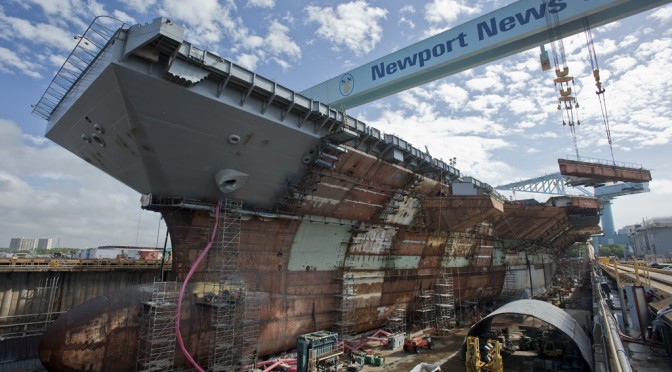
Huntington Ingalls – A rigger oversees a small-unit flip during construction currently underway on the second Gerald R. Ford-class aircraft carrier, the future USS John F. Kennedy (CVN-79) at Newport News Shipbuilding. “In 15 years – 2031 – the Navy will only have eight new combat ships of an entirely new design,” including three Fords.
Keep older ships in the fleet. A less time-intensive alternative to new ship designs or fleet architectures would be to modernize older ships and keep them in the fleet. But this approach has its own problems. Paradoxically, the Navy is already doing this to a large extent, so it is not clear that more can be done, but also historical experience suggests that the service dislikes doing so. Over the past 20 years, senior Navy leaders have extended the service lives of more than 100 submarines, destroyers, and amphibious ships relative to their original design lives. At the same time, the Navy retired dozens of ships that had many years of useful service life remaining, rather than purchasing slightly fewer new ships to pay for keeping the older ships in the fleet.
Specifically, in the early 2000s, the Navy increased the service life of the Ohio -class ballistic-missile submarines from 30 years to 42. If that had not been done, we would have debated the merits and means to pay for the Ohio replacement more than a decade ago, when the United States was fully engaged in two wars in Afghanistan and Iraq. Similarly, the service life of Los Angeles –class attack submarines was increased from 30 years to 33. The Navy now assumes its large-deck amphibious-assault ships will serve for 43 to 45 years, which is up from 40 years. And since the release of the 2009 shipbuilding plan, the Navy has assumed its Arleigh Burke –class destroyers would serve in the fleet for 40 years, rather than 35 years in earlier plans, which is up from the original design life of 30.
Extending the service lives of these ships further is impossible in some cases and questionable in others. The submarines will be at the limit for the number of cyclings (submerging and surfacing) that their pressure hulls can tolerate, and the energy in their reactors will be exhausted. Conventionally powered surface ships, however, could in theory be upgraded if the Navy chose to do so. Properly maintained, conventional hulls can last for many decades. Ships that were retired from the U.S. Navy and sold or transferred to other countries often serve for decades longer as a result. But at a certain point, a ship that is still useful in a South American or Asian navy would no longer be valuable to the U.S. Navy, because physical limitations may prevent a modernization of her combat systems to perform high-end missions. Further, keeping older ships in the fleet even longer would require the Navy to modernize combat systems and fully fund maintenance programs. But budgetary constraints and long, frequent deployments have made it hard for the service to do so. Thus, if it is not clear that Burkes can serve for 40 years, it seems even less likely they could serve for 45 to 50 years performing missions the Navy would find valuable.
At the same time the Navy was extending the service lives of some ships, it was retiring others well before the end of their design lives. In the late 1990s through the mid-2000s, the Navy retired the entire class of Spruance destroyers. To keep those ships in the fleet the Navy would have had to spend money on improving their material condition as well as upgrading their combat systems. It also would have cost money to continue to operate those ships. But a decade later, the surface-combatant force is overworked with long deployments because there are insufficient ships to meet the demand. In addition, the original plan was to retire the Oliver Hazard Perry –class frigates sooner and keep the Spruances around, but that decision was reversed because it was cheaper to operate the smaller ships. Relative capabilities apparently did not figure strongly in the decision.
Similarly, the Navy retired 17 Los Angeles –class attack submarines at an average age of 22 years, rather than pay to refuel those boats and keep them in the fleet. Paying for all 17 refuelings would have cost less than the price of two new Virginia -class submarines. Again, the Navy would have had to budget resources to operate those ships, but at about $40 million per submarine per year, that was not an insurmountable obstacle.
And more recently, the Navy proposed to retire seven Ticonderoga -class cruisers and two amphibious ships to help conform to the budgetary caps of the Budget Control Act, rather than reduce new ship purchases further. Congress intervened, however, directing the Navy to keep those ships in the fleet and provided additional appropriations to do so. But if the Navy had had its way two years ago, the fleet today would number 264 ships. In that event, the strain on large surface combatants and amphibious ships, which now routinely deploy for seven to ten months, would be even greater.
Size? Capabilities? Both?
One way for a policymaker or anyone interested in naval matters to think about these issues is to figure out what your objective is. Do you care most about the size of the fleet? Or are the capabilities of the fleet more important? Of course, both are important. But the tension between size and capabilities is in many ways a proxy for the tension between the Navy’s day-to-day responsibilities and its high-end warfighting requirements. In an unendingly tight fiscal environment, a larger Navy is one that is better able to provide overseas presence and perform the many, varied peacetime missions that our naval forces are routinely called on to conduct—without overly stressing the ships and crews. 7However, ships with the high-end warfighting capabilities that would be needed in an unlikely, but far from impossible, future conflict with a peer or near-peer competitor are expensive. The Navy cannot afford to build as many of them as it would like under historical funding levels.
If this seems like a daunting set of challenges for shipbuilding, that’s because it is. Yet, it may be possible that a little bit of everything could close the gap. If the Congress can shift a fraction of 1 percent of the defense budget toward shipbuilding, if improving acquisition can squeeze a fraction of 1 percent of the defense budget toward more shipbuilding, and if the Navy invests in some of its older ships to keep them in service, then perhaps it can step off the path toward a fleet of 237 ships that history says it is on. But that combination of outcomes would be difficult to achieve.
Dr. Labs, writing here as a private citizen, is Senior Analyst for Naval Forces and Weapons at the Congressional Budget Office. He specializes in issues related to the procurement, budgeting, and sizing of the forces for the Department of the Navy. Dr. Labs has testified before Congress several times and published numerous studies under the auspices of the CBO as well as a number of articles and papers in academic journals and conferences.
1. Report to Congress on the Annual Long-Range Plan for Construction of Naval Vessels for Fiscal Year 2016 (Washington, DC: Department of the Navy, March 2015), http://tinyurl.com/ocrqtfc [8] .
2. Congressional Budget Office, An Analysis of the Navy’s Fiscal Year 2016 Shipbuilding Plan , October 2015, www.cbo.gov/publication/50926[9] .
4. Ronald O’Rourke, A Shift in the International Security Environment: Potential Implications for Defense—Issues for Congress , Congressional Research Service, 20 November 2015,www.hsdl.org/?view&did=788858 [11] .
5. CAPT Arthur H. Barber, USN (Ret.), “Rethinking the Future Fleet,” U.S. Naval Institute Proceedings , vol. 140, no. 5 (May 2014), 48–52. CAPT Wayne P. Hughes, USN (Ret.), The New Navy Fighting Machine: A Study of the Connections Between Contemporary Policy, Strategy, Sea Power, Naval Operations, and the Composition of the United States Fleet , (Monterey, CA: Naval Postgraduate School, 2009). See also his “A Bimodal Force for the National Maritime Strategy,” Naval War College Review , vol. 60, no. 7 (Spring 2007), 29–47.