Distributed Lethality is a concept announced by U.S. Navy leadership in January 2015 to explore the warfighting benefits of dispersing surface combatants. CIMSEC launched a topic week in July 2015 to focus analysis on this new concept. This compendium consists of the articles that featured in the topic week.
Authors: James Davenport Chris O’Connor Eric Gomez John Salak Michael Glynn Steven Wills Ryan Kuhns Jimmy Drennan Majorie Greene Thomas Rowden
Editors: Sally DeBoer Jimmy Drennan Dmitry Filipoff Matt Hipple Matthew Merighi
John Stryker
CIMSEC is reintroducing PDF Compendiums to bolster its digital library. These compilations bring together the best articles CIMSEC has to offer on specific issue areas, all in an easy-to-read format. Our first release this year is Distributed Lethality, our topic week from July 2015. It can be found under the “Publications” tab.
In the future, CIMSEC will release compendiums for other topic weeks and issues. If you have compendium suggestions, please email Publications@cimsec.org.
Sincerely,
The CIMSEC Publications Team
Matthew Merighi & John Stryker
Matthew Merighi is a Master of Arts candidate at the Fletcher School of Law and Diplomacy at Tufts University, and CIMSEC’s Director of Publications. John Stryker is a International Relations and Hispanic Studies undergraduate student at the College of William and Mary, and is a CIMSEC Intern.
[otw_shortcode_button href=”https://cimsec.org/buying-cimsec-war-bonds/18115″ size=”medium” icon_position=”right” shape=”round” color_class=”otw-blue”]Donate to CIMSEC![/otw_shortcode_button]
Defence Reform Plan 2020 (DRP2020), originally set out in 2005 by the Republic of Korea’s (ROK) Ministry of Defence, presents an ambitious vision for future military capabilities. For the Army, this will mean personnel reductions – specifically a total drop in troop strength from 690,000 in 2005 to 500,000 by the end of 2020 – in an effort to promote a more modern, professional force. For the Republic of Korea Navy (ROKN), meanwhile, this has meant a shift in the focus of procurement projects so as to attain the status and prestige of a ‘blue-water navy’. In other words, the ROKN will seek expeditionary capabilities, operating across the deep waters of the open oceans, rather than concentrating on its traditional role of securing South Korean littorals against intrusion by the military forces of the Democratic People’s Republic of Korea (DPRK) or foreign fishing vessels.
But is such a shift from a green-water navy to blue-water possible? Furthermore, is it desirable, given the ROK’s strategic situation? To understand the evolution of this still relatively young navy, it is worthwhile consulting a resource compiled by another regional partner. Particularly valuable insights can be found in a paper produced for the US Naval War College in 2010, entitled “The Emerging Republic of Korea Navy: A Japanese Perspective,” by (retired) Vice Admiral Yoji Koda, who formerly served as the Commander-in-Chief of the Japan Maritime Self-Defence Force and interacted considerably with his ROKN counterparts from 1997 onward. VADM Koda briefly charts Korean naval history, starting from actions of Yi Sun-shin at the Battle of Myeongnyang in 1597 that thwarted a Japanese invasion, but his accounts of force modernization and expansion efforts by the ROKN since the 1990’s are the most detailed sections of the paper and will be of most interest for readers wanting to know what role the ROKN might play in the increasingly complex security order of the 21st century Asia-Pacific.
VADM Koda highlights two concerning capability gaps faced by the present-day ROKN: anti-submarine warfare (ASW) and mine countermeasures (MCM). On the first point, although the ROKN maintains a robust force of fast patrol craft to counter clandestine intrusions by North Korea, “the ASW posture of the ROKN still remains questionable today, in relation to the perceived threat of North Korean submarines and the geopolitical nature of the country.” Despite evidence suggesting that the Pohang-class corvette ROKS Cheonan was sunk in March 2010 by a torpedo launched by a North Korean submarine, there have been no compelling efforts by the ROKN to shore up its ASW capabilities. Perhaps the only saving grace for ROKN ASW has been, according to VADM Koda, the acquisition of three ASW-capable Gwanggaeto the Great-class destroyers in 1998-2000 and a small fleet of Westland Lynx helicopters. Though the ROKN is not without its own submarines – specifically four Sohn Won-yil diesel-electric submarines and nine Chang Bogo-class diesel-electric submarines – these are geared toward anti-surface warfare (ASUW).
The ROKN’s MCM capability has also been diminished by the decommissioning of coastal minesweepers donated by the United States following the Korean War. At the time of VADM Koda’s writing, the ROKN minesweeper fleet consisted of only three Yangyang-class coastal minesweepers and six Swallow-class coastal minehunters, which he deemed “not yet sufficient for the current security and military situation around the peninsula”. However, the ROKN seems to have recognized this vulnerability to the DPRK’s own doctrine of asymmetric warfare; in 2015, the ROKN launched the first vessel of the Nampo-class, a domestically built minelayer, and plans are in place to produce several new minesweepers based on the design of the Yangyang-class in the coming years. Even so, the ROKN could not solely carry out an MCM role in a future conflict on the Korean Peninsula – VADM Koda identifies the Tsushima Strait as vital to the logistics of any multilateral response to North Korean or Chinese aggression against the South. Unfortunately, no formal agreement currently exists between the Japanese and ROK authorities about conducting combined military operations, which would be crucial to ensuring a clear division of labour on MCM, with the ROKN securing the western end of the Tsushima Strait and the Japan Maritime Self-Defence Force (JMSDF) locking down the eastern channel. This stems from several ongoing political disputes between Japan and the ROK, including the status of Tsushima Island (known as Daemado Island in the ROK). The dispute over the island has persisted since 1948 and shows little sign of reaching a final resolution.
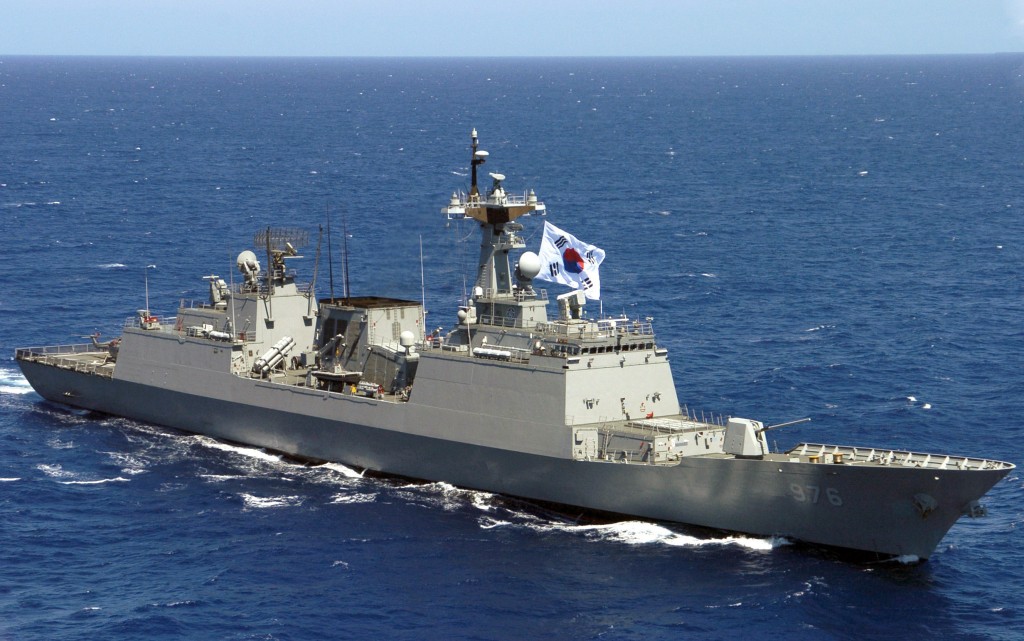
Korean Ship sails in formation at the end of Exercise Rim of the Pacific (RIMPAC) 2006.
The ROKN has demonstrably obtained blue-water capabilities. As the paper notes, ROK President Lee Myung-Bak approved the establishment in 2009 of the Cheonghae Anti-Piracy Unit and its deployment to the Gulf of Aden in support of Combined Task Force 151. A few months later, the ROK joined the Proliferation Security Initiative. New, domestically built surface combatants, such as the Sejong the Great-class destroyers and Incheon-class frigates, possess impressive capabilities and the capacity to project South Korean power beyond the country’s coastal waters. The ROKN has also succeeded in expanding its amphibious capabilities, particularly through the commissioning of its first Dokdo-class amphibious assault ship in 2007 and the replacement in 2014 of aging US-transferred landing ships with the new Cheon Wang Bong-class. VADM Koda interprets this interest in amphibious capabilities as a reaction to the “bitter experience” obtained when the ROKN “found itself unable to participate sufficiently in the multinational relief operations on northern Sumatra, in Indonesia, after the earthquake and tsunami in December 2004”.
In short, while the paper cites ample evidence to believe the ROKN is on course to become a blue-water navy (and perhaps already has), the country’s policymakers and defence planners should pay more thought toward the objectives they wish their maritime forces to fulfill. Boasting the blue-water label and participating actively in humanitarian operations abroad may benefit national prestige, but North Korea remains a paramount security threat. It is clear that the ROKAF assesses its own capabilities as so vastly superior to their DPRK opponents that another attempted invasion of the South would be impossible, and this can be seen in the ROKN’s focus on the quality of landing craft over quantity. But the sinking of the ROKS Cheonan demonstrates that the ROKN ignores ASW and MCM capabilities at the peril of its brave sailors.
Paul Pryce is Political Advisor to the Consul General of Japan in Calgary and a long-time member of the Center for International Maritime Security (CIMSEC). He has previously written as the Senior Research Fellow for the Atlantic Council of Canada’s Maritime Nation Program.
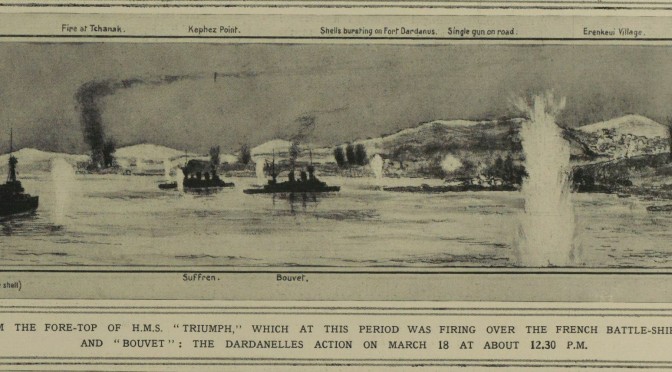
Title Photo:An Officer’s Sketches of the Attack on the Narrows on March 18, 1915 – the Allies’ fleet of 16 battleships attempt to force their way through the Dardanelles; by the end of the day, a quarter of them would be put out of service due to mines and shorefire.
Littoral Arena Topic Week
By Timothy Choi
Within 21st century discussions of littoral warfare challenges, the concept of anti-access/area-denial (A2/AD) is often used as a homogenous term. This has led to an overwhelming emphasis on the development and acquisition of high-tech weaponry such as anti-ship ballistic and cruise missiles that aim to hold a fleet at risk as far from shore as possible. Yet, this is representative of only the first half of the A2/AD concept. Should a fleet successfully defeat anti-access threats, it would have to still deal with the area-denial challenge within the littoral operational area. Here, one particular weapons system has remained understudied, but no less lethal: sea mines. With some 70% of US Navy ship casualties since the end of the Second World War caused by mines, any discussion of littoral warfare must include these incredibly cost-effective weapons. The disproportionate impact of sea mines in an area-denial role is perhaps best illustrated in the First World War’s Dardanelles campaign, which provide many lessons that continue to apply today in such potential littoral areas of operation as the Strait of Hormuz.
Mines and the Dardanelles
The Gallipoli land campaign is often mentioned in historical overviews of the First World War as an isolated event that began and ended on land. Although most histories succeed in noting that Gallipoli was intended to reopen traffic to southern Russia via the Turkish Straits, only dedicated study of the campaign actually explains its operational necessity: to enable Allied battleships to pass safely through the Dardanelles and bring their guns to within range of Constantinople, thereby bringing about the Ottomans’ surrender. The land campaign was thus supposed to be a supportive operation to the original naval-centric strategy and was to be concluded once Allied minesweepers could conduct sweeping operations in peace, allowing the battleships to safely make their way through into the Sea of Marmara.
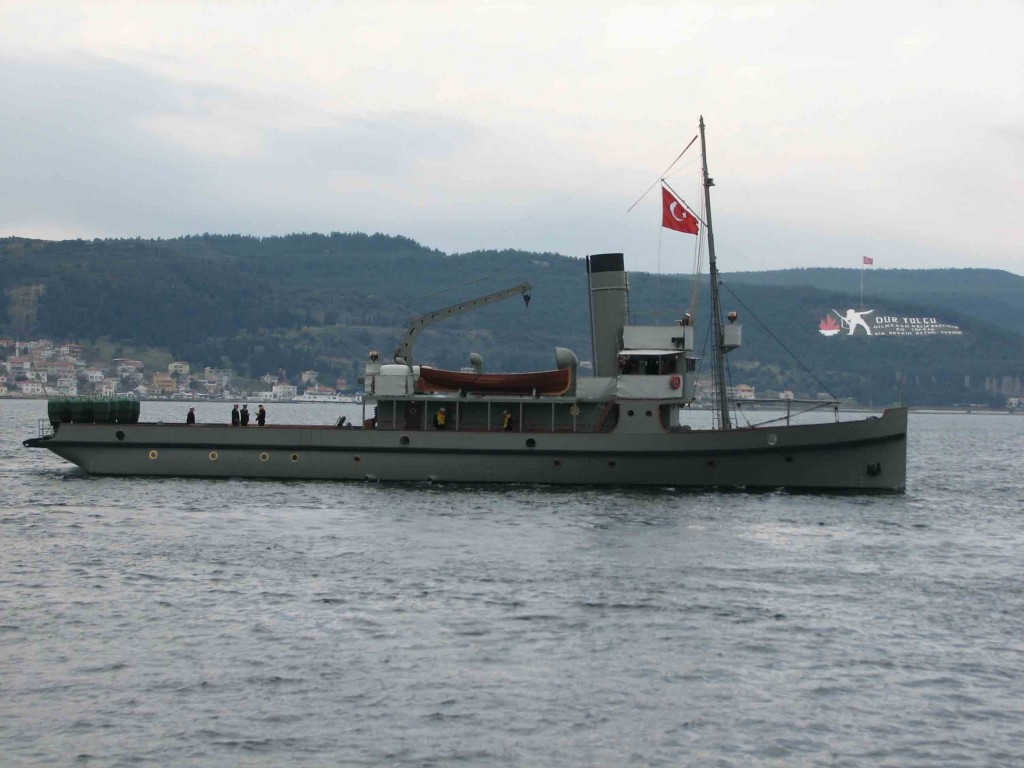
Ottoman minelayer Nusret (replica). Deploying her mines under the cover of darkness in the midst of the Allied operating area, she was responsible for the March 18 outcome, emphasizing the need for persistent MCM efforts during all phases of conflict.
Outgunned and outmatched in their conventional naval forces, the Ottomans utilized a defensive strategy that centred around the naval mine. In so doing, its forces needed to only prevent the minefields’ reduction – a fairly simple task that pitted Ottoman mobile howitzers against the Allies’ defenseless and slow minesweepers.[1] The vulnerability of big battleships to the humble mine was ably demonstrated during the March 18th, 1915, attempt at forcing the Dardanelles: there would be no reaching the Marmara unless the minesweepers could proceed free from howitzer harassment. Only through land forces would the howitzers be rooted out from behind their protective embankments.
Yet, the very land campaign that was to support the naval passage through the strait ended up being an operation that required naval support – resulting in even more losses for the RN in the form of Goliath, Triumph, and Majestic’s sinking by torpedo boat and submarine.[2]Instead of being an operation focused on the destruction of the howitzers, it became the standard trench warfare that plagued Western Europe and where Ottoman land forces proved that they were at no disadvantage. Furthermore, even had the Allies succeeded in taking and holding the Gallipoli peninsula, only half the problem would have been solved: the Asiatic shore still had to be controlled and would require much more effort given the lack of any landward chokepoints to that shore.
In the grand scope of the Dardanelles/Gallipoli campaign, it is quite clear to see what impact the humble naval mine had on Allied failure and Ottoman success: an instrument whose technical attributes so complicated matters at the tactical level that it completely altered the operational approach needed by the Allies, which in turn resulted in their loss of vision of the overall strategic objective. The mines could be trusted to do the job of sinking the heavily-armoured battlewagons – Ottoman guns only had to focus on the minesweepers to ensure this outcome.
Lessons for Today
What lessons might this suggest for today and tomorrow in the Strait of Hormuz (SoH)? The main lesson drawn from the Dardanelles is that minesweepers must be able to reach the mines and be able to conduct their mission safely once on-site. Today, the Avenger class MCM ships certainly face no problems against any open water currents. However, as modern mines have benefited from the drastic advances in electronics over the past decades, it is no longer advisable for MCM ships to put themselves into harm’s way to sweep mines. Modern influence mines can be set off by a wide variety of triggers: acoustic, magnetic, and pressure wave, just to name several[3] – the wood and fiberglass hulls of the Avengers will not guarantee safety. There is thus a move towards unmanned vehicles in order to keep sailors safe. Recently added to the USN MCM inventory was the SeaFox mine disposal system, meant to swim up to and explode against an identified mine. However, current battery technology means they can barely make six knots[4] – same as the Dardanelles minesweeping trawlers. SoH currents can run as high as 4.8 knots, depending on location and time of the year.[5] This reduces the effective range of the SeaFox, limiting the stand-off distance at which an Avenger can deploy the neutralizer. Thus, it will become very important to invest in better battery technologies to ensure manned MCM assets can stay as far back from the minefield as possible.
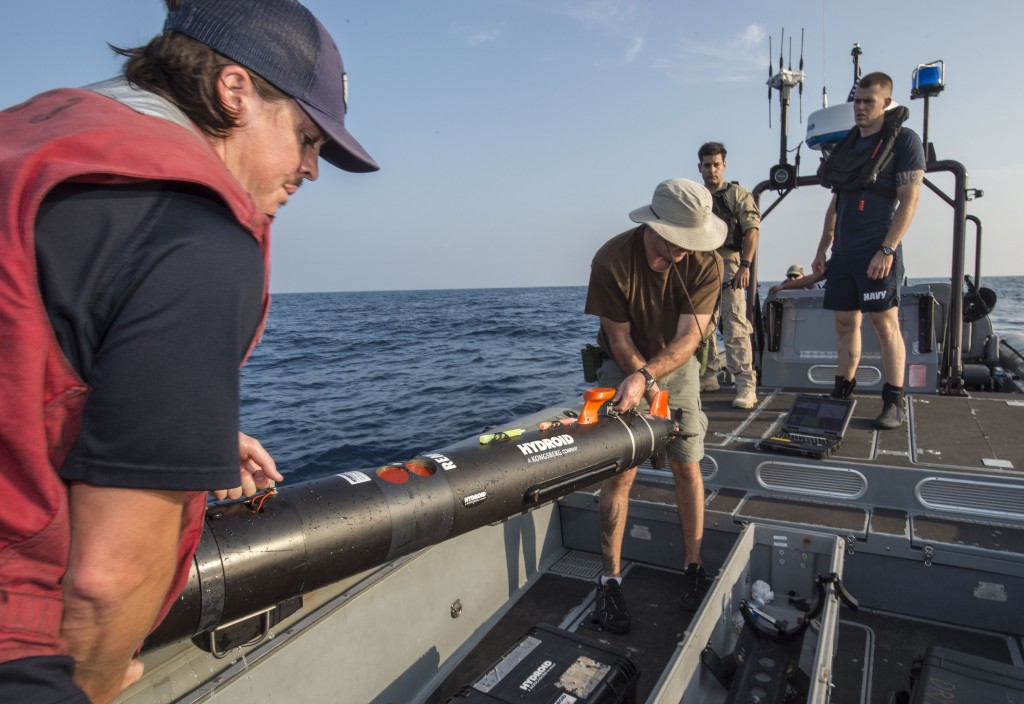
A Kongsberg REMUS 100 unmanned underwater vehicle being retrieved on one of USS Fort Worth LCS 3’s boats in the South China Sea. Much like the Seafox, its speed (~4.5 knots) and endurance are limited and will struggle in areas of high current. U.S. Navy photo.
Of course, MCM vessels cannot conduct the slow and onerous hunt for mines if they are under threat. While the distances of the SoH are large enough to preclude attacks from most Iranian shore howitzers, such is not the case for longer-ranged weapons like anti-ship cruise missiles (ASCMs). ASCMs are, of course, much more expensive than mines or artillery shells – the targets chosen for them must be of high value. While the obvious target choice may be an American aircraft carrier, the reality is that most Iranian ASCMs are of older generations and would likely be easily foiled by USN anti-air systems: the chance of a successful strike is fairly low. Taking a page from the Ottomans, then, Iran would have more success if they were to direct their ASCMs against American and allied MCM vessels. Unarmed and lacking the screen of heavy escorts enjoyed by carriers, current MCM assets would be vulnerable and easily neutralized. Coalition naval forces and civilian traffic, lacking suitable protection from the hidden and deadly mines, would be forced to remain away from the Strait of Hormuz. Unable to achieve freedom of maneuver along all areas of the coast, America’s ability to project power ashore would be significantly limited, with consequences not just in wartime, but peacetime deterrence as well.
CNO Adm. Richardson inspects a Remote Multi-Mission Vehicle, part of the LCS MCM mission package. Despite continued reliability problems, the concept of a long-endurance and relatively high-speed unmanned minehunting vehicle is sound and crucial for a robust modern MCM capability. More conventional unmanned surface vehicles are being considered for the RMMV’s role. U.S. Navy photo.
So how might the USN alleviate this rather dire-looking situation? Firstly, it must recognize that MCM vessels are attractive targets that may be prioritized over capital units like carriers. Accordingly, equip MCM assets with self-defense capability. For all their other faults, the Littoral Combat Ships, destined to be the USN’s next MCM platform, at least have basic self-defence weapons in the form of RAM or SeaRAM. This is a good start, but the centrality of the mine threat means that MCM assets require greater protection. They should not operate unless under the protective umbrella of higher-end surface combatants or air support. There are risks to providing such protection, of course: USS Princeton’s mining in 1991 took place as she was escorting MCM assets[6] – air cover may be preferable.
Secondly, invest greater capital on technologies that will increase the speed of mine-clearing. The Airborne Laser Mine Detection System (ALMDS) has been experiencing difficulties, though many of them appear to have been resolved. It appears to be the only method that has any promise for quickly identifying mines – a MH-60 flying over the ocean is a lot faster than waiting for an underwater drone to swim and scan the area with sonar. Ideally, reinstating the Rapid Airborne Mine Clearing System (RAMICS) and fixing its targeting difficulties would also go a long way towards speeding up the clearing of near-surface mines[7]: if Iran chooses to mine the SoH, the world cannot afford the three years that it took for coalition forces to completely clear Iraqi mines after the 1991 Gulf War. While shipping can probably resume within a few weeks as soon as a transit lane has been cleared, insurance companies will be unlikely to reduce their rates until all mines have been cleared. The need for speed, so to speak, is thus paramount.
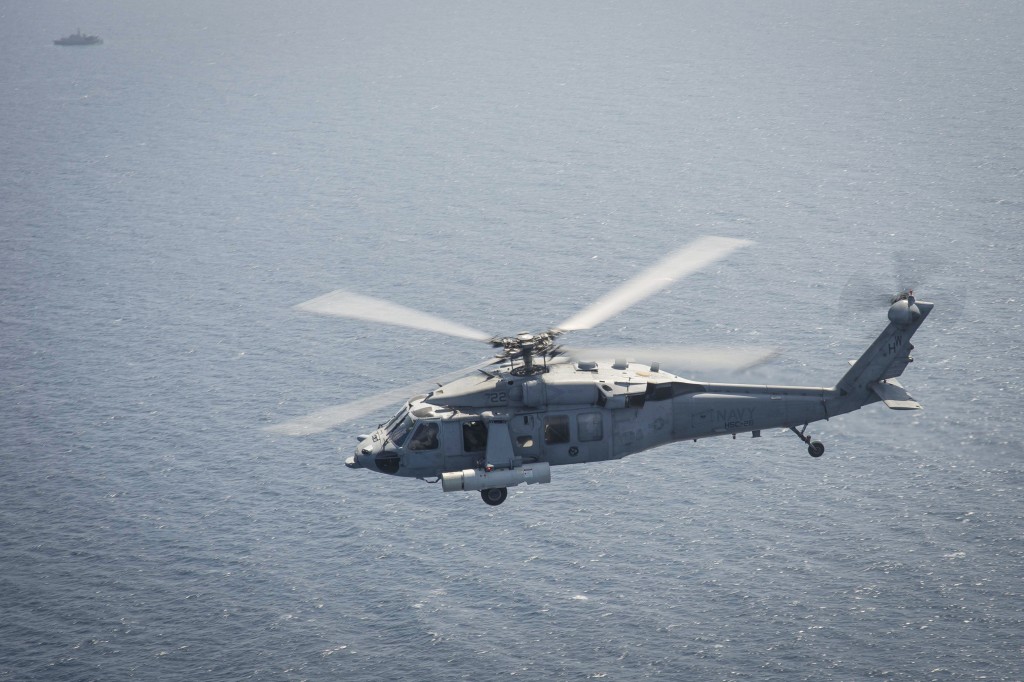
An MH-60S equipped with the Airborne Laser Mine Detection System (ALMDS) flies near Bahrain during the ALMDS’ maiden deployment. The ALMDS will play a crucial role in quickly detecting moored minefields before friendly vessels enter an area, but the helicopter will require protection. U.S. Navy Photo.
Finally, any attempt at clearing the SoH of mines must be accompanied by efforts to ensure that Iran does not use or reuse it shores as staging points for further attack. Such efforts may require ground forces – a modern Gallipoli, as it were. However, given the American war-weariness after Iraq and Afghanistan, a heavy presence of boots on the ground will be highly unlikely, not to mention causing the undesirable landward escalation of a littoral campaign. The advent of unmanned aerial vehicles may well alleviate the problem. Persistent surveillance and prompt overhead precision strikes can ensure that Iranian missile and artillery batteries are unable to maneuver into attack positions. Unlike the howitzers in 1915, hills and valleys will not provide protection.
This essay has identified several difficulties the United States and its allies may face in the event of an Iranian mining of the Strait of Hormuz. It has also offered several areas – technological, tactical, and operational – that coalition forces will need to improve upon or address in order to increase chances of success. In the particular problem of a littoral area-denial operation by a small power against a large navy, mines remain an effective and efficient weapon requiring as much attention as the threats posed by high-tech anti-access platforms.
Timothy Choi is a PhD candidate at the University of Calgary’s Centre for Military, Security, & Strategic Studies. Interested in all areas of maritime security and naval affairs, he struggles everyday with the fact that he studies at an institution located hundreds of kilometres away from the nearest ocean. When not on Twitter (@TimmyC62), he can be found building tiny ship models and plugging away at his dissertation on Scandinavian seapower.
[1] Admiral of the Fleet Lord Keyes, “66. Keyes to his wife,” in 1914-1918, ed. Paul G. Halpern, vol. 1 of The Keyes Papers: Selections from the Private and Official Correspondence of Admiral of the Fleet Baron Keyes of Zeebrugge (London: George Allen & Unwin, 1979), 106.
[2] Paul G. Halpern, A Naval History of World War I (Annapolis: Naval Institute Press, 1994), 117-118; Langensiepen and Güleryüz, The Ottoman Navy, 74;
[5]“Fujairah, UAE: Currents and Tides,” last modified February 2006, http://www.nrlmry.navy.mil/medports/mideastports/Fujairah/index.html; Prasad G. Thoppil and Patrick J. Hogan, ”On the Mechanisms of Episodic Salinity Overflow Events in the Strait of Hormuz,” Journal of Physical Oceanography 39(6): 1348.
[6] U.S. Navy, “21st Century U.S. Navy Mine Warfare,” 14.
[7] Ronald O’Rourke, “Navy Littoral Combat Ship (LCS) Program: Background, Issues, and Options for Congress,” Congressional Research Service, 15.