Category Archives: Strategic Outlook

Predictions and forecasting.

Toward a New Maritime Strategy


Toward a New Maritime Strategy

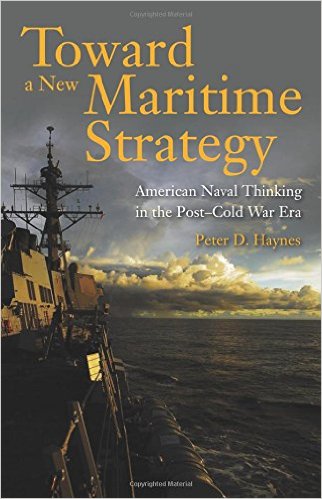
Toward a New Maritime Strategy: American Naval Thinking in the Post-Cold War Era. Peter D. Haynes. Naval Institute Press, 2015. 304pp. $49.95.

Review by James Holmes

Peter D. Haynes has written a singularly useful book for anyone interested in how the American sea services—shorthand for the U.S. Navy, Marine Corps, and Coast Guard—think about, make, and execute maritime strategy. Captain Haynes is a naval aviator, sports a Ph.D. from the Naval Postgraduate School, and serves as deputy director for strategy, plans, and policy at the U.S. Special Operations Command.

Now, it’s doubtful he has penned a bestseller. There just aren’t that many folks out there in the wider reading public inclined to get their navy geek on. That’s a shame. But it should be required reading for readers of these pixels, and for anyone entrusted with devising, prosecuting, or overseeing endeavors on the briny main. It will adorn my bookshelf from henceforth.

So much for the overall verdict. Let me share two big takeaways I culled out of Toward a New Maritime Strategy. First and foremost, this is a venture in self-knowledge. Take it from the ancients: that’s important. Know thyself, commanded an inscription at the entryway to the Greek temple at Delphi, where supplicants went to ask counsel from the god Apollo.

Knowing who we are as the seafaring arm of American foreign policy will alert us to habits of mind and patterns of behavior that prevail within the services. In so doing it helps us glimpse our future while alerting us to pitfalls and obstacles we’re apt to confront. Knowing ourselves is half the battle, as a Chinese sage of famous memory once advised.

Which is a roundabout path back to Haynes’s treatise. As the title advertises, the book is about strategy-making since the fall of the Soviet Union. The author, however, starts by delving into the prehistory to today’s strategic debates. He traces the maladies he discerns to the Cold War’s early days as much as to its endgame. Enamored of its tactical and operational success in the Pacific War, deprived of a peer adversary, and with the U.S. Air Force clamoring for an outsized share of the defense budget for the atomic age, the navy leadership in effect lost its vocabulary for thinking about and debating maritime strategy.

This was an unintended consequence of change in the marine surroundings. The navy commenced deployments around the Soviet periphery unbidden in the immediate post-World War II years. The proportion of sea time in a mariner’s career swelled as a result, making “sustained superior performance at sea” the benchmark of excellence—and thus of promotions, awards, and all manner of good things.

However healthy it may be for seamanship and tactical skill, sea duty affords little leisure for studying larger matters such as diplomacy and strategy. Other factors—the mania for scientific-technical disciplines, increased stovepiping between the surface, submarine, and aviation communities, and on and on—only compounded the career penalties besetting would-be strategic thinkers.

For Captain Haynes, in short, the early Cold War begat an organizational culture unfriendly to strategic thought. Culture is resilient. Oftentimes that’s a good thing. It provides intellectual ballast in tumultuous times.

But it can be a bad thing—as the greats attest. “To change anything in the Na-a-vy is like punching a featherbed,” as Franklin Roosevelt reportedly exclaimed while serving as assistant secretary of the navy during World War I. “You punch it with your right and you punch it with your left until you are finally exhausted, and then you find the damn bed just as it was before you started punching.”

Or as FDR’s secretary of war Henry Stimson joked after World War II, “the peculiar psychology of the Navy Department … frequently seemed to retire from the realm of logic into a dim religious world in which Neptune was God, Mahan his prophet, and the United States Navy the only true Church.”

In Roosevelt’s and Stimson’s spirit, Haynes suggests that navy culture worked against higher-order thought long after the war. Indeed, this failing constitutes a recurring theme as he examines strategy-making efforts spanning from the 1980s through the triservice 2007 Cooperative Strategy for 21st Century Seapower. His account of these enterprises—which gave rise to directives bearing titles like From the Sea and Sea Power 21—is worth perusing at length.

Second, Haynes attests to the hazards of placing inordinate faith in the social sciences when drawing up strategy and designing forces. Exhibit A: the 1991-1992 Naval Force Capabilities Planning Effort. This was the project that resulted in …From the Sea, the navy’s first post-Cold War statement of how it viewed the surroundings and intended to manage them. The planning effort convened a group of senior U.S. Navy and Marine officers and civilian academics.

Group members based their deliberations largely on the “Manthorpe Curve.” This graph, the brainchild of then-Deputy Director of Naval Intelligence Bill Manthorpe, represented an attempt to foretell how the strategic environment would evolve over the coming twenty years. Captain Manthorpe based it on his study of the past, looking at patterns of rise-and-fall and regional flare-ups. He forecast turbulence following the Soviet collapse, intermittent regional threats, and the rise of a potentially hostile empire around 2011.

Schools of thought coalesced around these three intervals: Cold War aftermath, midterm regional troubles, advent of a new peer competitor. Those worried about managing the transition to the post-Cold War world coveted large numbers of inexpensive constabulary-like platforms. Carrier aviators and a few fellow travelers called for pummeling rest-of-world threats selectively to keep them from mutating into global problems. Submariners beseeched the sea services to husband their technological edge, investing in top-end platforms—like attack and ballistic-missile subs—that it would take to face down another Soviet-caliber antagonist.

Such are the demands on a global sea power that feels obliged to manage the system of international trade and commerce, keep a lid on regional troublemaking, and discourage a Eurasian hegemon from challenging the international order it leads.

But isn’t strategy the art of staying in tune with the times? Why not realign strategy and forces to cope with immediate problems rather than hedge against a great-power struggle that may never come? That’s what some members of the Naval Force Capabilities Planning Effort urged. And indeed, …From the Sea in effect codified this view, proclaiming that the U.S. Navy could afford to focus on projecting power ashore because no one threatened its command of the sea.

Yet adapting to new, less trying circumstances is imprudent when it wrong-foots efforts to meet foreseeable challenges of greater consequence later on. For this observer the message that leaps out from the Manthorpe Curve is this: history granted post-Cold War America only a short respite—in historical terms—before the onset of the next great-power challenge. It was imperative to start getting ready then. It takes a long time to regenerate advanced weaponry and adept users—the lineaments of combat power—once those resources lapse. By adapting then, the naval leadership let the material and human capacity for readapting languish.

Think about it from the vantage point of 1991-1992. The generation of commanders destined to face Manthorpe’s next big thing circa 2011 was already in uniform. They were junior to mid-career officers. Having them unlearn the skills and habits needed to wrest maritime command from a serious foe was a decision of colossal moment.

Ships, aircraft, and armaments to wage the new struggle needed to be dreamt up, built, and tested to be ready when a new rival came on scene—meaning now. We’re now scrambling to reinvent capabilities—long-range anti-ship missiles, among many others—that atrophied when history ended a quarter-century ago. Others have disappeared without replacements.

Such insights are scattered throughout Toward a New Maritime Strategy. Lastly, it’s a book reviewer’s sad but sacred duty to join the nattering nabobs of negativity—that is, to find some fault with the work under review. One quick but significant critique. Maritime strategy is about more than naval strategy. It’s even about more than a navy and its corps of sea soldiers. Haynes can be taken to task for neglect on this point.

For the United States, any genuinely maritime strategy should encompass the U.S. Coast Guard, whose commandant, after all, was the third co-signer of the 2007 Maritime Strategy. Yet this sister sea service is largely invisible in Haynes’s account. The tension between this book’s title and subtitle is revealing: Toward a New Maritime Strategy, but American Naval Thinking in the Post-Cold War Era.

There’s more truth-in-advertising in the latter than the former. What was that hybrid constabulary/combat service doing during the era under study, how did its leadership contribute to the making of the Cooperative Strategy, how does the strategy shape its operations, and how does coastguardsmen’s maritime thought resemble and differ from that of fellow seafarers? What changed after 9/11, when the U.S. Coast Guard became an arm of the newly created Department of Homeland Security?

More attention to the coast guard, in short, would have enriched Haynes’s commentary while imparting a truly maritime flavor to it. But I quibble. Opinionated as it is, this book may win Peter Haynes few friends within the naval establishment. One hopes it influences people, nevertheless—reacquainting the services with their cultures, strengths, and foibles as they reenter a competitive age of sea power. Read it.

James Holmes is professor of strategy at the Naval War College and senior fellow at the University of Georgia School of Public and International Affairs. A former U.S. Navy surface warfare officer and combat veteran of the first Gulf War, he served as a gunnery and engineering officer in the battleship Wisconsin, engineering and damage-control instructor at the Surface Warfare Officers School Command, and military professor of strategy at the Naval War College. His most recent books (with long-time coauthor Toshi Yoshihara) are Strategy in the Second Nuclear Age and Red Star over the PacificDesignated an Atlantic Monthly Best Book of 2010, Red Star over the Pacific has been named to the Navy Professional Reading List as Essential Reading. The views voiced here are his alone.

Readers interested in reviewing books for CIMSEC can contact the book review editor at books@cimsec.org.
Call for Articles: Chinese Military Strategy Week, 3-7 Aug 15

Week Dates: 3-7 Aug 15
Articles Due: 29 Jul 15
Article Length: 500-1500 Words
Submit to: nextwar(at)cimsec(dot)org

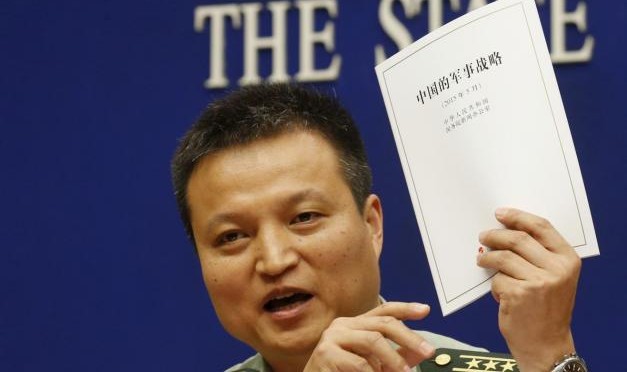
In a watershed moment, the Chinese Ministry of National Defense recently published a white paper on the Chinese Military Strategy (with an English-language version made available and published almost immediately by USNI News). This document lays out a policy for future Chinese military engagement with the world, proclaiming the centrality of active defense as the essence of the Chinese Communist Party’s military strategic thought and then describing an approach for implementing this military policy in the air, cyber, land, and maritime domains. This document comes at a particularly interesting time as General Martin Dempsey, Chairman on the Joint Chiefs of Staff, has since approved a new National Military Strategy for the United States, a strategy that names China explicitly as culpable for increased tension in the Asia-Pacific region and establishes an explicit interactive dynamic between the Chinese and U.S. strategies. While this is not the first time a U.S. National Military Strategy names China as a consideration, the shift in tone here is noteworthy.

During the first week of August, CIMSEC will host a series focused on exploring the relationship between the new Chinese military strategy and the strategic policies of the United States and others. Of particular interest are the dynamics of symmetry and asymmetry in their respective National Military Strategies (ideological, technological, doctrinal, coalitional, etc.); the implicit and explicit assumptions in each; the potentially divergent social and political purposes of such documents given their sources; and the implications for the other elements of national power in China, the United States, and the other actors (state and otherwise) in the international system. If the United States and China were to pursue their stated military strategies in whole or in part, what are the implications for their relative and absolute advantage? What are the acknowledged and unacknowledged risks for each in their stated policies?

Contributions should be between 500 and 1500 words in length and submitted no later than 29 July 2015. Publication reviews will also be accepted.

Eric Murphy is a Strategist and Operations Research Analyst with the United States Air Force and a graduate of the School of Advanced Air and Space Studies.

CIMSEC content is and always will be free; consider a voluntary monthly donation to offset our operational costs. As always, it is your support and patronage that have allowed us to build this community – and we are incredibly grateful.
Select a Donation Option (USD)

Enter Donation Amount (USD)

The Role of Swarm Intelligence for Distributed Lethality C2

This article was submitted by guest author Marjorie Greene for CIMSEC’s Distributed Lethality week.  Ms. Greene is a Research Analyst with CNA.  Views expressed are her own.

What will distributed lethality command and control look like?   This article introduces a self-organizing approach that addresses this question.   The increasing vulnerability of centralized command and control systems in network warfare suggests it may be time to take an entirely new approach that builds on the human capacity to interact locally and collectively with one another. Building on the concept of swarm intelligence, the approach suggests that information could be “shared” in a decentralized control system, much as insect colonies share information by constructing paths that represent the evolution of their collective knowledge.

This article builds on a self-organizing system that was developed for military analyses aimed at finding out “who talks to whom, about what, and how effectively” in a wide range of operational situations featuring the involvement of naval forces and commands. In an effort to describe the content of message traffic throughout the chain of command during a crisis, a technique was used to associate messages with each other through their formal references. “Reference-connected sets” were constructed that required no interpretation of the subject matter of the messages and, when further analyzed, were found to uniquely identify events during the crisis. For example, one set that was constructed from crisis-related message traffic found in files at three command headquarters contained 105 messages that dealt with preparation for landing airborne troops. Other sets of messages represented communications related to other events such as providing medical supplies and preparing evacuation lists. The technique therefore provided a “filter” of all messages during the crisis into events that could be analyzed – by computers or humans – without predetermined subject categories. It simply provided a way of quickly locating a message that had the information (as it was expressed in natural language) that was necessary to make a decision [1].

As the leaders of the Surface Navy continue to lay the intellectual groundwork for Distributed Lethality, this may be a good time to re-introduce the concept of creating “paths” to represent the “collective behavior” of decentralized self-organized systems” for control of hunter-killer surface action groups. Technologies could still be developed to centralize the control of multiple SAGs designed to counter adversaries in an A2/AD environment. But swarm intelligence techniques could also be used in which small surface combatants would each act locally on local information, with global control “emerging” from their collective dynamics. Such intelligence has been used in animal cultures to detect and respond to unanticipated environmental changes, including predator presence, resource challenges, and other adverse conditions without a centralized communication and control system. Perhaps a similar approach could be used for decentralized control of Distributed Lethality.

Swarm intelligence builds on behavioral models of animal cultures. For example, the ant routing algorithm tells us that when an ant forages for food, it lays pheromones on a trail from source to destination. When it arrives at its destination, it returns to its source following the same path it came from. If other ants have travelled along the same path, pheromone level is higher. Similarly, if other ants have not travelled along the path, the pheromone level is lower. If every ant tries to choose a trail that has higher pheromone concentration, eventually the pheromones accumulate when multiple ants use the same path and evaporate when no ant passes.

Just as an ant leaves a chemical trace of its movement along a path, an individual surface combatant could send messages to other surface ships that include traces of previous messages by means of “digital pheromones.” One way to do this would be through a simple rule that ensures that all surface ships are kept informed of all previous communications related to the same subject. This is a way to proactively create a reference-connected message set that relates to an event across all surface ships during an offense operation.

In his book, Cybernetics, Norbert Wiener discusses the ant routing algorithm and the concept of self-organizing systems. He does not explicitly define “self-organization” except to suggest it is a process which machines – and, by analogy, humans – learn by adapting to their environment. Now considered to be a fundamental characteristic of complex systems, self-organization refers to the emergence of higher-level properties and behaviors of a system that originate from the collective dynamics of that system’s components but are not found in nor are directly deducible from the lower-level properties of the system. Emergent properties are properties of the whole that are not possessed by any of the individual parts making up that whole. The parts act locally on local information and global order emerges without any need for external control.

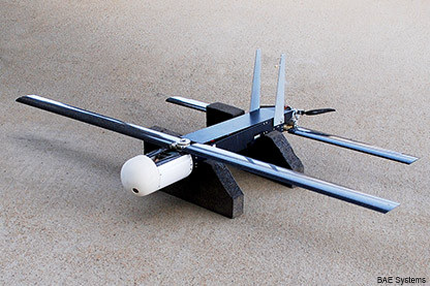
The Office of Naval Research has recently demonstrated a new era in autonomy and unmanned systems for naval operations that has great promise for Distributed Lethality. The LOCUST (Low-Cost UAV Swarming Technology) program utilizes information-sharing

The Coyote UAV, developed by BAE, used by the LOCUST program

between UAVs to enable autonomous collaborative behavior in either defensive or offensive scenarios. In the opinion of this author, this program should be analyzed for its potential application to Distributed Lethality.

Professor Vannevar Bush at MIT was perhaps the first person to come up with a new way of thinking about constructing paths for information-sharing. He suggested that an individual’s personal information storage and selection system could be based on direct connections between documents instead of the usual connections between index terms and documents. These direct connections were to be stored in the form of trails through the literature. Then at any future time the individual himself or one of his friends could retrieve this trail from document to document without the necessity of describing each document with a set of descriptors or tracing it down through a classification tree [2].

The current response to the dilemmas associated with command and control in any distributed operation has led this author to embrace the concept of swarm intelligence. Rather than attempting to interpret the subject matter of information exchanged by entities in confronting an adversary, why not build control systems that simply track information “flows”? Such flows would define the subject matter contained in a naval message without having to classify the information at all.

Any discussion of command and control would be incomplete without including the concept of fuzzy sets, introduced by Professor Lotfi Zadeh at the University of California, Berkeley in 1965. The concept addresses the vagueness that is inherent in most natural language and provides a basis for a qualitative approach to the analysis of command and control in Distributed Lethality. It is currently used in a wide range of domains in which information is incomplete or imprecise and has been extended into many, largely mathematical, constructions and theorems treating inexactness, ambiguity, and uncertainty. This approach to the study of information systems has gained a significant following and now includes major research areas such as pattern recognition, data mining, machine learning algorithms, and visualization, which all build on the theoretical foundations established in information systems theory [3].

Ultimately, the information paths constructed for the control of Distributed Lethality will be a function of organizational relationships and the distribution of information between them. Since a message in a path cannot reference a previous message unless its originator is cognizant of the previous message, the paths in a “reference-connected set” of messages will often reflect the information flows within a Surface Action Group. When paths are joined with other paths, the resulting path often reflects communications across Surface Action Groups. It remains to be determined whether the Surface Navy can use these concepts as it continues to explore the intellectual groundwork for Distributed Lethality. Nevertheless, it is very tempting to speculate that swarm intelligence will play an important role in the future. The most important consideration is that this approach concentrates on the evolution of an event, rather than upon a description of the event. Even if a satisfactory classification scheme could be found for control of hunter-killer Surface Action Groups, the dynamic nature of their operations suggests that predetermined categories would not suffice to describe the complex developments inherent in evolving and potentially changing situations.

Many organizations have supported research and development designed to explore the full benefits of shared information in an environment in which users will be linked through interconnected communications networks. However, in the view of this author, the model of “trails of messages” should be explored again. “Network warfare” will force an increased emphasis on human collaborative networks. Dynamic command and control will be based on communications paths and direct connections between human commanders of distributed surface ships rather than upon technologies that mechanically or electronically select information from a central store. Such an approach would not only prepare for Distributed Lethality, but may improve command and control altogether.

Ms. Greene is a Research Analyst with CNA. Views expressed are her own. 

REFERENCES:

  1. Greene, , “A Reference-Connecting Technique for Automatic Information Classification and Retrieval”, OEG Research Contribution No. 77, Center for Naval Analyses, 1967
  2. Bush, V., “As We May Think”, Atlantic Monthly 176 (1):101-108, 1945
  3. Zadeh, L.,” Fuzzy sets”, Information Control 8, 338-353, 1965
CIMSEC content is and always will be free; consider a voluntary monthly donation to offset our operational costs. As always, it is your support and patronage that have allowed us to build this community – and we are incredibly grateful.

Select a Donation Option (USD)

Enter Donation Amount (USD)

Airborne Over The Horizon Targeting Options to Enable Distributed Lethality

This article was submitted by guest author Michael Glynn for CIMSEC’s Distributed Lethality week. 

The Navy’s surface warfare community is committed to remedying its lack of anti-surface warfare (ASuW) punch with the concept of Distributed Lethality. “If it floats, it fights,” is the rallying cry.[1] Dispersed forces operating together pose challenges for an adversary, but also create targeting difficulties we must solve.

The detection range of shipboard sensors is limited by their height above the waterline and the curvature of the earth. Since it appears doubtful leaders would call on a ship to steam into visual range of adversaries, airborne assets are most likely to provide over the horizon (OTH) targeting.

In a January 2015 article in Proceedings, Vice Admiral Rowden, Rear Admiral Gumataotao, and Rear Admiral Fanta reference “persistent organic” air assets as key enablers of Distributed Lethality.[2] While a completely organic targeting solution offers opportunities in some scenarios, it has limits in high-end contingencies. In empowering the surface force, let us not ignore inorganic air assets. Distributed Lethality is far more effective with them.

TASM: A Cautionary Tale

During a January 2015 test, a Tomahawk Block IV test missile received in-flight updates from an aircraft and impacted its target, a mock cargo ship near the Channel Islands of California.[3] “This is potentially a game changing capability for not a lot of cost,” said Deputy Secretary of defense Bob Work. “It’s a 1000 mile anti-ship cruise missile.”[4]

But this test did not solve the fleet’s ASuW problem. Nor was it the first time the service had used Tomahawk in an anti-shipping role. To understand the difficulty of OTH targeting, we have to examine the final days of the Cold War.

In the late 1980’s, various ships and submarines carried the radar guided Tomahawk Anti-Ship Missile, or TASM. The TASM boasted a range of over 200 nm. But because TASM was subsonic, it took as long as 30 minutes to reach its target. In this time, a fast warship could steam as far as 15 miles from its initial location. Additionally, neutral shipping could inadvertently become the target of the seeker if the enemy vessel was not the closest to the missile when the radar activated.

Therefore, TASM could only reliably be used when there was no neutral shipping around, or in a massive conflict where collateral damage considerations were minimal. The Navy sought to remedy this by developing OTH targeting systems known as Outlaw Hunter and Outlaw Viking on the P-3 and S-3 aircraft. But with the demise of the Soviet Union, massive defense cuts and the evaporation of any blue water surface threat led to the retirement of TASM.

OTH targeting is not a new problem. To solve it, airborne platforms are critical. Let’s examine the organic and inorganic assets that can fill these roles. We will then discuss how inorganic assets offer the most promise.

Organic Assets: Benefits and Limitations

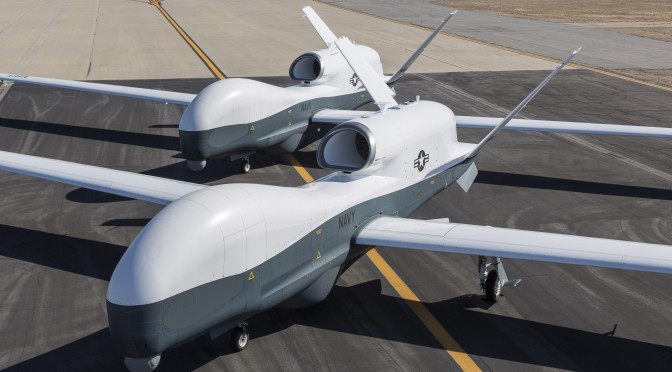
The surface force is equipped with rotary and fixed wing assets to enable OTH targeting. From a sensors standpoint, the MH-60R is most capable. Its inverse synthetic aperture radar (ISAR) can identify ships from long range, but it is limited in altitude and radar horizon. MQ-8 UAV’s offer increased endurance over manned assets. Their maximum altitudes are higher, but still constrain sensor range. The RQ-21 fixed wing UAV rounds out this group. It has solid endurance, but very limited speed.

The limited speed and altitude capabilities of these aircraft mean that the area they can search is small. Also, they must operate well within the weapons engagement zone of their targets to identify their prey. If these sensors platforms are radiating, a capable adversary will hunt them down or lure them into missile traps and destroy them in an effort to deny our forces a clear targeting picture.

Large Fixed Wing Assets: Increased Capability

While not organic to a surface action group, fixed wing aircraft bring speed, altitude, and persistence to the fight. P-8 and P-3 patrol aircraft offer standoff targeting and C5I capabilities. So too do the MQ-4 UAV and the E-8 JSTARS aircraft.

The carrier air wing brings blended detection and OTH targeting capabilities. The E-2 lacks ISAR identification capability, but does boast a passive electronic warfare (EW) suite and the ability to coordinate with the powerful EW system onboard EA-18G aircraft.  Additionally, the latest E-2 model can pass targeting quality data to surface ships to allow them to engage from the aircraft’s track, significantly increasing the ship’s effective missile envelope.

These platforms are expensive and limited in number, but their altitude capability and resulting sensor range allows them to standoff further from the enemy, radiating at will. Additionally, their high dash speed allows them to better escape targeting by enemy fighter aircraft. Their speed, persistence, sensor coverage, and survivability make them logical targeting platforms. They are far more capable and enable better effects than shipboard rotary assets and UAV’s.

Stand-in Stealthy Aircraft: The Ultimate Targeting Asset

The ultimate platform to provide targeting updates to long-range ASCM’s would be a stealthy UAV similar to the RQ-170.[5] Such an aircraft could receive cueing from other platforms, an onboard EW suite, or its own low probability of intercept (LPI) radar.[6] Able to stand in, it could provide visual identification, satisfying rules of engagement. It could provide target updates via a LPI datalink to inbound weapons. These technologies have their roots in the “Assault Breaker” initiative that led to the creation of the Tacit Blue test aircraft and the rise of modern stealth technology.[7],[8] Similar radars, datalinks, and low observable platforms have been proven and are flying today in various forms.[9]

Cost of a new platform is high, but their ability to get close and persist while unobserved is very useful and provides high confidence visual identification to commanders. Their survivability removes the need to provide airborne early warning (AEW) and high value airborne asset protection. Their stealth frees AEW aircraft and fighters to focus their energies elsewhere.

Conclusion

The concept of Distributed Lethality offers promise, but will be limited if its scope is confined to only utilizing capabilities resident in the surface fleet. It is best to pursue organic capabilities while also integrating inorganic assets when planning how the fleet will fight the conflicts of tomorrow. Let us pursue solutions that incorporate forces from many communities to best meet future warfare challenges.

Lieutenant Glynn is a Naval Aviator and a graduate of the University of Pennsylvania. He most recently served as a P-8 instructor pilot and mission commander with Patrol Squadron (VP) 16. He currently flies the T-45 with Training Squadron (VT) 21. He is a member of the CNO’s Rapid Innovation Cell. The views expressed in this article are entirely his own.  

Recommended photos illustrations:

[1] Sydney J. Freedberg Jr., “’If it Floats, it Fights’: Navy Seeks ‘Distributed Lethality’,” Breaking Defense, January 14, 2015, http://breakingdefense.com/2015/01/if-it-floats-it-fights-navy-seeks-distributed-lethality/.

[2] Thomas Rowden, Peter Gumataotao, Peter Fanta, “Distributed Lethality,” Proceedings Magazine, January 2015, Vol. 141, http://www.usni.org/magazines/proceedings/2015-01/distributed-lethality.

[3] “Tomahawk Hits Moving Target at Sea,” Raytheon Company, February 10, 2015, http://www.raytheon.com/news/feature/tomahawk_moving_target_sea.html.

[4] Sam LaGrone, “WEST: Bob Work Calls Navy’s Anti-Surface Tomahawk Test ‘Game Changing’,” USNI News, February 10, 2015, http://news.usni.org/2015/02/10/west-bob-work-calls-navys-anti-surface-tomahawk-test-game-changing.

[5] “RQ-170,” U.S. Air Force Fact File, December 10, 2009, http://www.af.mil/AboutUs/FactSheets/Display/tabid/224/Article/104547/rq-170-sentinel.aspx.

[6] Aytug Denk, “Detecting and Jamming Low Probability of Intercept (LPI) Radars,” Naval Post Graduate School, September 2006, http://dtic.mil/dtic/tr/fulltext/u2/a456960.pdf.

[7] Robert Tomes, “The Cold War Offset Strategy: Assault Breaker and the Beginning of the RSTA Revolution,” War on the Rocks, November 20, 2014, http://warontherocks.com/2014/11/the-cold-war-offset-strategy-assault-breaker-and-the-beginning-of-the-rsta-revolution/.

[8] “Northrop Tacit Blue,” National Museum of the U.S. Air Force, March 9, 2015, http://www.nationalmuseum.af.mil/factsheets/factsheet.asp?id=353.

[9] Kelley Sayler, “Talk Stealthy to Me,” War on the Rocks, December 4, 2014, http://warontherocks.com/2014/12/talk-stealthy-to-me/.

CIMSEC content is and always will be free; consider a voluntary monthly donation to offset our operational costs. As always, it is your support and patronage that have allowed us to build this community – and we are incredibly grateful.

Select a Donation Option (USD)

Enter Donation Amount (USD)