Category Archives: Current Operations

On-going Naval Ops or Maritime Current Events

Becoming a Maritime Power? – The First Chinese base in the Indian Ocean

Guest post for Chinese Military Strategy Week by Xunchao Zhang

In May 2015, it was reported that China was going to establish a naval base in the East African nation of Djibouti. In the past, there has been much talk about Chinese overseas bases, but the Chinese official response to this news suggest the base is likely to be more than a rumor. The Chinese Foreign Ministry did not deny the report but instead stated that “Regional peace and stability serves the interests of all countries and meets the aspirations shared by China, Djibouti and other countries around the world. The Chinese side is ready and obliged to make more contributions to that end.” Likewise, the Chinese Defense Ministry also expressed China’s willingness to “make even more contributions” to peace and stability of the region. More directly, the official Xinhua News Agency has argued that time is ripe for a base in Djibouti. The talk of a Chinese naval base in Djibouti seems to confirm a 2014 report from Washington predicting the establishment of Chinese “dual-use” bases in the Indian Ocean serving both commercial and security functions. All of this brings to mind three questions: First, why would China choose to increase its Indian Ocean presence? Second, what is the strategic environment in which China has to operate? And third, what are the strategic implications for Sino-U.S. strategic interactions and China’s maritime strategy?

Strategic Rationale         

The increasing importance of the Indian Ocean to vital Chinese maritime interests form the rationale of having a Chinese base in the area. Although the official white paper “China’s Military Strategy” did not explicit confirm an out-of-area naval base, it did designate several reasons requiring the People’s Liberation Army Navy’s (PLAN) presence in Indian Ocean. A base in the Horn of Africa is consistent with the strategic shift from solely “offshore waters defense” to a combined “offshore waters defense” and “open seas protection.”

The white paper states that the “traditional mentality that ‘land outweighs sea’ must be abandoned” especially regarding sea lines of communication (SLOCs), of which, exports of manufactured goods and crude oil imports are paramount. Since a significant share of these rely on Indian Ocean sea lines, an out-of-area naval presence is almost a necessity. The February PLAN exercise in Lombok Strait sent a strong signal of the increasing Chinese naval footprint in the Indian Ocean. Moreover, the PLAN has responded to several non-traditional security contingencies near the Horn of Africa. For instance, the PLAN has conducted a series of evacuation operations in the nearby states of Yemen, Libya, and Syria. China has also operated in the Gulf of Aden as a part of the international anti-piracy force since 2008. The official white paper states that the abilities and experiences in dealing with non-traditional challenges should be extended into traditional security areas.
Strategic environment

Multiple political and economic factors shape China’s rather favorable environment in the Indian Ocean region. One of the most significant is the lack of direct geopolitical tensions with the regional states. In contrast to the situation in the West Pacific, where China had a wide range of maritime territorial disputes with its neighbors in the South and East China Seas, China has far more cooperative relations with most states in the Indian Ocean region. Beijing not only has strong partnerships with countries like Pakistan but robust commercial and political ties with African states as well.

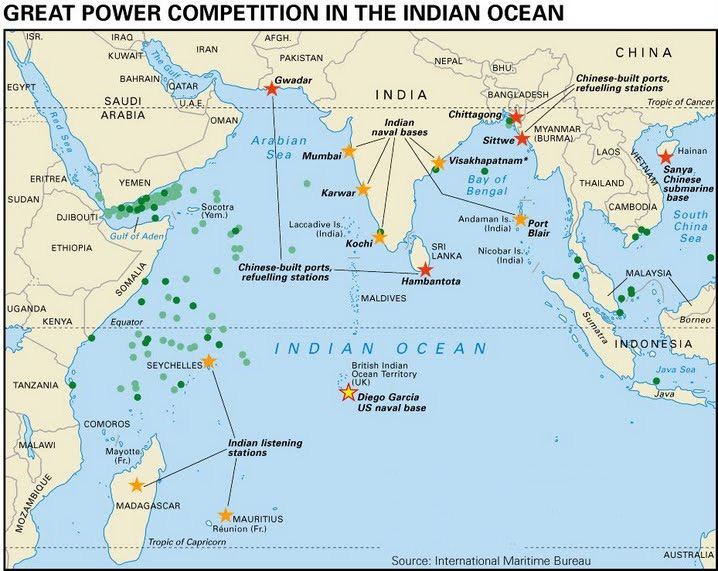
Under the Xi administration, China has placed greater economic emphasis on the Indian Ocean region. For instance, the recently announced ‘Maritime Silk Road’ involves connecting East Asia with Indian Ocean economies such as India, Pakistan, Kenya and others via the promotion of maritime trade and investment in port infrastructures. Indian analysts have dubbed this the “String of Pearls.” Although the “String of Pearls” concept is an exaggerated reading of largely commercial Chinese infrastructure investments in the Indian Ocean, the scope of Chinese port building does reveal Chinese economic-political weight in the area.
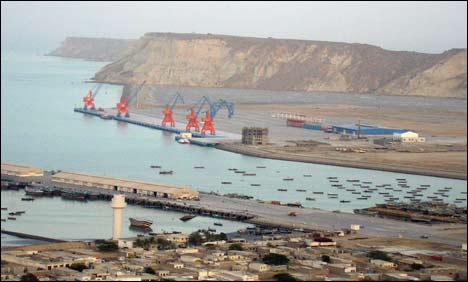
Port in Gwadar, Pakistan.

Many international media observers have zealously pointed out the “conflict” between China’s new overseas base strategy with China’s non-interventionist principles. However, overseas basing is not necessarily incompatible with the principle of non-intervention, as long as base arrangements and military deployments are based upon agreement with rather than coercion of foreign governments. A naval base is also irrelevant to the domestic politics of the state where base is to be located. Hence, in technical sense, it is possible for china to establish overseas bases while maintaining the non-intervention principle at the same time.

Strategic Implications

Realistically speaking, China has a long way to go if it is to fulfill the objectives outlined in the recent defense white paper. China would have to overcome not only the overall capability gap with the U.S., but also the lack of experience in running overseas bases, as well as the doubts concerning the cost-benefit calculus of overseas bases. Comparatively, the U.S. military has operated from its own Djibouti base, Camp Lemonnier, during a variety of naval and counter-terrorism missions since 2001. The U.S. base has more than 4,000 personnel and is likely to be much larger and more functionally comprehensive than the potential first Chinese base. Furthermore, as mentioned in the 2014 NDU report, some voices in China are rather skeptical of overseas bases citing concerns about the principle of non-intervention and the possibility of foreign opposition. Therefore, there is possibility that the function of a first Chinese overseas base in Djibouti would be deliberately kept small to avoid controversy. In addition, even in the official white paper, the goal of transformation from “offshore defense” to “open sea protection” remains a limited one, reflecting the Chinese awareness regarding its own limited power projection capabilities.

In terms of overseas naval operations, the Chinese defense strategy white paper clearly took a reassuring tone emphasizing the cooperative and non-confrontational nature of PLAN open sea protection, and SLOCs security objectives. Chinese naval presence in the Indian Ocean region is neither intended to nor sufficient to pose challenge to the current maritime order. But it does indicates an increasing determination on Beijing’s part to provide security for its own overseas interests rather than merely relying on the “public goods” provided by the U.S. Navy. In this sense, China’s increasing Indian Ocean presence, though insufficient to trigger real strategic competition between the United States and China, is certainly feeding the popular narrative of global Sino-US competition in the media.

In sum, the strategic move towards an overseas base is part of the continuation of changing Chinese strategic culture that is increasingly outward-looking and maritime-oriented. But if the base in Djibouti is to be materialized, even in its most limited form, it is certainly a transformative moment in the strategic cultural shift. The increasing PLAN overseas presence, particularly in the India Ocean region is almost a foregone conclusion. However, it depends on how the PLAN is able to deal with its growing pains, the extent and effectiveness of which remain to be seen.

Currently working for the Australian Institution of International affairs, Xunchao Zhang is an observer of Chinese defense and foreign policy, Zhang is also the sub-editor of ACYA journal of Australia-China Affairs. He has been an intern at the Sea Power and Centre Australia, a guest correspondent of China Radio International, and a member of CIMSEC.
 CIMSEC is and always will be free for everyone, but we would be grateful for those who wish to provide a modest regular donation to support our operations.
Select a Donation Option (USD)

Enter Donation Amount (USD)

China’s Yuan-class Submarine Visits Karachi: An Assessment

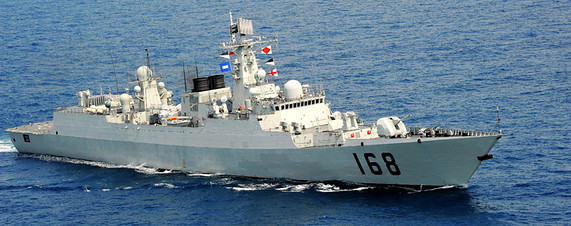
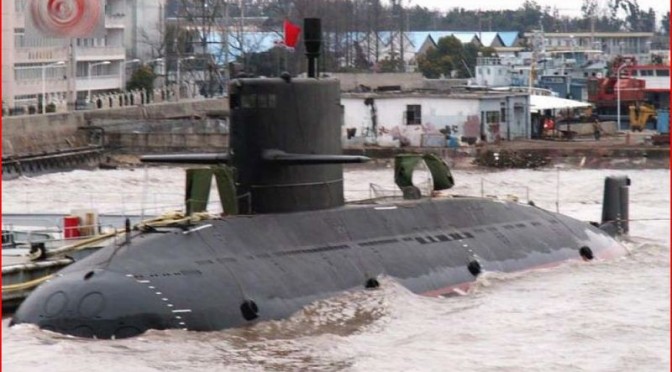
In May 2015, a Chinese Type 041 Yuan-class submarine (pennant number 335) entered the Indian Ocean and made a week-long port call at Karachi, Pakistan. This development caused alarm in India, at least in the media circles, particularly since it comes barely six months after the first-ever Indian Ocean deployment of China’s Song-class submarine between September and November 2014, and its docking in Sri Lanka’s Colombo port. Notably, following the Colombo docking, NMF view-point titled “PLA Navy’s Submarine Arm ‘Stretches its Sea Legs to the Indian Ocean” of 21 November 2014 had predicted future Chinese submarine dockings in Pakistan’s ports. These seminal developments call for an objective assessment in terms of China’s intent underlying its submarine deployments in the Indian Ocean and its implications for India.

Alike the port call in Sri Lanka, China is likely to justify the submarine visit to Pakistan as a replenishment halt enroute to PLA Navy’s ongoing counter-piracy mission in the Gulf of Aden. However, these deployments may be seen in context of the growing volatility of the security environment in the South China Sea, including the increasing brinkmanship between China and the United States. In case of a maritime conflict in the area, China’s energy shipments transiting the Indian Ocean are strategically vulnerable. Through its submarine deployments, China may be seeking to deter its potential adversaries against interdicting its Sea Lines of Communication (SLOC) in the Indian Ocean.

Route of the Yuan class submarine.

By virtue of its opaque operating medium, a submarine has always been a potent platform of war. The technological advances in satellite and air surveillance have not been able to offset the submarine’s inherent advantage of stealth. On the other hand, the advances in underwater weaponry – particularly submarine-launched anti-ship and land-attack missiles – have further enhanced the submarine’s lethality. The only constraint of a conventional (diesel-driven) submarine – like the Song-class – is to re-charge its batteries, for which its need to come up to the sea surface (for access to atmospheric oxygen) every two or three days, depending upon the usage of the batteries. This limits the submarine’s operational role and makes it highly vulnerable. However, Air Independent Propulsion (AIP) technology – such as on the Yuan class – has eased this constraint substantially, since its stored liquid oxygen enables the submarine to operate underwater for an extended durations of as much as two to three weeks.

Among the aims specific to the Yuan 335 call at Karachi, the foremost may be to showcase the Yuan to the Pakistan Navy. Notably, news-reports indicate that Pakistan Navy (PN) is likely to acquire up to eight Chinese Type 41 Yuan-class submarines. The contract between Karachi Shipyard and Engineering Works Limited (KSEW) and China Shipbuilding and Offshore International Co. Ltd. (CSOC) includes building some of these at KSEW. These submarines are equipped with Sterling AIP system, which the Chinese claim is more efficient than the AIP systems currently available in the world. The week-long docking of the Yuan at Karachi – too long merely for replenishment – may also have been utilised for training of the KSEW and PN personnel on the submarine, and its machinery and weapon systems, particularly the AIP system.

In broader terms, the two sets of Chinese submarine forays into the Indian Ocean (Colombo and Karachi) are likely to be ‘trial balloons’ for regular operational deployments of Chinese submarines in the region. The current deployments are also likely to be meant to familiarise the PLA Navy with the new operational environment in the Indian Ocean, train them for distant missions, collect intelligence, and collate hydrographic data specific to the Indian Ocean, which is essential for future submarine operations in the region. At present, the Chinese submarines need to replenish only fuel, food and fresh water. In the longer term, with the PN (and some other regional navies such as the Thai Navy) operating the same submarines, the PLA Navy is likely to benefit from a more comprehensive logistics support – technical services, machinery and equipment spare-parts and even ammunition. This will enable the Chinese submarines to remain deployed in the Indian Ocean for extended periods.

While China may continue to deploy its conventional submarines in the Indian Ocean, these are likely to be supplemented with the upgraded version of its new-generation Type 093 nuclear attack submarines (SSNs), whenever these are operationally deployable. These SSNs are likely to be armed with anti-ship and land-attack missiles, and capable of launching Special Operations Forces (SOF) via Swimmer Delivery Vehicles (SDV). Since SSNs do not need replenished, these submarines would not need to enter any regional port, unless China wants to demonstrate a deterrent posture.

China and India share a complex relationship, competitive, and even potentially adversarial. Hence, even if increasing Chinese submarine deployments in the Indian Ocean is not directly targeted at India, the development has severe national security implications for New Delhi. The response to increasing Chinese submarine forays in the Indian Ocean lies in developing affective air, ship and submarine based Anti-Submarine Warfare (ASW) capabilities, including sub-surface Maritime Domain Awareness (MDA).

Captain Gurpreet S Khurana, PhD is the Executive Director, National Maritime Foundation, New Delhi. The views expressed are his own and do not reflect the official policy or position of the Indian Navy, the NMF or the Government of India. He can be reached at gurpreet.bulbul@gmail.com.

CIMSEC content is and always will be free; consider a voluntary monthly donation to offset our operational costs. As always, it is your support and patronage that have allowed us to build this community – and we are incredibly grateful.
Select a Donation Option (USD)

Enter Donation Amount (USD)

Damen’s Presence in the Latin American and Caribbean Market, Part 2

By W. Alejandro Sanchez

Selling To Everyone

The list of Damen’s current clients in the Western Hemisphere highlights one curious fact about this company: the Dutch company sells its equipment to both U.S. allies and foes alike. Certainly, Washington sees no fault in Damen’s decision to upgrade Mexico’s naval equipment. On the other hand, the U.S. government probably frowns at Damen equipping countries that Washington is at odds with, such as Venezuela (which was declared a national security threat by the White House this past March). Similarly, Damen’s shipyard in Cuba, a country that was on the U.S. State Department’s list of states that sponsor terrorism until this past May, is not considered a positive development in Washington.

Nevertheless, Damen has remained neutral in Western Hemisphere geopolitics, as it has dealt with any government willing to pay. This issue deserves further analysis by stating two obvious facts: the U.S. and the Netherlands have generally enjoyed good security relations over the past decades, and Damen is a privately-owned company, which means that the Dutch government has limited influence in the contracts and initiatives it chooses to carry out. With that said, it is bizarre that Damen chose to build a shipyard in a country that has been at odds with the U.S. for decades, and is also selling vessels to countries like Ecuador and Venezuela, which have become a thorn on Washington’s side for years (in the case of Caracas’ for a decade and a half). Certainly, Damen does not need to take into account U.S. foreign policy in its business decisions, but it is nevertheless important to keep in mind how the sale of military equipment can upset regional geopolitics, particularly if this equipment is sold to nations that have carried out aggressive foreign policies in recent years (i.e. Venezuela).

Damen is Important, But Not A Pillar

While Damen has made a name for itself in the Latin American and Caribbean market, the shipbuilding company has not fully cornered this market, as it still faces a number of competitors.

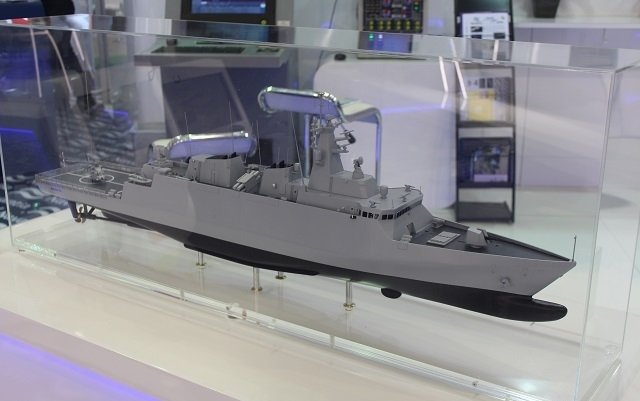
One of Damen’s major competitor is Navantia. The Spanish company has been trying to sell Peru its frigate F-538 model as well as attempting to sell Colombia (and Peru) its F-110 frigate. The company already has a strong presence in the region, best exemplified by a 2013 contract to upgrade the motor system of a Brazilian corvette, the “Julio de Noronha.” Government-to-government exchanges are also common as South Korea has donated one of its corvettes, the now-called “ARC Nariño,” to Colombia. The Donghae-class vessel served in the Republic of Korea Navy for 27 years before it was given to the South American state.

Navantia Warship. Source: Navyrecognition.com.

Finally, the know-how of Latin American military industries is improving. Case in point, the Peruvian shipyards Servicios Industriales de la Marina (SIMA) is currently constructing a new training vessel for the Peruvian Navy, the “BAP Union” – a project worth around $50-55 million USD. Moreover, with support from the Daewoo International Corporation and the Korea Trade-Investment Promotion Agency, SIMA is building a new multi-purpose vessel for its Navy.

These examples stress how competitive the shipbuilding industry is in Latin America. Not only are there several major companies trying to sell brand new warships, but governments are also donating surplus naval technology. Furthermore, regional shipyards are rapidly improving their knowledge when it comes to shipbuilding, as we now have modern shipyards in countries like Colombia, Ecuador, Mexico, Peru and Venezuela  that are constructing their own vessels.

In fact, countries like Ecuador, Mexico and Venezuela want Damen to construct some vessels in their own shipyards in order for local technicians to learn from Damen’s experts. Certainly, none of these facilities are in a position to build a ship as complex as a carrier, but they can now construct smaller vessels, like patrol boats or support ships.

What this means for a company like Damen is that while it will continue to enjoy new contracts for the immediate future, it will have to continue developing more modern and improved equipment that its Latin American and Caribbean clients cannot purchase, maybe at a better price, from other suppliers, or even construct themselves in the not-so distant future.

A Need for Stronger Naval Forces

As transnational crime over the Caribbean Sea and other maritime crimes, such as illegal fishing, continue throughout Latin America and the Caribbean, it has become a major priority for regional states to have modern and capable navies and coast guards in order to protect their exclusive economic zones.

Certainly, it can be argued that the current purchases of some naval technologies are generally unnecessary, given that the region has enjoyed inter-state peace for decades (the last inter-state war in the region was in 1995 between Peru and Ecuador, while the last conflict with naval warfare was the 1982 Falklands/Malvinas War between Argentina and the United Kingdom). Moreover, while transnational crime remains a persistent problem, Latin America has enjoyed cooperation at the inter-state level for two decades (the 2008 Colombia-Venezuela incident notwithstanding). Given this period of peace, some may argue that these defense dollars would be better spent in social programs, especially since many Latin American nations, including Damen-clients like Honduras, are very poor and underdeveloped.

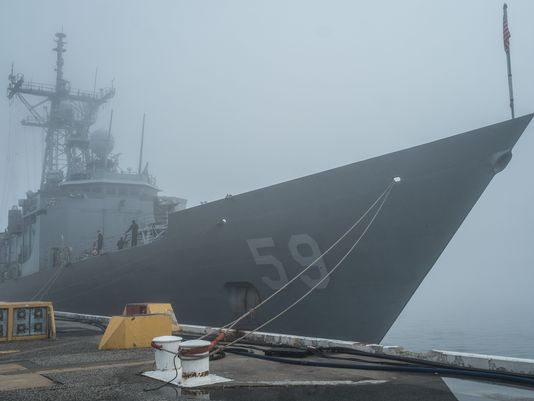
Unfortunately, the reality is different. First, Latin American and Caribbean nations must have some capabilities for deterrence as inter-state tensions continue, such as between Peru and Chile or even the aforementioned 2008 incident between Colombia and Venezuela. Second, transnational drug trafficking remains a major problem from Mexico to Argentina, particularly throughout the Greater Caribbean waters as cocaine is transported from Colombia and Venezuela to the U.S. and Mexico markets. Just last May, the U.S. Coast Guard and the USS Kauffman (FFG 59) interdicted almost 1,800 kilograms of cocaine in the Eastern Pacific.

USS Kauffman. Source: Mark D. Faram/Staff.

Hence, it is necessary for Latin American and Caribbean naval forces, including their coasts guards, to have fast and technologically advanced vessels for both internal and regional security – which in turn would diminish their dependence on U.S. security aid. In this sense, the involvement of companies like Damen and Navantia in the Western Hemisphere is a necessity (at least until regional states can build their own high-tech vessels).

Final Thoughts

In recent years the Dutch shipbuilding company Damen has made a name for itself as a provider of high-tech, fast vessels, from multipurpose boats to coast guard speedboats, for various Latin American and Caribbean states. Their clients include nations with small defense budgets like Honduras and Trinidad & Tobago, to major buyers like Mexico and Venezuela. Nevertheless, Damen has not cornered these region’s shipbuilding markets, as there are several other companies selling their products, such as the Spanish Navantia, in addition to regional states enjoying growing maritime defense industries.

Moreover, while Damen’s sales to the region have generally controversy-free, the incident over the overpriced vessels sold to Honduras highlights the potential for corruption, i.e. kickbacks, in countries renowned for lacking good governance. I have been unable to confirm if there were other similar discrepancies in Damen’s other contracts in the Western Hemisphere. Nevertheless, countries like Venezuela are known for their lack of transparency (case in point, the billions of petro-dollars spent by Caracas to purchase Russian military technology) while Mexico is infamous for its corrupt state-run oil company, PEMEX. Given these precedents, there are valid reasons for concern over Damen’s deals with its Latin American and Caribbean clients.

Ultimately, the question comes down to whether the region requires new vessels. Inter-state conflict may be scarce, but it remains a possibility given recent tensions between regional nations (i.e. Venezuela and Colombia, Peru and Chile or currently between Venezuela and Guyana). Thus, it is necessary for nations to maintain capable deterrent capabilities. Additionally, these states must have strong navies and coast guards to crack down on maritime crimes that range from illegal fishing to transnational drug trafficking.

In 2015, the waters along Latin American and Caribbean states are far from peaceful and Damen’s vessels, while not the cornerstone of regional navies, are an important addition to hemispheric maritime security.

Read Part One here.

W. Alejandro Sanchez is a Senior Research Fellow at the Council on Hemispheric Affairs (COHA) where he focuses on geopolitics, military and cyber security issues in the Western Hemisphere. His research interests include inter-state tensions, narco-insurgent movements and drug cartels, arms sales, the development of Latin American military industries, UN peacekeeping operations, as well as the rising use of drones (UAVs) for civilian and security uses in Latin America. Twitter: @W_Alex_Sanchez

Damen’s Presence in the Latin American and Caribbean Market, Part 1

By W. Alejandro Sanchez

Though shipbuilding is a competitive global industry, one company has become a major provider to the naval forces (coast guards included) of various Latin America and Caribbean states: Damen Shipyards Group. Damen is now a household name among Latin American and Caribbean navies as it provides multi-purpose vessels, patrol boats and speed boats. These sales have enhanced the capabilities of Damen’s clients as they face transnational threats.

While the defense budgets of Latin American and Caribbean states cannot be compared to those of the usual suspects (i.e. the U.S., Russia or China), a significant number of weapon deals have occurred in recent years between the Dutch-based company and these two regions.

Damen’s sale of technologically advanced vessels is a positive development for the region for a variety of reasons. Most notably, since Latin America and the Caribbean are enjoying a marked lack of inter-state conflict  (the last war between two regional states was in 1995), the region’s security forces are now focused largely on transnational crimes, particularly drug trafficking. Thus, it appears that Damen’s clientele will continue to grow for the immediate future as the company is looked upon as a reliable supplier of vessels necessary to combat criminal activities that occur at sea, particularly in the Greater Caribbean region.

Recent Sales

In order to discuss Damen’s effect on the shipbuilding industry and naval defense sector in Latin America and the Caribbean, a brief enumeration of confirmed deals and equipment delivery is necessary. This will also give us a clearer view of Damen’s clients.

  • The Caribbean

Damen has a number of clients in the Caribbean whose naval forces are more akin to coast guards rather than traditional navies. One good example is the Bahamas, which formalized a deal with Damen in 2014 for a variety of vessels, including four Stan Patrol 4207, four SPa 3007, and one roll-off ship Stand Lander 5612. The shipbuilding portion of this multi-faceted contract is valued at around $149 million.

The company has already delivered the four 4207 patrol boats. Moreover, this past January the Damen Gorinchen shipyard in the Netherlands received the hull for the Stan Patrol 3007. It is important for the 3007 to become operational soon as this vessel is urgently needed by Nassau to combat narcotics trafficking, a further example of how Damen technology is being utilized for positive security initiatives.

Another one of Damen’s clients in the Caribbean is Trinidad & Tobago. This past May, the government in Port-of-Spain ordered 12 new vessels for its coast guard, including four type Stan Patrol 5009, two Fast Crew Supply 5009 and six Interceptor speedboats. The deal is worth $189 million USD. In early June, the “TTS Point Lisas” (GC 23), one of the FCS ships, was delivered to the Caribbean government.

  • Latin America

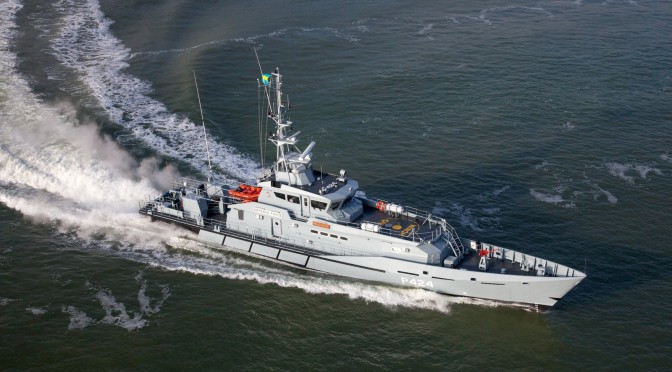
When it comes to the mainland, several Latin American states are turning to Damen for naval equipment. For example, the Colombian Navy purchased one of Damen’s Swath-type vessels, which was constructed in Singapore.  Additionally, in 2014, Ecuador signed a deal with Damen to obtain two Stan Patrol 5009 for the country’s coast guard. The vessels are being constructed in Ecuador by the country’s shipyard, Astilleros Navales Ecuatorianos, under the oversight of Damen technicians. Additionally, Damen obtained a contract in early 2014 to construct a fourth Stan Patrol 2606 (the country already operates three),  which will also be built in Ecuador.

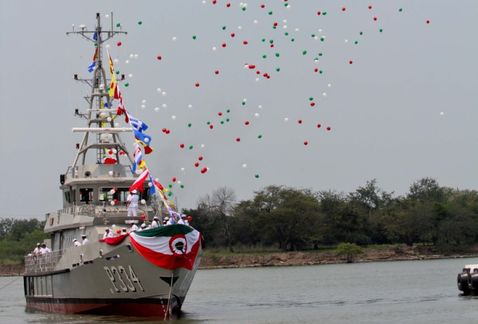
Additionally, Mexico and Venezuela have purchased various types of Damen’s vessels. Just this past January, the Mexican Navy received the Coast Guard vessel Tenochtitlan-class “ARM Mitla” (PC-334), which was constructed as a joint project between the shipyards of the Secretaria de Marina (the Mexican Navy) in Tamaulipas and Damen. The “Mitla” is based on the Stan Patrol 4207 model. This is the second of two vessels that Mexico and Damen are building together following a 2014 agreement. The other vessel is a supply variant of the Fast Crew Supplier 5009. Like the “Mitla,” it is also being constructed in Mexico’s Sonora state. These developments suggest that Damen has become an integral part of the country’s naval shipbuilding. Apart from the aforementioned vessels, SEMAR and Damen jointly constructed three other patrol vessels based on the 5009 model.

 Mexico’s new “ARM Mitla." Source: Cuartooscuro / Milenio.com.
Mexico’s new “ARM Mitla.” Source: Cuartooscuro / Milenio.com.

As for Venezuela, Caracas has ordered a number of new vessels for its Navy including a 2014 deal for 18 type Interceptor 1102 speedboats. The speedboats are being constructed in Cuba under the Havana-Caracas cooperation agreement. The first of these vessels arrived this past May and is currently undergoing testing. In addition, Damen has also constructed four support vessels for the South American nation based on the Stan Lander 5612 model. On February 2014, a new contract was signed for an additional eight vessels, a deal worth around $132 million USD. Finally, Venezuela’s military complex (UCOCAR) in Puerto Cabello is building five patrol boats based on the Stan Patrol 2606 model. The country’s navy already has one operational vessel based on that model, the “Pagalo” (PG-51).

Damen Interceptor 1102. Source: Damen.com.
  • Cuba’s Shipyards

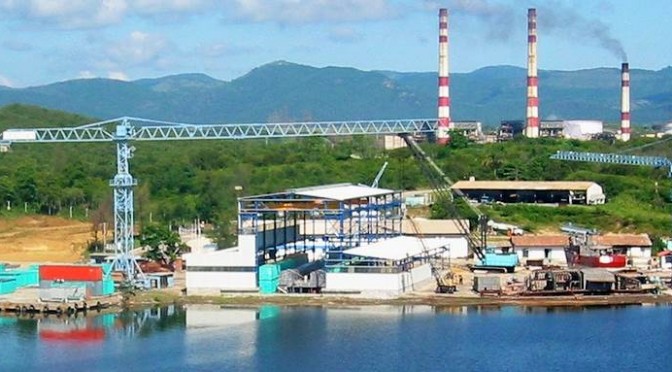
It is important to note that Damen has a construction facility, Damex Shipbuilding & Engineering, in Cuba. The facilities, which were established in 1995, are located in the bay of Santiago de Cuba. Damen’s website explains that “the yard is equipped with one slipway provided with transverse parking facilities for new buildings and repairs and a lateral slipway for new buildings of up to 100 metres.” As previously noted, the shipyards have constructed vessels for Venezuela.

  • The Honduran Affair

It is important to stress that not all Damen deals have been scandal-free. This is best exemplified by a 2013 contract via which the government of Honduras purchased six Interceptor speedboats and two Stan Patrol 4207. The contract deal was reportedly worth almost $62 million. However in late 2013, the Honduran judiciary investigated it due to various irregularities, specifically the accusation that the vessels were overpriced  – according to the Honduran newspaper La Prensa, the vessels were overpriced by some $29 million. The newspaper argued that the Honduran Secretariats of Defense and Finance created a paper company called “Servicios Maritimos S.A.,” which was utilized by Florentius Antonious Florentius Kluck,  a Dutch citizen and honorary consul, as the intermediary for the sale.

In spite of these accusations, the deal ultimately went through, and the Honduran Navy has begun to receive the vessels. This is an important deal for Honduras since drug traffickers utilize the country’s coast for transporting illegal narcotics, and thus it is especially necessary for small Central American country to have vessels that can locate and seize the infamous narco-speedboats. Nevertheless, the details of the deal themselves are problematic, as the question its transparency and whether the Honduran government could have obtained similar vessels at a cheaper price. Even more, even though the Honduran judiciary never passed judgment on the  deal, scandals like the Honduran affair throw into question whether other contracts gained by Damen were due to shadowy middle men and nefarious deals.

Read Part 2 here.

W. Alejandro Sanchez is a Senior Research Fellow at the Council on Hemispheric Affairs (COHA) where he focuses on geopolitics, military and cyber security issues in the Western Hemisphere. His research interests include inter-state tensions, narco-insurgent movements and drug cartels, arms sales, the development of Latin American military industries, UN peacekeeping operations, as well as the rising use of drones (UAVs) for civilian and security uses in Latin America. Twitter: @W_Alex_Sanchez