Category Archives: Current Operations

On-going Naval Ops or Maritime Current Events

Assessing the U.S. Navy’s Arctic Roadmap

By Andreas Kuersten

Shielded by a significant expanse of sea ice, the Arctic Ocean has historically had limited naval strategic relevance outside of submarine and early warning operations.  But the process of climate change is increasingly melting away this covering and laying bare previously inaccessible northern waters.  As a result, and in concert with the region’s vast natural resource endowments and potential shipping lanes, one of the world’s five oceans and adjacent marine areas are slowly opening to human maritime activity – both in terms of state and private actors.  As the military branch responsible for fielding forces “capable of winning wars, deterring aggression and maintaining freedom of the seas,” the United States Navy has understandably turned its attention northward. 

In planning for the Arctic Ocean’s opening and its ensuing responsibilities in the region, the Navy researched and published the Arctic Roadmap: 2014-2030.  The report lays out how the service views the high north as a theater for operations and its priorities in the area in the near- (2014-2020), mid- (2020-2030), and long-terms (2030-beyond). 

The Arctic Naval Strategic Environment

As outlined at the beginning of the Roadmap, the Navy expects the Arctic “to remain a low threat security environment where nations resolve differences peacefully.”  It sees its role as mostly a supporter of U.S. Coast Guard (USCG) operations and responder to search-and-rescue and disaster situations.  However, the presence of vast resource endowments and territorial disagreements “contributes to a possibility of localized episodes of friction in the Arctic Region, despite the peaceful intentions of the Arctic nations.” 

For the most part, this assessment appears accurate.  The Arctic has consistently remained an area of peaceful interaction despite periodic disagreements, and its harsh environment minimizes conflict potential.  But the region also presents a completely unique geopolitical and military situation for the Navy.  As Arctic sea ice melts, the Navy will find itself engaging a theater where it is not the most capable force for the first time in recent history.  Russia’s Northern Fleet, designated in 1937, has been based and operating in the Arctic for nearly 80 years.  Russian naval and support capabilities in the high north surpass those of the Navy: currently, they possess the only fleet of nuclear powered icebreakers and extensive naval bases. 

Direct comparisons with Russia, however, are not very telling in terms of what the Navy’s Arctic priorities should be.  Russian interests in the Arctic have always been far greater than those of the U.S.  As such, the Roadmap is right to avoid any language seeking American naval predominance in the region, or comparisons to the northern capacities of others.  But given Russia’s recent provocative actions in Ukraine and elsewhere, and the fact that the Roadmap was published before these commenced, the Navy would be right to incorporate awareness of Russian activities and capabilities into future Arctic policy publications. 
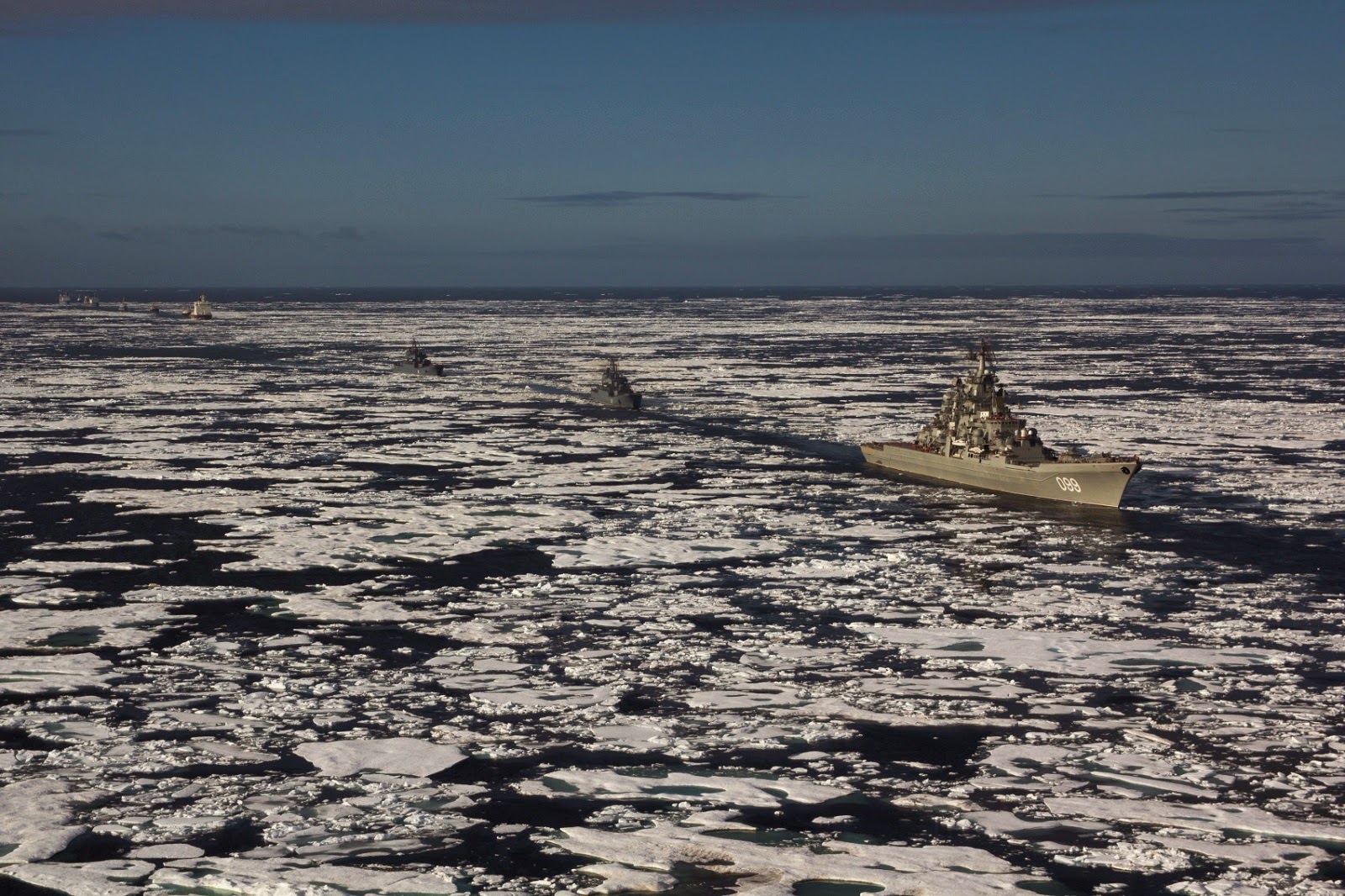
Russian warships en route to New Siberian islands, including Kirov class battlecruiser Pyotr Velikhiy.

The Navy’s Arctic Capabilities

Turning to the more technical issue of actual Arctic capabilities, the Roadmap presents the region as a unique operational environment.  It astutely notes that “Navy functions in the Arctic Region are not different from those in other maritime regions; however, the Arctic Region environment makes the execution of many of these functions much more challenging.”  This observation was born out in the Fleet Arctic Operations Game naval exercise of 2011.  Unfortunately, so was the reality that the Navy is currently ill equipped to operate in the high north.  A report from the U.S. Naval War College on this exercise noted the following:

The U.S. Navy is inadequately prepared to conduct sustained maritime operations in the Arctic region.  This assertion is due to the poor reliability of current capabilities as well as the need to develop new partnerships, ice capable platforms, infrastructure, satellite communications and training.  Efforts to strengthen relationships and access to specialized capabilities and information should be prioritized. 

The Roadmap seeks to take each of these failings into account, though it does so to varying degrees of prudence.  It presents the need for strong cooperation and partnership with foreign states, the USCG, and other government agencies.  Such interactions are aimed at helping to manage shared Arctic spaces, engage in multilateral training and operations, and develop Maritime Domain Awareness (MDA) for the region. 

The Roadmap puts a heavy emphasis on the advancement of MDA and logistics capabilities in the Arctic, and these foci are well warranted.  The principal restrictive variables in Arctic operations are severe and erratic weather, sea ice, poorly developed nautical charts, remoteness, and the absence of support infrastructure.  Tackling these issues begins with extensive data gathering and MDA development.  In this regard, the Roadmap asserts that partnerships with government agencies responsible for meteorology and geography – such as the National Geospatial-Intelligence Agency and National Oceanic and Atmospheric Administration – are crucial for helping “the Navy better predict ice conditions, shifting navigable waterways, and weather patterns to aid in safe navigation and operations at sea.”  A force with a robust understanding of a harsh environment has a significant advantage in any undertaking or confrontation therein. 

Arctic MDA will, in turn, aid in the maintenance of critical logistical support for naval assets deployed in remote northern theaters and the alleviation of infrastructure failings.  The distribution of fuel and other resources, along with the conservation of these assets, are important considerations in Arctic operations and ones the Roadmap shrewdly highlights. 

Beyond MDA and logistics, the Roadmap puts an emphasis on Arctic training and exercises.  These are often conducted with other countries and military branches and are touted to “improve knowledge of the Region and provide a positive foundation for future missions.”  While this is certainly true, training can only go so far when a force lacks the requisite equipment for operating in a region, and this is the Roadmap’s main problem. 

The Naval War College’s assessment of the Navy’s Fleet Arctic Operation Game, noted above, serves to illuminate the branch’s deficiency in terms of material capacity when it comes to the Arctic.  In addressing its equipment needs for northern operations, the Navy’s Roadmap is lacking.  Rather than stating the need to procure necessary equipment, it simply “directs review and identifications of requirements for improvements to platforms, sensors, and weapons systems.” 

For years, the needs of the Navy in terms of Arctic acquisitions and refitting have been extensively researched and presented.  Many individuals and organizations have laid out the various basic purchases and upgrades necessary for effective Arctic naval action.  Moreover, as reported by the website DoD Buzz through interviews with top Navy Officers, the branch is well aware of its needs and has undertaken numerous research and development projects to address them.  Ice-strengthened hulls, topside icing prevention and management, surveillance and reconnaissance sensor establishment and maintenance, and network systems adaptation to northern conditions are all clear areas of need with available remedies. 

Training and operating within equipment limitations enhances effectiveness, but being properly outfitted allows for substantially more freedom of action and strategy, as well as for the more likely attainment of superiority in any future confrontation. 

Even though the Navy is currently experiencing a time of relative budget constraint and massive asset redistribution – namely to the region of East and Southeast Asia – a policy roadmap encompassing the next several decades must make Arctic-directed equipment procurement an expressed priority.  These sorts of undertakings require a good deal of lead-time, and continuing to tread water by solely emphasizing need assessment over need fulfillment is a recipe for future shortfalls in necessary capabilities. 

In addition to equipment, the Navy is also lacking in terms of Arctic infrastructure.  Aside from Thule Air Base in Western Greenland, American deepwater ports are non-existent above the Arctic Circle.  The Navy has utilized temporary ice bases in the past for submarine exercises – the most recent being Camp Nautilus north of Prudhoe Bay in 2014 – but to support the necessity of an increasing naval presence in the next several decades a permanent base and deepwater ports will eventually be needed. 

These, however, are incredibly costly undertakings, both in terms of money and capital as well as force deployment to occupy such facilities.  The absence of any clear intent to look into permanent presence possibilities, or commit to equipment procurements, evinces the Navy’s desire to hedge its commitments to a remote and relatively minor area in the face of important responsibilities elsewhere.  While this is certainly prudent, such policies could become problematic if they result in the inconsequential development of Arctic capabilities over the period the Roadmap encompasses. 
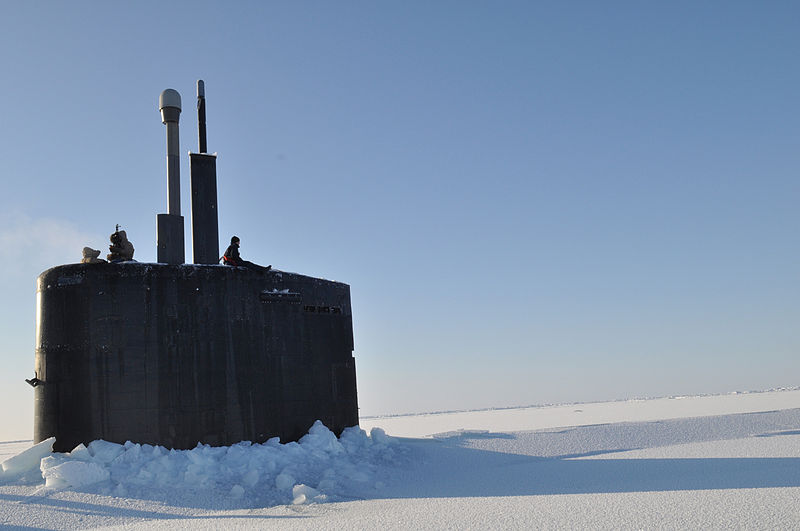
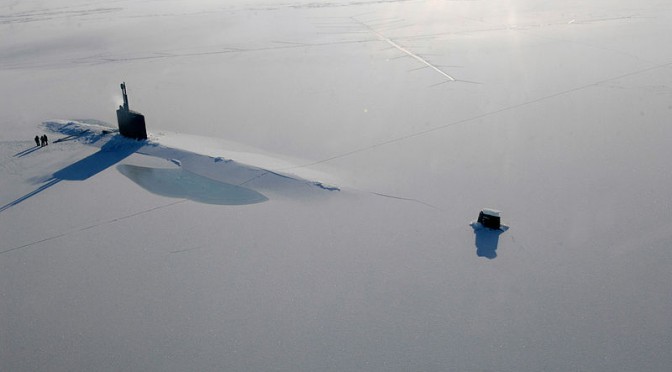
Crewmembers of the Los Angeles-class submarine USS Annapolis (SSN 760) man the bridge watch after breaking through the ice during Ice Exercise (ICEX 2009) in the Arctic Ocean.

The Navy’s Near-, Mid-, and Long-Term Arctic Assessments

The Navy’s concluding presentation on its ambitions over the timeline of the Roadmap lends credence to concerns over its intent to meaningfully prepare for future Arctic obligations. 

Within the near-term (2014-2020), the Navy plans to have a limited Arctic presence, “primarily through undersea and air assets.”  Surface operations will only take place in open water conditions.  More broadly, the Navy states that it aims to “increase the number of personnel trained in Arctic operations,” maintain ongoing exercises, “focus on areas where it provides unique capabilities,” “leverage…partners to fill identified gaps,” and “emphasize low cost, long-lead time activities to match capability and capacity to future demands.”  From this information, it appears that the Navy has minimal Arctic ambition in the near-term and is content to expand very little on its current capacities. 

In the mid-term (2020-2030), the Navy predicts that it “will have the necessary training and personnel to respond to contingencies and emergencies affecting national security.”  Its “surface vessels will operate in the expanding open water areas” and the Navy “will work to mitigate the gaps and seams and transition…from a capability to provide periodic presence to a capability to operate deliberately for sustained periods when needed.”  Although this language may be interpreted to push for accelerating Arctic initiatives in the mid-term, it actually simply shows the Navy moving at the speed of climate change.  Surface-wise, it will expand into the high north wherever the melting ice allows, but no real impetus is noted to engage the region outside of those areas that become like other environments in which the Navy already operates.  Furthermore, there is not even an ambiguous expression as to how the Navy plans to facilitate “deliberate and sustained” Arctic operations.

In the far-term (2030-beyond), the Roadmap asserts that the “Navy will be capable of supporting sustained operations in the Arctic Region as needed to meet national policy guidance” and “will enable naval forces to operate forward.”  Once again, however, no clear avenue, let alone a vague one, is presented through which these capabilities will be developed.  Consequential investment in region-adapted equipment and infrastructure are needed before the Navy can meaningfully operate in a forward capacity in the Arctic.  Unfortunately, as noted throughout this analysis, there is scant mention of any such commitment. 

Conclusion

The Roadmap ultimately shows the Navy having a keen understanding of the capacities it must develop to be a truly Arctic-capable force, but also evinces an organization weary of any real commitment to a region currently possessing little national security importance.  As the Navy puts it in the report’s final sentence: “The key will be to balance potential investments with other Service priorities.”  The Roadmap, however, currently shows that balance tipping away from any substantial Arctic engagement.  Hopefully the Navy’s fiscal apprehension will not hamstring its ability to operate in a future Arctic environment requiring its capable presence and leadership. 

Andreas Kuersten is a lawyer working in international law who has previously held positions with NOAA and the U.S. Navy and Air Force JAG Corps.
From Words to Action in the South China Sea – Updated 5/22

Update 5/22:

– China’s Foreign Ministry spokesman says U.S. actions in the South China Sea “‘irresponsible, dangerous” and that China’s military drove away the U.S. military aircraft.

– A Pentagon spokesman says the P-8 and naval vessels have not yet gone within 12nm of the islands, but said “that would be the next step.”

– The Washington Free Beacon also reports US officials as saying “China tried to electronically jam U.S. drone flights over the South China Sea in a bid to thwart spying on disputed island military construction.”

———————————————————————

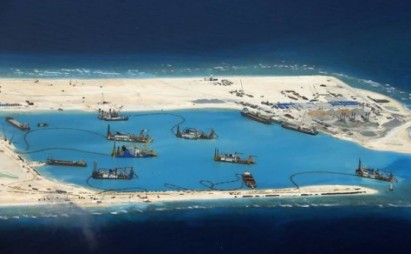
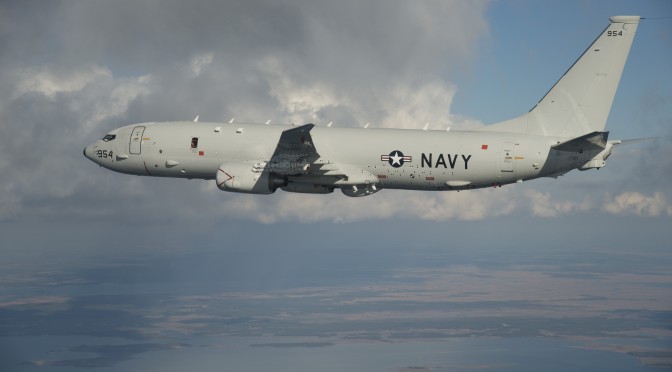
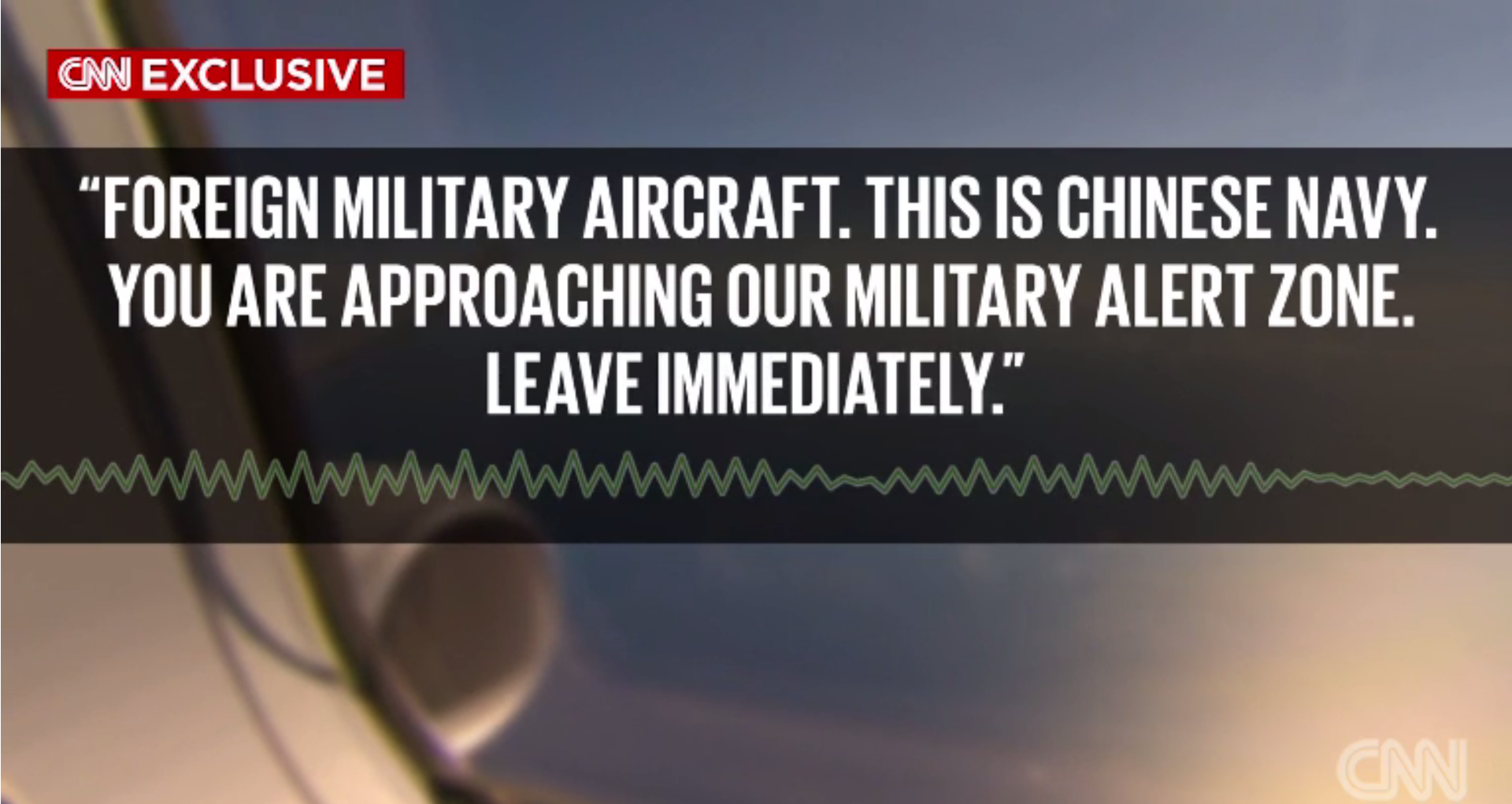
InterceptLast week the Wall Street Journal reported that the United States was considering sending U.S. air and naval assets to conduct freedom of navigation (FoN) transits around China’s artificial islands in the South China Sea, specifically the Spratlys – claimed in part or in whole by six nations. Today, CNN released exclusive footage from just such a flight, as a P-8 may have flown within the claimed 12nm of territorial airspace of three of the islands (more on that below), including Fiery Cross Reef and Mischief Reef. I highly recommend watching the video to gain a greater appreciation of the sort of interaction that is likely to occur with increasing regularity, and to see the dredging in action that CSIS’ Asia Maritime Transparency Initiative has so ably documented through overhead satellite imagery [full disclosure: I’ve contributed to the site in the past].

interphoto_1428568832One of the questions bedeviling the maritime security community over the past several years has been how to respond to China’s “salami slicing” actions – a question that took on new urgency with the previous year’s massive surge in reclamation efforts in the South China Sea. Among others, the Center for a New American Security (CNAS)’s excellent Maritime Strategy Series included several reports devoted to developing options to provide answers for policy makers. Unfortunately, much of the analysis more broadly has struggled to move from generalities of the need to “impose costs” or, conversely, to “develop cooperative strategies” to the specifics of application. And, for those that did, there had until now been little evidence of words being translated into action.

Spratly_Islands-CIA_WFB_MapNot everyone is happy. Over at our partners’ site – ASPI’s The Strategist – Sam Bateman questions whether the “US knows what it’s doing” and rightly points out that FoN operations have to be “conducted with ‘due regard’ to the rights of coastal States.” But he also asserts that U.S. action is an indication that the United States has “taken a position on the sovereignty of the claims.” If true, (and that’s not official policy) it belies the first qualm since the United States presumably would not therefore need to take claimed but invalid rights into account. Bateman is on stronger ground in noting that if the Navy is sailing through the territorial waters or flying through the islands’ territorial airspace (it is not clear in the video whether this is the case) – water/airspace granted due to the small fractions of at least Fiery Cross Reef’s natural features that remain above water during high tide – it would do so at risk of violating the “innocent” condition of innocent passage if the vessels were conducting military missions such as intelligence gathering. This is not the case if the island is entirely man-made, if a military vessel refrained from action prejudicial to the coastal state, or if the vessel stayed in an island’s EEZ – outside the 12nm of the territorial waters.

Of course this is all moot if, as Bateman suggests, the United States by these actions is declaring it holds specific island sovereignty claims invalid, rather than waiting any longer for China to explain upon what basis its claims are made. Perhaps the best course of action is for the United States to declare that until China has explained the basis for the nine-dash line claim in a manner in accordance with international law and so adjudicated it will not honor any of China’s South China Seas sovereignty claims or the rights derived thereof. This would cut through some of the legal complexity in providing a basis for the ongoing FoN activities and point to a way for China to take action to resolve the situation. While it is unlikely China will be persuaded to prematurely end its reclamation efforts, the actions undertaken by the Navy may at least demonstrate the likelihood that a declared South China Sea Air Defense Identification Zone (ADIZ) without resolution of outstanding claims will result in a frequent high-profile acts of indifference.

Scott Cheney-Peters is a surface warfare officer in the U.S. Navy Reserve and founder and president of the Center for International Maritime Security (CIMSEC). He is a graduate of Georgetown University and the U.S. Naval War College, a member of the Truman National Security Project, and a CNAS Next-Generation National Security Fellow. 

Russia’s Supersonic Tu-160 Bomber Is Back: Should America Worry?

The article can be found in its original form at The National Interest here and was republished with permission.

By Dr. Tom Nichols

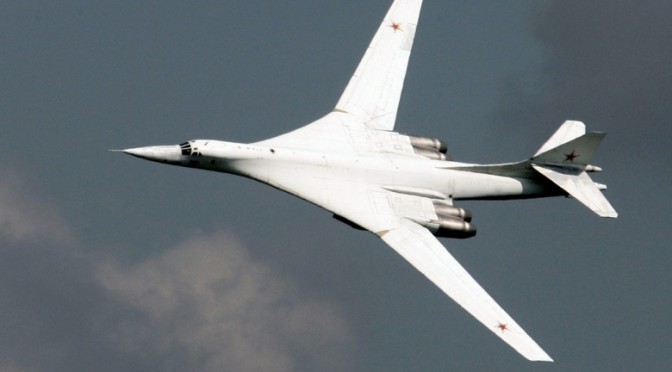
Russian defense minister Sergei Shoigu announced recently that Russia is going to begin production of the Tu-160, a Soviet-era bomber known as the “Blackjack.” The Tu-160 is a nuclear platform, basically something like the Soviet version of an American B-1 bomber: a big, heavy, swing-wing bomber meant to deliver nuclear weapons at long distances. The Soviets built about thirty-five of them in the 1980s, of which only fifteen remain in service.

So what does this mean to the strategic balance between the United States and the Russian Federation in 2015? In reality, it means absolutely nothing in military terms. As a political signal, however, Shoigu’s announcement is just the latest in a series of provocations. No American response is required and none would matter.

The Blackjack, assuming the Russians even manage to build any more of them, is a perfectly capable nuclear bomber that, in time of war, would fold back its swan-like wings and dart toward its targets at top speed. Once in range, it would launch cruise missiles that would make the last part of their journey low and slow under enemy radar. This is pretty much what all bombers would do in a nuclear war. (The one major advantage of the American B-2 is that it could penetrate farther into enemy airspace with less chance of detection.)

To worry about the extra capability of additional Blackjacks, however, requires believing that nuclear bombers matter at all in 2015. During the Cold War, when a “triad” of land, air and sea weapons were the guarantee against a massive surprise attack, both sides invested in various tripartite combinations of ICBMs, sea-launched weapons and bombers. In a massive first-strike, at least some of these weapons would survive and destroy the aggressor, which is why no one could contemplate doing it. (The Soviets likely did not contemplate it very seriously in any case. There’s an interesting declassified CIA report from 1973 you can read here.)

Today, no one seriously worries that the Russians or the Americans will, or can, execute a disabling first strike against the other. A “BOOB,” or “Bolt-Out-Of-the-Blue,” is neither politically likely, nor militarily feasible. The days when command and control, satellites and even strategic delivery systems themselves were all far more shaky are long gone. The ideological competition between two global systems, in which one would seek to destroy the other as rapidly as possible, is also over.

Moreover, the sheer number of strategic weapons isn’t up to the job. In 1981, the United States and the Soviet Union fielded a total of nearly 50,000 weapons against each other. Strategic targets, including opposing nuclear forces, numbered in the thousands. Today, in accordance with the New START treaty, Russia and America will only deploy 1550 warheads each. (Coincidentally, this week marks the fourth anniversary of New START.) Even if both sides were committed to a first strike, there aren’t enough weapons to do it: 1550 means 1550, and it doesn’t matter what platform—bomber, ICBM or submarine—is carrying them.

So why are the Russians even bothering to do this?

For starters, not everything is about us. The Russians have a huge nuclear infrastructure, and a military obsessed with symbols of nuclear power. Building more nuclear toys makes everyone happy: Russia’s nuclear military-industrial complex gets jobs and money, the military gets its nuclear security blanket, and Russian leaders like Shoigu and President Vladimir Putin get to thump their chests about holding back the nuclear savagery of Barack Obama. Outside of Russia, no one except nuclear wonks like me even know what a Tu-160 is, but Russians know of it and many are likely proud of it.

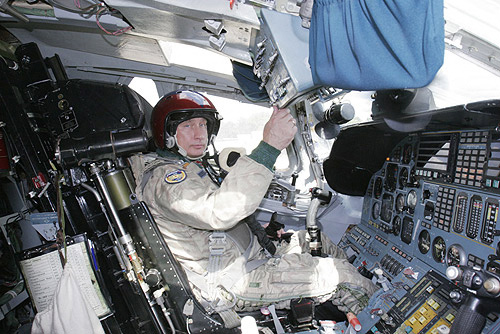
President Vladimir Putin in the cockpit of a TU-160 in August 2005

The part that is about us is more disturbing. The Russians, and Putin in particular, have decided to forego any further pretense of accepting the outcome of the Cold War. Some foreign-policy realists lay Putin’s aggressiveness at NATO’s door, and rightly point out that NATO expansion needlessly handed Russian nationalists a cause. But Putin, it should now be obvious, was never going to accept the Soviet loss. His feints at cooperation were unsustainable, and his Soviet-era nostalgia for the days of the USSR has reasserted itself with a vengeance. If Putin can’t get along with a U.S. president as passive and accommodating as Barack Obama, he can’t get along with anyone.

That’s why the United States has no play to make here, other than to remind the Russians of two things.

First, if we react to Shoigu, we should note only that the United States has a fully capable deterrent that cannot be destroyed, and that we have no interest in Russian bombers, so long as they do not exceed New START’s warhead limits. We do not need to create a new nuclear system, or start returning nuclear weapons to Europe. If Russia means war, they know it will end in 2015 the way it would have ended in 1965: with the destruction of most of Russia and North America, and the deaths of millions of innocent people.

More important, we must reaffirm our commitment to NATO, because Europe, not America, is really the intended audience for Russia’s nuclear antics. Bringing back the Tu-160 is another of the Kremlin’s many attempts to scare the Europeans with the same threat the Russians have been harping on since the 1950s: “If war comes, the Americans will be so afraid of us they will not lift a finger to help you.” Each time we ignore these threats, we encourage more of them.

The way to reassure NATO is match Russian moves not with nuclear threats, but with conventional forces, as U.S. ambassador Steven Pifer and others have argued. This is what the Russians fear most, because they know that the Cold War equation is now flipped, with Russia the weaker conventional power. If Shoigu wants to build more of his pretty bombers, that’s his business, but no Russian leader should think that an attack on NATO can produce anything but a Russian conventional loss, at which point the Russians will have to think about whether they want to face the escalatory burden that once haunted NATO.

Our reaction to Russia’s nuclear threats should be no reaction at all, other than to affirm our ability to defend ourselves—and the most populous, wealthy and powerful alliance in human history—as the mature and confident superpower that we are.

Tom Nichols is Professor of National Security Affairs at the Naval War College and an adjunct at the Harvard Extension School. His most recent book is No Use: Nuclear Weapons and U.S. National Security (University of Pennsylvania, 2014) The views expressed are solely his own. You can follow him on Twitter: @RadioFreeTom

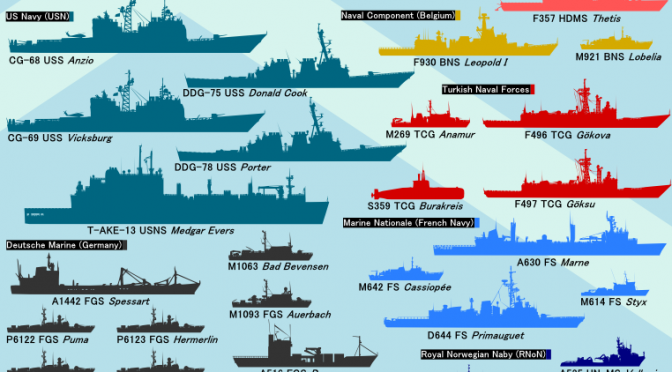
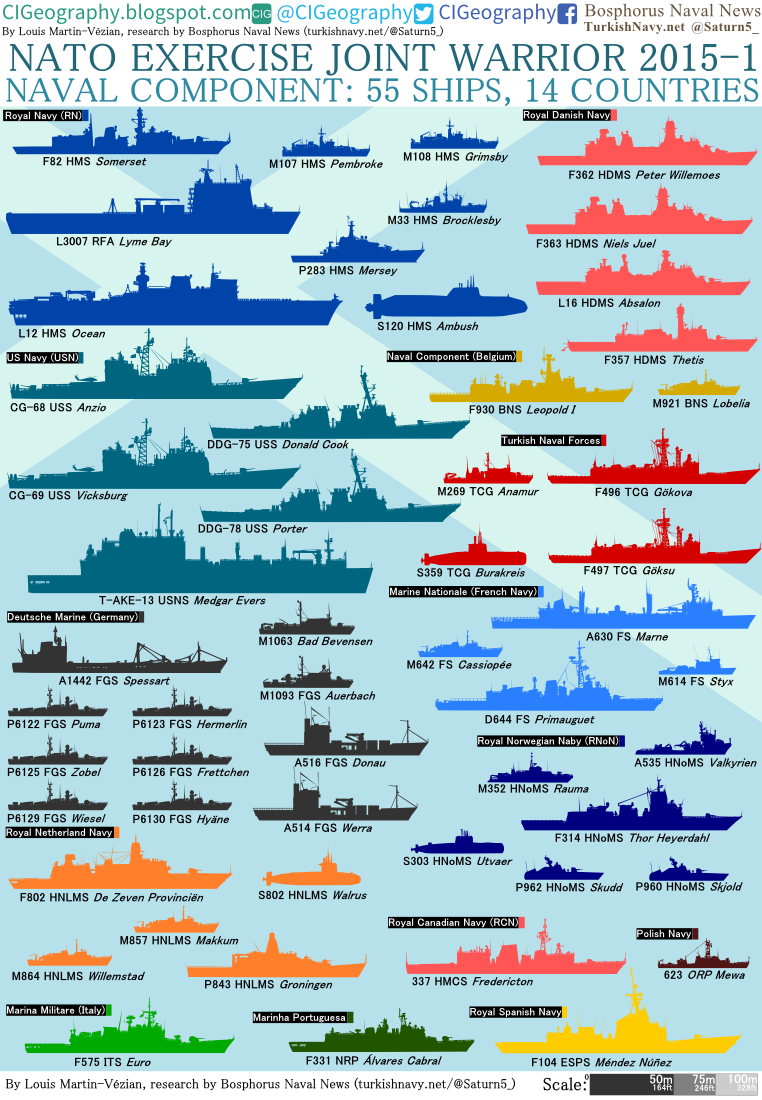
Joint Warrior 2015 Infographic

jointwarrior

Joint Warrior is the twice-yearly UK-led NATO exercise in Scotland involving both sea, air and land assets.

Joint Warrior 15-1 has gathered 55 ships, a similar number of planes, and 14,000 personnel from 14 countries. It will run from 11 to 24 April. The maritime part of the exercise will focus on mine warfare and fast attack craft swarming-attacks.2121

Two standing NATO mine counter-measures groups (SNMCMG1, SNMCMG2), including mine countermeasures vessels (MCMV) from 8 countries, arrived in Faslane (30km from Glasgow) earlier last week.

German and Norwegian fast attack craft (FAC) were deployed as well: 6 Gepard-class fast attack craft of the German navy (P6122 Puma, P6123 Hermerlin, P6125 Zobel, P6126 Frettchen, P6129 Wiesel, P6130 Hyäne) and the two Skjold-class stealth corvettes of the Royal Norwegian Navy. The German Gepard-class is an evolution of the Albatros-class, modernized with the addition of a GDC-RAM launcher. The Norwegian P960 Skjold and P962 Skudd are capable of reaching 60 knots and carrying 8 NSM anti-ship missiles.

This edition of Joint Warrior is the largest to date, and could be compared to RIMPAC, although RIMPAC2014 gathered 55 ships, 200 aircraft and 25.000 personnel. Thus, JW151 is 140 aircraft and 10,000 personnel smaller than RIMPAC2014.

This extraordinary participation in a NATO exercise may come in reaction to Russia’s increasingly aggressive posture towards Europe since March 2014. Over both Europe and Japan, Russian strategic bomber flights are becoming more and more frequent.

Louis Martin-Vézian is the co-president of the French chapter at CIMSEC.org, and the founder of CIGeography, where he posts his maps and infographics on various security and defense topics. He is currently studying Geography and Political Science in Lyon, France.