Category Archives: Capability Analysis

Analyzing Specific Naval and Maritime Platforms

Airpower-R-US: The Old, New Way of Doing Business?

“Kurdish Forces, Backed by Coalition Airstrikes, Move Toward Mosul” announced a recent headline from the front in the war against the so-called Islamic State (ISIS) in Iraq and Syria.  As I read this headline the slogan that popped into my mind was Toys-R-US, or more to the point, Airpower-R-US; and in a more joint context, Fires-R-US. The US stands for United States. The metaphor here involves going to the store (the US) and getting what one needs to handle one’s military and political problems. The toys, of course, are the array of capabilities that the US Department of Defense can provide, courtesy of the National Security Council and with the blessing of the President; especially combat aircraft and the best trained crews for them in the world.

With all the handwringing about the future of warfare and the 21st century “threat”  being bandied about in security policy circles, perhaps the new norm should be identified as the US’s propensity for “loaning out” its air power and fires capabilities. These tend to be assigned to causes US leaders perceive as “righteous” or at least worthwhile enough (to US interests) to apply the military component of national power. The Kurds for example might provide the ground troops and we provide the air/fire power to help them achieve their goals (and maybe even air defense and ballistic missile defense).  Or perhaps to simply prevent US enemies (like ISIS) from achieving their goals, or rather, more of their goals.

This approach to the use of military power seems to be something we previewed for everyone as early as World War II, and then practiced more deliberately in places like Vietnam, Iraq (1990- present), Bosnia, Kosovo, Afghanistan, Libya, and now Syria (whose conflict now overlaps with Iraq). In order to provide value, a brief review of the history of the evolution of Airpower-R-US is in order. As a reminder, the pattern we are discussing is a tendency to eschew the commitment of ground forces in favor of commitment of air power (including things like sea-launched land attack cruise missiles and Predator drones with hardkill payloads).

World War II: The Pattern in Preview

The US first previewed a pattern of providing high tech additives, primarily air power, in its strategic planning and initial execution of operations in World War II.

Its leaders, especially President Franklin Roosevelt and the air power lobby, initiated this practice during World War II, providing first the equipment (Lend-Lease) and then the manned air forces to sustain the major ground fights, primarily in the Soviet Union but also as a strategy for the Pacific in China.  Claire Chennault, for example, was sent to Nationalist China to help build, train, and employ its (American-built) air force against the Japanese in 1937. As for Europe, the air power advocates produced the overall air plan designed to achieve victory shortly after the war in Europe began in 1939 and over the course of 1940 and early 1941. It was designated AWPD-1.   Here is a summary that leaves no doubt about what it intended to do:

The primary target systems were selected on the basis of an air offensive embracing the entire strategic air force, after it had reached full strength and lasting for six months. Moreover, the offensive was planned to be completed before the invasion, if an invasion should prove necessary. Target schedule for the beginning of the main air offensive was taken as one year and nine months after the outbreak of war. One year was for the production, training, and organization of the force. Nine months were reserved for deployment overseas, build up, and initial combat experience of the force. By that time, we anticipated there should be a total bomber force of nearly 4,000 bombers in place. [emphases original]

However, both of these we-provide-the air-(and navy) and you-provide-the-troops strategies did not completely pan out.   It may have in Europe had the US accepted the probable loss of Western Europe to the Soviets. In any case, large numbers of US ground troops ended up being committed in combat.  This was a preview of an emerging pattern.

This pattern, it might be assumed, had proven itself somewhat less than efficacious, at least in terms of avoiding the commitment of US ground forces, although what was committed was the result of a gamble, that air power would work and the US only needed 90 divisions at most to win the war.  In fact it came dangerously close to running out of ground power by the end of the war.  The World War II pattern in many ways repeated itself just five short years later in Korea, when deterrence with atomic weapons delivered by air power came up short and there was precious little conventional air power on hand to help not only the South Koreans but even US ground forces until the crisis at Pusan had passed.

Vietnam and Beyond

At this point the pattern seemed to take a holiday.  That holiday was known as Vietnam; or more correctly the years of primarily advisory support to the government of South Vietnam (1959-1965).   However, with the failure of the advisory effort by Military Assistance Command, Vietnam (MAC-V), the pattern re-emerged as President Lyndon Johnson intervened with ground forces, initially as security forces for US and South Vietnamese air bases at places like Bien Hoa and Da Nang. However, ground forces soon got sucked into the fighting and the war assumed a two track character:  General William Westmoreland and the South Vietnamese Army (ARVN) fought the ground war while five separate air forces (four of them US) fought the air war.  The crowning jewel of the air war was Operation ROLLING THUNDER, an air campaign intended to actually win the war by sending “signals” to the North Vietnamese leaders in Hanoi to cease and desist with their aggressions in the south.  It failed miserably and was cancelled by Johnson during the chaotic year of 1968.  In contrast, the ground war achieved a stalemate as a result of the defeat of the North Vietnamese Army (NVA) and Viet Cong during the Tet Offensive.
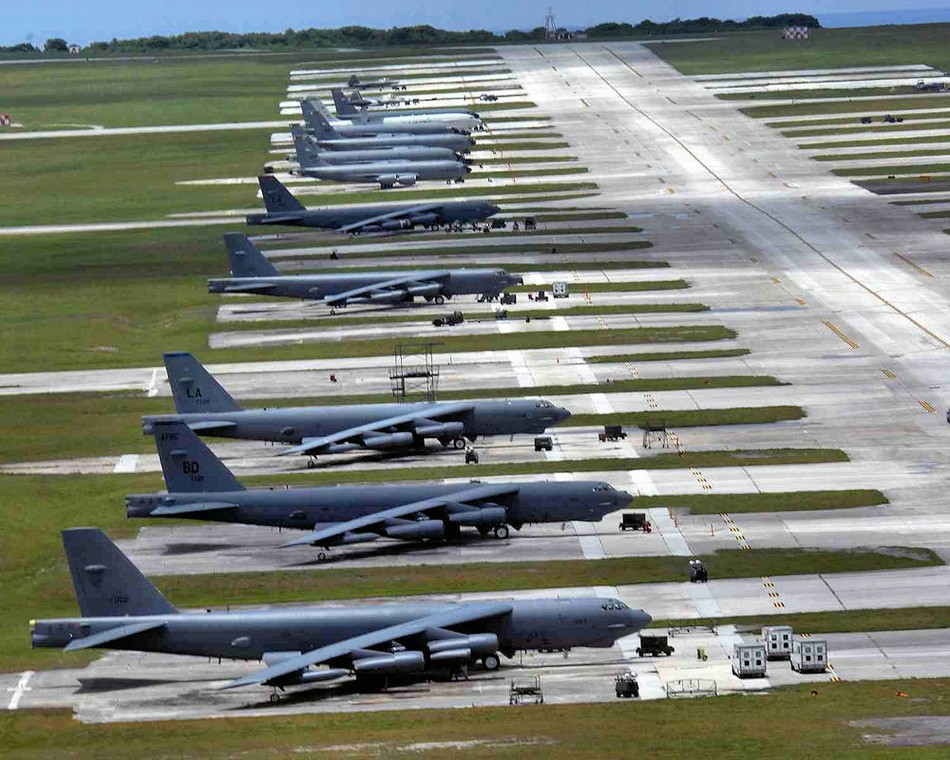
                              B-52 bombers at Andersen AFB, Guam

Failure and stalemate in Vietnam in 1968 led to the first realization of what today’s pattern, on display in places like Yemen, Syria, and Iraq, might look like.  Johnson’s successor as commander in chief, Richard Nixon, decided to “Vietnamize” the war.   Critical to this approach was the withdrawal of ground combat forces (as in Iraq and Afghanistan, today).   However, Nixon gave the South Vietnamese leaders assurances that their military would be supported by US air power and in 1972 this was successfully tested as the ARVN bore the brunt of the so-called Easter Offensive by the NVA in its attempt to conquer the south in one fell swoop.  Massive application of US air power in the two LINEBACKER air campaigns, along with some hard fighting by the ARVN, saved the day, albeit only temporarily. The Pattern (it now deserves formal noun status), had worked.  US air power and indigenous ground forces had staved off disaster, against one of the best armies in the world.  Until they didn’t—after two years (50 years ago this year) and Nixon was no longer President.   The US refused to use Airpower-R-US in 1975 to help its “abandoned” client in Saigon and the NVA achieved its long sought goal of unifying Vietnam under communist rule.

There was something like the Pattern in the US support of the Afghan Mujahedeen in their fight against the Soviets during the last decade of the Cold War, but instead of US pilots, the hardware was of the smaller variety, most especially surface-to-air missiles, an Anti-Airpower-R-US variant.   Similarly, the small Gulf States accessed a sea power version of US power in the late 1980s with the reflagging of Kuwaiti ships in response to Iranian mining threats.  In that case the US provided all of the maritime firepower during Operations . But these operations reflect something of the Pattern.  One might advance the idea that it was also a partial component behind Operations DESERT SHIELD and DESERT STORM, especially the seven week air campaign that preceded the ground offensive.  During the planning for that component of the operations, the air force chief of staff was relieved for suggesting that air power might do it alone, without the commitment of substantial US and coalition ground forces to actual combat beyond their coercive value as a threat.  As it turned out the US had to make good on that threat to use ground forces after all to retake Kuwait.

However, the Pattern, now in its mature form, emerged after the end of the Cold War.   The author experienced it directly while flying missions for the Navy during operations DENY FLIGHT and DELIBERATE FORCE, wherein NATO conducted overlapping air campaigns to stabilize the situation in Bosnia from 1994 to 1995.  NATO air power finally conducted limited bombing attacks, measurably aided by an offensive of Bosnian-Croat ground forces that led to the signing of the Dayton Accords in the Fall of 1995 by all parties (including the Bosnia Serb factions).  This same dynamic occurred again four years later with Operation ALLIED FORCE, the air campaign against Serbia and in support of the Kosovar Albanians.  It has been characterized as “winning ugly,” but for those folks interested in limited war, Airpower-R-US provided more evidence to support the efficacy of this approach, no matter how messy.  The commander of US forces in Europe, General Wesley Clark, even cached the experience into a book proclaiming that this was the face of modern war.

As with all things, after the terrorist attacks on 9/11, the US entered something of an interregnum, or interval, in which the Pattern was not the primary choice.  Both the Afghanistan and Iraq campaigns, although relying heavily on air power, employed substantial ground forces. Of the two, the initial phases of Operation ENDURING FREEDOM in Afghanistan most closely approximate the Pattern when US air power, special forces, and indigenous forces took the fight to Al Qaeda and the Taliban in 2001.  However, by Operation Anaconda in March of 2002, substantial US ground forces were back in the game and the utility of the Pattern presumably inadequate to achieving further national interests in that desolate place.

The sobering experiences in Iraq and Afghanistan from 2001 to 2014 led to a full-fledged return of the Pattern.   Its first widespread use has already occurred with the proliferation of armed drones, sometimes with the permission of governments, and, in the case of Pakistan, sometimes not .  The point at which use of the Pattern can definitely be characterized as the norm came with the so-called “Arab Spring,” most especially in the oddly named Operation ODYSSEY DAWN, although the bulk of NATO air power employed to help the Libyan insurgents against the forces of Muammar Gaddafi was US. Questions of its ultimate efficacy aside, it did get the job done of pairing up US/NATO air power (and sea power) in support of indigenous “boots on the ground” to accomplish regime change.  Whether this result was for better or worse is a different matter and beyond the scope of this discussion.

Which brings us back to today’s headlines and the current air campaign in Iraq and Syria—Operation .  The Pattern here supports a variety of different entities and their ground forces including: the government of Iraq, various rebel groups fighting ISIS, the aforementioned Kurds, and whether we like to admit it or not, Bashar Al Assad.   We might even throw in the enemy of our enemy, Iran.   The Obama administration’s embrace of this approach, similar to that of the earlier Clinton administration, has potentially far reaching implications in what it tells us about the evolving American Way of War.  Are these really “new” norms, or are they now established norms?  And based on this review of pertinent recent history, how new are they, really?

Today: Old-New Ways of War

In sum, The US has established a pattern of providing high tech capabilities, primarily air power, to the ground forces of others (nations as well as non-states like the Kurds and the Kosovo Liberation Army), as a means to achieve its national interests and objectives.  This US approach places air power alongside venerable mercenary icons such as the Swiss Landsknecht and the Italian Condottierri of the 15th and 16th Centuries.  Is Airpower-R US an updated version the infamous army of General Albrecht von Wallenstein that hired itself out to various bidders during the 30 Years War? Has it become a sort of paradigm mercenary force available for hire as a means to maintain and defend US (and sometimes Western) interests?  Instead of receiving money as payment, though, the US forgoes commitment of ground troops and gets stability in return (or maintains the stability of the existing system).

Is this approach worth preserving, or even improving?  Whatever the road ahead, it is here and it is in active use today in Iraq, Syria and elsewhere.   It might be in use in the near future in Ukraine and it is incumbent on US policymakers to think a bit more intensely about what they design the military instrument of national power to do, and not do, for the future.   In a time of relatively low risk, it makes some sense.  But does it need to be so expensive, and can we get the same bang for the buck for a lot less?  These are the questions we should be asking ourselves about Airpower-R-US, and certainly a few other related issues, as we await the next crisis in which we might employ it.

About the author:

Dr. John T. Kuehn is the General William Stofft Chair for Historical Research at the U.S. Army Command and General Staff College CGSC).  He retired from the U.S. Navy 2004 at the rank of commander after 23 years of service as a naval flight officer flying both land-based and carrier-based aircraft.  He has taught a variety of subjects, including military history, at CGSC since 2000.  He authored Agents of Innovation (2008), A Military History of Japan:  From the Age of the Samurai to the 21st Century (2014), and co-authored Eyewitness Pacific Theater (2008) with D.M. Giangreco as well as numerous articles and editorials and was awarded a Moncado Prize from the Society for Military History in 2011.  His latest book, due out from Praeger just in time for the 200th Anniversary of the Battle of Waterloo is Napoleonic Warfare: The Operational Art of the Great Campaigns.

The views are those of the author and do not reflect the official policy or position of the Department of the Army, Department of Defense, or the U.S. Government.
The Rapid Growth of the Algerian Navy

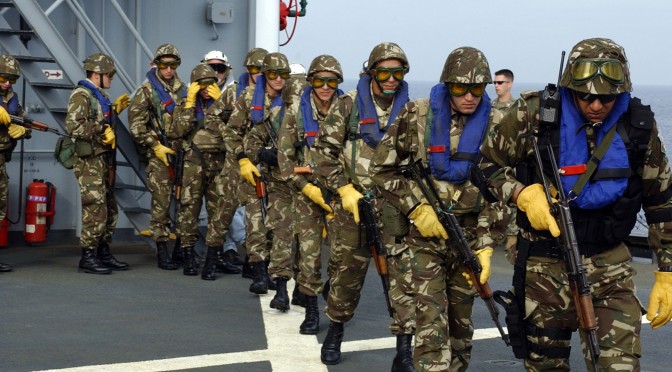
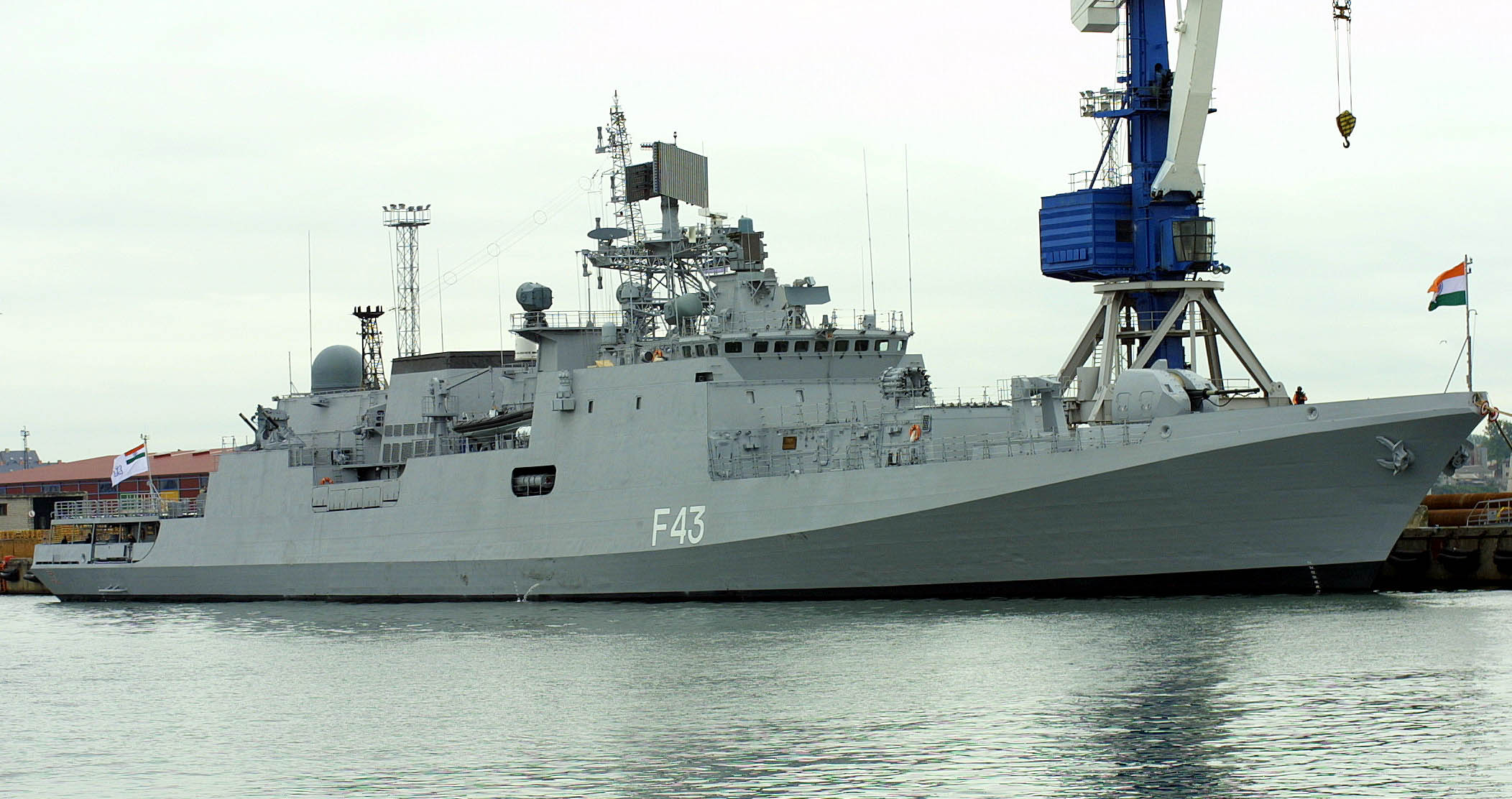
The Algerian Navy has been on a buying frenzy in recent years, amassing a significant maritime force. In September 2014, representing the culmination of a longer term procurement project, Italy’s Orizzonte Sistemi Navali (OSN) delivered Algeria’s new flagship, an 8,800-tonne amphibious assault ship called the Kalaat Beni-Abbes. But newer projects than OSN’s are currently underway. A shipyard in Saint Petersburg, Russia is building two new Kilo-class diesel-electric submarines for Algeria, while two MEKO A200-class frigates, three F-22P Zulfiquar-class frigates, and two Tigr-class corvettes are being produced for service in the Algerian National Navy at shipyards ranging from Kiel to Karachi.

z classThis vastly outpaces the procurement projects of Algeria’s neighbours. In 1993, Algeria and Tunisia successfully resolved their maritime boundary dispute and have since launched several joint energy exploration projects. Tunisia’s 2010-2011 revolution and concerns in Algeria that the uprising might bring an Islamist regime to power created some uncertainty, but the bilateral relationship remains on the whole quite positive. Although the nearby Strait of Gibraltar has seen some heightened tension between British and Spanish maritime forces, Algeria is not a party to any of these confrontations. In this context, the aggressive expansion of the Algerian National Navy must be rather confusing.

However, it is possible that Algeria is preparing for a significant counter-piracy role. NATO’s Operation Unified Protector devastated the Libyan Navy. Currently, that country’s maritime forces consist of one Koni-class frigate, one Natya-class minesweeper, and two Polnocny-C landing ships. NATO air strikes in May 2011 totally destroyed Libya’s naval bases at Sirte, Khoms, and Tripoli. While the maritime forces loyal to the Libyan government are small in number and poorly equipped, rebels continue to hold a few ports in Libya’s east, though most were freed in a series of offensives during the summer and autumn of 2014. Earlier, in March 2014, one rebel militia succeeded in loading an oil tanker in defiance of the Libyan authorities, prompting the ouster of Prime Minister Ali Zeidan.

If the Libyan authorities are struggling to secure their own ports, it is conceivable that rebel groups in the country’s eastern regions could engage in piracy in future years. Such a situation would jeopardize Algeria’s economic growth as it seeks to become a major energy exporter to Europe and Asia. In March 2014, Algerian officials announced plans to increase oil and natural gas production by 13% to 220 million metric tonnes of oil equivalent in two years. The resulting increase in tanker traffic on North Africa’s coast would present plenty of prime targets for Libyan pirates.

Yet it remains unclear whether it is indeed a counter-piracy role that is envisioned for the Algerian National Navy. Algeria is not officially cooperating with Operation Active Endeavour, which is NATO’s counter-terrorism and counter-proliferation force in the Mediterranean Sea, though five ships assigned to the NATO Mine Counter-Measures Group did make a port visit to Algiers in September 2014 prior to joining Active Endeavour. In order to avoid conflict from emerging between Algeria and Libya over the security of international shipping routes, it may be necessary for NATO officials to aggressively pursue a closer relationship with both countries.

Through the Mediterranean Dialogue, NATO established an Individual Cooperation Program (ICP) with Israel in 2006, which allows for Israeli participation in Operation Active Endeavour and other mutually beneficial initiatives. Other ICPs were completed with Egypt in 2007 and Jordan in 2009. Securing ICPs with Algeria and Libya, however, will be an uphill battle; Algeria has participated in NATO’s Mediterranean Dialogue since 2000 but Libya has yet to even respond to a 2012 invitation to join. Nonetheless, it is still an effort worth attempting as it may help to avoid much hardship and conflict in the future. For now, Algeria seems to be bracing for impact.

Paul Pryce is a Research Analyst at the Atlantic Council of Canada. His research interests are diverse and include maritime security, NATO affairs, and African regional integration.

This article can be found in its original form at Atlantic Council of Canada.

No Strait for Aircraft Carriers

Earlier this year, United States Naval Academy Museum hosted a debate on the future of aircraft carriers (with parallel debate on twitter under #carrierdebate). It is a timely debate as the utility of aircraft carriers is under review in the face of the proliferation of Anti-Access/Area Denial (A2AD) systems. Critics argue that current aircraft carriers are too vulnerable in highly contested environments and too crucial to lose. Indeed, ever more precise, maneuverable, and swift anti-ship missiles (ASM) and silent submarines make certain types of environments overly prohibitive for aircraft carriers. However, this is not an entirely new situation. In fact, sending aircraft carriers close to coastlines and into the littorals has always been dangerous and against their designed purpose.

Ever since the commissioning of the ex-Varyag into the People’s Liberation Army Navy (PLAN) as the Liaoning (CV-16), speculations have taken place as to its tactical, operational, and strategic implications. With Taiwan classified as one of China’s “core interests”, and due to the protection (however ambiguous) offered by the US under the Taiwan Relations Act of 1979, Taiwan remains a prime hotspots with the potential to escalate into an all-out great power war. Thus, various analysts have engaged in discussions on the Liaoning’s role in a potential crisis over Taiwan. However, in doing so, it is better not to fall for the allure of focusing on the hardware capability over doctrine, tactics and the nature of the specific theater.

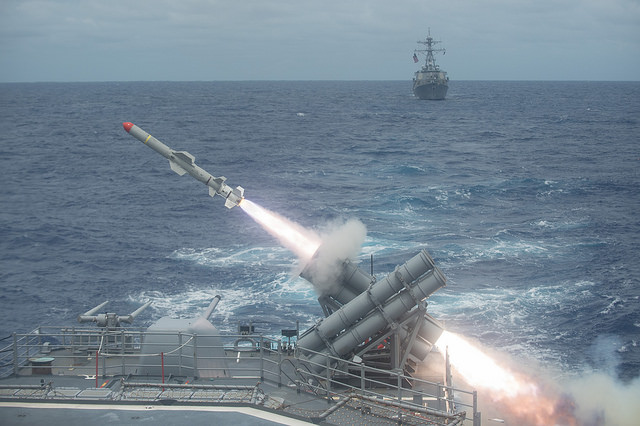
Harpoon anti-ship missile is launched from the Ticonderoga-class guided-missile cruiser USS Shiloh (CG 67) during a live-fire exercise. Image Credit: CC BY 2.0 Official U.S. Navy Page/Flickr.
Harpoon anti-ship missile is launched from the Ticonderoga-class guided-missile cruiser USS Shiloh (CG 67) during a live-fire exercise. Shilih is part of Japan-based Carrier Strike Group Five. Taiwan and Japan also posses Harpoon ASMs. Image Credit: CC BY 2.0 Official U.S. Navy Page/Flickr.

An examination of tactical and operational situations encountered by Carrier Strike Groups (CSG) through the Taiwan Strait reveals that adding a hypothetical Chinese carrier group’s presence does not augment existing the People’s Liberation Army Navy (PLAN)’s strategy. Instead PLAN doctrine relies on assets in the form of saturation missile attacks, submarines, fast missile boats and other Chinese A2AD elements. It is worth mentioning that these capabilities were already present in the the Taiwan Strait during the 1995-96 missile crisis. Being close to an enemy’s land-based assets poses a severe risk to the CSG’s survivability. Its combat effectiveness, is significantly diminished in the narrow waters of Taiwan Strait during high intensity combat conditions. In essence, the PLAN already had sufficient capabilities in place in 1996 such that sending a CSG into the Taiwan Strait would be a suicidal endeavor. The situation has only become more challenging for the US Navy in recent years not because the PLAN has acquired an aircraft carrier of its own, but rather due to the fact that China has greatly enhanced and modernized its existing A2AD capabilities.

The common reference to the 1996 deployment of aircraft carriers during the Taiwan Strait Missile Crisis as an indication of what could happen should the situation between China and Taiwan escalate into a shooting war suggests that there are two common misconceptions about the 1995-96 crisis. In late December’s piece for The Diplomat, Vasilis Trigkas presented interesting argument on the presence of aircraft carriers in the Taiwan Strait. In particular, he notes: 

Memories from 1996 – when Chinese missile tests in the strait prompted U.S. President Bill Clinton to order two fully armed carrier battle groups to pass through the Taiwan Strait – have shaped the strategic operational codes of the Chinese military and the Central Politburo. While China might have had the military resources to sink U.S. naval forces in its close periphery (quantity has a quality of its own) the strategic escalation that an attack against a U.S. carrier would trigger led Beijing to de-escalate. Since the importance of Taiwan’s reunification with the mainland remains an indispensible argument in the PRC’s rhetoric on the rejuvenation of the Chinese nation, China’s officials have long strategized about how to neutralize U.S. operational superiority in the event of a new strait crisis. The 2008 acquisition of an old Soviet aircraft carrier from Ukraine should be seen as an extension of this goal. This carrier is the missing piece in China’s strategic puzzle in its first island chain and adds new strategic variables to a Sino-U.S. clash over Taiwan.

First, contrary to popular belief, in March 1996 neither of the two deployed CSGs (Carrier Group Seven headed by CVN-68 Nimitz and Carrier Group Five centered around CV-62 Independence) entered Taiwan Strait (p. 110). Nimitz was deployed in the Philippine Sea ready to assist the Independence Battle Group deployed to the east of Taiwan. Indeed, earlier in December 1995 the Nimitz battle group did pass through the Taiwan Strait, but it was several months after Chinese first missile tests close to Taiwan in July 1995. Moreover, US officials back then believed that the passage went unnoticed by Beijing (p. 104).

Second, in 1995 and 1996, the issue at stake was Beijing displeasure with Taiwan’s effort to establish itself as a new democracy, demonstrated by then President Lee’s visit to Cornell University and the island’s first free presidential election in 1996. Beijing did not de-escalate because of the presence of the two CSGs but because it had made its point. However displeased the Chinese leadership was back then, no one has seriously contemplated further escalation. Moreover, China could very well have another motivation, testing the limits of US strategic ambiguity across the strait as they had tested the 1954 Taiwan-US defense alliance during the 1958 Taiwan Strait crisis. In that sense, deployment of two CSGs gave Beijing the indication that the US would indeed intervene should the Chinese Communist Party (CCP) decide to use deadly force against Taiwan.

Thus, the presence of the Nimitz and Independence CSGs in Taiwan’s proximity in 1996 should be understood as a symbolic gesture of the US commitment to the peaceful solution of cross-strait relations. It is doubtful that the acquisition of the Liaoning would deter Washington should it decide to demonstrate its resolve again. With the other assets that the PLA has been busy deploying in a meantime, now, that is all different story.

Trigkas argues that in 1996 the Chinese backed off because targeting US aircraft carriers would escalate the conflict out of proportion. Having an aircraft carrier and deploying it in advance of an intervening USN CSG would push the escalation ball to the US’ corner. Henceforth, it would be the US who would have to take the first shot because the Chinese CSG would block its way. Given that in 1996 the use of force was off the table and the crisis was all about making a political stance without intention to escalate, would a Chinese aircraft carrier prevent future US intervention by making itself too (politically) valuable to be attacked?

Not since World War II has the world seen any significant battle fought between rival carrier groups, and just as the carrier replaced the battleship through asymmetric means (the range of the onboard aircraft negated the firepower, speed and armor of a conventional battleship.), the effective counter to a CSG is unlikely another CSG, but instead a whole range of asymmetrical means such as strikes against its rear-echelon fast combat support ships (AOEs), land-based airpower or submarine warfare. Moreover, one need not send the aircraft carrier to the bottom, resulting in massive loss of lives of those on board, to neutralize the combat effectiveness of a CSG.

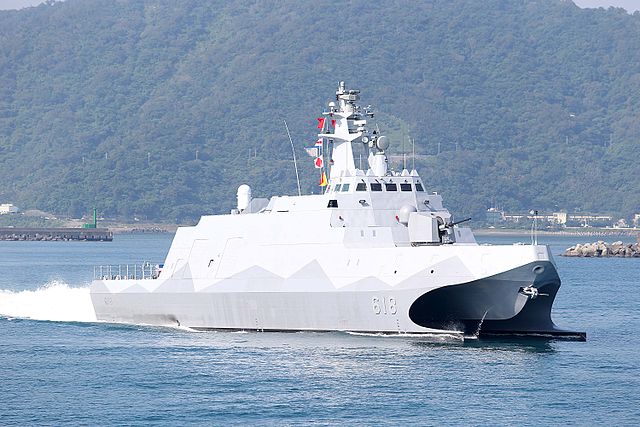
Tuo Jiang class missile corvette deployed by Taiwan could become major threat for PLAN's aircraft carriers. Image Credit: CC BY-SA 4.0 Larry41028/Wikimedia Commons.
Tuo Jiang class missile corvette deployed by Taiwan could become major threat for PLAN’s aircraft carriers. Image Credit: CC BY-SA 4.0 Larry41028/Wikimedia Commons.

Even if Chinese aircraft carriers were to become targets of the USN’s CSG, it would still be an unequal encounter for the PLAN, facing much more experienced USN CSGs with superior sortie rate and integrated defense. In such an encounter, the US Navy could inflict sufficient damage to incapacitate a Chinese aircraft carrier without actually sinking it. The best way to render an aircraft carrier useless is to limit the effectiveness of its air wing. Liaoning’s air wing is in this respect very modest totaling 30 J-15s fighter jets with compromised range, endurance and armament resulting from a lack of catapult launch systems. This number will most likely be higher for Liaoning’s successors, but the sortie generation rate accumulated through operational experience will take a lot longer to equalize. In comparison, Nimitz and Ford-class supercarriers typically carry 70-80 fixed wing aircraft and helicopters and their designs are much more flexible to accommodate various mission requirements.

Furthermore, the employment of a CSG in an open confrontation would run contrary to the tactics and culture consistently displayed by a sea-denial mindset influenced by the tradition of people’s war that informs so much of the CCP’s naval strategy (p. 37), prominently displayed during the Battle of Dongshan on 6 Aug 1965, where 11 PLAN torpedo boats and 4 patrol boats sunk 2 Taiwanese capital ships in 3 consecutive waves, resulting in 171 missing and 31 deaths, including the commander of the ROCN Second Fleet. The PLAN’s efforts towards becoming a Blue-Water Navy have undoubtedly changed its tactical mindset, but even then deployment of a Chinese aircraft carrier against Taiwan (and presumably against the USN) does not offer advantages that would outweigh the potential costs. If deployed outside of the A2AD protective cover, a Chinese CSG would be too weak to counter its US counterpart, and when deployed within A2AD cover, its capabilities are largely redundant.

Moreover, while the debate focuses on the political significance of sinking a US aircraft carrier, Beijing itself could ill-afford the political consequences of its CSG rendered impotent during combat in or close to the Taiwan Strait where potential adversaries such as Taiwan’s recently introduced Tuo Jiang class missile corvette could fully exploit its weaknesses. Indeed, should China deploy its CSG near Taiwan as a part of combat operations, USN would not need to fire a single shot and China’s capital ship could still end-up incapacitated or sunk. Taiwan’s sea and land-based anti-ship missiles represent a reverse A2AD significant challenge for China. 

Hence it is reasonable to conclude that the Chinese acquisition of the Liaoning and the further expansion of the Chinese aircraft carrier fleet, while significant, has very little direct impact on a potential crisis deployment in the Taiwan Strait. Instead one should look toward the prestige factor of presenting itself as a Blue Water Navy and a CSG’s value in prosecuting the territorial ambitions displayed by the Chinese government in recent times, e.g. in the South China Sea or the Diaoyutai/Senkaku Islands, where Chinese land-based airpower does not enjoy the same advantage as in the case of Taiwan-related contingency.

In a potential crisis across the Taiwan Strait, the PLAN’s goal would be better served through a deterrence formed by a combination of guided missiles destroyer-led surface action groups, land-based airpower utilizing supersonic ASMs coupled with over the horizon (OTH) targeting, and high-end attack submarines rivaling the low noise level of even US Seawolf-class SSNs. All of this could successfully prevent US reinforcements from accessing littoral regions of the theater (A2) and impede their movement along the First Island Chain (AD).

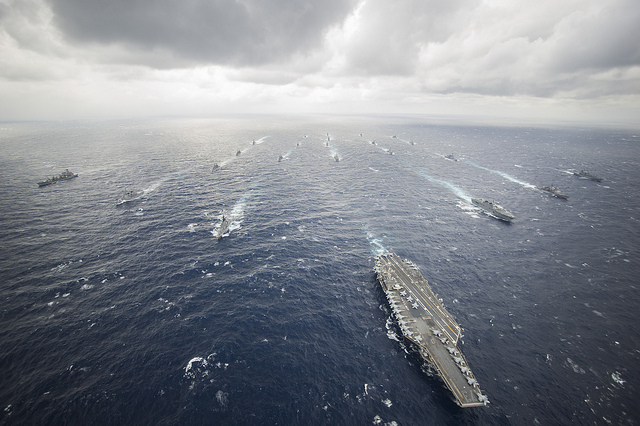
The aircraft carrier USS George Washington (CVN 73), center-right, leads the George Washington Carrier Strike Group and Japan Maritime Self-Defense Force ships in tactical maneuver training during Annual Exercise (AnnualEx) 13. Image Credit: CC BY 2.0 Official U.S. Navy Page/Flickr.

Aircraft carriers will maintain its role as a blue water force projector in the foreseeable future. Indeed, they are indispensable for a global sea-control navy tasked with missions to protect sea lines of communication. But the carrier battle groups were never meant to physically present itself in an environment similar to the Taiwan Strait. Granted, ASMs and submarines are problem on the open seas too but any potential opponents would be limited by the storage capacity of their onboard ordnance, with PLAN having limited ability of underway replenishment. In other words, open sea offers no advantage of a compressed engagement battlespace that littoral contestant such as China possesses against the limited range of present day CSG, bearing in mind that as China’s A2AD capabilities make it difficult for US Navy CSGs, PLAN’s own aircraft carrier faces the very same risk from the its neighbors, Taiwan included. 

Michal Thim is a Ph.D. candidate in the Taiwan Studies Program at the China Policy Institute (CPI), University of Nottingham, a member of The Center for International Maritime Security, an Asia-Pacific Desk Contributing Analyst for Wikistrat and a Research Fellow at the Prague-based think-tank Association for International Affairs. Michal tweets @michalthim.

Liao Yen-Fan is Taipei-based defense analyst specializing in airpower and Taiwanese military. He can be reached for comment at charlie_1701@msn.com.

The Potential for Panshih: Taiwan’s Expanding Maritime Role

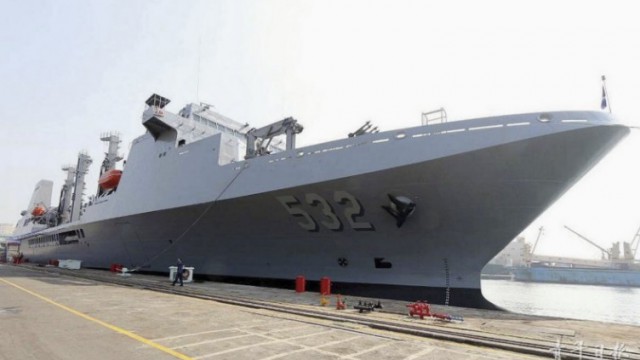
Taiwan has long enjoyed a robust maritime force, intended to defend the island nation from threats both real and perceived across the Taiwan Strait. An arrangement under which the United States will deliver four Oliver Hazard Perry-class frigates for use by the Republic of China Navy (ROCN) will only serve to further enhance the country’s maritime power. But perhaps the most interesting development for maritime affairs in the Asia-Pacific region so far in 2015 is the delivery of the ROCS Panshih.

With a total displacement of 20,000 tons and a range of almost 15,000 kilometers, the supply ship Panshih will greatly contribute to the ROCN’s expeditionary capabilities, allowing Taiwan to contribute meaningfully to disaster relief or humanitarian operations anywhere in the region. Historically, Taiwan has lacked this capability, fielding only the ROCS Yuen Feng, a troop transport. Although the ROCN has operated another supply ship for some years, ROCS Wu Yi, the Panshih is significantly larger and possesses much more advanced medical facilities. Reportedly, the Panshih is also only the first of its class – a second ship of an identical design is expected for the ROCN in the next few years.

These ships may soon cruise the seas in a Taiwanese effort to replicate the successes of China’s maritime diplomacy. The Peace Ark, a hospital ship in service with the People’s Liberation Army Navy (PLAN), has toured extensively since its commissioning in 2008. For example, the Peace Ark was deployed to assist the Philippines in recovering from Typhoon Haiyan in November 2013, and later was an important component of the Chinese participation in the Rim of the Pacific Exercise (RIMPAC) 2014. Port visits and participation in such multilateral operations enhance China’s “soft power”, whereas observers note that Taiwan has been sidelined for the most part in regional diplomatic affairs. Pursuing a similar theme to China’s charm offensive could be just the remedy to Taiwan’s isolation.

A port of the flight deck on the Panshih.

Yet there is one catch to the Panshih’s particular design. The vessel boasts some offensive capabilities, including a Phalanx close-in weapons system, a 20mm Gatling gun, short-range Sea Chaparral surface-to-air missiles, several .50 calibre machine guns, and 30mm turrets. In contrast, the Berlin-class auxiliary ships employed by the Germany Navy, and which the Royal Canadian Navy will also soon employ as the Queenston-class, have only four MLG 27mm autocannons for defence. China’s Peace Ark is entirely unarmed. While the Panshih’s armaments grant it operational flexibility, they also undermine the vessel’s capacity to act as a soft power tool.

Perhaps the most ideal role for this vessel in the future will be to join relief operations in unstable environments. Taiwan has not contributed much in this area in previous years, with the ROCN focusing almost entirely on defending the Taiwanese coastline from threats across the strait. But there is one success story: in 2011, Taiwan initiated some participation in the European Union’s Operation Atalanta. This constituted an important contribution to international efforts against piracy in the Gulf of Aden and the Indian Ocean. But this is the lone case of active engagement by the ROCN in any initiative beyond the Taiwan Strait. The Panshih could grant Taiwan more options in this regard, since the deployment of fully fledged combat vessels to an area like the Gulf of Aden could be viewed by domestic audiences as weakening Taiwan’s coastal defenses or otherwise as a misuse of Taiwanese defense resources. A supply ship could be more readily spared so far as the public is concerned.

Lending credence to the idea that the Panshih will be used to support humanitarian operations in failed or failing states, the vessel also has impressive hangar space, capable of storing up to three helicopters. The Taiwanese media has focused on the capacity for the ship to serve as a takeoff and landing platform for anti-submarine helicopters, but it is also certainly possible for the ship to serve as a base for transport helicopters ferrying supplies and specialized personnel to inland locations, while also bringing back patients requiring intensive care at the Panshih’s onboard medical facilities. The ROCN’s 19 Sikorsky S-70C(M) Thunderhawk helicopters offer some possibilities in this regard.

In any case, the ROCN now has in its possession a versatile ship. What remains to be seen are how the ROCN will put it to use in the coming years and to what extent this will reflect Taiwanese foreign policy priorities. With such a sophisticated vessel, it would be a shame for Taiwan to keep it docked as backup for a regional conflict that might never, and hopefully will never, come.

Paul Pryce is a Research Analyst at the Atlantic Council of Canada. His research interests are diverse and include maritime security, NATO affairs, and African regional integration.

This article can be found in its original form at offiziere.ch and was republished by permission.