Tag Archives: Taiwan Strait

Desert Storm Made the PLA. What is the Iran War Making?

By Commander Ander S. Heiles, USN

In January 1991, Chinese military officers watched CNN footage of the United States dismantling the Iraqi Army and experienced what one People’s Liberation Army (PLA) analyst later called a psychological nuclear attack.” Desert Storm displayed every capability the PLA lacked, and China had no choice but to begin remaking its military from the ground up.

Two years later, China’s Central Military Commission codified these lessons in the Military Strategic Guidelines centered on “Local Wars Under High Technology Conditions” and acknowledged the PLA had been preparing for the wrong war. The Gulf War didn’t just scare China, it gave it direction.

Thirty-five years later, the classroom has reopened. The United States and Israel are engaged in a military campaign against Iran, and the Persian Gulf is once again the center of a maritime crisis. The Strait of Hormuz is effectively closed. Not by minefields or naval blockade, but by the withdrawal of maritime insurance and the cascading commercial decisions that followed.

Tanker traffic dropped first by approximately 70% with almost 150 vessels loitering outside the Strait. Transit has since collapsed to nearly zero within the first week, disrupting roughly 20% of the world’s daily oil supply and significant volumes of liquefied natural gas. Roughly 750 vessels are now stranded within the Persian Gulf, and the PLA is paying very close attention.

The instinct is to assume Beijing is enjoying the bedlam: a distracted America, its military tied down in the Middle East, and precision munitions being expended far from the Pacific. That instinct is wrong.

What the PLA’s most attentive analysts are likely doing is war-gaming a Taiwan scenario in real-time using the Hormuz crisis as a live stress test for assumptions they have been modeling for decades. Some of what they are finding is deeply uncomfortable. The tactical lessons are significant but broadly familiar. However, the deeper strategic lessons, the ones that will reshape Chinese planning for the Taiwan Strait and South China Sea, are maritime.

The Chokepoint in the Mirror

In 1991, China’s Desert Storm lesson was almost entirely about its capability gap. The maritime domain barely registered because the Gulf War was largely a land-air campaign. The 2026 crisis is fundamentally a maritime crisis, and China is learning a new lesson: chokepoints do not just threaten an enemy, they threaten anyone who depends on them.

Approximately 84% of the oil transiting through the Strait of Hormuz flows to Asian markets. China alone imported roughly five million barrels per day through the Strait, representing approximately 40%-45% of its total crude imports. The Hormuz closure does not primarily threaten Houston or Rotterdam. It throttles Tianjin, Qingdao, and Zhoushan.

Prolific naval strategist Alfred Thayer Mahan understood this. He spent much of his seminal work, The Influence of Sea Power Upon History, explaining not just how navies project power but how dependence on sea lines of communication creates strategic vulnerabilities. A nation that does not control its own supply lines does not truly control its own strategic fate.

The PLA absorbed this lesson from Mahan and filtered it through the lens of Desert Storm’s demonstration of American power projection. In response, China has been building a blue-water navy and acquiring global port access in response.

However, the Hormuz crisis is forcing Beijing to confront a gap that was not illuminated by Desert Storm nor discussed in any specificity by Mahan: China remains critically dependent on chokepoints it cannot protect and does not control. The Strait of Hormuz is the immediate problem, but the Strait of Malacca, through which 80% of China’s oil imports transit, is the permanent one.

Beijing’s Foreign Ministry has been reduced to urging all parties to “keep the shipping routes in the Strait of Hormuz safe,” and reports that China has opened direct talks with Iran to negotiate safe passage for energy shipments underscores that vulnerability. A nation that must ask permission to use a chokepoint does not command it. For PLA planners gaming a Taiwan contingency, the lesson is immediate: any conflict that triggers a disruption at the Malacca Strait could strangle China’s economy before a single shot is fired.

The Insurance Blockade

If the chokepoint lesson is uncomfortable, the insurance lesson may be worse. Within 72 hours of the start of Operation Epic Fury, multiple members of the International Group of Protection and Indemnity (P&I) Clubs, which collectively insure roughly 90% of the world’s ocean-going tonnage, issued formal cancellation notices for war-risk coverage in the Gulf. Major container lines suspended operations. Lloyd’s Market Association confirmed that roughly 1,000 vessels with a hull value of over $25 billion sat anchored in the area.

The chokepoint was not closed by missiles. It was closed by spreadsheets.

The PLA is likely studying this closely because it maps directly onto a Taiwan scenario. Beijing has long assumed that the critical question in a cross-strait contingency would be whether the People’s Liberation Army Navy (PLAN) could establish sea control. The Hormuz crisis suggests a different question entirely: would commercial shipping continue to flow through the Strait of Malacca and South China Sea once insurers withdraw coverage and container lines suspend service?

The same insurance mechanism that shut Hormuz in 72 hours could shut the commercial sea lanes on which China’s economy depends. Unlike a naval blockade, an insurance withdrawal cannot be stopped by force. No navy can compel an underwriter to write a policy.

China has been building state-backed maritime insurance mechanisms and positioning its commercial fleet to operate under sovereign-risk coverage precisely to insulate itself from the kind of Western-backed market dependency that has strangled Gulf shipping. The Hormuz crisis validates that investment.

On the other hand, it also reveals how far Beijing needs to go. China’s maritime insurance ecosystem does not yet have enough depth or international credibility to underwrite the scale of coverage that a Taiwan-related disruption would demand. A harder problem still is even if China can insure its own flag vessels, it cannot compel foreign-flagged ships to continue sailing into a warzone.

The roughly 750 vessels stranded in the Persian Gulf are a preview of what the South China Sea could look like 48 hours into a Taiwan crisis. Commercial shipping frozen, supply chains severed, and the PLAN unable to restart them regardless of how many ships it deploys.

The Fleet Behind the Fleet

The Hormuz crisis is also teaching China a lesson about commercial shipping as a military instrument. When the United States declared a maritime warning zone in the Persian Gulf, it came with an unusual public admission: it could not guarantee the safety of merchant shipping. The major container lines made their own risk calculations and suspended operations. The financial architecture of global trade enforced a blockade more completely than any naval minefield.

Sinokor, a South Korean shipping conglomerate, began asking the equivalent of roughly $20 per barrel to transport oil to China. This is an extraordinary premium compared to the nominal $2.50 per barrel, and this illustrates how quickly commercial sealift becomes a strategic weapon when maritime risk spikes.

China has been preparing for exactly this scenario. Over the past two decades, Beijing has expanded its merchant fleet to over 4,000 internationally trading ships, captured over 46% of global commercial shipbuilding, and invested in the mariner training pipeline to crew those vessels. Critically, the PLA has also been integrating commercial shipping into military logistics planning. China’s national defense mobilization laws allow the requisitioning of civilian vessels, and its merchant fleet has been designed with dual-use capability in mind.

The Hormuz crisis is validating China’s investment in a state-linked merchant marine fleet while simultaneously demonstrating the cost of America’s failure to maintain one. However, it is also exposing a gap in China’s own planning: a fleet that can be mobilized for war is also a fleet that can be commercially paralyzed by insurance withdrawal, sanctioned by coalition financial instruments, or stranded at foreign ports. In a Taiwan contingency, the PLAN’s ability to move troops across the Strait may matter less than whether China’s commercial fleet can continue to feed, fuel, and supply the mainland economy under wartime conditions. The Hormuz crisis is the first live demonstration of how quick commercial architecture can collapse.

What This Means

Desert Storm inspired China spend 35 years building the military it now has. Operation Epic Fury will not trigger the same kind of wholesale structural overhaul – the PLA has already done that work. What the 2026 crisis is doing is stress-testing China’s maritime strategy against live data and finding specific, uncomfortable gaps: chokepoint dependency that blue-water naval investment has not yet solved, an insurance architecture that can impose a blockade no navy can break, and a commercial fleet that can be mobilized for war but paralyzed by the financial instruments.

Each lesson applies directly to the Taiwan Strait and South China Sea. PLA planners are not watching the Hormuz crisis as a distant curiosity. They are watching it as a dress rehearsal, and they are taking notes on themselves as much as on the United States.

Mahan argued that sea power rests on two pillars: naval force and commercial maritime enterprise. China has been absorbing both halves of that doctrine. The Strait of Hormuz crisis is revealing that even both halves may not be enough. The question is whether the United States, which builds less than 1% of the world’s commercial ships, fields fewer than 80 vessels in international trade, cannot crew the sealift fleet it already has, and had no war risk insurance mechanism ready when the crisis broke, is learning it too.

Commander Ander Heiles is a student at the Joint Advanced Warfighting School in Norfolk, VA. He commanded USS Monsoon (PC 4) and is the Prospective Executive Officer (P-XO) for the Naval Talent Acquisition Groups (NTAG) Empire State. The views expressed here are those of the author and do not necessarily represent the official positions or opinions of the U.S. Navy, the Department of Defense, or any part of the U.S. government.

Featured Image: Cosco Shipping Lines ultra-large container vessels at Rotterdam. (Photo via Kees Torn/Creative Commons)
A Question of Time: Improving Taiwan’s Maritime Deterrence Posture

The following essay is adapted from a report published by George Mason University’s Center for Security Policy Studies: A Question of Time: Enhancing Taiwan’s Conventional Deterrence Posture

By Joe Petrucelli

Just last month two U.S. Navy warships conducted a transit of the Taiwan Strait, reminding the world that the status of Taiwan remains contested and unresolved. Although China prefers to use peaceful means to achieve unification, it has not taken the possibility of force off the table. Accordingly, Taiwan remains one of the few states to endure the plausible risk of military invasion.

After visiting Taiwan to study this problem, a team of researchers, including the author, recently released a report advocating for a dramatic shift in Taiwan’s conventional deterrence posture. Among our recommendations, we call for Taiwan’s navy to change its current acquisition priorities and embrace an unconventional-asymmetric doctrine of sea denial.

We suggest this shift in maritime strategy because of what we termed Taiwan’s deterrence trilemma. At a strategic level, Taiwan must simultaneously accomplish three goals that exist in tension with each other:  

  • It must counter China’s grey zone challenges, which means Taiwan must project symbolic strength across its airspace and territorial waters;
  • It must raise the costs of invasion, which means it needs forces that can prolong any conflict and inflict unacceptable losses on the invaders; and
  • It must do both of these things in a resource-constrained environment defined by a general unwillingness to significantly increase defense spending

At least in the near term, a military invasion remains unlikely since the PLA faces a number of obstacles that complicate its ability to mount a successful invasion. Nonetheless, time is on China’s side and Taiwan’s naval doctrine and force posture remain misaligned. Although Taiwan has revised its strategy to emphasize multi-domain, asymmetric deterrence, it remains focused on purchasing high-end, high-capability systems such as the F-35B fighter, Aegis-like destroyers and diesel submarines, the “darlings of their service chiefs.” 

We argue that Taiwan should enhance its deterrence posture by adopting a more coherent and holistic approach. Specifically, we recommend that it adopt an elastic denial-in-defense strategy, which will consist of three core elements:

  • Accept risk in the grey zone. Grey zone aggression does not constitute an existential threat allowing Taiwan to rebalance its force to maintain “just enough” capability to push back against grey zone challenges, such sufficient naval strength to prevent and intercept unwanted excursions into Taiwanese waters;
  • Prioritize denial operations. Specifically, divest as many costly, high-tech platforms as possible so as to invest in large numbers of relatively low-cost, counter-invasion capabilities. This would raise the cost associated with bringing a hostile force close to Taiwan’s shores; and
  • Invest in popular resistance. The prospect of waging a prolonged insurgency will likely deter China’s leadership far more than the threat of fighting a relatively small, conventional force.

We are not the first to propose shifting to an asymmetric maritime force to deny China use of the seas as an invasion corridor. Numerous reports and analyses have suggested specific maritime platforms Taiwan should acquire to execute a sea denial strategy, such as fast missile boats, semi-submersibles, mini-submarines, mines, and coastal defense cruise missiles. We entirely agree with these recommendations and note that to date, despite talk of an asymmetric strategy, Taiwan has made only marginal changes. For example, while it has modestly increased its inventory of missile boats and anti-ship cruise missiles, Taiwan’s navy remains anchored around a relatively small and therefore vulnerable inventory of high-end platforms. 

The political reality is that Taiwan’s navy faces major resource constraints and so must make difficult choices. Accordingly, Taiwan should defer its high-profile procurement priorities, especially the Aegis-like destroyer and the Indigenous Diesel Submarine (IDS). These are technically challenging programs, especially given Taiwan’s lack of experience building similar platforms. Additionally, they are expensive enough that Taiwan will not be able to field them in large numbers and ultimately remain vulnerable to Chinese long-range strike and anti-access weapons systems. Taiwan’s current naval fleet, although aged, is sufficient to “show the flag” and resist grey-zone aggression for the near future. Instead of these planned procurements, Taiwan should significantly increase the numbers of low-cost, lethal platforms, even at the expense of other planned procurements.

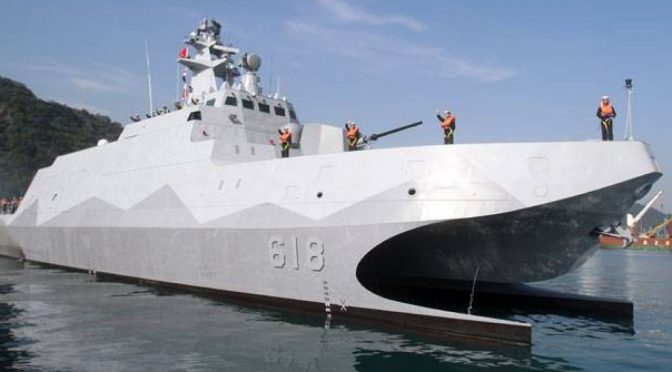
These lower cost platforms, by the larger numbers procured, complicate adversary targeting and improve their force-level survivability against PLA strike capabilities. Taiwan should start by fielding a larger fleet than currently envisioned of its stealthy Tuo Jiang missile corvette and build on the lessons learned from these small corvettes to field a future small frigate. Both can fulfill peacetime missions but be built in large enough numbers to possibly survive in a wartime environment. By delaying the more ambitious destroyer and IDS programs and starting with smaller, less expensive projects, Taiwan can best prioritize limited resources.

This incremental approach also helps develop relevant technical capability, so that potential future submarine and large surface combatant programs are less technically risky when it becomes fiscally and strategically appropriate to build them. The immediate savings from delaying the destroyer and IDS programs can be diverted into the sea denial platforms that Taiwan needs now, ranging from the small frigate discussed above to even smaller missile boats, mini-subs and mobile anti-ship cruise missiles.

Moreover, Taiwan should eliminate its entire amphibious force. Bluntly speaking, Taiwan’s amphibious assault ships are strategically unnecessary as they are not immediately useful for confronting limited challenges to Taiwan’s territorial sovereignty or other “grey zone” aggression. They also have no ability to counter a cross-strait invasion. Rather than procure expensive amphibious assault ships and maintain aging landing craft, which generate sizable sustainment costs, Taiwan should retire this entire force. It can then shift these savings into further investments in counter-invasion capabilities.

Because Taiwan’s Marine Corps would be losing its sealift, it should be rebranded as Taiwan’s premier counter-amphibious force so as to fill a gap between the navy’s sea denial role and the army’s ground denial mission. Specifically, it would specialize in defending possible landing zones with mines and spread out hard points in addition to engaging landing craft with dispersed, near-shore weapons such as anti-tank guided missiles.

These proposals to transform Taiwan’s naval strategy and procurement plans would produce a force capable of waging a sea denial campaign against a conventionally superior opponent, tailored to the specific threat of a cross-Strait invasion. The changes in naval force structure would be mirrored throughout Taiwan’s armed forces, to include a reduction in army ground strength, the termination of plans to procure F-35B fighters, and accelerated procurement of similar asymmetric capabilities. To invest in popular resistance, we recommend transforming Taiwan’s two-million-man Reserve Force into a Territorial Defense Force prepared to conduct a lengthy insurgency campaign. By abandoning plans for a decisive battle and shifting to a posture that increases invasion costs and prevents a quick victory, Taiwan can better deter China.

Read about these recommendations and more in the full report: A Question of Time: Enhancing Taiwan’s Conventional Deterrence Posture.

Joe Petrucelli is a Ph.D. student at George Mason University’s Schar School of Policy and Government and a currently mobilized U.S. Navy reserve officer. The analysis and opinions expressed here are his alone and they do not represent those of the Department of Defense.

Featured Image: Tuo Jiang-class missile boat in service with the Taiwanese Navy. (Defense Ministry of Taiwan)

The Other Deep-Water Battleground

This article originally featured on Reuters and was republished with the author’s permission. Read it in its original form here

By Peter Marino 

A floating dock of the Indian navy is pictured at the naval base at Port Blair in Andaman and Nicobar Islands, India, July 1, 2015. REUTERS/Sanjeev Miglani

The Indian Ocean may be the only ocean named for a country, but it’ s still heavily contested territory. Both China and India, who have major strategic interests there, are suspicious of each other. Their struggle for leadership in the “emerging world” will play out for decades and all around the globe, but today the Indian Ocean is Ground Zero.

The South China Sea is home to overlapping claims by China, the Philippines, and other countries in the region. And the Arctic Ocean, increasingly, has seen a build-up of U.S. and Russian troops, lured by the possibility of billions of barrels of untapped oil. The Indian Ocean is significant because of its strategically important sea lanes — particularly for India and China, two of the world’s largest importers.

China imports most of its oil by sea, and 80 percent of it crosses the Indian Ocean before it passes through the Straits of Malacca, on its way to the Chinese market. Beijing is very concerned about its dependency on a waterway it does not control, and is using diplomacy, both carrots and sticks, to ensure that it can continue to access the sea lanes. As part of this effort, Xi Jinping’s “maritime silk road” program will offer cheap Chinese financing to cash-strapped governments for trade and industrial infrastructure along such routes.

China is using hard power as well. Through China’s longstanding alliance with the Pakistani government, it has funded improvements at the deepwater port of Gwadar, Pakistan, where a state-owned Chinese company now has a 40-year management contract. That agreement allowed the port to host ships owned by the People’s Liberation Army Navy, giving the Chinese a permanent, or at least semi-permanent, presence in the region.

China’s participation, since 2012, in the international anti-piracy coalition that mans the Gulf of Aden has also allowed it to operate in the Western Indian Ocean, where it is reported to be conducting studies of the sea depth, presumably to aid future submarine patrol missions.

Delhi has been paying close attention, and is mobilizing its own diplomatic and hard-power tools to shore up its influence in its home region. Indian foreign aid, while not yet on the scale of Chinese state investment, is being spread liberally to countries near the Indian Ocean, especially to Bangladesh and Sri Lanka. India’s proximity and cultural similarities give it some advantages over the Chinese efforts. Nationalist Prime Minister Narendra Modi has been notably active in this area, making the first trip by an Indian PM to Sri Lanka in 28 years as part of the push to improve bilateral relations.

Moreover, Delhi is aware of the gap between the strength of its own forces, and that of the Chinese People’s Liberation Army, which has been modernizing for 20 years. India is opening up its checkbook for better equipment, including a multi-billion-euro deal for advanced Rafale fighter jets from France to replace its aging Russian Sukhois. And it is becoming less shy about the idea that it is countering China at sea. When U.S. Secretary of Defense Ashton Carter visited Delhi in June this year, he signed early paperwork establishing a collaboration to develop India’s next generation of aircraft carriers. Because China had recently launched its first aircraft carrier, the Liaoning, and was constructing two more, the motivation behind this proposed Indo-U.S. partnership was unmistakable.

Despite these conflicting interests, China and India could still have room to collaborate on several major global issues. As two of the world’s biggest importers of agricultural goods, minerals and energy, they share an interest in working with exporters to help smooth out price volatility in commodity cycles. And as countries that will be “great powers” while still relatively poor, they should work with each other to push through reforms at the United Nations, World Bank and other international groups that were set up by the rich world. Their shared interest in a peaceful and stable Southeast Asia should contribute to their joint participation in peaceful diplomacy there, too.

But for the moment, Delhi and Beijing are mostly in a mode of competition in the Indian Ocean, and the tendrils of their struggle extend even further, across the steppes of Central Asia, to the Western part of Africa, and into the Persian Gulf, as well. The Indian Ocean is the one major ocean not bounded by one of the existing great powers, which makes it the perfect locale in which the struggle for primacy in the “emerging world” can play out. What we are seeing now is only the beginning.

Peter Marino holds an MSc in Global Politics from The London School of Economics and is a graduate of Norwich University. He lived in Shanghai from 2003 to 2008 and served as head of China development for London-based Aurigon, Ltd. He founded and sold Quaternion, a political risk startup, and is currently establishing a new Think Tank for International Affairs aimed at promoting engagement with the “Millennial Generation.” He also produces Globalogues, a video blog with commentary on global politics and economics. The views expressed in this article are his own.

Deep Accommodation: The Best Option for Preventing War in the Taiwan Strait

Guest post for Chinese Military Strategy Week by Eric Gomez

History has shown that emerging great powers and established or declining great powers are likely to fight major wars in order to determine the balance of power in the international system. There is considerable fear that the U.S. and China are heading towards great power conflict. As Christopher Layne argues, there are “several important — and unsettling — parallels between the Anglo-Germany relationship during the run-up to 1914 and the unfolding Sino-American relationship.” The headline-grabbing dispute in the South China Sea offers an excellent example of one of the several flashpoints that could spark a larger conflict between the U.S. and China. But the probability of great power conflict between the U.S. and China can be reduced if the two states can find ways to better manage interactions in flashpoint areas.

The oldest flashpoint, and the area most important for Chinese domestic politics, is the Taiwan Strait. In 1972, the Shanghai Communique stated that the so-called Taiwan question was the most important issue blocking the normalization of relations between the U.S. and China. This question has yet to be solved, mostly because Taiwan has been able to deter attack through a strong indigenous defense capability backed up by American commitment.

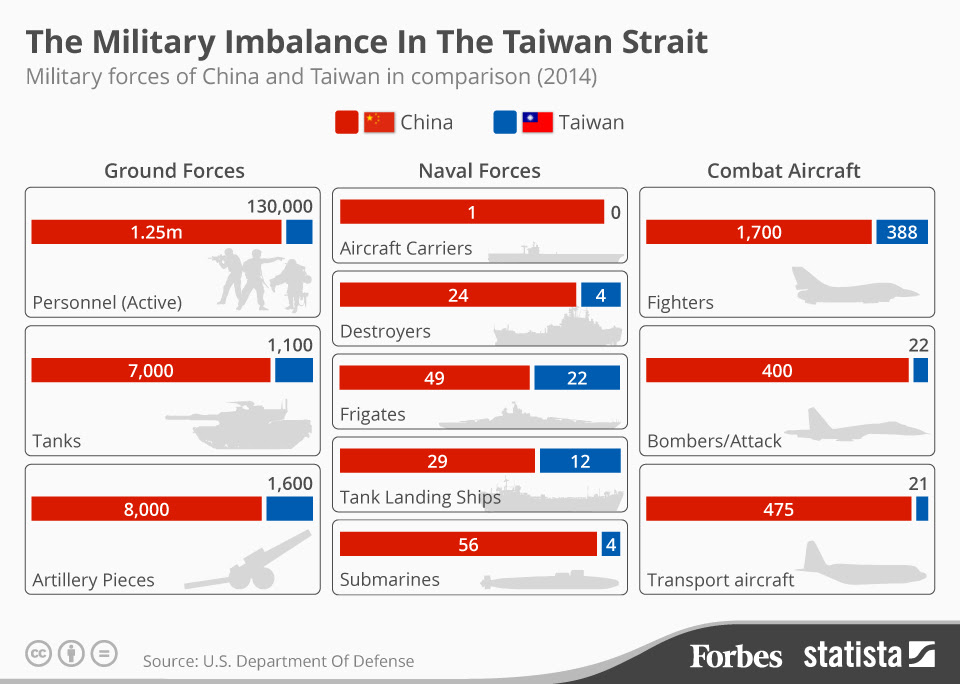
Military Balance in the Taiwan Strait, Forbes.

The status quo in the Taiwan Strait will be unsustainable as China continues to improve its military capabilities and adopt more aggressive military strategies. If the U.S. wants to avert a war with China in the Taiwan Strait, it must start looking for an alternative to the status quo. Taiwan’s strategy of economic accommodation with China under the Ma Ying-jeou administration has brought about benefits. The U.S. should encourage Taiwan to deepen its military and political accommodation with China. This would be a difficult pill for Taiwan to swallow, but it could offer the most sustainable deterrent to armed conflict in the Taiwan Strait.

For years, Taiwan’s de facto independence from China has relied on a qualitatively superior, defense-focused military that could prevent the landing of a large Chinese force on the island. The growing power of the Chinese military, especially its naval and missile forces, has begun eroding this qualitative advantage. Indeed, some observers have already concluded that “the days when [Taiwan] forces had a quantitative and qualitative advantage over [China] are over.” Taiwan still possesses a formidable military and could inflict high costs on an attacking Chinese force, but ultimately American intervention would likely be necessary to save Taiwan from a determined Chinese attack.

Military intervention by the U.S. on the behalf of Taiwan would be met with formidable Chinese resistance. China’s anti-access/area denial strategy complicates the U.S.’s ability to project power in the Taiwan Strait.  China’s latest maritime strategy document, released in May of this year, states that China’s navy will start shifting its focus further offshore to include open seas protection missions. Such a shift implies an aspirational capability to keep intervening American forces away from Taiwan. American political leaders have not given up on Taiwan, and the 2015 U.S. National Military Strategy places a premium on reassuring allies of America’s commitments. However, the fact that China’s improving military capabilities will make an American military intervention on behalf of Taiwan more and more costly must not be ignored.

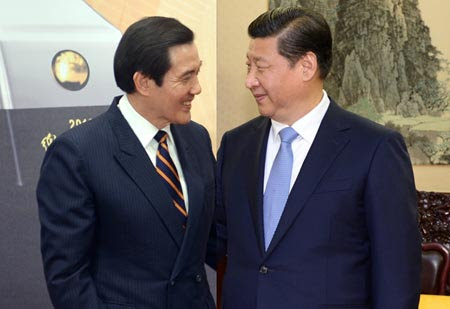
Ma Ying-jeou and Xi Jinping, Xinhua News Photo.

The best option for preventing a war in the Taiwan Strait is deepening the strategy of accommodation that Beijing and Taipei have already started. According to Baohui  Zhang, accommodation “relies on expanding common interests, institutionalizing dialogues, promoting security confidence-building and offering assurances to establish mutual trust.” The Ma Ying-jeou administration in Taiwan has tried to use accommodation as a way to lock in the status quo and avoid conflict, but their efforts have been met with more and more popular backlash in Taiwan. China’s military strategy document does acknowledge that “cross-Taiwan Straits relations have sustained a sound momentum of peaceful development, but the root cause of instability has not yet been removed.”

If Taiwan is serious about accommodation as a means of deterring military conflict, then it should cease purchasing military equipment from the U.S. Stopping the arms purchases would send a clear message to Beijing that Taiwan is interested in deeper accommodation. A halt in arms sales would also benefit U.S.-Chinese relations by removing a “major stumbling block for developing bilateral military-to-military ties.” This is certainly a very controversial proposal, and would likely be very difficult to sell to the Taiwanese people, but as I’ve already explained the status quo is becoming more and more untenable.

Getty Images
Getty Images

There are two important things to keep in mind about this proposal which mitigate fears that this is some kind of appeasement to China. First, halting U.S. arms sales does not mean that Taiwan’s self-defense forces would cease to exist. China may be gaining ground on Taiwan militarily, but the pain that Taiwan could inflict on an attacking force is still high. China may be able to defeat Taiwan in a conflict, but the losses its military would take to seize the island would significantly hamper its ability to use its military while it recovers from attacking Taiwan.

Second, there is an easily identifiable off-ramp that can be used by Taiwan if the policy is not successful. Stopping arms purchases is meant to be a way of testing the water. If the Chinese respond positively to the decision by offering greater military cooperation with Taiwan or some form of political concessions then Beijing signals its commitment to the accommodation process. On the other hand, if the Chinese refuse to follow through and meet Taiwan halfway then Beijing signals that it is not actually committed to accommodation. Taiwan would then resume purchasing American weapons with the knowledge that it must find some other way to prevent conflict.

Accommodation by giving up American arms sales is a tough pill for Taiwan to swallow, but it simply does not have many other viable alternatives to preventing conflict. Taiwan could pursue acquiring nuclear weapons, but this would be met by American opposition and would likely trigger a pre-emptive attack by China if the weapons program were discovered. Taiwan could try to avert conflict by increasing military spending to forestall, but this would be difficult to sustain so long as China’s economy and military spending is also growing. Analysts at CSBA have argued for deterrence through protraction, which advocates employing asymmetric guerrilla-style tactics to prevent China from achieving air and sea dominance. This has the highest likelihood of success of the three alternatives mentioned in this paragraph, but it still relies on intervention by outside powers to ultimately save the day.

Taiwan’s military deterrent will not be able to prevent a Chinese attempt to change the status quo by force for much longer. Any conflict in the Taiwan Strait would likely involve a commitment of U.S. forces and could lead to a major war between the U.S. and China. Accommodation could be the best worst option that Taiwan, and the U.S., has for preventing a war with China. Announcing an end to American weapons purchases could bring Taiwan progress on negotiations with China if successful while still providing off-ramps that Taiwan could take if unsuccessful. I admit, the idea of accommodation does have its flaws, and more work needs to be done to flesh out this idea. I hope that this idea of deep accommodation will add to the discussion about the management of the Taiwan Strait issue. The status quo won’t last forever, and a vigorous debate will be needed to arrive at the best possible solution. 

Eric Gomez is an independent analyst and recent Master’s graduate of the Bush School of Government and Public Service at Texas A&M University. He is working to develop expertise in regional security issues and U.S. military strategy in East Asia, with a focus on China. He can be reached at gomez.wellesreport@gmail.com.

CIMSEC content is and always will be free; consider a voluntary monthly donation to offset our operational costs. As always, it is your support and patronage that have allowed us to build this community – and we are incredibly grateful.
Select a Donation Option (USD)

Enter Donation Amount (USD)