Category Archives: Capability Analysis

Analyzing Specific Naval and Maritime Platforms

Damen’s Presence in the Latin American and Caribbean Market, Part 2

By W. Alejandro Sanchez

Selling To Everyone

The list of Damen’s current clients in the Western Hemisphere highlights one curious fact about this company: the Dutch company sells its equipment to both U.S. allies and foes alike. Certainly, Washington sees no fault in Damen’s decision to upgrade Mexico’s naval equipment. On the other hand, the U.S. government probably frowns at Damen equipping countries that Washington is at odds with, such as Venezuela (which was declared a national security threat by the White House this past March). Similarly, Damen’s shipyard in Cuba, a country that was on the U.S. State Department’s list of states that sponsor terrorism until this past May, is not considered a positive development in Washington.

Nevertheless, Damen has remained neutral in Western Hemisphere geopolitics, as it has dealt with any government willing to pay. This issue deserves further analysis by stating two obvious facts: the U.S. and the Netherlands have generally enjoyed good security relations over the past decades, and Damen is a privately-owned company, which means that the Dutch government has limited influence in the contracts and initiatives it chooses to carry out. With that said, it is bizarre that Damen chose to build a shipyard in a country that has been at odds with the U.S. for decades, and is also selling vessels to countries like Ecuador and Venezuela, which have become a thorn on Washington’s side for years (in the case of Caracas’ for a decade and a half). Certainly, Damen does not need to take into account U.S. foreign policy in its business decisions, but it is nevertheless important to keep in mind how the sale of military equipment can upset regional geopolitics, particularly if this equipment is sold to nations that have carried out aggressive foreign policies in recent years (i.e. Venezuela).

Damen is Important, But Not A Pillar

While Damen has made a name for itself in the Latin American and Caribbean market, the shipbuilding company has not fully cornered this market, as it still faces a number of competitors.

One of Damen’s major competitor is Navantia. The Spanish company has been trying to sell Peru its frigate F-538 model as well as attempting to sell Colombia (and Peru) its F-110 frigate. The company already has a strong presence in the region, best exemplified by a 2013 contract to upgrade the motor system of a Brazilian corvette, the “Julio de Noronha.” Government-to-government exchanges are also common as South Korea has donated one of its corvettes, the now-called “ARC Nariño,” to Colombia. The Donghae-class vessel served in the Republic of Korea Navy for 27 years before it was given to the South American state.
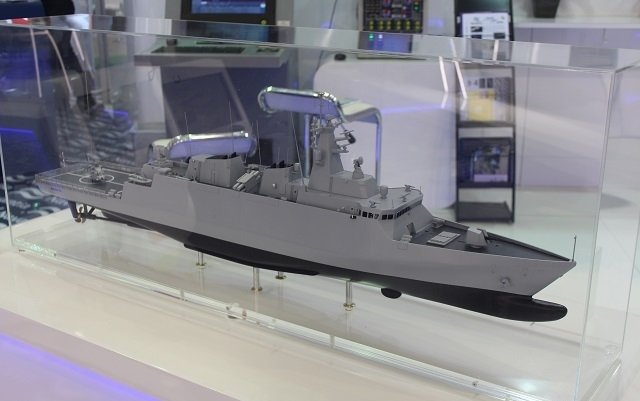
Navantia Warship. Source: Navyrecognition.com.

Finally, the know-how of Latin American military industries is improving. Case in point, the Peruvian shipyards Servicios Industriales de la Marina (SIMA) is currently constructing a new training vessel for the Peruvian Navy, the “BAP Union” – a project worth around $50-55 million USD. Moreover, with support from the Daewoo International Corporation and the Korea Trade-Investment Promotion Agency, SIMA is building a new multi-purpose vessel for its Navy.

These examples stress how competitive the shipbuilding industry is in Latin America. Not only are there several major companies trying to sell brand new warships, but governments are also donating surplus naval technology. Furthermore, regional shipyards are rapidly improving their knowledge when it comes to shipbuilding, as we now have modern shipyards in countries like Colombia, Ecuador, Mexico, Peru and Venezuela  that are constructing their own vessels.

In fact, countries like Ecuador, Mexico and Venezuela want Damen to construct some vessels in their own shipyards in order for local technicians to learn from Damen’s experts. Certainly, none of these facilities are in a position to build a ship as complex as a carrier, but they can now construct smaller vessels, like patrol boats or support ships.

What this means for a company like Damen is that while it will continue to enjoy new contracts for the immediate future, it will have to continue developing more modern and improved equipment that its Latin American and Caribbean clients cannot purchase, maybe at a better price, from other suppliers, or even construct themselves in the not-so distant future.

A Need for Stronger Naval Forces

As transnational crime over the Caribbean Sea and other maritime crimes, such as illegal fishing, continue throughout Latin America and the Caribbean, it has become a major priority for regional states to have modern and capable navies and coast guards in order to protect their exclusive economic zones.

Certainly, it can be argued that the current purchases of some naval technologies are generally unnecessary, given that the region has enjoyed inter-state peace for decades (the last inter-state war in the region was in 1995 between Peru and Ecuador, while the last conflict with naval warfare was the 1982 Falklands/Malvinas War between Argentina and the United Kingdom). Moreover, while transnational crime remains a persistent problem, Latin America has enjoyed cooperation at the inter-state level for two decades (the 2008 Colombia-Venezuela incident notwithstanding). Given this period of peace, some may argue that these defense dollars would be better spent in social programs, especially since many Latin American nations, including Damen-clients like Honduras, are very poor and underdeveloped.

Unfortunately, the reality is different. First, Latin American and Caribbean nations must have some capabilities for deterrence as inter-state tensions continue, such as between Peru and Chile or even the aforementioned 2008 incident between Colombia and Venezuela. Second, transnational drug trafficking remains a major problem from Mexico to Argentina, particularly throughout the Greater Caribbean waters as cocaine is transported from Colombia and Venezuela to the U.S. and Mexico markets. Just last May, the U.S. Coast Guard and the USS Kauffman (FFG 59) interdicted almost 1,800 kilograms of cocaine in the Eastern Pacific.
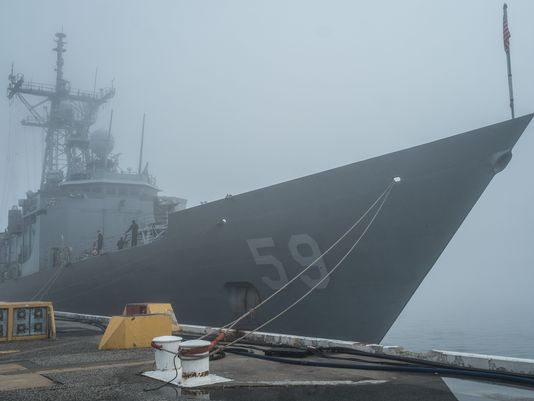
USS Kauffman. Source: Mark D. Faram/Staff.

Hence, it is necessary for Latin American and Caribbean naval forces, including their coasts guards, to have fast and technologically advanced vessels for both internal and regional security – which in turn would diminish their dependence on U.S. security aid. In this sense, the involvement of companies like Damen and Navantia in the Western Hemisphere is a necessity (at least until regional states can build their own high-tech vessels).

Final Thoughts

In recent years the Dutch shipbuilding company Damen has made a name for itself as a provider of high-tech, fast vessels, from multipurpose boats to coast guard speedboats, for various Latin American and Caribbean states. Their clients include nations with small defense budgets like Honduras and Trinidad & Tobago, to major buyers like Mexico and Venezuela. Nevertheless, Damen has not cornered these region’s shipbuilding markets, as there are several other companies selling their products, such as the Spanish Navantia, in addition to regional states enjoying growing maritime defense industries.

Moreover, while Damen’s sales to the region have generally controversy-free, the incident over the overpriced vessels sold to Honduras highlights the potential for corruption, i.e. kickbacks, in countries renowned for lacking good governance. I have been unable to confirm if there were other similar discrepancies in Damen’s other contracts in the Western Hemisphere. Nevertheless, countries like Venezuela are known for their lack of transparency (case in point, the billions of petro-dollars spent by Caracas to purchase Russian military technology) while Mexico is infamous for its corrupt state-run oil company, PEMEX. Given these precedents, there are valid reasons for concern over Damen’s deals with its Latin American and Caribbean clients.

Ultimately, the question comes down to whether the region requires new vessels. Inter-state conflict may be scarce, but it remains a possibility given recent tensions between regional nations (i.e. Venezuela and Colombia, Peru and Chile or currently between Venezuela and Guyana). Thus, it is necessary for nations to maintain capable deterrent capabilities. Additionally, these states must have strong navies and coast guards to crack down on maritime crimes that range from illegal fishing to transnational drug trafficking.

In 2015, the waters along Latin American and Caribbean states are far from peaceful and Damen’s vessels, while not the cornerstone of regional navies, are an important addition to hemispheric maritime security.

Read Part One here.

W. Alejandro Sanchez is a Senior Research Fellow at the Council on Hemispheric Affairs (COHA) where he focuses on geopolitics, military and cyber security issues in the Western Hemisphere. His research interests include inter-state tensions, narco-insurgent movements and drug cartels, arms sales, the development of Latin American military industries, UN peacekeeping operations, as well as the rising use of drones (UAVs) for civilian and security uses in Latin America. Twitter: @W_Alex_Sanchez
Damen’s Presence in the Latin American and Caribbean Market, Part 1

By W. Alejandro Sanchez

Though shipbuilding is a competitive global industry, one company has become a major provider to the naval forces (coast guards included) of various Latin America and Caribbean states: Damen Shipyards Group. Damen is now a household name among Latin American and Caribbean navies as it provides multi-purpose vessels, patrol boats and speed boats. These sales have enhanced the capabilities of Damen’s clients as they face transnational threats.

While the defense budgets of Latin American and Caribbean states cannot be compared to those of the usual suspects (i.e. the U.S., Russia or China), a significant number of weapon deals have occurred in recent years between the Dutch-based company and these two regions.

Damen’s sale of technologically advanced vessels is a positive development for the region for a variety of reasons. Most notably, since Latin America and the Caribbean are enjoying a marked lack of inter-state conflict  (the last war between two regional states was in 1995), the region’s security forces are now focused largely on transnational crimes, particularly drug trafficking. Thus, it appears that Damen’s clientele will continue to grow for the immediate future as the company is looked upon as a reliable supplier of vessels necessary to combat criminal activities that occur at sea, particularly in the Greater Caribbean region.

Recent Sales

In order to discuss Damen’s effect on the shipbuilding industry and naval defense sector in Latin America and the Caribbean, a brief enumeration of confirmed deals and equipment delivery is necessary. This will also give us a clearer view of Damen’s clients.

  • The Caribbean

Damen has a number of clients in the Caribbean whose naval forces are more akin to coast guards rather than traditional navies. One good example is the Bahamas, which formalized a deal with Damen in 2014 for a variety of vessels, including four Stan Patrol 4207, four SPa 3007, and one roll-off ship Stand Lander 5612. The shipbuilding portion of this multi-faceted contract is valued at around $149 million.

The company has already delivered the four 4207 patrol boats. Moreover, this past January the Damen Gorinchen shipyard in the Netherlands received the hull for the Stan Patrol 3007. It is important for the 3007 to become operational soon as this vessel is urgently needed by Nassau to combat narcotics trafficking, a further example of how Damen technology is being utilized for positive security initiatives.

Another one of Damen’s clients in the Caribbean is Trinidad & Tobago. This past May, the government in Port-of-Spain ordered 12 new vessels for its coast guard, including four type Stan Patrol 5009, two Fast Crew Supply 5009 and six Interceptor speedboats. The deal is worth $189 million USD. In early June, the “TTS Point Lisas” (GC 23), one of the FCS ships, was delivered to the Caribbean government.

  • Latin America

When it comes to the mainland, several Latin American states are turning to Damen for naval equipment. For example, the Colombian Navy purchased one of Damen’s Swath-type vessels, which was constructed in Singapore.  Additionally, in 2014, Ecuador signed a deal with Damen to obtain two Stan Patrol 5009 for the country’s coast guard. The vessels are being constructed in Ecuador by the country’s shipyard, Astilleros Navales Ecuatorianos, under the oversight of Damen technicians. Additionally, Damen obtained a contract in early 2014 to construct a fourth Stan Patrol 2606 (the country already operates three),  which will also be built in Ecuador.

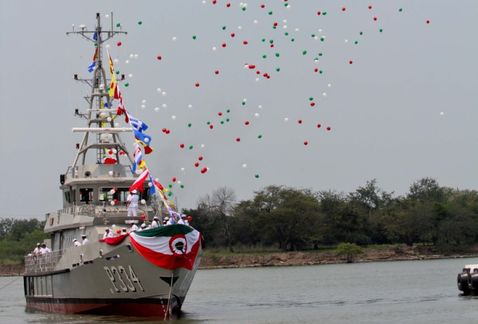
Additionally, Mexico and Venezuela have purchased various types of Damen’s vessels. Just this past January, the Mexican Navy received the Coast Guard vessel Tenochtitlan-class “ARM Mitla” (PC-334), which was constructed as a joint project between the shipyards of the Secretaria de Marina (the Mexican Navy) in Tamaulipas and Damen. The “Mitla” is based on the Stan Patrol 4207 model. This is the second of two vessels that Mexico and Damen are building together following a 2014 agreement. The other vessel is a supply variant of the Fast Crew Supplier 5009. Like the “Mitla,” it is also being constructed in Mexico’s Sonora state. These developments suggest that Damen has become an integral part of the country’s naval shipbuilding. Apart from the aforementioned vessels, SEMAR and Damen jointly constructed three other patrol vessels based on the 5009 model.

 Mexico’s new “ARM Mitla." Source: Cuartooscuro / Milenio.com.
Mexico’s new “ARM Mitla.” Source: Cuartooscuro / Milenio.com.

As for Venezuela, Caracas has ordered a number of new vessels for its Navy including a 2014 deal for 18 type Interceptor 1102 speedboats. The speedboats are being constructed in Cuba under the Havana-Caracas cooperation agreement. The first of these vessels arrived this past May and is currently undergoing testing. In addition, Damen has also constructed four support vessels for the South American nation based on the Stan Lander 5612 model. On February 2014, a new contract was signed for an additional eight vessels, a deal worth around $132 million USD. Finally, Venezuela’s military complex (UCOCAR) in Puerto Cabello is building five patrol boats based on the Stan Patrol 2606 model. The country’s navy already has one operational vessel based on that model, the “Pagalo” (PG-51).

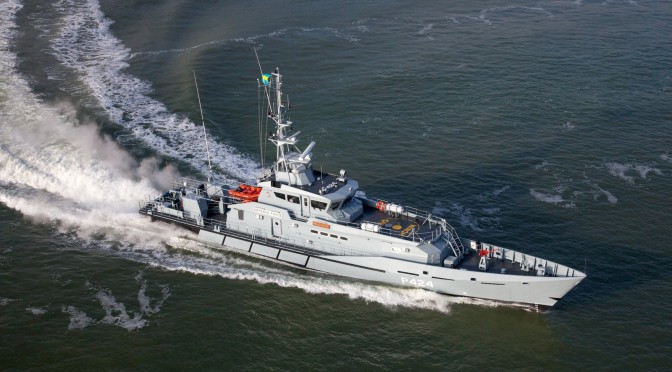
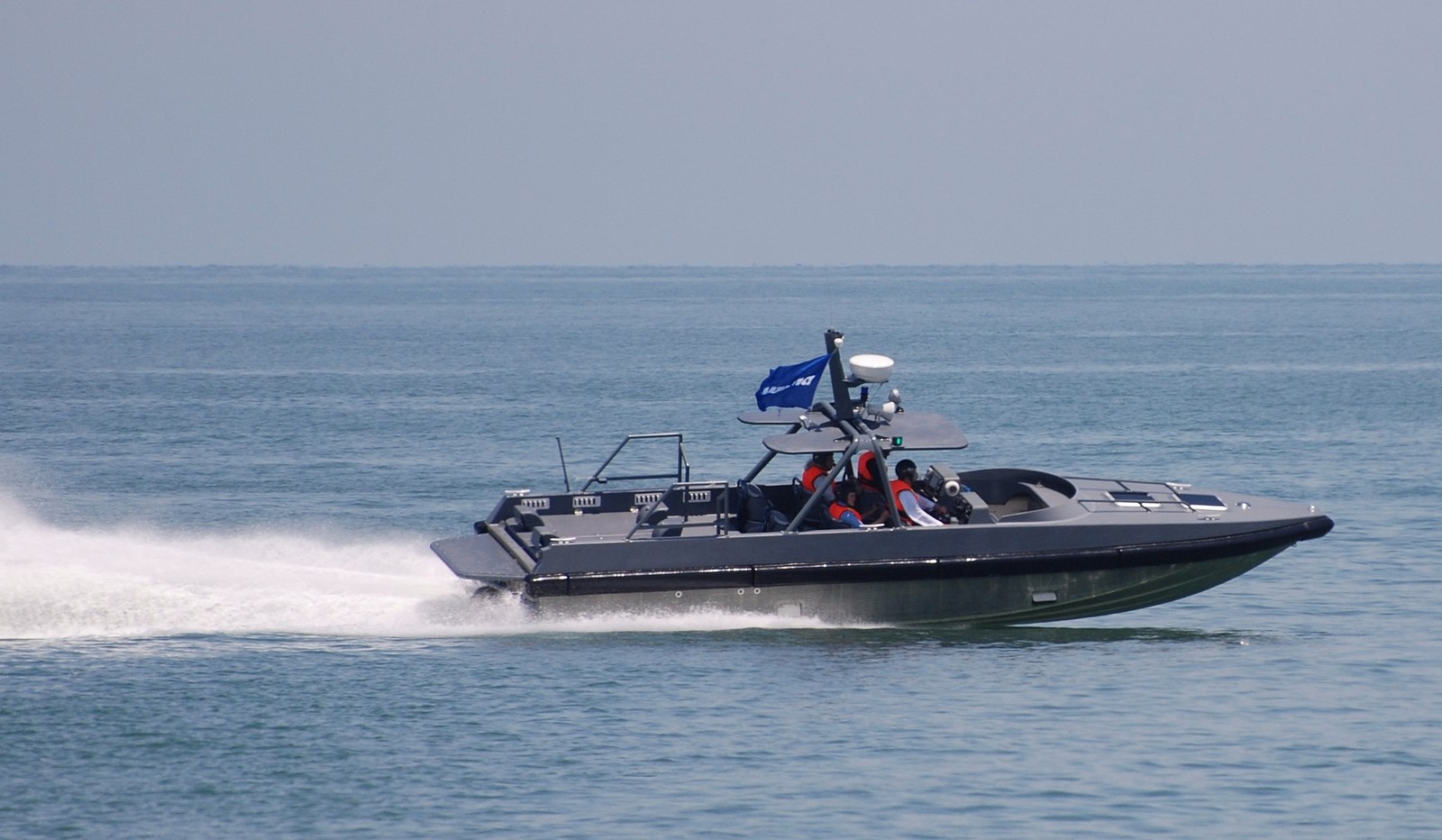
Damen Interceptor 1102. Source: Damen.com.
  • Cuba’s Shipyards

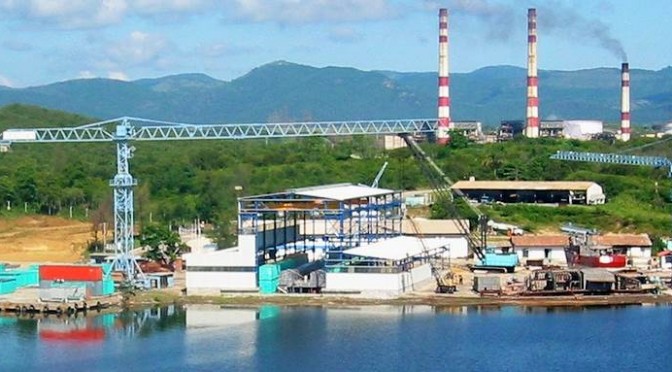
It is important to note that Damen has a construction facility, Damex Shipbuilding & Engineering, in Cuba. The facilities, which were established in 1995, are located in the bay of Santiago de Cuba. Damen’s website explains that “the yard is equipped with one slipway provided with transverse parking facilities for new buildings and repairs and a lateral slipway for new buildings of up to 100 metres.” As previously noted, the shipyards have constructed vessels for Venezuela.

  • The Honduran Affair

It is important to stress that not all Damen deals have been scandal-free. This is best exemplified by a 2013 contract via which the government of Honduras purchased six Interceptor speedboats and two Stan Patrol 4207. The contract deal was reportedly worth almost $62 million. However in late 2013, the Honduran judiciary investigated it due to various irregularities, specifically the accusation that the vessels were overpriced  – according to the Honduran newspaper La Prensa, the vessels were overpriced by some $29 million. The newspaper argued that the Honduran Secretariats of Defense and Finance created a paper company called “Servicios Maritimos S.A.,” which was utilized by Florentius Antonious Florentius Kluck,  a Dutch citizen and honorary consul, as the intermediary for the sale.

In spite of these accusations, the deal ultimately went through, and the Honduran Navy has begun to receive the vessels. This is an important deal for Honduras since drug traffickers utilize the country’s coast for transporting illegal narcotics, and thus it is especially necessary for small Central American country to have vessels that can locate and seize the infamous narco-speedboats. Nevertheless, the details of the deal themselves are problematic, as the question its transparency and whether the Honduran government could have obtained similar vessels at a cheaper price. Even more, even though the Honduran judiciary never passed judgment on the  deal, scandals like the Honduran affair throw into question whether other contracts gained by Damen were due to shadowy middle men and nefarious deals.

Read Part 2 here.

W. Alejandro Sanchez is a Senior Research Fellow at the Council on Hemispheric Affairs (COHA) where he focuses on geopolitics, military and cyber security issues in the Western Hemisphere. His research interests include inter-state tensions, narco-insurgent movements and drug cartels, arms sales, the development of Latin American military industries, UN peacekeeping operations, as well as the rising use of drones (UAVs) for civilian and security uses in Latin America. Twitter: @W_Alex_Sanchez
Naval Surface and Mine Warfighting Development Center: The Human Element of Distributed Lethality

To close out Distributed Lethality Week, VADM Rowden, Commander, Surface Forces, was kind enough to add his own piece to the milieu.

Once again, I am really pleased to see CIMSEC out front and leading with respect to providing a timely forum for information exchange and professional learning.  That you’ve chosen to focus on Distributed Lethality this week is an exciting development, and I look forward to checking in on the dialogue and getting a sense of how well the idea is catching on and where we might need to do a little more work in addressing concerns and criticisms.

Since we debuted Distributed Lethality six months ago at the Surface Navy Association Symposium, a team of superstars in DC, at my headquarters in San Diego, and from around the fleet have been doing the really hard work of putting the meat on the bones of what was admittedly an aspirational concept when I introduced it.  Don’t get me wrong—the basic concept of increasing individual warship lethality and then combining surface warships in innovative ways makes straightforward sense to virtually anyone who will listen.  But as with anything that will likely cause generational change in an enterprise as large as Surface Warfare, there are tough analytical questions that have to be answered, there are important questions of priority and timing, and there are critical questions of “how much?” and “how widely distributed?” the force can be.  This is what the Distributed Lethality team is working on, and we’ll convene in Newport in two weeks for our second series of wargames designed to get at some of the things I just mentioned.

The subject I really want to focus on with this piece however, is the human side of Distributed Lethality, represented by the Naval Surface and Mine Warfighting Development Center that we stood up last month in San Diego under the command of Rear Admiral Jim Kilby.  A lot of folks are likening NSMWDC to naval aviation’s Top Gun program, and I think there is something to that comparison.  For decades Top Gun has produced finely-honed tactical experts in the LT/LCDR grades — experts who then go back to their parent squadrons or wings and raise the tactical proficiency of those organizations.

Like a drop of dye in a glass of water, we look for a new generation of Surface Warfighting experts—Warfare Tactics Instructors (WTI)—to change the very character of our profession.  NSMWDC is part of the solution and will oversee the selection and training of those WTI’s – the ship’s CO’s are another part, integral in the selection of our WTI’s.  In essence, we are “distributing” the human factor in Surface Warfare.  We are investing in our junior officers in order to ensure that our crews are able to get the most out of training and the investments we are making in weapons and sensors.

We are looking to increase the warfighting professionalism of the force; to bring a new emphasis on tactics, tactical thinking, and tactical training, and we are going to do so one staff and one ship at a time.

Let’s face it, it is high-time we did this.  Our ships are powerful and sophisticated, and the future upgrades we’ll field will demand a higher level of tactical acumen to wring the most out of them.  While the mechanics are classified, I’m here to tell you that Navy Integrated Fire Control-Counter Air (NIFC-CA) engagements are not a trivial undertaking.  They will require considerable training and coordination across battle force components, but it all starts right in our Combat Information Centers.

We need to get more proficient in Mine Warfare.  But a different kind of Mine Warfare, one where we don’t steam into the middle of the minefield and then sweep.  Rather, we’ll stand-off and position a variety of surface, subsurface, and air deployed sensors that make up the LCS MIW mission module.

With respect to Anti-Submarine Warfare, the AN/SQR-89V(15) processing system presents operators with information at ranges that were — up to now — virtually impossible to gather.  We need to get back into serious passive localization techniques that enable us to exploit the detectable sound-sources of even the quietest energy submarines.  We need to move more quickly with less information to “good enough” targeting solutions.  Solutions that allow either a surface-based weapon system or an air-deployed weapon to put the submarine on the defensive so he no longer is capable of targeting us with HIS anti-ship weapons.

In Anti-Surface Warfare we’ll be right back in the War at Sea game.  First with a medium-range weapon we’ll field on the FF’s, and then on a longer range—and potentially supersonic—weapon that we’ll field on larger combatants.  We’ll be able to hold a greater number of things that adversaries value at risk while making every one of us a more interesting target for their ISR systems.

NSMWDC will eventually graduate more than 100 WTI’s a year; these officers will then go on to be XO’s and CO’s, and Strike Group Commanders.  Distributing the power of human talent more broadly across our fleet makes a lot of sense as we distribute lethality within our ships.  I look forward to providing CIMSEC readers (and anyone else who attends) with a full update on the progress of the analytical effort involved with Distributed Lethality at January 2016’s SNA.  An additional part of that update will be a continued emphasis on the demanding tactical training that our force must continue to pursue in order to get the most out of this exciting new concept.  Distributed Lethality is MUCH more than just putting more missiles on ships—it is about investing in warfighting expertise.   Let’s get to work.

Vice Admiral Thomas S. Rowden is Commander, Naval Surface Forces. A native of Washington, D.C., and a 1982 graduate of the United States Naval Academy, VADM Rowden has served in a diverse range of sea and shore assignments.

Missing an Opportunity for Innovation: A Conceptual Critique of Distributed Lethality

100 years ago today, in bunkers and boardrooms across Europe, the military and political leaders of a Europe that was being drowned in its own blood were attempting to solve the stagnant enigma of the Western Front. The traditional narrative of the First World War places the inability of military and political figures of the time to adapt to the previously unimaginable efficacy of modern defensive technology deployed on the battlefields of France and Belgium. While the popular narrative of the conflict usually ends with a nod to the tank and aircraft as the great mobilizers of the sclerotic armies, Stephen J. Biddle effectively argues with quantitative data, in his book Military Power, that it was in fact force employment (and the innovative tactics of the German Army) that broke the stalemate in the West and brought mobility back to warfare (see the Michael Offensive). The “modern system” of land warfare was born.

I’m reminded of Biddle’s illustration of the birth of the “modern system” when considering Distributed Lethality, not because I view the US Navy as antiquated as the armies of the old Europe, but because Distributed Lethality seems to be an intelligent effort at bypassing the tough and expensive learning curve associated with fighting the previous war by reorienting existing resources to meet new challenges. Within it appears to be the tacit recognition of the end of the aircraft carrier as the main instrument of maritime power in the types of 21st century A2/AD environments the US Navy is most likely to find itself fighting for dominance. Carriers will continue to be essential for the support of operations during the fight for dominance, and after it has been achieved in the maritime realm, but their time at the center of naval combat, contesting control of the world’s oceans, may well be over. Distributed Lethality is an attempt at defining the Navy’s future operational flexibility in the complex future of highly contested environments that preclude overuse of its most prominent investment.

At the same time, the reorientation of the surface fleet around the concept of increasing the fighting ability of individual craft within the current system may be too simple a concept to fully address the increasing complexity of the modern maritime environment, especially when that environment is seeing a proliferation of the number of actors able to potentially upset the capabilities of today’s Navy, with more advanced and capable anti-ship missiles, underwater sensors, and unmanned technology likely to be on the way. If the US Navy will have to engage in combat with a low to medium tier opponent within the next 17 years (the technology development timeline cited by Admiral Peter Fanta), then Distributed Lethality will be able to easily carry the day in the same way the Navy has been able to do in similar conflicts (maybe even at a lower price point). If the Navy is faced with a much more complex and determined threat (represented by a recent addition to the rank of top tier naval competitors, even just a regional one), then the concept of Distributed Lethality may be little more than a patch on the inadequacies of the contemporary Navy in considering the operational imperatives of facing and neutralizing that particular set of threats. It would seem to me that Distributed Lethality is, in fact, more a response to the emergence of a high tier threat (within a constricted budgetary environment) than a low to mid-tier threat, so its efficacy must be evaluated within this context.

The Navy, in its current state, could be considered the product of post-Cold War dominance (as Vice Admiral Rowden and Rear Admirals Gumataotao and Fanta explain in their Proceedings piece) and the attempts to take advantage of the concepts of network centric warfare and the revolution in military affairs (RMA) of the 1990s. This was done within the technological confines of the time period, and through the budgetary struggles of a US Navy competing for funds and defining itself within the budgetary narrative of the Global War on Terror. Its difficulties are manifest in the Navy After Next’s loss of its key platforms to cancellation and production truncation along with the discussions surrounding how the Navy will take on the A2/AD capabilities of today, let alone the future.

The US Navy now has a tremendous opportunity (in the face of rapidly evolving threats in the Asia-Pacific), that of being able to define itself within confines of its own primary operational environment, without the time and resource constraints of being actively engaged in combat. While the aircraft carrier’s time as the dominant maritime platform may be nearing the precipice of its decline, the rumblings within the military services and think tank sphere seem to point to the rise of Artificial Intelligence (AI), robotics, and the promise of additive manufacturing in the service of US operational and strategic needs, if the effects of their application can be grasped with full appreciation. If the US is to truly begin to push towards achievements that will open up the promise of network centric warfare and increase the ability to disrupt the defensive systems of the adversary (with acceptable costs in terms of equipment, money and lives) then we should be looking for cheaper ways to do that than through the Navy’s existing platforms, whose survivability and ease of replacement is questionable within the context of type of operational environment Andrew F. Krepninevich lays out in his excellent Maritime Competition in a Mature-Precision Strike Regime.

While Distributed Lethality is an important concept that should inform short and medium term planning (within the 17 year range that it takes to develop and deploy a new system), long range planning must begin now that takes into account the potential coming industrial revolution and advancements in AI and robotics that will bring about the full conceptual realization of networked warfare and unmanned systems. Their development could prove to be the real advantage in naval combat that will no longer feature a dominant aircraft carrier platform and will likely be the key to maintaining American maritime primacy in areas that have the potential to be seriously contested. Unlike the armies of 1917-18, the US Navy currently has the (limited) luxury of time and space to experiment. While the accusing finger of Kitchener, a draft notice, or more efficient bureaucracy could slowly make up for operational shortfalls during the Great War (still, at great human and financial cost), today’s strategic, technological and industrial imperatives are more exacting in terms of lost opportunities.

Ryan Kuhns is a master’s student at the University of Kentucky’s Patterson School of Diplomacy and International Commerce. He studies International Security and Commerce, focusing on defense economics, strategy, and the social/political organization of war.

CIMSEC content is and always will be free; consider a voluntary monthly donation to offset our operational costs. As always, it is your support and patronage that have allowed us to build this community – and we are incredibly grateful.
Select a Donation Option (USD)

Enter Donation Amount (USD)