Category Archives: Capability Analysis

Analyzing Specific Naval and Maritime Platforms

LCS: The Distributed Lethality Flotilla Combatant


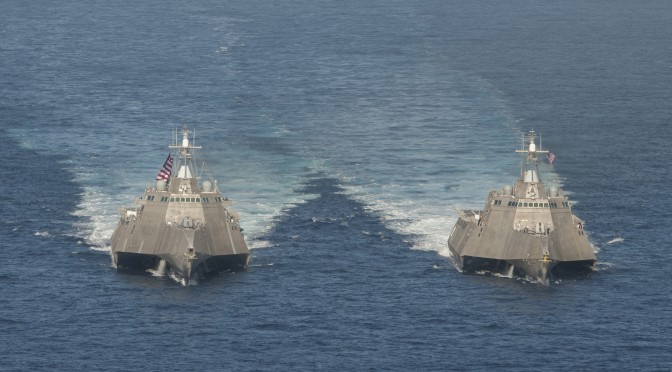
140423-N-VD564-016  PACIFIC OCEAN (April 23, 2014)  The littoral combat ships USS Independence (LCS 2), left, and USS Coronado (LCS 4) are underway in the Pacific Ocean. (U.S. Navy photo by Chief Mass Communication Specialist Keith DeVinney/Released)
PACIFIC OCEAN (April 23, 2014) The littoral combat ships USS Independence (LCS 2), left, and USS Coronado (LCS 4) are underway in the Pacific Ocean. (U.S. Navy photo by Chief Mass Communication Specialist Keith DeVinney/Released)

The Littoral Combat Ship (LCS) is the ideal platform to host a significant amount of offensive firepower in support of the emerging concept of distributive lethality. It is large enough have greater endurance and to support capabilities beyond that of the average missile combatant. Its modular approach to embarked capabilities allows for more potential offensive systems to be employed aboard than in similar ships. Deployed as a dispersed flotilla of networked combatants with other organic means of communication, it has the potential to deliver significant amounts of ordnance against a variety of targets. The dispersal of the LCS flotilla complicates and dissipates enemy counter-targeting abilities. LCS is the ideal combatant to carry forward the concept of distributed lethality into the next decade.

LCS’ Size and Modularity Brings Advantages
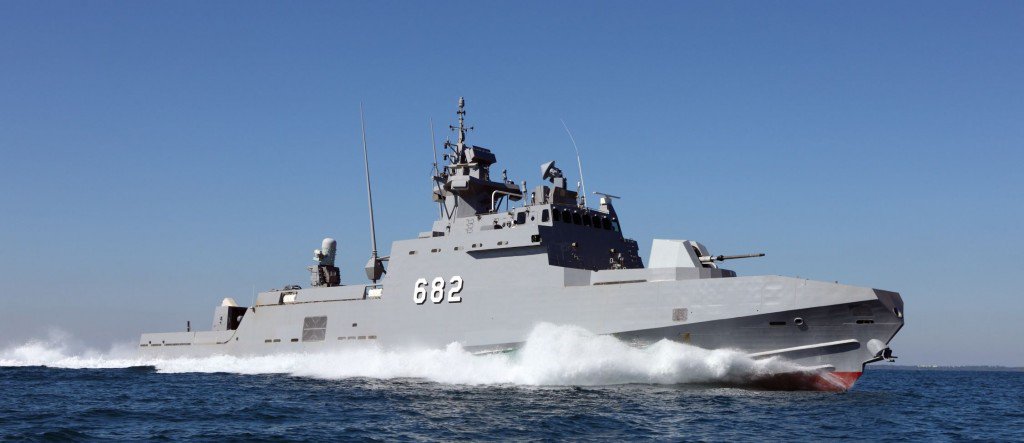
Ambassador
Ambassador class missile combatant
MH 60R on LCS
MH60R on USS Fort Worth, 2014

As described by Deputy Defense Secretary Bob Work in his 2013 history of the LCS program, the ship was always designed as a compromise between smaller, but less capable and globally deployable small combatants, and the larger, and more capable, but more expensive FFG-7 class frigate.1 Compared to smaller designs such as the Ambassador III or dedicated surface warfare corvettes like the Israeli Sa ar V, the LCS’ size and modularity offers advantages above those conventional small combatants. LCS’ has greater endurance then smaller missile combatants like the Ambassador (21 days verses 8) which enables it to remain at sea longer in support of surface warfare missions. The Saar V is more heavily armed then the baseline LCS seaframe, but supports only one rotary wing asset, and lacks the modularity to accommodate future sensors, weapons, and associated systems.
Both LCS seaframes, in contrast support two rotary wing assets (one MH-60R and one Firescout Unmanned Air Vehicle). The MH-60R in particular supports anti-surface and anti-submarine warfare missions, as well as extending the host ship’s sensors, weapons and communications capability far beyond those of a conventional missile combatant like the Ambassador.
The modularity of LCS also supports the embarkation of a more diverse set of capabilities than those hosted by mission-specific platforms like the Ambassador and the Saar V. An LCS might support a number of unmanned surface or subsurface vehicles separate from its Fire Scout UAV. Mines, additional munitions, and additional command and control equipment could also be supported depending on the desired mission. As the Spruance class destroyers later hosted Tomahawk cruise missiles, LCS’ modularity could support an array of heretofore undetermined systems and new capabilities in the future.

Keeping LCS Simple, but Lethal
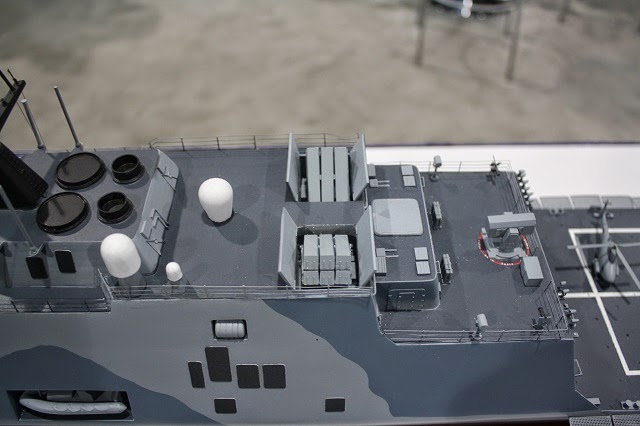
LCS 1 ASCM
Possible cruise missile arrangement in LCS-1 variant
LCS mission bay
Expansive LCS-2 mission bay

Although not presently suited to the Distributive Lethality mission, the LCS could be modified into a potent surface warfare platform with the addition of cruise missiles such as the Kongsburg/Ratheyon Naval Strike Missile. Both LCS producers (Lockheed Martin Corporation and Austal USA) have also said their respective ships could be outfitted with larger 76mm guns in place of the present 57mm weapons. While cruise missiles are a requirement for the Distributive Lethality mission, further weapons, sensors, armor and armament add little to that mission capability and increase costs which the Navy estimated to be from $60 to $75 million dollars per ship.2 This money might be better spent in additional LCS platforms as the original aim of the LCS program was to increase the size of the U.S. surface combatant fleet.
Application of additional weight for armor and warfare capabilities not related to Distributed Lethality limits the opportunity for mission package improvements in the future and could limit the number of offensive weapons the LCS can support in its current length and displacement. As reported by the GAO, LCS already has relatively tight weight ratios for further additions to the sea frames outside mission module improvements.3 Every warship is a compromise of virtues, where armament, fuel capacity, speed, survivability and other factors must be carefully balanced to achieve desired operational goals for the class. An appropriate balancing of such issues for LCS should be in favor of offensive capability to avoid the need for a costly redesign of the sea frame to support significant additions. The cost of the LCS sea frame has steadily decreased from nearly $700 million to approximately $440 million.4 Three can now be built for the cost of one DDG. This is not the time to increase the cost by redesigning the ship to fit an expanded armament. Such a process defeats the concept for making the LCS the “low” component of a new high/low mix of surface combatants.

Distribution plus Speed Equals Survival
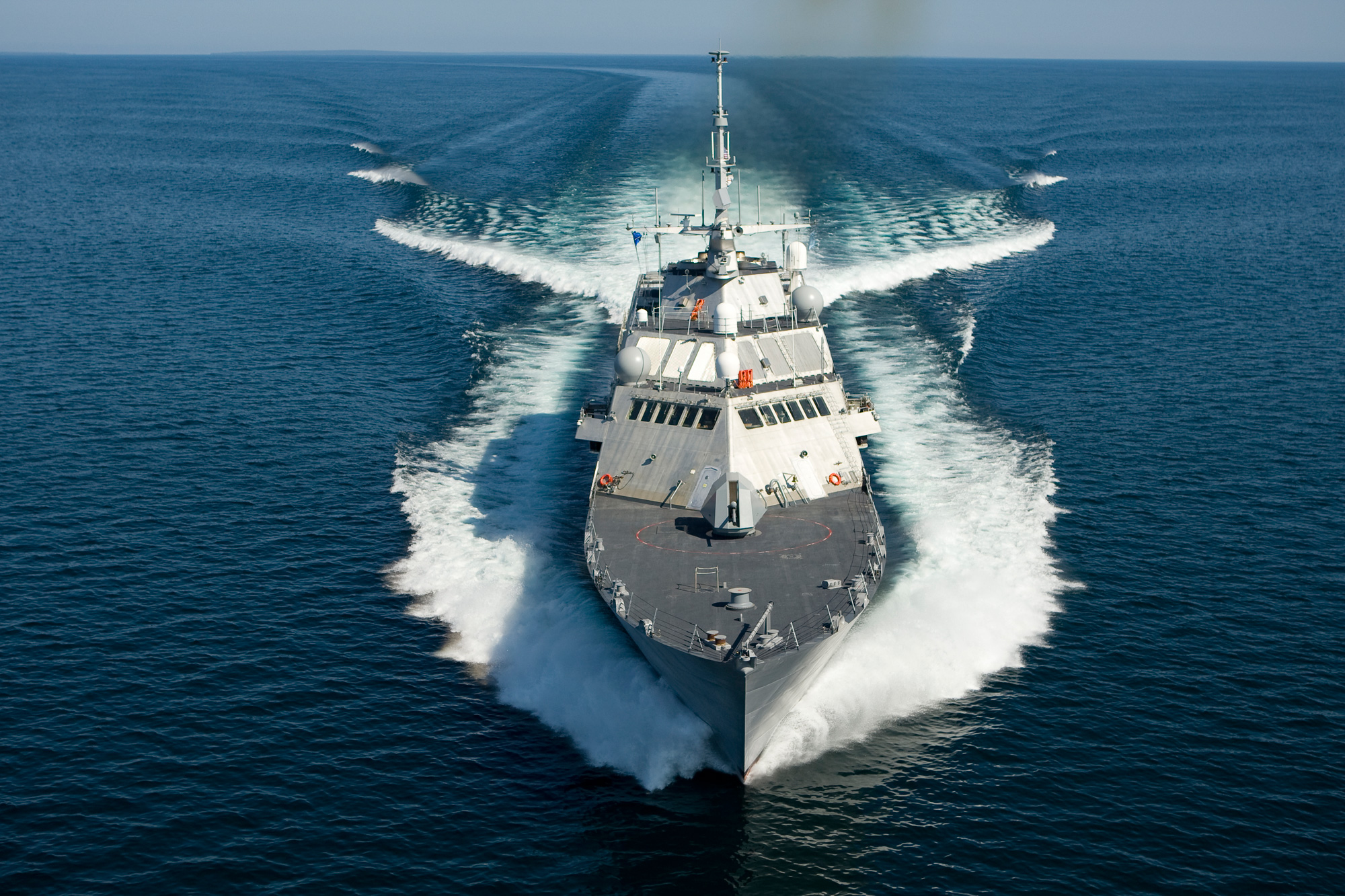
LCS at speed
Speed equals life

A squadron of LCS employed as part of a Distributive Lethality scheme will rely on their dispersed deployment pattern to reduce susceptibility to opponent targeting. The ships’ high speed, although often derided by critics is also a useful means of escaping enemy detection. An LCS capable of 40 knots can move away from a missile launch point faster than other U.S. combatants and potentially increase the area of uncertainty an opponent must consider in launching weapons down a return bearing.
An enemy would be forced to weigh significant risks in confronting such a force. An opponent might detect and attempt to eliminate one element of a distributive LCS force, but the remaining units might launch a devastating counter-salvo against therm. Such a response could cause significant harm to an unprepared, massed adversary force.
A basic LCS sea frame equipped with a moderate surface to surface missile capability could be a potent addition to the distributive lethality concept. Using means from fleet-wide networks to bring your own networks (BYON’s) created by groups of ships, a distributed LCS squadron operating as an anti-surface warfare (ASUW) formation could be a significant threat to opponent surface formations. The LCS’ larger size and rotary wing capabilities allow them to spend more time at sea, and see further beyond their own sensor horizon than smaller, dedicated missile combatants. LCS’s modularity allows the ships to bring additional weapons and capabilities to the fight beyond those of even heavily-armed corvettes and light frigates. These advantages suggest that LCS squadrons should be in the vanguard of the future distributed fleet.

Steve Wills is a retired surface warfare officer and a PhD student in military history at Ohio University. His focus areas are modern U.S. naval and military reorganization efforts and British naval strategy and policy from 1889-1941. 

1. http://awin.aviationweek.com/Portals/AWeek/Ares/work%20white%20paper.PDF, p. 13.

2.  http://www.defenseone.com/technology/2014/12/upgrades-will-let-navys-lcs-operate-more-dangerous-waters/101172/

3. http://www.gao.gov/assets/670/665114.pdf, p. 29.

4.  http://news.usni.org/2015/04/01/navy-awards-2-lcss-to-austal-1-and-advance-procurement-funding-to-lockheed-martin

CIMSEC content is and always will be free; consider a voluntary monthly donation to offset our operational costs. As always, it is your support and patronage that have allowed us to build this community – and we are incredibly grateful.

Select a Donation Option (USD)

Enter Donation Amount (USD)

Distributed Lethality: A Cultural Shift

The following is a submission from guest author James Davenport for CIMSEC’s Distributed Lethality week.

Despite the recent article on Distributed Lethality1 and the paper on Offensive Sea Control2, there is a sense of hesitancy in the surface force in embracing these ideas. The hesitation is understandable. Distributed Lethality and Offensive Sea Control (henceforth referred to as Distributed Lethality for brevity) run counter to recent experience, and they appear to challenge the most successful surface program in history, Aegis, by suggesting that offensive warfare is equal to or greater in importance than the defensive operations the surface force is so well-equipped and trained to perform.

Distributed Lethality cannot succeed without a change in the surface force’s culture. To enable that change in culture the surface force must understand where its bias towards the defensive originates. The surface force must understand why Distributed Lethality is sound military theory. The surface force needs to be reminded that it has embraced Distributed Lethality before to great effect. The surface force must rethink how it views survivability in an anti-access/ area denial (A2/AD) environment. Finally, the surface force must change its culture through training and repeated exposure to the concept of Distributed Lethality.

Institutional Perception of the Surface Force

With the fall of the Soviet Union, the USN’s superiority was unchallenged for more than a decade. The USN became a victim of its own success. Assured of its superiority, the Navy started reducing its offensive flexibility. The USN built thirty-four guided-missile destroyers with no over the horizon anti-ship capability at all and retired the long-range anti-ship version of the Tomahawk missile. There was no challenger to use it, or practice using it, on. The surface force’s focus was squarely on visit, board, search, and seizure and air and missile defense operations.

The focus on air and missile defense operations is reinforced by the superb training on the Aegis Weapon System most Surface Warfare Officers receive at some point in their careers. Aegis Training and Readiness Center in Dahlgren, VA is rightly regarded as a center of 1975028_1481959128698444_800990737_nexcellence for training. Surface Warfare Officers can receive training there three or four times through their career inculcating Surface Warfare Officers in the Aegis culture of excellence. The success of Aegis and its adaptation to the ballistic missile defense mission is a tribute to the partnership between the Navy, the Missile Defense Agency, and our industry partners. No one system has dominated the thinking of the surface force in the way Aegis has.

The result of these influences is a defensive-minded surface force. Many in the surface force perceive their mission as providing defense against small surface vessels, cruise missiles, ballistic missiles, and submarines. In return, the air wing goes on the offensive against ships and aircraft, while the submarine force goes on the offense against threat submarines and ships. This mindset says in order to survive the force has to operate as a whole, while concentrating the majority of the offensive firepower in a small number of submarines and an even smaller number of aircraft carriers and their air wings. This concentration of offensive firepower limits flexibility, reducing the Navy’s ability to operate against anti-access /area denial threats.

The Theory Behind Offensive Sea Control

Recognizing wholesale command of the seas is impractical in the face of A2/AD threats, admirals Rowden, Gumataotao, and Fanta argue for the use of distributed lethality to take control of the seas in key areas in order to project power.1 This is certainly one significant advantage of distributed lethality and offensive sea control. It is not the only advantage, however.

Corbett also recognized it would be impractical to dominate the seas completely, at all times. Corbett does identify a solution; prevent the enemy from securing or controlling the seas by “active defensive operations.”3 In Corbett’s view, sea control is not sitting web_101210-N-2885V-025off the coast of a hostile nation, asserting air, sea, and electromagnetic dominance, while launching strikes ashore. Corbett’s opinion, in more modern terminology, is that sea denial is sufficient.

No matter what it is called, sea denial or sea control, the concept has value. Equipping our surface ships with more offensive capability complicates our adversaries’ planning. A distributed, lethal force must be accounted for, either by devoting resources, to defend against it, to negate it, or by amassing a robust enough force to absorb more losses and still perform their mission. Enough offensive capability may even deter our adversaries from adventurism in the first place.

Distributed Operations

Not only does distributed lethality have value in disrupting and deterring potential adversaries, but it can also play a significant part in defeating them. The bulk of the USN is generally located far from potential hot spots. Only a fraction of the fleet is forward deployed. Furthermore, that fraction is spread across the globe in support of the nation’s interests. The nation’s adversaries have the advantage of being able to operate near their own shores as well as to determining when and where they will strike; in effect, negating the advantages in capability and mass the USN possesses. Thus, at the onset of hostilities the USN will be likely the inferior force, which is not necessarily the disadvantage it may seem, as long as that forward-deployed force is lethal.

Clausewitz argues a force not concentrated at the same place at the same time has an advantage over a force that is concentrated. A concentrated force attacked by a smaller force will suffer disproportionate casualties and suffer disorganization from the attack, as long as the smaller force has reinforcements to press home this advantage.4 Although, the example is tactical in nature, this idea is remarkably similar to the situation the USN finds itself in today and has relevance in a modern operational context. If equipped properly with both offensive capability and mindset, a small number of forward deployed units could inflict disproportionate casualties, while being able to call upon a much larger force assembled from across the globe to administer a coup de grace against the aggressor.

What Was Old is New Again

The value of distributing lethality is not an unknown or a new idea. In the 1970s, the Soviet Navy was growing and the USN carrier force was dwindling. From the commissioning of the U.S.S. John F. Kennedy in 1968 to the commissioning of the U.S.S. Carl Vinson in 1982, four aircraft carriers were commissioned, while 17 aircraft carriers were decommissioned.5

Faced with this new reality, the USN embraced Corbett’s view of sea control and implemented it in two ways. First, lethality of surface combatants was increased by fielding Harpoon missiles and Tomahawk missiles in both land attack and anti-ship variants. Second, this increased lethality was distributed by retrofitting older classes of ships and equipping future classes of ships with one or both of these weapons. One of the desired effects of this first iteration of Distributed Lethality, was to complicate our adversary’s scouting picture, by making them devote resources to finding, not only our carriers, but our newly lethal surface ships as well.6

Distribution Contributes to Force Survivability

Captain Wayne P. Hughes echoes the issue of complicating an adversary’s scouting picture in the first points on survivability applicable to Distributed Lethality in his book Fleet Tactics: Theory and Practice. “The great constant of scouting seems to be there is never enough of it.”7 This is the effect of “spreading the playing field” admirals Rowden, Gumataotao, and Fanta want to achieve with Distributed Lethality.1

Captain Hughes’ makes and additional point that applies to survivability. That is offensive firepower has the advantage early in a conflict. At Jutland, in the Pacific Theater of Operations, and more recently in the Falklands, offensive weapons were more effective than their defensive counterparts, until defenses had the necessary time to adapt to the realities of those conflicts.8 The USN’s offense will be more effective than our adversary’s defense just at the time when the USN’s surface ships are most likely to encounter the enemy without the support of the larger fleet and its accompanying defensive umbrella. In light of historical examples, how the surface force currently perceives survivability must be challenged.

The Way Forward

The key enabler to Distributed Lethality is developing a training infrastructure rivaling that of Aegis while complementing, not challenging, Aegis . The new training must emphasize the advantages and how to mitigate perceived disadvantages of Distributed Lethality. In order to accomplish this, the training must address exploiting gaps in and deceiving an adversary’s scouting capability, over the horizon targeting, coordinating dispersed offensive capability in an A2/AD environment, and, of course, the proper employment of offensive weapons. Finally, Distributed Lethality training must be delivered at multiple points throughout a Surface Warfare Officer’s career to keep the officer current in the latest tactics, techniques, and procedures, and to build on the officer’s understanding of Distributed Lethality.

The surface force needs to embrace the advantages of a distributed lethal force. The foremost step is equipping our force to be lethal and offensive in posture. However, weapons and sensors are not enough. The surface force must change its mindset. Only through a change of mindset, enabled by time and training, will the surface force be able to fully exploit the strengths of Distributed Lethality.

LCDR James Davenport is a Surface Warfare Officer currently stations at Surface Forces Atlantic.

1 VADM Thomas Rowden, RADM Peter Gumataotao, and RADM Peter Fanta. “Distributed Lethality.” U.S. Naval Institute. January 2015. Accessed February 13, 2015. http://www.usni.org/magazines/proceedings/2015-01/distributed-lethality.

2 Clark, Bryan. “Commanding the Seas: A Plan to Reinvigorate U.S. Navy Surface Warfare.” Commanding the Seas: A Plan to Reinvigorate U.S. Navy Surface Warfare. November 17, 2014. Accessed March 23, 2015. http://csbaonline.org/publications/2014/11/commanding-the-seas-a-plan-to-reinvigorate-u-s-navy-surface-warfare/.

3 Corbett, Julian S. “Some Principles of Maritime Warfare.” Internet Archive. February 16, 2005. Accessed February 13, 2015. https://ia700506.us.archive.org/20/items/someprinciplesof15076gut/15076-h/15076-h.htm.

4 von Clausewitz, Carl. “On War.” Chapter XII Assembly in Time. Accessed February 13, 2015. http://www.clausewitz.com/readings/OnWar1873/BK3ch12.html.

5 “Navy.mil Home Page.” The US Navy Aircraft Carriers. Accessed March 23, 2015. http://www.navy.mil/navydata/ships/carriers/cv-list.asp.

6 MUIR, Malcolm. “The Zumwalt Years and Aftermath.” In Black Shoes and Blue Water, 220. Honolulu, Hawaii: University Press of the Pacific, 1996.

7 Hughes, Wayne P. “The Great Constants.” In Fleet Tactics: Theory and Practice, 183. Annapolis, Md.: Naval Institute Press, 1986.

8 Hughes, Wayne P. “The Great Constants.” In Fleet Tactics: Theory and Practice, 180-181. Annapolis, Md.: Naval Institute Press, 1986.

CIMSEC content is and always will be free; consider a voluntary monthly donation to offset our operational costs. As always, it is your support and patronage that have allowed us to build this community – and we are incredibly grateful.

Select a Donation Option (USD)

Enter Donation Amount (USD)

East Asian Security in the Age of the Chinese Mega-Cutter

By Ryan D. Martinson

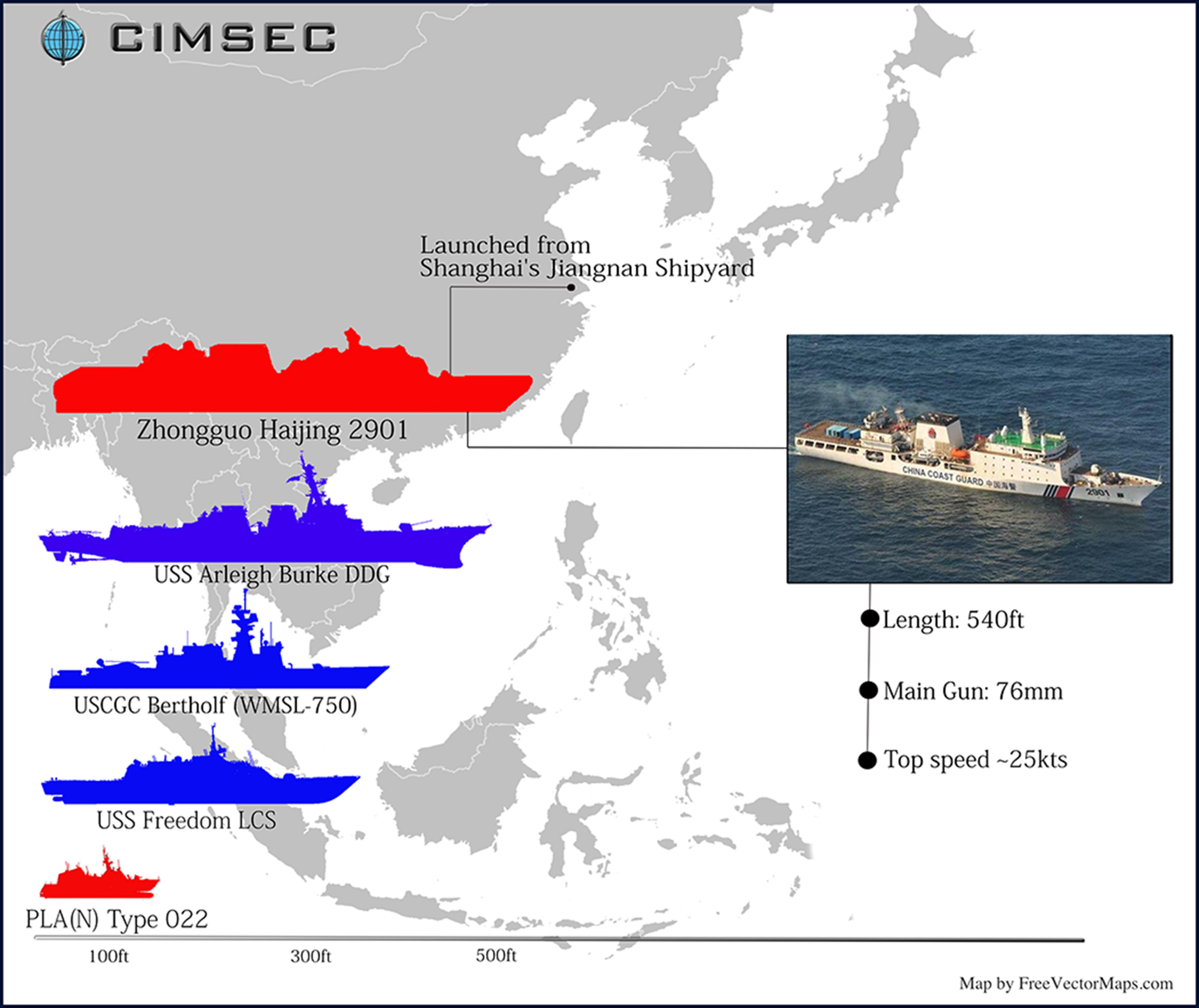
On May 19th, a formidable new Chinese ship put to sea for the first time.  As it left its berth at Jiangnan Shipyard, its onboard automatic identification system (AIS) transmitted signals for anyone who cared to receive them.  Its identity, Zhongguo Haijing 2901.  Its purpose, sea trials.  Its heading, somewhere in the East China Sea.

This was not the voyage of the Red October.  Zhongguo Haijing 2901 is not a stealthy nuclear submarine able to menace foreign capitals, or sink foreign fleets.  Nor is it a sister ship to China’s Liaoning (CV-16), that other potent symbol of sea power, the aircraft carrier. Indeed, by naval standards, its combat capabilities belong to an earlier age—the 19th century.

However, Zhongguo Haijing, or China Coast Guard (CCG) 2901, was not built to fight wars.  At over 10,000 metric tons, it is by far the world’s largest constabulary vessel, a class of ship operating at the vanguard of China’s peacetime expansion in maritime East Asia. When it is commissioned sometime in the coming weeks, it will provide a huge advantage to China in the battle of wills taking place along its maritime periphery.

The New Chinese Coast Guard Mega-Cutter/FreeVectorMaps.com

Building the Mega-Cutter

During the 2010-2012 period, Chinese policymakers made a series of decisions to vastly expand the capabilities of the country’s maritime law enforcement agencies.  They envisioned a great fleet of ships charged with advancing Beijing’s claims to waters and islands hundreds of miles away from the mainland coast, performing what Chinese texts euphemistically refer to as “rights protection” operations.  In the last two years, the China Coast Guard has received dozens of new ships, many of which have been used to buttress new footholds at Scarborough Reef, the Second Thomas Shoal, the Luconia Breakers, and the Senkaku Islands, and underwrite economic activities in disputed waters, most notably the two-month drilling operations of HYSY 981 in 2014.  CCG 2901 is an outcome of this surge in shipbuilding.

That CCG 2901 would someday put to sea was not a secret. In July 2013, the head of China State Shipbuilding Corporation, Hu Wenming, declared that his company would “accelerate research and development” of maritime law enforcement cutters displacing between 4,000-10,000 metric tons.  In January 2014, the research affiliate of another state shipbuilding firm revealed that the previous year it had signed a contract to do design work for this new ship class.  By late 2014, Chinese netizens were posting photos of the ship in the latter stages of construction.

That CCG 2901 would be studded with deck guns was not a given. Indeed, it represents a noteworthy breach of precedent: almost all of the new ships procured by the China Coast Guard have been unarmed.  This allows Chinese ships to aggressively engage the state and private craft of other countries without conjuring images of gunboat diplomacy or precipitating a war. With CCG 2901, the deterrent value of deck guns trumps these old aversions.

When it is commissioned, 2901 will be based at one of three cities with direct access to the East China Sea. Most likely it will be stationed along Shanghai’s Huangpu River, a hub of Chinese coast guard activity.  It may eventually find a home at a large new base to be built further south in Wenzhou.  It will primarily conduct missions to areas China disputes with Japan, including the sovereign waters adjacent to the Senkaku Islands. However like other ships based in these ports it will no doubt periodically patrol the South China Sea, working with sister units in Guangxi, Guangdong, and Hainan to impose the Chinese legal order in disputed waters.

CCG 2901 is the first, but not the last, of its class.  A second ship is in the latter stages of construction at Jiangnan Shipyard.  It will almost certainly be based at a facility with easy access to the South China Sea, probably on the banks of the Pearl River in the city of Guangzhou (Guangdong).

Sprinting to Superiority

Just a few years ago, the idea of Chinese maritime predominance was pure fantasy.  This is illustrated in a little-remembered confrontation between Japanese and Chinese forces that took place in 2002.  In December of the previous year, the Japan Coast Guard sank an armed North Korean trawler operating near the Japanese coast, an encounter that Wikipedia grandiosely calls the Battle of Amami-Ōshima.

After hours of fight and flight, the trawler ultimately went down in Chinese jurisdictional waters.  Japanese policymakers decided to raise the wreck, causing consternation among Chinese leaders.  The operation would involve questions of Chinese rights and interests embodied within the United Nations Convention on the Law of the Sea (UNCLOS), which China ratified six years earlier.  In response, Chinese policymakers instructed the China Marine Surveillance (CMS), a maritime law enforcement agency, to deploy a task force of ships to monitor the Japanese operations.

The CMS task force was ordered to “maintain presence and show jurisdiction,” that is, to be present to remind the Japanese who had authority.  But if the Chinese record is any guide, it was clear that the Japanese were in charge. According to the recollections of the CMS task force commander, Liu Zhendong, Japan created a security perimeter around the site, barring Chinese access to the salvage operations.  It could do so because it was able to muster many more ships: as many as 19 vessels, while CMS could send at most four, cobbled together from units from all over the country.  Moreover, Japan’s cutters were much larger than China’s. Among the ships buttressing Japan’s security perimeter was the 6,500 ton Shikishima (PLH-31)—the world’s largest coast guard ship. In the end, China was forced to resort to guile to gain access to the salvage operations: it accused a Japanese ship of leaking oil, a violation of China’s environmental protection laws.

In little more than a decade, the tables have completely turned. While Japan has a much more capable coast guard in many respects—it operates far more and better aircraft; its ships are more capable, their crews better trained—its white fleet is now much smaller than China’s, at the same time that the area of waters under its administration is far larger. And of course, with the commissioning of CCG 2901, China, not Japan, will own the world’s largest coast guard cutter.

Bigger is Always Better

In the type of missions China’s coast guard is asked to perform, ship size is a key determinant of capability. This differs from modern naval combat, where a 225 ton boat firing long-range cruise missiles might level a 100,000 ton super carrier. While the China Coast Guard does use water cannons, sirens, and other non-lethal measures to cow foreign mariners, the primary instrument of coercion is the ship itself.

This advantage was illustrated in a May 2012 encounter between a Chinese maritime law enforcement vessel—the 4,000 metric ton Haijian 83—and a much smaller foreign ship, probably Vietnamese.  As Haijian 83 sailed through disputed waters in the South China Sea, it was approached and ordered to leave by personnel on the foreign patrol vessel.  As the two ships got closer, the Chinese commander requested permission from superiors ashore to engage.  When this was granted, he ordered his ship to steam “full speed ahead” (kaizu mali), directly at the other craft. Given the size differential, the foreign ship had no choice but to retreat, which is what happened.

As this example shows, the type of confrontation taking place between non-naval vessels is akin to a game of chicken.  When two ships are close in size, nerve and seamanship go a long way, since neither side wants a collision.  When there is a major size disparity, the larger ship can simply drive others away. Indeed, when advantages in speed are combined with advantages size, a big ship can even sink a smaller craft.  At least one Vietnamese boat suffered this fate during contentious encounters in waters surrounding HYSY 981 in mid-2014.

The Implications of China’s Maritime Megalomania

When CCG 2901 does eventually deploy to disputed waters in the East China Sea, Japan may have few options. Because of its enormous size, this ship will sail and operate at will. Japan will be forced to either accept its unfettered movements, or escalate the conflict, which it will naturally be reluctant to do. During a moment of bilateral friction, CCG 2901 may even attempt to expel Japanese Coast Guard ships operating near the Senkaku Islands. Again, in that case Japan’s decision makers, beginning with front line commanders, will be faced with very difficult choices.  Chinese policymakers may assume Japan will back down no matter what China does. That would be a grave misjudgment.  Thus, with the commissioning of CCG 2901, the possibility of a shooting war in the East China Sea increases.

The Chinese mega-cutter will play a different role in the South China Sea, where Chinese forces already outmatch other disputants.  With its range and carrying capacity, it will be able to easily sail the great distances to China’s most remote claims and remain in disputed waters for long periods of time. Of most concern, these ships may engage foreign naval vessels, including those of the U.S. Navy.  In April 2014, both China and the U.S. approved a Code for Unplanned Encounters at Sea (CUES), an agreement to ensure professional behavior when foreign warships unexpectedly meet while on deployment.  However, the document only applies to naval vessels: the ships of the China Coast Guard and other maritime law enforcement entities are not required to adhere to its provisions.  Thus, U.S. naval commanders now must prepare for the possibility of testy encounters with Chinese mega-cutters on the high seas in peacetime, when their advanced weapons systems will do them little good.  This is an uncomfortable prospect given that China’s mega-cutters are larger than most U.S. surface combatants and positively dwarf the 3,500-ton USS Forth Worth (LCS-3) that recently patrolled waters near the Spratly Islands.

The strategic and operational implications of CCG 2901 should be the primary concern of other states. But it is also important to reflect on the chain of policy decisions that willed CCG 2901 into being. China has invested hundreds of millions of yuan to design and build this ship, and will spend hundreds of millions more to man, maintain, and replenish it over the course of its lifetime. Yet it exists for a single reason: to help China achieve peacetime dominance in Chinese-claimed waters.  Thus, the decision to build a class of 10,000-ton cutters should be seen as a measure of China’s resolve to prevail in its disputes.

Foreign states will no doubt react with fear and suspicion to the commissioning of these two armed mega-cutters. Chinese leaders must know this.  Just as they must have known that placing HYSY 981 in Vietnamese-claimed waters and building bases in the Spratly Archipelago would result in handwringing among its neighbors.  Not long ago, policies that risked inducing these emotions abroad found few supporters in Chinese councils of state.  The decision to build these ships, then, is another brushstroke in the portrait of a leadership operating on new assumptions, a state that does not fear the costs of its expansionary behavior, or one that believes they can and should be borne for the rewards they redeem.

Ryan D. Martinson is research administrator at the China Maritime Studies Institute (CMSI). He holds a master’s degree from the Tufts University Fletcher School of Law and Diplomacy and a bachelor of science from Union College. Martinson has also studied at Fudan University, the Beijing Language and Culture University, and the Hopkins-Nanjing Center. He edits the CMSI Red Book series and researches China’s maritime policy. The views expressed are those of the author and do not reflect the official policy or position of the US Navy, Department of Defense or the US Government.

CIMSEC is and always will be free for everyone, but we would be grateful for those who wish to provide a modest regular donation to support our operations.
Select a Donation Option (USD)

Enter Donation Amount (USD)

Assessing the U.S. Navy’s Arctic Roadmap

By Andreas Kuersten

Shielded by a significant expanse of sea ice, the Arctic Ocean has historically had limited naval strategic relevance outside of submarine and early warning operations.  But the process of climate change is increasingly melting away this covering and laying bare previously inaccessible northern waters.  As a result, and in concert with the region’s vast natural resource endowments and potential shipping lanes, one of the world’s five oceans and adjacent marine areas are slowly opening to human maritime activity – both in terms of state and private actors.  As the military branch responsible for fielding forces “capable of winning wars, deterring aggression and maintaining freedom of the seas,” the United States Navy has understandably turned its attention northward. 

In planning for the Arctic Ocean’s opening and its ensuing responsibilities in the region, the Navy researched and published the Arctic Roadmap: 2014-2030.  The report lays out how the service views the high north as a theater for operations and its priorities in the area in the near- (2014-2020), mid- (2020-2030), and long-terms (2030-beyond). 

The Arctic Naval Strategic Environment

As outlined at the beginning of the Roadmap, the Navy expects the Arctic “to remain a low threat security environment where nations resolve differences peacefully.”  It sees its role as mostly a supporter of U.S. Coast Guard (USCG) operations and responder to search-and-rescue and disaster situations.  However, the presence of vast resource endowments and territorial disagreements “contributes to a possibility of localized episodes of friction in the Arctic Region, despite the peaceful intentions of the Arctic nations.” 

For the most part, this assessment appears accurate.  The Arctic has consistently remained an area of peaceful interaction despite periodic disagreements, and its harsh environment minimizes conflict potential.  But the region also presents a completely unique geopolitical and military situation for the Navy.  As Arctic sea ice melts, the Navy will find itself engaging a theater where it is not the most capable force for the first time in recent history.  Russia’s Northern Fleet, designated in 1937, has been based and operating in the Arctic for nearly 80 years.  Russian naval and support capabilities in the high north surpass those of the Navy: currently, they possess the only fleet of nuclear powered icebreakers and extensive naval bases. 

Direct comparisons with Russia, however, are not very telling in terms of what the Navy’s Arctic priorities should be.  Russian interests in the Arctic have always been far greater than those of the U.S.  As such, the Roadmap is right to avoid any language seeking American naval predominance in the region, or comparisons to the northern capacities of others.  But given Russia’s recent provocative actions in Ukraine and elsewhere, and the fact that the Roadmap was published before these commenced, the Navy would be right to incorporate awareness of Russian activities and capabilities into future Arctic policy publications. 

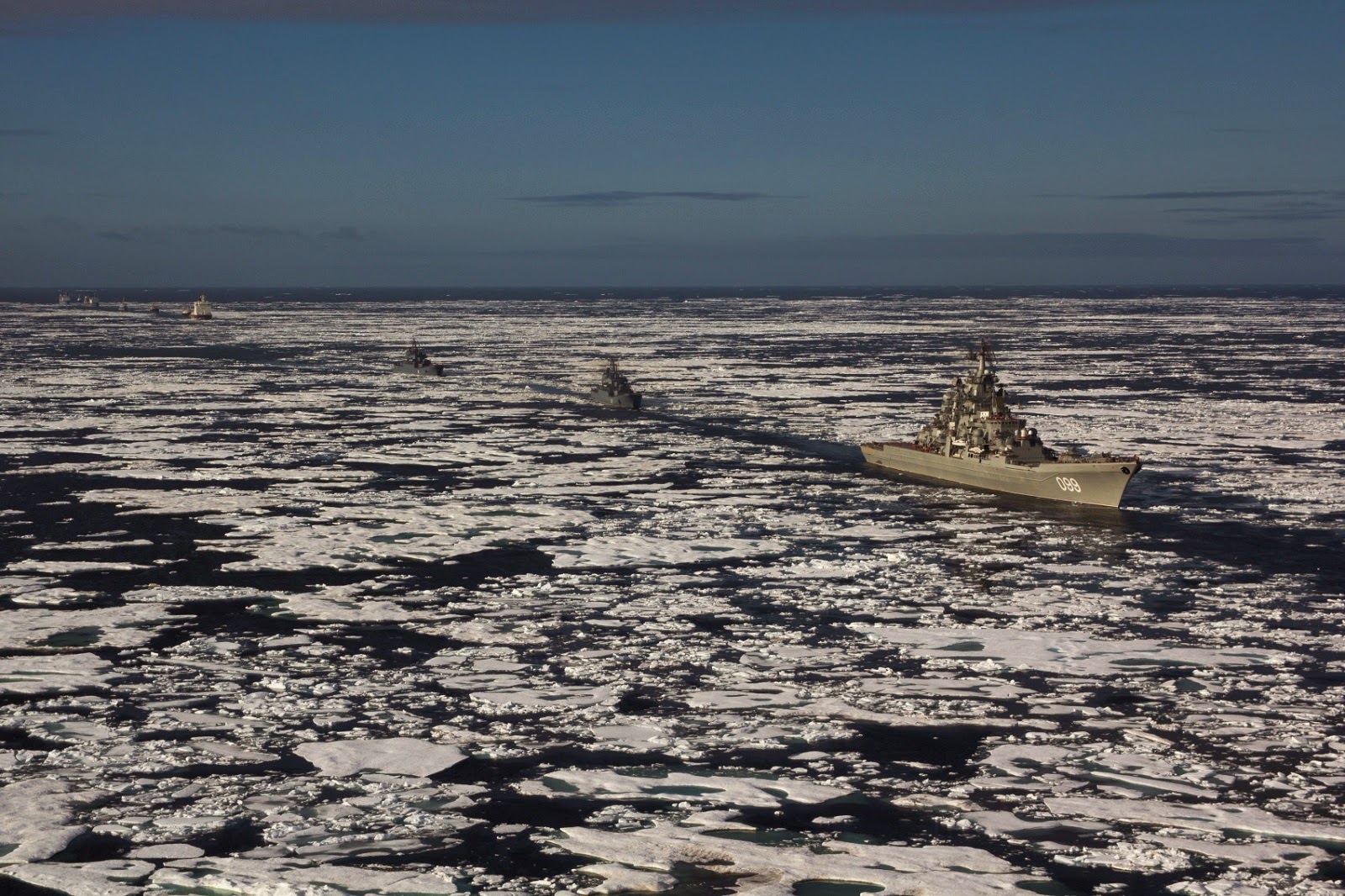
Russian warships en route to New Siberian islands, including Kirov class battlecruiser Pyotr Velikhiy.

The Navy’s Arctic Capabilities

Turning to the more technical issue of actual Arctic capabilities, the Roadmap presents the region as a unique operational environment.  It astutely notes that “Navy functions in the Arctic Region are not different from those in other maritime regions; however, the Arctic Region environment makes the execution of many of these functions much more challenging.”  This observation was born out in the Fleet Arctic Operations Game naval exercise of 2011.  Unfortunately, so was the reality that the Navy is currently ill equipped to operate in the high north.  A report from the U.S. Naval War College on this exercise noted the following:

The U.S. Navy is inadequately prepared to conduct sustained maritime operations in the Arctic region.  This assertion is due to the poor reliability of current capabilities as well as the need to develop new partnerships, ice capable platforms, infrastructure, satellite communications and training.  Efforts to strengthen relationships and access to specialized capabilities and information should be prioritized. 

The Roadmap seeks to take each of these failings into account, though it does so to varying degrees of prudence.  It presents the need for strong cooperation and partnership with foreign states, the USCG, and other government agencies.  Such interactions are aimed at helping to manage shared Arctic spaces, engage in multilateral training and operations, and develop Maritime Domain Awareness (MDA) for the region. 

The Roadmap puts a heavy emphasis on the advancement of MDA and logistics capabilities in the Arctic, and these foci are well warranted.  The principal restrictive variables in Arctic operations are severe and erratic weather, sea ice, poorly developed nautical charts, remoteness, and the absence of support infrastructure.  Tackling these issues begins with extensive data gathering and MDA development.  In this regard, the Roadmap asserts that partnerships with government agencies responsible for meteorology and geography – such as the National Geospatial-Intelligence Agency and National Oceanic and Atmospheric Administration – are crucial for helping “the Navy better predict ice conditions, shifting navigable waterways, and weather patterns to aid in safe navigation and operations at sea.”  A force with a robust understanding of a harsh environment has a significant advantage in any undertaking or confrontation therein. 

Arctic MDA will, in turn, aid in the maintenance of critical logistical support for naval assets deployed in remote northern theaters and the alleviation of infrastructure failings.  The distribution of fuel and other resources, along with the conservation of these assets, are important considerations in Arctic operations and ones the Roadmap shrewdly highlights. 

Beyond MDA and logistics, the Roadmap puts an emphasis on Arctic training and exercises.  These are often conducted with other countries and military branches and are touted to “improve knowledge of the Region and provide a positive foundation for future missions.”  While this is certainly true, training can only go so far when a force lacks the requisite equipment for operating in a region, and this is the Roadmap’s main problem. 

The Naval War College’s assessment of the Navy’s Fleet Arctic Operation Game, noted above, serves to illuminate the branch’s deficiency in terms of material capacity when it comes to the Arctic.  In addressing its equipment needs for northern operations, the Navy’s Roadmap is lacking.  Rather than stating the need to procure necessary equipment, it simply “directs review and identifications of requirements for improvements to platforms, sensors, and weapons systems.” 

For years, the needs of the Navy in terms of Arctic acquisitions and refitting have been extensively researched and presented.  Many individuals and organizations have laid out the various basic purchases and upgrades necessary for effective Arctic naval action.  Moreover, as reported by the website DoD Buzz through interviews with top Navy Officers, the branch is well aware of its needs and has undertaken numerous research and development projects to address them.  Ice-strengthened hulls, topside icing prevention and management, surveillance and reconnaissance sensor establishment and maintenance, and network systems adaptation to northern conditions are all clear areas of need with available remedies. 

Training and operating within equipment limitations enhances effectiveness, but being properly outfitted allows for substantially more freedom of action and strategy, as well as for the more likely attainment of superiority in any future confrontation. 

Even though the Navy is currently experiencing a time of relative budget constraint and massive asset redistribution – namely to the region of East and Southeast Asia – a policy roadmap encompassing the next several decades must make Arctic-directed equipment procurement an expressed priority.  These sorts of undertakings require a good deal of lead-time, and continuing to tread water by solely emphasizing need assessment over need fulfillment is a recipe for future shortfalls in necessary capabilities. 

In addition to equipment, the Navy is also lacking in terms of Arctic infrastructure.  Aside from Thule Air Base in Western Greenland, American deepwater ports are non-existent above the Arctic Circle.  The Navy has utilized temporary ice bases in the past for submarine exercises – the most recent being Camp Nautilus north of Prudhoe Bay in 2014 – but to support the necessity of an increasing naval presence in the next several decades a permanent base and deepwater ports will eventually be needed. 

These, however, are incredibly costly undertakings, both in terms of money and capital as well as force deployment to occupy such facilities.  The absence of any clear intent to look into permanent presence possibilities, or commit to equipment procurements, evinces the Navy’s desire to hedge its commitments to a remote and relatively minor area in the face of important responsibilities elsewhere.  While this is certainly prudent, such policies could become problematic if they result in the inconsequential development of Arctic capabilities over the period the Roadmap encompasses. 

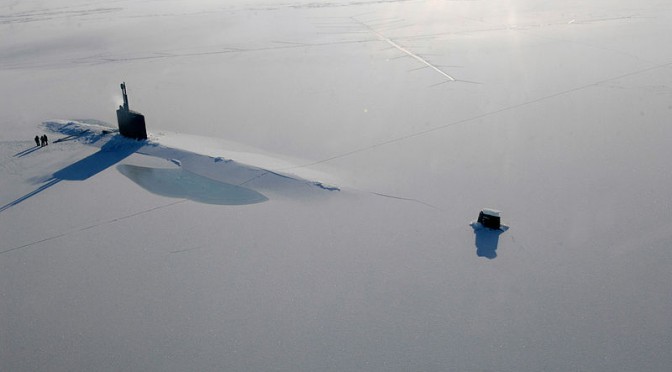
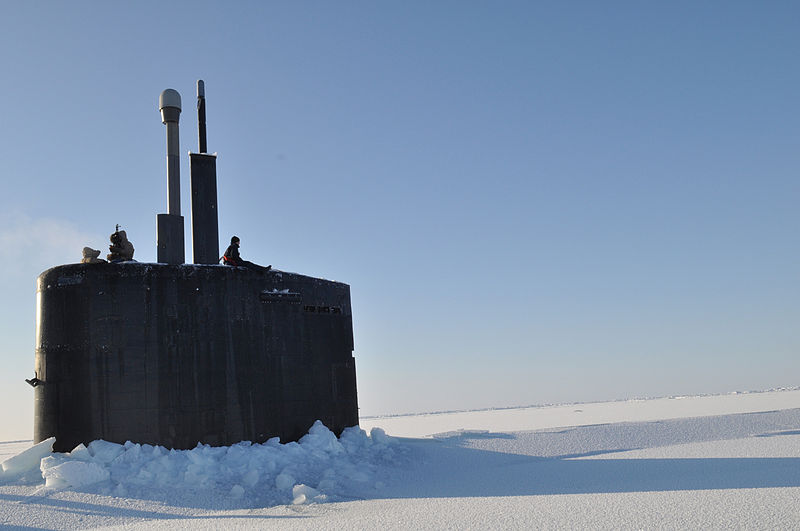
Crewmembers of the Los Angeles-class submarine USS Annapolis (SSN 760) man the bridge watch after breaking through the ice during Ice Exercise (ICEX 2009) in the Arctic Ocean.

The Navy’s Near-, Mid-, and Long-Term Arctic Assessments

The Navy’s concluding presentation on its ambitions over the timeline of the Roadmap lends credence to concerns over its intent to meaningfully prepare for future Arctic obligations. 

Within the near-term (2014-2020), the Navy plans to have a limited Arctic presence, “primarily through undersea and air assets.”  Surface operations will only take place in open water conditions.  More broadly, the Navy states that it aims to “increase the number of personnel trained in Arctic operations,” maintain ongoing exercises, “focus on areas where it provides unique capabilities,” “leverage…partners to fill identified gaps,” and “emphasize low cost, long-lead time activities to match capability and capacity to future demands.”  From this information, it appears that the Navy has minimal Arctic ambition in the near-term and is content to expand very little on its current capacities. 

In the mid-term (2020-2030), the Navy predicts that it “will have the necessary training and personnel to respond to contingencies and emergencies affecting national security.”  Its “surface vessels will operate in the expanding open water areas” and the Navy “will work to mitigate the gaps and seams and transition…from a capability to provide periodic presence to a capability to operate deliberately for sustained periods when needed.”  Although this language may be interpreted to push for accelerating Arctic initiatives in the mid-term, it actually simply shows the Navy moving at the speed of climate change.  Surface-wise, it will expand into the high north wherever the melting ice allows, but no real impetus is noted to engage the region outside of those areas that become like other environments in which the Navy already operates.  Furthermore, there is not even an ambiguous expression as to how the Navy plans to facilitate “deliberate and sustained” Arctic operations.

In the far-term (2030-beyond), the Roadmap asserts that the “Navy will be capable of supporting sustained operations in the Arctic Region as needed to meet national policy guidance” and “will enable naval forces to operate forward.”  Once again, however, no clear avenue, let alone a vague one, is presented through which these capabilities will be developed.  Consequential investment in region-adapted equipment and infrastructure are needed before the Navy can meaningfully operate in a forward capacity in the Arctic.  Unfortunately, as noted throughout this analysis, there is scant mention of any such commitment. 

Conclusion

The Roadmap ultimately shows the Navy having a keen understanding of the capacities it must develop to be a truly Arctic-capable force, but also evinces an organization weary of any real commitment to a region currently possessing little national security importance.  As the Navy puts it in the report’s final sentence: “The key will be to balance potential investments with other Service priorities.”  The Roadmap, however, currently shows that balance tipping away from any substantial Arctic engagement.  Hopefully the Navy’s fiscal apprehension will not hamstring its ability to operate in a future Arctic environment requiring its capable presence and leadership. 

Andreas Kuersten is a lawyer working in international law who has previously held positions with NOAA and the U.S. Navy and Air Force JAG Corps.