Category Archives: Capability Analysis

Analyzing Specific Naval and Maritime Platforms

American Strategy in the 21st Century: Maritime Power and China – Part II

This is the second of a three-part series. See Jake’s first article here.

China is a Land Power
While China continues to invest heavily in a navy, it still remains a continental for several reasons. First, China must maintain a large land force for internal stability and as a deterrent to regional competitors such as India, Vietnam and Russia. It faces demographic, economic and social challenges which threaten the Communist Party’s grip on power. Bernard D. Cole states, “Economic priorities and the need to defend the world’s longest land border with the most nations … still argue against [the PLA(N)’s] ambition for a global navy.”[1] That being said, China continues to develop a navy capable of meeting security interests within the first island chain and most of the South China Sea up to 1,000 nm off the coast.

Second, while China has vastly improved “blue water” capabilities, it has not yet capable of protecting maritime interests beyond the first island chain. Investing heavily in “anti-access/area denial” (A2AD) capabilities is a defensive strategy designed to make the cost of U.S power projection too high. However, A2AD is not a sea control strategy. It does little to prevent the cumulative effect[2] of American (and allied) maritime power to strangle China beyond the first island chain, as outlined by Thomas Hammes.[3] Finally, China’s substantial investment in a navy will likely lead to organizational pressure not to risk it to heavy losses, something which Arquilla and others have also noted. [4]

“Quantity has a quality of its own,” and China will enjoy early numerical superiority against forward-deployed American forces. It would take two to three weeks for additional forces to reach the Western Pacific in the event of an unexpected crisis. A comparison of the PLA(N) and forward deployed American naval forces is found below.
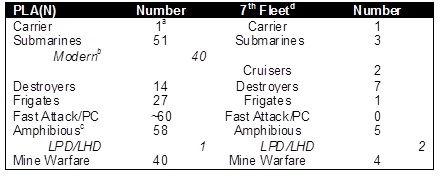
Figure 1. 2012 Comparison of PLA(N) and U.S. 7th Fleet Derived from China Naval Modernization (2012)  a-CV 16 “Liaoning”, while commissioned, does not have a carrier air wing. b-Does not include “Jin” class SSBN or “Ming” class SS c-Derived from Table 4, pg. 41 of China Naval Modernization (2012) d-U.S. 7th Fleet derived from public information available at http://www.c7f.navy.mil/forces.htm
Figure 1. 2012 Comparison of PLA(N) and U.S. 7th Fleet
Derived from China Naval Modernization (2012) [5]
a- CV 16 “Liaoning”, while commissioned, does not have a carrier air wing.
b- Does not include “Jin” class SSBN or “Ming” class SS
c- Derived from Table 4, pg. 41 of China Naval Modernization (2012)
d- U.S. 7th Fleet derived from public information available at http://www.c7f.navy.mil/forces.htm
Noting the numerical superiority of the PLA(N) over local American forces, the PRC may miscalculate on American resolve (or that of allies such as Japan and South Korea) and initiate a conflict.

Also, while the U.S. has not fought a traditional fleet action since World War II, the Navy has been conducting combat operations around the globe for the past two decades. China, for all the investment and exercises, has not engaged in maritime combat since 1988 in the Spratly Islands with Vietnam. PLA(N) commanders may assume their combat capabilities are better than they actually are, providing unfounded assurance to their own political leadership, increasing the odds of miscalculation.

American Maritime Power and the Strategy to Defeat China
America’s super power status is preserved through the ability to project power across the oceans. While the most obvious component of maritime power is the Navy, it is in jointness with the land, air, space and cyberspace components that makes it formidable. The “pivot” to the Asia-Pacific region must include a reallocation of forces and capabilities. China has continued to aggressively pursue territorial disputes, which have had the effect of driving many Asian countries to seek a greater American presence in the region. A larger land presence is out of the question, but naval and air assets – especially airborne ISR platforms – are much less intrusive and appealing. Space and cyberspace will play a significant (perhaps decisive) role, not only in sensor capabilities but also in defeating A2AD systems and PRC ISR.

The core of American maritime power is built upon destruction of enemy naval forces while preserving its own. Around this core are five pillars: scouting effectiveness, long-range strike, logistics and supply, amphibious assault and coalition warfare.

The Core – Sea Combat and Survivability
The ability to destroy or render inoperable the enemy’s navy – on the surface, in the air or under the sea – is the sine qua non of maritime power. At the same time, the survivability of forces enables the Navy to follow up on success and execute further operations, such as additional combat, blockade, escort or other sea control/sea denial tasks. The introduction of amphibious forces also requires sea combat and may be undertaken in contested waters. A maritime war with China will pit numerically inferior American forces against a formidable yet untested larger PLA(N). U.S. forces must be able to fight, win and survive to carry the war closer to China’s shores.

The Pillars
Scouting effectiveness. Wayne Hughes defines scouting as “the gathering and delivery of information,” a more compact and encompassing term than the currently used “ISR.”[6] It also includes the processing and analysis of vast quantities of all-source information – including space and cyberspace – to provide commanders the best picture possible from which they can make timely decisions. Scouting effectiveness is judged by how quickly information can be turned into actionable intelligence. If commanders can remain inside the decision-making loop of their enemy, they can have a distinct advantage.

Long-range strike. American military development continues to pursue the goal of projecting power from extreme distances or from a position of stealth or sanctuary. Long-range strike should be thought of as a “family of systems,” including land-based bombers, carrier-based strike aircraft (manned and unmanned), rail guns, cruise missiles and supporting airborne electronic attack aircraft.[7] The ability to strike the PRC’s A2AD systems, which are located not only on the coast but also far inland, will be crucial in a maritime fight. In this case, space and cyberspace offensive operations should also be considered in the family of “long range” strike.

Amphibious assault. War is ultimately decided by the “man on the scene with a gun.” The ability to insert land forces onto hostile shores in contested seas may be the ultimate arbiter in a maritime conflict with China, especially in the scenario described above. Even if not used immediately, the credible threat of an amphibious landing could have the effect of tying down Chinese naval, land and air forces hundreds of miles away.

Logistics and supply. In a conflict with China, we should expect that forward supply bases such as those in Japan, South Korea and Guam will become targets, along with supply ships. The flow of food, fuel, forces and ammunition will be the determining factor in our ability to sustain a long-term conflict, so our defense of “sea lanes of communication” (SLOCs) will be tested. Concurrently, the ability to restrict or deny China’s SLOCs should be an early objective of operational planning. A prolonged conflict will test both American and Chinese logistical capacity. The longer America is able to sustain a conflict while controlling SLOCs, the more untenable the Chinese position becomes.

Coalition warfare. The scenario we introduced highlights the importance of coalition and allied warfare. From a perspective of legitimacy, American national security policy has largely adopted the position that the unilateral use of force, while retained, is undesirable. World, and more importantly American, public opinion matters significantly in our ability to conduct and sustain military operations. More importantly, the participation of allies is necessary to offset the quantitative advantages of the PLA(N). The Japan Maritime Self-Defense Force (JMSDF) and the Republic of Korea Navy (ROKN) are significant forces in their own right, and combined with the U.S. Navy, would match up well against the PLA(N). Third, while some of our coalition partners and allies such as the Philippines, Thailand, Australia, New Zealand or Singapore may not directly participate, they may provide critical logistical hubs or basing. The pillars described above – scouting effectiveness, long-range strike, amphibious assault and logistics and supply – will hinge on the participation and/or support of our allies and friends.

Preparing to Pivot – Restructuring Forward Deployed American Forces
Former Secretary of Defense Leon Panetta suggested that approximately 60 percent of the U.S. naval forces will be postured toward the Pacific region by 2020. How those forces are configured remains a central question.[8]
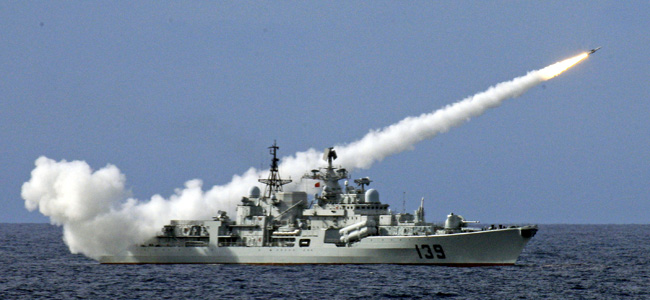
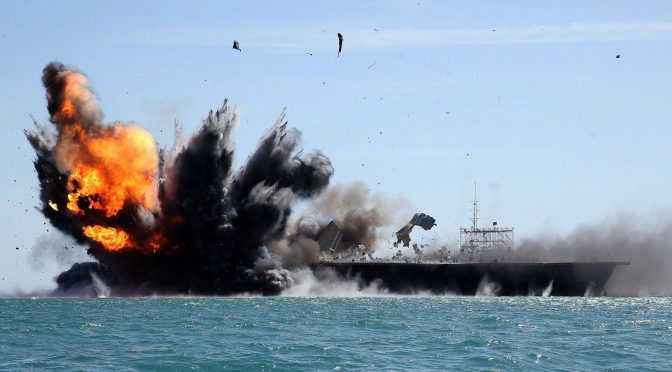
A Chinese warship launches a missile during a live-ammunition military drill held by the South China Sea Fleet last year.

Current maritime forces are centered on the USS George Washington carrier strike group and a large amphibious task force, CTF 76. The Air Force, Army, Marines and special forces also have a significant presence in the region in Japan, South Korea and Guam.

Future force realignment in the region should include an increase in the number of forward deployed U.S. submarines. The immediate availability of subsurface assets would tip the balance against the numerical advantage of the PLA(N) and allow commanders the option to operate immediately in the first island chain without risking large surface combatants.

In that vein, the development and construction of small fast and stealthy surface missile combatants would provide another avenue to commanders for operations closer in to Chinese waters.[9] Significant investment has already been made in both the littoral combat ship (LCS) and joint high speed vessel (JHSV), which represents a starting point. If equipped with next-generation anti-ship cruise missiles (ASCM’s) such as the Harpoon Block III, advanced capability (ADCAP) torpedoes and SM-2 missiles, these surface combatants could sortie into the East China and Yellow Seas conducting “hit and run” attacks on the PLA(N) surface units as well as protect Japanese and Korean home waters. Further out from the first island chain, they can also be utilized from the Philippines to the Spratly Islands and Singapore to participate in off-shore blockade of the Malacca strait.

Much like the Navy, the Air Force will operate at a numerical disadvantage to the Chinese air and naval air forces. It will fight further from bases, requiring tanker support making them vulnerable and limiting their attack depth. Both the Navy and Air Force will depend on advantages in electronic warfare to blind China’s air forces and air defense systems while fifth generation stealth fighters, such as the F-22, will be critical to achieve air superiority.

Land forces in a maritime conflict are naturally built around maritime assault. However, the presence of a significant force on the Korean peninsula serves as both a deterrent to North Korea attempting to take advantage of a conflict as well as representing a pool of forces to draw from to conduct amphibious operations. Soldiers and Marines stationed on Okinawa, Guam, Korea, Japan and Australia, have to be sufficient in number to conduct a forced entry and capture of any number of island-war scenarios, whether in the tiny Spratly, Paracel or Senkaku Islands to larger ones such as Taiwan.

Land forces also have a role in our own ability to contest the seas and defeat PRC A2AD systems. They can be used to station our own ASCM capabilities among the many islands and littorals in the East and South China Seas. Coupled with land-based rail or traditional gun systems, they could provide an effective deterrence against a PLA(N) sortie and give the PRC leadership pause before initiating conflict.

The opening stages of a maritime conflict with China will be a contest of sea denial. Large American surface combatants will not be operating within the first island chain until Chinese land-based ASCM capabilities are sufficiently neutralized. Control of the undersea, air and space will be bitterly contested. The PRC will attempt to “blind” American ISR and “command and control” capabilities using cyber attacks and anti-satellite (ASAT) missile systems.

U.S. submarines will play a crucial role attriting Chinese naval forces as well as executing strikes against ports and logistic facilities. U.S. land-based and carrier aircraft will begin to contest the skies. With stealthy, fast missile boats, surface forces could sortie out into contested seas. America will not have initial sea control within the first island chain, but should pursue sea denial to limit the PLA(N)’s freedom of action.

At the same time, larger surface action groups made up of guided missile destroyers and cruisers can begin to choke off China’s economic lifelines, especially south of the Spratly Islands and in the Western Pacific. Long-range strike platforms and airborne electronic attack, coupled with space and cyberspace warfare operations, will attempt to roll back China’s formidable integrated air defense (IAD) and A2AD systems. This will create an ever-tightening grip on Chinese economic activity and achieve air superiority in areas critical to the conflict.

About the Author
LT Robert “Jake” Bebber USN is an information warfare officer assigned to the staff of the United States Cyber Command. He holds a Ph.D. in Public Policy from the University of Central Florida. The views expressed here do not represent those of the Department of Defense, Department of the Navy or the U.S. Cyber Command. He welcomes your comments at jbebber@gmail.com.

Sources

[1] Cole, Bernard D. The Great Wall at Sea: China’s Navy in the Twenty-First Century (2nd Ed). Annapolis: Naval Institute Press, 2010. Pg. 201.

[2] Wylie outlined two types of strategies: sequential and cumulative. A sequential strategy is one in which each success is built upon the other in a march toward victory. He suggests the “island hopping” campaign in the middle Pacific as an example. A cumulative strategy is “made up of a series of lesser actions” which are not “sequentially interdependent.” See pg 22-27 of Military Strategy.

[3] Hammes, T. X. Offshore Control: A Proposed Strategy for an Unlikely Conflict. Washington DC: Institute for National Strategic Studies, National Defense University, 2012.

[4] However, this risk aversion may apply only to newer, modern platforms. The PLA(N) may be more willing to sortie older surface combatants which are still heavily armed anti-ship cruise missile (ASCM) platforms

[5] O’Rourke, Ronald. China Naval Modernization: Implications for U.S. Navy Capabilities – Background and Issues for Congress. CRS Report for Congress, Washington, DC: Congressional Research Service, 2012.

[6]Wayne P. Hughes, Jr. “Naval Operations: A Close Look at the Operational Level of War at Sea.” Naval War College Review, 2012: 23-47. Pg. 32.

[7] Gunzinger, Mark A. Sustaining America’s Advantage in Long-Range Strike. Washington DC: Center for Strategic and Budgetary Assessments, 2010. Pg. ix.

[8] Neisloss, Liz. U.S. defense secretary announces new strategy with Asia. June 2, 2012. http://edition.cnn.com/2012/06/02/us/panetta-asia/index.html (accessed December 1, 2012).

[9] Huges, op cit., Pg. 29.
TLAMs and ISIS: Insane and Cynical Ways to Blow Things Up

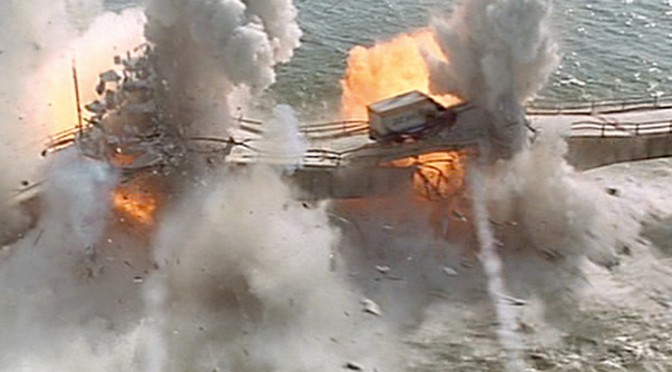
Several days ago (Tuesday September 23), I drove to work listening to the report of the United States’ government’s latest military adventure in the area of the Levant at the confluence of northeastern Syria and western Iraq.     The National Public Radio (NPR) announcers intoned dryly on the launches, among other things, of 50—yes fifty—tomahawk land attack cruise missiles (TLAM) as part of a major strike against the threat de jour of this season, the brutal Islamic State.[1]   At 1.4 million dollars a pop, tomahawks[2] are a very very expensive way to kill people and blow up their sinews of war, the most expensive of which were captured from the Syrian and most recently Iraqi armies—in other words less expensive stuff (like towed artillery and armored personnel carriers) that originated mostly in Russian and US factories.[3]


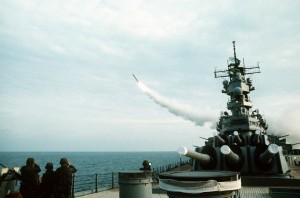
USS WISCONSIN launches a BGM-109 Tomahawk missile against a target in Iraq during Operation Desert Storm.

23 and a half years ago the US launched its first TLAMS as a part of the opening air campaign of Operation Desert Storm, the combat phase of the US-led coalition’s successful effort to liberate Kuwait from the military forces of Saddam Hussein’s Iraq and to restore stability, of some kind, to the Persian Gulf region.[4]   That use was part of an overall suppression of enemy air defense (SEAD) campaign that built on the lessons learned from Vietnam in 1972, the Yom Kippur War in 1973, and finally the Israeli Bekka Valley SEAD campaign in 1982. TLAMS served as a means, along with electronic countermeasures like radar jamming and use of anti-radiation missiles (ARM), to suppress Iraqi air defenses. Their use made sense because they were part of an overall campaign to achieve air superiority before launching the ground war that quickly liberated Kuwait under skies dominated by US and coalition aircraft.

Since then, TLAMs have been used in a similar fashion in Bosnia (Deliberate Force, 1995), Kosovo (Allied Force, 1999), Iraq again (Desert Fox, 1998, and Iraqi Freedom, 2003), and most recently in Libya (Odyssey Dawn, 2011).[5] One sees a trend here, with the exception of Iraq in 2003, of using these weapons as a means to show resolve without risking the lives of US service personnel on the ground.     Arguments can be made to support this use, although similar arguments can be made against their use, especially in the air-only campaigns. Today, they are again supposedly a part of a larger air campaign against the thug-regime of the Islamic State (for our purposes here ISIS).   One supposes that they were being used because of the air defense capabilities of ISIS, especially captured surface-to-air missile (SAM) equipment, anti-aircraft artillery, and radars.   Some of this concern for both manned and unmanned aircraft attacking ISIS is also directed at the Syrian regime, which has not guaranteed that its air defense system will remain silent during this expansion of the air war into Syria to attack the “capital” of the ISIS caliphate at Raqqa. However, ISIS’s air defenses have been assessed by some as being “relatively limited.”[6]

One must ask the question, why expand the war, both geographically and in terms of means, for the purposes of this essay, the means equating to TLAM use?   Has anyone done a cost benefit analysis (CBA) of this usage or is their use more an informational tactic meant to show sexy pictures of TLAM use to convey the seriousness of the intent by the Obama Administration?   A CBA notwithstanding, these other things may all be true to varying degrees, but it points to a more troubling suggestion. Is the use of TLAMs, like the use aircraft carriers to deliver the air power to these land-locked regions, simply a reflection of the strategic poverty of American thinking?

There are very few positive benefits in all these results.   Strategic poverty? Or cynical public relations campaign? Or wasteful expenditure of high technology smart ordnance against a very weak target (the ISIS air defense “system”)?   None of these choices offers much in the way of reassurance to this writer.

Further, the criteria for the use of these expensive “kamikaze drones”—my characterization for TLAMS—seems to be lower and lower. More and more, in the 1990s and since, when the US government wanted to blow up some meaningless bit of sand or dirt to display US resolve it sent these weapons in to do the job—or not do the job in most cases. We think we are sending a signal of resolve but our enemies, like the North Vietnamese during the ineffectual Rolling Thunder campaign, “hear” us sending a message of weakness, lack of resolve, and even cowardice.[7]   A friend of mine, who shall remain anonymous, refers to the TLAM as: “the 20th Century equivalent of a diplomatic note, meant to convey disapproval without really doing anything.”


Alcoholics Anonymous—among others—has a saying: “doing the same thing over and over again and expecting a different result is the definition of insanity.”   This latest gross expenditure of US tax dollars by the US Navy at the behest of its strategic masters to blow things up in a remote corner of the globe provides more evidence that US policy is either insane, impoverished, cynical, or all of the above. Let us hope it is impoverished, because that we can change; one day, and one election, at a time. But first the US must quit its knee jerk reactions to these sorts of events, like an alcoholic going on another binge.


John T. Kuehn’s views are his own and do not reflect the official policy or position of the Department of the Army, Department of Defense, or the U.S. Government.


[1] http://news.usni.org/2014/09/23/implications-expanding-isis-airstrikes-syria, (accessed 9/23/2014).

[2] http://fas.org/man/dod-101/sys/smart/bgm-109.htm, (accessed 9/23/2014).

[3] http://www.infowars.com/isis-is-taking-over-iraq-using-captured-american-weapons/, (accessed 9/23/2014).

[4] Ed Marolda and Robert Schneller, Jr., Shield and Sword: The United States Navy and the Persian Gulf War (Annapolis, MD: Naval Institute Press), 167-183.

[5] http://www.navy.mil/submit/display.asp?story_id=59476, (accessed 9/23/2014); and http://fas.org/man/dod-101/sys/smart/bgm-109.htm, (accessed 9/23/2014).

[6] http://news.usni.org/2014/09/23/implications-expanding-isis-airstrikes-syria, (accessed 9/23/2014).

[7] LCDR Douglas M. White, USN, “ROLLING THUNDER TO LINEBACKER: U.S. FIXED WING

SURVIVABILITY OVER NORTH VIETNAM,” 2014, unpublished masters thesis (Fort Leavenworth, KS: Combined Arms Research Library, 2014), passim.

The Virtue of Being a Generalist, Part 2: Are All Nuggets Created Equal?

By Jon Paris

U.S. Navy Surface Warfare Officers have a Napoleon complex. The community is often described as inherently self-conscious and hyper-competitive. Though SWO’s often sell themselves short, in reality, they are in the highest demand at all levels of our service and throughout the joint world. Commanders want Surface Warfare Officers because they can be counted on to get any job done – regardless of past experiences or training. The community can be a meat grinder, and those with upward mobility possess well-earned street credibility. How do they get to that point, though? In Part 1 of this series, we compared the training pipeline, billet structure, and shipboard priorities of the Surface Warfare Officer and Royal Navy Warfare Officer communities. Now let us delve into the mysterious world of the Fleet Nugget. This piece will compare the products that the Naval Aviation, nuclear, and conventional Surface Warfare communities deliver to the Fleet on Day One.

Surface Warfare Officers and Naval Aviators – the Jets and the Sharks. While there is no more fearsome combat team in the world, the communities are notorious for their sibling rivalry. Though we train fiercely to integrate our forces and work extremely well together to the detriment of the enemy, the professional blueprints of each community are oceans apart.

A Nugget is a first-tour Naval Aviator or flight officer, especially applicable during their first deployment. The origin of the term absolutely belongs to aviators, but it does have cross-over appeal, and its connotation paints a faithful picture of a new officer in his first unit, regardless of designator. The general insinuation of the term is that the officer has little to offer their unit and must be taken under someone’s wing – pun intended. Is an F/A-18 Nugget equal to a SWO Nugget, though? What does each community really provide to their Fleet Squadrons and ships when they deliver a new batch of officers?

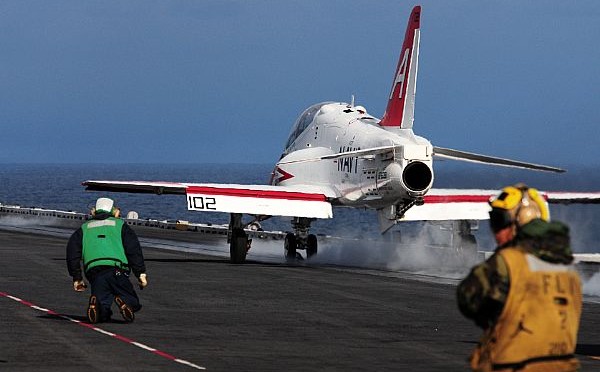
Student Naval Aviators in the Advanced Strike pipeline spend approximately two years learning everything from aerodynamics and physiology to air combat maneuvering and carrier qualification. During the training pipeline, they spend nearly 250 hours in the air testing their skills on three different airframes and refine those skills over the course of 75 simulator hours. Earning one’s Wings of Gold does not spell the end of training. The new Naval Aviator’s final stop before hitting the Fleet is the Fleet Replacement Squadron, where they perfect their art in their assigned airframe, spending another 175 hours in the air and in the simulator. When a Naval Aviator executes his orders to his first fleet squadron, he has spent at least 500 hours in hands-on training scenarios.

What is expected of a new Naval Aviator? What do wings mean on Day 1? Wings only come after an officer has demonstrated that they are able to meet a well-defined standard. When seasoned pilots accept a Nugget into their ready room, they see a pilot who can safely operate their aircraft, manage their respective mission and flight administration, and serve as a competent and safe wingman.

Aviators are well-trained before reporting to the Fleet and we have established the practical meaning of wings. What is the true nature of the product, though? On Day 1, the Naval Aviator Nugget will already have demonstrated proficiency at landing aboard a carrier during day and night operations. During his initial weeks in the squadron, he could be entrusted to conduct mid-air refueling, air-to-ground strike, strafing, and close-air-support missions, carrier qualifications, or high-value air-asset escort duties. With these baseline skills, the new aviators are immediately useful to their squadrons and are able to jump into the rigorous Strike Fighter Tactics Instructor-lead curriculum.

Like aviators, Nuclear Surface Warfare Officers also use the train-to-qualify method. After they complete a conventional division officer tour, they spend 6 months at Nuclear Power School where they master advanced mathematics, chemistry, physics, and nuclear theory. This school is widely acknowledged as the most demanding academic program in the U.S. military. They continue their pipeline with an intensive 6 months of hands-on watch-standing training and examinations at one of two Nuclear Power Training Units, or Prototype. Their community’s methods are known internally as the “Gold Standard.” This standard is rigid, unquestioned, and unabashedly enforced. When an officer graduates Prototype, they report to their aircraft carrier as a proven, and more importantly, qualified watch-stander. Shortly after reporting, a SWO Nuke Nugget earns their platform endorsement and re-qualifies on their ship as a Plant Watch Officer, immediately contributing to their department’s watch organization while also leading their respective division.

Newly commissioned Surface Warfare Officer candidates notionally attend an 8-week course known as the Basic Division Officer Course, or BDOC, prior to reporting to their respective ships. Keeping with the community’s focus on generalists, BDOC covers a wide-range of topics, including: basic damage control, Navy pistol qualification, basic SWO engineering, Maintenance University, maritime warfare, division officer leadership and fundamentals, basic navigation, seamanship, and ship-handling. Students take numerous exams and are held to the community standard of a 90% passing grade on their Navigation Rules (Rules of the Road) exam. It is a demanding school and was established to rectify the absence of any such schooling that existed for nearly a decade. During their time at BDOC, the ensigns spend 24 cumulative hours in the ship-handling simulators where they get a taste for everything from pier work to harbor transits and man-overboard recoveries.

After graduating BDOC, our SWO Nuggets report to their ships and take over their first divisions. Unlike their aviator brethren, they do not wear a warfare pin when they report to the Fleet, nor do they possess any watch-standing qualifications. What then is the product that we are delivering to our ships? Our new ensigns – our Nuggets – are confident leaders and are capable of taking over the responsibility for people and gear from the get-go. They board their ships with a basic familiarization with shipboard systems, service policies, and standard commands (used to drive a ship). SWO Nuggets are not qualified to stand watch on their own, much less to lead an entire watch team, but they are prepared to step onto the bridge and take over as a Conning Officer – learning the finer details of ship handling from their fellow junior officers, enlisted specialists, and the ship’s leadership. Though they are not flying a Hornet solo over Afghanistan, they are standing tall in front of their divisions, as well as on the bridge, issuing commands to the helm and engines of their billion-dollar warships, increasing their competency and savvy exponentially during every watch.

There is no doubt that the aviation and surface warfare communities have different demands, different priorities, and nearly polar-opposite cultures. An aviator must know what he is doing when he enters the Fleet, lest he crash his aircraft on the flight deck or drop his bomb on the wrong people. The Death-and-Destruction Factor is certainly relevant and is often used as an excuse for why Surface Warfare Officers do not have a similar training mindset. In other words, the argument is that young SWO’s can afford to be inexperienced because their mistakes are far less likely to cause catastrophe and because they operate with a safety-net of sorts made up of other watch standers. While I recognize the inherent danger of Naval Aviation, I disagree with this argument as a way to justify short-changing Surface Warfare Officer training. The culture and doctrine of the aviation community would not tolerate – much less conceive of – squadron skippers in the Fleet being burdened with building an aviator from scratch, yet our service puts that same burden on our ships’ captains, taking away from their crew’s overall combat-effectiveness. We are doing the world’s most fearsome warships an injustice. Surface Warfare Nuggets should report to the Fleet with know-how and qualifications, ready to drive and fight at the pointy-end from the moment they cross the brow.

After comparing the lives, methods, and priorities of Royal Navy Warfare Officers, Naval Aviators, and Surface Warfare Officers, I want to take the opportunity in the final piece of this series to analyze where the SWO community is getting it right, and where we could improve, as well as put forth two proposals that would fundamentally alter how the community trains and operates. In an era where fiscal uncertainty, regional conflict, and increasing operational tempos reign supreme, we must put our very best on the front lines – our country and our crews deserve it, and our enemies must fear it.

Read the next installment here

Lieutenant Jon Paris is a U.S. Navy Surface Warfare Officer. At sea, he has served aboard both a destroyer and cruiser, in both Weapons and Navigation Department. Ashore he has served as a Navigation Instructor at the U.S. Naval Academy and as a Flag Aide. He is a prospective destroyer Operations Officer. His opinions and generalizations are his own and do not reflect official stances or policy of the U.S. Navy.

Learning Curve: Iranian Asymmetrical Warfare and Millennium Challenge 2002

By Brett Davis

Tension between U.S. and Iranian military assets in the Arabian Gulf are nothing new. Confrontations between Iranian Revolutionary Guard Corps Navy (IRGCN), the Islamic Republic of Iran Navy (IRIN) and U.S. Navy vessels in the Gulf, the Strait of Hormuz, and the Gulf of Oman are a regular occurrence for forward-deployed ships. Iran knows it cannot match the U.S. in a conventional confrontation, and focuses on an asymmetrical style of warfare to increase damage and costs of confrontation to the U.S.

In 2002, a joint war game exercise, known as Millennium Challenge 2002 (MC02), took place to gauge readiness in the event of a conflict with a hostile Middle Eastern nation. The results were disastrous for the U.S., with over a dozen ships destroyed and thousands killed or wounded as a result of asymmetric and unconventional naval warfare. 14 years later, Iranian asymmetrical warfare can still have a devastating effect on U.S. and allied forces in the Middle East. Unconventional warfare has been the Achilles Heel of the U.S. military for decades, and more gaming and training are needed to enhance U.S. capabilities in an asymmetric environment.

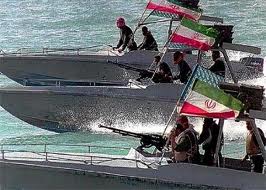
Just a relaxing day sailing the Persian Gulf.

A Combination of Threats

Following their lackluster performance during Operation Praying Mantis, in which the U.S. Navy laid waste to several conventional naval vessels, Iran began to focus on asymmetrical warfare. Tactics include Fast Inshore Attack Craft (FIAC), covert civilian craft, naval mines, and submarines.

The IRGCN utilizes swarming tactics as its method of choice. IRGCN bases are situated in various locations along Iran’s Gulf coast, from the Strait of Hormuz to the Northern Arabian Gulf. This is a key tenet in swarming attacks: packs of small attack craft covertly leave their bases at various times, all heading for the same target, i.e. a Carrier strike group operating in the Gulf. While this dispersed tactic may result in a weaker attack that is easier to repel, it is also much more difficult to detect, as the swarms don’t operate in a large formation. Also, craft equipped with torpedoes and anti-ship missiles can fire their payloads at a greater distance, ensuring survivability and destruction of their target.

Iran currently has the fourth-largest inventory of naval mines, as well as various platforms for deployment. Mines are a successful tool in the Gulf: USS Tripoli and USS Princeton struck Iraqi mines in the Northern Gulf during the Gulf War, and USS Samuel B. Roberts struck an Iranian-laid mine during the Tanker Wars of the 1980s. Iranian mines also dispatched large numbers of civilian merchant vessels in the same time period.

Iranian mines are largely cheap and unsophisticated. However, some Chinese and Russian variants, including the EM-52 multiple influence mine, are much more sophisticated and can be used in waters up to 600 feet – plenty deep to make the Central Gulf a dangerous place.

A majority of bottom-dwelling mines are designed for shallower waters. In some places, depths in the Strait of Hormuz are between 150-300 feet and are prime locations for these types of mines.

While the mines may not be sophisticated, deployment tactics are much harder to detect. IRGCN small craft are capable of laying mines, as are dhows, fishing boats and submarines. These platforms can carry up to 6 mines each and can be resupplied at sea. Mine laying platforms disguised as civilian craft would not raise suspicion on the part of Coalition forces while submarines can be quite difficult to detect by surface or air assets.

Iran operates several different types of submarines, all of the diesel variety. The Kilo-class are Soviet surplus that are nearing the end of their service life, but still require respect, especially in an asymmetrical warfare environment. Kilos can carry several dozen mines, laying them covertly beneath the waves and avoiding the overt detection by surface assets that endanger the mission of mine laying dhows and small boats. Kilos would also require an increase in anti-submarine warfare (ASW) platforms in theater for sub identification and prosecution, such as submarines and air and surface assets. They would also increase the standoff distance of high-value assets such as carriers and troop landing ships. These platforms would most likely not venture too close to a known hostile submarine operating area with few defensive weapons.

Iran’s mini-subs are another part of the undersea warfare threat worth considering. There are at least three separate classes of mini-sub in the Iranian inventory, all diesel operated. Their small size makes them difficult to detect, and their ability to operate in shallow waters makes them a perfect tool to target vessels in the littorals, such as amphibious assault ships and patrol craft, and any convoy of warships or shipping making its way through the Strait of Hormuz. They can also participate in mine laying operations  in shallower seas as a support asset.

Millennium Challenge 2002

MC02 was framed as a Red vs. Blue game depicting the invasion of a smaller Middle Eastern nation by a much larger and more capable adversary. It was the largest war game ever devised; 13,000 troops, aircraft and warships spread throughout the world, at a cost of $250 million. While it looked much like the upcoming invasion of Iraq, the tactics employed by Red closely resembled the nonlinear and asymmetric tactics of the IRGCN.

The Red forces, led by Marine Lieutenant General Paul van Riper, utilized several unorthodox measures and tactics to exploit the weaknesses of the Blue forces. When electronic warfare aircraft fried Red team communications sensors, van Riper used coded messages voiced from the minarets of Mosques at prayer times. This signaled the armada of civilian boats and light aircraft underway in the Persian Gulf to take action, conducting swarm and suicide attacks on U.S. warships and firing Silkworm missiles at high-value assets, claiming two amphibious assault ships and an aircraft carrier. At the conclusion of the attacks, 16 ships were sunk and thousands of servicemen were dead or wounded. Instead of digesting the results and using them to refine tactics and strategies in the face of a nonlinear threat, MC02’s controllers simply reset the problem – ensuring a Blue victory and “gaming” the most expensive and important war game in modern history.

Was anything learned from the surprise ending of MC02? It appears not. Iran’s tactics are nothing new; they have been using asymmetric warfare since the Iran-Iraq war. Iran’s weak Navy isn’t a new development either; most ships are decades old with few modern capabilities. What Iran does have, however, is a military strategy with a basis in unconventional warfare. Asymmetric tactics, like those described above, coupled with a decentralized command and control structure and semi-autonomous unit commanders make Iran survivable in the event of a first strike.

Unfortunately, the U.S. thinks of nations with weak conventional militaries as no match for the technological and modern behemoth that is the U.S. military. This was evident in Iraq and Afghanistan, where insurgents with little resources utilized out-of-the box thinking and nonlinear tactics to inflict heavy damage on U.S. forces, culminating in eventual retreats. U.S. strategy rests on technological and conventional dominance as well as engaging in non-traditional conflicts using traditional strategy and doctrine.

While Iran’s bluster regarding its eventual destruction of the U.S. fleet shouldn’t be entertained, the threat posed by Iran should be. Nonlinear and suicide attacks from the sea, increasingly capable long-range anti-ship missiles able to reach any vessel in the Gulf, and unconventional communications and command tactics are nothing to brush off. More exercises like MC02 are needed to adequately gauge the readiness of the U.S.’s land, sea and air forces to any asymmetric conflict with Iran. Where there are tactical and strategic gaps, a shift in training is required to prepare our forces for this type of conflict. A Blue defeat in a war game isn’t an embarrassment; it’s a chance to lean forward and become a well-rounded fighting force able to meet any challenge.

The chances of a major conventional conflict with another nation are extremely rare. Unconventional land and sea combat has been the norm for decades, and the U.S. needs more gaming and training in order to cope with the nonlinear threat.

Brett Davis is a U.S. Navy Surface Warfare Officer. He also runs the blog ClearedHot and occasionally navigates Twitter. His opinions are his own and do not represent the views of the U.S. Navy or Department of Defense.