Category Archives: Capability Analysis

Analyzing Specific Naval and Maritime Platforms

MoneyJet: DEF Innovation Competition 3rd Prize

On Sunday, 26 October, the Defense Entrepreneurs Forum hosted an innovation competition sponsored by the United States Naval Institute. $5,000 in prizes were awarded after the eight contestants made their pitches. This is the third prize winner posted originally at the DEF Whiteboard.

THIRD PRIZE WINNER

Contestant: Dave Blair, US Air Force Officer

MoneyJet: Harnessing Big Data to Build Better Pilots

BLUF: ‘Moneyball’ for flying. Track flight recorder and simulator ‘Big Data’ throughout an aviator’s flying career. Structure and store these data so that aviators can continually improve their performance and maximize training efficiency for their students.

Problem:

High-fidelity data exists for flights and simulators in an aviator’s career. However, these data are not structured as ‘big data’ for training and proficiency – we track these statistics by airframe, and not aircrew, unless there is an incident. Therefore, we rely on flawed heuristics and self-fulfilling prophecies about ‘fit’ when we could be using rich data. Solution. Simple changes in data retrieval and storage make a ‘big data’ solution feasible. By making these datasets available to aircrew, individuals can observe their own trends and how they compare to their own and other flying populations. Instructors can tailor flights to student-specific needs. Commanders can identify ‘diamonds in the rough’ (good flyers with one or two key problems) who might otherwise be dismissed, and ‘hidden treasure’ (quiet flyers with excellent skills) who might otherwise be overlooked. Like in ‘Moneyball,’ the ability to build a winning team at minimum cost using stats is needed in this time of fiscal austerity.

Benefits:

Rich Data environment for objective assessments.

o Self-Improvement, Squadron Competitions, Counterbalance Halo/Horns effect

o Whole-force shaping, Global trend assessments, Optimize training syllabi

o Maximize by giving aircrew autonomy in configuring metrics.

Costs: Contingent on aircrew seeing program as a benefit or a burden.

o Logistics: Low implementation cost, data already exist, just need to re-structure.

o Culture: Potential high resistance if seen as ‘big brother’ rather than a tool.

o Minimize by treating as non-punitive ‘safety data’ not ‘checkride data’

Opportunities:

Partial foundation for training/ops/tactics rich data ecosystem.

o Build culture of ‘Tactical Sabermetrics’ – stats-smart organizational learning

o Amplify thru Weapons School use of force stats, large-n sim experiments

Risks

Over-reliance on statistics to the expense of traditional aircrew judgment

o If used for promotion, rankings, could lead to gaming & stats obsession

o Mitigate by ensuring good stats only replace bad stats, not judgment Implementation. First, we build a secure repository for all flight-performance-relevant data.

All data is structured by aviators, not airframes. This data is stored at the FOUO level for accessibility (w/secure annex for wartime data.) Second, we incorporate data retrieval and downloading into post-flight/sim maintenance checklists. Finally, we present data in an intuitive form, with metrics optimized to mission set. For individuals, we provide stats and percentiles for events such as touchdown point/speed, fuel burn, and WEZ positioning. For groups, we provide trend data and cross-unit comparison with anonymized names.

Analyzing and Improving Airborne Command and Control

In the command and control realm, size does not matter.

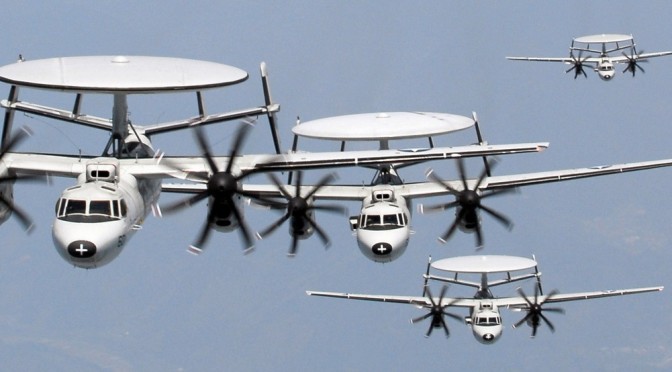
For decades, aircraft such as the Navy’s E-2 Hawkeye and the Air Force’s E-3 AWACS have performed duties as airborne command and control (C2) platforms. In Iraq and Afghanistan today, these units play a key role in the daily execution of the commander’s Air Tasking Order (ATO) and Airspace Control Order (ACO). Their duties include everything from the safe deconfliction of aircraft to the expeditious processing of air support requests from troops on the ground.

However, unlike other tactical aircraft, no measure currently exists to evaluate or compare the effectiveness of airborne C2 platforms.

Due to their size and persistence, most outside observers assume that the AWACS is the most capable airborne C2 platform. Conversely, with a crew of five and attached to the Carrier Air Wing (CVW), the E-2 Hawkeye is often dubbed a second-rate, “mini-AWACS.”

Rather than an impediment, the size of the Hawkeye crew is its greatest strength. While both platforms are equally capable in theater, a comparison of the data transfer rate of these two units validates the importance of Crew Resource Management (CRM) in the ability to perform C2 duties.

Crew Resource Management

Crew Resource Management (CRM) was first introduced in 1979 out of a need to address unsafe operating practices in the airline industry that had resulted in too-frequent, high profile crashes. Aviation professionals needed better procedures to incorporate each member of the flight crew to ensure safety of the aircraft.

In its early years, CRM emphasized improved communication, leadership, and decision making in the cockpit. By empowering each member of the crew to speak up to correct an unsafe situation, the National Transportation Safety Board (NTSB) hoped that CRM might lead to earlier recognition of potentially unsafe scenarios and fewer aviation mishaps.

Naval aviation was quick to recognize the success of the civilian CRM process and began adopting it as standard practice in 1989. Over the years, CRM has evolved to impact not just safety of flight concerns, but also the tactical performance of aircrew serving on various platforms.

Today, CRM encompasses seven characteristics: decision making, assertiveness, mission analysis, communication, leadership, adaptability/flexibility, and situational awareness. Aviators are expected to incorporate these concepts into the conduct of their flights, whether they are F/A-18E Super Hornet pilots or multi-crewed P-8 Poseidon aircrew.

Command and Control

In combat missions over Iraq and Afghanistan, E-2 and E-3 aircrew operate as airborne C2 units in accordance with theater Special Instructions (SPINS). They are assigned as Battle Management Area (BMA) controllers for large geographic areas, controlling all aircraft and communicating with all theater agencies in the Area of Operations (AOR).

At its most basic level, command and control is essentially information management. Aircrew must manage the flow of information through both verbal and non-verbal communications between other crewmembers in the aircraft and with external agencies or individuals. Typical information includes management of the theater aerial refueling plan, changes to tasking and dynamic targeting, emergency coordination, and airspace management that ensures the safe routing and deconfliction of all aircraft.

To be successful, C2 units must strive to pass information as efficiently and accurately as possible. Rather than strike or fighter aircraft, whose practiced execution of air-to-air and air-to-ground procedures defines success in combat, the management and routing of large amounts of information via radio and chat communication is essential for effective C2.

For this reason, CRM plays a crucial role in command and control. Communication, adaptability, and flexibility — central tenets of CRM — are closely related to time. While radio communications take a measurable amount of time (i.e. length of transmission), the act of receiving and processing a given piece of data often takes longer and is difficult to quantify. Specifically, the greater the number of individuals that must process and communicate a set piece of data, the longer the entire transmission process will take.

Data Transfer Rate

In telecommunications, the data transfer rate is defined as the amount of data that can be transferred from one place to the next per unit time. We typically consider data transfer rates when we compare the speeds of various Internet connections, measured in bytes or kilobytes per second.

Mathematically, if y equals the total amount of data to be processed and communicated and t equals the time required to process and transmit, we can solve for the standard data transfer rate (x):

X=y/t

By adapting this equation, we can judge a unit’s ability to process and communicate information and, hence, their effectiveness as a C2 platform. To do so, we must consider how many individuals are required to receive, process, and transmit the given amount of data (y). If we allow z to equal the number of crewmembers involved, we can amend the equation:

X=y/z*t

We can use this equation to roughly compare the efficiency of Tactical C2 platforms and use that data to reflect on some realities concerning C2 and CRM.

For example, if the total instantaneous amount of theater data, or situational awareness, to be communicated is notionally equivalent to 100 kilobytes (KB), then y=100 KB. We will assume that it takes each crewmember 2 seconds to process and transmit the data, as required, so t=2 sec. For our purposes, we will maintain that crewmembers are processing the data sequentially rather than simultaneously.[i]

We can then compare the theoretical data transfer rate of an E-2 Hawkeye, with a crew of 5 (z=5), with that of an E-3 AWACS, with a nominal crew size of 20 (z=20):

E-2C Hawkeye

X=y/z*t
X=100 KB / 5*2 sec
X=10 KB/sec

E-3C AWACS

X=y/z*t
X=100 KB / 20*2 sec
X=2.5 KB/sec

On its face, the crew of the Hawkeye appears able to process and transmit data, or situational awareness, four times faster than its AWACS counterpart.[ii] Since fewer individuals are required to share knowledge in the Hawkeye, information can be processed and transmitted more quickly. Hawkeye crews also regularly brief and practice CRM techniques that help enhance their overall efficiency.

This is not to say that E-2 crews are superior to their E-3 counterparts; in theater, both units work closely together with other joint agencies to provide unparalleled C2 coverage. Additionally, the radar and passive detection systems on the AWACS provide better value.[iii]

However, on average, larger AWACS crews must work harder than their Hawkeye counterparts to process, manage, and communicate information. Rather than a hindrance, the comparative size of the Hawkeye crew can provide an important advantage in a dynamic theater environment.

Improving C2

This revelation teaches the importance of including solid CRM procedures as part of mission preparation. While crews cannot change the amount of data in theater (y), they can take steps to control the number of people (z) and amount of time (t) required to process data.

Five key considerations can maximize a crew’s data transfer rate and improve the quality of C2:

1. Compartmentalization. Minimizing the amount of individuals required to consider each piece of C2 data can increase efficiency. This demands crews become comfortable with decentralized control, as the necessity to constantly feed all information to one centralized individual can degrade the effectiveness of C2. In mission planning, crews should assign duties to each individual — i.e. communications with fighter and tanker aircraft, tasking and tanking changes, communications with other agencies, etc — and consider the supervision required for each task. During mission execution, crews should adhere to these contracts to the maximum extent possible.

2. Verbal communications. During mission planning, crews must determine not only radio frequencies, but also radio contracts for each crewmember. Controllers must determine whom in the crew they are required to talk to before transmitting information or orders. Units should strive to produce autonomous controllers, as these individuals require less supervision and, therefore, fewer crewmembers required to help process their information.

With the introduction of Internet-based chat capability in airborne platforms, crews must additionally consider how the chat operator interfaces with the crew. Does this person listen to his or her own set of radios, or are they waiting for others in the crew to tell them specific pieces of information to transmit? As the Air Force moves their primary C2 medium to Internet-based chat, airborne C2 units must continue to improve their processes in this regard.

3. Non-verbal communications. Crews that are able to visually communicate can significantly augment their verbal communications. Simple measures such as a thumbs up, head nod, or physical touch can “close the loop” of understanding without having to clutter intra-ship communications. To be effective, these non-verbal measures must be briefed before flight and adhered to during execution. Some considerations, such as the physical layout of the space, are beyond an airborne platform’s ability to control. However, ground-based C2 units and designers of future airborne C2 platforms must consider the influence of these characteristics and their impact on CRM.

4. Contingency management. German general Helmuth Graf von Moltke once asserted, “No campaign plan survives first contact with the enemy.” Similarly, no C2 plan survives long after the brief. Adaptability and flexibility, central tenets of CRM, can help a crew persevere. Crews must brief how to handle deviations, whether they are dictated from higher headquarters or must be proposed and executed by the C2 unit.

Since systems such as radar and radios often break, crews must also consider how to continue executing the mission with degraded capabilities or during an aircraft emergency. Oftentimes, the mettle of a C2 unit is not shown during normal operations; it must be proven in times of crisis.

5. Controller proficiency. A confident, proficient controller can significantly improve the efficiency of radio communications and overall C2. Controllers should strive to be concise, communicating all situational awareness in as few radio calls as possible. Additionally, controllers must “close the loop” on information by ensuring that changes are disseminated to and acknowledged by all parties involved. While adhering to a pre-determined script is too rigid and can be a detractor, practicing communications and “chair flying” the mission beforehand can improve performance.

Airborne command and control is one of the most unique capabilities in the United States military arsenal. However, C2 units cannot exist in a vacuum; they must always strive for progress. Practicing good CRM and focusing on improvement during each flight can help crews better their data transfer rate and enhance overall theater command and control.

[i] Depending on the mission process model, some crewmembers may process information simultaneously. This approximation was considered in establishing the value for t in this scenario.

[ii] The comparison of an E-2 crew of 5 and an E-3 crew of 20 is for consistency, i.e. comparing whole crews. The total number of crewmembers required to process specific pieces of data varies by squadron and theater.

[iii] Improvements in the E-2D Advanced Hawkeye make its radar and passive detection systems on par with the AWACS.

LT Roger Misso is an E-2C Naval Flight Officer, MAWTS-1 graduate, and former director of the Naval Academy Foreign Affairs Conference (NAFAC). The ideas expressed here are his own and do not necessarily reflect those of the Department of Defense establishment.


The Innovation that Wasn’t: U.S. Cavalry, Their Weapons, and Their Training on the Great Plains

Written for Innovation Week by Major Andrew J. Forney, US ARMY

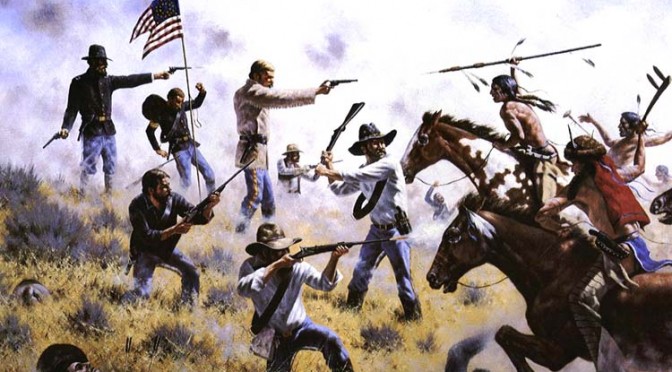
During the winter of 1879, Army officers reported to Chicago to decide whom to blame for the disaster at the Little Bighorn. Ostensibly meeting to clear the name of Major Marcus Reno, the commander of the southern wing of Custer’s Seventh Cavalry during the battle, some of the attendees surely hoped that the Court of Inquiry would prove cathartic and help explain the battle’s tragic outcome. Custer’s defeat during the summer of 1876 had shocked a nation celebrating the centennial of its founding and espousing notions of progress and growth. How could Custer, one of the Army’s ablest tacticians, and his vaunted Seventh Cavalry have been decimated by a coalition of Plains Tribes Indians over the course of one afternoon?

By the Inquiry’s conclusion, the presiding officers had half-heartedly cleared Reno of any wrong-doing during the battle, but did place blame on two others: the dead Custer and the very-much still in use 1872 .45 caliber Springfield carbine. While one could explain away the designs of a purportedly narcissistic and egomaniacal commanding officers, the reported combat malfunctions and slow rate of fire of the Springfield carbine wreaked of bureaucratic inefficiency and government malfeasance. Not only did Custer’s troopers find themselves outnumbered by Sioux warriors, they also claimed to have been outgunned, as several survivors of the battle recounted the prevalence of Winchester repeating rifles among the Sioux. Reading the minutes of the Inquiry, many contemporary observes roundly criticized the United States government and the army for not only allowing soldiers to fight at a technological mismatch, but for also missing the opportunity to revolutionize the mounted force by arming them with faster-firing repeating rifles.

The Springfield carbine/Winchester repeating rifle debate, particularly in the wake of Custer’s defeat at the Little Bighorn, provides a very interesting case study in military innovation. Many present-day scholars still insist that the 1872 board of officers ordered by then-General of the Army William T. Sherman to choose a single small arm for use by the U.S. army missed the mark. The board chose the 1872 Springfield rifle for use in the Army, selecting it over many other experimental and retooled designs then on the market. For the cavalry branch, the board decided upon the same design, just in carbine form, the shortened stock and barrel allowing for easier management on horseback. Interestingly enough, the board had ominous connections with the disaster still four years in the future. General Alfred Terry, later commander of the Department of the Dakotas and overall in charge of the 1876 Centennial Campaign, served as chair of the board; Major Marcus Reno, later besmirched survivor of the Little Bighorn battlefield, represented the cavalry branch.

What many critics of the Springfield carbine and the board overlook is how innovative the board and its selection actually were. New technology aside, the board operated under some guiding notions. First, the War Department wanted to use a single round for all of its weapons, as opposed to the myriad of round sizes and grain weights currently in service. They also hoped to conserve ammunition. Most officers believed that soldiers fired wildly and inaccurately during combat, leading to an inefficient exhaustion of ammunition stores. Enlistment data, presented to the board, showed that uneducated industrial workers and partially-literate foreign immigrants composed the majority of the post-Civil War force. Commanders could not assume that new recruits possessed any experience with firearms. Finally, the transition to conflict on the western frontier necessitated a lengthy supply line. Moving large amounts of specialized parts over long distances in inhospitable terrain and weather to maintain the small arms of a widely scattered force daunted many on the board. The Springfield rifle, and its carbine variant, brought simplicity and durability to the army; as a single-shot breechloader, it addressed the board’s concern with ammunition expenditure, while the .45/70 metallic center fire round provided high muzzle velocity and added range. Granted, the carbine used a smaller .45/55 round, but its internal parts and design mirrored the larger model. By deciding on the Springfield, the War Department modernized and standardized the force, increasing efficiency in arming soldiers, repairing weapons, and supplying units. While not necessarily the “sexy” choice, the selection of the Springfield signaled the genesis of bureaucratic innovation in the U.S. army. The Springfield would remain as the army’s primary small arm until the eve of the Spanish-American War and the adoption of the Krag-Jorgensen Rifle.

Later small arms studies and archaeological evidence also seemed to, if not invalidate, at least weaken the pro-Winchester argument. The United States Military Academy (USMA) commissioned a series of short films during the 1990s that examined small arms throughout military history, eventually devoting an entire forty-five minute film to discuss the debate over the Springfield carbine and the Winchester repeater at the Battle of Little Bighorn. The narrator points out that the Winchester repeater models of the early 1870s suffered from a poor design, the weapon’s internal mechanisms preventing the adoption of a long and powerful round. The Winchester could reach out accurately to 120 yards at best, with little force behind the round after approximately 80 – 100 yards. The Springfield carbine could maintain a steady rate of fire and deliver well placed and effective rounds past 200 yards. The USMA analysis built off of archaeological evidence found during the 1980s and 1990s at the Little Bighorn. Surveys of the battlefield helped to discount the idea that every Sioux warrior fired a Winchester repeater during the battle. Searchers found evidence of forty-three other types of small arms used at the battle, running the gamut from old muzzle-loading muskets to the historically much-ballyhooed Winchesters. They and others advanced the proposition that about a third of all warriors possessed firearms of any kind, further evidence and first person Indian accounts showing that the majority of the Sioux, particularly early in the battle, fought with bows and arrows instead of rifles. Historians also point out the lack of range the Winchesters possessed, as well as the lack of a regimented Indian marksmanship program. Custer’s troopers would have most felt the impact of the repeaters at close range, the short distance limiting the impact of their carbines’ rate of fire and accuracy.

If one cannot fully blame the Springfield carbine for the disaster, can we thus disregard the Battle of the Little Bighorn as a learning point in terms of innovation? No, for it does illustrate a key component of technological innovation that well-meaning theorists and intellectuals often over-look: TRAINING. As stated above, the 1872 small arms selection board used as one of its guiding assumptions that the new recruit would most likely be semi-literate or a non-native English-speaker who would have little to no experience with firearms. This in mind, the board never recommended and the army never explored the idea of an institutionalized recruit training program. The army instead banked on the hope that the gaining regiment or troop would familiarize the recruit with tactical and technical information. This rarely played out in terms favorable for the new trooper. The USMA small arms analysis placed a significant portion of the blame for the Little Bighorn on a perceived lack of discipline and preparedness within Custer’s command. Several Indian accounts from the battle noted that many of the cavalry’s shots travelled over their head, even though the majority of the troopers fired from stationary positions, indicative of poor marksmanship training. At the same time, ammunition expenditure during the battle appears to have been quite high, with numerous officers voicing their concerns about the scarcity of ammunition. Strikingly, most troopers chose to fight dismounted, foregoing mobility over a sense of grounded security. More than likely, this also stemmed from a lack of training, as troopers untaught in how to fight from horseback went to ground in the hopes of placing a semblance of well-aimed fire against their foes. More often than not, this practice eventually led to the routing of dismounted forces by their more mobile and horse-bound Sioux enemy.

My recent participation in a symposium discussing the future of small arms made me realize that the problem of linking training with innovation still exists in some quarters. As we debated what the future force would carry into battle, other scholars and experts repeatedly instructed me to “not worry about training” and to instead focus on capabilities. These maxims stayed with me, particularly as I considered the half-way or deadened innovation of the early 1870s. While the War Department correctly pursued innovations in procurement and sustainment, the lack of other institutional changes prevented them from realizing the fullest potential of their technological advance. A hard look at structures, doctrine, and training prior to Custer entering the valley of the Little Bighorn might have precluded the need to lay blame during the cold Chicago winter of 1879.

MAJ Andrew J. Forney is an Army strategist serving as the American Division Counselor and teaching in the History Department of the United States Military Academy, West Point.  The views expressed are the author’s alone and do not reflect the U.S. Military Academy, the U.S. Army, or the Department of Defense.

Corps Existentialism: Ensuring a Future for the Marines

After more than a decade of overwhelming success in combat operations ashore, the United States Marine Corps is mounting a very public return to its sea faring roots—and the timing could not be worse.  The defense budget is shrinking by billions of dollars each fiscal year, impacting everything from amphibious ship maintenance / readiness / modernization and interoperability to Marine acquisitions and end strength.  In the midst of all this fiscal turmoil, the Department of the Navy (DoN) is further handicapped by an absence of Department level strategic communications coordination evidenced by the distant narratives being communicated from the Blue and Green sides on amphibious operations. With America’s largest Global War on Terror land campaigns wrapping up and with it a shrinking appetite to maintain two land armies, the lack of a coherent, unified justification for the future employment of Marines aboard Navy shipping existentially threatens the Marine Corps. Below are eight major items that the DoN must internally reconcile in this budget cycle to further guarantee future relevancy of the US Marine Corps:

1.       DOCTRINE: Reconsider the Marines new Capstone Document, Expeditionary Force 21 (EF-21).

“EF-21 will not change what Marines do, but how they do it[1].”  To this I would add “and when they will do it, and why they will do it.”  EF-21 represents a unilateral, fundamental paradigm shift in Joint Forcible Entry Operations (JFEO) doctrine that disconnects with existing concepts such as the Joint Operational Access Concept and the Army – Marine Corps Access Concept.  EF-21 asserts the Marine Corps’ preeminence in conceiving Amphibious Doctrine and announces dramatic changes in USN shipping standoff ranges during landing operations (an almost unfathomable 65 nautical miles) as well as a novel sequencing of operations—landing Marines prior to cyber, naval, or air preparation of the battle space in order to conduct USMC counter anti-access and counter area-denial operations.  The Marines have blazed a new doctrinal path, replete with unique assumptions on surface ship missile defense capabilities (underestimated) and surface connector capabilities (overestimated). With EF-21 they have created a schism that—left unreconciled —will call into question Naval / Joint doctrine and acquisitions to support amphibious entry operations.

2.       ORGANIZATION: Re-evaluate the ARG MEU and MAGTF

For well over a decade, the Amphibious Ready Group / Marine Expeditionary Units (ARG MEU) have been operating outside of their normal 3 ship formations. “Split Force Operations” and “Distributed Operations”[2] have been directed by Geographic Combatant Commanders, thereby breaking up the traditional ARG MEU formations in order to distribute the ships and personnel where operationally required.  While the ARG MEU has been historically conceived as an amphibious, expeditionary rapid reaction combined arms force capable of self-sustainment, the proliferation of lesser contingency operations has resulted in the placing of greater preeminence on the pieces parts vs. the whole.  This trend of separating not only ARG-MEUs but also and their Marine Corps combined arms Marine Air Ground Task Forces (MAGTF) will likely only increase in the future (especially with game changing acquisitions like the 5th Generation F-35B Lightning II coming to the Fleet in FY-17).  The cross domain synergy envisioned in the JOAC—“…the complementary vs additive employment of capabilities which enhances the capabilities and compensates for the vulnerabilities of others”—will drive independent elements of the MAGTF further into the Joint arena, and may precede a paradigm shift fundamentally altering the current ARG MEU and MAGTFconstructs.  Getting in front of that bow wave will be essential to maintaining both the MAGTF’s integrity, its capability set and its Joint Force relevency in both fully integrated and split/disaggregated instantiations throughout the range of military operations.

3.       TRAINING: Refine the agility instead of preparing for Tarawa II

Exercise BOLD ALLIGATOR is as much about domestic and international strategic communications as it is a Marine Expeditionary Brigade level exercise.  The Navy – Marine Corps team has used the exercise to host many distinguished visitors (DVs) to demonstrate the capability of amphibious forces to conduct forcible entry operations even after a decade spent waging two land wars and a significant curtailment of practiced amphibious landings on both coasts.  MEB level landings haven’t been employed operationally since the Gulf War—and in that case it was a pump fake at Ash Shuaybah.  What the Navy-Marine Corps Team has done plenty of is split/disaggregated operations, and despite their prevalence over the last decade, there has not been enough concept refinement and exercises to perfect the planning, combat cargo loading, disaggregating and (most importantly) re-aggregating of the force in order to conduct larger scale operations.  Real emphasis on these modern deployment dynamics have to become a priority so that Navy-Marine Corps amphibious forces can maintain their relevance as a scalable, agile force capable of deploying to conduct both distributed, lesser contingency operations and focused, combined arms major combat operations.


4.       MATERIEL: Preserve the Assault Echelon by ensuring that the ACV does not become a “Ship to Objective Commuter[3]”

With the current Amphibious Assault Vehicle (AAV) fleet nearing 50 years of age, the Marines are in desperate need of a replacement.  The Expeditionary Fighting Vehicle—previously the heir apparent to the AAV—was cancelled in 2011 after $3 Billion was spent and $15 Billion more required.  The successor to the EFV, the Amphibious Combat Vehicle (ACV), is reported to lack an amphibious capability (it will not swim unlike its predecessors) and will instead rely on US Navy surface connectors (Landing Craft Air Cushion [hoovercraft] and Landing Craft Utility [regular displacement craft]) to get ashore. As stated by LtCol Howard F. Hall in the Marine Corps Gazette, “… regardless of its land capabilities, the [non amphibious ACV] lack of personnel carrying capacity, reliance on connectors, and delayed transition from those connectors once ashore exacerbate operational risks.” Those risks include surrendering the assault echelon writ large: without amphibious capability, the connectors—which are very vulnerable to small arms, coastal artillery / mortars—would be stuck depositing ACVs instead of follow on logistics and supplies.  Once ashore, the ocean becomes a brick wall to Marines embarked in ACVs instead of maneuver space.  EF-21 envisions a 65 nautical mile standoff between Marines on the beach and Sailors on the amphibs.  If that distance is to be honored, an “amphibious combat vehicle” that lives up to its name must be fielded.

5.       LEADERSHIP: Challenge convention, support the Joint Force and the Corps will continue to thrive

The Marines are famous for their institutional paranoia on both Navy support and Army efforts to subsume them.  This paranoia, however, is detrimental to effecting needed change, and often causes a reflexive opposition to anything which threatens existing Marine Corps doctrine—seen as the Corps’ existential guarantor.  The Corps is not without their own innovators, however.  Earl “Pete” Hancock Ellis, as a Major in the Marines, conceived and developed the innovative Operations Plan 712—the basic strategy for the United States in the Pacific that led to the Corps’ modern day monopoly on Amphibious Assault (and in no small part its survival through the twentieth century). If not for Ellis’ own benefactor, General LeJeune, OPLAN 712 may never have received the vetting that drove it to become foundational to the Pacific Campaign.  This same kind of innovation and support, and not just doubling-down of core competencies in more difficult settings, must take place with Marine leadership going forward to ensure that the Corps is positioned strategically to act when the Joint Force requires.

6.       PERSONNEL: Bring back Marines assigned to Navy ships at the platoon level to augment Navy VBSS, security, small arms, ATFP capabilities

The Marines had an illustrious 223 year run on Navy capital ships, which ended in January 1998 as the defense department drew down its end strength as part of the Clinton era peace dividend.  Today, as the Corps is set to shrink once again post Afghanistan and Iraq, there is ironically a pressing need for Marines to return to Navy ships.  Anti-terrorism / Force Protection (ATFP) requirements—sentries, crew served weapons and quick reaction forces—have been on a steady rise since the 2000 USS Cole suicide bombing in Yemen.  These watch stations strain Navy crews and are manned by personnel whose primary responsibility is not the handling of small arms.  Likewise, Navy Visit Board, Search and Seizure teams—while more proficiently trained than their ATFP counterparts—are principally manned and trained for inspection and self-defense; they do not have an assault / counter-assault capability and therefore usually rely on heavily tasked special operations forces (SOF) to conduct opposed boardings.  Returning Marines to Navy ships will bring additional ATFP and VBSS capabilities to the Fleet while insulating the Marine Corps from additional manpower cuts.

7.       FACILITIES: Prepare special units to embark non-traditional shipping (and keep them light)

Commandant of the Marine Corps General James Amos testified in front of Congress on 01 October on his initiative to form a Special Purpose Marine Air Ground Task Force (SP MAGTF) in Kuwait to provide regional Quick Reaction Force (QRF) capability.  Retired Captain Jerry Hendrix of the Center for a New American Security endorsed the innovation in the Wall Street Journal.

“Looking at the Marines as a crisis response force is good in the sense the Corps knows it must develop an alternative mission and a new future.” [4]

However, Amos believes that his efforts are being hamstrung by the lack of amphibious shipping.

“In a perfect world we would rather have these teams sea-based, but we don’t have enough ships.”[5]

Not every contingency warrants a warship.  For lesser contingency operations—everything from embassy reinforcement, snatch-and-grabs to theater security cooperation—the Navy is looking towards employing ships from its “Moneyball Fleet”.  Joint High Speed Vessels, Afloat Forward Staging Bases, Dry Cargo Logistics Ships and Littoral Combat Ships are considerably cheaper to build and operate than their USS cousins, boast considerable cargo space, have sufficient flight deck / boat deck facilities while operating with a considerably smaller “signature.”  In order to ensure that these vessels do not become the exclusive domain of lighter / sexier Special Operations Forces (SOF), Marines must build tailored, scalable packages that can rapidly deploy, integrate, conduct operations and debark as cheaply and as expeditiously as possible.  Throwing down similar communications integration, berthing, and command and control requirements on non-traditional shipping as amphibious shipping is a surefire way to get priced out and left on the pier.

8.       POLICY: A greater role for the Secretary of the Navy in ensuring unity of effort / purpose within DoN DOTMLPF

At the end of the day, Title 10 authority to man, equip and train the members of the United States Navy and United States Marine Corps is invested in the Secretary of the Navy, the Honorable Ray Mabus.  The department’s strategic vision must be clearly defined and communicated at the Secretariat level.  There is no room for competing narratives, especially in an era of ever shrinking fiscal resources and ever expanding operational requirements.  It must become the policy of the Department of the Navy that all Navy / Marine Corps Doctrine, Organization, Training, Materiel, Leadership, Personnel, Facilities conform to the department’s strategic vision and serve in promoting its unity of purpose.  Anything less introduces risk and presents an existential threat to the Marine Corps.


Nicolas di Leonardo is a member of the Expeditionary Warfare Division on the staff of the Chief of Naval Operations and a student at the US Naval War College.  The views expressed here are his own and do not necessarily reflect those of the Expeditionary Warfare Division or the Naval War College.

[1] Amos, General James E. et al.  “EF-21,” Headquarters Marine Corps, 04 March 2015, p.5
[2] Disaggregated Operations are defined in EF-21 as “…requiring elements of the ARG/MEU to function separately and independently, regardless of time and distance, with elements under a command relationship that changes/limits the ARG/MEU commanders’ control of their forces.  Distributed Operations / Split Force Operations are defined as “…requiring elements of the ARG/MEU  to function separately for various durations and various distances with the ARG and MEU commanders retaining control of their forces under the Geographic Combatant Commander.”

[3] Hall, LtCol Howard F.  “Ship to Objective Commuters: The Continuing Search for Amphibious Vehicle Capability.”  The Marine Corps Gazette, August 2014
[4] Barnes, Julian E.  “Marines Deploy New Quick Reaction Force in Kuwait.”  The Wall Street Journal, 02 October 2014.
[5] Barnes, Julian E.  “Marines Deploy New Quick Reaction Force in Kuwait.”  The Wall Street Journal, 02 October 2014.