Category Archives: Capability Analysis

Analyzing Specific Naval and Maritime Platforms

With EF21, Marines Struggle to Remain Relevant

This article by Lloyd Freeman is in response to our call for articles on Amphibious Warfare. Also, an editor’s reminder, we DO accept response articles at nextwar(at)cimsec.org.

The Marines are no longer America’s 911 force…and it gets worse: If the Marine Corps continues on its current trajectory of developing unrealistic operational concepts and platforms, it risks becoming irrelevant in light of much more capable U.S. warfighting organizations and platforms. The Marine Corps’ decision to go “all in” on the F-35B Joint Strike Fighter and its corresponding failure to embrace new, game-changing technologies and corresponding doctrine and tactics will result in a force that is ill-suited for next-generation warfare and will ultimately become subservient to other, much more capable U.S. military fighting forces.

The Marine Corps Goes It Alone

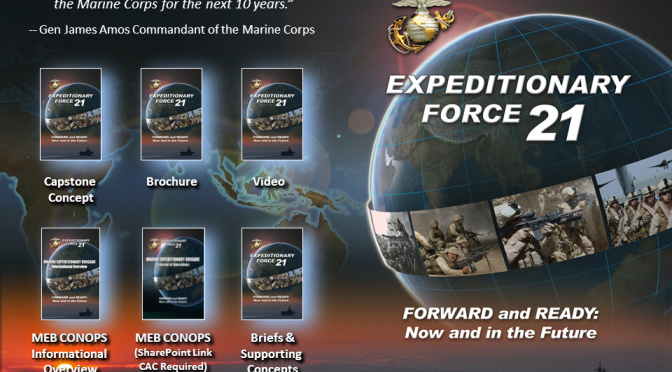
Over the past few years, the Marine Corps has started down a dangerous path of developing tactically and operationally unsound vision statements that are designed to protect their outlandish and expensive platforms. The Marine Corps recently rolled out their Expeditionary Force 21 (EF21) “vision,” which states that Marines will need to be able to conduct ship-to-shore operations from 65 nautical miles away—an incredible distance for any kind of surface assault. The analysis (or lack thereof….EF21 was developed independent of the U.S. Navy) behind EF21 is the belief that amphibious ships will be susceptible to coastal-defense cruise missiles (CDCMs). Rather than adhere to joint doctrine, for some inexplicable reason the Marine Corps has decided the way around enemy capability is not to neutralize but rather to swim right through it with future high-speed amphibious combat vehicles (ACVs). In light of U.S. technological dominance, this is puzzling. China has dug thousands of miles of tunnels and has constructed massive fuel-storage depots deep underground for a very obvious reason. Our potential adversaries know that if the U.S. military can see it, it can and will kill it. The Marine Corps refuses to accept that the U.S. Navy and the joint force will first set conditions for any possible future amphibious assault in accordance with Joint and Naval Doctrine, which currently allows for the first amphibious assault wave to be launched within 12 nautical miles (or closer)—not 65 nautical miles. Moreover, the Marine Corps does not consider the possible contributions of unmanned systems to future amphibious assaults. There is no need to place a single Marine into harm’s way if an autonomous system can swim onto or fly over the beach and provide the confirmation and subsequent destruction of enemy forces.

A thorough mechanical sweep of objective areas can be conducted with autonomous systems today in preparation for follow-on forces. It’s even possible that follow-on forces may not even be needed in an age of autonomous and unmanned systems. With such technological dominance at our finger tips, why is the Marine Corps still planning for a “Normandy”-type amphibious landing and creating concepts like EF21 that do not adhere to current doctrine and worse, do not attempt to maximize U.S. technological military dominance? The Marine Corps remains fixated on World War II tactics. This drives the procurement of outlandish and expensive platforms such as the Amphibious Combat Vehicle (ACV), or worse: platforms that are not even designed to support your operations and/or tactics….and herein lies the problem.

A 5th-Generation Fighter Mistake

Developing suspect doctrine is bad enough, but the Marine Corps’ procurement of platforms that are not designed to support its service-unique tactics and operating procedures only compounds the challenges it faces today. Although the short, take-off, and landing version of the F-35B Joint Strike Fighter (JSF) is possibly the best fighter jet ever built, it is not a close-air support platform and was never intended to be. The F-35 is designed for high-end, air supremacy operations during the setting of battlefield conditions that occur long before landing forces ever arrive in theater. Rather than pursuing aviation platforms ideally suited for close-air support, the Marine Corps aviation community hitched its wagon to the JSF program and now stands to join the elite-strike aviation community. However, in the joint arena, it is the job of the Air Force and Naval Aviation to conduct air supremacy operations. Marine Corps Aviation should be focused on supporting ground troops; close-air support has always been the ‘bread and butter’ of Marine Aviation….until now. The JSF 5th generation fighter is designed to penetrate enemy air defenses rather than loiter over a battlefield in support of ground troops. It truly is a difficult to understand how the Joint Staff and Congress approved such an expensive platform for procurement by the Marine Corps.

As a result of procuring a 5th-generation strike fighter, Marine Corps aviation has logically pursued employment options that actually match this new aircraft’s impressive capabilities. Marine aviation is currently focusing on turning the general-purpose amphibious assault ship (LHA) and the Wasp-class multiple-purpose amphibious assault ship (LHD)LHA/LHD amphibious ships into JSF platforms—essentially “light” carriers—which would deploy with up to 16 JSF platforms at the expense of rotary wing and embarked ground forces. Such an employment concept would provide true “bang for the buck” compared to the expensive deployment of the JSFs from the nuclear carrier fleet. However, for the Marine Corps, there is great danger in this path.

The Joint Staff and the Office of Secretary of Defense (OSD) are continuously challenged with the problems of sustaining and maintaining the current nuclear carrier fleet. The Marine Corps concept of using LHA and LHDs as light carriers would be a very attractive capability for policymakers, essentially creating a new, national strategic strike asset in support of national tasking vice support to Navy and Marine Corps amphibious ready group deployments. The Marine Corps aviation community has led the Marine Corps down a path of short-term gain with probably lethal long-term effects for traditional Navy/Marine Corps expeditionary missions. These are exciting times for Marine Corps aviation—right up to the point where the OSD and the Joint Staff determine that the LHA and LHD fleet would be better utilized deploying with a squadron of F-35B aircraft in support of national tasking vice serving as the central asset of the Marine Expeditionary Units. Marine pilots will love their new relevance as LHDs/LHAs and F-35Bs become national, strategic assets at the expense of the lost relevance of the Marine Corps as an expeditionary service. The Marine Corps infantry community is aware of the danger of the F-35B and winces at how much Marine capital has been consumed over a fighter platform that will probably rarely ever support Marine ground forces; but they have been disunited and fragmented in their opposition to the now powerful, Marine Corps Aviation community.

A Force Out of Touch

Very soon, the only relevant capability in the Marine Corps could be the JSF while the rest of the force is relegated to conducting low-end humanitarian-assistance and disaster-relief missions. In fact, if you look closely at the most recent Marine Corps commercials on TV that is exactly how the Marine Corps is depicted, a force providing disaster relief and humanitarian assistance, not an elite force closing with the enemy. Instead, the Special Operations Command (SOCOM) has taken on the higher-end, “911” mission sets that require capable, highly trained warriors and it has been extremely successful. SOCOM’s emergence as the new 911 force has been dramatic. It has led the way in leveraging technology with game-changing tactics to maximize technological dominance while employing a very small footprint. While the venerable USMC drill instructor is yelling at his candidates, the Navy SEAL instructor is quietly instructing his candidates how to put two rounds into the center of a target over and over again with devastating consistency. While young Marine lieutenants are learning how to operate and be comfortable in the fog of war, SOCOM operators have figured out how to lift it by using intelligence, surveillance, and reconnaissance (ISR) “orbits” from drones and other platforms to provide clear, battlefield situational awareness through all phases of an operation. While the Marine Corps maintains a training curriculum that lauds the automatic response to orders, SOCOM seeks that rare breed of individual who is smart, in superior condition, and can think his way out of any problem or challenge. In other words, SOCOM wants the guys who don’t need orders.

In a world of game-changing technology, the Marine Corps has decided to keep playing the old, one-dimensional war game of running straight at your enemy yelling and hollering. Conversely, SOCOM has perfected the tactical art of surprise-utilizing stealth where the enemy never hears a sound or sees what hit him. SOCOM’s record, which includes killing the captors of Captain Richard Phillips as well as Osama Bin Laden, is already legendary. It has truly established itself as America’s new 911 force while the United States Marine Corps has been relegated to an outdated force.

The Need for New Doctrine

To be relevant today, the Marine Corps must revise its doctrine. It must outline how it plans to reestablish itself as a tier-one warfighting capability in a new operating environment in which amphibious operations will probably not require Marines to hit the beach in the same way they did over 60 years ago. As discussed earlier, Marine Corps doctrine is noticeably behind the times in leveraging unmanned systems and examining how this game-changing capability can and will be used in any future military campaign. Amphibious and Joint forcible entry doctrine will still be required. However, how we will do amphibious operations in the future probably differs dramatically from how the Marine Corps envisions it in EF-21.

While the Marine Corps continues to pursue costly, high-speed systems (such as JSF and high speed landing craft), it has yet to outline how an amphibious operation could be conducted with unmanned systems. The use of unmanned surface and aerial systems during the first waves of an amphibious assault would most likely dramatically change unit organization and tactics—and save lives. Furthermore, whether Marines want it or not, policymakers and the Joint Staff will probably force unmanned systems into the equation to reduce operational risk. Marines do not need to “hit the beach.” By letting drones conduct the first waves, follow-on Marines can then occupy ‘cleared’ ground and plan for follow-on missions. However, to make such an argument would call into question the wisdom and relevance of current Marine Corps programs such as JSF, which probably explains the silence among Marine Corps leaders when it comes to fostering real change.

Most Marine leaders would acknowledge that we will not fight a future war the same way we fought during World War II or the Korean War, yet they never seem to propose serious efforts to review current doctrine, organization, and what might be needed in light of emerging technologies and capabilities. Publications like EF-21 do not offer new doctrine but instead are repackaging of old strategies that propose the same old requirement for robust platforms that can bring Marines ashore from great distances offshore. Behind the glossy cover page is the same old World War II doctrine of “hitting the beach.”

Start Thinking Joint

The Marine Corps is notorious for ignoring the tremendous assets that are available in the Joint community. Hampering possible change is the Marine Corps’ fixation on the Marine-Air Ground Task Force (MAGTF), a holistic concept that aims to ensure it has an independent ability to logistically sustain a robust ground force with a capable aviation component in an expeditionary environment. The Marine Corps takes great pride in its ability to maintain this organic capability, but this has resulted in a reluctance to think outside Marine-Corps circles. Conversely, SOCOM is probably the most joint organization in the Department of Defense today and their results speak for themselves. SOCOM’s impressive performance reflects the very best capability of joint platforms that comprise its operating forces. Unfortunately, the Marine Corps continues to attempt “going it alone,” which is unfortunate: There are incredible intelligence/surveillance and support platforms that could enable the Marine Corps to conduct higher-end missions along the lines of SOCOM. Joint platforms such as predator drones, the P-3/P-8 Advanced Airborne Sensor, AC-130, or many of the other joint platforms would be much more conducive to supporting Marines on the ground. However, instead of investing in practical platforms ideally suited to supporting ground troops, the Marine Corps inexplicably decided to buy the multi-billion dollar JSF, a platform ill-suited to supporting ground troops.

The Marine Corps probably cannot reverse its commitment to the JSF. However, it can stop constraining itself to its own organic assets and reach out to the joint community to enhance its ground combat capability. The Marine Corps must also begin focusing resources on future platforms that can better support lethal, highly mobile ground forces that can leverage data-centric support platforms—or better yet, start pushing itself to begin operating more jointly during training and deployments as SOCOM presently does. However, to gain access and allocation of high-demand, joint assets, the Joint Staff and senior policymakers will probably want to know how the Marine Corps can contribute in today’s security environment. Focusing on lower-end security missions such as non-combatant evacuation operations and humanitarian assistance are not going to get anyone’s attention.

Change or Become Irrelevant

SOCOM is increasingly creeping into the missions that have historically been the bread and butter of the Marine Corps during peacetime operations. The Marine Corps must assess and revise its current organization from a top-heavy, rigid command structure designed to fight large land campaigns toward a smaller, better trained, highly skilled organization designed to conduct surgical strikes organized around robust ISR and advanced aerial strike assets if it hopes to get in on some of SOCOM’s action. Small high intensity missions will most likely dominate the security environment for decades to come. The Marine Corps could complement the capability of SOCOM by providing a more robust, combat-oriented version of SOCOM. This would of course require much greater cooperation with SOCOM and could affect Marine Corps manpower and training if SOCOM standards are to be met partially or in full. The Marine Corps needs to swallow the bitter pill and recognize that its current World War II organizational structure is outdated, impractical, and increasingly irrelevant on today’s battlefield.

The day of reckoning will come. Eventually, someone will again ask what makes the Marine Corps unique, and the F-35B JSF better not be the answer. The Air Force and Navy will have many more JSF platforms deployable from many more locations. By also failing to adapt ground forces to new tactics and doctrine and by failing to utilize new platforms that can virtually lift the “fog of war,” the Marine Corps is stuck in a time warp. New aspirational concepts such as EF21 that are not grounded in sound analysis and run counter to doctrine make the Marine Corps look even more disconnected and out of touch with modern tactics and technological capabilities. If the Marine Corps does not change and adapt to new technologies and tactics and focus on a clear vision of how it is to operate in the rapidly changing security environment, the future will consist of simply looking good in uniform.


Lloyd Freeman is a retired Marine infantry officer.
India Reinforces Maritime Domain Awareness but Challenges Remain

Six years ago, in November 2008, a group of Pakistan-based terrorists landed at unsecured waterfronts in Mumbai, the financial capital of India, and attacked public places such as hotels, restaurants, and a railway station. Although the Indian security forces were quick to respond, the attack, popularly referred to as 26/11, exposed three significant gaps in India’s maritime security apparatus: a. the porous nature of India’s coastline; b. the poor surveillance of the maritime domain; and c. the lack of inter-agency coordination.

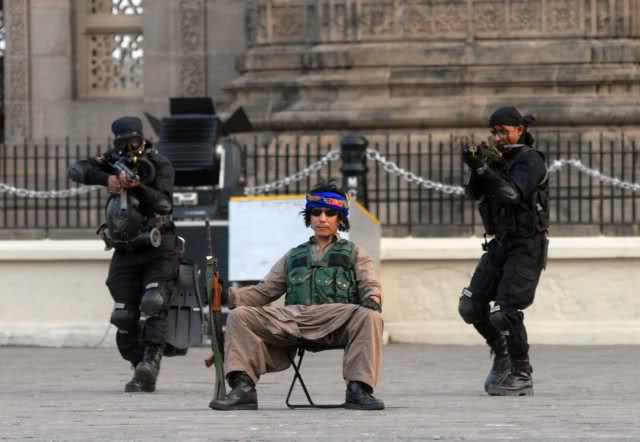
Indian Navy's marine commandos in action during a mock rescue demonstration at the Gate of India during the Navy Day celebrations in Mumbai, India, 04 December 2010.
Indian Navy’s marine commandos in action during a mock rescue demonstration at the Gate of India during the Navy Day celebrations in Mumbai, India, 04 December 2010.

Post the 26/11 attacks, the Indian government undertook a number of proactive measures to restructure coastal security and push the defensive perimeter further away from the coast into the seas. The focus was on building national maritime domain awareness (NMDA) grid via a number of organisational, operational and technological changes. The Indian Navy has now set up the National Command Control Communication Intelligence (NC3I) network that hosts the Information Management and Analysis Centre (IMAC).

It connects 41 radar stations (20 Indian Navy and 31 Coast Guard) located along the coast and on the island territories, and helps collate, fuse and disseminate critical intelligence and information about ‘unusual or suspicious movements and activities at sea’. There are plans for additional coastal radar stations to cover gap/shadow zones in the second phase; these are currently addressed through deployment of ships and aircraft of the Indian Navy and the Coast Guard.

The IMAC receives vital operational data from multiple sources such as the Automatic Identification System (AIS) and the long-range identification and tracking (LRIT), a satellite-based, real-time reporting mechanism for reporting the position of ships. This information is further supplemented by shore based electro-optical systems and high definition radars. Significantly, maritime domain awareness is also received through satellite data.

There are 74 AIS receivers along the Indian coast and these are capable of tracking 30,000 to 40,000 merchant ships transiting through the Indian Ocean. The AIS is mandatory for all merchant ships above 300 tons DWT and it helps monitoring agencies to keep track of shipping and detect suspicious ships. However the AIS a vulnerable to ‘data manipulation’. According to a recent study, the international shipping manipulates AIS data for a number of reasons, and the trends are quite disturbing.

In the last two years, there has been 30 per cent increase in the number of ships reporting false identities. Nearly 40 per cent of the ships do not report their next port of call to prevent the commodity operators and to preclude speculation. Interestingly, there is growing tendency among merchant ships to shut down AIS, and ‘go dark’ and spoofing (generating false transmissions) is perhaps the most dangerous. It can potentially mislead the security forces who have to respond to such targets and on finding none, leads to loss and wastage of precious time and human effort which adversely affects operational efficiency of the maritime security forces.

At another level, small fishing boats can complicate maritime domain awareness; however, it is fair to say that they can also be the ‘eyes and ears’ of the security agencies. Indian authorities have undertaken a number of steps, including compulsory identity cards for fishermen; registration of over 200,000 fishing boats and tracking them through central database; security awareness programmes, etc. Furthermore, Marine Police Training Institutes have been established. They are coordinated by the apex National Committee for Strengthening Maritime and Coastal Security (NCSMCS) that is headed by the Cabinet Secretary.

thCAH3R4K0The Indian government has also drawn plans to reinforce the NMDA via multilateral cooperation. It is in talks with at least 24 countries for exchanging information on shipping to ensure that the seas are safe and secure for global commerce. India has placed maritime security high on the agenda through active participation in the Indian Ocean Rim association (IORA), the Indian Ocean Naval symposium (IONS), the East Asia Summit (EAS), the ASEAN Defence Ministers Meeting (ADMM) Plus. Additionally, it is in talks with other countries to institutionalise intelligence exchange among the respective security agencies.

The Indian Navy and the Coast Guard have been at the helm and have developed a sophisticated strategy that involves joint exercises, hot lines, exchange of intelligence and training with a number of navies. It will be useful to explore if the NC3I is suitably linked to the Singapore-based Information Fusion Centre (IFC) established at Changi Command and Control Centre (CC2C), which has received much acclaim as an effective MDA hub.

It is fair to argue that weak legislations can compromise maritime security. In this connection, it is important to point out that the Coastal Security Bill drafted in 2013 is yet to be tabled in the Indian Parliament. Unfortunately, the draft Piracy Bill placed before the law makers in 2012 lapsed due to priority given to other issues.

Dr Vijay Sakhuja is the Director, National Maritime Foundation, New Delhi. The views expressed are those of the author and do not reflect the official policy or position of the National Maritime Foundation. He can be reached at director.nmf@gmail.com.

This article is courtesy Institute of Peace and Conflict Studies (IPCS), New Delhi and originally appeared at http://www.ipcs.org/article/india/india-reinforces-maritime-domain-awareness-but-challenges-remain-4764.html.

Not Your “Father’s Aegis”

By Robert Holzer and Scott C. Truver

“Stand by, Admiral Gorshkov, Aegis is at Sea!”

The U.S. Navy’s first Aegis-equipped surface warship, the USS Ticonderoga (CG-47), joined the Fleet in January 1983, and all-but dared the Soviet Navy to take its best anti-ship cruise-missile shot.

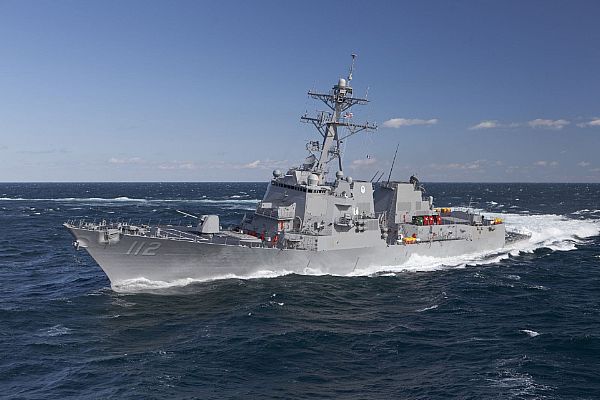
The Navy’s newest Aegis guided-missile destroyer in the fall 2014, the USS Michael Murphy (DDG-112), was commissioned in December 2012. Murphy is the Navy’s 102nd Aegis warship. Another 10 Aegis DDGs are under construction, under contract or planned––a remarkable achievement!

Aegis surface warships were conceived during the height of the Cold War to defend U.S. aircraft carrier battle groups from massed Soviet aircraft and anti-ship cruise missile attacks. With the early retirements/layups of as many as 16 of 27 Aegis cruisers (beginning with Ticonderoga’s decommissioning in September 2004), some observers characterize the Aegis Weapon System (AWS) as an old, legacy program, whose time has passed.

This is just plain wrong. No other naval warfare capability has experienced more upgrades and significant changes over the years than Aegis. As global threats evolved and new missions emerged, so too have Aegis’ capabilities “flexed” to meet increasingly daunting operational demands. Even more advanced versions of Aegis are planned in the years ahead.

To paraphrase a classic 1990s Oldsmobile commercial: This is not your “father’s Aegis!”

Aegis: Don’t Leave Homeports without It

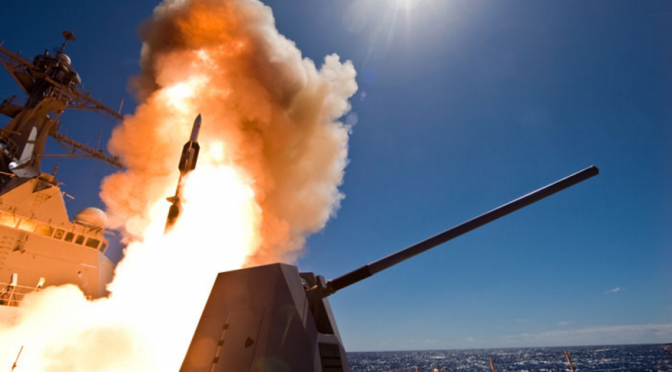
DN-SC-84-10077Without doubt, the Aegis Weapon System in 1983 represented a true revolution in shipboard air defense. Based on an enormous investment in time, resources and management focus, Aegis was the first truly integrated ship-based system. It brought together radar and sensor detection, tracking and missile interception into a coherent, well-integrated weapon system. This was a staggering engineering achievement for the time. And was the culmination of nearly 40-years of Navy experience in confronting and overcoming ever more dangerous air defense challenges, beginning with kamikaze attacks in the waning months of World War II and extending to Soviet Backfire bombers in the 1970s and 1980s.

Originally focused primarily on the fleet air defense/anti-air warfare mission—hence, the “Shield of the Fleet” slogan––Aegis has steadily expanded its mission set over the decades to successively include cruise missile defense, area theater ballistic missile defense, integrated air and missile defense (IAMD), and longer-range ballistic missile defense (BMD) cued by space-based sensors. (In Greek mythology, Aegis was the shield wielded by Zeus.) As more advanced radars and missiles enter the inventory in coming years, Aegis will play an increasingly important role in national BMD, too.
During the past 30 years, Aegis has expanded beyond the original 27 Ticonderoga-class cruisers to also include the entire fleet of 75 Arleigh Burke-class guided missile destroyers. In mid-2014, Aegis is deployed on 84 ships: 22 cruisers and 62 destroyers. Thus, Aegis is no longer just the “backbone” of the surface fleet, but constitutes its “central nervous system” as well.

Build a Little…

Critical to Aegis’ ability to evolve and defeat new threats—some only dimly seen when the program was conceived more than 40 years ago—has been an enormous capacity for growth that was built into the system from its very beginning. This growth in mission capacity can be attributed to the late-Rear Adm. Wayne E. Meyer, who guided the development of Aegis and worked tirelessly to ensure the architecture retained sufficient flexibility to accommodate future changes in threats, missions and technology. Long known as the “Father of Aegis,” Meyer trusted empirics and not analytics. In his view, the real ground truth that undergirds weapon system performance comes from engineering or operational test data. As such, he embraced a simple, but powerful, management mantra: “Build a little, test a little, learn a lot!”

Meyer’s technical and engineering driver was the warfighting requirement to get an interim, initial Aegis capability into the fleet to solve the warfare problem: “Detect, Control and Engage.” Rear Adm. Timothy Hood, the Naval Sea System Command (NAVSEA) program executive officer for theater air defense in the early 1990s, would say whereas detect-control-engage identified the Aegis warfare problem, build-a-little, test-a-little, learn-a-lot described the Aegis process. The specific functional/performance cornerstones of Aegis then put real numbers to the capabilities Aegis engineers were striving to meet—all to achieve the ultimate objective of putting Aegis to sea. (1)

Aegis cornerstones have guided the program for more than four decades. Fundamentally, Meyer made project decisions based on the best technical approach. As such, he instilled a rigorous systems engineering discipline in the Aegis program and established key performance factors. He then defined these factors to be quantitatively expressed to serve as guidance for engineering trade-offs and compromises to address the detect-control-engage warfare problem. These cornerstones required constant attention and were reflected in what Meyer called “people, parts, paper and [computer] programs.”(2)

In the end, Meyer successfully translated the Aegis cornerstones into acquisition process principles that informed decision-making at every level. To keep Aegis system-engineering development moving forward in advance of a Navy decision on ship design, Meyer employed the so-called Superset design and engineering approach. Superset called for integrating the largest set of combat system elements (sensors, control systems and weapons) and then down-designing that superset of capabilities to meet specific ship suites when finally approved. The payoff was in getting Aegis to sea on budget, on time. This philosophy continues to animate the Aegis program.

Baseline Continuous Improvement

uss-chosinMeyer’s project office opted to introduce initial, interim capabilities via continuous construction lines for cruisers and destroyers (rather than expensively introducing new ship classes with block upgrades) to accommodate Aegis advances. The engineering development approach that enabled this decision was a process practice called the Aegis Combat System Baseline Upgrade Program. Each Aegis Baseline—focused primarily on major systems and upgrades—was an engineering package of improvements introduced on two-to-four year cycles. A major warfighting change—for example, the introduction of the Mk 41 Vertical Launching System (VLS), Tomahawk Land-Attack Missile (TLAM) and an integrated anti-submarine warfare (ASW) suite into Aegis—would call for a new engineering baseline. The introduction of these three components in fact constituted Aegis Baseline 2. In addition, the Baseline Upgrade Program allowed for retrofits. Under the principle “Forward Fit before Backward Fit,” engineering and design focused on new construction ships while at the same time enabling cost-effective retrofits of Aegis ships already in the fleet.

To ensure Aegis outpaces today’s developing threats, Navy program officials with the Program Executive Office for Integrated Warfare Systems (PEO IWS) now exercise development and management oversight for service combat systems to inject new capabilities into Aegis through this time-tested approach to upgrades and improvements. Today’s baselines continue to be added to new ships during their construction phase and deployed ships when they undergo their specified shipyard maintenance cycles.

Initial baselines focused on adding only a few, discrete upgrades to Aegis. As this process has matured and Navy program engineers and system designers have accumulated more experience in understanding the nuances of Aegis baseline upgrades, their complexity, capabilities and capacities have grown exponentially. Baselines have grown in terms of the amount of new capabilities added to Aegis at each modernization interval to address both the pace of technological change and the acceleration of new threats and challenges. This is an ever-expanding OODA (Observe, Orient, Decide and Act) loop that Aegis is well accustomed to facing.

As of the fall 2014, a total of eight specific baselines have been fielded across the fleet of Aegis-equipped ships. A more advanced Baseline 9 version is undergoing its operational test and evaluation phase and will be deployed next year.

Baseline upgrades have added the following key capabilities to Aegis-equipped cruisers and destroyers over time since Baseline 0 that went to sea with the first Aegis warship, Ticonderoga. Within these numbered baselines, multiple versions at times have been introduced to accommodate minor variations to a particular Aegis combat system element development or shipbuilding program. Broadly stated, these baseline upgrades include:

Baseline 1: The original Aegis system attributes deployed on the first Ticonderoga-class cruisers (CGs 47-51) that consisted of the SPY-1A radar, the Mk-26 trainable launcher and the Navy’s mil-spec UYK-7 computers. Baseline 1 equipped the first five Aegis cruisers with the final combat system computer program whose configuration was based on the lessons learned from Ticonderoga’s first deployment.

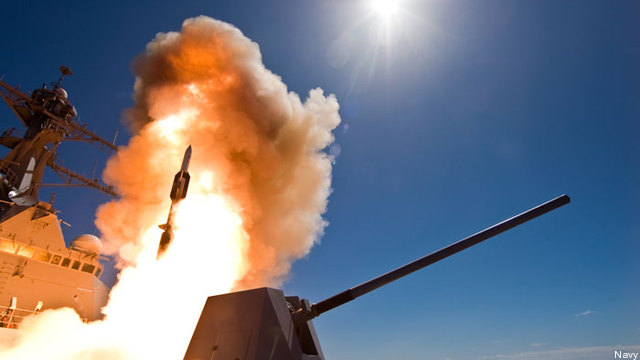
Baseline 2: The first real upgrade to Aegis deployed on the next tranche of cruisers (CGs 52-58) that introduced, as stated above, the Mk 41 VLS, Tomahawk and an upgraded ASW suite, the SQQ-89, with the SQS-53B sonar. Introduction of VLS and Tomahawk gave Aegis cruisers a long-range strike, land-attack capability. As well, the VLS cells led to use of the larger, more capable SM-3 missile that would greatly expand Aegis air defense capabilities to include BMD.

Baseline 3: These upgrades were added to the later-built cruisers (CGs 59-64) and included the more advanced SPY-1B version of the radar, along with the SM-2 Block II missile and new UYQ-21 computer consoles. By enabling use of the SPY-1B, this baseline was a major capability enhancer with respect to electronic counter-counter measures (ECCM).

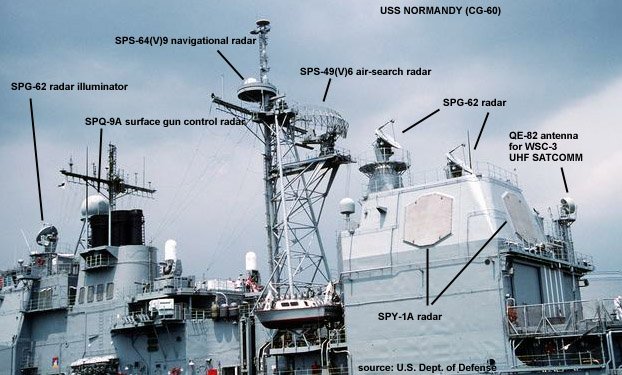
Antenna_suite_on_CG-60_Normandy_AEGIS_cruiserBaseline 4: This baseline was the first to accommodate both cruisers and destroyers. Improved capabilities were added to the final lot of cruiser construction (CGs 65-73) and the first construction lot of the newer Arleigh Burke-class destroyers (DDGs 51-67). The new capabilities added to the cruisers included the next-generation UYK-43/44 computers and the latest-version of the SQS-53C sonar. The DDG upgrades included the new SPY-1D radar, SQQ-89(V) ASW system and UYK-43/44 computers. Of note, the SPY-1D, though identical to the SPY-1B, required only a single deckhouse in the destroyer superstructure since it used only a single set of power amplifiers (instead of the two in the fore and aft deckhouses on the cruisers). Later the SPY-1B(V) radar was retrofitted to the cruisers beginning with CG-59.

Baseline 5: These upgrades were targeted to Burke-class destroyers (DDGs 68-78) and consisted of SPY-1D radar, SLQ-32 electronic countermeasures system, SM-2 Block IV missile, Link-16 system and Combat Direction Finding. Introduction of this baseline required a major effort in the track file and associated track processing in the command and decision (C&D) display enabling Aegis to become a major player in battle group networks.

Baseline 6: Brought a significant list of new capabilities to Aegis destroyers (DDGs 79-90) including SPY-1D(V) with modifications for littoral operations. It introduced the Cooperative Engagement Capability (CEC), Evolved Sea Sparrow Missile (ESSM) and UYK-70 display consoles. Baseline 6 was a notable transition from a Navy mil-spec-based combat system to one with a fully commercial-off-the-shelf (COTS) hardware environment. A mil-spec/COTS hybrid, it was the first forward fit of COTS computers for tactical purposes that provided area air warfare, CEC and an area theater ballistic missile defense (TBMD) capability for Baseline 6 DDGs and six upgraded Baseline 6 cruisers.

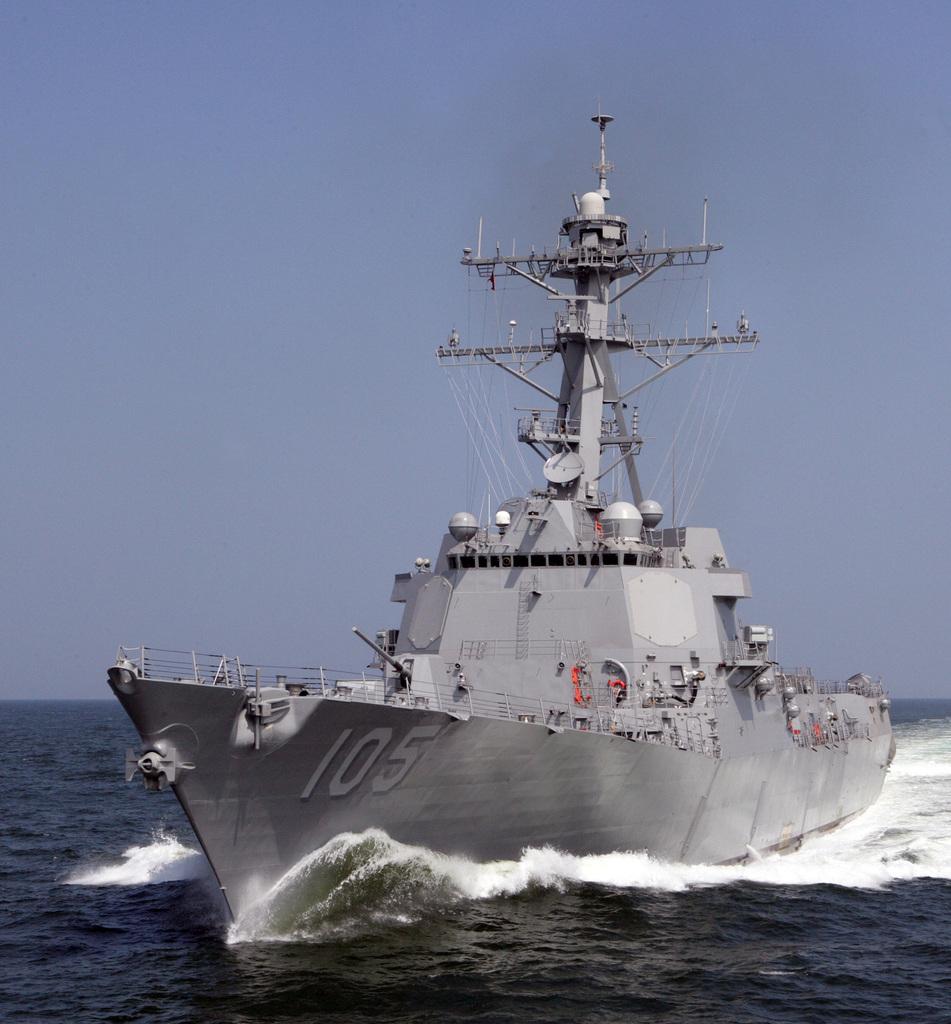
Aegis-Destroyer-Dewey-DDG-105 (1)Baseline 7: The last baseline designed specifically for forward-fit into new construction ships, it represented a full conversion to commercial computers, i.e., the complete transfer to COTS processing. The baseline added the Tomahawk fire control system upgrade and Theater Wide BMD to Burke-class destroyers (DDGs 91-112). The introduction of the third-generation SPY-1D(V) radar provided major performance enhancements against stealth threats and all threats in the littoral environments. Baseline 7 DDGs had the capability for network-centric operations: they were enabled to employ the so-called Tactical Tomahawk that was reprogrammable in-flight, e.g., for use against ships and mobile land-attack targets.

Baseline 8: Brought COTS and open architecture to Baseline 2 equipped Aegis cruisers. The baseline captured tailored upgrades from new construction Baseline 7.1R destroyers (DDG 103-112), bringing the seven cruisers greater capacity for technical data collection and enhanced area air warfare and CEC.

Baseline 9: The latest version of the long-running and highly successful Aegis upgrade process, this baseline will bring significant improvements to the Fleet in several key respects. The new baseline brings radical changes to the software environment creating a true open-architecture computing framework. Common source code shared among Baseline 9 variants enhances software development, maintenance and re-use, boosting the capability to support combat system interoperability improvements and enhanced capacity and functionality.

Major Warfighting Improvements

Baseline 9 will deliver three major warfighting capability improvements. These are: the Naval Integrated Fire Control-Counter Air (NIFC-CA), Integrated Air and Missile Defense and Enhanced Ballistic Missile Defense.

The NIFC-CA capability for Baseline 9 cruisers and destroyers provides integrated fire control for theater air and anti-ship cruise missile defense, greatly expanding the over-the-horizon air warfare battle space for surface combatants by enabling third-party targeting of threats and use of “smart” missiles. NIFC-CA is valuable since it will allow greater performance of the Aegis radar over land and in the congested littorals where radar signals can be degraded given the topography and other local conditions. NIFC-CA allows Aegis to conduct over-the-horizon targeting using Standard anti-air missiles against targets based on data and other information received via the CEC net from off-board sensors such as enhanced E-2D Hawkeye aircraft.

/Users/Photo2/Desktop/IPTC.IPTIAMD brings the Fleet a more comprehensive capability to conduct ship self-defense, area air defense and ballistic missile defense missions at the same time. A core Navy mission driving capabilities for mobile, persistent, multi-mission Surface Forces, IAMD enables Aegis-equipped ships to optimize shipboard radar resources rather than forcing the radar to devote its energy to only one mission at a time. This full-up capability in all air- and missile-defense domains represents another major advance in the continuously evolving AWS capabilities against emerging threats. The Aegis SPY-1D radar uses the new Multi-Mission Signal Processor (MMSP) software package that is the centerpiece of IAMD. The MMSP integrates signal-processing inputs from the combat system’s BMD signal processor and the legacy Aegis signal processor for the radar. Prior to MMSP a ship had to devote the bulk of her radar’s power resources to tracking the more demanding BMD threat with a corresponding diminution to the air defense mission.

navy-sm-6Enhanced BMD comes with Baseline 9’s open architecture environment that will provide both a launch-on remote (LoR) and engage-on-remote (EoR) capability for Aegis where the interceptor missile uses tracking data provided from remote, off-board (land, sea, airborne and space-based) sensors to launch against and to destroy missile threats. Previous baselines have progressively expanded the LoR capability for Aegis BMD “shooters” to launch missile interceptors earlier in the target missile’s trajectory. Baseline 9’s open architecture will accommodate the Aegis BMD 5.1 system software upgrade to enable an engage-on-remote capability that advances launch-on-remote by providing an organic track to the interceptor missile late in its flight. To the extent that LoR and EoR can provide enhanced capability to the Block IA, IB and IIA versions of the Standard missile—supported by a netted sensor framework—they have the potential to provide BMD to strike group and homeland defense missions.

Ultimately, EoR will enable the shooter to complete the intercept. LoR and EoR thus add to layered defense, a critical capability for the successful intercept of longer-range and fast-flying missiles. When launch-on-remote and engage-on-remote become operational, the Aegis system can reach further into the joint and combined arenas. For example, Aegis open architecture provided by the Aegis BMD 5.0 family of system software upgrades will make it easier for allies and partners to integrate new weapon systems and sensors into their Aegis systems. This enhanced network integration will legitimize the concept of “any sensor, any shooter” to extend the battlespace and defended area.

Past Being Prologue…

Aegis has enjoyed a remarkable history in the U.S. Navy—as well as several foreign navies––and with the deployment of the new Baseline 9 version, and most likely other upgrades coming, there is no final chapter yet to be written for this workhorse capability. Aegis has truly evolved from the “Shield of the Fleet” to the Fleet’s “Central Nervous System” and more. A system originally designed to launch surface-to-air missiles against air-breathing bombers and cruise missiles has evolved into a networked combat system that can target land-launched ballistic missiles and even satellites in space—and destroy them. While its roots are traceable to the Cold War, Aegis is firmly focused on overcoming the challenges and threats the U.S. Navy faces in tomorrow’s murky and increasingly dangerous future.

Robert Holzer is senior national security manager with Gryphon Technologies’ TeamBlue National Security Programs group. Dr. Truver is TeamBlue’s director.

(1) Rear Adm. J.T. Hood, USN (Ret.), “The Aegis Movement—A Project Office Perspective,” Naval Engineers Journal: The Story of Aegis, Special Edition (2009/Vol. 121 No. 3), p. 194.
(2) Robert E. Gray and Troy S. Kimmel, “The Aegis Movement,” The Story of Aegis, op.cit., p. 41.

eDIVO: DEF Innovation Competition 2nd Prize

On Sunday, 26 October, the Defense Entrepreneurs Forum hosted an innovation competition sponsored by the United States Naval Institute. $5,000 in prizes were awarded after the eight contestants made their pitches. This is the second prize winner posted originally at the DEF Whiteboard.

SECOND PLACE WINNER

Contestant: Charlie Hymen, US NAVY

Access to the Navy’s abundance of official information is too limited. This is a problem recognized by leaders onboard ships and in operational units at sea. There is no shortage of official military guidance that discusses a leader’s responsibilities pertaining to basic administration, personnel management, and professional development, but this information is often embedded in large, cumbersome documents that one must access from a computer. This proves challenging for those at sea, as computers are scarce resources on many vessels. Furthermore, inexperienced officers and junior Sailors have difficulty locating the correct information needed at any given time because they simply do not know where find it.

eDIVO will solve these inefficiencies. As a mobile application that will be available through the Apple Store and Google Play in February 2015, eDIVO will provide access to the most commonly used and referenced Navy documents and serve as a quick reference management and education tool for Navy leaders of all ranks. The mobile application will also extract the most important information contained in these documents and organize it in a logical, user-friendly format. All information included in the application is nonproprietary, and the vast majority will be accessible free from internet connectivity. Whether conducting an inspection in the engine room, training with peers while navigating around the world, or mentoring a struggling Sailor at sea, eDIVO will enable leaders to provide accurate guidance to their subordinates, peers, and superiors at any time and in any place. No longer will one be required to waste valuable time finding access to a computer, locating pertinent documents, and printing the applicable pages; a user’s personal mobile device is the only hardware necessary.

Topics of focus within eDIVO include, but are not limited to, legal and financial guidance, operational safety precautions, basic navigation principles, sexual assault reporting procedures, and suicide prevention measures. Armed with the Navy’s official guidance on these subjects, leaders will be able to shave from their workweeks hours spent searching for information. Not only will leaders be empowered to provide accurate guidance, but they will also have more time available that can be devoted to leading their teams, learning their jobs, strategizing against potential threats, and ultimately becoming more effective and informed leaders.

The Navy has provided initial funding to develop the first version of this mobile application. While approximately 75% of information contained within eDIVO is applicable to all ranks and specialties in the Navy, the initial version is tailored to leaders serving on ships. Future versions of eDIVO will be customized to those in other specialties. On a broader level, eDIVO represents the first operationally focused mobile application funded within the Department of the Navy. Its success, and the lessons learned from its development, will shape the Navy’s policy for all future mobile ventures.