Let’s briefly discuss the Russian expeditionary force in Syria and the European refugee crisis, because from a systems standpoint they are both emanations of the same phenomenon.
The great challenge of international relations and national security is to maintain a system in being: specifically, defending a global order presided over and more or less guaranteed by the United States, while preserving a toleration for the inevitable dynamism of that system. American hegemony will not last if it is expressed as a frozen status quo, nor if it sees an absence of American engagement. The problem is that American policymakers understand this rather poorly.
Two sorts of arrogance have characterized the American approach to this systemic-preservation imperative in this century. The first was the belief that American systemic hegemony was sufficient to impose outcomes on individual subsets of that system without accounting for their own dynamism. This brought us the outcomes we saw in Iraq and Afghanistan. The second, succeeding the first and in reaction to it, was that American systemic hegemony on its own — absent deliberation and engagement — was sufficient to defend America and its core interests from the consequences of unattended disorder in those same subsets of the system. This brought us the outcomes we see in Syria and Europe, and deserves some exposition.
Both types of hubris were on display in the September 2013 Syrian crisis, in which the President of the United States first declared that America would make war on the Assad regime (type one, determinative arrogance), and then declared that it was not necessary to make war on the Assad regime (type two, the arrogance of self-sufficiency). Having declared enmity against a power engaged in an existential struggle, and then having failed to act upon that enmity, the United States reaped all the disadvantages of antagonism with none of the potential advantages. One specific disadvantage it relinquished was the friendship of that power’s own enemies, all of whom perceived that alliance with the Americans would yield no positive outcomes. Those enemies instead turned to perceived-effective foes of that power, among whom the radical Sunnis of Al Qaeda and (arguably worse) ISIS emerged as chief. Further muddying the waters have been American efforts to placate the Assad regime’s major ally and sponsor in Iran, guaranteeing that no anti-Assad force in its right mind will trust us — and in fact many believe we are secretly in league with their antagonists.
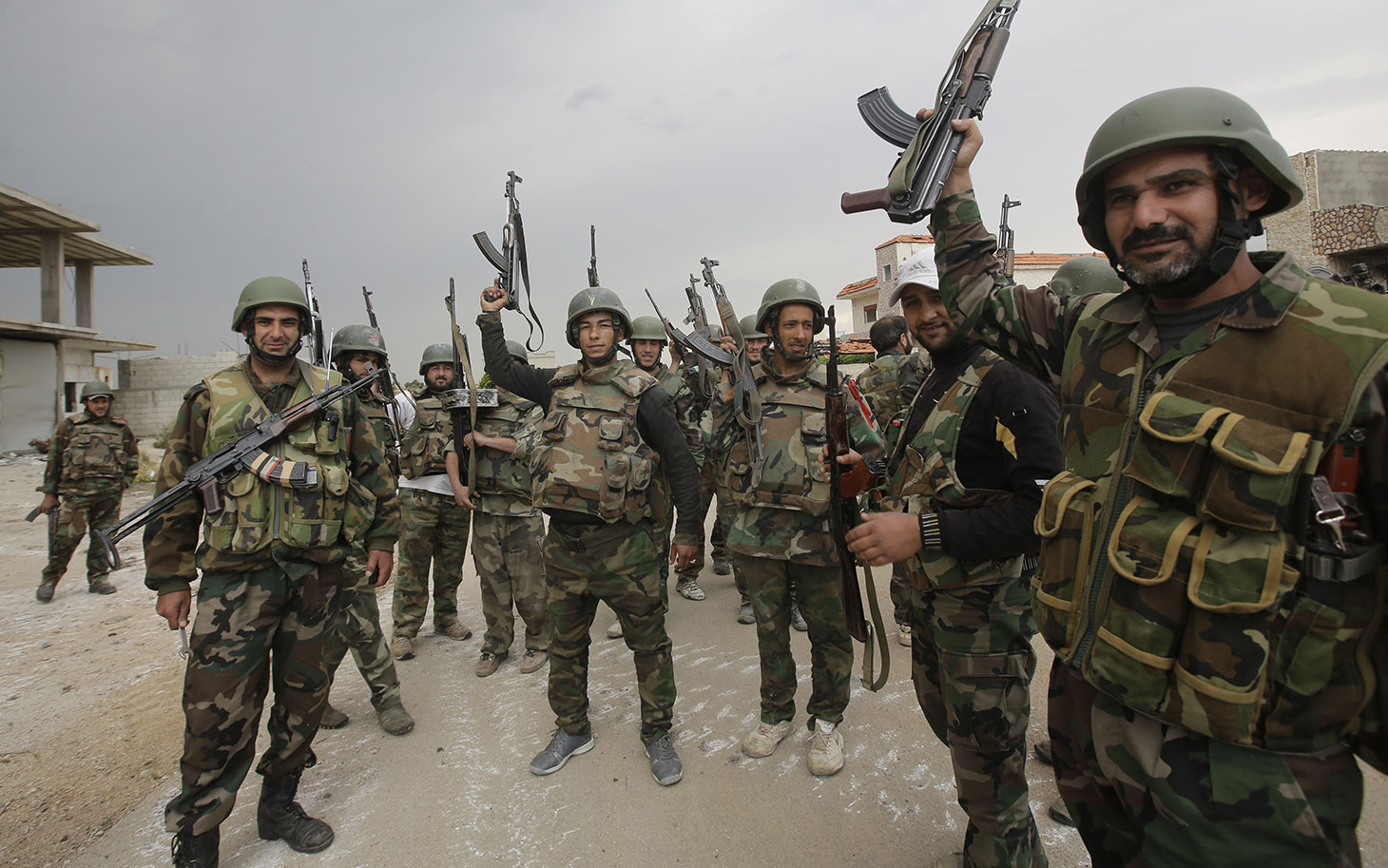
Soldiers of the Syrian Arab Army (SAA).
The outcomes in Syria ought to be a testament to the futility of existing policy. Disorder in the system, left unattended, has spread as entropy does. The Assad regime, once perceived as the worst player in the region — or the system’s local minimum — is now arguably the best, and inarguably not the worst. Disengagement has completely failed for all parties, as disorder emanates to Europe in the form of refugee flows, and to America as a challenge to its hegemony with the dispatch of a Russian expeditionary force. The refugee crisis is a rebuke to the Europeans, who pay the price of freeloading off an American-led order (and therefore suffer when the Americans refrain), and also (along with the Greek crisis) seen their continental union project exposed as mostly a superstructure for the benefit of elites. European separation from the broader system has failed. Similarly, Americans are learning that their disinterest in war does not diminish war’s interest in them.
It is worth noting that the Russian expeditionary commitment to Syria may be, given visionary strategic leadership, a master stroke. (That given is of course not a given where the Russians are concerned.) The narrative roles the Russians have the potential to fill are a cornucopia of goodwill-generating engagements: defender of Christians, destroyers of ISIS, vigorous great power, guarantor of order, ender of refugee flows, et cetera. Every single one of these narrative roles is in direct contrast to American and European actions (or more properly inactions), and have the added benefit of likely commanding the sympathy of significant minorities within both populations. Russia is not well-equipped to pacify a fractious nation of 20 million people — but it is eminently qualified to ruthlessly crush a local faction, and that is all that matters here. A task leveraging the player’s strengths with such massive prospective benefits embedded in the narrative flaws and faulty assumptions of strategic rivals is either the result of strategic genius — or stupefying luck.
Here’s the bottom line: both conceits that have governed the American approach to foreign engagement are false. Entropy extends throughout systems, and one does not get to secede from them as situations demand. We cannot impose control upon dynamic systems. Nor can we secede from those systems and their effects. We are all part of a gigantic meta-system, as a nation and a people, and so our charge is to see to its continuance. That does not mean decisive engagement or disengagement. It means entanglement and — this is unpopular and opaque — maintenance. It means we venture abroad, not to decide and direct, but to contend and affect. It means that sometimes the choice is between dangerous great-power opportunism and catastrophic migrations on the one hand, and desultory and interminable expeditions to strange lands on the other.
This is the logic of hegemony and the nature of systems, and it is therefore what we must do. The tragedy is that a democratic society bottle-fed a narrative of “progress” is increasingly unable to do it.
Jack Hays is a pseudonym of a public-policy professional and amateur Russophile. See his 2014 analysis of the Crimean annexation here.
Welcome to Part One of the September 2015 Member Round-up, covering the first two weeks of the month. CIMSEC members examined several international maritime security issues, including Russian blue water operations, European maritime security threats, the PLA-N maritime strategy in the Asia-Pacific and aspects of the U.S. military defense procurement program.
The first part of the September Round-up begins with Alex Calvo for The Jamestown Foundation, where he discuses Russia’s naval presence in Spain’s African exclave of Ceuta. Mr. Calvo describes the strategic importance of Ceuta as a launching point for Russian surface fleet operations throughout the Mediterranean Sea region. Additionally, a geopolitical assessment is provided regarding the unique relationship between Spain and Russia in a period of high tensions between Russia and NATO over Ukraine.
Continuing on European maritime security issues, Chuck Hill, for his Coast Guard Blog, discusses the development of Offshore Patrol Vessels (OPV) in France and in the Netherlands. Mr. Hill identifies the development of OPVs in France as a response to the government attempting to increase their enforcement capabilities of EEZ territory. Regarding the Netherlands, Mr. Hill describes the specifications of future OPVs with emphasis on the deployment of ‘hull vane’ technologies to increase OPV mobility, stability and range.
Bryan McGrath for The War on the Rocks, concludes the Round-up with discussing aspects of the U.S. Navy’s procurement strategy. He provides a detailed examination on the number of ships required by the U.S. Navy to meet the current security threats facing the United States as well as to sustain the requirements of the maritime objectives of the navy itself. Mr. McGrath explains that the current and projected size of the U.S. Naval fleet, 273 and 308 respectively, is too small to remain effective in multiple regions. He references the U.S. Navy’s 346-ship fleet from the Clinton-era as an appropriate number for managing the current maritime environment and providing sufficient influence in all U.S. theatres of operation.
Members of CIMSEC were also active elsewhere so far in September:
Lauren Dickey, for The Council on Foreign Relations, discusses the modernization of the PLA, noting the development of a U.S.-style joint command system within the Chinese military structure.
At CIMSEC we encourage members to continue writing, either here on the NextWar blog or through other means. You can assist us by emailing your works to me, the Director of Member Publicity, at dmp@cimsec.org to make sure we include them in our next round-up.
Last year, I wrote about “The Return of Great Power Politics” and described an emerging multi-polarity and its impact on the global security environment. Since then, the updated Russian Military Doctrine, Chinese Military Strategy, the U.S. National Military Strategy were all released. Each has its own distinct characteristics that illuminate each nation’s perception of its global power and that of its primary threats. While there has been commentary on a possible Sino-Russian block balancing the U.S. hegemonic position, the jockeying for global power, position, and prestige is far more complicated. As such, I offer a comparative analysis of the three military doctrines/strategies and how they relate to one another.
The Bear Reawakens but Remains Paranoid
A woman reaches into her bag, which rests on a fallen Soviet hammer-and-sickle on a Moscow street in 1991, Getty Images
Russian President Putin described the collapse of the Soviet Union as the greatest geo-political disaster of the 20th Century. It ushered in an era of weakness and shame for the Russian people as NATO expanded eastward next to the Russian border. During this period, the Russian military performed poorly in Chechnya and much of its infrastructure and human capital degenerated. However, since Putin’s rise to power, he has charted a new course for Russia, promising to re-establish the global respect it once had during the Soviet period.
The 2014 Russian Military Doctrine reflects this new optimism while remaining true to the Russian historical paranoia about its security. It clearly identifies NATO, and by extension the U.S., as its primary security threat. This includes the presence of NATO in Afghanistan and U.S. forces operating from regions considered within the traditional spheres of influence of previous Russian empires. Because of their realization of their conventional force inferiority compared to the West, the Russian doctrine emphasizes the right to use nuclear weapons in the event of an aggressive conventional force act by the West that makes nuclear escalation necessary – an ambiguous red-line that undermines the US policy of escalation dominance. To regain its influence in its immediate border region (to include Ukraine), Russia has employed an unconventional war strategy to keep the conflict below the boiling point for a western response while simultaneously exercising its heavy conventional forces and deployment of theater ballistic missiles as deterrence towards NATO. Simultaneously, Russia is expanding its military capability in the arctic region and sees naval cooperation with China in the Pacific and India in the Indian Ocean. Russia’s military doctrine does not view China as a military threat and states areas of cooperation with China on regional counter-terrorism through the Shanghai Cooperation Organization (SCO). However, as China grows more powerful, Russia may need to relook the threat to its eastern frontier; especially as recent Russian policy attempts to counter the PRC essentially squatting its way to de facto control over parts of Siberia.
The rest of the document focuses on how the Russian Military and Defense establishment will rebuild itself. It focuses on reforming its military command and control structures, developing professional expeditionary forces, and investing in advanced technologies for cyber, ISR, precision strike, and anti-access/area denial (A2/AD). Additionally, it calls for reform of Russia’s defense industrial sector, patriotic indoctrination of the Russian people, and greater cooperation with bordering states representing the Commonwealth of Independent States, Collective Security Treaty Organization, and SCO. The document reflects the reawakening of the Russian Bear from the nightmare of the post-Soviet collapse as it seeks to remind the world of its place among the great powers of the global order.
The Dragon’s Ascent
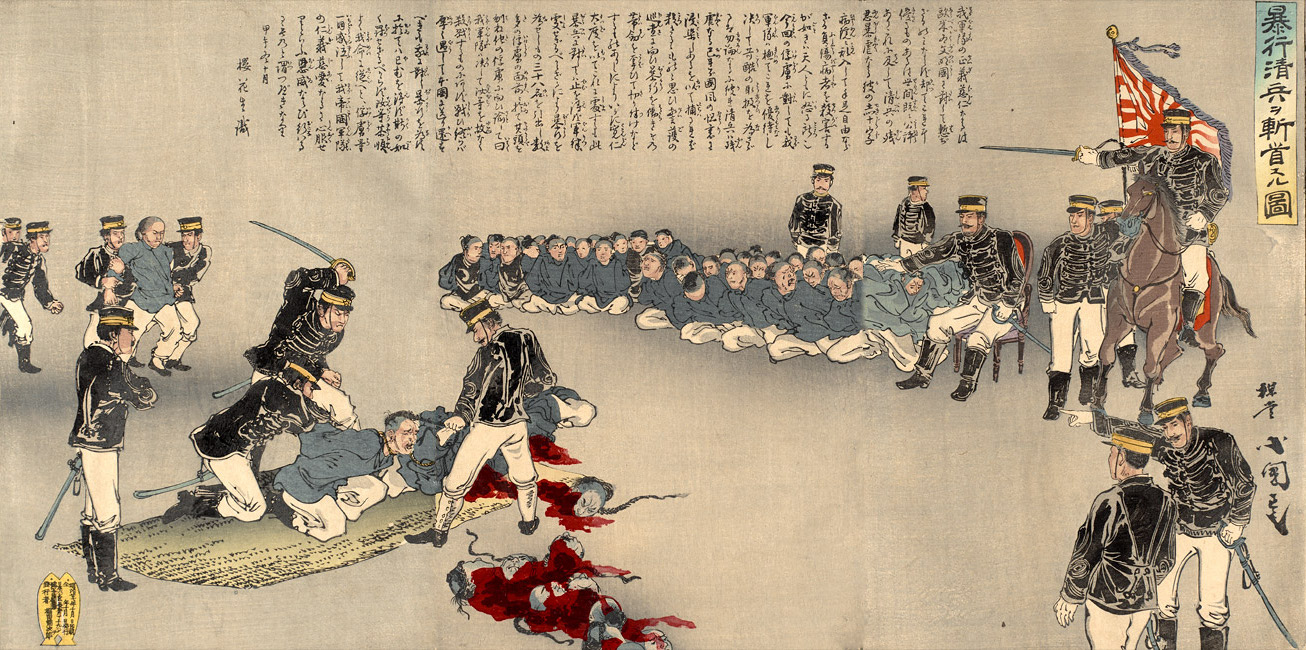
“Illustration of the Decapitation of Violent Chinese Soldiers” by Utagawa Kokunimasa, Public Domain.
The Chinese Military Strategy reflects the Chinese Dream to repair the damage of the Century of Humiliation and regain a position atop the global order by the 100th anniversary of the Communist Party’s defeat of the Nationalists. Its growing confidence and the perceived decline of U.S. hegemonic power is evident in its analysis of the world order when it states, “Global trends toward multi-polarity and economic globalization are intensifying, and an information society is rapidly coming into being.” China views the U.S. and its allies and partners as the primary threats to its ascent in the global order. According to Henry Kissinger’s book World Order, the Chinese had no say in the development of the post-WWII order and now seek to modify it “with Chinese Characteristics” according to their Neo-Confucius Tributary Hierarchal world view where China was called the Middle Kingdom for a reason.
The Chinese Military Strategy serves to safeguard the nation’s core interests while preparing to assume a greater global role in security matters. Its Strategic Guideline for Active Defense lays out the goal of updating its operational doctrines to ensure combat forces are integrated to “prevail in system-vs-system operations featuring information dominance, precision strike, and joint operations.” As a result of the Chinese studying U.S. joint operations since the 1991 Gulf War, the Chinese appear on the path of counter-optimizing against U.S. Joint Operational Doctrine (especially the “Joint Anti-Air Raid campaign”). This PRC strategy culminates a 75-year evolution of the People’s Liberation Army from securing the Communist Party of China, to securing China from invaders and disruptors, to an unprecedented role as guarantor of access to the global markets upon which China’s economy depends.
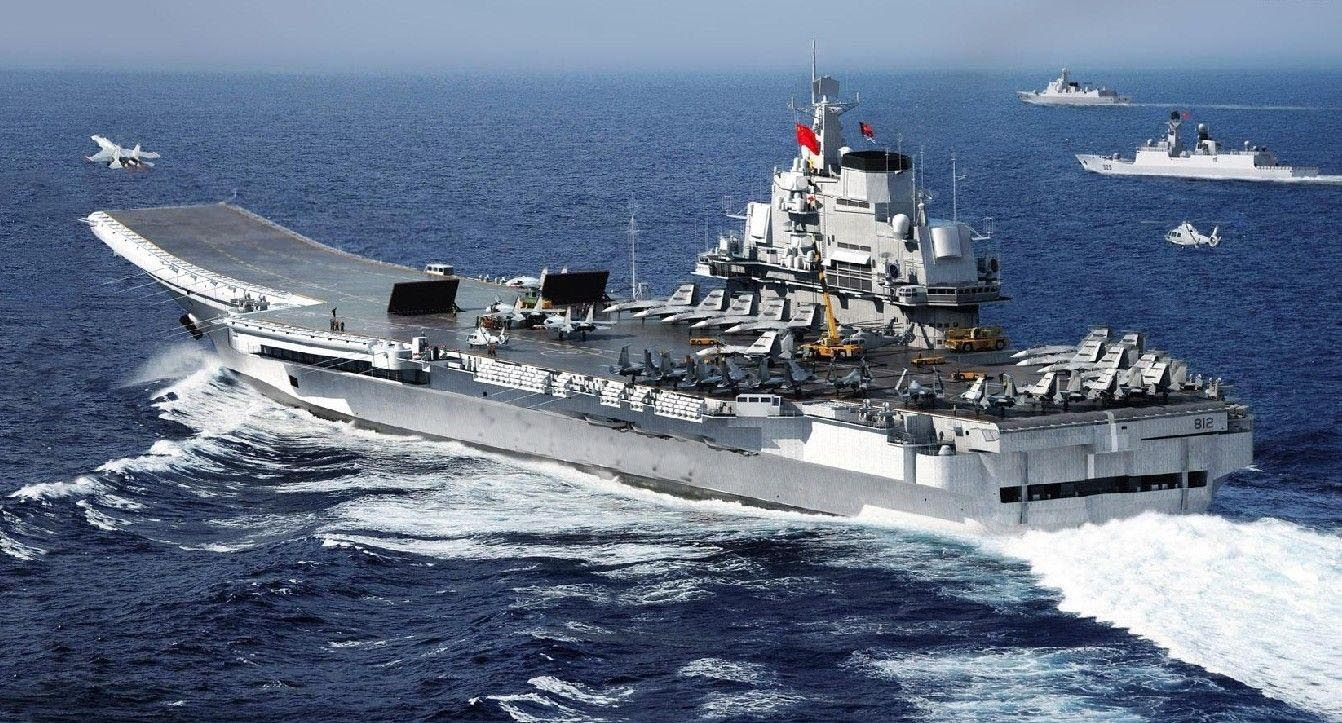
Chinese Carrier Liaoning, PLAN Photo.
To gain the initiative, the Chinese seek to “proactively plan for military struggle in all directions and domains, and grasp the opportunities to accelerate military building, reform, and development.” To achieve its ends, the People’s Liberation Army is directed to “elevate its capabilities for precise, multi-dimensional, trans-theater, and multi-functional and sustainable operations.” The Navy was directed to shift towards an “Open Seas Protection” approach, build an effective marine force, and be capable of “strategic deterrence and counterattack, maritime maneuvers, joint operations at sea, comprehensive defense and comprehensive support.” The Air Force was directed to shift its focus from “territorial defense to both defense and offense, and build an air-space defense force structure that can meet the requirements of ‘informationized’ operations.” It also recognizes its critical security elements of cyber, space, and nuclear forces. Finally, the Chinese recognize the need to plan for military operations other than war ranging from counterterrorism to humanitarian assistance and disaster relief.
The Chinese strategy recognizes the need for security cooperation to create “a security environment favorable to China’s peaceful development.” It articulates the need to maintain cooperation with the Russian military within a framework of a comprehensive strategic partnership while maintaining ties with the U.S. military that conform to a new model of “major-country relations.” The difference in language reflects China’s view that they are more on par with the U.S. in global standing and that the Russians are simply regional partners.
China’s strategic position is shaped by having the world’s second largest economy and, unlike the U.S., a worldview that doesn’t see Russia as a military threat – though the PRC has historically calibrated its rhetoric on Russia to its correlation of military forces, so Russian activism in the Pacific could quickly change China’s rhetoric. Like Russia, however, China’s economy is experiencing a slowdown that may threaten its ability to increase military spending due to domestic pressures to alleviate rising unemployment. Also like Russia, demographic pressures are likely to force more internal investment as China’s working population moves from wage earners to pensioners and transitions to a new working cohort that is severely constrained by the aftermath of the one-child policy. For now, though, the PRC appears to recognize that there is a unique window of opportunity to reassert itself as the Middle Kingdom.
Exhausted Eagle
The tone of the U.S. National Military Strategy (NMS) is one of an exhausted super power engaged in the preservation of a global order increasingly threatened by state and non-state actors. It asserts that “we now face multiple, simultaneous security challenges from traditional state actors and trans-regional networks of sub-state groups – all taking advantage of rapid technological change.” The NMS articulates the threat that both Russia and China represent; however, unlike the Chinese and Russians, it clearly articulates the threat posed by Iran, North Korea, non-state actors such as ISIL, and cyber. These threats fall in line with Chairman Dempsey’s 2-2-2-1 construct describing the global security environment: two heavyweights (Russia and China); two middleweights (Iran and North Korea); Al Qaeda and trans-national criminal networks; and cyber.
To address the emergent security environment, the NMS specifies three national military objectives: (1) Deter, deny, and defeat state adversaries; (2) Disrupt, degrade, and defeat violent extremist organizations; and (3) Strengthen our global network of allies and partners. The NMS enumerates 12 prioritized joint force missions ranging from maintaining a nuclear deterrent to security cooperation within the global integrated operations construct. In an increasing fiscally constrained environment, the NSM list the mission of “strengthening partners is fundamental to our security, building strategic depth for our national defense.” While the NMS acknowledges the potential negative impact of sequestration on the defense budget, it fails to specify what trade-offs it will make in the face of these pressures, such as placing less emphasis on developing a global network to ensure remaining available forces are capable of achieving the deter, deny, defeat state adversaries.
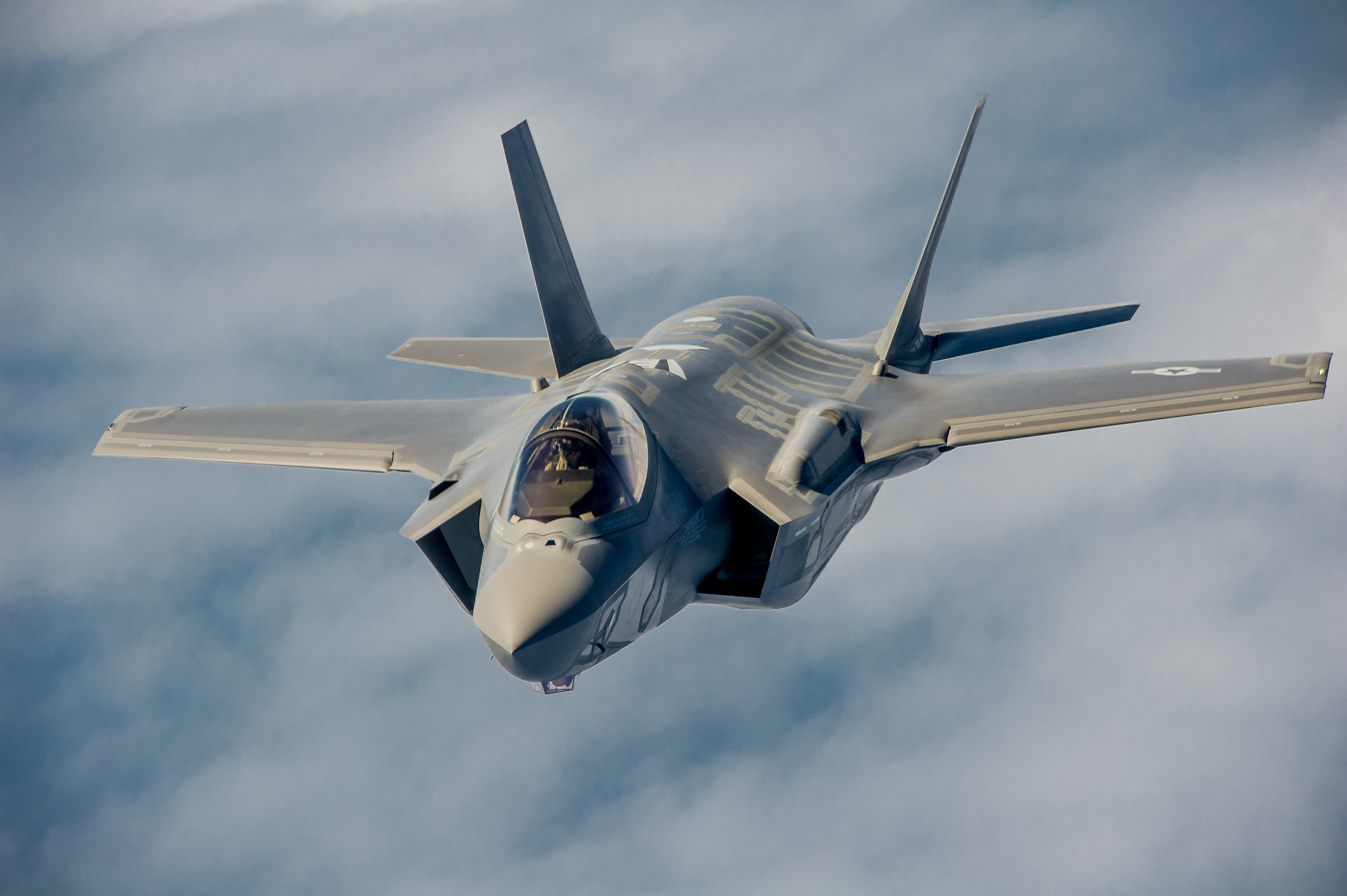
F-35A Lightning II Joint Strike Fighter, USAF Photo.
To address the growing risk and fiscal constraints, the NMS list three areas of Joint Force initiatives: (1) producing creative, adaptive leaders; (2) adopting efficient, dynamic processes; and (3) developing flexible, interoperable capabilities. Of these, adopting efficient, dynamic processes will be the most important as the Department of Defense will continue to struggle with balancing the capabilities required and available resources. As the nation struggles to reduce its financial debt, the DoD needs to demonstrate greater efficiency in resource management in light of two decades of program mismanagement ranging from the Army’s Future Combat System (FCS) to the F-35 Joint Strike Fighter.
The Eagle, is exhausted by 14 years of continual conflict with violent extremist groups. Even as it attempts to contain the global terrorist threat, it faces traditional-state challengers seeking to re-align the global order. These challenges coupled with domestic political gridlock and fiscal mismanagement will continue to stress the U.S.’s ability to maintain its position.
Areas of Convergence and Divergence
The Russian, Chinese, and U.S. National Military Strategies have three areas of convergence where cooperation among the powers is possible. All three national military doctrines/strategies recognize the threat from violent terrorist organizations such as ISIL/Daesh – both the direct threat and the indirect threat via similar or affiliated groups such as Chechnyan extremists and Uighur separatists – and all three nations seek their destruction. However, unlike the U.S., Russia and China will not commit significant resources to combat ISIL/Daesh. In fact, it serves their longer term interests to allow the U.S. to take the lead against ISIL/Daesh and further erode its resource base in the effort. Further, all three powers agree on the dangers caused by trans-regional criminal and narco-trafficking groups that cause instability in places like Afghanistan and the Central Asian States. Finally, all three powers recognize the danger from the proliferation of WMD falling into the hands of terrorist organizations but have different views on the threats posed by nation states such as Iran and North Korea.
There are two significant areas of divergence between the three powers. The strategies and the national interests of the Russians, Chinese, and U.S. will more seriously diverge in the Central Asian States as all three powers compete for influence and access to tap into the region’s economic potential. While Russia may accept Chinese economic development in the region, it may react negatively to any Chinese military engagement or posture to protect its core economic interests. Both Russia and China are wary of a long-term US presence in the region fearing that any counter-terrorism posture could be refocused on serving as a military platform against either state. A second area of divergence will be the emerging importance of the Arctic. While Russia is actively building its military capability for the arctic region, the U.S. published a strategy in 2013 highlighting the importance of the region and the need to work with its key Arctic Allies such as Canada and Norway. China is also looking northward in the race for natural resources by actively engaging with the Nordic Nations and Irish, signing a joint statement with Russia on shipping access, and becoming a member of the Arctic Council in 2013.
Conclusion
As a multi-polar moment approaches, understanding the military strategies of the key players will be of utmost importance. Unlike the Cold War’s bi-polar world, the Bear, the Dragon, and the Eagle will simultaneously seek cooperation while posturing to deter the others. Additionally, each will have to develop new relations with other emerging regional powers such as Iran and India who will play increased roles in the global order. As a result, each will have to place a greater emphasis on balance between its external national security and domestic responsibilities. And the global power whose economic and political foundation collapses first from the competitive strain will be displaced with unforeseeable global consequences.
Major Chad M. Pillai is an Army Strategist currently assigned to MacDill Air Force Base. He previously served assignments at the Army’s Capability Integration Center (ARCIC), ISAF Commander’s Action Group (CAG), Speechwriter to the Army Chief of Staff, and as a Strategic Planner at the Army’s War Plans Division. MAJ Pillai has published articles in Infinity Journal, War on the Rocks, Small Wars Journal, Military Review, The Strategy Bridge, and Offiziere.Ch. He received his Masters in International Public Policy from the Johns Hopkins University School of Advanced International Studies (SAIS) in 2009. The views expressed in this article are his own.
CIMSEC content is and always will be free; consider a voluntary monthly donation to offset our operational costs. As always, it is your support and patronage that have allowed us to build this community – and we are incredibly grateful.
New satellite imagery shows that India’s first indigenous aircraft carrier has made significant progress since it was launched in August 2013, helping India inch towards the goal of a two carrier battle group.
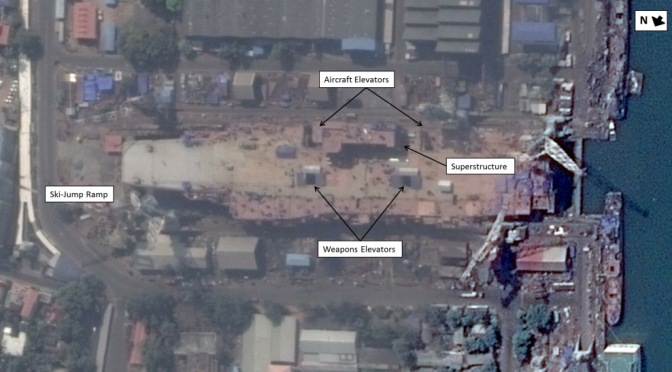
Imagery acquired by commercial satellite firm DigitalGlobein February 2015 shows further assembly of INS Vikrant, a 40,000 ton aircraft carrier and India’s soon-to-be largest vessel once commissioned. Additional ship modules now welded to the hull have enlarged the deck width — measuring almost 60 meters. The erection of the superstructure reported last November was also confirmed. India’s first domestically produced carrier is currently under construction at state-owned Cochin Shipyard Limited, the country’s largest shipbuilding and maintenance facility located inKerala on the west coast.
Like other vessels built in India, significant cost overruns and delays have hampered shipbuilding progress. The South Asian country is already four years behind schedule on the project with the latests estimates pushing an operational date closer to December 2018, if not beyond. However, the Indian Navy expects that the vessel will “undock” sometime this month after mounting the propellers on the engine shafts, according to an April statement from Vice Admiral Ashok Subedar. Afterward, the shipyard will continue with the fitting out process.
Originally, India was to have fielded her carrier by 2014, eleven years after the government approved the build. Last July, the Cabinet Committee on Security released an additional Rs 19,000 crore (approx USD 3.18 billion), the lion’s share, to complete the vessel’s construction — on top the USD 585 million already spent. Due to India’s extensive bureaucracy, the funds languished for almost a year halting progress on the project.
“As much as 95 per cent of its hull is complete as is 22,000 tons of [its] steel structure,” Subedar went on to say. That’s 3,500 tons heavier than its August 2013 launch weight though significantly less than its planned 40,000 tons. Of course, much of the that weight will be comprised of two fixed wing squadrons (12 x fighters each) of Russian-built MIG-29K and Indian-built Tejas Light Combat Aircraft, 10 x Ka-31 ASW helicopters as well as necessary ammo, fuel, and other supplies.
Indian Navy Computer Model of INS Vikrant
Featuring a STOBAR (short take-off but arrested recovery) configuration with a ski-jump, India’s indigenous carrier will push naval pilots to master a new launch and recovery system, one very different from its existing STOVL(short take-off and vertical landing). Luckily, Russia helped India build a shore-based testing facility which became operational early last year. Imagery shows that Indian pilots are already hard at work. (INS Vikramaditya also features a STOBAR configuration).
Aircraft aside, India’s latest carrier will be powered by four General Electric LM2500 gas turbines capable of cruising speeds around 18 knots. With an endurance of 7,500 nautical miles the Navy should have few problems projecting force throughout the Indian Ocean region, especially given India’s previous proficiency in carrier operations.
But if issues do arise, the United States has proposed a joint working group to help support Indian ops, share best practices and even possibly, technology. All of which may lead observers to conclude that India’s naval capability has become increasingly important. Prime Minister Modi made that clear while visiting Mauritius in March: “India is becoming more integrated globally. We will be more dependent than before on the ocean and the surrounding regions. We must also assume our responsibility to shape its future. So, [the] Indian Ocean region is at the top of our policy priorities.”
As perhaps it should be. India is already advantaged by its unique geography, jutting out in the Indian Ocean with its 7,500km coastline and island territories. Given India has short distances to travel to manage any regional conflict or rivalry, it only makes sense that India would focus resources on protecting national interests in its own backyard.
Satellite Imagery of PLAN Vessel at Oman’s Salalah port (DigitalGlobe 11MAR15)
However, few regional contenders are making a splash in the maritime space, though emerging challenges from China are certainly on India’s radar. China’s People’s Liberation Army Navy (PLAN) commissioned its first aircraft carrier, the Liaoning, in 2012 and has already started construction on a second. With recent infrastructure established in the South China Sea and additional PLAN deployments in the Indian Ocean region, China appears poised to take a more aggressive maritime stance, a clear departure from India’s Cold War experience.
In response, India is planning a 160-plus-ship navy as it seeks to constrain what it sees as a Chinese incursion into its sphere of influence. Unfortunately for the navy, India is still predominately a land force with the Army maintaining the biggest share of the defense budget. Regardless, India expects that its homegrown carrier program will eventually allow it to maintain two carrier battle groups supporting its respective Eastern and Western Naval Commands.
Named after India’s first aircraft carrier recently scrapped, the INS Vikrant is one of two homegrown carriers planned for the Indian Navy. The second carrier, INS Vishal is currently being fast-tracked—though it’s unknown what this means for Vishal’s construction timeline. In the meantime, India’s lack of experience building carriers and the uncertainty of outside assistance may impede India’s pressing strategic goals, probably pushing the operation of its second carrier to 2025 or beyond.
This article can be found in its original form at Offiziere.ch