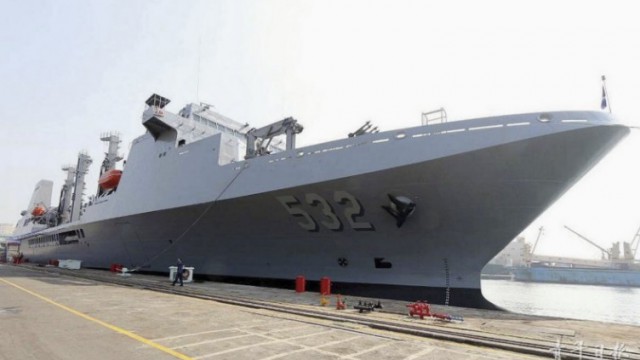
Taiwan has long enjoyed a robust maritime force, intended to defend the island nation from threats both real and perceived across the Taiwan Strait. An arrangement under which the United States will deliver four Oliver Hazard Perry-class frigates for use by the Republic of China Navy (ROCN) will only serve to further enhance the country’s maritime power. But perhaps the most interesting development for maritime affairs in the Asia-Pacific region so far in 2015 is the delivery of the ROCS Panshih.
With a total displacement of 20,000 tons and a range of almost 15,000 kilometers, the supply ship Panshih will greatly contribute to the ROCN’s expeditionary capabilities, allowing Taiwan to contribute meaningfully to disaster relief or humanitarian operations anywhere in the region. Historically, Taiwan has lacked this capability, fielding only the ROCS Yuen Feng, a troop transport. Although the ROCN has operated another supply ship for some years, ROCS Wu Yi, the Panshih is significantly larger and possesses much more advanced medical facilities. Reportedly, the Panshih is also only the first of its class – a second ship of an identical design is expected for the ROCN in the next few years.
These ships may soon cruise the seas in a Taiwanese effort to replicate the successes of China’s maritime diplomacy. The Peace Ark, a hospital ship in service with the People’s Liberation Army Navy (PLAN), has toured extensively since its commissioning in 2008. For example, the Peace Ark was deployed to assist the Philippines in recovering from Typhoon Haiyan in November 2013, and later was an important component of the Chinese participation in the Rim of the Pacific Exercise (RIMPAC) 2014. Port visits and participation in such multilateral operations enhance China’s “soft power”, whereas observers note that Taiwan has been sidelined for the most part in regional diplomatic affairs. Pursuing a similar theme to China’s charm offensive could be just the remedy to Taiwan’s isolation.
Yet there is one catch to the Panshih’s particular design. The vessel boasts some offensive capabilities, including a Phalanx close-in weapons system, a 20mm Gatling gun, short-range Sea Chaparral surface-to-air missiles, several .50 calibre machine guns, and 30mm turrets. In contrast, the Berlin-class auxiliary ships employed by the Germany Navy, and which theRoyal Canadian Navy will also soon employ as the Queenston-class, have only four MLG 27mm autocannons for defence. China’s Peace Ark is entirely unarmed. While the Panshih’s armaments grant it operational flexibility, they also undermine the vessel’s capacity to act as a soft power tool.
Perhaps the most ideal role for this vessel in the future will be to join relief operations in unstable environments. Taiwan has not contributed much in this area in previous years, with the ROCN focusing almost entirely on defending the Taiwanese coastline from threats across the strait. But there is one success story: in 2011, Taiwan initiated some participation in the European Union’s Operation Atalanta. This constituted an important contribution to international efforts against piracy in the Gulf of Aden and the Indian Ocean. But this is the lone case of active engagement by the ROCN in any initiative beyond the Taiwan Strait. The Panshih could grant Taiwan more options in this regard, since the deployment of fully fledged combat vessels to an area like the Gulf of Aden could be viewed by domestic audiences as weakening Taiwan’s coastal defenses or otherwise as a misuse of Taiwanese defense resources. A supply ship could be more readily spared so far as the public is concerned.
Lending credence to the idea that the Panshih will be used to support humanitarian operations in failed or failing states, the vessel also has impressive hangar space, capable of storing up to three helicopters. The Taiwanese media has focused on the capacity for the ship to serve as a takeoff and landing platform for anti-submarine helicopters, but it is also certainly possible for the ship to serve as a base for transport helicopters ferrying supplies and specialized personnel to inland locations, while also bringing back patients requiring intensive care at the Panshih’s onboard medical facilities. The ROCN’s 19 Sikorsky S-70C(M) Thunderhawk helicopters offer some possibilities in this regard.
In any case, the ROCN now has in its possession a versatile ship. What remains to be seen are how the ROCN will put it to use in the coming years and to what extent this will reflect Taiwanese foreign policy priorities. With such a sophisticated vessel, it would be a shame for Taiwan to keep it docked as backup for a regional conflict that might never, and hopefully will never, come.
Paul Pryce is a Research Analyst at the Atlantic Council of Canada. His research interests are diverse and include maritime security, NATO affairs, and African regional integration.
This article can be found in its original form at offiziere.chand was republished by permission.
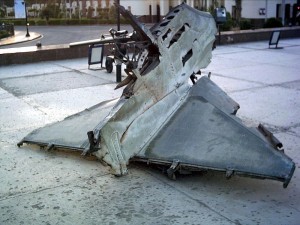
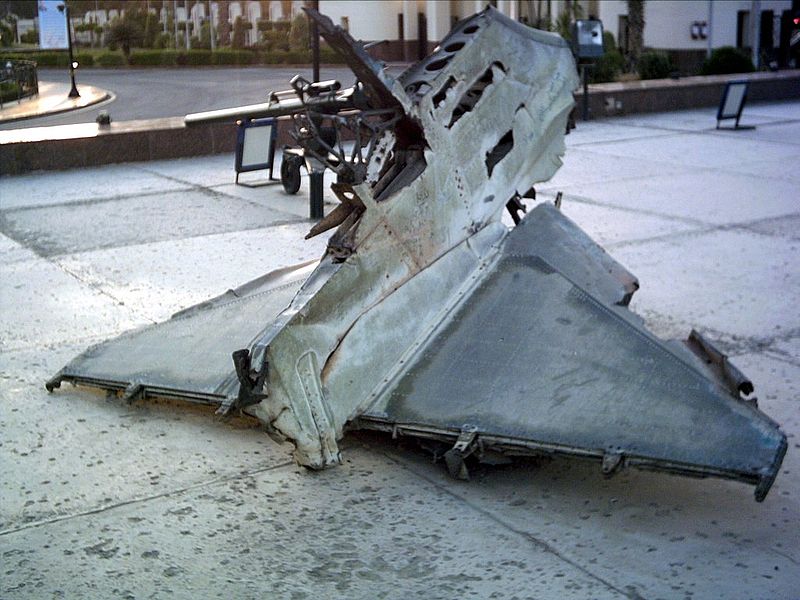
Wreckage of a Destroyed Israeli Plane (Wikimedia Commons)
As part of the run-up to #CFAR15 on Thursday, we asked those who received the most votes but are unable to attend to provide some thoughts and updates on their articles to share with our readers, along with the original, most-popular pieces of the past year:
LCDR Mark Munson: This piece was originally published as part of “Air-Sea Battle Week.” I chose to not write directly about the Air-Sea Battle (ASB) Operational Concept (or China) because I had no particular interest in ASB. I also was working at OPNAV at the time, and though I had no involvement or even any particular knowledge of ASB, I did not want to give the false impression that I had any insight into the U.S. Navy or Air Force efforts in support of that “Operational Concept.”
Of course since then the Air-Sea Battle office and concept is gone, recently subsumed into the larger Joint Concept for Access and Maneuver in the Global Commons (JAM-GC). JAM-GC may prove to be more successful than ASB in terms of facilitating the procurement of technologies that counter Anti-Access/Area-Denial (A2AD) capabilities. However, since I wrote this article the conventional wisdom regarding the pursuit of A2AD by China has also been challenged. In the Winter 2015 issue of The Washington Quarterly, M. Taylor Fravel and Christopher Twomey argue that “counter-intervention” is not the cornerstone of Chinese military strategy and that any Chinese emphasis on fielding A2AD capabilities are driven primarily to equip it for “a potential conflict over Taiwan.” (Full disclosure: Twomey is a former professor of mine) In fact, Fravel and Twomey argue that the focus on A2AD may the development of U.S. strategy and future weapons.
Regardless of whether and/or why China is developing the a significant A2AD capability, I think the thesis of my argument below is still sound. The notions behind A2AD or “Counter-Intervention” are not new, as militaries have attempted to develop stand-off weapons that deny maneuver to their enemies on the battlefield since the dawn of warfare. This article could just have easily been written about English and Welsh longbowmen at Agincourt as the Egyptians in Sinai in 1973.
The threat posed by Anti-Access/Area-Denial (A2AD) capabilities is at the core of the the U.S. Navy and Air Force’s Air Sea Battle (ASB) operational concept. However, A2AD weapons are not new, in particular playing an important role in the 1973 Yom Kippur War.
Using A2AD weapons, particularly surface-to-air missiles (SAM), surface-to-surface missiles (SSM), and anti-ship cruise missiles (ASCM), to conduct a form of asymmetric warfare is not a new idea. In particular, the use of missiles to counteract an enemy’s superiority in the air or on the ground was very much a part of Soviet doctrine by the 1960s. To protect against the U.S. air campaign during the Vietnam War, Soviet missiles and personnel were extensively used by North Vietnam. Perhaps the best example of A2AD in action, however, was the Soviet-enabled missile campaign waged by Egypt against the Israeli military during the 1973 Yom Kippur War (also known as the Ramadan War or October War).
The use of missiles formed an essential part of the plans of Egypt and Syria to win back the territories lost so precipitously during the 1967 Six Day War. In his book the Arab-Israel Wars, historian and former Israeli President Chaim Herzog noted that:
“the Egyptians had meanwhile studied and absorbed the lessons of the Six Day War: with the Russians, they concluded they could answer the problem of the Israeli Air Force over the battlefield by the creation of a very dense “wall” of missiles along the canal, denser even that that used in North Vietnam. The problem posed by Israeli armour was to be answered by the creation of a large concentration of anti-tank weapons at every level, from the RPG shoulder-operated missile at platoon level up to the Sagger missiles with a range of some 3000 yards and the BRDM armoured missile-carrying vehicles at battalion and brigade level.”
As part of Operation Caucasus, the Soviet Union “deployed an overstrength division” of air defense forces, with eighteen battalions each composed of SAM batteries, Anti-Aircraft Artillery (AAA), and teams equipped with Man-Portable Air Defense Systems (MANPADS). Although technically identified as instructors, the Soviet troops actually “were dressed in Egyptian uniforms and provided full crewing for the deployed SAM systems.” Using lessons learned in Vietnam, the air defense forces along the Suez Canal were capable of “relocating frequently and setting up ambushes for Israeli aircraft using multiple mutually supporting batteries.” Syria also procured Soviet SAM batteries to support their part of the planned surprise attack. In Herzog’s words, the overwhelming array of SAMs and AAA “would provide an effective umbrella over the planned area of operations along the Suez Canal” and “to a very considerable degree neutralize the effects of Israeli air superiority over the immediate field of battle.”
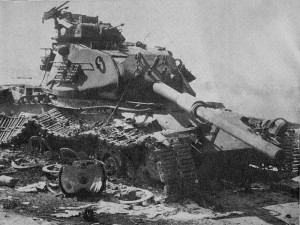
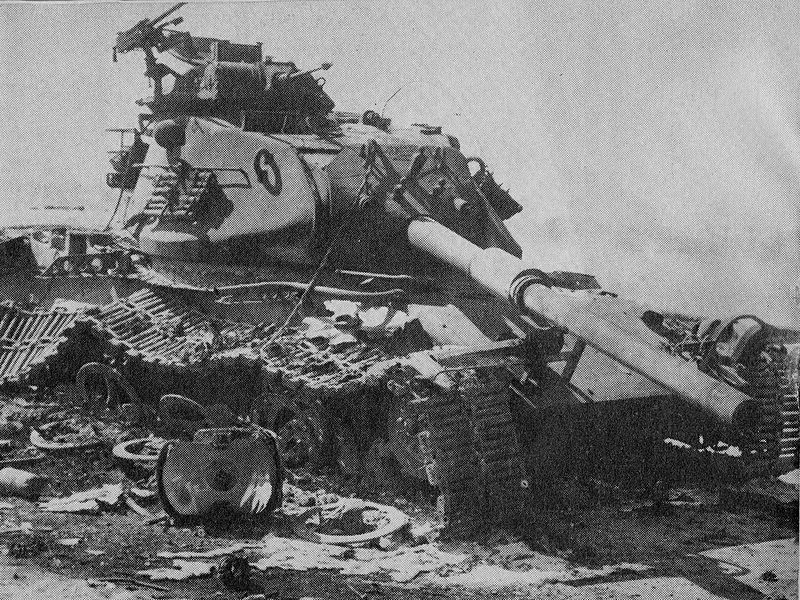
Destroyed Israeli Tank in the Sinai (Wikimedia Commons)
The Egyptians pursued a similar effort in their efforts to combat Israel’s ground forces. Per Herzog, Israel’s “armoured philosophy” emphasizing “massive, rapidly deployed, armoured counterattack” would be faced by an Egyptian Army that had crossed the Suez Canal “equipped to the saturation point in anti-tank weapons and missiles in order to wear down the Israeli armour.” The Arab leaders were not just concerned with achieving missile dominance inside the expected battlefield along the canal, however, but also that Eyptian and Syrian aircraft could not match their Israeli counterparts “outside the range of missile surface-to-air defence systems.” Therefore, the Soviets also provided surface-to-surface FROG and SCUD missiles capable of directly striking at Israel itself, with the hope that they could deter against Israel’s ability to attack their own capitals.
Egypt and Syria’s employment of A2AD weapons had a significant tactical impact on the war. Estimates of the losses of Israeli aircraft vary. Herzog stated that 102 Israeli planes were shot down (50 during the first three days), with half shot down by missiles and the other half shot down by AAA. According to other articles, “Israeli public claims are that 303 aircraft were lost in combat,” crediting SAMs with shooting down 40 and “between four and 12 to Arab fighters.” This means that although most Israeli aircraft may have been shot down by AAA, the “missile wall” can be credited with “denying the use of high and medium altitude airspace, driving aircraft down into the envelope of high-density AAA.”
One can argue that the lessons learned from employment of A2AD in 1973 can be overstated (after all, Israel eventually won the war, at great cost). However, Herzog’s claim that it was “a war of great historic significance” is merited, as it “was the first war in which the various types of missiles – surface-to-surface, surface-to-air, air-to-surface, and sea-to-sea – were used on a major scale,” and that “the entire science of military strategy and technique has had to be re-evaluated in the light of” its lessons. In particular, the Egyptians in 1973 executed what the Air-Sea Battle concept identifies as an important objective of A2AD, in which “an aggressor can slow deployment of U.S. and allied forces to a theater, prevent coalition operations from desired theater locations, or force friendly forces to operate from disadvantageous longer distances.”
Evolution of Air-Land Battle and the Influence of the 73 War
How and why Israel won the war in 1973 entails a much longer discussion possible in this particular blog post. The solution to A2AD that the Navy and Air Force have proposed through Air-Sea Battle “is to develop networked, integrated forces capable of attack-in-depth to disrupt, destroy and defeat adversary forces.” The reader can decide whether those are just buzzwords and whether the A2AD threat faced by the Israelis forty years ago was an easier challenge to overcome than what could be faced by the U.S. military today and in the future What is clear, however, is that the notion of A2AD is not new, and was very much an important part of Soviet-supported military operations during the Cold War.
Lieutenant Commander Mark Munson is a Naval Intelligence officer currently serving on the OPNAV staff. He has previously served at Naval Special Warfare Group FOUR, the Office of Naval Intelligence, and onboard USS ESSEX (LHD 2). The views expressed are solely those of the author and do not reflect the official viewpoints or policies of the Department of Defense or the US Government.
An academic (Dr. Alexander Clarke), an operator (Cdr Paul Fisher, RN (ret)) and a builder (Douglas Clarke) discuss 21st Century Fleet Design and whether it should be driven by a ruthless pragmatism or a more grand design. Intelligent and all very British, they also mention Germany, The War, and railways. Well worth an hour of your commute this week!
Wreckage From a Destroyed Israeli Plane (Wikimedia Commons)
The threat posed by Anti-Access/Area-Denial (A2AD) capabilities is at the core of the the U.S. Navy and Air Force’s Air Sea Battle (ASB) operational concept. However, A2AD weapons are not new, in particular playing an important role in the 1973 Yom Kippur War.
Using A2AD weapons, particularly surface-to-air missiles (SAM), surface-to-surface missiles (SSM), and anti-ship cruise missiles (ASCM), to conduct a form of asymmetric warfare is not a new idea. In particular, the use of missiles to counteract an enemy’s superiority in the air or on the ground was very much a part of Soviet doctrine by the 1960s. To protect against the U.S. air campaign during the Vietnam War, Soviet missiles and personnel were extensively used by North Vietnam. Perhaps the best example of A2AD in action, however, was the Soviet-enabled missile campaign waged by Egypt against the Israeli military during the 1973 Yom Kippur War (also known as the Ramadan War or October War).
The use of missiles formed an essential part of the plans of Egypt and Syria to win back the territories lost so precipitously during the 1967 Six Day War. In his book the Arab-Israel Wars, historian and former Israeli President Chaim Herzog noted that:
“the Egyptians had meanwhile studied and absorbed the lessons of the Six Day War: with the Russians, they concluded they could answer the problem of the Israeli Air Force over the battlefield by the creation of a very dense “wall” of missiles along the canal, denser even that that used in North Vietnam. The problem posed by Israeli armour was to be answered by the creation of a large concentration of anti-tank weapons at every level, from the RPG shoulder-operated missile at platoon level up to the Sagger missiles with a range of some 3000 yards and the BRDM armoured missile-carrying vehicles at battalion and brigade level.”
As part of Operation Caucasus, the Soviet Union “deployed an overstrength division” of air defense forces, with eighteen battalions each composed of SAM batteries, Anti-Aircraft Artillery (AAA), and teams equipped with Man-Portable Air Defense Systems (MANPADS). Although technically identified as instructors, the Soviet troops actually “were dressed in Egyptian uniforms and provided full crewing for the deployed SAM systems.” Using lessons learned in Vietnam, the air defense forces along the Suez Canal were capable of “relocating frequently and setting up ambushes for Israeli aircraft using multiple mutually supporting batteries.” Syria also procured Soviet SAM batteries to support their part of the planned surprise attack. In Herzog’s words, the overwhelming array of SAMs and AAA “would provide an effective umbrella over the planned area of operations along the Suez Canal” and “to a very considerable degree neutralize the effects of Israeli air superiority over the immediate field of battle.”
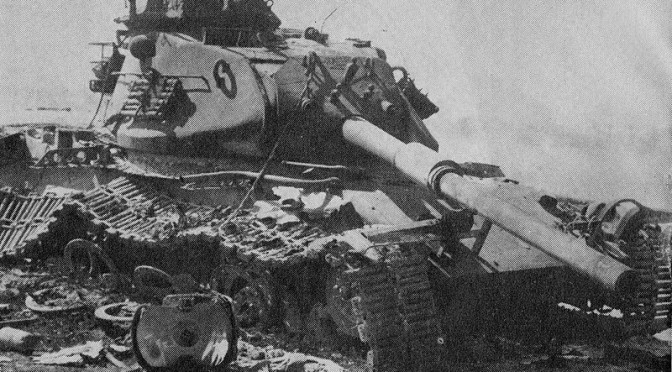
Destroyed Israeli Tank in the Sinai (Wikimedia Commons)
The Egyptians pursued a similar effort in their efforts to combat Israel’s ground forces. Per Herzog, Israel’s “armoured philosophy” emphasizing “massive, rapidly deployed, armoured counterattack” would be faced by an Egyptian Army that had crossed the Suez Canal “equipped to the saturation point in anti-tank weapons and missiles in order to wear down the Israeli armour.” The Arab leaders were not just concerned with achieving missile dominance inside the expected battlefield along the canal, however, but also that Eyptian and Syrian aircraft could not match their Israeli counterparts “outside the range of missile surface-to-air defence systems.” Therefore, the Soviets also provided surface-to-surface FROG and SCUD missiles capable of directly striking at Israel itself, with the hope that they could deter against Israel’s ability to attack their own capitals.
Egypt and Syria’s employment of A2AD weapons had a significant tactical impact on the war. Estimates of the losses of Israeli aircraft vary. Herzog stated that 102 Israeli planes were shot down (50 during the first three days), with half shot down by missiles and the other half shot down by AAA. According to other articles, “Israeli public claims are that 303 aircraft were lost in combat,” crediting SAMs with shooting down 40 and “between four and 12 to Arab fighters.” This means that although most Israeli aircraft may have been shot down by AAA, the “missile wall” can be credited with “denying the use of high and medium altitude airspace, driving aircraft down into the envelope of high-density AAA.”
One can argue that the lessons learned from employment of A2AD in 1973 can be overstated (after all, Israel eventually won the war, at great cost). However, Herzog’s claim that it was “a war of great historic significance” is merited, as it “was the first war in which the various types of missiles – surface-to-surface, surface-to-air, air-to-surface, and sea-to-sea – were used on a major scale,” and that “the entire science of military strategy and technique has had to be re-evaluated in the light of” its lessons. In particular, the Egyptians in 1973 executed what the Air-Sea Battle concept identifies as an important objective of A2AD, in which “an aggressor can slow deployment of U.S. and allied forces to a theater, prevent coalition operations from desired theater locations, or force friendly forces to operate from disadvantageous longer distances.”
Evolution of Air-Land Battle and the Influence of the 73 War
How and why Israel won the war in 1973 entails a much longer discussion possible in this particular blog post. The solution to A2AD that the Navy and Air Force have proposed through Air-Sea Battle “is to develop networked, integrated forces capable of attack-in-depth to disrupt, destroy and defeat adversary forces.” The reader can decide whether those are just buzzwords and whether the A2AD threat faced by the Israelis forty years ago was an easier challenge to overcome than what could be faced by the U.S. military today and in the future What is clear, however, is that the notion of A2AD is not new, and was very much an important part of Soviet-supported military operations during the Cold War.
Lieutenant Commander Mark Munson is a Naval Intelligence officer currently serving on the OPNAV staff. He has previously served at Naval Special Warfare Group FOUR, the Office of Naval Intelligence, and onboard USS ESSEX (LHD 2). The views expressed are solely those of the author and do not reflect the official viewpoints or policies of the Department of Defense or the US Government.


 An academic (Dr. Alexander Clarke), an operator (Cdr Paul