Tag Archives: featured

Damen’s Presence in the Latin American and Caribbean Market, Part 2

By W. Alejandro Sanchez

Selling To Everyone

The list of Damen’s current clients in the Western Hemisphere highlights one curious fact about this company: the Dutch company sells its equipment to both U.S. allies and foes alike. Certainly, Washington sees no fault in Damen’s decision to upgrade Mexico’s naval equipment. On the other hand, the U.S. government probably frowns at Damen equipping countries that Washington is at odds with, such as Venezuela (which was declared a national security threat by the White House this past March). Similarly, Damen’s shipyard in Cuba, a country that was on the U.S. State Department’s list of states that sponsor terrorism until this past May, is not considered a positive development in Washington.

Nevertheless, Damen has remained neutral in Western Hemisphere geopolitics, as it has dealt with any government willing to pay. This issue deserves further analysis by stating two obvious facts: the U.S. and the Netherlands have generally enjoyed good security relations over the past decades, and Damen is a privately-owned company, which means that the Dutch government has limited influence in the contracts and initiatives it chooses to carry out. With that said, it is bizarre that Damen chose to build a shipyard in a country that has been at odds with the U.S. for decades, and is also selling vessels to countries like Ecuador and Venezuela, which have become a thorn on Washington’s side for years (in the case of Caracas’ for a decade and a half). Certainly, Damen does not need to take into account U.S. foreign policy in its business decisions, but it is nevertheless important to keep in mind how the sale of military equipment can upset regional geopolitics, particularly if this equipment is sold to nations that have carried out aggressive foreign policies in recent years (i.e. Venezuela).

Damen is Important, But Not A Pillar

While Damen has made a name for itself in the Latin American and Caribbean market, the shipbuilding company has not fully cornered this market, as it still faces a number of competitors.

One of Damen’s major competitor is Navantia. The Spanish company has been trying to sell Peru its frigate F-538 model as well as attempting to sell Colombia (and Peru) its F-110 frigate. The company already has a strong presence in the region, best exemplified by a 2013 contract to upgrade the motor system of a Brazilian corvette, the “Julio de Noronha.” Government-to-government exchanges are also common as South Korea has donated one of its corvettes, the now-called “ARC Nariño,” to Colombia. The Donghae-class vessel served in the Republic of Korea Navy for 27 years before it was given to the South American state.
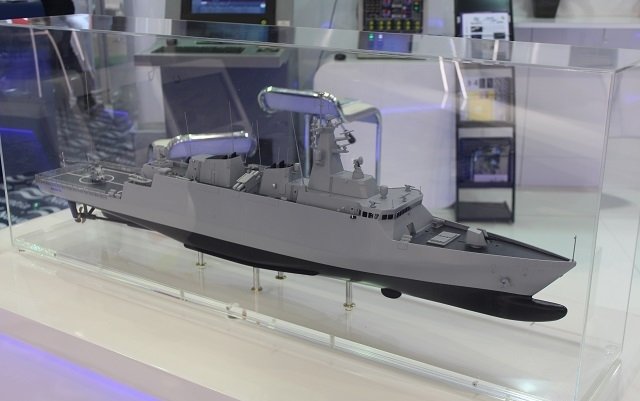
Navantia Warship. Source: Navyrecognition.com.

Finally, the know-how of Latin American military industries is improving. Case in point, the Peruvian shipyards Servicios Industriales de la Marina (SIMA) is currently constructing a new training vessel for the Peruvian Navy, the “BAP Union” – a project worth around $50-55 million USD. Moreover, with support from the Daewoo International Corporation and the Korea Trade-Investment Promotion Agency, SIMA is building a new multi-purpose vessel for its Navy.

These examples stress how competitive the shipbuilding industry is in Latin America. Not only are there several major companies trying to sell brand new warships, but governments are also donating surplus naval technology. Furthermore, regional shipyards are rapidly improving their knowledge when it comes to shipbuilding, as we now have modern shipyards in countries like Colombia, Ecuador, Mexico, Peru and Venezuela  that are constructing their own vessels.

In fact, countries like Ecuador, Mexico and Venezuela want Damen to construct some vessels in their own shipyards in order for local technicians to learn from Damen’s experts. Certainly, none of these facilities are in a position to build a ship as complex as a carrier, but they can now construct smaller vessels, like patrol boats or support ships.

What this means for a company like Damen is that while it will continue to enjoy new contracts for the immediate future, it will have to continue developing more modern and improved equipment that its Latin American and Caribbean clients cannot purchase, maybe at a better price, from other suppliers, or even construct themselves in the not-so distant future.

A Need for Stronger Naval Forces

As transnational crime over the Caribbean Sea and other maritime crimes, such as illegal fishing, continue throughout Latin America and the Caribbean, it has become a major priority for regional states to have modern and capable navies and coast guards in order to protect their exclusive economic zones.

Certainly, it can be argued that the current purchases of some naval technologies are generally unnecessary, given that the region has enjoyed inter-state peace for decades (the last inter-state war in the region was in 1995 between Peru and Ecuador, while the last conflict with naval warfare was the 1982 Falklands/Malvinas War between Argentina and the United Kingdom). Moreover, while transnational crime remains a persistent problem, Latin America has enjoyed cooperation at the inter-state level for two decades (the 2008 Colombia-Venezuela incident notwithstanding). Given this period of peace, some may argue that these defense dollars would be better spent in social programs, especially since many Latin American nations, including Damen-clients like Honduras, are very poor and underdeveloped.

Unfortunately, the reality is different. First, Latin American and Caribbean nations must have some capabilities for deterrence as inter-state tensions continue, such as between Peru and Chile or even the aforementioned 2008 incident between Colombia and Venezuela. Second, transnational drug trafficking remains a major problem from Mexico to Argentina, particularly throughout the Greater Caribbean waters as cocaine is transported from Colombia and Venezuela to the U.S. and Mexico markets. Just last May, the U.S. Coast Guard and the USS Kauffman (FFG 59) interdicted almost 1,800 kilograms of cocaine in the Eastern Pacific.
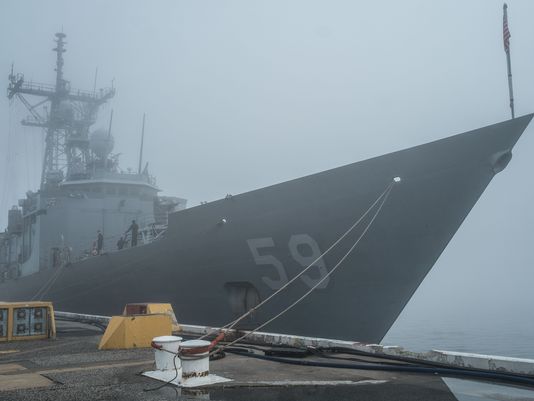
USS Kauffman. Source: Mark D. Faram/Staff.

Hence, it is necessary for Latin American and Caribbean naval forces, including their coasts guards, to have fast and technologically advanced vessels for both internal and regional security – which in turn would diminish their dependence on U.S. security aid. In this sense, the involvement of companies like Damen and Navantia in the Western Hemisphere is a necessity (at least until regional states can build their own high-tech vessels).

Final Thoughts

In recent years the Dutch shipbuilding company Damen has made a name for itself as a provider of high-tech, fast vessels, from multipurpose boats to coast guard speedboats, for various Latin American and Caribbean states. Their clients include nations with small defense budgets like Honduras and Trinidad & Tobago, to major buyers like Mexico and Venezuela. Nevertheless, Damen has not cornered these region’s shipbuilding markets, as there are several other companies selling their products, such as the Spanish Navantia, in addition to regional states enjoying growing maritime defense industries.

Moreover, while Damen’s sales to the region have generally controversy-free, the incident over the overpriced vessels sold to Honduras highlights the potential for corruption, i.e. kickbacks, in countries renowned for lacking good governance. I have been unable to confirm if there were other similar discrepancies in Damen’s other contracts in the Western Hemisphere. Nevertheless, countries like Venezuela are known for their lack of transparency (case in point, the billions of petro-dollars spent by Caracas to purchase Russian military technology) while Mexico is infamous for its corrupt state-run oil company, PEMEX. Given these precedents, there are valid reasons for concern over Damen’s deals with its Latin American and Caribbean clients.

Ultimately, the question comes down to whether the region requires new vessels. Inter-state conflict may be scarce, but it remains a possibility given recent tensions between regional nations (i.e. Venezuela and Colombia, Peru and Chile or currently between Venezuela and Guyana). Thus, it is necessary for nations to maintain capable deterrent capabilities. Additionally, these states must have strong navies and coast guards to crack down on maritime crimes that range from illegal fishing to transnational drug trafficking.

In 2015, the waters along Latin American and Caribbean states are far from peaceful and Damen’s vessels, while not the cornerstone of regional navies, are an important addition to hemispheric maritime security.

Read Part One here.

W. Alejandro Sanchez is a Senior Research Fellow at the Council on Hemispheric Affairs (COHA) where he focuses on geopolitics, military and cyber security issues in the Western Hemisphere. His research interests include inter-state tensions, narco-insurgent movements and drug cartels, arms sales, the development of Latin American military industries, UN peacekeeping operations, as well as the rising use of drones (UAVs) for civilian and security uses in Latin America. Twitter: @W_Alex_Sanchez
Damen’s Presence in the Latin American and Caribbean Market, Part 1

By W. Alejandro Sanchez

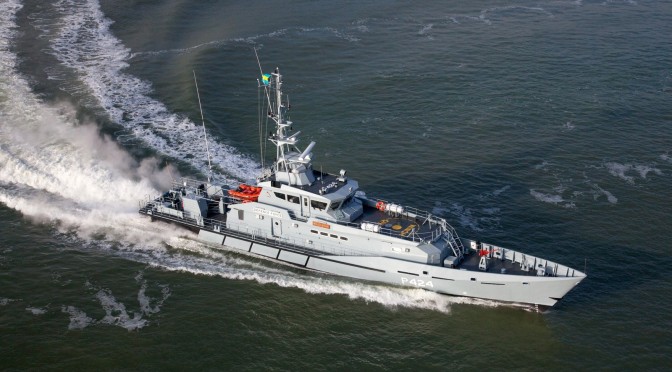
Though shipbuilding is a competitive global industry, one company has become a major provider to the naval forces (coast guards included) of various Latin America and Caribbean states: Damen Shipyards Group. Damen is now a household name among Latin American and Caribbean navies as it provides multi-purpose vessels, patrol boats and speed boats. These sales have enhanced the capabilities of Damen’s clients as they face transnational threats.

While the defense budgets of Latin American and Caribbean states cannot be compared to those of the usual suspects (i.e. the U.S., Russia or China), a significant number of weapon deals have occurred in recent years between the Dutch-based company and these two regions.

Damen’s sale of technologically advanced vessels is a positive development for the region for a variety of reasons. Most notably, since Latin America and the Caribbean are enjoying a marked lack of inter-state conflict  (the last war between two regional states was in 1995), the region’s security forces are now focused largely on transnational crimes, particularly drug trafficking. Thus, it appears that Damen’s clientele will continue to grow for the immediate future as the company is looked upon as a reliable supplier of vessels necessary to combat criminal activities that occur at sea, particularly in the Greater Caribbean region.

Recent Sales

In order to discuss Damen’s effect on the shipbuilding industry and naval defense sector in Latin America and the Caribbean, a brief enumeration of confirmed deals and equipment delivery is necessary. This will also give us a clearer view of Damen’s clients.

  • The Caribbean

Damen has a number of clients in the Caribbean whose naval forces are more akin to coast guards rather than traditional navies. One good example is the Bahamas, which formalized a deal with Damen in 2014 for a variety of vessels, including four Stan Patrol 4207, four SPa 3007, and one roll-off ship Stand Lander 5612. The shipbuilding portion of this multi-faceted contract is valued at around $149 million.

The company has already delivered the four 4207 patrol boats. Moreover, this past January the Damen Gorinchen shipyard in the Netherlands received the hull for the Stan Patrol 3007. It is important for the 3007 to become operational soon as this vessel is urgently needed by Nassau to combat narcotics trafficking, a further example of how Damen technology is being utilized for positive security initiatives.

Another one of Damen’s clients in the Caribbean is Trinidad & Tobago. This past May, the government in Port-of-Spain ordered 12 new vessels for its coast guard, including four type Stan Patrol 5009, two Fast Crew Supply 5009 and six Interceptor speedboats. The deal is worth $189 million USD. In early June, the “TTS Point Lisas” (GC 23), one of the FCS ships, was delivered to the Caribbean government.

  • Latin America

When it comes to the mainland, several Latin American states are turning to Damen for naval equipment. For example, the Colombian Navy purchased one of Damen’s Swath-type vessels, which was constructed in Singapore.  Additionally, in 2014, Ecuador signed a deal with Damen to obtain two Stan Patrol 5009 for the country’s coast guard. The vessels are being constructed in Ecuador by the country’s shipyard, Astilleros Navales Ecuatorianos, under the oversight of Damen technicians. Additionally, Damen obtained a contract in early 2014 to construct a fourth Stan Patrol 2606 (the country already operates three),  which will also be built in Ecuador.

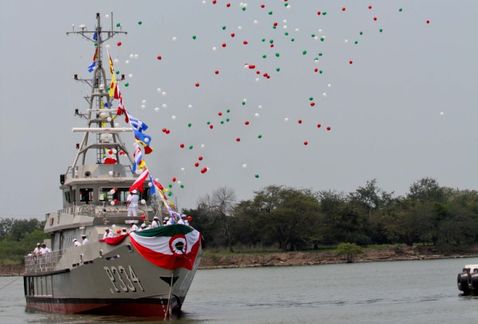
Additionally, Mexico and Venezuela have purchased various types of Damen’s vessels. Just this past January, the Mexican Navy received the Coast Guard vessel Tenochtitlan-class “ARM Mitla” (PC-334), which was constructed as a joint project between the shipyards of the Secretaria de Marina (the Mexican Navy) in Tamaulipas and Damen. The “Mitla” is based on the Stan Patrol 4207 model. This is the second of two vessels that Mexico and Damen are building together following a 2014 agreement. The other vessel is a supply variant of the Fast Crew Supplier 5009. Like the “Mitla,” it is also being constructed in Mexico’s Sonora state. These developments suggest that Damen has become an integral part of the country’s naval shipbuilding. Apart from the aforementioned vessels, SEMAR and Damen jointly constructed three other patrol vessels based on the 5009 model.

 Mexico’s new “ARM Mitla." Source: Cuartooscuro / Milenio.com.
Mexico’s new “ARM Mitla.” Source: Cuartooscuro / Milenio.com.

As for Venezuela, Caracas has ordered a number of new vessels for its Navy including a 2014 deal for 18 type Interceptor 1102 speedboats. The speedboats are being constructed in Cuba under the Havana-Caracas cooperation agreement. The first of these vessels arrived this past May and is currently undergoing testing. In addition, Damen has also constructed four support vessels for the South American nation based on the Stan Lander 5612 model. On February 2014, a new contract was signed for an additional eight vessels, a deal worth around $132 million USD. Finally, Venezuela’s military complex (UCOCAR) in Puerto Cabello is building five patrol boats based on the Stan Patrol 2606 model. The country’s navy already has one operational vessel based on that model, the “Pagalo” (PG-51).

Damen Interceptor 1102. Source: Damen.com.
  • Cuba’s Shipyards

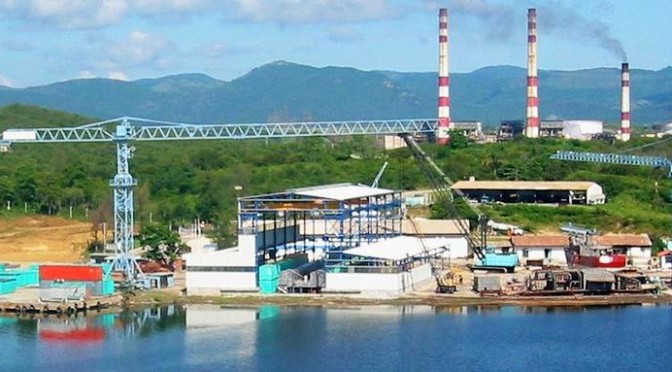
It is important to note that Damen has a construction facility, Damex Shipbuilding & Engineering, in Cuba. The facilities, which were established in 1995, are located in the bay of Santiago de Cuba. Damen’s website explains that “the yard is equipped with one slipway provided with transverse parking facilities for new buildings and repairs and a lateral slipway for new buildings of up to 100 metres.” As previously noted, the shipyards have constructed vessels for Venezuela.

  • The Honduran Affair

It is important to stress that not all Damen deals have been scandal-free. This is best exemplified by a 2013 contract via which the government of Honduras purchased six Interceptor speedboats and two Stan Patrol 4207. The contract deal was reportedly worth almost $62 million. However in late 2013, the Honduran judiciary investigated it due to various irregularities, specifically the accusation that the vessels were overpriced  – according to the Honduran newspaper La Prensa, the vessels were overpriced by some $29 million. The newspaper argued that the Honduran Secretariats of Defense and Finance created a paper company called “Servicios Maritimos S.A.,” which was utilized by Florentius Antonious Florentius Kluck,  a Dutch citizen and honorary consul, as the intermediary for the sale.

In spite of these accusations, the deal ultimately went through, and the Honduran Navy has begun to receive the vessels. This is an important deal for Honduras since drug traffickers utilize the country’s coast for transporting illegal narcotics, and thus it is especially necessary for small Central American country to have vessels that can locate and seize the infamous narco-speedboats. Nevertheless, the details of the deal themselves are problematic, as the question its transparency and whether the Honduran government could have obtained similar vessels at a cheaper price. Even more, even though the Honduran judiciary never passed judgment on the  deal, scandals like the Honduran affair throw into question whether other contracts gained by Damen were due to shadowy middle men and nefarious deals.

Read Part 2 here.

W. Alejandro Sanchez is a Senior Research Fellow at the Council on Hemispheric Affairs (COHA) where he focuses on geopolitics, military and cyber security issues in the Western Hemisphere. His research interests include inter-state tensions, narco-insurgent movements and drug cartels, arms sales, the development of Latin American military industries, UN peacekeeping operations, as well as the rising use of drones (UAVs) for civilian and security uses in Latin America. Twitter: @W_Alex_Sanchez
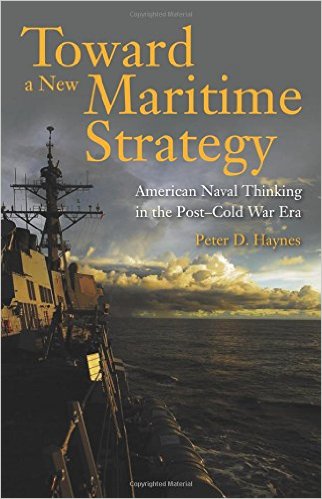
Toward a New Maritime Strategy


Toward a New Maritime Strategy

Toward a New Maritime Strategy: American Naval Thinking in the Post-Cold War Era. Peter D. Haynes. Naval Institute Press, 2015. 304pp. $49.95.

Review by James Holmes

Peter D. Haynes has written a singularly useful book for anyone interested in how the American sea services—shorthand for the U.S. Navy, Marine Corps, and Coast Guard—think about, make, and execute maritime strategy. Captain Haynes is a naval aviator, sports a Ph.D. from the Naval Postgraduate School, and serves as deputy director for strategy, plans, and policy at the U.S. Special Operations Command.

Now, it’s doubtful he has penned a bestseller. There just aren’t that many folks out there in the wider reading public inclined to get their navy geek on. That’s a shame. But it should be required reading for readers of these pixels, and for anyone entrusted with devising, prosecuting, or overseeing endeavors on the briny main. It will adorn my bookshelf from henceforth.

So much for the overall verdict. Let me share two big takeaways I culled out of Toward a New Maritime Strategy. First and foremost, this is a venture in self-knowledge. Take it from the ancients: that’s important. Know thyself, commanded an inscription at the entryway to the Greek temple at Delphi, where supplicants went to ask counsel from the god Apollo.

Knowing who we are as the seafaring arm of American foreign policy will alert us to habits of mind and patterns of behavior that prevail within the services. In so doing it helps us glimpse our future while alerting us to pitfalls and obstacles we’re apt to confront. Knowing ourselves is half the battle, as a Chinese sage of famous memory once advised.

Which is a roundabout path back to Haynes’s treatise. As the title advertises, the book is about strategy-making since the fall of the Soviet Union. The author, however, starts by delving into the prehistory to today’s strategic debates. He traces the maladies he discerns to the Cold War’s early days as much as to its endgame. Enamored of its tactical and operational success in the Pacific War, deprived of a peer adversary, and with the U.S. Air Force clamoring for an outsized share of the defense budget for the atomic age, the navy leadership in effect lost its vocabulary for thinking about and debating maritime strategy.

This was an unintended consequence of change in the marine surroundings. The navy commenced deployments around the Soviet periphery unbidden in the immediate post-World War II years. The proportion of sea time in a mariner’s career swelled as a result, making “sustained superior performance at sea” the benchmark of excellence—and thus of promotions, awards, and all manner of good things.

However healthy it may be for seamanship and tactical skill, sea duty affords little leisure for studying larger matters such as diplomacy and strategy. Other factors—the mania for scientific-technical disciplines, increased stovepiping between the surface, submarine, and aviation communities, and on and on—only compounded the career penalties besetting would-be strategic thinkers.

For Captain Haynes, in short, the early Cold War begat an organizational culture unfriendly to strategic thought. Culture is resilient. Oftentimes that’s a good thing. It provides intellectual ballast in tumultuous times.

But it can be a bad thing—as the greats attest. “To change anything in the Na-a-vy is like punching a featherbed,” as Franklin Roosevelt reportedly exclaimed while serving as assistant secretary of the navy during World War I. “You punch it with your right and you punch it with your left until you are finally exhausted, and then you find the damn bed just as it was before you started punching.”

Or as FDR’s secretary of war Henry Stimson joked after World War II, “the peculiar psychology of the Navy Department … frequently seemed to retire from the realm of logic into a dim religious world in which Neptune was God, Mahan his prophet, and the United States Navy the only true Church.”

In Roosevelt’s and Stimson’s spirit, Haynes suggests that navy culture worked against higher-order thought long after the war. Indeed, this failing constitutes a recurring theme as he examines strategy-making efforts spanning from the 1980s through the triservice 2007 Cooperative Strategy for 21st Century Seapower. His account of these enterprises—which gave rise to directives bearing titles like …From the Sea and Sea Power 21—is worth perusing at length.

Second, Haynes attests to the hazards of placing inordinate faith in the social sciences when drawing up strategy and designing forces. Exhibit A: the 1991-1992 Naval Force Capabilities Planning Effort. This was the project that resulted in …From the Sea, the navy’s first post-Cold War statement of how it viewed the surroundings and intended to manage them. The planning effort convened a group of senior U.S. Navy and Marine officers and civilian academics.

Group members based their deliberations largely on the “Manthorpe Curve.” This graph, the brainchild of then-Deputy Director of Naval Intelligence Bill Manthorpe, represented an attempt to foretell how the strategic environment would evolve over the coming twenty years. Captain Manthorpe based it on his study of the past, looking at patterns of rise-and-fall and regional flare-ups. He forecast turbulence following the Soviet collapse, intermittent regional threats, and the rise of a potentially hostile empire around 2011.

Schools of thought coalesced around these three intervals: Cold War aftermath, midterm regional troubles, advent of a new peer competitor. Those worried about managing the transition to the post-Cold War world coveted large numbers of inexpensive constabulary-like platforms. Carrier aviators and a few fellow travelers called for pummeling rest-of-world threats selectively to keep them from mutating into global problems. Submariners beseeched the sea services to husband their technological edge, investing in top-end platforms—like attack and ballistic-missile subs—that it would take to face down another Soviet-caliber antagonist.

Such are the demands on a global sea power that feels obliged to manage the system of international trade and commerce, keep a lid on regional troublemaking, and discourage a Eurasian hegemon from challenging the international order it leads.

But isn’t strategy the art of staying in tune with the times? Why not realign strategy and forces to cope with immediate problems rather than hedge against a great-power struggle that may never come? That’s what some members of the Naval Force Capabilities Planning Effort urged. And indeed, …From the Sea in effect codified this view, proclaiming that the U.S. Navy could afford to focus on projecting power ashore because no one threatened its command of the sea.

Yet adapting to new, less trying circumstances is imprudent when it wrong-foots efforts to meet foreseeable challenges of greater consequence later on. For this observer the message that leaps out from the Manthorpe Curve is this: history granted post-Cold War America only a short respite—in historical terms—before the onset of the next great-power challenge. It was imperative to start getting ready then. It takes a long time to regenerate advanced weaponry and adept users—the lineaments of combat power—once those resources lapse. By adapting then, the naval leadership let the material and human capacity for readapting languish.

Think about it from the vantage point of 1991-1992. The generation of commanders destined to face Manthorpe’s next big thing circa 2011 was already in uniform. They were junior to mid-career officers. Having them unlearn the skills and habits needed to wrest maritime command from a serious foe was a decision of colossal moment.

Ships, aircraft, and armaments to wage the new struggle needed to be dreamt up, built, and tested to be ready when a new rival came on scene—meaning now. We’re now scrambling to reinvent capabilities—long-range anti-ship missiles, among many others—that atrophied when history ended a quarter-century ago. Others have disappeared without replacements.

Such insights are scattered throughout Toward a New Maritime Strategy. Lastly, it’s a book reviewer’s sad but sacred duty to join the nattering nabobs of negativity—that is, to find some fault with the work under review. One quick but significant critique. Maritime strategy is about more than naval strategy. It’s even about more than a navy and its corps of sea soldiers. Haynes can be taken to task for neglect on this point.

For the United States, any genuinely maritime strategy should encompass the U.S. Coast Guard, whose commandant, after all, was the third co-signer of the 2007 Maritime Strategy. Yet this sister sea service is largely invisible in Haynes’s account. The tension between this book’s title and subtitle is revealing: Toward a New Maritime Strategy, but American Naval Thinking in the Post-Cold War Era.

There’s more truth-in-advertising in the latter than the former. What was that hybrid constabulary/combat service doing during the era under study, how did its leadership contribute to the making of the Cooperative Strategy, how does the strategy shape its operations, and how does coastguardsmen’s maritime thought resemble and differ from that of fellow seafarers? What changed after 9/11, when the U.S. Coast Guard became an arm of the newly created Department of Homeland Security?

More attention to the coast guard, in short, would have enriched Haynes’s commentary while imparting a truly maritime flavor to it. But I quibble. Opinionated as it is, this book may win Peter Haynes few friends within the naval establishment. One hopes it influences people, nevertheless—reacquainting the services with their cultures, strengths, and foibles as they reenter a competitive age of sea power. Read it.

James Holmes is professor of strategy at the Naval War College and senior fellow at the University of Georgia School of Public and International Affairs. A former U.S. Navy surface warfare officer and combat veteran of the first Gulf War, he served as a gunnery and engineering officer in the battleship Wisconsin, engineering and damage-control instructor at the Surface Warfare Officers School Command, and military professor of strategy at the Naval War College. His most recent books (with long-time coauthor Toshi Yoshihara) are Strategy in the Second Nuclear Age and Red Star over the Pacific. Designated an Atlantic Monthly Best Book of 2010, Red Star over the Pacific has been named to the Navy Professional Reading List as Essential Reading. The views voiced here are his alone.

Readers interested in reviewing books for CIMSEC can contact the book review editor at books@cimsec.org.

Call for Articles: Chinese Military Strategy Week, 3-7 Aug 15

Week Dates: 3-7 Aug 15
Articles Due: 29 Jul 15
Article Length: 500-1500 Words
Submit to: nextwar(at)cimsec(dot)org

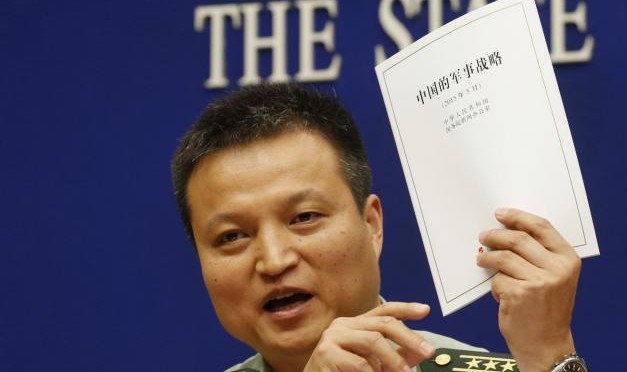
In a watershed moment, the Chinese Ministry of National Defense recently published a white paper on the Chinese Military Strategy (with an English-language version made available and published almost immediately by USNI News). This document lays out a policy for future Chinese military engagement with the world, proclaiming the centrality of active defense as the essence of the Chinese Communist Party’s military strategic thought and then describing an approach for implementing this military policy in the air, cyber, land, and maritime domains. This document comes at a particularly interesting time as General Martin Dempsey, Chairman on the Joint Chiefs of Staff, has since approved a new National Military Strategy for the United States, a strategy that names China explicitly as culpable for increased tension in the Asia-Pacific region and establishes an explicit interactive dynamic between the Chinese and U.S. strategies. While this is not the first time a U.S. National Military Strategy names China as a consideration, the shift in tone here is noteworthy.

During the first week of August, CIMSEC will host a series focused on exploring the relationship between the new Chinese military strategy and the strategic policies of the United States and others. Of particular interest are the dynamics of symmetry and asymmetry in their respective National Military Strategies (ideological, technological, doctrinal, coalitional, etc.); the implicit and explicit assumptions in each; the potentially divergent social and political purposes of such documents given their sources; and the implications for the other elements of national power in China, the United States, and the other actors (state and otherwise) in the international system. If the United States and China were to pursue their stated military strategies in whole or in part, what are the implications for their relative and absolute advantage? What are the acknowledged and unacknowledged risks for each in their stated policies?

Contributions should be between 500 and 1500 words in length and submitted no later than 29 July 2015. Publication reviews will also be accepted.

Eric Murphy is a Strategist and Operations Research Analyst with the United States Air Force and a graduate of the School of Advanced Air and Space Studies.

CIMSEC content is and always will be free; consider a voluntary monthly donation to offset our operational costs. As always, it is your support and patronage that have allowed us to build this community – and we are incredibly grateful.
Select a Donation Option (USD)

Enter Donation Amount (USD)