Tag Archives: drones

Call for Articles, Non-Navies Week: 29 JUL-2 AUG

CIMSEC is having a Non-Navies Week from 29 July to 2 August as a first step in a longer series on specific non-navies. Delve into this list of non-navy navies with us.

Mainstream policy discussions of navies and maritime law enforcement often consider the denizens of the high seas to be a pliant polity – passive actors being defended, disrupted, or directed by the might of global or local security networks. However, national fleets and their individual warships are not the only ones with the agency to effect global politics and security.

Some topics we have covered at length – pirates and the Private Military Contractors that have risen up in opposition – but we have only scratched the surface.

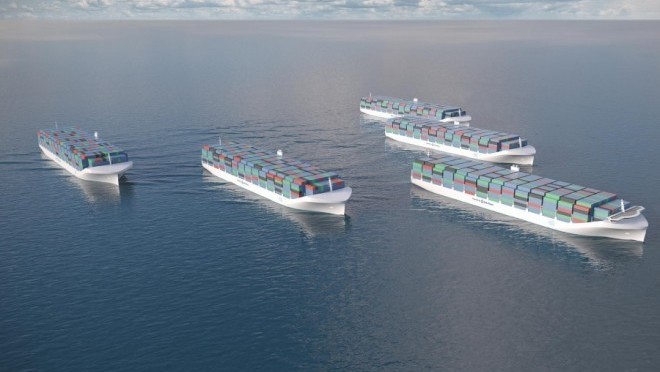
Commercial enterpirses pursue the possibility of massive drone-ships, bringing new possibilities and vulnerabilities as our virtual network and our trade network grow closer together. Remember those pirates?

Fishing fleets have their own interests and controls – their operations and movement impacting global politics from the Gibraltar to the South China Sea. Sometimes inadvertant, sometimes purposeful, their movements can motivate states or global institutions – from territorial disuptes, to security, to environmental concerns.

Activists attempted to plant Chinese flags on the Senkaku Islands, which are controlled by Japan, as an assertion of the Chinese regime's sovereignty over the uninhabited islands. (Jingcai Mingren/Weibo.com)
Activists planting Chinese flags on Japanese-controlled Senkaku Islands. (Jingcai Mingren/Weibo.com)

Ever-better organized and equipped activists are taking to the high-seas, battling whalers or even states. From the Sea Shepards to the “amphibious landings” of Japanese and Chinese activists in the Senkakus, civilians are taking the politics to sea. Somalian piracy actually started as activism, fisherman-come-vigilantes.

Terrorists are an unfortunate reality on the high seas, from the category of at-sea terrorist attacks to the use of amphibious operations as vectors for attack from Israel to Mumbai. Some groups, such as the Tamil Tiger’s “Sea Tigers”, even went so far as be considered a possible real-world naval force.

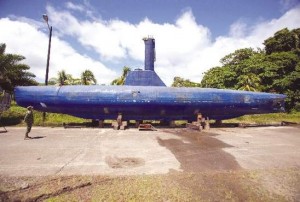
Colombian authorities discovered this fully functional narco-submarine in 2011. The vessel could carry 8 tons of cocaine and has a range of 8,000 miles. The submarine is similar to the Colombian Navy's own tactical sub, except this one has an interior bathroom and larger beds, sailors said. (Juan Manuel Barrero Bueno/Miami Herald/MCT)
Colombian authorities discovered this fully functional narco-submarine in 2011. The vessel could carry 8 tons of cocaine and has a range of 8,000 miles. The submarine is similar to the Colombian Navy’s own tactical sub, except this one has an interior bathroom and larger beds, sailors said. (Juan Manuel Barrero Bueno/Miami Herald/MCT)

Around the raucus political conflicts flows the silent  schemes of smugglers, black marketeers, and human traffickers. From drug runners to sanction busters, admirals are not the only ones trying to mask their position. Criminal enterprises conduct their own air-sea battle, even operating submarines to smuggle goods.

map_strategic_passages
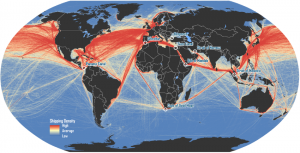
Shipping density data adapted from National Center for Ecological Analysis and Synthesis, A Global Map of Human Impacts to Marine Ecosystems.

The almost clinicically precise maps of the sea lines of communication would lead one to think that the oceans are a tame and organized place. Hardly. The sea is as alive with merchants, combatants, and all number of active players creating their own order and chaos.

ARTICLES ARE DUE 24 JULY TO NEXTWAR@CIMSEC.ORG OR IN OUR WORDPRESS QUEUE. LATE ENTRIES WILL BE ACCEPTED, BUT DON’T PUSH YOUR LUCK. THIS IS FIRST-COME, FIRST/MOST AWESOME SERVED.

The Hacking of Rome

This is the second article of our “Sacking of Rome” week: red-teaming the global order and learning from history.

This is not a prediction for the future, simply a thought experiment to tell a story of what might be. Thinking about how American power and influence might decline is not a slight to the United States. It is a strength. We are not a people blinded by American hubris, but instead are willing to honestly analyze the negative what-ifs while working toward the positive ones.

When discussing the fall of the United States, the initial reaction is to think of a dramatic collapse. Things such as losing World War III in an enormous battle or an economic collapse making the Great Depression look like a little setback could make for an engaging movie, but reality does not have to entertain – it simply has to be.

This is fiction, not a prediction, but hopefully it makes us think.

And Now for our Story…

The United States is powerless. Though our economy is still intact for the moment, our ability to influence events on the world stage and protect our national interests is gone. We try to turn to our allies for help, but even our oldest friends recognize that the balance of power has shifted and begin to reshape their alliances to look out for their best interests. We are alone, afraid, and powerless in a very complicated world. How did we get here?

The Age of Austerity

As the War on Terror wound down, the Department of Defense entered what has now become known as “the age of austerity.” We began to heed the warnings of Admiral Mike Mullen that our national debt is the biggest threat to our national security. It started with sequestration in 2013. The writing was on the wall that we were no longer the post-Cold War hegemon of the 1990s and once again simply a strong player within a multipolar world.

Before we knew it, China was no longer just a developing power. Profits from energy exports enabled Russia to regain its seat as a major player on the global stage. If there was a time for more guns and less butter it was then. But America was tired and mostly broke from over a decade of war, so the Department of Defense was forced to confront more diverse global challenges with fewer resources.

The future emerged amongst a sea of buzzwords and lightning bolts connecting nodes on countless PowerPoint slides within the Pentagon. It was impossible to attend a Department of Defense brief without network-centric warfare, cross-domain synergy, asymmetric advantages, and autonomous unmanned systems being heralded as the solution to all problems.

In an effort to preserve America’s military advantage while reducing long-term spending, we invested in unmanned technologies and the ability to network unmanned and highly advanced manned systems together. The network enabled coordinated operations across all domains almost simultaneously. This would provide the quick and overwhelming response necessary to defeat any adversary, and the best part was it required minimal personnel. Unmanned systems might have a high upfront cost, but they do not require a salary, medical care for dependents, or a retirement plan. The extra savings from eliminating as many people as possible enabled the establishment of a network of unmanned undersea, surface, air, and even space systems providing continuous intelligence, surveillance, and reconnaissance on a global scale and immediate coordinated response in the event of hostilities. The global influence of the United States was secured at a fraction of the long-term costs.

The Unmanned Network Watches All

The Bubble Bursts

The American drone network continuously patrols the Air Defense Identification Zones (ADIZs) which China has established encompassing the East and South China Seas. China has made repeated complaints to the United States and the United Nations, and there have been many close calls between American assets and the People’s Liberation Army (PLA) Navy and PLA Air Force resulting in the loss of some drones, but without loss of life. Relations are tense, but the global status quo is maintained. The strategic goal of the United States is to keep economic relations with China how they currently are.

Suddenly the handful of operators within the Joint Force Drone Operations Center necessary to monitor and operate the global unmanned network find themselves staring at blank screens. What happened? An unannounced drill? A power outage? A loss this extensive has never happened before. They wonder and begin to troubleshoot.

While the casualty to the network is being reported up the chain of command, drones begin disappearing from radar screens at monitoring stations around the world. A flight of drones scheduled to land at Kadena Air Base in Okinawa for routine maintenance and refueling never arrives. Reports even begin to arrive of flights taking off and immediately crash landing. U.S. Cyber Command is alerted and begins to investigate. Once they know what to look for, it does not take long to find the malicious code responsible and it is glaringly obvious where it originated. The PLA. Not only did they not try to cover their tracks, but it looks like they wanted us to know who was responsible.

The Overwhelming Opening Salvo of the Cyber War

The few remaining manned platforms – a mere shadow of the previous numbers during the Cold War – are ordered to sortie toward the western Pacific in a show of force. Everyone quickly makes a devastating discovery. They are receiving no signal from the Global Positioning System. Once they are out of sight from land, ships and aircraft have no idea where they are. The Fleet attempts to adapt. They pull out the old paper charts – which they luckily retained onboard. Utilizing their mechanical compass and dead-reckoning for navigation, they set sail and attempt to find the Chinese coast.

They might not be at 100% capability, but they can at least make a show of American power with presence. Luckily, satellite communications are still functioning so they can coordinate between each other and with their operational commander. As they cross the Pacific, one by one they drop out of communications. The failures are first noticed in the radio room, but they quickly spread to ship control, combat systems, and to engineering. Every U.S. platform is now blind, impotent, and dead in the water. Within a few short days the once-feared military power of the United States is defeated without any bloodshed. Not with a bang, but a whimper.

Jason H. Chuma is a U.S. Navy submarine officer who has deployed to the U.S. 4th Fleet and U.S. 6th Fleet areas of responsibility. He is a graduate of the Citadel, holds a master’s degree from Old Dominion University, and has completed the Intermediate Command and Staff Course from the U.S. Naval War College. He can be followed on Twitter @Jason_Chuma.

The opinions and views expressed in this post are his alone and are presented in his personal capacity. They do not necessarily represent the views of U.S. Department of Defense or the U.S. Navy.

Print, Plug, and Play Robotics

William Selby is a Marine Officer who previously completed studies at the US Naval Academy and MIT researching robotics. The views and opinions expressed in this article are his own.

In September 1999, NASA lost a $125 million Mars orbiter because a contracted engineering team used English units of measurement while NASA’s team used the metric system for a key spacecraft operation.[i] In everyday life we are forced to choose between differing formats with the same function. What was once VHS vs. Betamax became Blu-ray vs. HD DVD. A lack of component standardization can reduce the operational effectiveness of a system as shown by the NASA orbiter. More commonly, the end user may waste resources purchasing multiple components that serve the same purpose, as was the case for DVD players in the late 2000s. These same issues are occurring in the development, procurement, and operation of our unmanned systems. Over the last decade, the US military has amassed large numbers of unmanned systems composed of highly proprietary hardware and software components. However, future unmanned systems designed with interoperable hardware and software and constructed utilizing advanced manufacturing techniques will operate more effectively and efficiently than today’s platforms.


Advances in manufacturing techniques as well as efforts to standardize software and hardware development are being pursued in order to diminish the negative effects caused by proprietary components in unmanned systems. These new technologies focus on speed and customization, creating a new and evolving research, development, and production methodology. Modular designs increase the rate of production and upgrades while new manufacturing techniques enable rapid prototyping and fabrication on the front lines. Replacement parts can be stored digitally, produced on demand, and swapped between unmanned systems, reducing the system’s logistical footprint. This organic production capability will enable units to tailor manufacturing needs to match operational requirements. The resulting unmanned systems will operate with interchangeable payloads making them quick to adapt to a dynamic environment while common software will enable easier control of the vehicles and wider data dissemination.


Complementary Technologies


The concept of interoperable hardware and software is more formally referred to as open architecture (OA). DOD Directive 5000.1, “The Defense Acquisition System,” outlines the DOD’s goal to acquire systems that can be easily swapped between unmanned systems similar to the way different types of USB devices can be swapped out on a personal computer. [ii] This ranges from swapping sensor payloads between platforms to entire unmanned systems between services and countries.[iii] Establishing standards and creating policy for OA are the responsibilities of multiple organizations. For unmanned aerial systems (UASs), the Interoperability Integrated Product Team (I-IPT) drafts UAS System Interoperability Profiles (USIPs). Similarly, the Robotic Systems Joint Program Office (RS JPO) creates Interoperability Profiles (IOPs) to identify and define interoperability standards for unmanned ground systems. Several of the IOP standards have been adopted for unmanned maritime systems by the Naval Undersea Warfare Center.[iv]


Advances in manufacturing techniques complement and leverage the OA concept. In general, these techniques focus on converting a digital blueprint of a component into its physical form. The advantages of additive manufacturing, commonly known as 3D printing, have been recently publicized as well as potential military applications.[v],[vi],[vii],[viii] 3D printing creates the desired object in metal or plastic by converting liquid or powdered raw materials into a thin solid layer, forming a single layer at a time until the piece is completed. Less mature technologies include Printed Circuit Microelectromechanical Systems (PC-MEMS) uses 3D printing to create a flat object of rigid and flexible materials with special joints that are later activated turning the flat object into a three-dimensional object much like a children’s pop up book. [ix],[x] A final technique inspired by origami involves etching crease patterns into flat sheets of metal allowing them to be quickly folded and assembled into complex components. [xi]


Lifecycle Impacts


Production of future unmanned systems will be altered by these technologies beginning with the initial system requirements.[xii] Standard capability descriptors minimize the need for a single, large business to create and entire unmanned system. This will allow small businesses to focus research and development on a single capability that can be integrated into multiple platforms requiring that capability thereby increasing competition and innovation while reducing initial procurement costs.[xiii],[xiv] These unmanned systems will be easily upgradeable since payloads, sensors, and software are anticipated to evolve much faster than the base platforms.[xv] Open hardware and software ensures that upgrades can be designed knowing the component will function successfully across multiple platforms. Advanced manufacturing techniques will enhance the development of these upgrades by allowing companies to rapidly prototype system components for immediate testing and modification. Companies can digitally simulate their component to verify their design before mass producing a final version with more cost effective traditional manufacturing techniques. The final version can then be digitally distributed enabling the end user to quickly load the most recent version before production.


These technologies also have the potential to significantly impact supply chain management and maintenance procedures required for unmanned systems. Since components can be swapped across multiple platforms, it will no longer be necessary to maintain independent stocks of proprietary components unique to each platform. If a component can be created using organic advanced manufacturing techniques, only the digital blueprint and raw materials need to be available. While the strength of components created using additive manufacturing may not be enough for a permanent replacement, temporary spare parts can be created in a remote area without quick access to supplies or depot repair facilities while permanent replacements are delivered. This reduces the logistical footprint and maintenance costs by limiting the number of parts and raw materials required to be physically stored for each system.


Most importantly, these technologies will produce unmanned systems with the operational flexibility necessary for the unknown conflicts of the future. Components ranging from power systems to sensor payloads can be quickly and easily swapped between platforms of varying vendors, selected to fit the mission requirements and replaced as the situation develops.[xvi]Standardizing the sensor’s data transmission format and metadata will generate timely and accurate data that is more easily accessed and navigated by all interested parties.[xvii] An early example of these advancements, the Army’s One System Remote Video Terminal, allows the user to receive real time video footage from multiple platform types as well as control the sensor payload.[xviii],[xix] Digital libraries will close the gap between developer and user ensuring the most recent component design is manufactured or the latest software capability is downloaded and transferred across platforms.[xx] Standardized communications protocols between the platform and the controller will enable a single controller to operate different platforms, as recently demonstrated by the Office of Naval Research.[xxi] Further into the future, the operator may be able to control multiple unmanned systems across various domain simultaneously.[xxii],[xxiii] The ability to create heterogeneous “swarms” of unmanned systems with varying sensor suites in different physical operating environments will give the commander the flexibility to quickly configure and re-configure the unmanned system support throughout the duration of the operation.


New Technologies Create New Vulnerabilities


As these technologies are implemented, it is important to keep in mind their unique limitations and vulnerabilities. The stringent qualification process for military components, especially those with the potential to harm someone, is often described a key limitation to the implementation of modular components.[xxiv] However, without people on board, unmanned systems have lower safety standards making it easier to implement modular components in final designs. Compared to traditional methods, additive manufacturing is slow and produces parts limited in size. The materials have limited strength and can be 50 to 100 times more expensive than materials used in traditional methods.[xxv] While future development will decrease prices and increase material strength, traditional manufacturing techniques will remain more cost effective means of producing high volume items into the near future. Additionally, open designs and digital storage can create vulnerabilities that may be exploited if not properly secured. Militants in Iraq purportedly viewed live video feeds from UASs using cheap commercial software while Chinese cyberspies allegedly gained access to many of the US’s advanced weapons systems designs.[xxvi],[xxvii] Further, digital blueprints of parts have the potential to be modified by nefarious actors to create counterfeit or falsified parts.[xxviii] As the price of manufacturing equipment quickly drops, anyone can create the products when given access to the digital copies.[xxix]


Future technological innovations have the ability to modify traditional supply methodologies allowing the end user to manufacture parts on demand for use in a variety of unmanned systems. Proprietary hardware and software can be minimized, resulting in unmanned systems with smaller logistical footprints condensing vulnerable supply chains while reducing overall system cost. These benefits are tempered by the unique vulnerabilities that arise when standardizing and digitizing unmanned system designs. Despite these potential vulnerabilities, the ability to equip a force with increased capability while reducing costs and logistical requirements is indispensable. While the locations of the next conflicts will remain hard to predict, unmanned systems able to complete a variety of missions in remote areas with limited logistical support will become an operational necessity.


[i] Lloyd, Robin, Metric mishap caused loss of NASA orbiter, accessed athttp://www.cnn.com/TECH/space/9909/30/mars.metric.02/index.html?_s=PM:TECH, 30 September 1999.

[ii] U.S. Department of Defense, DOD Directive 5000.1 – The Defense Acquisition System, Washington D.C., 12 May 2003.

[iii] U.S. Department of Defense, Unmanned Systems Integrated Roadmap FY2013-2038, Washington D.C., 2013.

[iv] U.S. Department of Defense, Unmanned Systems Integrated Roadmap FY2013-2038, Washington D.C., 2013.

[v] Llenza, Michael, “Print when ready, Gridley,” Armed Forces Journal, May 2013.

[vi] Beckhusen, Robert, Need Ships? Try a 3-D Printed Navy, accessed at http://www.wired.com/dangerroom/2013/04/3d-printed-navy/, 04 May 2013.

[vii] Cheney-Peters, Scott and Matthew Hipple, “Print Me a Cruiser!” USNI Proceedings, vol. 139, April 2013.

[viii] Beckhusen, Robert, In Tomorrow’s Wars, Battles Will Be Fought With a 3-D Printer, accessed at http://www.wired.com/dangerroom/2013/05/military-3d-printers/, 17 May 2013.

[ix] Leung, Isaac, All abuzz over small pop-up machines with Printed Circuit MEMS, accessed at http://www.electronicsnews.com.au/news/all-abuzz-over-small-pop-up-machines-with-printed-, 22 February 2012.

[x] Wood, R.J., “The First Takeoff of a Biologically Inspired At-Scale Robotic Insect,” Robotics, IEEE Transactions on , vol.24, no.2, pp.341,347, April 2008.

[xi] Soltero, D.E.; Julian, B.J.; Onal, C.D.; Rus, D., “A lightweight modular 12-DOF print-and-fold hexapod,” Intelligent Robots and Systems (IROS), 2013 IEEE/RSJ International Conference on , vol., no., pp.1465,1471, 3-7 Nov. 2013.

[xii] U.S. Department of Defense, Unmanned Systems Integrated Roadmap FY2011-2036, Washington D.C., 18 September 2012.

[xiii] Real-Time Innovations, Interoperable Open Architecture, accessed at

http://www.rti.com/industries/open-architecture.html, 2012.

[xiv] U.S. Department of Defense, Unmanned Systems Integrated Roadmap FY2013-2038, Washington D.C., 2013.

[xv] U.S. Department of Defense, Unmanned Systems Integrated Roadmap FY2013-2038, Washington D.C., 2013.

[xvi] Real-Time Innovations, Interoperable Open Architecture, accessed at

http://www.rti.com/industries/open-architecture.html, 2012.

[xvii] Crawford, Katherine, ONR Provides Blueprint for Controlling All Military Unmanned Systems, accessed at http://www.onr.navy.mil/Media-Center/Press-Releases/2013/ONR-Provides-Blueprint-for-Controlling-UAVs.aspx, 01 May 2013.

[xviii] Shelton, Marty, Manned Unmanned Systems Integration: Mission accomplished, accessed at http://www.army.mil/article/67838, 24 October 2011.

[xix] AAI Corporation, One System Remote Video Terminal, accessed at https://www.aaicorp.com/sites/default/files/datasheets/OSRVT_07-14-11u.pdf, 14 July 2011.

[xx] Lundquist, Edward, DoD’s Systems Control Services (UAS) developing standards, common control systems for UAVs, accessed at GSNMagazine.com, 06 January 2014.

[xxi] Crawford, Katherine, ONR Provides Blueprint for Controlling All Military Unmanned Systems, accessed at http://www.onr.navy.mil/Media-Center/Press-Releases/2013/ONR-Provides-Blueprint-for-Controlling-UAVs.aspx, 01 May 2013.

[xxii] DreamHammer goes Ballista for multi-vehicle control software, Unmanned Daily News, 15 August 2013.

[xxiii] SPAWAR Systems Center San Diego, Multi-robot Operator Control Unit (MOCU), accessed at http://www.public.navy.mil/spawar/Pacific/Robotics/Pages/MOCU.aspx.

[xxiv] Freedberg, Sydney J., Navy Warship Is Taking 3D Printer To Sea; Don’t Expect A Revolution, accessed at http://breakingdefense.com, April 2014.

[xxv] McKinsey Global Institute, Disruptive technologies: Advances that will transform life, business, and the global economy, accessed at http://www.mckinsey.com/insights/business_technology/disruptive_technologies, May 2013.

[xxvi] Gorman, Siobhan, Yochi Dreazen, and August Cole, Insurgents Hack U.S. Drones, The Wall Street Journal, 17 December 2009.

[xxvii] Nakashima, Ellen, Confidential report lists U.S. weapons system designs compromised by Chinese cyberspies, The Washington Post, 27 May 2013.

[xxviii] NexTech, Project Summary, NOETICGROUP.COM, April 2012.

[xxix] Llenza, Michael, “Print when ready, Grindley”, Armed Forces Journal, May 2013.



Embracing Pandora’s Box – Unleash the Drone Exports

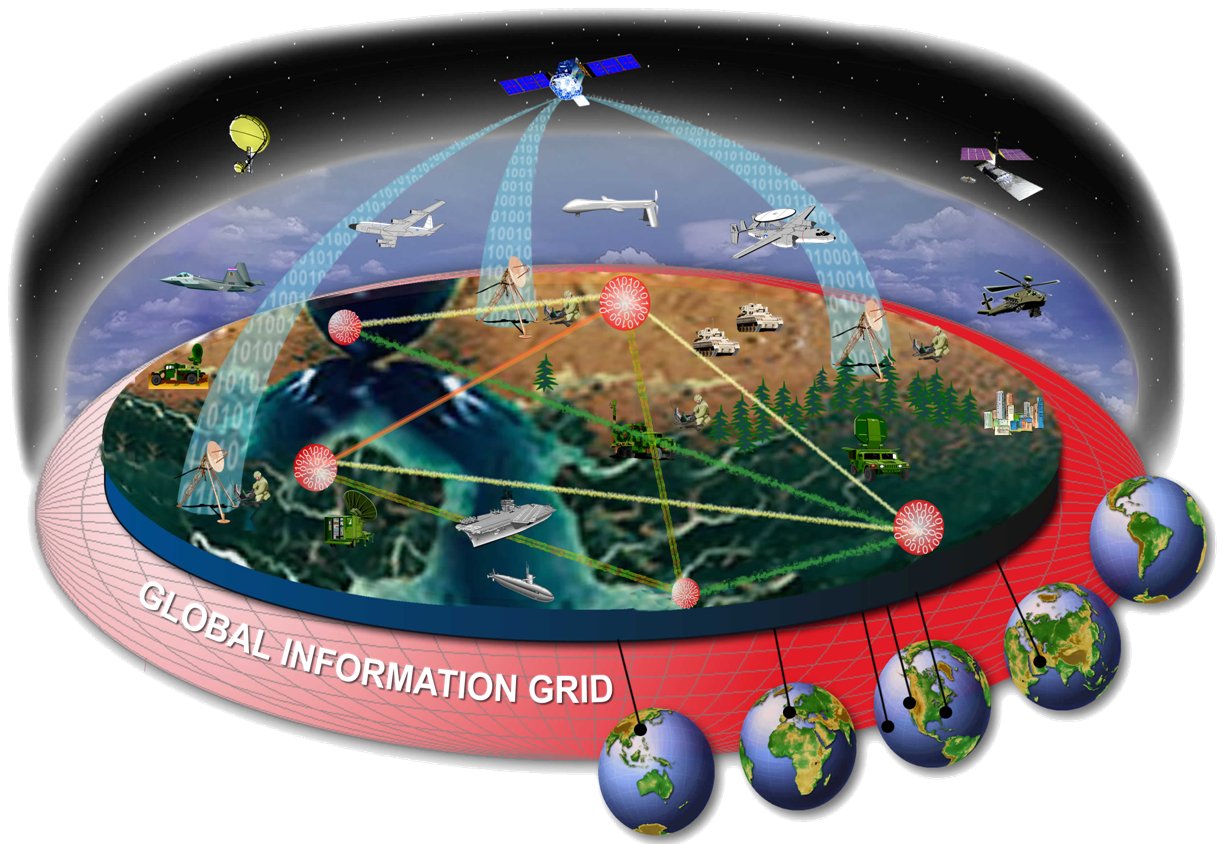
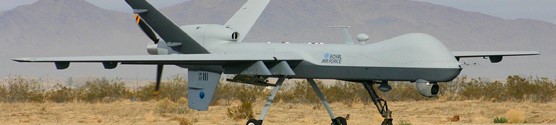
Drones are a rapidly expanding market in the international arms trade. Intelligence, surveillance, and reconnaissance (ISR) is crucial for operating in the modern battlespace and drones are the best way to get that information by maximizing loiter and removing risk to a pilot. Demand is high and supply is low; only a few countries produce the class of drones that are most in demand. This would seem a perfect market for the United States to sell its wares and dominate the exchange but it is currently hamstrung by policies which discourage their export. The hesitation to export the technology, while done for good reasons like maintaining United States’ technological advantage and protecting a powerful capability from exploitation by foreign agents, is misguided; without the powerful network of communications satellites and Global Information Grid (GIG), the drones themselves are little more than complex model airplanes with good cameras. The United States’ efforts are akin to closing Pandora’s Box because of imagined evils without recognizing the good that remains left trapped inside.
 
Exporting drones is a good thing for the United States. First, it promulgates a capability we want our allies and partners to possess. For years, British and Italian MQ-9 Reapers have patrolled the skies over Afghanistan, bringing the twin benefit of additional ISR to the battlefield and eliminating the need for American assets to cover those units. In addition, the British have armed MQ-9s that provide additional strike assets to coalition operations. The United States only stands to gain by exporting more of these assets.
 
Dominating the supply of drones brings the United States leverage it would not otherwise have. Just as with other aviation assets, drones need a steady stream of supplies to be viable. If the country that operates those assets uses them for purposes that are against the United States’ interests, the United States can then press forward with sanctions and cut off supply of crucial parts needed to keep the assets operational. In a world fraught with fault lines and shifting loyalties, leverage matters.
 
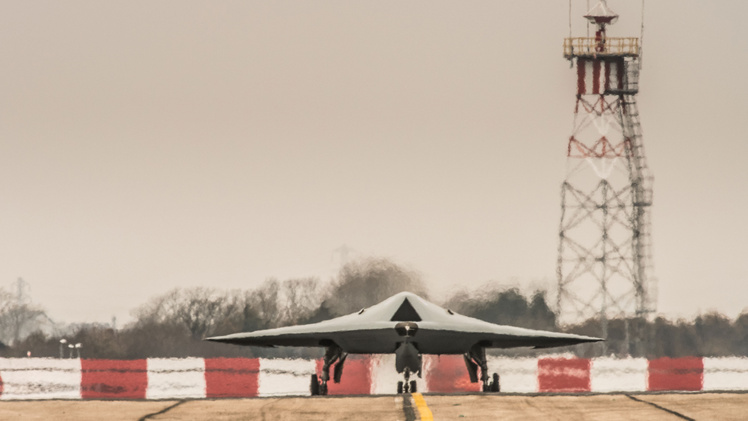
There are a couple arguments in favor of restricting drone exports. The first is wishful thinking. The argument holds that by restricting the sale of to foreign clients, we will deny them drone capabilities, particularly their ability to conduct strike missions. The problem is that Pandora’s Box is already open. Even though there are few suppliers of in the field right now, there are many others that are about to enter the market. A joint European consortium, led by France, is developing the nEUROn. Britain is developing the Taranis. China is aggressively marketing the ASN-209 at international airshows. Chris Rawley highlighted Singapore’s entry into the market in his recent article (https://cimsec.org/unmanned-systems-distributed-operations-one-many/). Even Turkey is developing the Anka. If there are lots of suppliers, the United States will no longer have its privileged negotiating position and will need to make more available to encourage use of its platforms. This means expanding the list of what is exportable and seriously considering exporting armed assets.
Taranis
Britain is developing the Taranis, one of many competitors the United States will face in the international drone marketplace (image from BAE Systems)
 
The other argument against exporting drones is out of fantasy (as Dave Blair elucidates in his excellent article here: https://cimsec.org/remote-aviation-technology-actually-talking/). The argument goes that the United States should not export drones because they are a revolutionary capability that would unfairly strengthen possible adversaries. This, too, falls short. The aircraft themselves are only a small portion of the equation and what makes them great tools of war. The real strength of drones is their ability to conduct global operations which requires the United States’ network of satellite communications to operate in a distributed manner. Without that network, the drones are nothing more than a more capable model airplane that linger longer than a fighter or helicopter.
 
The story of Pandora’s Box ends with Pandora desperately shutting the lid in a vain attempt to keep bad things from entering the world. Unfortunately for Pandora, it was too late; the damage was done. The only effect that she reaped by keeping the box closed was to leave hope penned inside. While the United States did not unleash the desire for countries to acquire drones, it certainly is achieving the same effect as Pandora by ignoring the world in which it lives. The better course of action is to recognize what drones are truly capable of on their own and embrace an export mindset.
Matthew Merighi is a civilian employee with the United States Air Force’s Office of International Affairs (SAF/IA). His views do not reflect those of the United States Government, Department of Defense, or Air Force.