Tag Archives: drones

Drones and the Human-War Relationship

Robots fascinate humans. They abound in movies: Star Wars, the Terminator, the Matrix. They are a foil for the human condition. In rosy predictions they are like Star Trek’s Data, “perfect” in strength and intellect yet void of emotion. In dystopian futures, killer robots are poetic justice. Created by humanity, robots attempt to annihilate their creators. If told killer robots exist in the U.S. arsenal, most Americans would probably think of “drones.” The name sounds robotic; it implies automaton behavior. Drones lack an onboard crew, and just like robots, drones fascinate Americans. In one important way, however, drones are not robots: they are flown by humans; they are just flown by remote control, but this creates a problem all of its own.

The Armed Forces are not even sure how to deal with drone pilots. The pilots play a pivotal role in combat operations. They make life or death decisions. They press the button to fire missiles. They probably engage in more “lethal actions” than other air units at present. Nevertheless, most fellow service members and the public at large do not think drone pilots hold “combat” jobs. Our system cannot square the responsibilities these service members have with the lack of surrounding danger.

The presence of danger has always been a defining characteristic of war and particularly in the way civilians see the armed forces. While Americans generally no longer glorify the taking of spoils, we do glorify success in the face of adversity and particularly danger. American society regularly “thanks” service members with things like recognition at sporting events and military discounts. These types of recognition purposely avoid mention of the policies those being thanked implement: “Support the Troops, whether you support the war or not.” But that approach only works if service members are seen to represent honorable values like service and sacrifice. Take away the danger and something of those values seems to disappear too.
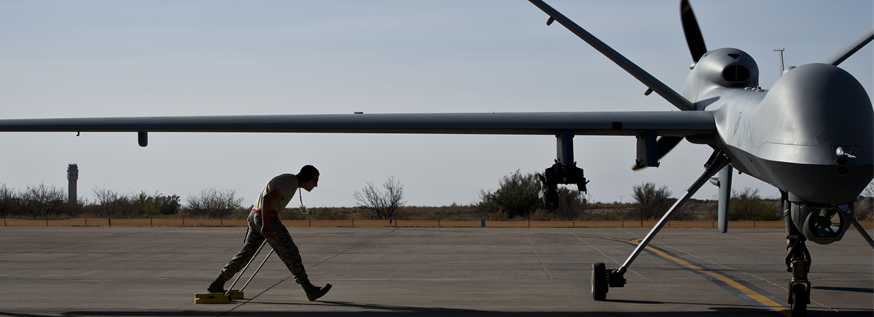
130424-F-NL936-999.JPGOf course, some soldiers have always been relatively safe, performing jobs in the rear areas. Most civilians do not see past the uniform, but service members know who is actually at the front (though ironically the insurgencies of the past 40 years have eroded the difference). For those actually pulling the trigger, danger was always at least reciprocal if not near. While an artilleryman might not have been within rifle range of the enemy, he was in range of the enemy’s artillery.  Even ballistic missile crews in the United States were held at risk by their Soviet counterparts during the Cold War.

Drone pilots seem different because there is no reciprocity, but even that does not quite make drone pilots unique. The U.S. government has long looked to reduce danger to service members. Drones are only the latest idea. As the old Army saying goes “Why send a man if you can send a bullet?” The Navy has fully embraced this idea. The ships that launch manned aircraft and Tomahawk cruise missiles (a true killer robot) from the Mediterranean are in no more danger today than if they were training off the coast of California or Virginia. The closest most shipboard sailors have come to fighting in the last 10 years is pressing a button and then rushing to the TV in hopes that CNN will cover the resulting explosions. The Navy still uses the Iranian mine-laying operations in the late 1980s to justify for “imminent danger” pay for crews. If the Navy has not faced the same challenges as the drone community it is principally because distance from American shores obscures what is going on. A similar lack of reciprocity exists for most air and even some ground forces, both masked by distance. Indeed, this lack of reciprocity in many aspects of warfare is inherent to the asymmetric wars in which the United States has engaged.

Wars of the future may ameliorate this problem in some situations but will likely exacerbate in most. As the United States again faces the potential of great power conflict, the likelihood it will face an adversary with advanced air, land, and sear forces greatly increases. Nonetheless, a key lesson of the past decades has been that those who fight the United States on its own terms lose. This situation is likely to remain unchanged for several decades. Thus even great power competitors will seek to field forces that challenge American forces asymmetrically which made lead to situations lacking reciprocity even as the United States continues to develop technology to further protect its service members from danger.

Drones illuminate a problem which has already existed and will only grow in the future: In a society that professes not to value military spoils, how does the relationship with the armed forces change as service members become increasingly removed from danger?

Long-range weapons like artillery, naval gunfire, or close air support in a combined arms environment may suggest an answer. The Marine Corps has best developed this idea. Every Marine who is not primarily a rifleman understands his or her purpose is to support rifleman. For the naval gunnery liaison officer, his or her job directing the shore bombardment in support of forces ashore becomes more important because that officer operates from the relative safety of the ship but his or her actions mean life or death for forces ashore. At their best, these units draw their identity from the support and protection they provide to those in the greatest danger, and those in danger would never deny the importance of that support when well executed.

Without a doubt, danger will never disappear, nor should we reduce efforts to lessen it, but we must begin to think about a how the armed forces will relate to society as fewer service members go in harm’s way. While drones may not actually be robots, in one at least one way their arrival seems to have played a similar role: Drones have highlighted an all too human problem about how people relate to war.

Erik Sand is a Surface Warfare Officer in the U.S. Navy and a graduate of Harvard University. His opinions are his own and do not represent the views of the U.S. Navy or Department of Defense.
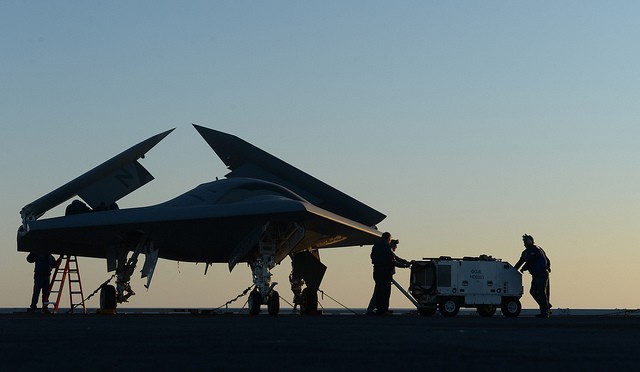

A New Kind of Drone War: UCAV vs UCLASS

This article was originally posted by with our partners at the Australian Strategic Policy Institute (ASPI’s) The Strategist.

The Australian government recently approved the acquisition of a fleet of US Navy Triton surveillance drones to patrol our oceans. Australia has mostly used Israeli drones to date, such as the Herons in Afghanistan. So as we dip our toes into the American UAV market, it’s worth taking note of a recent development that might be threatening US primacy in this area.

While the Predator and Reaper laid the groundwork for the use of armed drones in warfare, a question remains about the survivability of the technology against modern air defences. Developing a stealthy long-range drone with a decent weapons payload that could go beyond missions in Yemen and Pakistan appeared to be the next order of business for the US, especially in the future Asia-Pacific theatre. Projects like the demonstrator X-47B unmanned combat air vehicle (UCAV) have shown promise in achieving those missions. But for now the US Navy has decided to go for an unmanned carrier-launched surveillance and strike (UCLASS) system that won’t have the stealth or payload to penetrate air defences.

The UCLASS system will be designed to provide Navy carriers with long-range surveillance and strike capabilities to target terrorists in much the same way as the Air Force’s drones are currently doing from bases around the world. The capacity to carry out those missions without relying on foreign bases is driving this decision, along with lower costs. But the UCLASS system will only operate over states that have limited air defences (because of UCLASS vulnerability) or have provided the US permission to conduct strikes. Al-Qaeda affiliates are on the rise in Syria, where the Assad regime is both hostile toward the US and has the capability to deny drones. This raises the question of how many states will fit this category.

Consequently, at a program cost of US$3.7 billion, the UCLASS won’t provide the degree of innovation the 2014 Quadrennial Defense Review (PDF) advocated. This would be money better spent on more research and development (R&D) into a UCAV, which could potentially have greater impact in the future strategic environment. Moreover, the UCLASS would be mostly redundant in Asia, the most strategically important future region for the US. UCAVs, on the other hand, could have an impact in, for example, a future conflict with China. According to Mark Gunzinger and Bryan Clark at the Center for Strategic and Budgetary Assessments (CSBA), a UCAV with a range of 2,000kms, broadband stealth, a payload to rival the manned F-35C combat aircraft, and a capacity for aerial refuelling, is achievable. Developing a UCAV that’s survivable is no mean feat, but the US has a good start in terms of support systems and personnel established over the past few decades.

UCAVs would be capable of rapid deployment from carriers, which could stay out of the range of anti-access threats. A persistent surveillance capability that could also strike vital command and control and air defence sites if required could open the way for follow-on operations by manned aircraft. A UCAV would form a valuable part of the US deep strike suite, a key feature of AirSea Battle (PDF). And while losing platforms is never good, drastically reducing risk to personnel is a major incentive, especially early on in a conflict.

China’s an active player in drone development, and the PLA’s R&D investments are another good reason for the US to think carefully about holding off on UCAV development. China’s Sharp Sword UCAV, which was flight-tested in 2013, shows the PLA’s commitment to creating a mix of manned and unmanned combat aircraft. The growing Chinese defence budget (with a reported increase of a 12% this year) could lead to rapid advances in this area.

Funding the UCAV is the big question considering the cuts to the US defence budget; its price-tag would be heftier than the UCLASS. Proponents of the UCAV such as CSBA and the Center for New American Security (CNAS) (PDF), argue that the money could come from decommissioning two (or possibly more) carrier groups. Budget pressures have already seen cuts and deferrals to the carrier force and it would be a big step to cut two more. What’s important in these perspectives, however, is that the UCAV’s stand-off capacity and flexibility could make each carrier more effective. As Michael O’Hanlon pointed out on The Strategist last month, capability should be the metric of adequacy, not dollars or hull numbers.

The UCLASS could be redundant by the time it enters service in 2020, even in the targeted killing missions it’s designed to carry-out. A UCAV, on the other hand, would stretch the envelope in relation to advanced technologies, which would contribute to sustaining US strategic advantage. It would enhance a carrier group’s capability to respond to anti-access threats and it could also be versatile enough to respond to terror threats globally. Unmanned systems show no signs of fading into the background, and even in a tight fiscal environment represent a potentially high payoff for R&D funds.

Rosalyn Turner is an intern at ASPI.

Drones, Ethics, and The Indispensable Pilot

The on-going conversation about the ethics of drones (or of remotely piloted aircraft[1]) is quickly becoming saturated. The ubiquity of the United States’ remotely piloted aircraft program has arisen so suddenly that ethicists have struggled just to keep up. The last decade, though, has provided sufficient time for thinkers to grapple with the difficult questions involved in killing from thousands of miles away.

In a field of study as fertile as this one, cultivation is paramount, and distinctions are indispensable. Professor Gregory Johnson of Princeton offers a helpful lens through which to survey the landscape. Each argument about drone ethics is concerned with one of three things: The morality, legality, or wisdom of drone use.[2]

Arguments about the wisdom (or lack thereof) of drones typically make value judgments on drones based upon their efficacy.[3] One common example argues that, because of the emotional response drone strikes elicit in the targets’ family and friends, drone strikes may create more terrorists than they kill.

Legal considerations take a step back from the question of efficacy. These ask whether drone policies conform to standing domestic and international legal norms. These questions are not easily answered for two reasons. First, some argue that remote systems have changed the nature of war, requiring changes to the legal norms.[4] Second, the U.S. government is not forthcoming with details on its drone programs.[5]

The moral question takes a further step back even from the law. It asks, regardless of the law, whether drones are right or wrong–morally good, or morally bad. A great deal has been written on broad questions of drone morality, and sufficient summaries of it already exist in print.[6]

If there is a void in the literature, I think it is centered on the frequent failure to include the drone operator in the ethical analysis. That is, most ethicists who address the question of “unmanned” aircraft tend to draw a border around the area of operations (AOR) and consider in their analysis everything in it–enemy combatants, civilians, air power, special operations forces (SOF), tribal leaders, hellfire missiles, etc. They are also willing to take one giant step outside the AOR to include Washington–lawmakers, The Executive, military leaders, etc. Most analyses of the ethics of drones, then, include everyone involved except the operator.[7] This is problematic for a number of reasons discussed below.

Bradley Strawser, for example, argues in favor of remote weapons from a premise that leaders ought to reduce risk to their forces wherever possible. He therefore hangs his argument on the claim that drone pilots are not “present in the primary theater of combat.”[8] While this statement is technically correct, it is misleading. The pilot, while not collocated with the aircraft, plays a crucial role in the ethical analysis.

Sarah Kreps and John Kaag argue that the U.S.’s capability to wage war without risk, may make the decision to go to war too easy. Therefore, any decision to go to war under such circumstances may be unjust.[9] This view is contingent upon a war without risk, which fails to consider the operator, and the ground unit the operator supports.

Paul Kahn goes so far as to call remote warfare “riskless.” But suggesting that remote war is riskless supposes that at least one side in the conflict employes no people at all. Where there are people conducting combat operations, there is risk. Contrary to Kahn’s position, drones are controlled by people, in support of people, and thus, war (as we know it) is not riskless.

The common presupposition throughout these arguments, namely that remote war does not involve people in an ethically meaningful way, is detrimental to a fruitful discussion of the ethics of remote warfare for three reasons.

First, the world has not yet seen, and it may never see, a drone-only war. What that means is that even though the drone operator may face no risk to him or herself, the supported unit on the ground faces mortal risk.[10] The suggestion, then, that a remote warfare capability produces war without risk is empirically untenable.

Second, there exist in this world risks that are non-physical. Cases of psychological distress (both in the military and outside it) abound, and the case has been made in other fields that psychological wounds are as real as physical ones.[11] There have already been a small number of documented post-traumatic stress disorder (PTSD) cases among drone operators.[12] Though the number of cases may be small, consider what is being asked of these individuals. Unlike their counterparts, RPA crews are asked to take life for reasons other than self defense. It is possible, and I think plausible, to suggest that killing an enemy, in such a way that one cannot ground the justification of one’s actions in self-defense, may carry long-term, and latent, psychological implications. The psychological risk to drone operators is, then, present but indeterminate.

Finally, there is the often-neglected point that a government which chooses to conduct remote warfare from home changes the status of its domestic military bases. That government effectively re-draws the battlespace such that it includes the drone operators within its borders. RPA bases within the Continental United States (CONUS) become military targets that carry tremendous operational and tactical significance, and are thereby likely targets.

There is a fine point to be made here about the validity of military targets. According to international norms, any violent action carried out by a terror network is illegal. So what would be a valid military target for a state in wartime is still an illegal target for al Qaeda. Technically, then, a U.S. drone base cannot be called a valid military target for a terrorist organization, but the point here about risk is maintained if we consider such bases attractive targets. Because the following claims are applicable beyond current overseas contingency operations against terror networks, the remaining discussion will assume the validity of U.S. drone bases as targets.[13]

The just war tradition, and derivatively the international laws of war, recognize that collateral damage is acceptable as long as that damage does not exceed the military value of the target.[14] The impact of this fact on domestically operated drones is undeniable.

Suppose an F-15E[15] pilot is targeted by the enemy while she sleeps on a U.S. base in Afghanistan. The collateral damage will undoubtedly include other military members. Now suppose a drone operator is targeted while she sleeps in her home near a drone base in the U.S.. In this scenario, the collateral damage may include her spouse and children. If it can be argued that such a target’s military value exceeds the significance of the collateral damage (and given the success of the U.S. drone program, perhaps it can) then killing her, knowing that her family may also die, becomes legally permissible.[16] Nations with the ability to wage war from within their own domestic boundaries, then, ought to consider the consequences of doing so.[17]

There will be two responses to these claims. First, someone will object that the psychological effects on the drone operator are overstated. Suppose this objection is granted, for the moment. The world of remote warfare, though, is a dynamic one, and one must consider the relationship between technology and distance. The earths sphere creates a boundary to the physical distance from which one person can kill another person. If pilots are in the United States, and targets are in Pakistan, then the geometric boundary has already been reached.

It cannot be the case, now that physical distance has reached a maximum, that technology will cease to develop. Technology will continue to develop, and with that development, physical distance will not increase; but information transmission rates will. The U.S. Air Force is already pursuing high definition cameras,[18] wide area motion imagery sensors,[19] and increased bandwidth to transmit all this new data.[20]

If technology has driven the shooter (the drone pilot, in this case) as far from the weapons effects as Earths geometry allows, then future technological developments will not increase physical distance, but they will increase video quality, time on station and sensor capability. Now that physical distance has reached a boundary, future technological developments will exceed previously established limits. That is, the psychological distance between killers and those they kill will decrease.[21] 

The future of drone operations will see a resurgence of elements from the old wars. Crews will look in a mans face, seeing his eyes and his fearthe killer must shoot at a person and kill a specific individual.[22] Any claim that RPA pilots are not shooting at people, but only at pixels will become obsolete. The command, dont fire until you see the whites of their eyesmay soon become as meaningful in drone operations as it was at Breeds Hill in 1775.[23]

As this technology improves, the RPA pilots will see a target, not as mere pixels, but as a human, as a person, as a husband and father, as one who was alive, but is now dead. Increased psychological effects are inevitable.

A second objection will claim that, although RPA bases may make attractive targets, the global terror networks with whom the U.S. is currently engaged lack the capability to strike such targets. But this objection also views a dynamic world as though it were static. Even if the current capabilities of our enemies are knowable today, we cannot know what they will be tomorrow. Likewise, we cannot know where the next war will be, nor the capabilities of the next enemy. We have learned in this young century that strikes against the continental United States are still possible.

The question of whether drones are, or can be, ethical is far too big a question to be tackled in this brief essay. What we can know for certain, though, is that any serious discussion of the question must include the RPA pilot in its ethical analysis. Wars change. Enemies change. Tactics change. It would seem, though, that remotely piloted weapons will remain for the foreseeable future.

Joe Chapa is a veteran of the U.S. Air Force. He served as a pilot and instructor pilot in Oklahoma, Nevada and Missouri, and completed two deployments to Afghanistan and Europe. He earned a B.A in Philosophy from Boston University, an M.A. in Theological Studies from Liberty Baptist Theological Seminary and an M.A. in Philosophy from Boston College (anticipated 2014). The views expressed here are of the author, and do not necessarily reflect those of the Air Force, the DoD or the U.S. government.

[1] Throughout this essay, I will use the terms ‘remotely piloted aircraft’ and ‘drone’ synonymously. With these terms I am referring to U.S. aircraft which have a human pilot not collocated with the aircraft, which are capable of releasing kinetic ordnance.

[2] This distinction comes from a Rev. Michael J. McFarland, S.J. Center for Religion, Ethics, and Culture panel discussion held at The College of The Holy Cross. Released Mar 13, 2013. https://itunes.apple.com/us/institution/college-of-the-holy-cross/id637884273. (Accessed February 25, 2014).

[3] The following contain arguments on the wisdom of drones. Audrey Kurth-Cronin, “Why Drones Fail:When Tactics Drive Strategy,”Foreign Affairs,July/August 2013; Patterson, Eric & teresa Casale, “Targeting Terror: The Ethical and Practical Implications of Targeted Killing,”International Journal of Intelligence and Counterintelligence”18:4, 21 Aug 2006; and Jeff McMahan, “Preface” in Killing by Remote Control: The Ethics of an Unmanned Military, Bradley Strawser, ed., (Oxford: Oxford University Press, 2013).

[4] For example, Mark Bowden, “The Killing Machines,” The Atlantic (8/16/13): 3. Others disagree. See Matthew W. Hillgarth, “Just War Theory and Remote Military Technology: A Primer,” in Killing by Remote Control: The Ethics of an Unmanned Military, Bradley Strawser, ed. (Oxford: Oxford University Press, 2013): 27.

[5] Rosa Brooks, “The War Professor,” Foreign Policy, (May 23, 2013): 7.

[6] For an excellent overview of the on-going discussion of drone ethics, see Bradley Strawsers chapter Introduction: The Moral Landscape of Unmanned Weaponsin his edited book Killing By Remote Control (Oxford: Oxford University Press, 2013): 3-24.

[7] This point highlights the merits of the Air Force’s term ‘remotely piloted aircraft’ (RPA). The aircraft are not unmanned. Etymologically, the term “unmanned” most nearly means “autonomous.”  While there are significant ethical questions surrounding autonomous killing machines, they are distinct from the questions of remotely piloted killing machines. It is only because the popular term “drone” is so pervasive that I have decided to use both terms interchangeably throughout this essay.

[8] Bradley Strawser, “Moral Predators: The Duty to Employ Uninhabited Aerial Vehicles,” Journal of Military Ethics 9, no. 4 (16 Dec 2010): 356.

[9] Though I do not have the space to develop it fully, this argument is well-grounded in the just war tradition, and is one of the stronger arguments against a military use of remote warfare technology.

[10] Since September eleventh, 2011, U.S. “drone strikes” have been executed under the Authorizatino for The Military Use of Force, signed by Congress in 2001. From a legal perspective, then, all drone strikes, even those outside Iraq and Afghanistan have been against targets who pose an imminnent threat to the United States. Thus, even any reported “targeted killings” in Yemen, Somalia, Pakistan, or elsewhere, were conducted in self-defense, and therefore involved risk.

[11] By way of example, consider cases of hate speech, bullying and ‘torture lite’ in Rae Langton, “Beyond Belief: Pragmatics in Hate Speech and Pornography,” in Speech & Harm: Controversies Over Free Speech, ed. Ishani Maitra and Mary Kate McGowan (Oxford: Oxford University Press, May, 2012), 76-77.; Isbani Maitra, “Subordinating Speech,” in Speech & Harcm: Controversies Over Free Speech, ed. Ishani Maitra and Mary Kate McGowan (Oxford: Oxford University Press, May, 2012), 96.; Jessica Wolfendale, “The Myth of ‘Torture Lite’,” Carnegie Council on Ethics in International Affairs (2009), 50.

[12] James Dao, “Drone Pilots Found to Get Stress Disorders Much as Those in Combat Do,” New York Times, (February 22, 2013).

[13] The question of whether organizations like al Qaeda are to be treated as enemy combatants (as though they were equivalent to states) or criminals remains open. For more on the distinction between combatants and criminals, see Michael L. Gross, “Assassination and Targeted Killing: Law Enforcement, Execution or Self-Defense?” Journal of Applied Philosophy, vol. 23, no. 3, (2006): 323-335.)

[14] Avery Plaw, Counting the Dead: The Proportionality of Predation in Pakistan,Bradley Strawser, ed. in Killing by Remote Control (Oxford: Oxford University Press, 2013): 135.

[15] A traditionally manned U.S. Air Force asset capable of delivering kinetic ordnance.

[16] This statement is only true of enemy states. As discussed above, all terror network targets are illegal targets.

[17] I have developed this argument more fully in “The Ethics of Remotely Piloted Aircraft” Air and Space Power Journal, Spanish Edition, vol. 25, no. 4, (2013): 23-33.

[18] Exhibit R-2, RDT&E Budget Item Justification, MQ-9 Development and Fielding, February 2012, (page 1). (http://www.dtic.mil/descriptivesum/Y2013/AirForce/stamped/0205219F_7_PB_2013.pdf) accessed 30 July 2013.

[19] Lance Menthe, Amado Cordova, Carl Rhodes, Rachel Costello, and Jeffrey Sullivan, The Future of Air Force Motion Imagery Exploitation Lessons from the Commercial World, Rand Project Air Force, (page iii). (http://www.rand.org/content/dam/rand/pubs/technical_reports/2012/RAND_TR1133.pdf) accessed 30 July 2013.

[20] Grace V. Jean, Remotely Piloted Aircraft Fuel Demand for Satellite BandwidthNational Defense Magazine,  July 2011. (http://www.nationaldefensemagazine.org/archive/2011/July/Pages/RemotelyPilotedAircraftFuelsDemandforSatelliteBandwidth.aspx) accessed 30 July 2013.

[21] Ibid, 97-98.

[22] Ibid, 119.

[23] George E. Ellis, Battle of Bunkers Hill, (Boston: Rockwell and Churchill, 1895), 70.

Unmanned Systems and Distributed Operations: Out of One, Many

Let’s face facts: it appears the U.S. Navy is incapable of building surface combatants, even small ones, for less than about a billion dollars apiece.  Consequently, it is likely the fleet will continue to shrink for the foreseeable future.  Yet it appears that the global demand for surface ship presence remains high for both peacetime operations and as an on-call force for contingency response.  So how can the Navy continue to meet worldwide operational commitments given fewer ships?  The key to maximizing the effectiveness of a declining surface force lies in combining suitable motherships with the latest unmanned warfighting technology.

Unmanned naval systems are rapidly proliferating internationally because they are increasingly capable and cheaper than manned alternatives for certain missions.  To date, sea-based unmanned systems have primarily conducted intelligence, surveillance, reconnaissance and mine countermeasures operations.  But within the next decade or so, we’ll see naval drones supporting a much wider spectrum of warfighting; including anti-submarine warfare, anti-surface warfare, electronic warfare, vertical replenishment, and even anti-air warfare. 

Fundamentally, naval warfare is about deploying payloads (sensors, weapons, and people) into different domains (water, air, land, and electromagnetic/cyber) from or against sea-based platforms.  These payloads have historically been delivered from ships, submarines, and aircraft.  Ships deploy offensive and defensive weapons, or those of their embarked aircraft, out to the limit of their organic sensors.  Sometimes they can be delivered over-the-horizon when cued by the sensors of another platform.  A guided missile destroyer fires its magazines of anti-aircraft weapons at targets it can detect and track.  A frigate deploys a single towed array sonar and perhaps a helicopter with sonobuoys and torpedoes that extend the reach of its ASW reach. A corvette can engage a surface threat within the range of its guns and surface search radar or electro-optical fire control system.  The point is that current naval operations are generally designed around weapons and systems hosted from surface combatants, so the number of primary platforms available limits the span of a Navy’s operations.

The Venus is an unmanned surface vehicle built by Singapore Technologies Electronics Limited (ST Electronics) and based on a hull developed by US company Navatek Ltd.

By employing distributed maritime operations, a single surface platform with embarked unmanned vehicles can operate over a wider area than one without.  Using a multi-tiered hub-and-spoke concept, a large surface ship should be capable of simultaneously operating dozens of air, surface, and sub-surface vessels.  Some of these would be launched from an intermediate staging craft carried on the mothership such as a RHIB or Unmanned Surface Vehicle, while others will launch directly from the main ship.  Currently, many of these intermediate platforms are manned, but in the future, large volume unmanned underwater vehicles and unmanned surface vehicles will operate for several days or more independently from a larger mothership which transports them into an operational theater.  The persistent over-the-horizon UUVs and USVs will deploy their own smaller drone counterparts to transport sensors or weapons the last dozens of miles to a target. 

Despite more than a few hiccups in her development, this distributed operations model is roughly the construct that the Littoral Combat Ship (LCS) will follow.  The off-board MIW and ASW mission packages will consist of a variety of UUVs, USVs, and the MQ-8B Firescout UAV.  The LCS was designed to shift out entire mission packages to use the same “sea frame” for surface, anti-surface, or mine counter-measures operations, although not at the same time.  The intent of this modularity was additional flexibility with fewer platforms; however, that concept of operations has not panned out because the ships will not be capable of shifting warfare areas as quickly as originally envisioned.  Rather than focusing on the LCS’ modularity and ability to transfer wholesale mission packages, it would be wiser to shift attention to finalizing the actual vehicles and interfaces that will support these warfare mission areas.  Moreover, LCS unmanned payloads that are not compatible with other vessels should be scrapped immediately.  With the future of the LCS program uncertain at best, unmanned vehicle integration lessons learned should be leveraged for other platforms. Flexibility and compatibility with multiple platforms are the key to ensuring a distributed operations model is successful.

Ships that feature spare volume for additional payloads and “interfaces” – flight decks, well decks, ramps, davits, and cranes – will be in highest demand for distributed operations involving drones.  So in addition to LCS, amphibious ships, the Joint High Speed Vessel (JHSV), Mobile Landing Platform (MLP), and other Military Sealift Command ships are included in this category.  In tune with the CNO’s “payload over platform” theme, given these attributes, ships that might otherwise not be considered state of the art warfighting vessels can have a new lease on life as unmanned motherships.  And ships that have generally been considered auxiliaries will now play a role in supporting offensive naval warfare by deploying sensors and weapons systems to complement the main batteries of high end surface combatants.  The end result of these drone motherships will be more sensors and weapons deployed across a wider ocean area with the same, if not smaller number of surface combatants.

The venerable Ponce’s recent conversion into an Afloat Forward Staging Base and its ongoing Arabian Gulf deployment is telling.  Ponce flew the ScanEagle UAV from her own flight deck, but also demonstrated the ability embark several Riverine Command Boats (RCBs) which can operate the PUMA UAV.  In a wartime scenario, each of these UAVs could support targeting for surface engagement (whether from a VBSS team or anti-surface missile).  During International Mine Countermeasures Exercises, Ponce deployed RHIBs with multiple mine-hunting UUVs.  So while a traditional surface ship might operate a boat or two and the same number of helicopters, using unmanned vehicles, that same platform can deploy numerous sensors and weapons at a considerable distance from the ship across all maritime domains.  

Distributed unmanned operations will require new concepts in afloat logistics.  Moored undersea docking stations to recharge the batteries of long range UUVs should be designed for air or surface deployment.  Unmanned air vehicles flying from surface ships will also support vertical resupply of distributed sea and ground elements operating hundreds of miles from their motherships.  This concept has been demonstrated successfully ashore with the K-MAX rotary wing vehicle which has flown 17,000+ sorties in Afghanistan since 2011, delivering over four million pounds of supplies to Marines in remote forward operating bases. 

The critical path to operational success will be tying all these systems together. Common technology standards and protocols must be developed sooner rather than later as discussed in detail here by Captain Lundquist.  Rather than relying on 40 year old legacy data-links, the architecture that connects manned and unmanned systems, regardless of domain, should be secure, light-weight, high-bandwidth, and affordable.  With today’s technology, those attributes need not be mutually exclusive.

The challenges and limitations to deploying these distributed unmanned concepts are non-trivial.  In addition to the issues with standards discussed above, autonomous algorithms need improvement, electrical storage capacity (especially for UUVs) must be increased, and cultural apprehension to offensive unmanned vessels need to be overcome.  But shrinking operational reach need not be a foregone conclusion with declining fleet size if the next wave in operating unmanned vehicles distributively is embraced.

CDR Chris Rawley is a surface warfare officer.  The opinions expressed are his own.