Category Archives: Strategic Outlook

Predictions and forecasting.

Forecast 2015: Maritime Challenges in the Indian Ocean

Guest Post by Vijay Sakhuja

What could be the trend lines for 2015 in the Indian Ocean? A quick survey of events, incidents and trends in the Indian Ocean during 2014 suggests that the region witnessed cooperation, competition and inclusiveness among the littoral states.

Three baskets could be identified: geopolitical, geostrategic and geo-economic, to help forecast trends in 2015. However, a caveat is in order i.e. these baskets can spring a number of surprises, given that ‘prediction is a risky business’.

IORA: Moving from Australia to Indonesia
In the geopolitical domain, the region remained peaceful and pan-Indian Ocean multilateral organizations such as the Indian Ocean Rim Association (IORA) and Indian Ocean Naval Symposium (IONS) were proactive and provided the platform and leadership to address issues of common interest among the partner states. The Perth Communiqué released in September 2014 reinforced the Association’s commitment to ‘building a more stable, secure and prosperous Indian Ocean region’ and promote the IORA’s six priority areas of cooperation. The regional navies met under the IONS banner and addressed a number of common security issues confronting the region.

Later in 2015, the IORA baton will pass from Australia to Indonesia who would continue to carry the great work done by the earlier Chair – India. The new government in Jakarta led by President Joko Widodo has endorsed the importance of maritime matters through the establishment of a new Coordinating Ministry for Maritime Affairs and announced the doctrine of ‘global maritime axis’ (poros maritim dunia). In addition, South Africa, the next Vice Chair of IORA, will prepare to take the leadership role in 2017. These provide ‘continuity and purpose’ to the IORA.

China and the Maritime Silk Road: Increasing footprints in the Indian Ocean
China would continue to make attractive offers to Indian Ocean states and seek support for the MSR. Its forays in the Indian Ocean can potentially sharpen difference between China and India and may even lead to these powers becoming more assertive.

During 2014, the Indian Ocean geostrategic environment, though peaceful, was a bit tenuous. The presence of Chinese submarines in the Indian Ocean created unease in New Delhi. Though predicted, it surprised the Indian strategic community and the Indian Navy is beefing up capabilities to respond to the Chinese forays in the Indian Ocean.

India was also ruffled by the Chinese Maritime Silk Road (MSR) initiative and its growing popularity among a number of Indian Ocean states particularly Bangladesh, Sri Lanka and Maldives. New Delhi believes that the MSR can potentially help China consolidate its naval / maritime strategy of access and basing in the Indian Ocean in support of PLA Navy’s future operations.

Continuing US Anchor
The US will continue to be the strategic anchor and security provider in the Indian Ocean and its role welcomed by the regional countries to ‘correct security imbalances, challenge the hegemony of any dominant power and ensure regional stability’.

Likewise, the UK decision to permanently position a number of power projection platforms  in the Persian Gulf prompted New Delhi to recall the idea of  Indian Ocean ‘Zone of Peace’ and withdrawal of extra regional naval powers from the Indian Ocean.

2015: End of Piracy, Attractiveness of Drug smuggling and Re-emergence of Maritime Terrorism in the Indian Ocean
One of the important positive developments in the Indian Ocean was the near total suppression of piracy in the Gulf of Aden / Somali coast. It took eight years for the naval forces from nearly two dozen countries including a number of UN Security Council resolutions, to send pirates back home.

However, another ugly face of illegal activities at sea i.e. drug smuggling appears to have caught the attention of the Indian Ocean countries. During 2014, the multinational forces operating in the Indian Ocean intercepted a number of dhows/boats carrying narcotics from South Asia bound for destinations in East Africa. Perhaps what is more disturbing is that east coast of Africa emerged popular among drug smugglers from Colombia. Kenyan President Kenyatta’s initiative to oversee the destruction of a vessel carrying about 370 Kilograms of heroin worth US $ 11.4 million in international market exhibited Indian Ocean countries resolve to counter global trade in narcotics.

The rise of the Al Qaeda in the Indian Subcontinent (AQIS), the new wing of the Al Qaeda, has already raised a new threat whether Pakistan will become a haven for maritime terrorism.

Will 2015 see the idea of “Blue Economy” leaping forward?
The geo-economic environment in the Indian Ocean witnessed the emergence of a new concept ‘Blue Economy’ led by Seychelles and Mauritius. The idea is resonating among a number of Indian Ocean littorals including Australia, Indonesia, Bangladesh, South Africa to name a few. The leaders are committed to the sustainable development of living and non-living marine resources to enhance food and energy security.

Will 2015 ensure better Search and Rescue Coordination?
Perhaps the most traumatic and heartrending events in 2014 were the tragic loss of Malaysian Airlines flight MH 370 in the southern Indian Ocean, which still remains a mystery, and the more recent loss of Air Asia flight QZ 8501 in the Java Sea. These were stark reminders of the need to develop robust search and rescue (SAR) mechanism in the Indian Ocean. Yet, these incidents exhibited the Indian Ocean countries’ commitment to provide ‘public goods at sea’ and a number of navies deployed their navies for SAR.

Dr Vijay Sakhuja is the Director, National Maritime Foundation, New Delhi. The views expressed are those of the author and do not reflect the official policy or position of the National Maritime Foundation. He can be reached at director.nmf@gmail.com.

This article is courtesy Institute of Peace and Conflict Studies (IPCS), New Delhi and originally appeared at http://www.ipcs.org/article/china/ipcs-forecast-the-indian-ocean-in-2015-4797.html It is a precis of the larger document of the same name, that is part of the IPCS’s ‘Forecast 2015’ series. Click here to read the full report.

Grail War 2050, Last Stand at Battle Site One

This piece by Dave Shunk is part of our Future Military Fiction Week for the New Year. The week topic was chosen as a prize by one of our Kickstarter supporters.

The nation state had decided not to invest in robotic armies. Autonomous killing machines were beyond their ethics. However, the enemy had no problem building autonomous robotic killing machines.

The enemy robotic land assault caught the nation state by surprise. The enemy forces especially sought to destroy the nation state’s treasure nicknamed “The Grail Project.”  The enemy’s battle plan sought to overcome the human defenders at the various Grail Project sites by overwhelming swarms.

The tactical fight went badly against the solely human forces defending the outlying Grail Project sites. The horde of enemy robotics on land, sea and air were the perfect attrition strategy.  Soul less killers, mass produced, networked together and built cheaply with advanced 3D printers in secret production facilities were deadly.

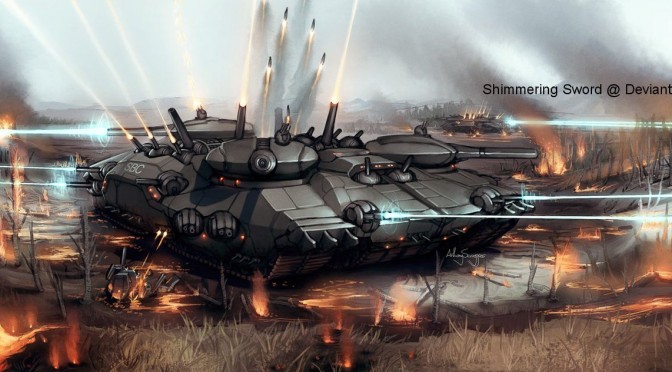
The nation state had not pursued the robotic armies but went a different route. HAL and Major Wittmann were the first experimental AI/Human team at training site “One” adjacent to one of the remaining Grail Project sites.  They were a prototype weapon – human and AI bonded together as a weapon system team within the tank with a shared neural network. However, this tank was unlike early 21st century tanks. This tank had advanced weapon systems – a tank on technology steroids.

HAL (Human Armor Liaison) is the artificial intelligence (AI) that controls the tank, the weapon systems, and communications. HAL is incorporated and encased into the advanced nanotechnology shell of the tank.  HAL has self repairing armor and neural circuits woven into the structure of the tank.  HAL also monitors the physical and mental health of Lt Wittmann via the neural connection with nanobot sensors throughout his body and bloodstream.

Major Wittmann has twelve years of service. He is a combat veteran, tank commander and human crew of one.  With genetic, physical and mental screening beginning in preschool, Major Wittmann began his military training early. He had the mental and intellectual capability for the nation state’s Human Performance Enhancement program. During his initial military training he received the neural implant for direct communication with advanced computer AIs. He also received nanotechnology enhancements in the form of nanobots in his blood stream to enhance and accelerate his cognitive and physical attributes.

HAL and Major Wittmann had trained as a team for two weeks. Due to the neural implant and nanobots, the bonding program progressed much quicker than human to human bonding. Days of training became the equivalent of months or years of purely human to human bonding. As the first AI/Human armored team they would chart the course for the fight against purely robotic forces. The speed of warfare had overtaken purely human skills due to AI and robotic technology.  At the same time science and technology opened new doors such as AI/human teaming, enhancing both warriors.

Orders came down to protect the Grail Project adjacent to HALS/Major Wittmann’s position at all costs. HAL monitored the battle flow from the network and Major Wittmann correctly anticipated the enemy tactical attack plan.  Within .01 seconds HAL detected the inbound swarm of enemy hypersonic missiles meant for the Grail Project.  HAL countered within .001 seconds by launching a counterstrike of steel flechettes which intercepted, detonated or deflected the inbound hypersonic missiles.  Inside the tank, observing from his 360 degree visual hologram of the battle, Major Wittmann thanked HAL via the neural network for his quick and decisive action to protect the Grail Project and them.

HAL and Major Wittmann knew if the enemy held to his doctrine, the robotic tanks would be next on the scene and attempt to destroy the sole AI/human tank. The twenty enemy robotic tanks announced their arrival by firing their laser cannon main weapons. Within .002 seconds of their firing HAL modified the external nanotechnology armor to disperse the energy along the entire hull and recharge the backup energy grid.

Before the last laser impacted the hull, HAL counter targeted the enemy robotic tanks. HAL fired the multiple barrel railgun and destroyed or severely damaged the robotic force. Fifteen burning hulks remained stationary and would move no more. Five other damaged tanks attempted to retreat. In .003 seconds HAL targeted the five with miniature hypersonic anti-tank missiles turning them into molten scrap. The enemy robotic scout force had been destroyed.

HAL knew they would need reinforcements to defeat the upcoming main robotic assault force. Major Wittmann came up with the “Improvise, Adapt, Overcome” solution.  On the training grounds in an underground warehouse were ten more experimental tanks – with AI’s on board but no human team member.  Due to neural limits Major Wittmann could not directly control another 10 AIs  – but HAL could.


Major Hartmann use his command emergency authority to over ride HAL’s protocol and programming limits. These limits stated that HAL could not control other AI tanks – a limit set by the nation state in peacetime.  But this was war and the Grail Project must survive.

HAL reached out to the ten tanks in warehouse by their AI battle network. Within .001 seconds the AIs received the mission, the situation, enemy order of battle, and threats. With the AI’s knowledge of military history, one other AI suggested that they form a laager around the Grail Project .

The Boers, like American wagon trains in the 19th century, formed mobile defensive laagers. The laager consisted of vehicles forming a defensive perimeter in whatever shape needed. The eleven AI tanks and one human formed a formidable interlinked mobile defensive perimeter around the Grail Project.

The battle ended quickly. The massed mobile firepower of the tanks overwhelmed the robotic attack force, but at a high cost. Tanks 1, 3 and 5 suffered catastrophic laser burn through on the armor plating destroying the AIs. Tanks 2, 4 and 8 suffered massive missile hits which destroyed various armaments reducing their offensive effectiveness to near zero.  The burning remains of the robotic army demonstrated they had fallen short of destroying the Grail Project at Site One.  In the classic struggle of over whelming force against determined defense, the combined AI/human teaming had turned the tide.


HAL watched the unfolding scene with curiosity as Major Wittmann exited the tank. The Grail Project at Site One had survived without loss. As the doors of the Grail Project opened, Major Wittmann, age 22, reached down and picked up his four year old son and gave a silent prayer of thanks as he held him once more.


His son had just been admitted with other select four year olds to the AI/Enhanced Human Performance Military Academy (The Grail Project). Eighteen years ago Major Wittmann had been in the first class of the Grail Project in 2032.


Article motivation for Grail War 2050, Last Stand at Battle Site One

The paper is meant as a wakeup that technology is changing warfare in a unique way. The era of human on human war is almost over. With artificial intelligence (AI) and robotics the speed of warfare will increase beyond human ability to react or intervene. The paper presents one possible solution.


This idea of human warfare nearing an end was presented in:

Future Warfare and the Decline of Human Decisionmaking by Thomas K. Adams

http://strategicstudiesinstitute.army.mil/pubs/parameters/articles/01winter/adams.pdf

This article was first published in the Winter 2001-02 issue of Parameters.


“Warfare has begun to leave “human space.” … In short, the military systems (including weapons) now on the horizon will be too fast, too small, too numerous, and will create an environment too complex for humans to direct. Furthermore, the proliferation of information-based systems will produce a data overload that will make it difficult or impossible for humans to directly intervene in decisionmaking. This is not a consideration for the remote science-fiction future.”


Other ideas in the paper:

  • AI/Human teaming and bonding
  • Robotic armies used with attrition strategy against human armies
  • AI controlling other AI vehicles with human oversight
  • Nanotechnology adaptable armor with embedded AI neural links
  • Human neural implants for AI link
  • Human nanobot implants
  • Multi-barrel Rail Gun for armor vehicles
  • Laser weapons for armor vehicles
  • Fletchette weapon as counter missile weapon
  • Hypersonic anti-tank missiles
  • Early military screening for youth (Ender’s Game influence)
  • Early military training for youth (Ender’s Game influence)


The second intent of the paper is a tribute to the military science fiction of Keith Laumer and his creation of Bolos – tanks with AI and teamed with military officers. His writings in the 1960s and 1970s were not really about just Bolos but about duty, honor and a tribute to the warriors. I read Last Command in the late sixties and devoured all the Bolo stories.


Last Command can be found here: (with preface by David Drake, Vietnam Vet and Author of many military science fiction books)

http://hell.pl/szymon/Baen/The%20best%20of%20Jim%20Baens%20Universe/The%20World%20Turned%20Upside%20Down/0743498747__14.htm


Dave Shunk is a retired USAF Colonel, B-52G pilot, and Desert Storm combat veteran whose last military assignment was as the B-2 Vice Wing Commander of the 509th Bomb Wing, Whitman AFB, MO. Currently, he is a researcher/writer and DA civilian working in Army Capabilities Integration Center (ARCIC), Future Warfare Division, Fort Eustis, Virginia.

More Nukes Doesn’t Always Mean Better Deterrence

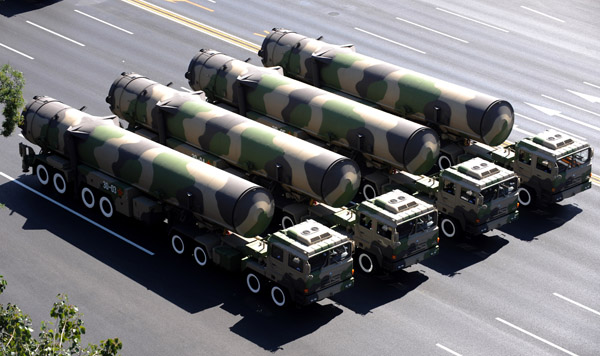
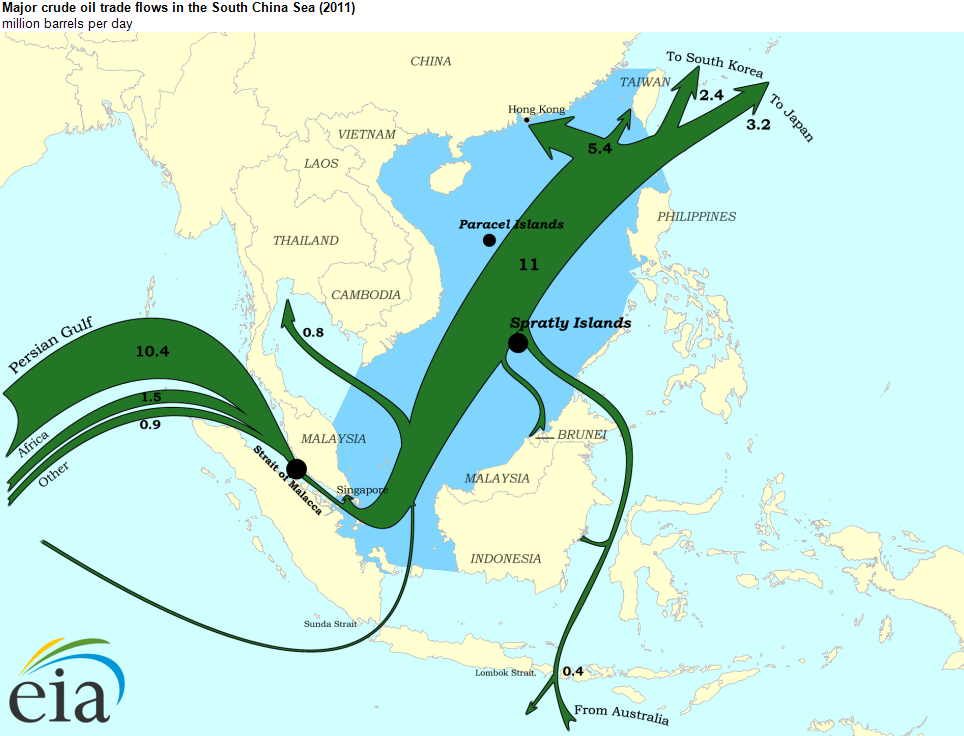
In a short article recently published by The National Interest, Xunchao Zhang argues that blockade is an effective means for the U.S. Navy to conduct a war against China because of its reliance on oil imports and then proposes that China has two options for countering a blockade strategy: vulnerability-reducing and conflict-avoiding. He dismisses the first because the Peoples Liberation Army Navy (PLAN) does not have the capacity to escort oil tanker convoys half-way round the world and China’s overland pipelines would be vulnerable to US strikes. Zhang therefore argues that a policy of avoiding conflict with the United States entirely is the only means for China to counteract a US blockade strategy. Key to this, he claims, is strengthening the Chinese nuclear deterrent and renouncing the No-First-Use policy. Only then will the Chinese nuclear deterrent be sufficient to prevent conflict with the United States and avoid a blockade which would likely be crippling. But this argument misses a fundamental point about deterrence and any US use of blockade in a war with China.

Jugular of the economy

Deterrence is about avoiding war. Zhang argues that by strengthening the Chinese nuclear arsenal, the likelihood of war with the United States would decrease, thereby countering the threat of an American blockade. However, the United States is already unlikely to initiate a war, for numerous reasons. What Zhang calls China’s “minimal nuclear deterrent”, the possible world economic consequences, lack of domestic support for such an endeavor, and the historical unwillingness of the United States to be seen as the aggressor all combine to deter the US from attacking China. Any U.S.-China war would be initiated by China, and therefore a strengthening in the Chinese nuclear arsenal, to include abandoning No-First-Use, does not make a compelling case that the likelihood of war with the United States would be decreased. At best it would have no effect, and at worst it would put the Chinese leadership in a position where a stronger nuclear deterrent could simply increase the attractiveness of conducting a conventional war beneath the nuclear umbrella.

 Furthermore, if a conflict-avoiding policy fails, an expanded nuclear arsenal would be useless in stopping the United States from imposing a blockade. Nuclear deterrence operates even in the context of war. It is unlikely that China would turn their nuclear weapons against the United States when under even a crippling blockade because the United States could respond overwhelmingly. A severe economic decline would be difficult to face, but nuclear weapons raining down on Beijing and Shanghai are on an entirely different plane. The incentive to not escalate to the point of nuclear warfare would be significant, and both sides understand this. The United States would have free reign to conduct the blockade without concern of nuclear escalation because of mutual deterrence.

Recent events support this view. In the context of the Ukraine Crisis, the United States has leveraged sanctions against Russia, which has the world’s largest nuclear arsenal, without fear of escalation. Another one or 10,000 Russian nuclear weapons would not change the fact that economic disruption is very different from physical destruction. If the possible effects of a blockade are as serious as Zhang argues, a strengthened nuclear deterrent is not the way to counter it.

Zhang is correct, however, to argue that China’s best way to counteract a potential blockade by the U.S. Navy is to avoid war entirely. Oil pipelines from Russia and Kazakhstan are highly vulnerable. Hitting fixed targets with precision weapons is a skill the United States military has very nearly perfected, with strikes this summer in Syria from carrier-based aircraft and Tomahawk-toting surface ships again proving the point. He also correctly assesses the PLA Navy as insufficient to protect its maritime trade routes. It has no experience conducting convoy operations and has limited, if slowly improving, antisubmarine warfare capabilities. Despite the effort expended to deploy a task force off Somalia, China does not have the capacity to support the number and array of forces necessary to defend its trade routes.

Not your grandpa’s U-Boot

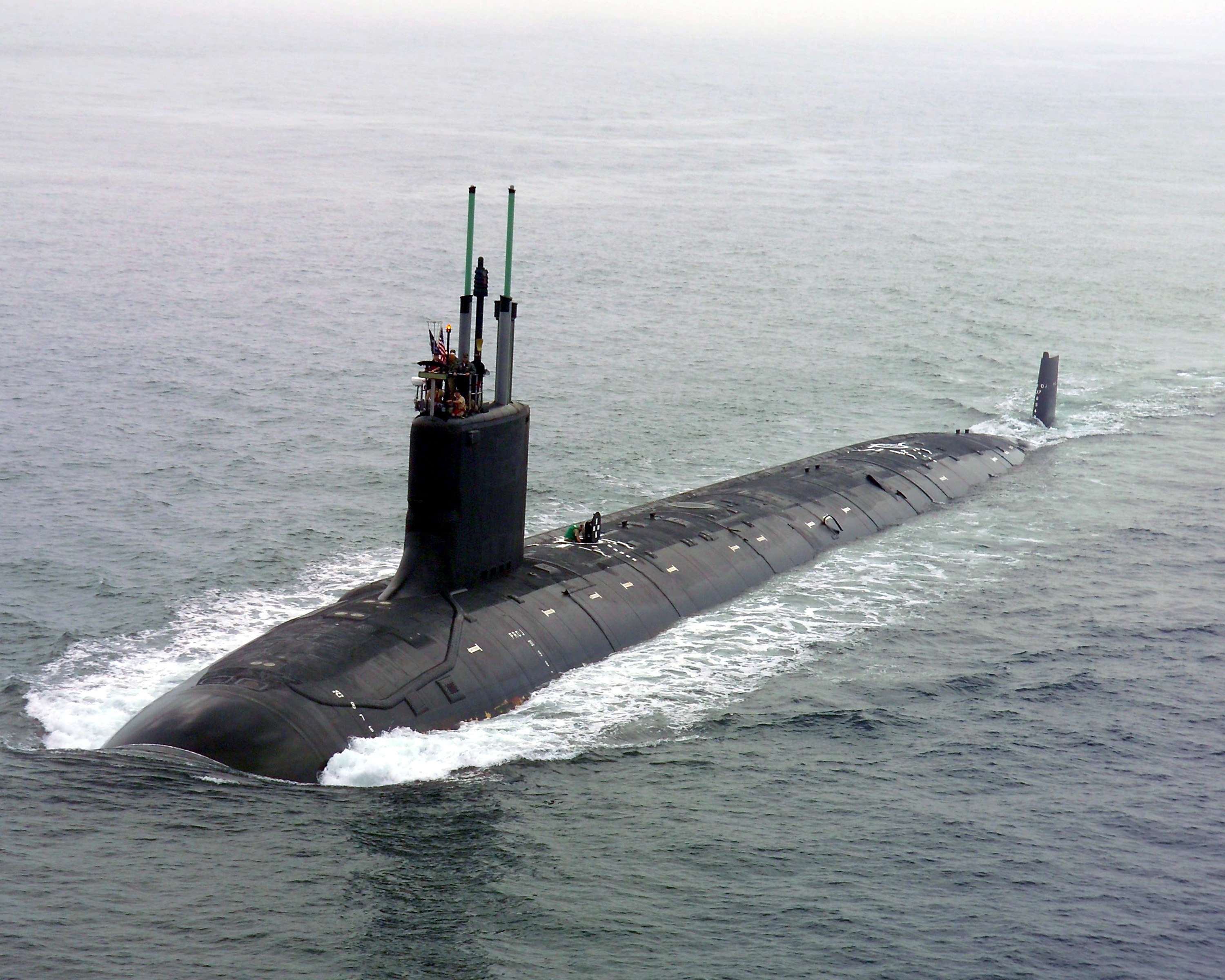
Furthermore, the geography of East Asia contains numerous maritime chokepoints, U.S. submarines are fast, quiet, and have incredible endurance, the U.S. surface fleet has decades of experience conducting maritime interdiction in some of the same waters it would blockade, and the United States has the ability to intercept maritime traffic far outside the range of PLAN capabilities, interdicting oil tankers at their source in the Persian Gulf. While Air-Sea battle in the face of A2/AD capabilities requires the development of any number of new weapons systems, the U.S. Navy has the capacity now and for the foreseeable future to cripple the Chinese economy in the event of war, at ranges far outside those of any existing or upcoming A2/AD capabilities. There is no simple panacea for China to overcome the threat of blockade in the event of war, but Zhang does get it right when he says that China’s best option is to avoid conflict entirely.

______________________________________________

Ian Sundstrom is a surface warfare officer in the United States Navy and holds a master’s degree in War Studies from King’s College London. The views expressed here are his own and do not represent those of the United States Department of Defense.

Sea Control from Ashore

The following, written by guest author Niel Kaneshiro, is an abstract from a US Naval War College Directed Research Project of the same name submitted in response to our call for Amphibious Warfare articles. Please direct response articles to nextwar(at)cimsec.org.

The United States faces an increasingly complex security environment in the Indo-Pacific. In the event of a crisis, China’s growing Anti-Access/Area Denial (A2AD) capabilities will allow it to challenge U.S. military access to the region, as well as raise the risks and costs to the U.S. should it intervene on behalf of a regional ally or partner.

By leveraging security treaties and access agreements, the United States can employ ground forces in cooperation with partners to secure maritime choke points and littoral areas, denying their use to an adversary during a crisis or hostilities. These land forces can also create protected areas from A2AD capabilities for combined and joint military operations, ensuring continued access into the region. Furthermore, ground forces can allow naval and air forces to concentrate on operations in areas outside the reach of land based weapon systems. Ground forces can help address the problem of sea control in the Western Pacific in the context of A2AD challenges in several ways. First, ground forces can provide persistent control of choke points and littoral areas using anti-ship missiles, helicopters, and drones. Second, ground forces can conduct maritime intercept operations by employing heliborne troops who can board and capture merchant shipping. Third, ground forces can create protected areas for friendly forces, keeping them clear of adversary air, missile, and surface ship threats.

Ground forces also provide reassurance to allies and partners – indicating U.S. commitment to the region and to its treaty obligations. “Boots on the ground” have significant symbolic and practical importance. For many countries in Asia, the most important military service is their army. Ground forces, specifically the U.S. Army and Marines, can develop important and enduring partnerships with those services, even assisting them with building their own military capability.

U.S. military planners and theorists have proposed strategies and operational concepts that take into account China’s A2AD capability, thus allowing U.S. forces to perform their missions despite an increasingly hostile environment. “Air Sea Battle” (ASB) is an operational concept that proposes to employ closely coordinated air and naval power to defeat A2AD threats. A primary tenet of ASB is the habitual coordination of U.S. Air Force and Navy assets to mount joint attacks on various A2AD systems, which include anti-ship ballistic missiles, over the horizon sensors, long-range bombers, and cruise missile equipped surface ships and submarines while defending U.S. naval forces and bases from attack. The actions inherent in the ASB concept would be one part of a larger strategy to address a crisis. [i]

An alternative to conducting ASB operations is “Offshore Control”, a proposed strategy wherein U.S. forces conduct a “distant blockade” against China, avoiding the A2AD problem by remaining out of the range of ballistic missiles and bombers. Offshore Control emphasizes sea control outside of what China refers to as the “first island chain” – the islands that consist of Japan, Taiwan, the Philippines, and Borneo – with the objective of interdicting China’s maritime commerce. This concept would result in a more protracted conflict that would use largely militarily induced pressure on China’s economy to de-escalate a crisis, and would avoid destabilizing attacks on the Chinese mainland; such attacks could lead to escalation, a serious problem when dealing with a nuclear power.[ii]

Neither of the concepts involves significant use of ground forces. The roles for ground forces typically are limited to supporting activities, mainly the defense of ports and airfields from missile attack. Other U.S. military writings suggest joint forcible entry operations, which could consist of air or amphibious raids and assaults against A2AD capabilities or to seize key terrain.[iii] However, a forcible entry operation in the face of A2AD capabilities and the strength of the Chinese People’s Liberation Army (PLA) is likely a risky and costly proposition. U.S. forces operating in close proximity to the Asian mainland will have to face the same A2AD capabilities that they propose to defeat.

Land power defined is “the ability – by threat, force, or occupation – to gain, sustain, and exploit control over land, resources, and people.”[iv] By extension, land power means the ability to exploit land areas for other purposes. U.S. military thinkers largely conceive of the Pacific as primarily a U.S. Air Force and Navy theatre; however, there are key islands that make land power relevant to any military campaign in the region. The Second World War in the Pacific was fought for and around islands. Geographically important islands became bases for continuing naval operations and served as unsinkable aircraft carriers for long-range bombers.

The geography of the Western Pacific has not changed. Modern missiles, sensors, unmanned aerial vehicles (UAV), and helicopters allow ground forces to project combat power out to sea in a way that was not possible before. American ground combat forces – Army or Marine, have the potential to conduct sea control operations and contribute substantively to an offshore control strategy or an ASB type campaign. In other words, land power can be exploited to gain sea control.

Niel Kaneshiro is a former United States Navy and current United States Army analyst as well as a student of the US Naval War College.

[i] Air-Sea Battle Office, “Air-Sea Battle: Service Collaboration to Address Anti-Access & Area Denial Challenges”, May 2013: 4.

[ii] Hammes, T.X. “Offshore Control: A Proposed Strategy for an Unlikely Conflict”, Institute for National Strategic Studies . June 2012: 4-5.

[iii] U.S. Army and U.S. Marine Corps, “Gaining and Maintaining Access: An Army-Marine Corps Concept”, March 2012: 6.

[iv] U.S. Department of the Army, “ADRP 3-0 – Unified Land Operations” 2012: Glossary-4