Given recent activities by the PLA(N) and the Russian Navy, the matters of seabed warfare and the defense of undersea infrastructure have emerged as topics of interest to the U. S. Navy.1,2 Part One of this paper presents several significant considerations, arguably contrary to common thinking, that highlight the challenges of bringing the deep sea and benthic realm into cross-domain warfighting in the maritime environment. Part Two presents three warfighting concepts drawn from the body of work done by the CNO Strategic Studies Group (SSG) that would give the Navy capabilities of value for the potential battlespace.
The Deep Ocean Environment
For clarity the term “deep ocean” will be used to cover the ocean bottom, beneath the ocean bottom to some unspecified depth, and the ocean water column deeper than about 3,000 feet.3 The deep ocean is where the U.S. Navy and the submarine force are not. Undersea infrastructures are in the deep ocean and on or under the seabed for various purposes.
How does the maritime fight on the ocean surface change when there must be a comparable fight for the deep ocean? In the maritime environment, it is long past time for the U.S. Navy to be mindful of and develop capabilities that account for effects in, from, and into the deep ocean, including effects on the ocean floor. Cross-domain warfighting demands this kind of completeness and specificity. As the Army had to learn about and embrace the air domain for its Air-Land battle in the 1980s, the Navy must do the same with the deep ocean for maritime warfare today and for the future.
However, the current frameworks of mine warfare, undersea warfare, and anti-submarine warfare as practiced by the Navy today are by no means sufficient to even deny the deep ocean to an adversary let alone control the deep ocean. To “own” a domain, a force must have the capability to sense and understand what is in and what is happening in that domain. The force must also have the capability to act in a timely manner throughout that domain.
Today, the Navy and many nations around the world have radars and other sensors that can detect, track, and classify most of anything and everything that exists and happens in the atmosphere from the surface of the ocean and land up to an altitude of 90,000 feet altitude or higher, even into outer space. The Navy and many nations also have weapons – on the surface and on land, and in the air – that can act anywhere within the atmosphere. Some nations even have weapons that can act in the atmosphere from below the ocean surface. In short, with regard to the air domain, relevant maritime capabilities abound, including fixed or mobile, unmanned or manned, precise or area. Naval forces can readily affect the air domain with capabilities that can cover the entire atmosphere.
But the same cannot be said for the deep ocean. Figure 1 below is based on information drawn from unclassified sources. Consider this depiction of the undersea in comparison with the air domain. Notice that there is a lot of light blue space – space where the Navy apparently does not have any capability to sense, understand, and act. The Navy’s capability to effect in, from, and into the deep ocean is at best extremely limited, but for the most part non-existent. Capabilities specifically relative to the seabed are even less, and with the Navy’s mine countermeasures capabilities also being very limited. What systems does the Navy have to detect unmanned underwater vehicles at very deep depths? What systems does the Navy have to surveil large ocean areas and the resident seabed infrastructure? What systems does the Navy have to act, defend, or attack, in the deep ocean?
Figure 1 – The Deep Ocean
Arguably, the Navy has built an approach to maritime warfighting that dismisses the deep ocean, and done so based on the assumption that dominating the top 3,000 feet of the waterspace is sufficient to dominating the entire waterspace – ocean floor to ocean surface. Undersea infrastructure is presumably safe and protected because the ceiling over it is locked up.
However, the force must have the capabilities to sense, understand, and act in the deep ocean.
While the assumption for dominating the deep ocean by dominating the ceiling may have been useful in the past, it clearly is no longer valid. In the past, it was very expensive to do anything in the deep ocean. The technology was not readily available, residing only in the hands of two or three nations or big oil companies. This no longer holds true. The cost of undersea technology for even the deepest known parts of the ocean has dropped dramatically, and also widely proliferated. If one has a couple hundred million dollars or maybe a billion dollars, they can sense, understand, and act in the deep ocean without any help from a nation or military. Unlike the U.S. government-funded search for the SS Titanic by Robert Ballard, Microsoft co-founder Paul Allen independently found USS Indianapolis in over 15,000 feet of water in the Philippine Sea. The capabilities to sense, understand, and act in the deep ocean are available to anyone with a reasonable amount of money to buy them.
Figure 1 is misleading in one perspective. At the level of scale in figure 1, the ocean floor looks flat and smooth. If something is placed on the ocean bottom, such as a towed payload module, a logistics cache, sensors, or a weapon system, could it be easily found?
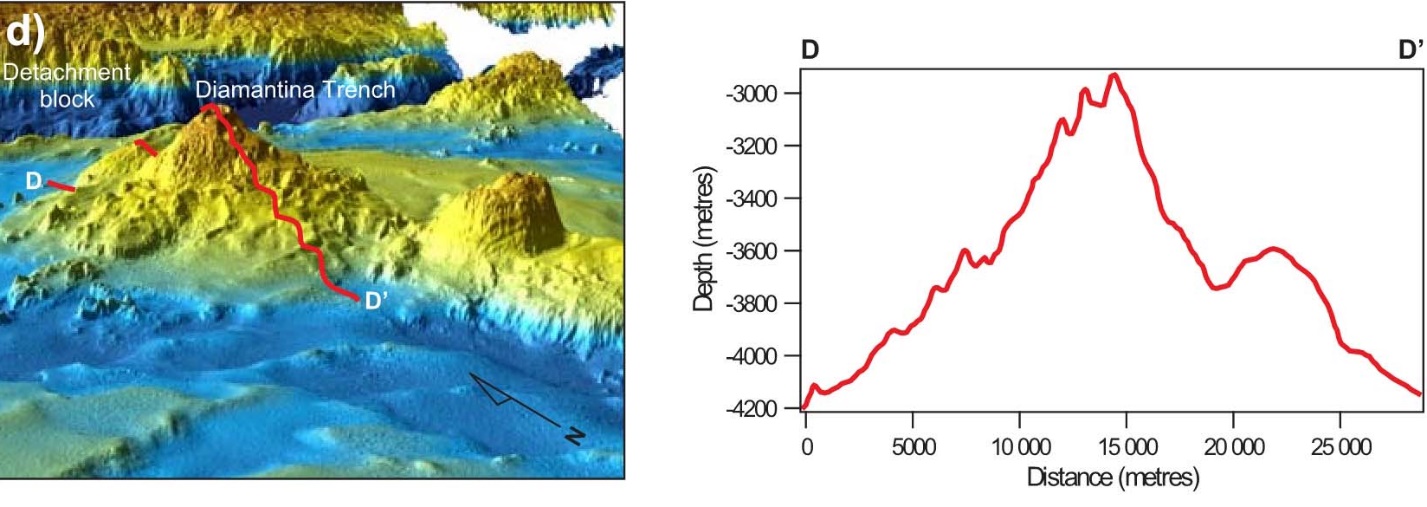
Figure 2 is a picture of survey results from the vicinity of the Diamantina Trench approximately 700 miles west of Perth, Australia in the Indian Ocean. The red line over the undersea mountain is about 17 miles in length. The water depth on the red line varies from 13,800 feet to 9,500 feet as shown on the right.4
Figure 2 – Diamantina Trench
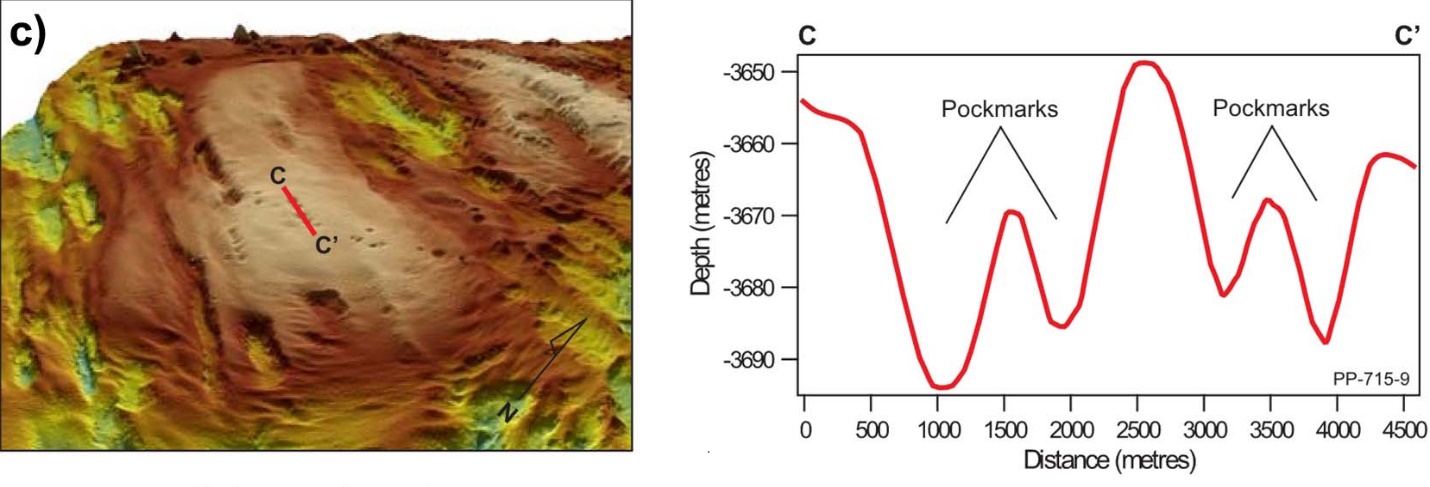
Consider figure 3. The red line is just under three miles in length. The depth variation ranges from 12,100 feet to 11,900 feet.5 These figures provide examples of evidence that the abyssal is not featureless. The assumption of a flat and smooth ocean floor is simply wrong, and severely understates the challenge of sensing and acting in the deep sea.
Figure 3 – A Closer View in the Diamantina Trench
How hard would it be to find a standard-sized shipping container (8ft x 8ft x 20ft or even 40ft) on this floor? It could be incredibly difficult, requiring days or weeks or even months with many survey vehicles, especially if the area had not been previously surveyed. This is a lesson the U. S. Navy learned in the Cold War and has long since forgotten from its “Q routes” for port access. And it would be harder still if one were purposefully trying to hide whatever they placed on the ocean floor, such as in the pockmarks of figure 3.
Based on reported results from a two-year search for Malaysian Airlines flight MH-370, approximately 1.8 million square miles of the ocean floor were searched and mapped to a horizontal resolution on the order of 100 meters and vertical resolution of less than one meter.6 Yet, the plane remains unlocated.
Hiding things on the seabed is fairly easy, while finding things on the seabed is incredibly difficult. Unless one is looking all the time, and has an accurate baseline from which to start the search and compare the results, sensing in the deep sea is significant challenge. The next consideration is that of the matter of scale of the geographic area and what resides within it. This is what makes numbers matter.
Figure 4 provides a view of the Gulf of Mexico covering about 600,000 square miles in area and with waters as deep as 14,000 feet. There are about 3,500 platforms and rigs, and approximately 43,000 miles of pipeline spread across the Gulf.
Figure 4. – The Gulf of Mexico (National Geographic)
Of note, the global economy and worldwide demands for energy have caused the emergence of a strategic asymmetry exemplified by this figure. China gets most of its energy imports by surface shipping which is vulnerable to traditional anti-shipping campaigns. The U. S. gets much of its energy from undersea systems in the Gulf of Mexico. While immune from anti-shipping, this infrastructure is vulnerable to seabed attack. In late 2017, the Mexican government leased part of their Gulf of Mexico Exclusive Economic Zone seafloor to the Chinese for oil exploration.
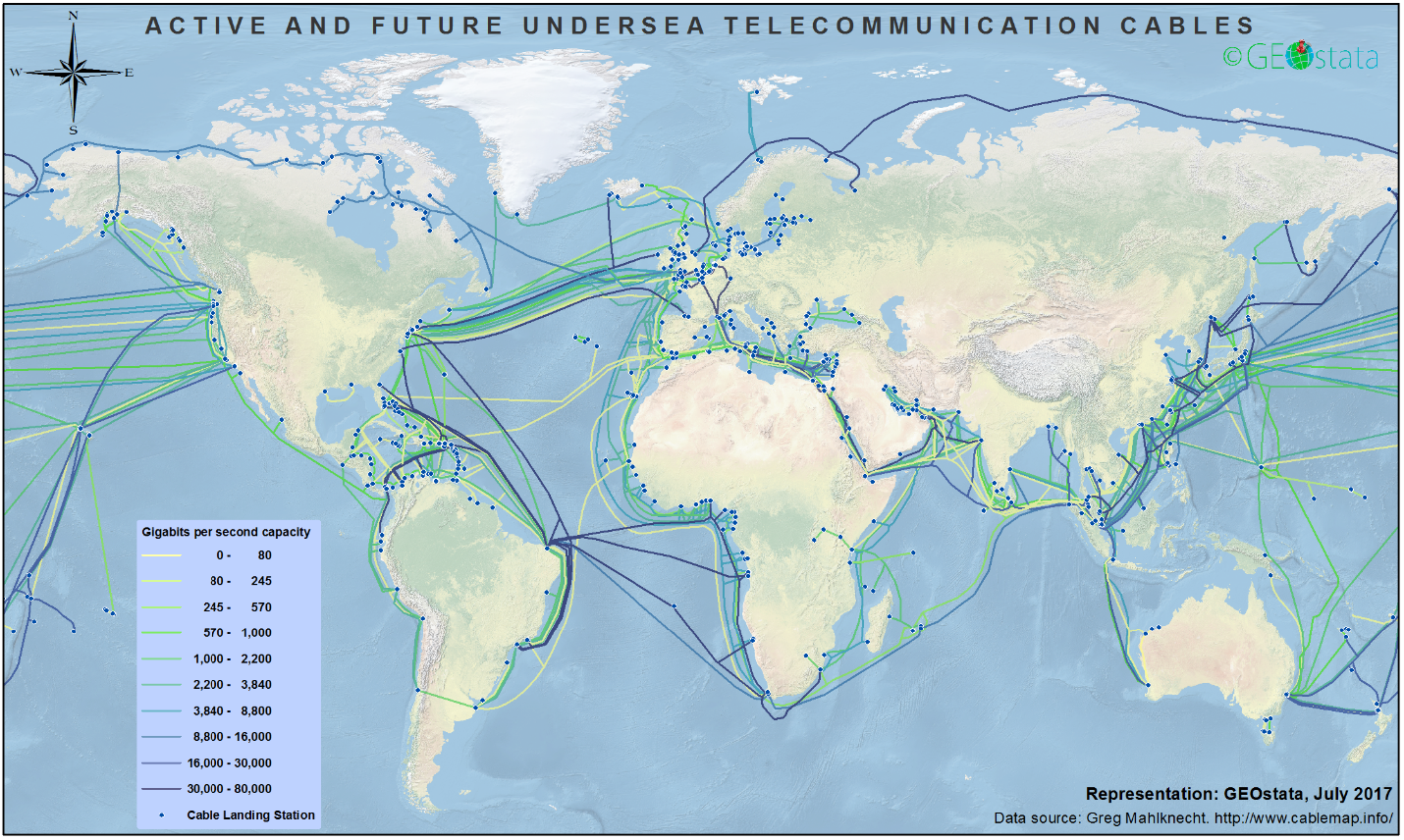
Figure 5 provides a depiction of global undersea communication cables with some 300 cables and about 550,000 miles of cabling.
Figure 5 – Global Undersea Telecommunications Cables
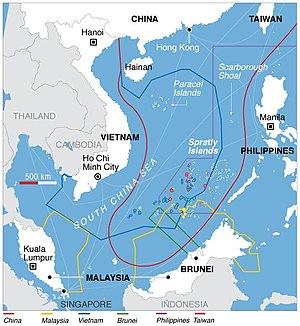
Figure 6 provides a view of the South China Sea near Natuna Besar. This area is about 1.35 million square miles with waters as deep as 8,500 feet. Recall that in the two-year search for Malaysian Air flight MH 370 they surveyed only 1.8 million square miles, and did so in a militarily-benign environment.
Figure 6 – The South China Sea
The deep ocean demands that a maritime force be capable of surveilling and acting in and over large geographic areas just like the ocean surface above it. Undersea infrastructure is already dispersed throughout those large areas. In addition, because the components of undersea infrastructure are finite in size, the deep ocean also demands that a maritime force be capable of surveilling and acting in discrete places. While it is arguable that defense in the deep ocean is a wide-area challenge and offense is a discrete challenge, the deep ocean demands that a maritime force be capable of doing both as part of the maritime battle. Therefore, the deep ocean presents an “area” challenge and a “point” challenge simultaneously, and both must be addressed by maritime forces.
In addition, the size of the area and the number of points of interest means that a dozen UUVs or a couple of nuclear submarines are not in any way sufficient to address the maritime warfighting challenge of defending the deep ocean and undersea infrastructure of this scale. Furthermore, the situation is exacerbated by systems and vehicles in the deep ocean above the seabed. The threat is not a few, large, manned platforms, but many small unmanned vehicles and weapons.
The historical demarcation among torpedoes, mines, and vehicles is no longer productive except maybe for purposes of international law and OPNAV programmatics. Operationally and tactically, the differentiation is arbitrary and a distraction from operational thinking. The Navy should be talking in terms of unmanned systems – some armed or weaponized, and some not; some mobile and some not; some intelligent and some not. Torpedoes can easily become mobile, armed UUVs with limited intelligence. Mines can also become mobile or fixed UUVs with very limited intelligence.
In the course of the author’s research and in research conducted by the CNO SSG, there were no situations or considerations where reclassifying mines and torpedoes as UUVs was problematic with regard to envisioning war at sea. Doing so eliminated a significant tactical and operational seam and opened up operational thinking. The systems for the detection and neutralization of UUVs are the same as those needed to detect and neutralize torpedoes and mines, and the same for surveilling or attacking undersea infrastructure.
Conclusion
Ultimately, understanding the deep ocean and warfare in the deep ocean is a matter of numbers and time – requiring plenty of sensors, and plenty of time. Part Two will present three warfighting concepts drawn from the body of work done by the CNO Strategic Studies Group (SSG) that would give the Navy capabilities for the deep sea battlespace.
Professor William G. Glenney, IV, is a researcher in the Institute for Future Warfare Studies at the U. S. Naval War College.
The views presented here are personal and do not reflect official positions of the Naval War College, DON or DOD.
References
1. This article is based on the author’s remarks given at the Naval Postgraduate School Warfare Innovation Continuum Workshop on 19 September 2018. All information and conclusions are based entirely on unclassified information.
3. Based on unclassified sources, manned nuclear submarines can operate to water depth of 1,000-1,500 feet, manned diesel submarines somewhat shallower, and existing undersea weapons to depths approaching 3,000 feet.
4. Kim Picard, et. al., “Malaysia Airlines flight MH370 search data reveal geomorphology and seafloor processes in the remote southeast Indian Ocean,” Marine Geology 395 (2018) 301-319, pg 316.
5. Kim Picard, et. al., “Malaysia Airlines flight MH370 search data reveal geomorphology and seafloor processes in the remote southeast Indian Ocean,” Marine Geology 395 (2018) 301-319, pg 317.
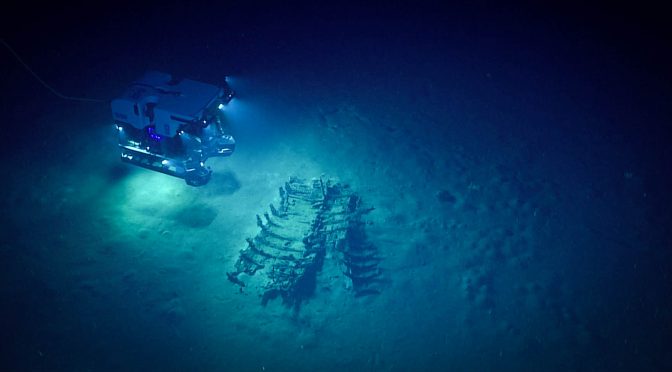
Featured Image: Deep Discoverer, a remotely operated vehicle, explores a cultural heritage site during Dive 02 of the Gulf of Mexico 2018 expedition. (Image courtesy of the NOAA/OER)
Imagine, for a moment, a hypothetical country rapidly spiraling towards autocracy, illegally arresting American citizens, imprisoning journalists, and attacking American-supported forces. Now imagine that same country actively purchasing Russian surface-to-air missile systems and erecting missile defense sites around its territory. In such a hypothetical, it would be difficult to assume that the United States would ever support or even arm such a country. Unfortunately, this is not a hypothetical scenario. Not only is the U.S. treaty-bound to an alliance with such a country, it is actively engaged in efforts to sell fifth generation attack aircraft to it. The country in question, Turkey, and its drive toward acquiring a fleet of F-35s represents a serious threat to American national security and technological superiority. Fortunately, this threat has not been ignored by American policymakers, though more can be done to secure American aerial supremacy.
Two main factors combine to make the sale of F-35s to Turkey a credible threat to American national security. First, on the immediate and kinetic front, Ankara’s continued efforts to acquire and deploy Russian-made integrated surface-to-air missile systems could give Russian engineers and radar systems operators key insight into the radar cross section and signals signature of the F-35. Second, on a broader and more strategically oriented scale, further supporting Turkey’s military advancement could backfire should the country slip further toward authoritarianism.
The first of these issues has thus far garnered the most attention on the Hill, due largely to its immediacy and clear outcome. Put simply, should the Turkish Air Force operate the F-35 in the vicinity of Russian S-400 missile systems Turkey will receive in 2019, Russian engineers could gain valuable insight into the aircraft’s detectability and flight profile. This would greatly hinder American aerial superiority and could jeopardize some of the most critical capabilities of the new aircraft should conflict with Russia arise. Lawmakers were quick to recognize the signals intelligence threat posed by Turkey linking the Russian missile system to the fleet of F-35s it is scheduled to receive in 2020. Last fall, Congress put a halt on the sale of F-35s to Turkey pending a report from the Pentagon on the implications of Ankara’s acquisition of the 100 F-35s it originally planned on purchasing. That report was delivered in November and Congress has yet to formally announce its conclusions on whether or not the sale will go ahead as planned.
Unfortunately, Congressional concern over Turkish F-35 acquisition might come too late to have a strong impact on Russian examination of the aircraft. Indeed, as President Erdogan continues to develop a stronger relationship with Moscow, pilots of the Turkish Air Force are training to fly American-made F-35s out of Arizona’s Luke Air Force Base. Moreover, the Turkish Air Force has already received its first F-35 and, though the plane remains in the United States, as Sebastien Roblin wrote in early September, it cannot be legally confiscated by the U.S. government. Should this specific aircraft successfully make its way to Turkey, it would likely be exposed to the prying sensors of the S-400.
The problems do not stop there. Beyond the immediate concern of compromising the classified capabilities of the F-35, fifth generation fighter sales to Turkey represent a strategic and ethical threat to both the United States and the NATO alliance as a whole. In the past few years, President Erdogan has successfully solidified himself as a modern autocrat in all but name. After 2016’s failed coup attempt, Erdogan has directed the arrests of tens of thousands of political opponents, journalists, teachers, and activists. He has illegally detained American citizens and threatened American-supported forces on the ground in Syria. These hardly represent the actions of a dedicated ally and should cause grave concern for export control professionals engaged in the sale of any advanced weapons systems, let alone the F-35, to Ankara.
Moreover, Erdogan has repeatedly threatened to leave the NATO alliance as a response to the growing tensions between Turkey and the United States. This comes at a time when the alliance faces increased Russian aggression on its borders and Russian interference in the political spheres of member nations. Indeed, Erdogan’s actions hardly support an image of a united alliance against Russian aggression. Rewarding such threats and rhetoric with the delivery of F-35s, regardless of Turkey’s investment in the program, is hardly a sound strategy. Indeed, as the leader of the world’s largest alliance of liberal democracies, it would behoove Washington to distance itself from Ankara’s rapid descent towards despotism. This argument is only compounded further when recognizing that not only American F-35s would be put at risk by Turkish acquisition, but the F-35 fleets of NATO allies like the UK and Norway as well.
While diagnosing the risks associated with selling F-35s to Turkey is an easy task, treating them is far more difficult. Largely, this is a result of Turkey’s deep industrial involvement in the development of the aircraft. To date, ten separate Turkish firms have engaged in significant support efforts in the F-35 program ranging from the integration of the plane’s new precision-guided Stand-off Missile to direct production of the F-35s weapons bay doors. Beyond the private sector, President Erdogan has repeatedly brought up the fact that the Turkish government has spent, in total, almost a billion dollars on the procurement of F-35 airframes. Such an immense level of sunk cost and existing investment means that Ankara will not simply roll over should Congress decide to cancel the sale of further F-35s. The White House must then determine whether fraying military ties with Turkey is worth preserving its new fifth generation fighter.
Conclusion
In light of Turkey’s increased relationship with Russia, commitment to purchasing Russian weapon systems, and rapid devolution into a modern autocracy, Washington’s best interest lies in denying the sale of further F-35 airframes to Turkey. The F-35 is critical to the future of American and NATO air superiority. It cannot be used as just another political chip on the global chessboard. Should it be sold to Turkey without Ankara’s cancellation of the S-400 deal, the F-35 could be compromised before it even takes flight as America’s primary strike fighter.
Duncan Kellogg is a developing naval analyst studying nuclear defense posture and maritime security at George Washington University’s Elliott School of International Affairs. Duncan has been writing about the intersection of deterrence theory and maritime security since 2015. He lives in Washington, D.C. with his fish Maverick.
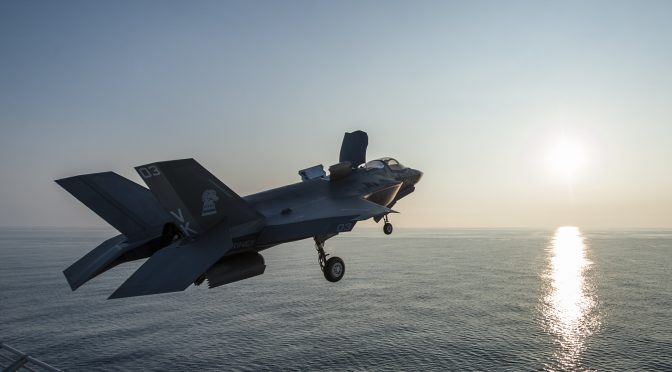
Featured Image: PACIFIC OCEAN (July 17, 2018) An F-35B Lightning II aircraft assigned to Marine Fighter Attack Squadron (VFMA) 121 takes off from the amphibious assault ship USS Wasp (LHD 1) during carrier qualifications and flight deck certifications. (U.S. Navy photo by Mass Communication Specialist 2nd Class Rawad Madanat/Released)180717-N-JW440-0037
By Jeffrey Kline, John Tanalega, Jeffrey Appleget, and Tom Lucas
Introduction
The paper is about synergy. It demonstrates the power of using analytical tools in a logical sequence to generate, develop, and assess new concepts and technologies in warfare. Individually there is nothing new here. Each of the analytical tools described in this paper is thoroughly discussed in academic literature. The use of intelligent experimental design and large scale simulation to advance knowledge in defense and homeland security issues is well describe in Design and Analysis of Experiments by leaders in the Naval Postgraduate School’s Simulation Experiments and Efficient Design (SEED) Center for Data Farming (Sanchez, 2012).1 The power of campaign analysis to gain insight and quantify the value of new technologies and capabilities is covered in the campaign analysis chapter of Wiley’s Encyclopedia of Operations Research and Management Science (Kline, 2010).2 Wargaming’s use to develop concepts for employment of those new technologies and discover possible risks to them are discussed recently in both the Military Operations Research Society’s Phalanx (Appleget, 2015)3 and the journal for Cyber Security and Information Systems Information Analysis Center (Appleget, 2016).4
It is the synergy created by bringing these tools together—linked by officers with tactical experience and educated in the analytical techniques—which this paper addresses. We provide it as an example of military operations research in practice to advance naval force development and fleet combat tactics. We tell this story through the lens of our co-author, LT John Tanagela, USN, and one technology, the Medium Displacement Unmanned Surface Vessel (MDUSV), but provide multiple examples of past work similar in nature. LT Tanagela is a qualified Surface Warfare Officer who chose to attend the Naval Postgraduate School to obtain a master’s degree in Operations Research. We select John’s educational and research experience not for its uniqueness, but instead for its normalcy as a NPS OR student with unrestricted line qualifications. Our other co-authors were John’s combat models instructor, campaign analysis instructor, wargaming instructor, and thesis research advisors. We provide descriptions and results from the analytical courses John leveraged to advance his research in employing a MDUSV and highlights from his thesis. We conclude with brief summaries of other concepts and technologies advanced in this manner.
Triad of Military Applied Courses
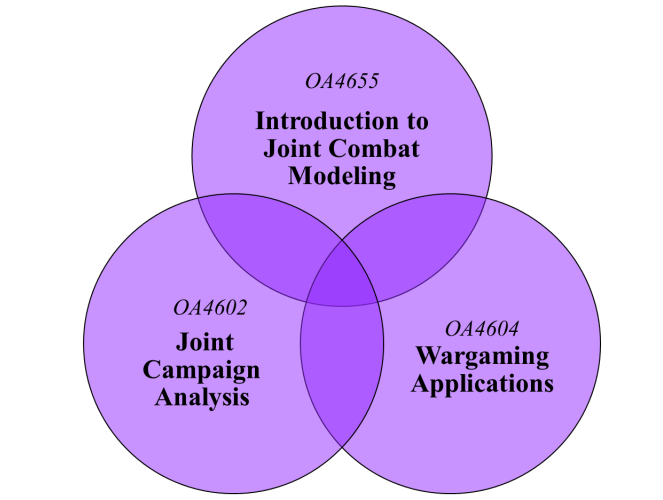
The Naval Postgraduate School’s Operations Research students receive three foundational courses in warfare analysis: the introduction to joint combat modeling course, the joint campaign analysis course, and the wargaming course (See Figure 1). In these applied courses they learn to model combat effects in tactical and operational level conflict, integrate these quantitative techniques in campaign analysis and human decision making, and, as a result, develop and quantitatively assess new concepts, tactics, and technologies.
Figure 1: The three warfare analysis courses provided to NPS operations research students.
The joint combat models course introduces traditional force-on-force modeling, including homogeneous and heterogeneous Lanchester equations, Hughes’ salvo equations, and computer-based combat simulations. It provides our officers the experience to integrate uncertainty into these models to allow for sensitivity analysis and design of experiments in exploring new capabilities.
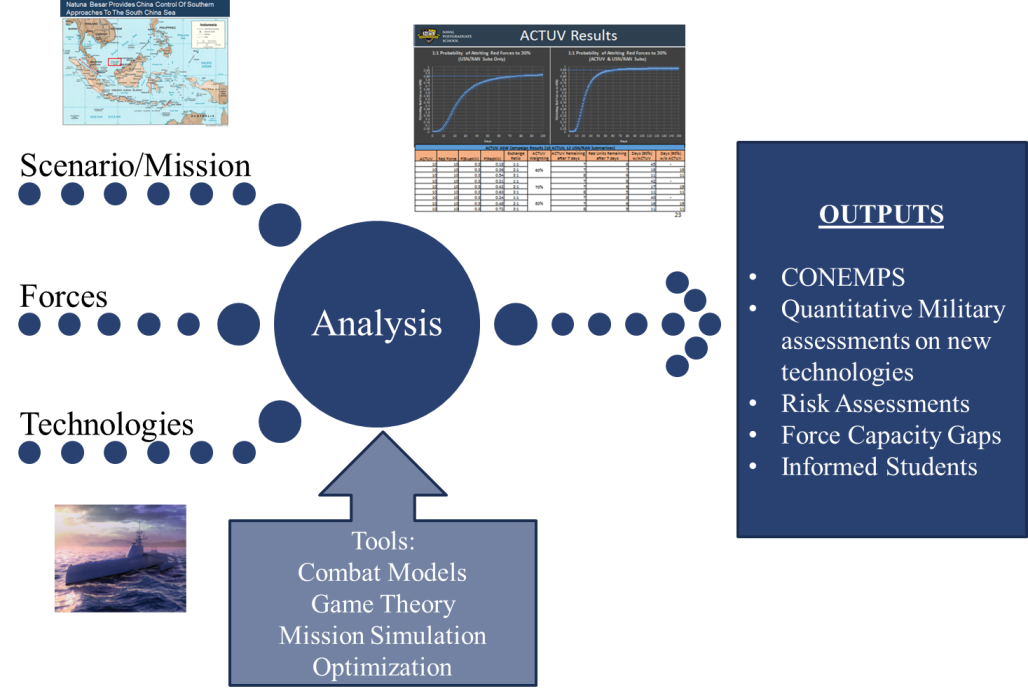
The joint campaign analysis class leverages these new skills and previous course work in simulation, optimization, decision analysis, search theory, and probability theory by challenging our officers to apply them in a campaign-level scenario. During the course they must develop a concept of operation to meet campaign objectives, model that concept to assess risk using appropriate measures for their objective, and assess “new” technical capabilities by comparing them to their baseline concept analytical results. The results are quantitative military assessments of new concepts and technologies, identification of force capability gaps, and risk assessments (See Figure 2).
Figure 2: The NPS Joint Campaign Analysis class process for applying officers’ new analytical skills to campaign and operational level issues.
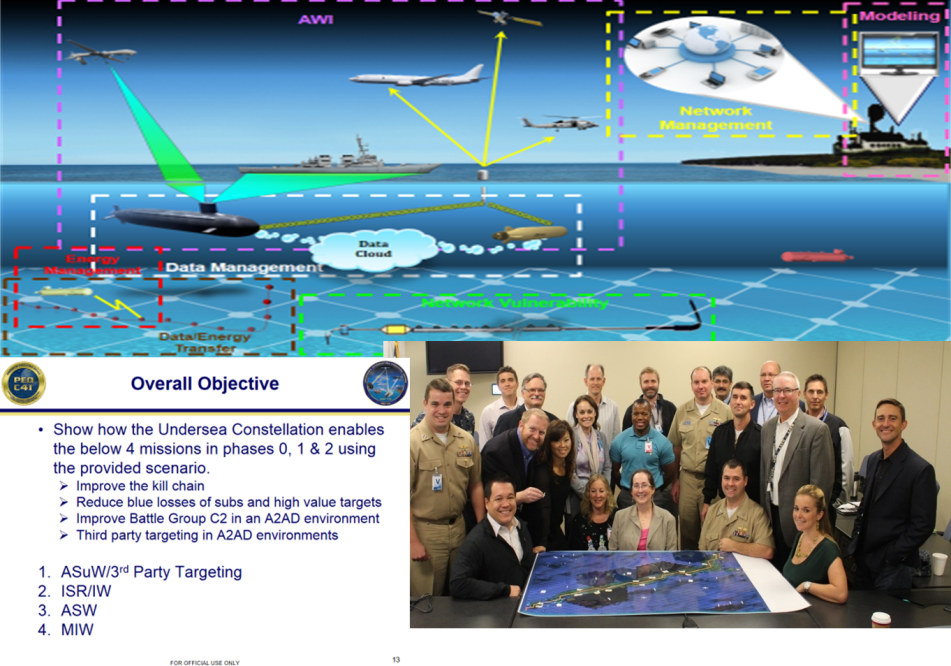
The wargaming class provides an overview of the history, uses, and types of wargaming, but focuses its efforts on teaching officers how to design, develop, execute, analyze, and report on an analytical wargame. After learning the fundamentals, officer-teams are assigned real-world sponsors who provide the objective and the issues they desire to address during a wargame. The officer-teams work with the sponsor through execution of an actual wargame, completing their course work by reporting the wargame’s analysis and results to the sponsor. An example is supporting the Navy’s PEO C4I by assessing the Undersea Constellation concept and technology. (See Figure 3)
Figure 3: Sponsor, student wargaming team (in uniform) and players of the NPS wargaming course’s PEO C4I Undersea Constellation Game.
Passing Lessons and Students along
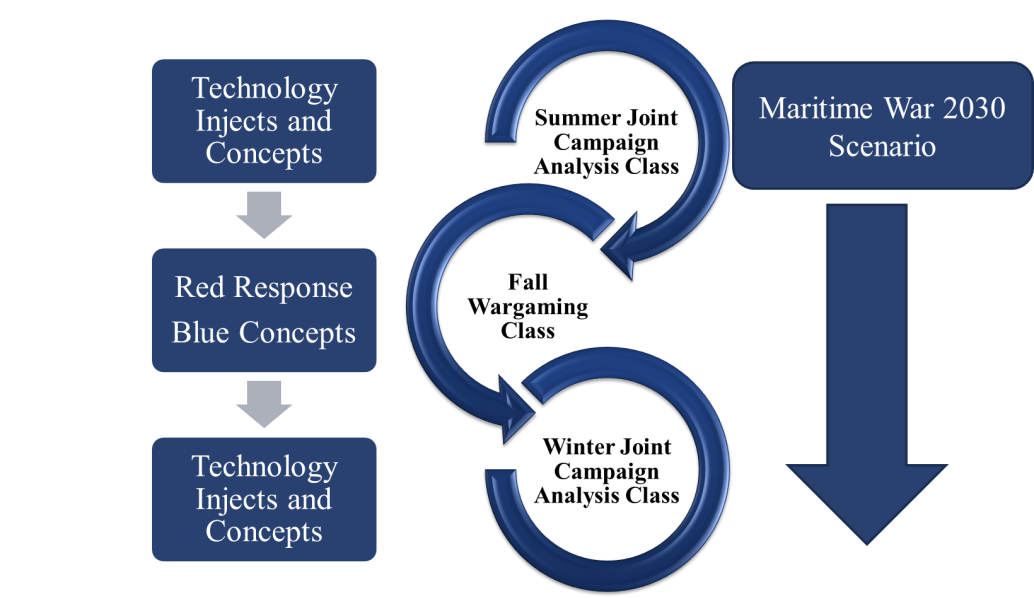
As the NPS operations research students proceed from one course to another in the triad above—where they are joined by Joint Operational Logistics students, Systems Engineering Analysis students, Defense Analysis students, and Undersea Warfare students—there is an opportunity to carry lessons from on course into another, and gain further insight into those concepts and technologies. The teaching faculty work closely to ensure that happens by design. NPS Warfare Analysis faculty and researchers use these courses synergistically to provide insights to real-world sponsors in advancing their concepts, assessing new technologies proposed by DoD labs and industry, and developing new tactics—all the while enhancing our officer-students’ educational experience and sharpening their combat skills. For example, after learning to model a war at sea strike using salvo equations in the joint combat modeling course, the officers are challenged to develop a maritime concept of employment using distributed forces in the joint campaign analysis class, and assess that concept using the salvo equations and simulation. That concept is passed to the wargaming class (usually the same students) to better understand Blue’s decisions in employing distributed forces and Red’s potential reactions. Common scenarios are used between classes with similar forces structures (See Figure 4).
Figure 4: The NPS Joint Campaign Analysis and Wargaming connection. Technologies and concepts analyzed in the Joint Campaign Analysis class are frequently introduced by real-world sponsors in the wargaming class to better understand Blue’s force employments and Red’s reactions to new Blue capabilities.
The results of these capstone classroom efforts are a series of analytical and wargaming briefings, reports, and papers frequently shared with DoD and service organizations. In addition, the work informs other NPS research occurring in unmanned systems, networks, and command and control. Most impactful, however, is when officers are inspired to take a much more detailed look at new capabilities as their thesis research, using the insights gathered from their capstone course work as a foundation to build upon.
Simulating a Half Million Tactical Engagements
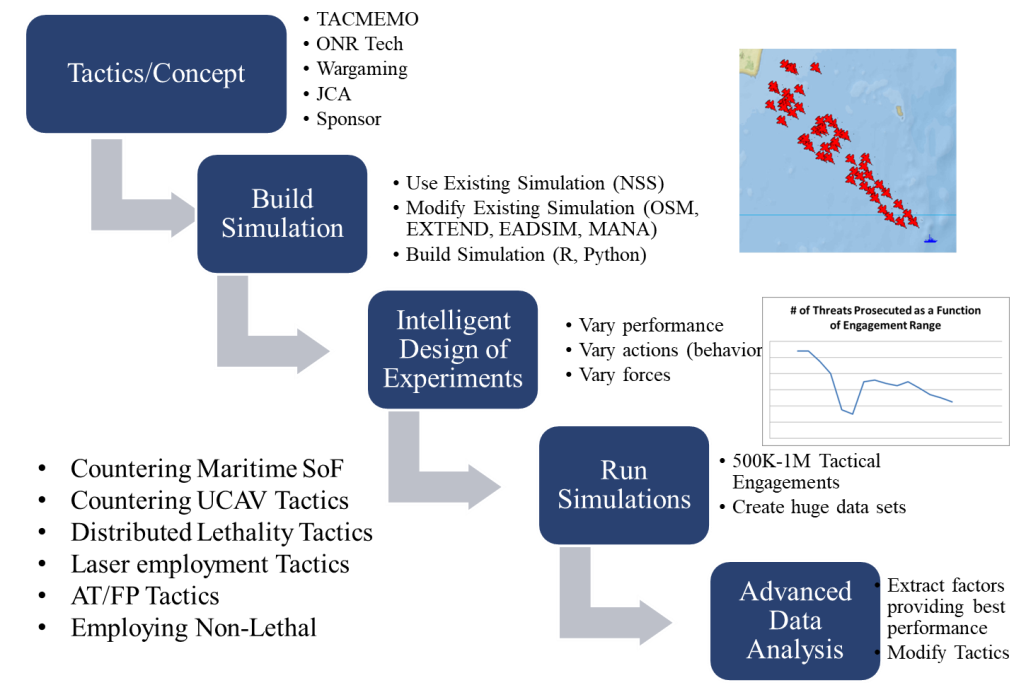
Officers frequently select a new technology explored in their military operations research applied courses to further study in their thesis work. They will draw upon their own operational experience to develop tactics to employ these technologies; work with weapon tactics instructors to refine these tactical situations; identify important variables and parameters within that scenario to further identify needed performance capabilities (range, speed, etc.) and tactical employment (formations, distances, logistics, etc.); build or use an existing simulation to model those tactics; use intelligent experimental design to efficiently explore a range of values for each of identified parameter; execute the experiment—frequently running over a half million tactical engagements; then use advanced data analytics to identify the most important parameters’ values to be successful (See Figure 5.)
Figure 5: Using simulation, intelligent experimental design, and advance data analytics to identify the most import performance parameters of a technology or tactical employment.
These theses’ results are always of great value to warfare and tactics development commands, to resources sponsors, material commands, and defense laboratories developing new technologies. Their insights also inform future capstone course work and NPS technical research. We now turn to our specific example, LT John Tanalega and the Medium Displacement Unmanned Surface Vessel.
The Technology: The Medium Displacement Unmanned Surface Vessel
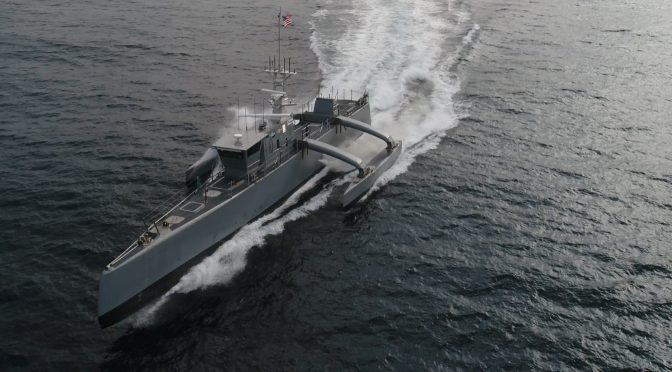
The Office of Naval Research (ONR) Medium Displacement Unmanned Surface Vessel (MDUSV) program is a self-deployed surface unmanned system capable of on station times of 60-90 days with ranges of 900-10000 nautical miles depending on speed (3-24 knots) and payload (5-20 tones).5 For the NPS warfare analysis group, we provide it the following future mission capabilities. In an antisubmarine warfare (ASW) role, it receives an off-board cue and hand off, then conducts overt trail with active sonar. It can act as an ASW scout in coordination with area ASW assets like the P-8 maritime patrol aircraft or benthic laid sensors in an Undersea Constellation, conducting large acoustic surveillance using passive and/or active bi-static sonar. It can deploy three Mk 54 or six smaller CRAW torpedoes. In its Intelligence, Surveillance, and Reconnaissance (ISR) role, it can work with surface ships as an advanced scout employing passive sensors, and in an offensive role, can carry eight RBS-15 surface-to-surface missiles. In its mine warfare role, it can conduct mine sweeping with a MK-104 acoustic sweep body or can deploy a clandestine delivered mine in an offensive mining role. It may also act as a forward environmental survey ship, a platform for operational military deception, a tow for a logistics barge, and special operations equipment delivery.
All MDUSVs in these analyses are augmented by TALON (Towed Airborne lift of naval systems)6, which can carry up to 150 pounds of payload up to 1,500 feet. This payload can be communication relays, radar, electronic jammers (or emitters for decoy operations), or optical sensors.
ACTUV conducting testing with TALONS (DARPA Video)
The MDUSV equipped with TALON has been introduced in several Joint Campaign Analysis classes and Wargaming classes as technical injects to be assessed. LT Tanalega was given the MDUSV as a technical inject for both these classes.
The Student: LT John Tanalega
Academically talented, John has a typical operational background for a Naval Postgraduate School Operations Research student. He graduated from the U.S. Naval Academy in 2011 with a Bachelor of Science degree in English. His initial sea tour was as Auxiliaries and Electrical Officer, and later First Lieutenant, in USS DEWEY (DDG 105). While assigned to DEWEY, he deployed to the Western Pacific, Arabian Gulf, Red Sea, and Eastern Mediterranean. His second division officer tour was as the Fire Control Officer in USS JOHN PAUL JONES (DDG 53), the U.S. Navy’s ballistic missile defense test ship. He attended the Naval Postgraduate School in from 2016 to 2018, where he earned a Master of Science degree in Operations Research and conducted his thesis research in tactical employment of the MDUSV.
Insights from the Joint Campaign Analysis classes, the Wargaming Classes, and other NPS research
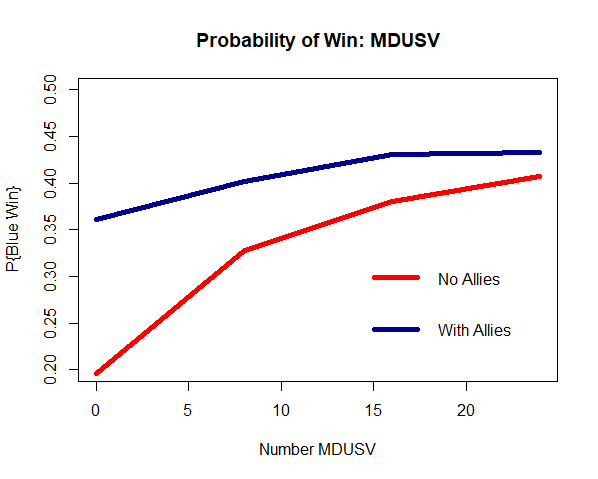
As mentioned, the MDUSV with TALON was introduced to a series of Joint Campaign Analysis classes and several NPS wargames. Officer-students have employed it in a variety of missions, from active operational deception to logistics delivery to riverine patrol. Its strongest characteristics are on-station time over unmanned aerial systems, sensor payload capacity over all other unmanned systems, and speed over unmanned underwater systems. Its limitations include vulnerability to attack (it has no active defense), which is mitigated by a low radar cross section making it difficult to target and/or acquire. Our analytical and wargaming teams have found their value forward in offensive naval formations and in defense screening formations (Figure 5). Employing a single or pair of MDUSV with a P-8 maritime patrol aircraft in an area ASW environment is also valuable. (Figure 6).Figure 5: The graph shows the probability of successfully finding and engaging an adversary’s amphibious task force in a South China Sea scenario with a traditional U.S. Surface Action Group (SAG) with and without allied ship support. As MDUSVs are added to the SAG, the probability of mission success is increased. The MDUSV are contributing to the ISR and targeting capabilities of the SAG. This analysis was produced using combat modeling by a Joint Campaign Analysis class team.
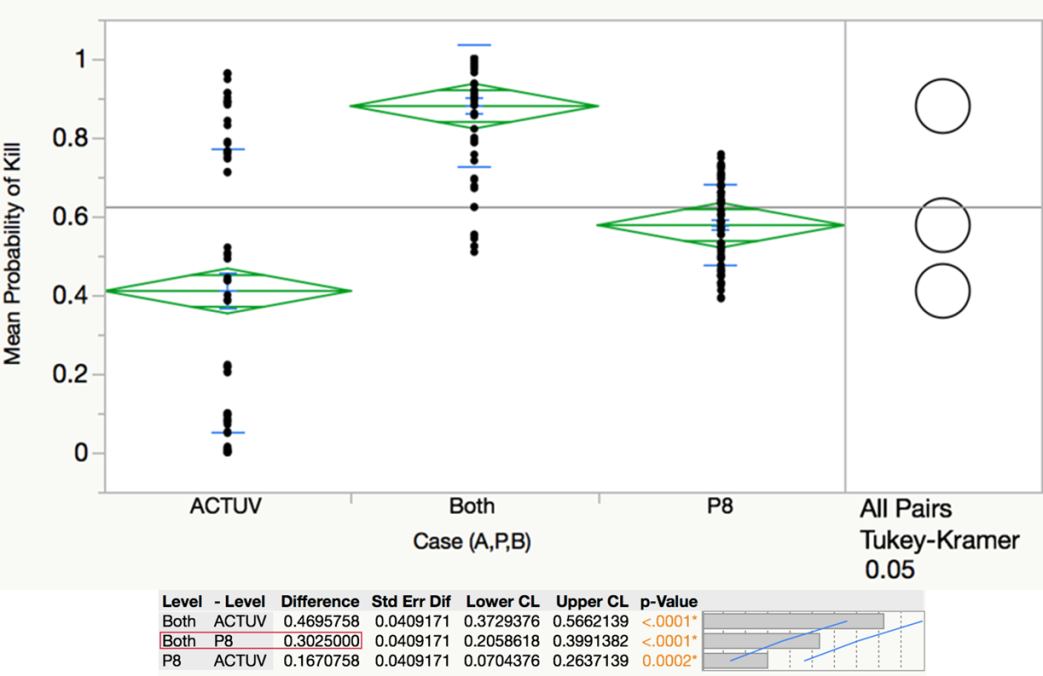
Figure 6: This plot shows the simulation results of an Area ASW engagement between a PLA Navy SSK submarine and the MDUSV alone (labeled ACTUV or Anti-Submarine Warfare Continuous Trail Unmanned Vessel, the original DAPRA program name); the MDUSV with a P-8 (labeled both), and the P-8 alone. The Tukey-Kramer test displays significant improvement with the MDUSV and P-8 work as an unmanned-manned pair.
Unique employment concepts are also developed, such as employing paired MDUSVs working as an active-passive team for both active radar and acoustic search. This information is passed to both sponsors and the NPS combat systems research faculty for engineering analysis.
LT John Tanalega’s Joint Campaign Analysis efforts included analyzing the MDUSV’s contribution to a scouting advantage for Blue forces in a surface-to-surface engagement (see figure 5). While a student in the NPS Wargaming Class, John’s team designed, developed, and executed a classified South China Sea game for United States Fleet Forces Command exploring distributed maritime operations and a force structure that included the MDUSV. Lessons from both classes were then applied to his further research in the MDUSV’s best tactical employment in a surface to surface engagement.
Furthering the study by use of simulation (Problem, Tactical Engagement, and Design of Experiments)
In transitioning MDUSV from technical concept to operational reality, several questions are prominent. First, MDUSV is just what its name implies—a vessel. The specific technologies which will make it effective in the maritime domain are all in various stages of development, and they are too numerous for MDUSV to carry all of them. Therefore, an exploration of which capabilities improve operational effectiveness the most is essential. Second, while superior technology is necessary, alone it is not sufficient. USVs must also be used with effective tactics, techniques, and procedures (TTPs) to make them effective SUW platforms. USVs are entirely new to the U.S. Navy, and no historical data exists for their use in combat. Modeling, simulation, and data farming7 provide an opportunity to explore concepts and systems that, today, are only theories and prototypes.
Computer-based modeling and simulation are an effective means of exploring MDUSV capabilities and tactics. Live experiments at-sea are always important to gather real-world data and provide proofs of concepts. However, they require a mature design. They are prohibitively expensive, and the low number of trials that can be conducted reduces the confidence levels of their conclusions. Computer-based modeling and simulation allows us to run tens of thousands of experiments over a wide range of factors. It is, therefore, better suited for design exploration. Using high-performance computing and special techniques in design of experiments (DoE), such as nearly orthogonal and balanced (NOB) designs, simulation experiments that would have taken months or years with legacy factorial designs can be can be performed in a matter of days. This highly efficient technique provides greater insights that inform and direct live experimentation and requirements development.
To explore the effects of MDUSV on surface warfare, LT Tanalega used the Lightweight Interstitials Toolkit for Mission Engineering using Simulation (LITMUS), developed by the Naval Surface Warfare Center, Dahlgren Division (NSWC DD). LITMUS is an agent-based modeling and simulation tool suited specifically to naval combat. Ships, aircraft, and submarines are built by users and customized with weapons, sensors, and behaviors to mirror the capabilities and actions of real-world combat systems. Using an efficient design of experiments and LITMUS scenario, over 29,000 surface battles were simulated with varied active and passive sensor ranges, MDUSV formations and armament, and emissions control EMCON policies.
To compare battle results, LT Tanalega used the probability of a surface force being first to fire a salvo of missiles against an adversary as a measure of effectiveness. This choice is motivated by the maxim of naval combat in the missile era to “fire effectively first,” and indicates a clear advantage in offensive tactics.8
Simulation Results (Unclassified)
Analysis of the simulation output shows that a traditional Blue force combating a very capable Red force in its home waters has 19 percent probability of meeting first-to-fire criteria (See Table 1). Blue surface forces equipped with MDUSV are nearly three times as likely to be first-to-fire. Analysis also found the increase in performance is due primarily to the extended sensor range afforded by the TALONS platform on scouting MDUSV. Based on the presence of MDUSV alone, Blue improves its probability of being first-to-fire by a factor of nearly three (from 19 percent to 56 percent), as shown in Table 1. Though a SAG will likely have helicopters embarked, it is important to note that helicopters are more limited in endurance. Further, the use of a helicopter in Phase II of a conflict poses exceptional risk to human pilots, especially if the enemy is equipped with capable air defense systems. We therefore modeled “worst case” without an airborne helo during the engagements. Given the long endurance of MDUSV and its autonomous nature, MDUSV represents a worthwhile investment for the surface force. When numerically disadvantaged and fighting in dangerous waters, MDUSV levels the odds for Blue.
Table 1. MDUSV Effect on First-to-Fire Probability
Advanced partition tree analysis of the data noted a breakpoint at an MDUSV passive sensor range of 36nm. With this range or greater, Blue was first-to-fire in 81% of the design replications (Table 2). Using the mathematical horizontal slant range formula to approximate visual horizon, this equates to a tether height of approximately 1020 feet. Given the current 150-pound weight limit for a TALONS payload, a passive electro-optical sensor may be more feasible than an active radar. Placing a high power radar, with power amplification, transmission, and signals processing in a TALONS mission package may not be feasible in the near term. Further study, from an electrical engineering and systems engineering perspective, is required.
Table 2. MDUSV Passive Sensor Range Effect on First-to-Fire Probability
While arming MDUSV provides a marginal increase in first-to-fire performance with EMCON policies 1 and 2, it has a small negative effect with EMCON policy 3. Ultimately, first-to-fire in each replication is driven by scouting—who saw whom and fired first. Since detecting the enemy is a necessary condition to shooting him, providing MDUSV with over the horizon sensor capabilities should be the first concern. This will allow the missile shooters of the surface and air forces to employ their weapons without emitting with their own sensors.
Furthering the Study by Use of Wargaming
The Fleet Design Wargame consisted of three separate gameplay sessions. During each session, the BLUE Team received a different order of battle. During gameplay, the study team observed the players’ decisions to organize and maneuver their forces, as well as the rationale behind those decisions. After two to three turns of gameplay, a member of the study team facilitated a seminar in which all players discussed the game results. Each team, BLUE and RED, had a leader playing as the “Task Force Commander,” and a supporting staff. The Blue Team consisted of three SWOs, a Navy pilot, an Air Force pilot, a Navy cryptologic warfare officer, two human resources officers, and a supply officer. The RED team consisted of three SWOs, one Marine NFO, one Navy cryptologic warfare officer, two Naval intelligence officers, and two supply officers. Search was adjudicated using probability tables and dice. Combat actions are being analyzed using combat models, such as a stochastic implementation of the salvo model.
Wargaming Results (unclassified)
The game demonstrated the combat potential that networked platforms, sensors, and weapons provide. Long endurance systems, such as the MQ-4C Triton and the Medium Displacement Unmanned Surface Vehicle (MDUSV) can be the eyes and ears of missile platforms like destroyers. The game also showed that with its range alone, an ASuW-capable Maritime Strike Tomahawk provides BLUE forces with greater flexibility when stationing units. On the other hand, unmanned systems also provide RED with a wider range of options to escalate and test U.S. resolve during phase 1. The study team also found that expeditionary warfare can have a double effect on the sea control fight. The presence of an LHA is a “double threat” to the enemy, acting as both an F-35B platform, and as a means of landing Marines.
Further Research Work on the MDUSV
Future research is required to optimize MDUSV design and to better characterize the human element of MDUSV employment and coordination. While TALONS provides a unique elevated sensor platform, a 150-pound maximum payload will be a considerable constraint. Passive sensors, such as EO/IR, may be mounted on the TALONS platform, but the weight required to house a high-performance radar will be a higher hurdle to overcome. Though this can be mitigated by changing the parasail design to increase lift, this will require more in-depth study of the engineering trade-offs. Also, the process will have to be automated. TALONS testing to-date has involved members of the test team deploying and recovering it.
Though this study was performed with software-driven automata, the tactical decisions leading-up to the placement of MDUSV will be made by humans. The long endurance of MDUSV makes it an ideal platform for deception. Tactical and operational level wargaming may yield insight into the affect that adding MDUSV will have on human decision-making.
As this study was the first SUW simulation of a man-machine teamed force, the scope of the agents explored was purposefully limited. To add to the realism of the experiment, and to explore future tactics, the addition of helicopters and other scout aircraft to the scenario may yield further insight into the design requirements and tactical employment of MDUSV.
MDUSVs in this study were homogenously equipped and shared the same EMCON policy. However, if each MDUSV is given only one capability, such as a particular sensor type or a weapon, their strengths may offset their weaknesses. Grouping several MDUSVs with different mission load-outs may be an alternative to sending a manned multi-mission ship like a DDG. It may also prove to be more resilient to battle damage, as the loss of a single MDUSV would mean the loss of an individual mission, while the mission-kill of a DDG would result in a loss of all combat capability. Further simulation and analysis with LITMUS may yield insights into this trade-off.
Other Examples
Although we have highlighted LT Tanalega’s recent research to demonstrate how the NPS Warfare Analysis group integrates officer’s tactical experience, classroom work, and more detailed research to provide insights in new technologies, tactics, and operational concepts, many other examples can be mentioned. These include tactics to defeat swarms of unmanned combat aerial vehicles, best use of lasers aboard ships, developing tactics to counter maritime special operations insertion, employing expeditionary basing in contested environments, exploration in distributed logistics, best convoy screening tactics against missile-capable submarines, and use of sea bed sensors and systems. Analytical red teaming is also used for sponsors wishing to better understand the resilience and vulnerability of their new systems—employed in the same classes mentioned in this paper. These results are shared with DoD and Navy sponsors interested in getting robust and quantitative assessments of the strengths and weaknesses of their systems.
Although the NPS Warfare Analysis group is pleased to make real-world contributions as part of our students’ education experience, our greatest satisfaction comes from observing the junior officer’s military professional growth that accompanies the application of their newly learned analytical skills. To model and analyze an engagement, a thorough understanding of the tactical factors and performance parameters is necessary. By the end of our students’ experience, they have gained expertise in that mission and in operations analysis—a perfect blend to contribute to our nation’s future force architecture and design.
CAPT Jeff Kline, USN (ret.) is a Professor of Practice in Military Operations Research at the Naval Postgraduate School. He holds the OPNAV N9I Chair of Systems Engineering Analysis and teaches Joint Campaign Analysis, Systems Analysis, and Risk Assessment. jekline@nps.edu
Dr. Jeff Appleget is a retired Army Colonel who served as an Artilleryman and Operations Research analyst in his 30-year Army career. He teaches the Wargaming Analysis, Combat Modeling, and Advanced Wargaming Applications courses. Jeff directs the activities of the NPS Wargaming Activity Hub. He is the Joint Warfare Analysis Center (JWAC) Chair of Applied Operations Research at NPS. jaappleg@nps.edu
Dr. Tom Lucas is a Professor in the Operations Research Department at the Naval Postgraduate School (NPS), joining the Department in 1998. Previously, he worked as a statistician and project leader for six years at RAND and as a systems engineer for 11 years at Hughes Aircraft Company. Dr. Lucas is the Co-Director of the NPS Simulation, Experiments, and Efficient Design (SEED) Center and has advised over 100 graduate theses using simulation and efficient experimental design to explore a variety of tactical and technical topcs. twlucas@nps.edu
LT John F. Tanalega is a Navy Surface Warfare Officer from North Las Vegas, Nevada and is a 2011 graduate of the United States Naval Academy His first operational tour was as Auxiliaries and Electrical Officer, and later as First Lieutenant, in USS DEWEY (DDG 105). He next served as Fire Control Officer in USS JOHN PAUL JONES (DDG 53). As an operations analysis student at the Naval Postgraduate School, his research focused on combat modeling, campaign analysis, and analytic wargaming. After graduating from NPS, he reported to the Surface Warfare Officer School (SWOS) in Newport, Rhode Island, in preparation for his next at-sea assignment.
References
1. Sanchez, S.M., T.W. Lucas, P.J. Sanchez, C.J. Nannini, and H. Wong, “Designs for Large-Scale Simulation Experiments with Applications to Defense and Homeland Security,” Design and Analysis of Experiments, volume III, by Hinckleman (ed.), Wiley, 2012, pp. 413-441
2. Kline, J., Hughes, W., and Otte, D., 2010, “Campaign Analysis: An Introductory Review,” Wiley Encyclopedia of Operations Research and Management Science, ed Cochran, J. John Wiley & Sons, Inc
3. Appleget, J., Cameron, F., “Analytical Wargaming on the Rise,” Phalanx, Military Operations Research Society, March 2015, pp 28-32
4. Appleget, J., Cameron, F., Burks, R., and Kline, J., “Wargaming at the Naval Postgraduate School,” CSIAC Journal, Vol 4, No 3, November 2016 pp 18- 23
“You sort of take on the role of one of the leaders in those battles and you get to rethink it through and you lead the team through that talk and you’re there on station. It’s a very educational experience, and I’ve always envied the opportunity to do that…I always envied these land battles, and the Army or the Marine Corps that fought them because in our business we have nothing like [staff rides]…We can study our battles but we have nothing like that. At the end of our conflict, at the end of our battles, the winners sail away victorious and the losers sink to the bottom, and the sea washes over them and soon after, there’s almost no trace of what happened. Maybe, if you want to reach, you can think about walking theConstitution, and you get a chance to see what war at sea in the age of sail might have been like. Maybe you can walk the USS Missouri and you get a chance to see what fighting that battleship in World War II might have been like…Pearl Harbor, a naval battle of sorts…you can see where the terrain might have played a role. But in general, we don’t get a chance to do anything close to a staff ride, and it’s a stark testament to the unforgiving nature of our environment, and it imposes a level of accountability far greater than any administrative measures that any Navy could ever take.” –Chief of Naval Operations Admiral John Richardson1
Major conditions are coming to fruition that will allow the Navy to transform itself for the high-end fight. A new national security strategy has officially refocused the Department of Defense on great power competition after decades of focusing on lower-end threats. A new deploying construct based on unpredictability will help the Navy reset its operating patterns and find more time to work on itself. New weapons and networks that will give the Navy greater firepower than ever before are about to hit the fleet. The time is ripe for revolution. What force development strategy will guide the Navy into the future?
Setting Priorities
“NIFC-CA employs ships and aircraft to consummate missile engagements beyond the radar horizon. This execution is operational rocket science. Those who master it will be identified as the best and brightest.” –Captain Jim Kilby, “Surface Warfare: Lynchpin of Naval Integrated Air/Missile Defense,” 20162
Force development is a process of evolution, where the education and equipment of the force is being continually updated to align with visions of how future conflict may transpire. A force development strategy must guide this evolution by aligning the components of military evolution, mainly capabilities, tactics, doctrine, and training. These components can be aligned toward producing specific warfighting concepts, and also toward generating individual tactics that are a key element of succeeding in future combat regardless of the higher-order concepts they serve.
But the major warfighting experiments and training events that make force development flourish are undoubtedly large expenditures of time and effort. Their scarcity can act as a constraint that forces prioritization. Numerous stakeholders will be competing for time in order to fully experiment with tactics, capabilities, concepts of operation, and other ideas. The products of force development will then compete for the time of the Sailor, and force the Navy to prioritize what it wants Sailors to be proficient at. As it considers a wide variety of demand signals, the Navy must deliberate on what specific force development questions are important enough to warrant sustained series of experiments and new training curriculum. If Distributed Maritime Operations (DMO) is an operational warfighting concept in need of a force development strategy, then the interconnected nature of force development can be revealed in a specific line of effort that develops a hallmark tactic of DMO.
Distributed naval forces will be able to use networking to aggregate anti-ship firepower from across the force and collect missiles into overwhelming salvos on demand. But it is still practically impossible for the U.S. Navy to execute missile aggregation tactics because almost all of its anti-ship missiles have a meager range of less than 80 miles. That hard limit means U.S. ships can barely spread out and distribute themselves if they want to keep their anti-ship firepower concentrated. A lack of long-range anti-ship firepower will stand in the way of the Navy’s ability to full realize its next major warfighting concept until new capabilities are introduced.
Capability introduction must be matched by tactical development. This will require a heavy experimentation component to identify the best means. What is the ideal method to collect firepower from across a distributed force? What are the best methods to program missiles in such a way as to overwhelm and confuse an adversary? Aggregating missile fires can be a hallmark tactic of distributed naval forces, but will depend on the ability of units to execute other tactics as a prerequisite. Units must be able to use engage-on-remote tactics to cue networked fires from widely dispersed forces, and to use retargeting tactics to keep the kill chains of those missiles fresh. DMO requires new interlocking sets of networking tactics if it is to be fleshed out as a concept.
Training must prioritize proficiency for executing those specific tactics, and should seek to cultivate an overall tactical sense. Units will need good tactical sense to assess the risks of emissions control while facilitating networking. Units must also be trained in executing tactics for managing datalinks, including through jamming and deception. If Sailors are not well-trained in managing datalinks under contested conditions, then a training shortfall can also be enough to inhibit the Navy from making the most of DMO.
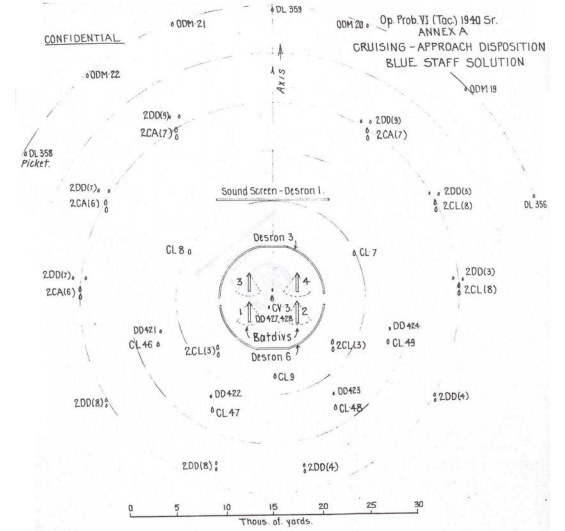
DMO can also take a note from how the interwar period Navy prioritized its own force development. Some of the interwar period Navy’s most important subjects of tactical and doctrinal investigation were fleet formations. The advent of airpower and the diverse types of units that could engage one another in naval combat added a significant degree of complexity in designing fleet formations. These formations attempted to promote maneuverability, facilitate the concentration of firepower, and give room for a variety of command and control options from the fleet commander down to the initiative of the unit leader.
The advent of distributed operations and the enormous range of modern weapon systems presents the Navy with a similar challenge, but of greater magnitude. The Navy must focus a significant amount of effort into crafting a variety of distributed fleet formations – fighting stances for how a distributed fleet could steam into a contested zone or meet a hostile force of a certain kind.
Because the speed of a ship is miniscule compared to the speed of missiles, a formation of ships could hardly change during fleet combat. A modern fleet action could be over within minutes, causing fleets to rely heavily on speedy aviation for flexibility and responsiveness. Therefore a distributed fleet formation should also pay great care to a distributed airpower formation, and the nature of that fleet-wide ship-to-aircraft interface can help determine tactics for emissions control, retargeting, and engage-on-remote. Understanding how various distributed airpower schemes can overlay distributed fleet formations is a prime area of interest, as well as how critical networking capabilities like NIFC-CA and CEC can be flexed with different formations.
An animation of a hypothetical scenario demonstrating the Cooperative Engagement Capability and an associated fleet formation. (JHU APL)
Distributed fleet formations are a higher-order force development question for the Distributed Maritime Operations concept. A major fleet action is a complex mosaic of many warfighting dynamics, but the Navy needs to prioritizes specialized series of events that flesh out individual areas to gradually fill in this mosaic and refine the larger exercises and simulations.
However, experimenting with force development usually suffers from handicaps posed by the numerous artificialities and practical restrictions that come with warfighting simulations.Safety regulations can sometimes be so restrictive that they harm the realism of exercises to an unreasonable degree. The use of special “war modes” for certain sensors and electronic capabilities can also be restricted. Firings are often simulated since it can be highly impractical and dangerous to use real weapons. But these restrictions and artificialities run the risk of hiding valuable insight and hindering force development. Force development must find ways to selectively push these limits for the sake of realism and to ensure that tactical investigations are thorough. A force development strategy should define targeted tactical investigations that are being held back by restrictions or obscured by artificialities, and execute specialized series of events in controlled environments. This will help ensure that the details of certain tactics or capabilities are not overlooked, and that surprise is not incurred.
A strong candidate for frequent live-fire testing and experimentation is the incoming generation of anti-ship missiles that are about to hit the fleet. A significant amount of tactical decision-making could still transpire after an anti-ship missile salvo is fired, and much of that decision-making could be in the hands of autonomous actors. Missiles can use a variety of sensors and networking to close in on their targets, refine their attack profiles, and evade defenses. Other platforms can use networking and retargeting to keep the salvo’s kill chain fresh, and ensure missiles are not deceived by decoys or jamming. Actors could in turn seek to interfere with the datalinks that connect the missiles within a salvo and with the broader force. Evolving the tactics, behavior, and decision-making of autonomous missile salvos and those defending against them is a paramount area of interest for focused tactical investigation.
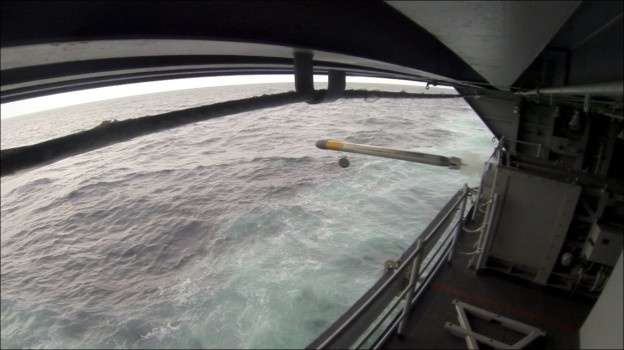
Arguably one of the most interesting recent developments in naval arms is the advent of the anti-torpedo torpedo, a novel system the U.S. Navy is currently installing on its capital ships. What makes this system noteworthy is that it introduces a hardkill dynamic into modern torpedo defense for what appears to be the first time. Prior to the advent of this system, it appears torpedo defense was confined to only softkill countermeasures – decoys and other distractions that could lure a torpedo away but not outright destroy it. Introducing a hardkill dynamic into torpedo defense could drastically change the tactics of undersea warfare, and create new offensive/defensive dynamics. If the anti-torpedo torpedo proves to be effective enough and widely proliferates, then it could negate much of the American military’s offensive advantage in the undersea domain until its submarines finally get anti-ship missiles. The tactical effects of this seemingly innocuous system could have serious strategic consequences.
Experimental Countermeasure Anti-Torpedo (CAT) launches from the fantail of USS George HW Bush (CVN-77) in May, 2013. (U.S. Navy Photo)
Power projection operations presume a degree of sea control in order to be executed, and in a similar sense, naval power presumes a degree of cyber control in order to function at all. Warships are highly complex machines made up of advanced electronics, and fleets form sophisticated networks from among their many elements. The cyber terrain of an individual warship is enormous (let alone that of a fleet), and offers numerous points of failure.
It is not too far-fetched to suggest that a cyberattack on a ship could spark grievous mechanical failures, hijack equipment from operators, or scramble the code of combat systems like Aegis. In a time of war, ships could be stuck pierside or dead in the water if they are being wracked by cyberattacks. No Navy can afford to lose in cyberspace, making cyberwarfare one of the most important areas for force development. In spite of this, those who led the cyberforensics investigation into the USS John S. McCain collision suggested that the Navy is extremely far behind on establishing even a basic cyber defense capability:
“To generate network situational awareness sophisticated enough to do cyber forensics, the team will need to search for electronic anomalies across a wide range of interconnected systems. A key component of anomaly detection is the availability of normal baseline operating data, or trusted images, that can be used for comparison. These critical datasets of trusted images do not currently exist.”3
Cyberwarfare is a prime area for the Navy to loosen the restraints and create a specialized series of tactical investigations and training events. However, it will be challenging to effectively resource and constrain this sort of exploration because of the expansiveness of the cyber domain. In order to resource realistic cyber warfighting practice and experimentation, the Navy should consider taking ships from each class and turning them into full-time cyber battlegrounds. Crews will be able to practice damage control on realistic terrain, and operators will be able to understand how gracefully (or ungracefully) their capabilities degrade. For certain experiments, cyber Red teams must be empowered to break things and attack systems with the relentlessness of a great power adversary. Over time this will help build a base of knowledge on cyber hygiene, and eventually aim to give the Navy the confidence that adversaries have not been able to pre-position cyber weapons into ships and systems during peacetime.
Designing the Field of Application
“Two interdependent activities, exercises and experimentation, help to bring joint concepts to life. Throughout history, military exercises have served to reduce uncertainty, increase readiness, and refine and test new concepts. Recognizing the complexity of today’s strategic landscape, we are reenergizing and reorienting the joint exercise program…” –Chairman of the Joint Chiefs of Staff General Joe Dunford4
Military tools are more advanced and interconnected than ever, driving warfighting concepts toward more complex tactics and doctrine. Yet it is infeasible to realistically test the complex tangle of a great power battle when it can involve things as expensive as warships, as numerous as missile salvos, or as expansive as cyber warfare. These trends are pushing military experimentation and training further and further into the virtual realm, and making force development more vulnerable to the caveats of simulation. The difference between what can be reasonably tested and the nature of actual combat has grown to unprecedented heights, and surprises may lie within that gulf of the unknown. Because of this, force development must include a robust system of real-world experimentation and training that pushes these limits frequently and with rigor.
Exercises can serve as the bedrock of force development because only they can serve as the real-world field of application short of war itself. How these events and their participants evolve over time can reflect the pace of learning. The concepts and scenarios that are deemed worthy of sustained real-world testing and training will reflect the highest priorities. The standards that undergird the field of application can reflect the seriousness of force development, and the level of understanding on warfighting. The learning architecture that is built around exercises helps determine how stakeholders can make the most of the field of application. Ultimately, how the military makes use of exercises as the field of application can reveal much about the state of a force development strategy as a whole.
Exercise events can be widely dissimilar, depending if they are focused on training, experimentation, or partnership engagement. The Navy must define standards and create formats for its major warfighting experiments and training events. It can also learn from earlier difficulties in designing major experimentation exercises. The Fleet Battle Experiments intended to be exercises that could test out important ideas for the Navy’s development. However, they became overcomplicated. They often combined elements of virtual forces, live forces, readiness evolutions, and wargaming. On top of this hodgepodge they stacked numerous test goals driven by many stakeholders. All of this complexity made it difficult for the Navy to extract value from the events.
Adding virtual forces to live exercises can be driven by the need to create appropriately large scenarios. However, because they are simulations, virtual forces introduce simulation caveats which can complicate analysis. Compared to live opposing forces, virtual units can certainly be more accurate representations of adversaries in a technical sense, but their behavior may be more simplistic. Virtual forces can hold great value for training events, but they must be more carefully used when mixed with experimentation.
Wargaming is a virtual field of application, and there is already a significant learning architecture built around certain wargaming programs. Wargames focused on tactics and doctrine should work together with the real-world field of application in a process of cooperative refinement, where wargames can refine concepts for eventual field application. But some balance must be struck between the two, lest wargames get too ahead of themselves or too much is spent on real-world trials.
Adding too many goals to the Fleet Battle Experiments made it difficult to organize follow-on events that could build on insights. Because warfighting is highly complex, multiple rounds of trial and error must characterize force development trials. However, if the Navy is to facilitate this sort of trial and error on the field of application, then events must be tightly constrained to focus on narrowly defined objectives. Otherwise, it is extraordinarily difficult to design the appropriate follow-through for a large-scale event that attempts to answer too many questions for too many stakeholders.
Multiple rounds of trial and error must also require that events take the form of a series, and where a single series can be focused on exhaustively probing only a handful of questions, warfare areas, or scenarios. One can look to the Air Force, with Red Flag as the premier combat training event, Green Flag as the main close air support exercise, and Space Flag which focuses on space-based effects.Those who program the schedule of events for the field of application should often think in terms of series, and not just one-off events.
Oversight
In a responsible system of force development, warfighting concepts and programs should live or die by their ability to prove their tactical worth. Arguments on the lasting usefulness of a system are not settled by simply identifying the capability it brings or the mission areas it contributes to. Capabilities have to be tested with an eye toward the specific tactics they produce, and in fleshed out environments. Regardless if the systems are functioning in a technical sense, capabilities can be proven useless or even counterproductive in the context of their application. Poor tactical performance in simulations or exercises should be enough to force changes or cancellations as force development weeds out brittle ideas. If a service or a warfighting community is concerned about the viability of a particular concept or a system, then they should be made to compete through superior tactical innovation. But having realistic proving grounds, a robust learning architecture, and a healthy learning culture is not enough to have the utmost confidence in the military’s ability to change. Despite all the good they can do for military evolution, exercises and wargames have often been deliberately shaped to defend preconceived notions.
Objective tactical investigation and competition requires that trials be realistic, unbiased, and transparent to crucial stakeholders. However, defense programs and warfighting concepts do not exist in an objective vacuum, and involve bureaucratic and political equity. Various communities within each of the services compete with one another for resources for their respective programs, and each has their sacred cows. Multiple tools can exist for the same mission, such as for anti-submarine warfare, but reside among the different tribes and communities. Institutional divisions can emerge along varying interpretations on what will dominate in future war. The services can also compete with each other, such as in the infamous Revolt of the Admirals that was driven by arguments that pitted the Air Force’s strategic bombers against the Navy’s carrier aviation. Questions of tactical effectiveness are but one element of these debates, and sometimes parochial interests can become overriding. These dynamics can also go far beyond the Pentagon and also reach into the halls of Congress. Members of Congress can strongly depend on certain defense programs for jobs and political capital, and can hold other attachments to certain systems of interest. In the past, Congress has forced the military to retain platforms that the services deemed to have outlived their tactical usefulness, including battleships and the A-10.
In How Much Is Enough, Alain Enthoven and K. Wayne Smith pointed to how military culture and bureaucracy can be susceptible to unobjective influences, and how independent analysts in the once-controversial Systems Analysis office were able to compensate:
“Military officers as a group (and some civilians as well) are in a position to have very limited intellectual and career independence. While many individuals succeed in standing up to the system, there are numerous institutional factors working to limit the officer’s intellectual independence…The military man lives in an atmosphere in which many assumptions, attitudes, and beliefs – generally unspoken – are shared…Officers who do not share these beliefs are liable to reprisal on their annual fitness reports…This lack of career independence further helps to ensure conformity to the Service point of view…[independent civilian] analysts could more easily ask the hard questions and pose genuine alternatives, arriving at a recommendation via a more rational and objective process. They were not constrained to defer to rank, age, experience, or chain of command. They had the time to think about important long-range policy problems and [had] the room for imagination, initiative, and fresh thinking. They were comparatively free to gore sacred cows. Such liberties are institutionally very difficult to exercise in a military organization, joint or single Service. There have been loud complaints about civilians ‘muzzling the military’; but anyone who is familiar with the system knows that most of the muzzling is done by the military themselves.”5
For these reasons and others, the Department of Defense and the Congress should establish an independent body that seeks to provide an unbiased set of eyes on major exercising and wargaming programs. Important independent bodies already exist in the Department of Defense, such as the Office of Cost Assessment and Program Evaluation (CAPE, which is descended from the Systems Analysis office) and Director of Operational Test and Evaluation (DOTE). These organizations aid in assessing major programmatic decisions and provide oversight and evaluation of weapons testing, respectively. These organizations play important roles in providing independent assessments, maintaining standards, and help act as a check on the military’s parochial interests. An organization that seeks to provide similar functions for major exercises and wargames could focus on accounting for:
Nature and extent of exercise/wargame artificialities and assumptions
Fidelity and behavior of opposing forces
Fairness of adjudication
Effective inclusion and communication of results in follow-on reporting
Exercises and wargames can have enormous programmatic implications like the programs CAPE and DOTE assess. However, they are venues that can still be corrupted by institutional bias. One such example includes the Congressionally mandated “flyoff” between the F-35 and A-10, which was supposed to be an exercise designed to assess the tactical merits of the platforms in the close air support mission. However, the Project On Government Oversight (POGO), an independent watchdog, released a scathing report on the flyoff that argued the exercise design was deliberately distorted to favor the F-35. While pointing to a variety of flaws, POGO claimed:
“Air Force leaders…are staging an unpublicized, quickie test on existing training ranges, creating unrealistic scenarios that presuppose an ignorant and inert enemy force, writing ground rules for the tests that make the F-35 look good—and they got the new testing director, the retired Air Force general Robert Behler, to approve all of it. According to sources closely involved with the A-10 versus F-35 fly-off, who wished to remain anonymous out of concerns about retaliation, this testing program was designed without ever consulting the Air Force’s resident experts on close air support, A-10 pilots and joint terminal attack ground controllers…”6
The frequency with which it appears the military distorts the field of application to protect assumptions, to include scripting behaviors and other measures, points to an uncomfortable truth of force development. The military cannot be expected to always accept or disclose the most disruptive implications that can come from investigating the future of war. Despite their hefty mandate, the armed forces, like any other organization, can still stifle progress through bias, bureaucratic inertia, and an unreceptive culture. An independent body that assesses major exercises and wargames can add needed discipline to force development, safeguard the field of application, and promote military evolution that is appropriately receptive to change.
Resourcing and Reorganization
“Sailors are the most modular, lethal, and adaptable asset the Navy has. No weapon system, no matter how technologically advanced, is more instrumental to warfighting effectiveness than the person directing it. But competency and confidence are not naturally ingrained in a sailor. Warfighting effectiveness only can develop in a sailor who is properly educated, rigorously trained, and meaningfully assessed—and all these factors require resourcing.” –Lt. Brendan Cordial, “People Over Payloads,” 20187
If strategy is to inform budget in an age of great power competition, then the Navy must decide how it can invest more into learning tactics and doctrine. Resourcing priorities can focus on providing more operational units in order to increase the frequency of major training events and warfighting experiments, as well as investing in the unique personnel assignments that are specifically tailored toward force development. However, the current political environment and other constraints are not going to allow for a sudden major increase in force development funding. When it comes to resourcing, how the Navy makes the most of its force development will greatly depend on how it reinvests its time.
The Navy’s force development agenda and the overseas operational agenda will compete for the fleet’s time and units. The Navy’s current ability to resource its own force development with enough field trials and opposing forces will be heavily tied to its ability to wind down its overseas operations. With respect to becoming a learning organization that intends to learn more about high-end warfighting specifically, the Navy must weigh the learning value of major force development events versus overseas operations. In this vein, it should be plainly clear that advanced training and experimentation events help the Navy learn more about high-end warfighting than virtually any presence patrol or maritime security mission.
If the Navy wants to maximize the “reps and sets” of its force development, then it can invert what it has long been its operating paradigm. Advanced events like SWATT and the Fleet Problems shouldn’t just be the prelude to a long deployment, they can become the point of a deployment. Allowing units to do these events several times in the course of a single stretch will accelerate the Navy’s learning to incredible heights, and give the training audience multiple attempts to better themselves in large-scale venues. More importantly, this will add greater speed to the Navy’s ongoing transition away from the low-end focus and gradually reduce the strategic liability it incurred. How frequently the fleet chooses to conduct high-end training events at the onset of this transition will determine how quickly the Navy can close the door on any adversary that seeks to capitalize on the Navy’s lingering neglect of full-spectrum skills.
A baseline resourcing requirement can include defining a dedicated opposing force, because major real-world trials will often need meaningful opposition as a basic realism requirement, and dedicated opposing forces require adequate time to train to foreign doctrine. By designating a combination of units to act as a dedicated opposing force, the fleet will also have a major unit that can be mostly focused on solving Navy problems and not just combatant commander problems. Such a force can maximize its size and availability by including virtual units and operating on a workup cycle similar to that of forward deployed naval forces.
Another resourcing requirement will come from how the field of application is organized, and the various series of events that are defined. Some events could focus exclusively on training while others focus only on experimentation, since the two can be distinct types of events. Many tactical investigations will require a series of experiments, and many units will need to pass through training crucibles each year. How the Navy organizes the field of application and then allocates units and spends readiness across the various events can drive resourcing requirements.
The Navy has a tremendous advantage over its great power rivals when it comes to resourcing force development. The numerous allies the U.S. has around the world can also put their navies to use in answering critical force development questions. Allies can be asked to investigate specific tactical problems, and can offer more units to serve as opposition forces. Every allied navy adds size to the field of application, and can allow for a more expansive force development agenda that is shared among partners.
Aside from investing more energy toward live exercises and away from forward operations, the Navy must learn to better resource learning at the individual level. The Navy must give Sailors the time to focus on what makes them better warfighters, and also improve access to the career opportunities that hold the greatest value for their development as warfighters.
Debriefs and replays can and should be reviewed by many more than those who actually participated. No Sailor needs to wait to participate in order to learn from a Fleet Problem, a SWATT evolution, or a wargame. The Navy can widen the reach of its learning architecture by creating deliverable lesson plans and replays for each of these events. Easily digestible and widely disseminated deliverables will multiply the size of the training audience, and make the most of expensive exercises. However, this sort of learning experience should not be left to the initiative of Sailors, since the Navy’s lessons learned systems are infamously difficult and underutilized. Instead, Sailors should be mandated to review these sorts of replays and debriefs as a part of their training curriculum, which will ensure the Navy multiplies the value of these events. Also, for certain trials, opposition forces need to be capable and unpredictable enough so this sort of reviewing doesn’t amount to finding an answer key.
Sailors still need to be given enough time if they are to have better learning experiences. The Navy already makes plenty of time for Sailors to learn things, but among numerous workshops, inspections, and trainings, not enough are truly focused on making Sailors better warfighters. Leaders have long sought to cut these burdens and have made some progress, but Sailors are still overburdened and their focus spread thin. The Navy must recognize that many of these burdens are the accumulated baggage of a risk-averse culture and a low-end operating focus that was not well-constrained. Similar to how a SWATT exercise teaches more than virtually any presence patrol, spending a few hours watching a Fleet Problem replay teaches more about warfighting than virtually any admin paperwork. The Navy should redefine individual training requirements for the high-end fight, and then force most other burdens to conform to those requirements and not the other way around.
By the time the Imperial Japanese Navy struck Pearl Harbor, 99 percent of the U.S. Navy’s admirals were graduates of the Naval War College.8All the admirals who graduated from the interwar period Naval War College learned from a curriculum that included a heavy wargaming component. Through multiple wargames that could last weeks at a time, naval officers acted out major fleet actions against great power rivals and became engrossed in warfighting specifics. This shared wargaming experience was invaluable in giving the Navy’s admirals a common baseline of expertise on tactics, doctrine, and operational thinking.
The first move of Tactical Maneuver IV for the Naval War College class of 1923. This chart shows the Red fleet at the upper right and the Blue fleet in the lower left. (“Battle of Emerald Bank, Tactical Problem IV, TAC 94, 1923. Naval Historical Collection) [Click to Expand]While many of the modern Navy’s flag officers are also graduates of the College, the current curriculum is more diverse and does not come close to producing the base of warfighting expertise the interwar Navy earned through the same institution. Wargaming programs at the College such as the Gravely and Halsey programs have become very exclusive, yet do not often feature in the experience of flag officers. Wargaming experience should become more mainstream throughout the Navy’s officer ranks because it is a valuable training and research experience, and it is far more affordable training than live exercising.
Distinction in wargaming should also be rewarded with better career prospects. This should hold especially true for earning flag rank because wargaming can help compensate for the natural disadvantages of how command experience evolves. Naval officers usually do not have the opportunity to lead multi-ship operations until they have served for decades and are already fairly senior. A more mainstream wargaming curriculum will help the Navy identify leaders with a knack for commanding large-scale combat operations far earlier in their careers, and ensure that the senior ranks are populated with leaders that have experience thinking through high-end conflict scenarios.
Conclusion
Whether artillery begins to rain on the Korean peninsula, or Iranian mines litter the Strait of Hormuz, or a major terrorist attack unfolds, the Navy must never again allow itself to totally do away with preparing for the high-end fight. The story of the modern American Navy is unfortunately that of an organization that was divorced from the main purpose that had long animated its spirit, and dysfunction radiated throughout its institutions as a result. A difficult transition looms ahead, its urgency underscored by the sudden naval ascendance of a great power rival.
The U.S. Navy still retains its global preeminence, and has the greatest potential of any other navy today. Its history is replete with historic victories, its resources are unmatched, and the world still regards it as a powerful expression of American global leadership. The mettle of the fleet will be forged anew as an emerging era of great power competition infuses it with urgent spirit.
Now the U.S. Navy is embarking on a bold transformation, and soon it will rediscover the power of its essence–to command the seas.
Dmitry Filipoff is CIMSEC’s Director of Online Content. Contact him at Nextwar@cimsec.org.
8. John Lillard, Playing War: Wargaming and U.S. Navy Preparations for World War II, Potomac Books, 2016.
Featured Image: NORWEGIAN SEA (Oct. 26, 2018) Aviation Machinist’s Mate Airman Jadah Martinez inspects an after burner for fuel leaks during an active test on the fantail aboard the Nimitz-class aircraft carrier USS Harry S. Truman (CVN 75). (U.S. Navy photo by Mass Communication Specialist 3rd Class Victoria Granado/Released)