Category Archives: Capability Analysis

Analyzing Specific Naval and Maritime Platforms

The Gulf of Guinea is Ready for Maritime Technology

By Dr. Ian Ralby, Dr. David Soud, and Rohini Ralby

Few regions of the world have seen more improvement in maritime security institutions over the last five years than the Gulf of Guinea. At the same time, however, maritime security threats across West and Central Africa have continued to evolve and are increasingly difficult to address. Ironically, the region is becoming a victim of its own success: improved maritime law enforcement drove criminals to become both more brazen and more innovative in how they pursue illicit profit. These heightened challenges, however, are no longer as insurmountable as even basic ones were a decade ago. Having built one of the most sophisticated and promising sets of maritime security architecture in the world, the Gulf of Guinea is actually well-placed to take on the new challenges it faces.

To maximize the efficiency and effectiveness of this architecture in confronting these threats, a new element has to enter the conversation: technology. States, zones, regions, and the wider interregional mechanisms must all explore ways of leveraging technology to realize their respective mandates in the most cost effective way. Five years ago, discussing maritime technology would have been of limited value, as the state and cooperative mechanisms across West and Central Africa were too nascent to take advantage of it. Now, however, the Gulf of Guinea is primed to make better use of maritime security technology. 

The Gulf of Guinea Has Momentum

While progress in developing functional maritime security in the Gulf of Guinea may not have been as fast as some would prefer, it is now moving rapidly, and its trajectory is unmistakable. The signing of the 2013 Code of Conduct Concerning the Repression of Piracy, Armed Robbery against Ships, and Illicit Maritime Activity in West and Central Africa – known informally as the Yaoundé Code of Conduct – catalyzed an intensive process of national, zonal, regional, and interregional improvement that continues to gain momentum. As Article 2 of the Code states, “the Signatories intend to co-operate to the fullest possible extent in the repression of transnational organized crime in the maritime domain, maritime terrorism, IUU fishing, and other illegal activities at sea.” This initiative has given rise to a multi-tiered effort.
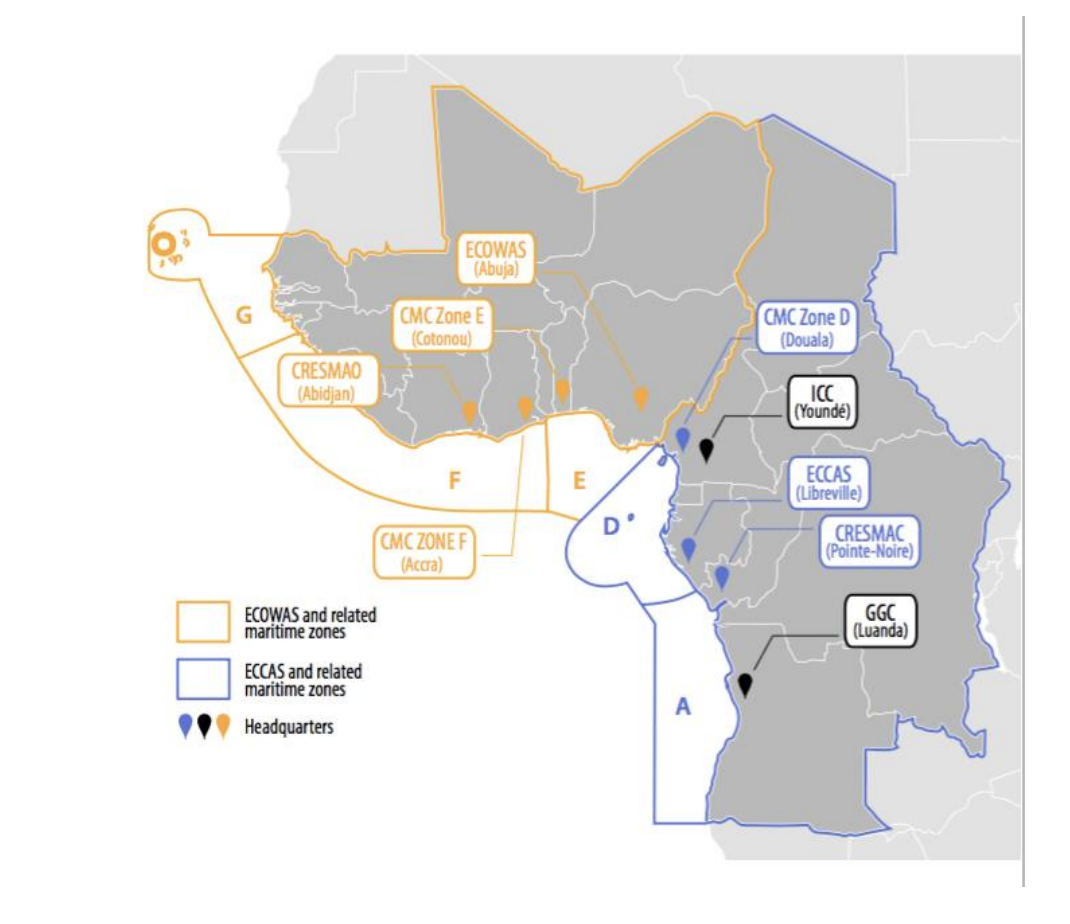
The Gulf of Guinea (Osservatorio Strategico 2017 – Year XIX issue IV)

At the national level, states are working to establish interagency processes for maritime governance, and to develop and implement national maritime strategies. States will remain the fundamental building blocks of maritime security in the Gulf of Guinea. Only through the national laws of the regional states can maritime crimes be effectively prosecuted. Beyond these national efforts, however, the states are engaging in an increasingly integrated, multilateral architecture that facilitates seamless cooperation.

The states, including the landlocked signatories to the Yaoundé Code of Conduct, are grouped by their respective Regional Economic Communities (REC) into maritime Zones. The Economic Community for Central African States (ECCAS) has Zones A and D (there is neither a B nor a C) and the Economic Community for Western African States (ECOWAS) has Zones E, F, and G. The national groupings are as follows, with an asterisk indicating each country that hosts a Zonal Multinational Coordination Center (MCC):

  • Zone A: Angola, Democratic Republic of Congo, Congo
  • Zone D: Cameroon*, Equatorial Guinea, Gabon, São Tomé and Príncipe
  • Zone E: Nigeria, Benin*, Togo, Niger
  • Zone F: Ghana*, Côte d’Ivoire, Burkina Faso, Sierra Leone, Liberia, Guinea
  • Zone G: Cabo Verde*, Senegal, the Gambia, Guinea Bissau, Mali

Each REC also has a corresponding Regional Coordination Center – CRESMAC for ECCAS based in Pointe Noir, Congo, and CRESMAO for ECOWAS based in Abidjan, Côte d’Ivoire. The two regional centers interact and share information with the MCCs to ensure operational cooperation across their respective areas of responsibility.

At the apex of the architecture is the Inter-regional Coordination Center (CIC) in Yaoundé – the intersection of the operational, strategic, and political aspects of maritime safety and security in the Gulf of Guinea. CIC both coordinates and supports the work of the two regional centers, the five zones, and the 25 member states. At the same time, it has the important role of engaging both with international partners and national governments to build political will and ensure the Gulf of Guinea’s momentum continues.

Importantly, the Yaoundé Architecture for Maritime Safety and Security (YAMSS), as the institutional framework is often called, is not merely a nice idea on paper; it is increasingly producing real results on the water. Furthermore, the community of maritime professionals involved in implementing this architectural design are increasingly connected with each other and working collectively to make maritime safety and security a reality in the Gulf of Guinea. As perhaps the most notable example, Zone D already serves as a leading example of how to conduct systematic combined operations at sea for maritime security, not just in Africa but around the world. CRESMAC and CRESMAO are becoming increasingly operational in sharing information across their regions and with each other. And CIC is beginning to garner the attention needed to be successful. At every level, there are encouraging signs of growing momentum and increased community among the maritime professionals in West and Central Africa.

Most technology for maritime law enforcement is procured at the national level. Given the extent of the integration within the Yaoundé architecture, however, there is also an opportunity for technology to be procured at the zonal, regional or inter-regional levels to ensure harmonization, to streamline access to common, inherently interoperable systems and provide a uniform operating picture. 

Technology, some procured within the Gulf of Guinea and some provided by international partners, has been a part of this process from the start. Most of it has involved enhancing visibility to improve maritime domain awareness (MDA). But with the growing coordination across states and regions, and the problem-solving and advance thinking that expansion has generated, key stakeholders have crossed a threshold: they can now discern with confidence what technologies will actually help maximize the impact of maritime operations. The lessons learned along the way merit careful attention from anyone seeking to leverage technology for improved maritime security. What follows are some of those insights.1

Avoiding Information Overload 

Improving MDA has been a major focus for years in Africa. But there is a balance to strike: being aware of everything is almost as challenging as being aware of nothing. Efficiency and effectiveness therefore begin with how information is selected and packaged for use on and off the water. Operators from across different maritime agencies share a keen interest in technology that highlights useful, actionable information, and not only collects but also filters input, helping them focus on key areas of concern rather than providing blanket visibility of all maritime activity. Given the region’s limited human as well as financial resources, such technology could guide them toward confidently engaging in targeted interdiction. This holds true for maritime criminal activity as well as fisheries protection.

But to be used consistently and effectively, the technology must be user-friendly as well. Simplicity is an important differentiator between technology that would improve general maritime domain awareness and technology that would actually help operations in law enforcement, fisheries protection, or search and rescue. For instance, artificial intelligence has now made it possible to have an MDA platform that not only shows ship positions and makes recent AIS anomalies visible, but also aggregates a wide range of real-time and historic data and filters them according to selected parameters, providing instant alerts to suspected illegal activity. That array of functions would allow for both launching decisive interdictions and detecting patterns of illicit activity.

Technology Can Facilitate Inter-Regional Harmonization 

When any one state or even zone is perceived to be weaker than its neighbors, in terms of either its laws or its capacity for law enforcement, that state or zone becomes a magnet for criminality. Consequently, a major focus of the YAMSS is on harmonization to ensure consistency in deterring and addressing maritime crime throughout the Gulf of Guinea. Depending on how it is chosen, distributed and applied, technology could either exacerbate the problem or help resolve it.

When one state has a significant technological advantage over its neighbors, the neighboring states are likely to suffer. Conversely, when shared technologies are deployed across neighboring zones and regions, new possibilities arise for communication, coordination, interoperability, and even harmonization of legal and regulatory frameworks. Some technologies, for example, could provide insight across the region as to where IUU fishing and illicit transshipment most frequently occur, or call attention to ships on erratic or otherwise suspicious courses. This could in turn inform legislative or regulatory action as well as operational decision-making at the national or zonal levels to help address maritime problems where they are most acute. Such an approach can therefore help CIC with building the political will to harmonize, as well as help the operators in their planning and execution of law enforcement activities. The more seamlessly technology is deployed across a region, the more difficult it becomes for criminals to find venues for illicit activity. As the name suggests, transnational crime is borderless; a common operating picture across the regions is therefore vital to identifying that illicit activity.

Not only have the maritime institutions evolved in recent years, the available maritime technology has developed greatly. Surveillance systems to identify illicit activity on the water – from illegal fishing to illicit transshipment to trafficking and smuggling – have improved dramatically. Employing this technology means that operators are not merely patrolling on the off chance they encounter illicit activity. The confidence of law enforcement agencies that they will not be wasting fuel and other resources is greatly enhanced by engaging in targeted interdiction of vessels reasonably certain to be committing offenses based on real-time information.

If law enforcement agencies can show that their efficiency is such that they have successful interdictions nearly every time they deploy assets, that success can become contagious. It can help energize the maritime agencies, deter criminal actors, and at the same time build the political will to ensure the longer-term safety and security of the maritime domain. Politicians are persuaded by success, and technology can greatly increase the odds of operational success.

Culprits Do Not Have to be Caught Red-Handed

In addition to facilitating targeted interdiction, advanced surveillance technologies can offer a further benefit. Just as a robber could be arrested at home for a heist caught on closed caption television (CCTV), it is now possible for vessels to be arrested in port for illicit actions committed at sea and recorded using sophisticated maritime surveillance platforms. Though CCTV is not a possibility on the water, other technologies including the use of the vessels’ Automated Information System (AIS), Synthetic Aperture Radar (SAR), and Electro Optical Imaging (EO) can produce high degrees of certainty regarding illicit activity. While states must ensure that their rules of evidence allow for such electronic and digital data to be used in court, this leveraging of historic surveillance data is another way the technology available today can greatly amplify the impact of limited maritime law enforcement resources. 

Technology that helps counter smuggling will inherently benefit two states simultaneously – the state that is losing the smuggled good, and the state that is losing the tax on the importation of that smuggled product. If implemented effectively, technology could disincentivize the smuggling of certain goods. One crucial example of this is fuel: the cost of doing business in illicit fuel could, with effective law enforcement, become higher than that of selling it legally, thereby making it an unattractive business proposition. A suite of technologies such as molecular marking, GPS tracking of shipments, digital documentation, and state-of-the-art metering, strategically implemented across the Gulf of Guinea, would alter the risk-reward calculus and help West and Central Africa eradicate most cross-border smuggling of fuel. These and related technologies could also appreciably mitigate other modalities of illicit trade, including counterfeit tobacco and pharmaceuticals.

Technology that Pays for Itself Sells Itself

For states and multinational bodies working to secure and govern vast maritime spaces that seldom command the political attention they deserve, investments in technology have to bring returns that justify initial and ongoing expenditure. Technologies that enable more streamlined and cost-effective operations, that combat activities that lead to substantial economic losses, or that actively generate revenue in the form of taxes, fees or various kinds of penalties are preferable to those that run at ongoing cost.

Countering IUU fishing, prosecuting environmental crimes, and combating fuel smuggling are three efforts that could hold precisely this kind of appeal. Acquiring new technology that can stem economic losses from depleted fisheries and degraded marine spaces, elicit substantial financial penalties for illegal fishing or environmental, dumping, recover revenues previously lost to fuel smuggling or prevent subsidies fraud may well find more support among decision-makers than procuring more patrol vessels that need to be crewed, fueled, and maintained. And when the technology begins to pay for itself and lead to more success on the water, investing in new patrol vessels that can amplify that success also begins to look more attractive.

If the political classes can see financial return on investment as well as improved maritime safety, security, and sustainability, wider adoption of the technology becomes more likely. Furthermore, if the procurement approach does not put all the economic burden on the purchaser, but rather balances investment and return, the Gulf of Guinea states are more likely to proceed.

Maritime Safety, Security and Resource Protection Can Share Technology 

The Gulf of Guinea Code of Conduct not only laid the groundwork for an inter-regional security architecture, it also established IUU fishing as a crime coequal with piracy, trafficking, oil theft, and other illicit activities. This move made it possible to establish far more effective legal deterrents than the administrative penalties that often accompany fisheries-related crimes. It also allows for more sharing of technology and information across agencies that combat the full range of illicit maritime activities. In light of how such criminal enterprises as IUU fishing, trafficking, and oil theft often overlap, sharing technology in this fashion can close gaps in law enforcement that criminals have all too often exploited.

Given that limited resources become even more limited when they are divided among multiple agencies trying to accomplish similar tasks, this sort of integration could have an immediate impact on maritime safety, fisheries protection and maritime security. Such sharing of resources, however, necessitates a functional interagency mechanism for maritime governance. Thus the state-level work on both whole-of-government approaches to maritime security and integrated maritime strategy development and implementation go hand-in-hand with the prospects for effective use of such technology. 

Technology Can Both Help and Complicate Legal Finish 

One of the most difficult challenges for the Gulf of Guinea, and indeed for any region, is translating operational successes into legal finish. If no prosecutorial or regulatory action is taken to penalize illicit activity, maritime law enforcement becomes a matter of catch and release. Technology can play an important role in assisting with maritime interdiction, but it also has an essential role to play in effectuating legal finish.

That said, a challenge must first be overcome. Not all legal systems have provisions for technological, digital, or electronic evidence. In order to be able to use the evidence provided by the MDA and monitoring, control, and surveillance (MCS) technologies now emerging, the state’s evidentiary rules must be amended to ensure that technology can be used in court. If those evidentiary rules are more permissive, however, there is another possibility for assisting law enforcement.

Traditionally, in the maritime space, perpetrators have to be caught in the act. But, as noted above, technology that provides evidence of illicit activity at sea could potentially be used to arrest vessels at the pier and on their return from a voyage that involved a breach of the law. In other words, limited vessels or a lack of fuel would not be a barrier to arrest and prosecution. Furthermore, regardless of where a vessel was caught, historical data could be used to increase the charges and penalties for prior offenses as indicated by the technology.

Conclusion 

The Gulf of Guinea is ready to more effectively use technology to enhance the work done to develop and operationalize the cooperative maritime security architecture in West and Central Africa. Cost-neutral or even revenue generating technology is most likely to garner the necessary political will, but from an operator’s standpoint, simplicity is also key. In addition to aiding targeted interdiction, technology can help provide the evidence for pier-side arrests and even enhance charges and penalties based on prior illicit activity. That said, legal systems must account for such technological evidence in court. Harmonized legal finish across the Gulf of Guinea must be a central focus, as that is the only way to change the risk-reward calculus and ensure that no state or zone becomes a magnet for crime.

In a larger, more strategic sense, the individual states and regional bodies pursuing greater maritime security and development in the Gulf of Guinea must also work together to harmonize their more foundational approaches to the challenges facing the region. Too often stakeholders presented with the chance to cooperate or collaborate in confronting such issues fall into the trap of viewing that effort in terms of false dichotomies. They may rightly be keen to exercise autonomy in light of a history in which their sovereignty has been compromised. But they may also unhelpfully misinterpret the cooperative and collaborative harmonization of approaches as being a threat to sovereignty. In an effort to maintain their autonomy, they may therefore isolate themselves, and consequently become more of a magnet to the highly cooperative, transnational criminals they face.

Exercising autonomy Losing sovereignty
Isolating Cooperating and collaborating

This diagram reveals how the terms of a dichotomy are never simply binary, but actually part of a cluster of related terms that are often conflated, or defined in varying ways.2 Failing to get outside the “box” formed by these choices can narrow vision and obstruct communication, and thus frustrate efforts at progress. The stakeholders in the Gulf of Guinea must clarify for themselves and each other the difference between exercising autonomy and isolating themselves, and between cooperating or collaborating and losing sovereignty. If everyone can achieve this “outside-the-box” clarity, progress can happen quickly and effectively. While many of the maritime operators recognize these nuanced dynamics, they have a challenge to overcome in convincing their political leadership to move past a limiting dichotomy centered on autonomy, and instead embrace cooperation and recognize the value in sharing resources and technology to secure, govern, and develop the maritime space in the Gulf of Guinea.

The work of maritime professionals in West and Central Africa to pursue safety, security, and sustainability in the maritime domain has already led to some notable successes. Now it is in a position to begin realizing the ambitious vision of successfully securing, governing, and developing the region’s maritime domain. This is where new, better, and more effectively used technology can play a pivotal role by enabling individual states and regional bodies to make far more effective use of their resources to control the maritime space. Stakeholders must now select the right tools for the job – those that provide the necessary precision, simplicity of use, cost-effectiveness, and ability to link efforts across both agencies and maritime boundaries.

Ian Ralby is a recognized expert in maritime law and security, serving as Adjunct Professor of Maritime Law and Security at the US Department of Defense’s Africa Center for Strategic Studies; a Maritime Crime Expert for UNODC; and as CEO of I.R. Consilium, a family business that works matters of security, governance and development.

David Soud is Head of Research and Analysis at I.R. Consilium and works on issues at the intersection of fisheries governance and transnational organized crime.

Rohini Ralby is Managing Director of I.R. Consilium and works on strategy development and implementation.

References

1. A recent public-private conference organized by the US firm I.R. Consilium, LLC in Freetown, Sierra Leone explored this topic and served as the basis for the key points of this article.

2. The diagram is an example of the “fourchotomy,” a strategic tool devised by Rohini Ralby.

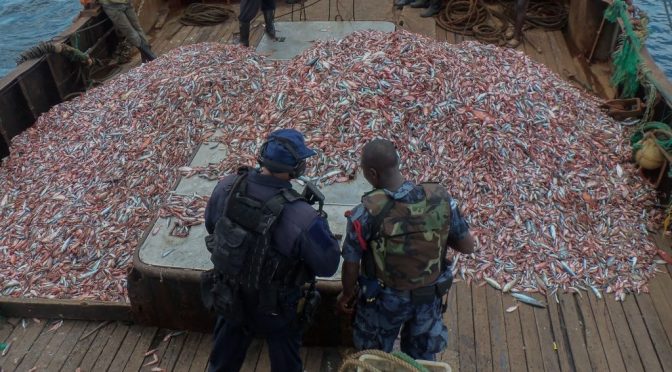
Featured Image:  GULF OF GUINEA (April 2, 2014) A U.S. Coast Guard law enforcement detachment member and a Ghanaian navy sailor inspect a fishing vessel suspected of illegal fishing during the Africa Maritime Law Enforcement Partnership. The partnership is the operational phase of Africa Partnership Station and brings together U.S. Navy, U.S. Coast Guard, and respective Africa partner maritime forces to actively patrol that partner’s territorial waters and economic exclusion zone with the goal of intercepting vessels that may have been involved in illicit activity. (U.S. Navy photo by Kwabena Akuamoah-Boateng/Released)
Breaking the Mold: How to Build a 355-Ship Navy Today, Pt. 1

“It shall be the policy of the United States to have available, as soon as practicable, not fewer than 355 battle force ships.”

-Section 1025, Para (A) of the National Defense Authorization Act for FY2018 (FY18 NDAA)

“Battle force ships are commissioned United States Ship (USS) warships capable of contributing to combat operations, or a United States Naval Ship that contributes directly to Navy warfighting or support missions, and shall be maintained in the Naval Vessel Register” –SECNAVINST 5030.8C

By Keith Patton

During the Reagan administration, it was the policy goal of the United States to build a 600-ship Navy. That goal came very close to being realized, but the end of the Cold War and the “peace dividend” resulted in a rapid contraction of U.S. battle force ship count. This is not to say the U.S. Navy became less powerful since current U.S. multi-mission destroyers are far more capable than their 80s predecessors, but the fleet can be in far fewer places at once and is less casualty tolerant.

In 2015, the Navy’s force level goal was 308 ships. In 2016, this was raised to 355. This policy goal was codified by Congress in the FY18 NDAA. Currently, the Navy has 286 battle force ships, or only 80 percent of its own and now the Congressionally stated requirement. Pursuant to FY18 NDAA, the Navy produced a report to Congress with a plan for achieving a 355-ship force level after 2050, but included options to achieve this level by 2030.

What if world circumstances or political decisions forced the U.S. to look at achieving a 355-ship Navy far sooner than in 11 to 30 years? Possibilities range from how to stretch or improve what already exists, to more radical notions of foreign warship procurement, armed merchantmen, and development of a U.S. Navy foreign legion type force.

Assumptions

Some of the current and proposed policies for fleet building are built on numerous assumptions. One, that a 355-ship Navy is necessary. This is codified in the FY18 NDAA, but some the forthcoming ideas will stretch the definition or purpose of a 355-ship Navy. Second, that the Navy is in a technological competition and simply adding hulls to the battle force count is insufficient. These hulls must be capable of adapting to emerging technology rather than simply using what is available today. However, some of the offered ideas focus on using current or less capable designs to reach 355 ships. Third, that it is feasible for the Navy to fund a commensurate increase in personnel and weapons procurement. This is also impacted by the type of ships procured. This assumption is not directly challenged, but is fundamental to manning and arming the fleet constructed. Finally, that the political will exists to champion these changes, which could threaten established programs, industrial bases, or voting blocks.

Stretching What We Have

The Department of Transportation’s Maritime Administration has already been told by the Navy that, in the event of a major conflict, there will be insufficient ships to escort a sealift effort to Asia or Europe. Recalling Operation Drumbeat, or the “happy times” of the German U-boat force off the U.S. Atlantic coast in 1942, this is very concerning. 23 merchants were sunk off the U.S. coast by just five Type IX U-boats. For perspective, that is equivalent to 40 percent of the current ship inventory of the Maritime Administration’s Ready Reserve Fleet, which is tasked with transporting U.S. forces in wartime. During U-boat operations, 22 percent of the tanker fleet was sunk, and 232 ships total in seven months. This is more than the entire U.S. merchant marine fleet today. Raising the U.S. battle force ship strength to provide escorts for vital transport and logistics vessels would seem a logical first step.

A quick way to preserve and grow battle force ships is to stop decommissioning vessels and to execute service life extensions on them instead. These would include younger Los Angeles-class SSNs and DDGs. The FY18 NDAA already prohibits the Navy from retiring Avenger-class MCM (Sec 1046). By extending the life of Arleigh Burke-class destroyers to 45 or 50 years, the Navy can reach its desired large surface combatant end strength by 2029. However, this is still 10 years away. Even with extending the lives of Los Angeles-class SSNs, the Navy does not reach its desired attack submarine count until after 2048. Stopping the bleeding is not sufficient to reach 355 in less than a few decades,if the Navy needs to find more hulls in the next few years.

The Navy also could draw upon a limited quantity of warships in Naval Inactive Ship Maintenance Facilities (NISMF) including two aircraft carriers, two cruisers, two destroyers, a score of frigates, amphibious assault ships, and auxiliaries. Appendix 6 of the Navy report to Congress on shipbuilding notes 66 battle force ships being retired, dismantled, or sunk in the next five years. Reactivating those ships would almost instantly reach the 355 vessel goal. A 355-ship fleet, therefore, might be quickly met by delaying decommissioning and returning old warships to active duty

There is a significant downside to both extending the life of existing ships and returning old ships to service. First, there is the upfront cost of nuclear refueling and updating combat systems. Some cost savings could be made, for instance not using the catapults or arresting gear of the old carriers, making them STOVL carriers for helicopters, Ospreys, and F-35Bs (and saving significant manning and maintenance costs) or not updating the combat systems of the Oliver Hazard Perry-class frigates and only using them for low-end counter-piracy or counter-narcotics missions. However, this would severely limit the combat capabilities of the ships to the battle force. They may be able to handle a low end mission and free more expensive assets for higher-threat theaters, but they would not be suitable for great power conflict. Upgrading them with modern combat systems would further increase their cost. Additionally, these old vessels were decommissioned for a reason. Taking old vessels back into service introduces assets that are less capable in modern warfare due to limited growth margins and worn out hulls, and adds significant maintenance costs to stretch their service for a few more years. Long term, this seems far less bang for the buck than procuring new, modern combatants with growth margins for emerging technology. It also violates the planning assumption that the Navy’s new hulls will need growth room for emerging technology to field new weapons and systems.

Building Smarter, Better and Faster

The Navy currently receives new warships from five large and two smaller private shipyards. The shipbuilding industry is not at capacity in the U.S. To achieve a 355-ship in a decade would require almost doubling new ship production.1 Additionally, buying more warships in a smaller interval of time drives down unit cost. The Congressional Research Service (CRS) estimated 10 percent savings by doubling the production rate of combatants.2 The same report also estimated 5-10 percent savings by using multiyear procurement. By energizing the U.S. shipbuilding industry, the 355 battle force ship count can be achieved sooner.

However, U.S. shipbuilding can only achieve a 355-ship Navy slowly. Upon funding, it takes two years for long lead time components for a SSN to be produced, and five to six years for construction. Additional workers and production space would be needed before the five to six year construction phase began. Even with immediate funding, therefore, a decade might elapse before additional warships and specifically SSNs could join the fleet.

The Government Accountability Office 2018 report on Navy Shipbuilding does not give much room for optimism on meeting shipbuilding time or costs. It notes “construction during the last 10 years have often not achieved their cost, schedule, quality, and performance goals” and that the Navy has spent more on shipbuilding but has fifty fewer ships in the inventory than was planned in its 2007 shipbuilding plan.

Another consideration is that building more of existing designs does not allow margins for growth. The DDG-51 Flight III design does not have the growth margin or electrical generation to support projected future weapons, nor crew reductions. Procuring more DDG-51s at an accelerated rate provides a short-term advantage, but leaves the Navy with a large number of hulls that consume manpower and can’t adapt efficiently as new systems are developed. Designing a new combatant takes years, and this will delay the date when the Navy can achieve a 355-ship force. Simply building existing or projected future designs faster does not offer much hope of meeting a 355-ship battle force quickly.

Another consideration is the boom and bust effect of sudden surges in shipbuilding. Even if a 355-ship Navy could be built in three to five years, what would befall the warship industry in the following years? Once the goal was reached, unless there was a new, higher goal set, shipyards would have to massively trim the workforces they hired to support a surge in construction. A stable growth plan is more economical and sustainable than one based on sudden surges and decelerations. It would also be more politically palatable to the Congress that authorized it.

Increasing the Firepower of What We Have

If ships cannot be built or brought back into service in a timely or economical way, could there be a way to increase the fleets combat ability until a 355 ship force is achieved? This is “breaking the mold” of the first assumption – that a 355-ship navy is necessary. Can a more powerful force of what we have suffice in the interim until a true 355-ship fleet can be achieved? 

The SSGN conversion of four SSBNs gave the Navy four stealthy, high-capacity, long-range, strike platforms. Each can be equipped with up to 154 cruise missiles and other payloads, more than a  cruiser, and offers far more offensive capability when one considers that many of the cruiser’s tubes are filled with defensive weaponry. What if the Navy converted the remaining 14 Ohios? This would provide an 18 percent increase in missile tubes (or firepower) available to the  battle force, when the 355 battle force count goal is a 20 percent increase in hulls. This seems to close the capability gap, for strike anyway, with what is available. The question is, would 18 Ohio SSGNs roaming the oceans provide a greater conventional deterrent, and an effective platform in worst case A2AD environments than more of other ships? For high-end warfare and strike, likely yes. But there are many missions a submarine does not do well, like air and ballistic missile defense, presence, and maritime interdiction. The SSGNs would also be a stop gap since they are aging out. To replace the Ohio SSGNs as they age out, the new Columbia-class SSBN could be repurposed as SSGN as well.

This would dramatically alter U.S. nuclear posture by removing the SSBN leg of the triad. However, this could be mitigated to an extent by the already announced plan to put nuclear-tipped Tomahawks back on U.S. submarines. As hypersonic or smaller intermediate range ballistic missiles became available, nuclear armed versions of these weapons on all the SSGN would provide a survivable nuclear response to underpin US deterrence. The Navy could also consider spreading nuclear Tomahawks or successor systems across more than just the submarine fleet. Instead of a few, high capacity SSBNs, the naval leg of the triad would become a dispersed force of ships and subs with a few weapons each, much as it was during the Cold War.

While far less survivable than a submarine, missile tubes could also be added to existing combat logistics force ships or even amphibious assault ships. The San Antonio-class LPD was originally designed with a 16-cell Mk 41 VLS forward. The Navy has considered back fitting it. However useful, the entire fleet of LPDs outfitted with VLS would yield fewer missiles than two SSGNs, and be less survivable. Another concept would be to take the San Antonio follow on and build them as missile ships with large radars and extensive VLS capability. Huntington Ingalls has produced a model of this concept, with twice the missile firepower of a U.S. cruiser. This would allow the Navy to close the firepower gap between a 355-ship Navy and now with fewer than 355 ships.

While these ideas do not produce a 355-battle force ship fleet any sooner, they do produce a fleet that is more survivable, with more firepower, sooner, than the official ship building plans call for. The cost is shifting and ceding some capability in nuclear deterrence and amphibious lift. Each of these would be controversial alone. Even together, they may be insufficient should the U.S. feel it needs a 355 battle force ship equivalent sooner rather than later.

Change in Deployment Methodology/Theater Specific Ships

While not directly increasing the battle force ship count, changing Navy deployment methodology could allow the force to be more capable as the size grows. This methodology is similar to the report published by the Center for Strategic and Budgetary Assessments as part of the Navy’s fleet architecture study. This report suggested the Navy be divided into two forces. First was a deterrence force, sub-divided among COCOMs, with the capacity to provide prompt, high capacity fires to punish an adversary should their existence fail to deter them. These ships would be tasked to support a particular COCOM rather than CONUS-based forces rotating between them. In low-threat SOUTHCOM, LCS and reactivated Oliver Hazard Perry-class frigates, Coast Guard, or newly designed ships could focus on low-end missions and free up high end warships for other theaters. In CENTCOM, the ships assigned would focus on FAC/FIAC threats and air and missile defense. Ships assigned to PACOM or EUCOM would focus on high end missions. Ships could be built, manned, and trained around these priorities, in contrast to current operations where ships focus on all warfare areas and multiple AORs, risking becoming jacks of all trades but masters of none. While this may have been adequate during a low naval threat period, with the return of great power competition, specialization may be needed again. The SSGN conversions in particular might be outstanding vessels for the deterrence force in EUCOM and PACOM. Difficult to detect and counter, and with two or three perhaps on station at any time able to bring high capacity fires against an adversary’s aggression, the could depart the theater to reload and join the maneuver force.

Theater-specific ships could also be homeported in their AOR, reducing transit time and acting as a force multiplier. CRS estimated it takes 42 additional warships to keep eight additional ones on station in the Mediterranean if home ported in CONUS.3 If homeported in the Mediterranean, only 14 warships would be required. This could reduce the need for a 355-ship force, or allow those 28 warships to be tasked to other missions.

The second part of the fleet would be a maneuver force consisting of a multiple carrier strike groups and larger amphibious vessels that would relieve and replace the deterrence force and provide sustained combat power. By keeping the multi-carrier maneuver force together and away from the immediate area of crisis, it could conduct more high-end training and not be at risk in the initial stage of conflict. This would also mesh with the enduring Mahanian desire to keep a large portion of the fleet concentrated and surge capable. This contrasts with the current deployment methodology where ships frequently shift COCOM and tasking, and carriers don’t consistently operate together as they may have to in wartime to provide 24/7 effects and protection.

All of these ideas, deterrence/maneuver force, theater-specific ships, or greatly increasing overseas homeporting, breaks the mold of U.S. deployments and acquisition. However, they fail to increase the battle force ship count. They simply hold the dream of making the existing ships more efficient, available, or capable for specific missions.

Change in Battle Force Ship Definition

Another idea would be to change SECNAVINST 5030.8C, specifically enclosures (1) and (2) to assign more vessels from the category of Auxiliary to Combatant. The combatant category, which counts toward the 355-ship goal, already includes afloat forward staging bases, cargo and ammunition vessels, expeditionary sea bases, fast transports, fleet tugs, surveillance ships, and towing and salvage vessels. Adding in oceanographic research vessels and survey ships (both similar to surveillance ships), transport oilers and aviation logistics support (both similar to combat logistics ships) and high speed transports (very similar to expeditionary fast transports) could immediately add vessels to the battle force ship count with the stroke of a pen.

Doing this, while breaking the mold in the definition of a battle force ship, seems to be going against the spirit and intent of Congressional policy and U.S. Navy desire to increase force strength. While it could be argued some of the ships listed as auxiliaries provide very similar support to ships listed as “Fleet Support” or “Expeditionary Support,” reclassifying is simply smoke and mirrors while not increasing capability. Even if weapon systems were added to these platforms to make them more plausible as “battle force ships” the increase in Navy power and capability would be far less than battle force ships as listed under current definitions.

CDR Patton is deputy chairman for the U.S. Naval War College’s Strategic and Operational Research (SORD) Department. SORD produces innovative strategic research and analysis for the U.S. Navy, the Department of Defense, and the broader national security community.  CDR Patton was commissioned in 1995 from Tufts University NROTC, with degrees in history and political science and has served four tours conducting airborne nuclear command and control missions aboard the US Navy E-6B Mercury aircraft, and two tours as Tactical Action Officer (TAO) and Combat Direction Center Officer (CDCO) aboard the carriers USS KITTY HAWK and USS NIMITZ. 

The opinions and ideas above do not necessarily represent those of the Department of Defense, U.S. Navy, or the Naval War College. The ideas expressed here do not necessarily reflect those of the principal author either. They were drawn from the Breaking the Mold II workshop held at the U.S. Naval War College with invited participants from military, industry, government and academic institutions. The workshop was held under the Chatham House Rule, so these ideas will not be attributed to their originator. Some ideas were specific enough that they are not included here because the idea itself might identify the originator and violate the Chatham House rule.

References

1. Congressional Budget Office “Costs of Building a 355-Ship Navy”, April 2017 pg.9

2. Ronald O’Rourke, “Options and Considerations for Achieving a 355-Ship Navy” July 25, 2017. Pg. 3

3. Ronald O’Rourke, “Options and Considerations for Achieving a 355-Ship Navy” July 25, 2017. Pg. 11

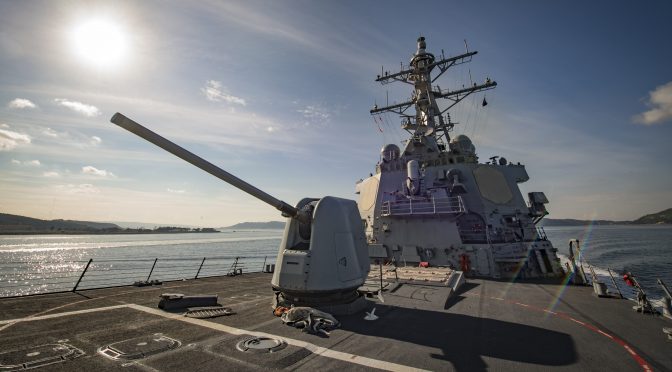
Featured Image: DARDANELLES STRAIT (Jan. 19, 2019) The Arleigh Burke-class guided-missile destroyer USS Donald Cook (DDG 75) transits the Dardanelles Strait, en route to the Black Sea, Jan. 19, 2019. (U.S. Navy photo by Mass Communication Specialist 2nd Class Ford Williams/Released) 190119-N-JI086-050

Regaining the High Ground at Sea: Transforming the U.S. Navy’s Carrier Air Wing

By Bryan Clark

Regaining the Maritime “High Ground”

Aircraft carriers have been the centerpiece of the U.S. Navy since they came to prominence during the Second World War. Their mobility and firepower were essential to winning the Pacific Campaign during that conflict, and carriers’ adaptability enabled them to remain the fleet’s primary means of power projection through the Cold War and in multiple smaller conflicts thereafter. Unless the Navy dramatically transforms its carrier air wings (CVW), however, the carrier’s preeminence will soon come to an end.

America’s carriers, often the target of adversaries, are once again under threat. China and Russia are investing in networks of sensors and weapons designed to deter U.S. and allied forces from intervening in their regions. As part of their efforts, these great power competitors, in addition to regional powers like Iran and North Korea, are fielding anti-ship cruise and ballistic missiles, warships, and submarines to threaten U.S. carriers.

The Navy is developing ways to counter enemy kill chains from initial detection through engagement. Carrier strike groups (CSG) will need to maneuver, minimize their radiofrequency emissions, and limit flight operations to reduce the vulnerability of carriers to detection and targeting and maximize the capacity of their air defenses. But employing these capabilities and tactics could significantly constrain carriers’ sortie generation capacity.

To retain their ability to defeat aggression, CSGs will need to conduct wartime operations from areas where they can generate high-volume sorties and fires and their defenses can realistically defeat enemy attacks. This will likely place them about 1000 miles from concentrations of Russian or Chinese forces, or up to 500 miles from the missile batteries of regional powers. At these ranges, the Navy’ current and planned air defense capabilities will be sufficient for CSGs to protect themselves without having to rely extensively on countering enemy sensors.

Unfortunately, the Navy’s current and planned carrier air wings (CVW) lack the reach, survivability, and specialized capabilities to effectively protect U.S. forces at sea and ashore or attack the enemy from 1000 miles away. Carriers are an important, and in some scenarios essential, element of the National Defense Strategy’s “contact” and “blunt” forces that will counter enemy aggression because they are more heavily defended and less vulnerable than forward land bases. If CSGs cannot substantially contribute to degrading, delaying, or defeating aggression, the Navy should reconsider continuing its investment in carriers and their aircraft and shift those resources toward more effective approaches.

As arguably the ultimate modular military platform, carriers can address emerging threats and opportunities by changing the size and mix of aircraft they carry. Without the ability to evolve and support new missions, carriers and their CVWs would likely have gone the way of the battleship and left the fleet decades ago. Our new Center for Strategic and Budgetary Assessments study describes how the Navy could transform its CVWs during the next 20 years to address the challenges posed by great power militaries.

Changing Carrier Strategy and Tactics

Some analysts recommend that rather than invest in new aircraft and improved carrier defenses, the Navy should use missiles from surface combatants and submarines to defend naval forces and attack enemy targets. This approach, however, would be unsustainable and may not deter a committed aggressor.

Long-range surface-launched missiles are more expensive and less numerous than the glide, gravity, and powered weapons carried by aircraft. Moreover, once a ship or submarine expends its missiles, it will need to withdraw from the fight to safely reload, even if that reloading could be done at sea. Using large numbers of missile-carrying merchant vessels to sustain fires would not solve these problems, because large numbers of expensive standoff weapons would still be needed, as well as defenses for the vessels carrying them.

Instead of replacing carriers with missiles, the Navy should use them as complementary capabilities. Missile-centric platforms such as submarines and surface combatants are well-suited for the NDS’ contact forces, which will be the first to engage the enemy and need to generate large volumes of offensive and defensive fires on short notice. Carriers should be used mostly in the NDS’ blunt force, which will reinforce and support the contact force. Carriers take time to generate sorties, but can sustain fires as long as the carrier is resupplied, allowing contact force ships and submarines to withdraw and reload. Without the threat of sustained resistance from the blunt force, an aggressor like China could choose to fight through ship-launched missiles until ships and submarines need to reload.

Under this construct, CSGs will be employed in four main categories of operations, which are similar to how carriers were used in previous great power competitions and conflicts:

  • Day-to-day training, port calls, and exercises inside contested regions during peacetime to build alliances and demonstrate U.S resolve not to cede waters to adversary intimidation or coercion.
  • Smaller-scale operations at long range against highly defended targets of great power adversaries, such as strike and surface warfare (SUW) attacks of 200 weapons or less, electromagnetic warfare (EMW) or escort missions, and anti-submarine warfare (ASW);
  • Sustained operations at the periphery of great power confrontations, such as in the Philippine or South China Seas against China or in the Norwegian Sea against Russia; and
  • The full range of operations against regional powers such as Iran or North Korea that lack integrated, long-range surveillance, anti-air, and anti-ship capabilities.

Within these broad categories, CVWs will need perform the same missions they do today, but using new operational concepts that address ongoing and future enhancements to adversary threats and the geographic advantages enjoyed by great power and some regional adversaries.

The predominant challenge facing U.S. forces against China and Russia is the threat of long-range precision weapons, making air and missile defense an important enabling concept for CVWs. To survive against Chinese or Russian surface-, air-, and submarine-launched missiles, U.S. forces will need to complement air defenses on ships and air bases with actions to thin out missile salvos in flight and attack enemy missile-launching “archers” before they can launch their “arrows.”

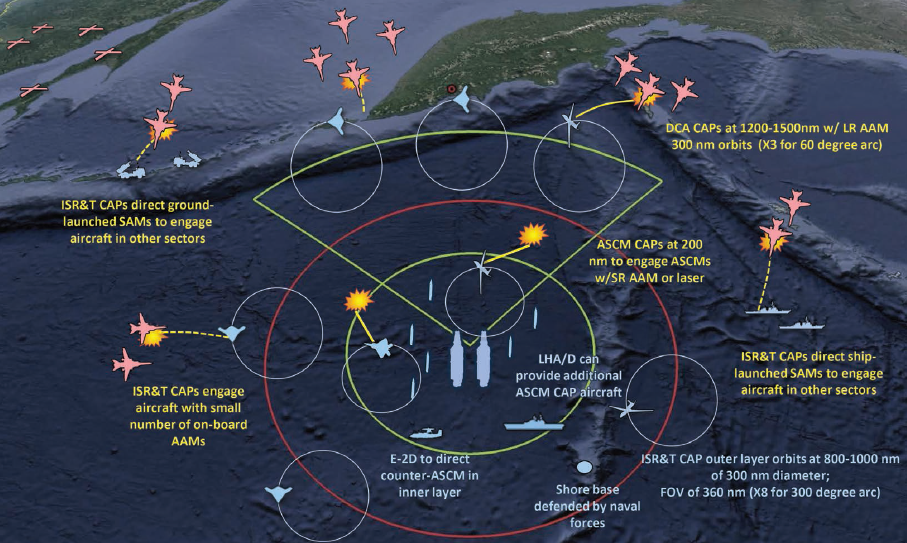
This updated version of the Navy’s “Outer Air Battle” doctrine would place defensive counterair (DCA) combat air patrols (CAP) along the most likely threat axes at the ranges of future anti-ship and land-attack missiles, or about 800 to 1,000 miles. Outside the most likely threat sectors, distributed fires from surface combatants, ground-based air defenses, and DCA aircraft would engage enemy aircraft using targeting from intelligence, surveillance, reconnaissance, and targeting (ISR&T) CAPs. Shorter-range CAPs operating 100-200 miles from carriers and other defended targets would thin out cruise missile salvos, effectively adding capacity to ship and shore-based air defenses.

21st Century Outer Air Battle (CSBA graphic)

Because of their operating areas and the challenge of air- and sea-launched missiles, future CVW strike and SUW operations will need to occur 500–1,000 miles away from the CSG, depending on the adversary. Using standoff weapons such as the Joint Air-to-Surface Standoff Missile (JASSM) could allow carrier aircraft to launch strike and SUW attacks from closer to the carrier, but these weapons are expensive and in short supply. Instead, strike and SUW operations will need to occur from shorter standoff ranges, employing a combination of survivable aircraft, and offensive counterair (OCA) and EMW operations.

With the growing number and sophistication of Russian and Chinese submarines, the Navy has reinvigorated its efforts at anti-submarine warfare (ASW). Today’s ASW platforms such as the P-8A Poseidon are potentially too vulnerable to conduct ASW operations near a great power adversary’s territory. Others, like the MH-60R Seahawk helicopter, lack the range or endurance to conduct ASW operations beyond the 1,000-mile reach of enemy submarine-launched cruise missiles. To conduct ASW in contested areas, U.S. naval forces will need to rely increasingly on unmanned sensors to find and target submarines. CVW aircraft operating in ASW CAPs would then promptly engage possible submarines at ranges of up to 1,000 miles from the carrier or defended areas ashore.

U.S. adversaries are likely to protect valuable ports, airfields, and sensor and C2 facilities with their own DCA CAPs and air defense systems. To enable CVW or land-based attack aircraft to closely approach targets and use smaller short-range weapons, carrier-based escort aircraft could attack air defenses, help protect strike aircraft from CAPs, and launch expendable jammers and decoys to confuse aircraft and air defense radars and weapons.

Escort missions will require a combination of long-range fighters able to engage enemy DCA CAPs and attack aircraft with the payload capacity to carry missile- or unmanned aerial vehicle (UAV)-borne jammers, sensors, or decoys. An attack aircraft could also carry high-power standoff jammers such as the Next Generation Jammer (NGJ) that will be carried by the E/A-18G Growler until it retires in the 2030s.

A Needed Transformation

The operational concepts needed to implement current and likely future defense strategies will require new aircraft and a different CVW configuration than in today’s fleet. CSBA’s proposed CVW would include:

Long-range Multi-mission Survivable Unmanned Combat Air Vehicle (UCAV)

Air and missile defense, ISR&T, strike, SUW, ASW, and EMW missions are all evolving in a way that makes them best conducted by aircraft with longer range or endurance, higher survivability, and a payload on par with today’s Navy strike-fighters. An attack aircraft such as an unmanned combat air vehicle (UCAV) could achieve an unrefueled range of up to 3,000 miles through a fuel-efficient airframe optimized for subsonic speeds. A UCAV could also achieve high levels of survivability by combining a radar-scattering shape with electronic warfare systems and self-defense weapons. And although being unmanned would not necessarily increase its range, a UCAV would be capable of longer endurance than manned strike-fighters provided aerial refueling is available.

UCAV-based Airborne Electronic Attack (AEA) Aircraft

The Navy plans to continue using the E/A-18G as its AEA platform into the 2030s and beyond, but its reliance on standoff effects from outside the range of enemy air defenses is likely unsustainable in the face of improving passive sensors and the increasing range of surface-to-air missiles (SAM) and AAMs. A low-observable platform such as the proposed UCAV could be made into an stand-in AEA platform by incorporating subsystems of the E/A-18G into its mission bay and installing multiple active electronically scanned arrays (AESA) along its wings and fuselage. A UCAV-based AEA aircraft could also carry and deploy expendable EMW UAVs and missiles that would conduct ISR&T, jamming, decoy, and deception operations over target areas.

Unmanned Aerial Refueling Aircraft (MQ-25)

A dedicated carrier-based aerial refueling tanker could enable CVW aircraft to reach CAP stations 1,000 miles from the carrier and conduct long-range attacks against enemy ships and shore targets. The U.S. Navy is already pursuing the MQ-25 carrier-based tanker UAV for this reason and recently awarded design and construction contracts for the first MQ-25 demonstrators.

To fully exploit the potential of the MQ-25, the Navy should re-designate it as a multi-mission UAV. The initial version of the MQ-25 would remain focused on the aerial refueling mission to avoid delays in program development. The Navy could then develop modifications that would enable it also to conduct ISR, attack, and EMW missions in appropriate operational environments. Alternatively, the Navy could explore ways for the UCAV to also conduct the refueling mission once it is fielded.

Long-range Fighter (FA-XX)

Escort and OCA operations will require a long-range fighter to counter enemy DCA CAPs and enable land-based or CVW strike aircraft to closely approach targets and use smaller, short-range strike weapons. The range, sensor capability, and weapons capacity needed in a future long-range fighter could be provided with a modified version of an existing fighter or strike-fighter by shifting weapons payload to fuel capacity and incorporating additional fuel efficiency measures.

Planned Aircraft Retained in Proposed 2040 CVW

Between FY 2019 and FY 2023, the Navy plans to complete the procurement of MH-60R ASW and MH-60S logistics helicopters, E-2D AEW&C aircraft, and E/A-18G EW strike-fighters. The proposed 2040 CVW includes MH-60s and E-2Ds, which may require some life extension; both aircraft will, however, have reduced roles in 2040 compared to today due to their constrained range and survivability.

The proposed 2040 CVW would buy the first half of the F-35C program to supply one squadron per CVW, but the second squadron would be replaced with the FA-XX. Although not formally part of the CVW, the proposed 2040 CVW assumes the Navy’s ongoing plan to replace the C-2A logistics aircraft with the CMV-22 Osprey. The 2040 CVW also includes in its helicopter squadrons a medium-altitude, long-endurance (MALE) Vertical Take-Off and Landing Tactical Unmanned Aerial Vehicle (VTUAV) based on ongoing development efforts in the Navy and Marine Corps for an unmanned multi-mission aircraft, known as the Marine Air-Ground Task Force (MAGTF) Unmanned Aerial System (UAS) Expeditionary (or MUX).

Future CVW Composition

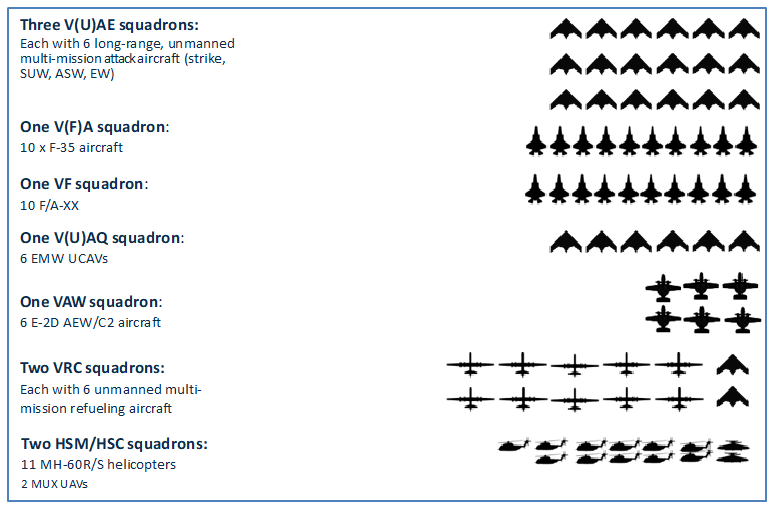
CSBA’s proposed 2040 CVW, shown below, includes the new and existing aircraft described above in a mix that improves the Navy’s CVW range, endurance, survivability, and payload capacity. Whereas the Navy’s planned CVW would center around 20 F-35C and 24 F-18 E/F or FA-XX strike-fighters, the proposed CVW is built around 18 UCAVs, ten FA-XX fighters, ten F-35C strike-fighters, and six UCAV-based AEA aircraft. Although the aggregate payload capacity of the proposed CVW is about the same as the Navy’s plan, the 2040 CVW could deliver its payload twice as far or remain on station much longer.

The proposed CVW also incorporates more specialized aircraft to address the growing capability of great power competitors. The long-range FA-XX fighter will be better able to counter enemy DCA aircraft, and the UCAV will be a more effective platform to support long-endurance CAP missions for air defense, ASW, SUW, and ISR&T than the Navy’s planned CVW of short-range strike-fighters. The CVW also includes more MQ-25 tankers to maximize the CVW’s reach and endurance.

CSBA’s Proposed 2040 CVW (CSBA Graphic)

Making the New CVW a Reality

There are several different combinations of programmatic changes that could be used to reach the proposed CVW by 2040. CSBA recommends the following actions, starting with the President’s Budget for FY 2020. Notably, the new procurement proposed by this study would not begin until after the FY 2020–2024 Future Year’s Defense Plan (FYDP), although some research and development funding would be repurposed within the FYDP.

  • Sustain procurement of F/A-18 E/Fs as planned through 2023. Although the future CVW requires half the strike-fighters of the Navy’s planned CVW, these aircraft will fill near- to mid-term capacity gaps. F/A-18 E/Fs still in service by 2040 can be used in place of UCAVs or F-35Cs if those aircraft are not yet fully fielded.
  • Sustain F-35C procurement as planned through the first half of production, ending in 2024, to support the proposed 2040 CVW’s squadron of ten F-35Cs.
  • Develop the FA-XX fighter during the 2020–2024 timeframe as a derivative of an existing aircraft, with production starting in 2025. Block III F/A-18 E/Fs and F-35Cs will be in production during the FY 2020–2024 FYDP, and either they or another in-production fighter or strike-fighter could be modified into an FA-XX. Although this approach will require some additional funding for non-recurring engineering between about 2020 and 2024, it will save billions of dollars compared to the Navy’s plan to develop a new fighter aircraft from scratch.
  • Develop a low-observable UCAV attack aircraft during the 2020–2024 timeframe, with production starting in 2025. Although the UCAV could be based on an existing design such as the X-47B, 1–2 years of development may be needed to create a missionized version.
  • Continue development of the MQ-25, transitioning the program to the UCAV-based refueling aircraft when sufficient attack UCAVs are fielded. Increase the overall procurement of MQ-25 and UCAV-based refueling aircraft to support twelve per CVW.
  • Retire E/A-18Gs as they reach the end of their service lives starting in the late 2020s, replacing their capability with NGJ-equipped UCAVs and UAV- and missile-expendable EMW payloads.
  • In concert with the U.S. Marine Corps, field a MALE rotary-wing UAV such as the Tactically Exploitable Reconnaissance Node (TERN), which can augment CVW helicopter squadrons and could take over some of their ASW operations by the mid-2030s.

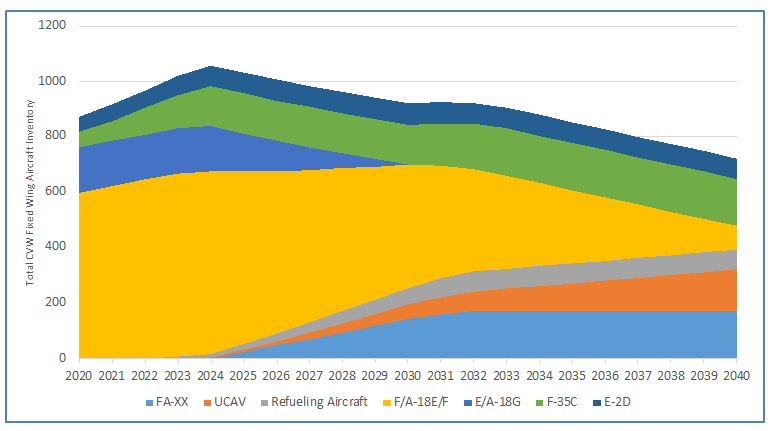
The fixed-wing carrier aircraft inventory associated with these recommendations is shown below. Under this plan, research and development of the planned MQ-25, modified FA-XX, and new UCAV would occur during the 2020–2024 timeframe, with production of new aircraft starting in 2025. Today’s F/A-18 E/Fs and E/A-18Gs would begin retiring in the late 2020s, to be replaced by UCAVs. The overall inventory of CVW aircraft will decrease as unmanned aircraft replace manned platforms, because operators and maintainers of unmanned aircraft can practice using simulators that will be as realistic as actual UAVs, eliminating the need for unmanned aircraft in training squadrons or in fleet squadrons that are not deployed or preparing to deploy. The smaller number of aircraft and squadrons results in a cost savings for unmanned aircraft compared to manned aircraft.

Fixed-Wing CVW Aircraft Inventory to Build Proposed 2040 CVW. (CSBA graphic)

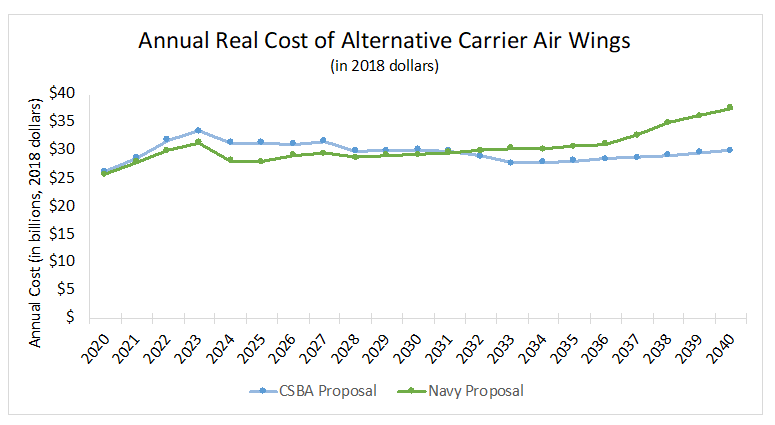
The approximate cost of the proposed 2040 CVW is shown below. Except for developmental spending associated with the proposed UCAV, proposed new development, procurement, and operations spending does not begin until FY 2024. The cost associated with the proposed 2040 CVW is less than the Navy would likely incur with its planned strike-fighter focused CVW. The continued reliance on manned strike-fighters results in a larger overall number of aircraft being required compared to the proposed CVW, primarily to train pilots and maintain their proficiency when not deployed. The higher aircraft inventory increases operations and maintenance (O&M) costs during the first decade of the period shown and raises procurement costs during the 2030s when today’s F/A-18 E/Fs are replaced with a new manned strike-fighter.

Total Cost of Proposed and strike-fighter Focused CVWs (CSBA Graphic)

A Clear Choice

The proposed 2040 CVW will be more expensive in the near-term than the Navy’s planned CVW, but the Navy will need to incur these additional costs if it is to prevent carrier aviation from becoming irrelevant to the most pressing defense challenges of the near future. The threats posed by great power competitors, and increasingly by regional powers such as Iran and North Korea, preclude relying on legacy capabilities to protect American allies and interests overseas.

Naval forces will be instrumental in deterring and defeating aggression by these adversaries, as described in the NDS. Carrier air wings provide the ability to sustain naval combat operations beyond the first few days, when ship and submarine missile inventories are depleted. Without a clear plan to improve the Navy’s CVWs, the United States may not be able to implement its defense strategy, and DoD leaders would need to reconsider if they want to continue the Navy’s investment in carrier aviation or shift resources to other, more effective, capabilities.

Bryan Clark is a Senior Fellow at the Center for Strategic and Budgetary Assessments. He was a career enlisted and officer submariner and held several positions in the Chief of Naval Operations staff, including Director of the CNO’s Commander’s Action Group.

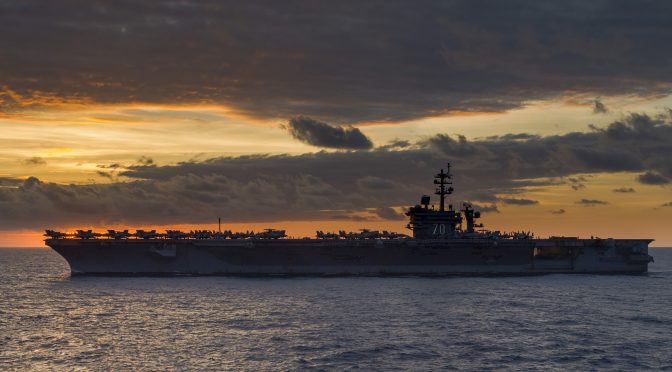
Featured Image: South China Sea (Feb. 10, 2018) The Nimitz-class aircraft carrier USS Carl Vinson (CVN 70) transits the South China Sea. (U.S. Navy photo by Mass Communication Specialist Third Class Jasen Morenogarcia/Released)

The Deep Ocean: Seabed Warfare and the Defense of Undersea Infrastructure, Pt. 2

Read Part One here.

By Bill Glenney

Concepts from the CNO SSG

From 1998 to 2016, the CNO Strategic Studies Group (SSG) consistently recognized and accounted for the challenge of cross-domain maritime warfare, including the deep ocean. The Group generated several operational concepts that would give the Navy significant capabilities for the deep ocean part of the maritime battle.

Vehicles and Systems

Within the body of SSG concepts were reasonably detailed descriptions of a range of unmanned underwater vehicles, undersea sensors, and undersea weapons such as the towed payload modules, extra-large UUVs, logistics packages, and bottom-moored weapons. All would use the seabed and undersea for sensing, attacking, and sustaining in support of maritime forces.

One vehicle worth discussing is the armed UUV for single-sortie obstacle neutralization that would provide the Navy with the capability to counter armed UUVs, or conduct search for and clearance of fixed and mobile mines without the need for local air/surface superiority, or a manned support ship.1 It could plausibly do so at tactical sweep rates higher than today’s MCM forces. This can be achieved well before 2030, yet this capability is something neither the existing nor planned MCM forces can do.

The SSG XXXII concept can be achieved by integrating the following capabilities on the conceptualized extra-large UUV (XLUUV):

  • A synthetic aperture sonar – a capability the Navy had in 2013 
  • Automatic target-recognition software – a capability the Navy was developing
  • A 30 mm cannon that shoots super-cavitating rounds – a capability previously funded but not developed by the Navy

But, instead of focusing on the vehicles, there are two examples of operational-level concepts that exploit these vehicles and systems in recognition of the fact that the deep ocean is a critical yet misunderstood and underutilized part of maritime warfighting. 

Blitz MCM

In 1999, the SSG generated a concept called “Blitz MCM.”2 This work has stood the test of time technically and analytically, but has not been adopted by the Navy. And, while the SSG described it in terms of mine countermeasures, this same approach can be applied to deep ocean warfighting and the defense of undersea infrastructure.

At its most basic level, Blitz MCM resulted from the recognition that sensor performance in the undersea was not going to improve significantly from a tactical perspective over the period of 2000-2030. For clarity, yes, the accuracy of various undersea sensors has improved routinely, providing accuracy down to fractions of a meter and able to produce fairly detailed pictures of objects. But the effective range of these sensors has not and will not dramatically increase, still being measured in hundreds and maybe a thousand yards at best. These short ranges preclude their use as a single sensor when it comes to tactical maneuver in the maritime environment.

The SSG solution was to use large numbers of these individual sensors.

In order to enable the rapid maneuver by maritime forces, the force must be able to conduct in-stride mine reconnaissance and clearance of approach routes and intended areas of operations. In order to avoid lengthy operational pauses to search large areas and neutralize mines or armed UUVs or undersea explosives, Blitz MCM uses relatively autonomous UUVs that rely on sensing technology only moderately advanced beyond that available to the fleet 20 years ago. However, unlike today’s operations where small numbers of mine-hunting vehicles and aircraft are involved, Blitz MCM relies on the deployment of large numbers of unmanned vehicles out ahead of the force to rapidly work through the areas of interest to find, tag, or clear threats. Hundreds of small UUVs can work together as an intelligent swarm to clear thousands of square miles of ocean per day.

In some cases, based on the information provided by the vehicles, alternate approach routes or operating areas would be chosen, and the movements of closing units can be rapidly redirected accordingly. In other cases, the required paths will be cleared with a level of confidence that allows force elements to safely continue through to their intended operating areas.

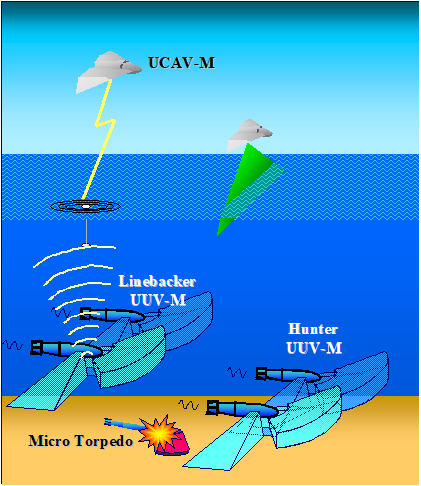
As illustrated in figure 7, UUV-Ms use conformal, wide-band active/passive sonar arrays, magnetic sensors, electric field sensors, blue-green active/passive lasers, and trace chemical “sniffing” capabilities to detect mines. Onboard automatic target recognition capabilities are essential to the classification and identification effort. Acoustic and laser communications to near-surface relays or seabed fiber-optic gateways maintain connectivity.

Figure 7 – Mine Hunting and Clearance Operations (CNO SSG XIX Final Report)

Unmanned air vehicles are critical in their role as UUV carriers, especially when rapid deployment of UUVs is required across a large space. UCAV-Ms contribute to the effort with their mine-hunting lasers. They also serve as communications gateways from the “swimmer” UUVs to the network.

The UUV-Ms will generally operate in notional minehunting groups of several dozen to over a hundred vehicles. Teams of vehicles will swim in line abreast formations or in echelons with overlapping fields of sonar coverage. Normally they will swim at about 8-10 knots approximately 50 feet above the bottom. Following in trail would be additional UUVs assigned a “linebacker” function to approach closely and examine any suspicious objects detected. Tasking and team coordination will be conducted by the UUVs over acoustic or laser modems. Once a linebacker classifies and identifies a probable mine, its usual protocol will be to report the contact, standoff a short distance, and then send in a self-propelled mine clearing charge to destroy or neutralize the mine. Each UUV-M could carry approximately 16 of these micro-torpedoes. When one linebacker has exhausted its supply, it will automatically trade places with another UUV-M in the hunting team.

Rapid neutralization of mine threats is key to the clearance effort. Today, this dangerous task is often performed by human divers. 

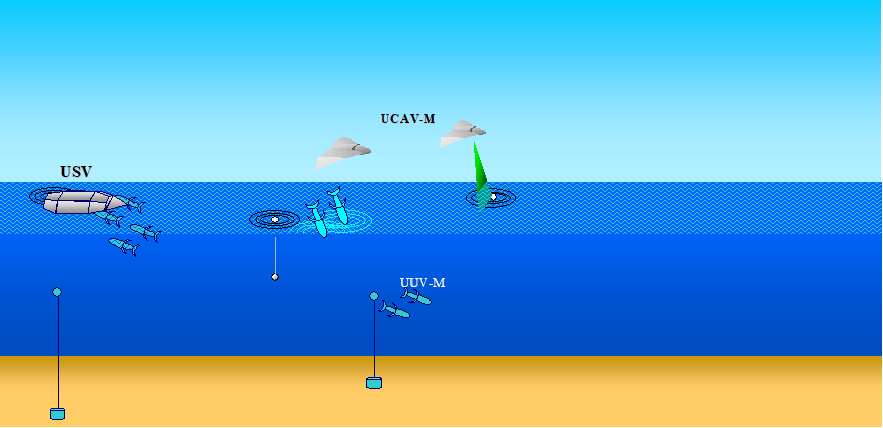
Blitz MCM uses a “leapfrog laydown” of UUV-Ms, as illustrated in Figure 8. Analogous to the manner that sonobuoys are employed in an area for ASW coverage, the force would saturate an area of interest with UUV-Ms to maximize minehunting and clearance capabilities. Once dropped into the water, the UUV-Ms quickly form into echelons and begin their hunting efforts. Navigation and communication nodes will be dropped along with the Hunter UUV-Ms.

Figure 8 – Leapfrog Laydown of UUVs (CNO SSG XIX Final Report)

Large delivery rates will be possible with multiple sorties of UCAV-Ms each dropping two to four UUV-Ms on a single load and then rapidly returning with more. Upon completion of their missions, the Hunter UUV-Ms will be recovered by UCAVs or USVs and returned to the appropriate platforms for refueling, servicing, and re-deployment.

First order analysis indicates that with approximately 150 UUV-Ms in the water and a favorable oceanographic and bottom environment, reconnaissance and clearance rates of about 6,000 to 10,000 square miles per day (a 20-mile wide swath moving at 12-20 knots) should be achievable. This capability is several orders of magnitude over current MCM capabilities.

Naval Warfighting Bases

The SSG XXXII concept called Naval Warfighting Bases3 requires the Navy to think about sea power and undersea dominance in an entirely new way. And this new thinking goes against the grain of culture and training for most naval officers and is unconventional in two ways:

  • First, in Naval Warfighting Bases, forces ashore will have a direct and decisive role in establishing permanent undersea superiority in high interest areas
  • Second, “playing the away game” – the purview of forward deployed naval forces − is not sufficient to establish and sustain undersea dominance at home

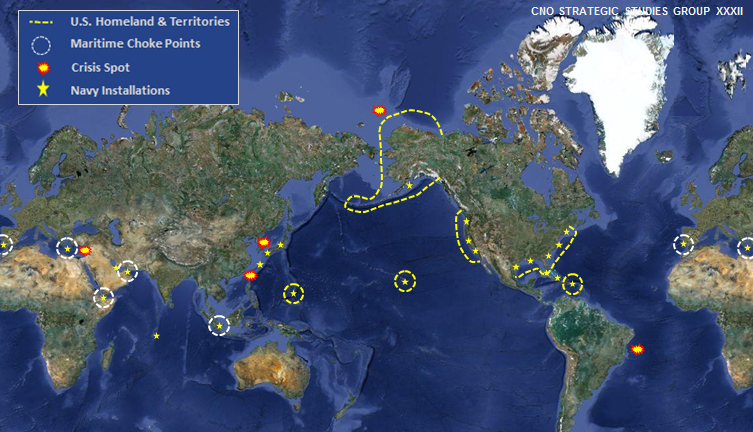
As shown in Figure  9, afloat forces – CSGs, ESGs, SAGs, and submarines – do not have the capacity or the capabilities to establish permanent undersea dominance of the waters adjacent to the U.S. homeland and its territories (shown in yellow) and of key maritime choke points (shown with white circles), while simultaneously reacting to multiple crisis spots around the world (shown in red). The Navy must discard its current model of undersea dominance derived solely from mobile, forward deployed at-sea forces and replace it with one that is more inclusive − one that looks beyond just afloat forces. This new model must capitalize on the permanent access the Navy already has from shore-based installations at home and abroad (shown with yellow stars).

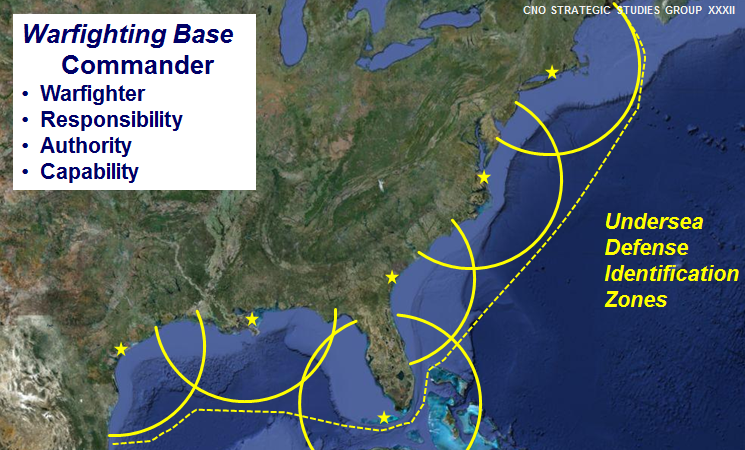
Figure 9 – Global Requirements for Undersea Superiority

Naval Warfighting Bases builds on detailed local understanding of the undersea, coupled with the projection of combat power from the land to control the sea; thereby providing permanent undersea dominance to defend undersea critical infrastructure near the homeland, protect major naval bases and ports of interest, and to control strategic chokepoints. Naval Warfighting Bases also provides the critical benefit of freeing up afloat Navy forces for missions only they can conduct.

At home, the U.S. Navy could establish something called an Undersea Defense Identification Zone, akin to the Air Defense Identification Zone, to detect and classify all deep sea contacts prior to their entry into the U.S. exclusive economic zone (EEZ). By enhancing the capabilities of key coastal installations, the Navy will transform each into a Naval Warfighting Base. The base commander will be a warfighter with the responsibility, authority, and capability to establish and maintain permanent undersea superiority out to a nominal range of 300 nautical miles seaward from the base to include the majority of U.S. undersea and maritime critical infrastructure.

Figure 10 – Undersea Defense Identification Zones Provide Permanent Undersea Superiority

Base commanders will have the capability to detect and track large numbers of contacts as small as wave-glider sized UUVs. Each Naval Warfighting Base will have a detachment of forces to actively patrol its sector. Naval Warfighting Base commanders will be able to maintain continuous undersea understanding, enabling control of the deep ocean.

Naval Warfighting Base commanders will also have an integrated set of shore-based and mobile weapons systems with the capability to neutralize adversary undersea systems, such as UUVs, mines, and sensors. Naval Warfighting Base commanders will be capable of disabling or destroying all undersea threats in their sector, employing armed unmanned systems, and employing undersea warfare missiles fired from ashore.

An undersea warfare missile is a tactical concept that combines a missile and a torpedo, similar to modern ASROC missiles. The missile portion would provide the range and speed of response, while the torpedo portion would provide the undersea killing power. Broadly integrating undersea warfare missiles into a variety of platforms would provide a tremendous capability to cover larger areas without having to tap manned aviation or surface assets for weapon delivery. These missiles would provide responsive, high volume, and lethal capabilities. And they could be fired from land installations, submarines, surface combatants, and aircraft.

As practiced today, waterspace management (WSM) and prevention of mutual interference (PMI) result in a highly centralized authority, and extremely tight control and execution for undersea forces. This type of C2 would prevent undersea forces and Naval Warfighting Bases from becoming operational realities, and it would eliminate the warfighting capabilities from a balanced force of manned and unmanned systems. Undersea dominance is not possible without more deconflicted C2. The submarine force in particular must get over the fear of putting manned submarines in the same water as UUVs, and develop the related procedures and tactics to do so.

Defense of Undersea Infrastructure as a Navy Mission

As early as 2008 in their final report to the CNO, after having spent a second year of deep study on the convergence of sea power and cyber power, the SSG gave the CNO the immediately actionable step to:

take the lead in developing the nation’s deep seabed defense (emphasis in the original), given the absolute criticality of seabed infrastructure to cyberspace. Challenge maritime forces and the research establishment to identify actions and technologies that will extend maritime domain awareness to the ocean bottom, from the U.S. coastline to the outer continental shelf and beyond. Prepare now for a future in which U.S. commercial exploitation of the deep seabed – including the Arctic – is both commercially feasible and urgently required, making deep seabed defense a national necessity.”4

In 2008 and again in 2013, Navy leadership offered that there is no requirement for the U.S. Navy to defend undersea infrastructure except for some very specific, small area locations.5 In this context, the term requirement is as it relates to formally approved DON missions, functions, tasks, budgeting and acquisition, but not actual warfighting necessity.

Conclusion

The force must have the capabilities to sense, understand, and act in the deep ocean. The capabilities to do so are already available to anyone with a reasonable amount of money to buy them. Operationally speaking, hiding things on the seabed is fairly easy. On the other hand, finding things on the seabed is relatively difficult unless one is looking all the time, and has an accurate baseline from which to start the search and compare the results. The deep ocean presents an “area” challenge and a “point” challenge simultaneously, and both must be addressed by the maritime force. Understanding the deep ocean and fighting within it is also a matter of numbers and time – requiring lots of vehicles, sensors, and time.

The U. S. Navy is not currently in the game. With a variety of unmanned vehicles, sensors, and weapons coupled with Blitz MCM, Naval Warfighting Bases, and making undersea infrastructure defense a core U.S. Navy mission, the fleet can make the deep ocean – the entire undersea and seabed – a critical advantage in cross-domain warfighting at sea.

Professor William G. Glenney, IV, is a researcher in the Institute for Future Warfare Studies at the U. S. Naval War College.

The views presented here are personal and do not reflect official positions of the Naval War College, DON or DOD.

References

1. Chief of Naval Operations Strategic Studies Group XXXII Final Report, Own the Undersea (March 2014, Newport, RI), pp 4-6 to 4-9.

2. Chief of Naval Operations Strategic Studies Group XIX Final Report, Naval Power Forward (September 2000, Newport, RI), pp 6-8 to 6-12.

3. Chief of Naval Operations Strategic Studies Group XXXII Final Report, Own the Undersea (March 2014, Newport, RI), pp 2-15 to 2-20.

4. Chief of Naval Operations Strategic Studies Group XXVII Final Report Collaborate & Compel – Maritime Force Operations in the Interconnected Age (December 2008), pp 8-1 and 8-4.

5. Author’s personal notes from attendance at SSG XXVII briefings to the CNO on 19 July 2008 and SECNAV on 24 July 2008, and SSG XXXII briefing to the CNO on 25 July 2013.

Featured Image: Pioneer ROV (Blueye Robotics AS)