
Tag Archives: US Navy

Clausewitz and Corbett are Now Too Much

clausewitz-1
Carl von Clausewitz

The 20th century American strategist Rear Admiral J.C. Wylie said, “I believe deeply that strategy is everyone’s business.”1 The expansion of internet-based strategic commentary, and the greater distribution of traditional sources of strategic discussion like the U.S. Naval Institute Proceedings, and The Naval War College Review have certainly played a role in achieving Admiral Wylie’s desire. The works of strategic theorists such as Carl von Clausewitz, Alfred Thayer Mahan, Sir Julian Corbett, and Wylie himself are discussed on a daily basis in multiple global mediums. Many would-be strategic thinkers are happy to drop comments from all four of these experts within their writings in support of the policy they advocate. These “hipster” strategists and their overly-familiar homilies to the teachings of “Uncle Carl” and “Sir Julian” (as if these long-dead strategists were their drinking companions) often obscure the backgrounds, geopolitical world views, and national goals of these noted military theorists. The world is rapidly leaving behind the period of the U.S. “unipolar moment” (1991-2008). It is now entering a new multipolar period of great power and non-state actor activity reminiscent of the period that ended in 1945 with the defeat of the Axis powers. While the works of all four have a role to play in determining the next U.S. military strategy, the writings of Mahan and Wylie have much more currency than those of Clausewitz and Corbett.  Their focus on operational vice strategic issues is a handicap in a new age when preliminary strategic decision rather than operational art is the key. While it is evident that both Clausewitz and Corbett were masters of the strategic geography and warfare methods in their own times, their applicability in the second decade of the 21st century is problematic at best. For these reasons, the U.S. should ignore the strategic “hipsters” and their plethora of Corbett and Clausewitz quotations and instead embrace the sound combination of strategic, operational, and tactical thinking found in the works of Admirals Alfred Thayer Mahan and J.C. Wylie.

The works of Carl von Clausewitz and Sir Julian Corbett are directly influenced by their backgrounds, associations, and by the geopolitical situations of their respective nations during their lives. Clausewitz wrote On War at a time when his nation was recovering from the wreckage of Napoleonic Europe, and just beginning to compete with the Austrian Empire for domination of the Confederation of German States that emerged from the final breakdown of the Holy Roman Empire. Since the re-emergence of the nation state in the late Middles Ages, state structures have been primarily geared for the making of war for offensive and defensive purposes. Well known Ohio State University military historian Geoffrey Parker noted that in the period from 1641-1815, “hardly a decade can be found in which at least one battle did not take place.”2 The rise of the bureaucratic European state from the Renaissance forward was primarily directed toward a nation’s army, which Clausewitz described as “the center of gravity” for leaders from Alexander the Great to Frederick the Great.3 It is perhaps no wonder then that a staff officer from a land-locked garrison state organized primarily for life and death military contests against similar European monarchical elements would determine that “war is merely the continuation of policy by other means.”4 While this key phrase has been mistranslated and Clausewitz clearly desired to subordinate the military to civilian authority, his ideas on conflict are firmly rooted in the Prussian military experience.5 The geography of the book is limited to operational and tactical discussion. Geographic locations, whether the Rhine River, the fortress of Olmutz, or the forests of Russia and Poland are treated as obstacles to an army’s tactical or operational movement rather than as strategic strong points to be taken or lost. The continued existence of the armed forces of the nation as an employable tool of the monarch, rather than the possession of any one or more key geographic locations is what matters. On War was written in German and intended for the use of other Prussian Staff Officers with world views analogous to that of Clausewitz. It is very much a product of an army-centric central European world view. Prussia had a known reputation as a warlike state. Napoleon Bonaparte said, “Prussia was hatched from a cannonball” and the French aristocrat and later revolutionary the Count of Mirabeau said, “War was Prussia’s national industry.”
Corbett
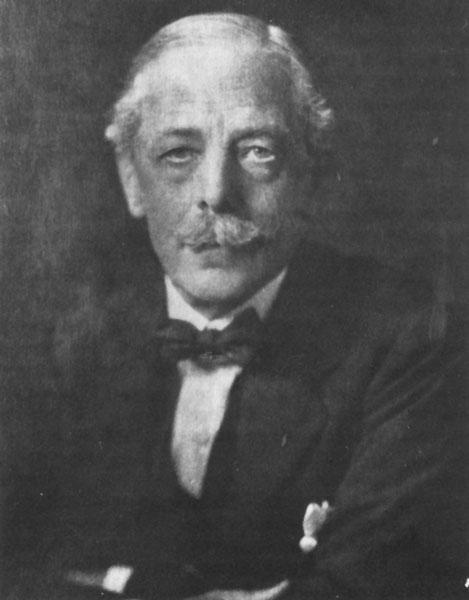
Sir Julian Corbett

The writings of Sir Julian Corbett are equally reflective of the general mindset of the British Empire at the high noon of its existence in the late 19th and early 20th century. The Royal Navy (RN) had not faced a peer competitor in pitched battle at sea since Trafalgar in 1805. The Naval Defence Act of 1889 brought with it the” two power standard” measure of British naval superiority where the RN would maintain a number of battleships equal or superior to the next two ranking naval powers. France and Russia struggled to match the British in quality and quantity of warship construction, but largely failed in their endeavors to create equivalent fleets. The chief threats to imperial security were not from enemy battle fleets or direct attacks on the British Isles, but rather assaults on the vital imperial lines of communication and supply. The French in fact largely eschewed battleship construction for a time and instead concentrated in the construction of large commerce-raiding cruisers. The RN saw these ships as a direct threat to the security of the Empire. Protection of the lines of communication between London and Cairo, Delhi, and on to Singapore and Sidney was vital to commercial activity and provided the British the ability to rapidly reinforce beleaguered dominions threatened by external invasion. The problem of reinforcing India against a Russian invasion through Afghanistan in particular was a source of great concern to British statesmen and military leaders from the period of the Indian Mutiny of 1857 onward to the early 20th century.

It is perhaps no wonder that the writings of Corbett, and the opinions of his most significant interlocutor, First Sea Lord Admiral Sir John Fisher, focus on protecting these imperial lines of communication rather than in the engagement of enemy battle fleets in decisive combat. Corbett defined “command of the sea” as means nothing but the control of maritime communications, whether for commercial or military purposes. The object of naval warfare is the control of communications, and not, as in land warfare, the conquest of territory.”6 Corbett seldom references geography except as loci of communications. These “naval positions” he defines as “firstly, naval bases and, secondly, the terminals of the greater lines of communication or trade-routes and the focal areas where they tend to converge, as at Finisterre, Gibraltar, Suez, the Cape, Singapore, and many others.”7 Corbett’s rather loose reference to specific locations is explained by the fact that the principle audience of his book, British naval officers who sat in his War College courses, had no need of a strategic geography course. As Clausewitz’s lectures were written to inform Prussian military officers, so Corbett’s concepts of operational warfare were designed to be employed by the Royal Navy in defense of the far flung British Empire. The RN had spent the last 300 years striving to control key geographic positions around the world in order to isolate opponents and protect its own lines of communications. Admiral Fisher in 1904 said “five keys (Singapore, the Cape of Good Hope, the entrance to the Suez Canal, Gibraltar, and Dover at the entrance to the English Channel) lock up the world!”8 The radical new component of naval force structure Fisher proposed to defend these routes was the heavily armed, high speed battle cruiser.9 Corbett for his part emphasized the importance of “cruisers” and specifically labeled them as central to control of the routes communication.10 British statesmen of the period were equally well versed in the Empire’s strategic geography. It was the civilian First Lord of the Admiralty, Lord Selborne, who conceived of the masterful geographic re-balancing of the Royal Navy in reply to big geopolitical changes at the dawn of the 20th century.11 Even the average British citizen of the late 19th and early 20th century understood that the maintenance of the nation’s sea power was of vital importance to its national interest. One popular English music hall song of the period exclaimed, “We don’t want to fight but by Jingo if we do, we’ve got the ships, we’ve got the men, we’ve got the money too.” Working among such knowledgeable geopoliticians as Selborne and Fisher, Corbett could comfortably maintain focus on the operational aspects of “imperial” warfare.

Potential U.S. application of both Clausewitz and Corbett in the 2nd decade of the 21st century is problematic at best. Clausewitz’s maxim that “war is a continuation of political action (mistranslated or not)” is, however, not a useful tool for nation not as centrally organized for war as was 19th century Prussia. Admiral Wylie said, “War for a non-aggressor nation is actually a nearly complete collapse of policy.”12 In the coming of war then, he says, “nearly all prewar policy is utterly invalid because the setting in which it was designed to function no longer corresponds with reality.”13 From Wylie it is fairly clear that the paranoid Prussian garrison state model has little relevance to a democratic government committed to the preservation of peace and active deterrence of war. Corbett’s operational concepts embodied in Some Principles of Maritime Strategy are more applicable to contemporary U.S. strategic issues. His notion of “Sea Control”, however, is more constrained by its focus on the maintenance of communication with other parts of the British Empire than contemporary U.S. requirements to police global common spaces. The most important of these imperial communication routes was that from Great Britain itself to India. British historians Ronald Robinson and John Gallagher wrote, “To all Victorian statesmen, India and the British Isles were the twin centres of their wealth and strength in the world as a whole”.14 They further noted that the principal reason for the establishment of British colonies in Africa was the preservation of the communication route to India from the British Isles.15 There is no U.S. equivalent of India as a focal point around which U.S. global communications must be constructed. U.S. strategic interests are global in nature, but more distributive than those of late 19th and early 20th century Britain. The wars of the past decade in Afghanistan and Iraq also seem to have discouraged many U.S. defense and foreign policy elites from contemplating similar efforts to influence events ashore through the deployment of ground forces. Accordingly, the concept of Sea Control, as defined by Corbett may not be of the same importance for naval forces for the foreseeable future.
Most importantly, both the writings of Clausewitz and Corbett both supported well-established strategies.

The United States, by contrast, has been in a kind of strategic drift since the end of the Cold War in 1991. It has been bereft until the past several years of a specific opponent or opponents around which to construct a replacement to the successive Cold War strategy of Containment. Defense reform efforts like the Goldwater Nichols Act of 1986 reduced the power of service chiefs who traditionally formulated strategy. In their place, a distributive combination of regional military commanders supported by joint and service elements from Washington D.C. created ad hoc operational solutions to regional issues. The first Gulf War of 1991, operations in the Balkans in the mid 1990’s and even the opening battles of the War on Terrorism in Afghanistan (2001) and Iraq (2003) represent this focus on regional operational issues that often neglected wider strategic concerns. It is perhaps not surprising that the rise of joint-enabled operational solutions to these problems of the last two decades coincided with a rise in the quotation of Clausewitz and Corbett as the touchstones for this effort. Military historian Williamson Murray labeled this result as “operational solutions to strategic problems” in his description of the military policy of the German Empire, but his further description of its use of an “infallible central planning role for a general staff” and embrace of “an unquestioned cult of the offensive” could also characterize U.S. action in the period from 1991-2008.16
wylie2
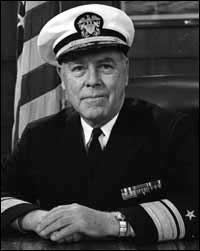
Rear Admiral Wylie

While it is not necessary to entirely remove Clausewitz and Corbett from the War College curriculum, it is perhaps time to limit their use in favor of those theorists who speak in terms of long range strategy, and those more relevant to the current U.S. experience. Admirals Alfred Thayer Mahan and J.C. Wylie represent such a combination of strategic thought supported by a more recent experience than either Clausewitz or Corbett. The works of Alfred Thayer Mahan cover a wide field of concepts and disciplines, but a large number combine the disciplines of history and geography as the principal components of strategic thought. Mahan described the importance of history in strategic thinking through a quote from the esteemed French naval strategist Captain Rene Daveluy as:

“History, being the record of experience, if exhaustively studied, brings out all of the variable factors which enter war; because history, however imperfect, forgets none of them. History is photographic, where as the rational processes, that is, when a man having established a basis of truth, builds up his system without checking it by history, the rational processes tend to be selective. History in short gives you all of the qualifying factors; whereas reason, in love with its own refinements, is liable to overlook that which should refine them.”17

imahana001p1
Alfred Thayer Mahan

Some of Mahan’s concepts are also rooted in the geostrategic situation that confronted the United States in his lifetime. His belief in the concentration of forces as vital to combat success was as much influenced by U.S. strategic geography and potential opponents as it was by the history of past British naval wars he imparted. In the years before the First World War the primary strategic threat to the U.S. homeland was expected to come in the form of a cross-Atlantic invasion by an aggressive European power such as the German Empire. Only through concentration of its battle fleet would the U.S. likely prevail against a cross Atlantic invasion force. Mahan’s greatest contribution according to Wylie was “his recognition of seapower as a basis of national power.”18
Admiral Wylie’s works represent a synthesis of work of Clausewitz, Corbett and Mahan, as well as that of 20th century air and guerilla warfare disciplines. Wylie’s work is remarkably enduring in that it acknowledges that “terrorism is not going to disappear tomorrow” in spite of the information revolution or other aspects of advanced technology.19 He respects and anticipates that advances in missile and guidance technology will make war at sea more challenging.20 Finally, Admiral Wylie’s thinking and associated analysis are firmly grounded in the American experience of war, an aspect of his work that Clausewitz and Corbett do not necessarily reflect. The Prussian officer and the British operational theorist still have a part to play in the War College classroom, but their role in the curriculum should be adjusted for current events.

A notable naval history conference held at the Naval War College in September 1992 declared “Mahan is not Enough” and rightly suggested that the works of Corbett, and British Admiral turned historian Sir Herbert Richmond had been unfairly ignored in the study of 20th century naval history and strategy. The message was also a warning that the United States did not focus enough on operational art in the achievement of its military and national objectives. The brief period of the American “hyper power moment”, however, ended in the period 2008-2010. The rise of new competitors, the return of old challengers, and increasing disorder throughout the globe calls for an emphasis on historical strategic thinkers like Mahan and Wylie rather than operational artists like Clausewitz and Corbett. The strategic hipsters would do well to remember that “Uncle Carl” and “Sir Julian” could not have developed in the absence of underlying strategy that supported their operational theories. Rather than be concerned about numbers of strategists trained, the War Colleges would do better to improve the strategic curriculum in order to train a new generation of Mahans and Wylies to confront the nation’s present strategic challenges.

Steve Wills is a retired surface warfare officer and a PhD student in military history at Ohio University. His focus areas are modern U.S. naval and military reorganization efforts and British naval strategy and policy from 1889-1941. He posts here at CIMSEC, sailorbob.com and at informationdissemination.org under the pen name of “Lazarus”.

1.  J.C. Wylie, Maritime Strategy, A General Theory of Power Control, Annapolis, MD, Naval Institute Press, 1989, p. 1.
2.  Geoffrey Parker, The Military Revolution, Military Innovation and the Rise of the West, 1500-1800, Cambridge, UK, Cambridge University Press, 1996, p. 1.
3.  Parker, p. 168.
4.  Carl von Clausewitz, edited and translated by Michael Howard and Peter Paret, On War, Princeton, NJ, Princeton University Press, 1976, p. 87.
5.  Wylie, p. 67.
6.  Sir Julian Corbett, Some Principles of Maritime Strategy, Project Gutenberg E-Book, released 16 February 2005, p. 94.
7.  Corbett, p. 106.
8.  Peter Kemp, ed, The Papers of Admiral Sir John Fisher, Volume 1, London, NRS, 1960, p. 161.
9.  Nicholas A. Lambert, Sir John Fisher’s Naval Revolution, Columbia, SC, University of South Carolina Press, 199, p. 93.
10.  Corbett, pp 114, 115.
11.  Aaron l. Friedberg, The Weary Titan, Britain and the Experience of Relative Decline, 1895-1905, Princeton, NJ, Princeton University Press, 1988, p. 135.
12.  Wylie, pp. 67-68.
13.  Wylie, p 68.
14.  Ronald Robinson and John Gallagher, Africa and the Victorians, The Official Mind of Imperialism, London, Palgrave Macmillan, 1978, p. 17.
15.  Robinson and Gallagher, Africa and the Victorians, p. 464.
16.  Williamson Murray, McGregor Knox, and Alan Bernstein, eds. The Making of Strategy, Rulers, States, and War, 1996, Cambridge, UK, Cambridge University Press, 1996, p. 80.
17.  Alfred Thayer Mahan, Naval Strategy, Compared and Contrasted with the Principles and Practices of Military Operations on Land, London, Sampson, Low, Marston, and Co., 1911, p. 16.
18.  Wylie, p. 34.
19.  Wylie, p. 106.
10.  Wylie, p. 102.
A2AD Since Seventy-Three

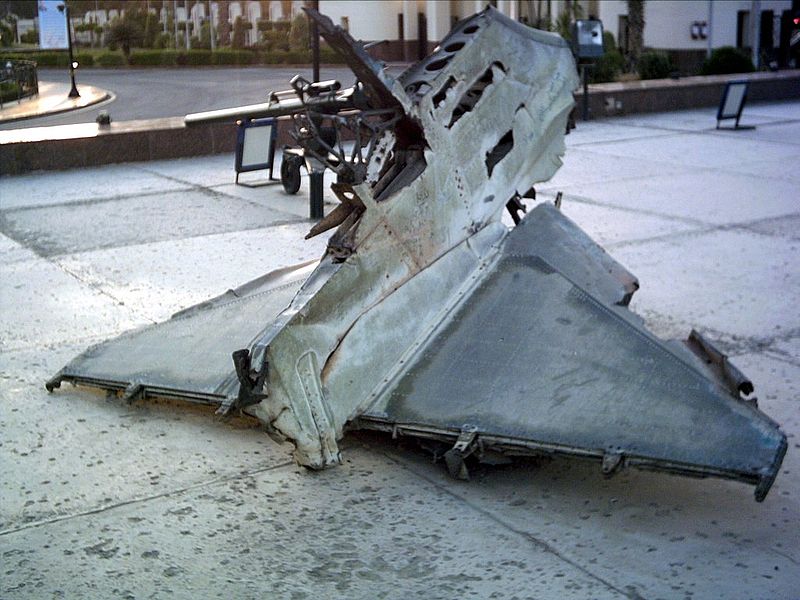
Wreckage of a Destroyed Israeli Plane (Wikimedia Commons)

As part of the run-up to #CFAR15 on Thursday, we asked those who received the most votes but are unable to attend to provide some thoughts and updates on their articles to share with our readers, along with the original, most-popular pieces of the past year:

LCDR Mark Munson: This piece was originally published as part of “Air-Sea Battle Week.”  I chose to not write directly about the Air-Sea Battle (ASB) Operational Concept (or China) because I had no particular interest in ASB.  I also was working at OPNAV at the time, and though I had no involvement or even any particular knowledge of ASB, I did not want to give the false impression that I had any insight into the U.S. Navy or Air Force efforts in support of that “Operational Concept.”

Of course since then the Air-Sea Battle office and concept is gone, recently subsumed into the larger Joint Concept for Access and Maneuver in the Global Commons (JAM-GC). JAM-GC may prove to be more successful than ASB in terms of facilitating the procurement of technologies that counter Anti-Access/Area-Denial (A2AD) capabilities. However, since I wrote this article the conventional wisdom regarding the pursuit of A2AD by China has also been challenged.  In the Winter 2015 issue of The Washington Quarterly, M. Taylor Fravel and Christopher Twomey argue that “counter-intervention” is not the cornerstone of Chinese military strategy and that any Chinese emphasis on  fielding A2AD capabilities are driven primarily to equip it  for “a potential conflict over Taiwan.” (Full disclosure: Twomey is a former professor of mine)  In fact, Fravel and Twomey argue that the focus on A2AD may the development of U.S. strategy and future weapons.

Regardless of whether and/or why China is developing the a significant A2AD capability, I think the thesis of my argument below is still sound. The notions behind A2AD or “Counter-Intervention” are not new, as militaries have attempted to develop stand-off weapons that deny maneuver to their enemies on the battlefield since the dawn of warfare. This article could just have easily been written about English and Welsh longbowmen  at Agincourt as the Egyptians in Sinai in 1973.  


The threat posed by Anti-Access/Area-Denial (A2AD) capabilities is at the core of the the U.S. Navy and Air Force’s Air Sea Battle (ASB) operational concept.  However, A2AD weapons are not new,  in particular playing an important role in the 1973 Yom Kippur War.

A2AD and the ASB Concept

The ASB operational concept defines A2AD capabilities as “those which challenge and threaten the ability of U.S. and allied forces to both get to the fight and to fight effectively once there.”  One of the main capabilities that ASB has been established to counteract and mitigate against is the “new generation of cruise, ballistic, air-to-air, and surface-to-air missiles with improved range, accuracy, and lethality” that are increasingly available to states around the world.  Figuring out ways to operate in a world in which missiles are easy to acquire and operate is extremely important to the U.S. military, since A2AD weapons “make U.S. power projection increasingly risky, and in some cases prohibitive,” threatening the very foundation upon which the ability of the U.S. military’s ability to operate at will across the globe rests upon.

Missile Warfare in the Middle East

Using A2AD weapons, particularly surface-to-air missiles (SAM), surface-to-surface missiles (SSM), and anti-ship cruise missiles (ASCM), to conduct a form of asymmetric warfare is not a new idea.   In particular, the use of missiles to counteract an enemy’s superiority in the air or on the ground was very much a part of Soviet doctrine by the 1960s.  To protect against the U.S. air campaign during the Vietnam War, Soviet missiles and personnel were extensively used by North Vietnam.  Perhaps the best example of A2AD in action, however, was the Soviet-enabled missile campaign waged by Egypt against the Israeli military during the 1973 Yom Kippur War (also known as the Ramadan War or October War).

The use of missiles formed an essential part of the plans of Egypt and Syria to win back the territories lost so precipitously during the 1967 Six Day War.  In his book the Arab-Israel Wars, historian and former Israeli President Chaim Herzog noted that:

“the Egyptians had meanwhile studied and absorbed the lessons of the Six Day War: with the Russians, they concluded they could answer the problem of the Israeli Air Force over the battlefield by the creation of a very dense “wall” of missiles along the canal, denser even that that used in North Vietnam.  The problem posed by Israeli armour was to be answered by the creation of a large concentration of anti-tank weapons at every level, from the RPG shoulder-operated missile at platoon level up to the Sagger missiles with a range of some 3000 yards and the BRDM armoured missile-carrying vehicles at battalion and brigade level.”

As part of Operation Caucasus, the Soviet Union “deployed an overstrength division” of air defense forces, with eighteen battalions each composed of SAM batteries, Anti-Aircraft Artillery (AAA), and teams equipped with Man-Portable Air Defense Systems (MANPADS).  Although technically identified as instructors, the Soviet troops actually “were dressed in Egyptian uniforms and provided full crewing for the deployed SAM systems.” Using lessons learned in Vietnam, the air defense forces along the Suez Canal were capable of  “relocating frequently and setting up ambushes for Israeli aircraft using multiple mutually supporting batteries.”  Syria also procured Soviet SAM batteries to support their part of the planned surprise attack.  In Herzog’s words, the overwhelming array of SAMs and AAA “would provide an effective umbrella over the planned area of operations along the Suez Canal” and “to a very considerable degree neutralize the effects of Israeli air superiority over the immediate field of battle.”

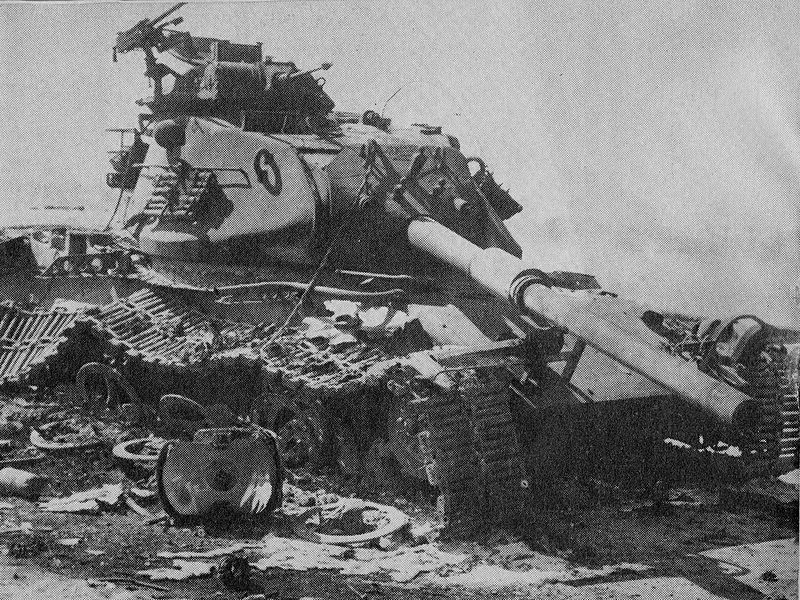
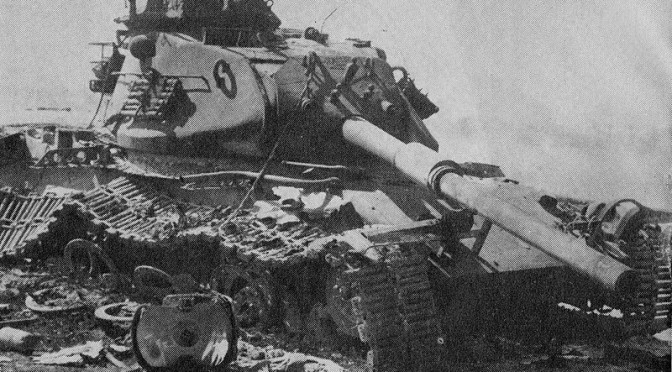
Destroyed Israeli Tank in the Sinai (Wikimedia Commons)


The Egyptians pursued a similar effort in their efforts to combat Israel’s ground forces.  Per Herzog, Israel’s “armoured philosophy” emphasizing “massive, rapidly deployed, armoured counterattack” would be faced by an Egyptian Army that had crossed the Suez Canal “equipped to the saturation point in anti-tank weapons and missiles in order to wear down the Israeli armour.” The Arab leaders were not just concerned with achieving missile dominance inside the expected battlefield along the canal, however, but also that Eyptian and Syrian aircraft could not match their Israeli counterparts “outside the range of missile surface-to-air defence systems.”  Therefore, the Soviets also provided surface-to-surface FROG and SCUD missiles capable of directly striking at Israel itself, with the hope that they could deter against Israel’s ability to attack their own capitals.

Egypt and Syria’s employment of A2AD weapons had a significant tactical impact on the war.  Estimates of the losses of Israeli aircraft vary.  Herzog stated that 102 Israeli planes were shot down (50 during the first three days), with half shot down by missiles and the other half shot down by AAA.  According to other articles, “Israeli public claims are that 303 aircraft were lost in combat,” crediting SAMs with shooting down 40 and “between four and 12 to Arab fighters.”  This means that although most Israeli aircraft may have been shot down by AAA, the “missile wall” can be credited with “denying the use of high and medium altitude airspace, driving aircraft down into the envelope of high-density AAA.”

One can argue that the lessons learned from employment of A2AD in 1973 can be overstated (after all, Israel eventually won the war, at great cost).  However, Herzog’s claim that it was “a war of great historic significance” is merited, as it “was the first war in which the various types of missiles – surface-to-surface, surface-to-air, air-to-surface, and sea-to-sea – were used on a major scale,” and that “the entire science of military strategy and technique has had to be re-evaluated in the light of” its lessons.  In particular, the Egyptians in 1973 executed what the Air-Sea Battle concept identifies as an important objective of A2AD, in which “an aggressor can slow deployment of U.S. and allied forces to a theater, prevent coalition operations from desired theater locations, or force friendly forces to operate from disadvantageous longer distances.”

Evolution of Air-Land Battle and the Influence of the 73 War

If the Army’s AirLand Battle doctrine of the 1970/1980s can be seen as an intellectual precursor to Air-Sea Battle in its emphasis on “degradation of rear echelon forces before they could engage allied forces,” then the link between the 1973 Yom Kippur War and Air-Sea Battle is clear.  General William DePuy was the first commander of the U.S. Army’s Training and Doctrine Command (TRADOC) upon its establishment in 1973.  In particular, “DePuy had taken an intense interest in the reform of tactics and training, in line with tactical lessons drawn from the 1973 Arab-Israeli War.”  During the tenure of DePuy’s successor, General Donn Starry, TRADOC formulated AirLand Battle and laid the doctrinal framework for the modernization of the U.S. Army and inter-service, joint operations.

What is the Answer?

How and why Israel won the war in 1973 entails a much longer discussion possible in this particular blog post.  The solution to A2AD that the Navy and Air Force  have proposed through Air-Sea Battle “is to develop networked, integrated forces capable of attack-in-depth to disrupt, destroy and defeat adversary forces.”  The reader can decide whether those are just buzzwords and whether the A2AD threat faced by the Israelis forty years ago was an easier challenge to  overcome than what could be faced by the U.S. military today and in the future  What is clear, however, is that the notion of A2AD is not new, and was very much an important part of Soviet-supported military operations during the Cold War.

Lieutenant Commander Mark Munson is a Naval Intelligence officer currently serving on the OPNAV staff. He has previously served at Naval Special Warfare Group FOUR, the Office of Naval Intelligence, and onboard USS ESSEX (LHD 2).  The views expressed are solely those of the author and do not reflect the official viewpoints or policies of the Department of Defense or the US Government.

The Gutting of Ukraine

By Norman Friedman

UkraineChina has consistently supported Ukraine during its agony at the hands of Russian-supported separatists. One of the less-publicized reasons why is that China has relied heavily on Ukrainian firms to help modernize its military.

For example, the active phased-array radar on board Chinese Type 052C destroyers was developed by a Ukrainian company. The current Chinese main battle tank is essentially the current Ukrainian one. The firms involved are all in the heavily-industrialized area in which the Russian-backed forces are operating; it may even be that the Russians are specifically targeting particular Ukrainian towns and companies. From Mr. Putin’s point of view, the Ukrainian companies may be unwanted competitors with the military industrialists on whom he depends for much of his power. At the least, he is trying to put them out of business. The white trucks supposedly carrying humanitarian aid into Ukraine from Russia were actually arriving to plunder Ukrainian factories of their modern machine tools. What the West may not want to sell to Mr. Putin, his forces can steal.

The Ukrainian plants and development companies exist because of policies implemented long before the Soviet Union broke up. The rulers of the Soviet Union were always worried that nationalism would break up their country — as, in the end, it did. One of their insurance policies against breakup was to make it difficult or impossible for those in any one of the republics making up the Soviet Union to build key items independently. For example, gas turbine ships built in Leningrad (St. Petersburg) in Russia were powered by gas turbines made in Ukraine. Their torpedoes came from Kazakhstan. Sonobuoys came from Ukraine, as did helicopter dipping sonars. Some ballistic missiles came from Ukraine. The only shipyard in the old Soviet Union capable of building carriers was in Nikolaev, in Ukraine. However, any carrier built there was armed with weapons and sensors from elsewhere in the Soviet Union, mainly from Russia.

In Soviet times, none of this really mattered. The Ukrainian factory making gas turbines responded to commands from Moscow to deliver engines to St. Petersburg, just as any factory in Russia did. There was little or no distinction between what happened in Moscow and what happened in, say, Nikolaev — no border, no transfer of cash. To a considerable extent design organizations were set up in Ukraine in the early 1960s or the late 1950s because Nikita Khrushchev, who ran the Soviet Union, was Ukrainian. For example, Khrushchev decided to reward his homeland by transferring the Crimea to it. Unsurprisingly, Russians applauded its seizure, since they had never considered the transfer legitimate. Ukrainian independence is a much more substantial issue, although most Russians apparently consider it a spurious notion, its separation a penalty imposed by the West at the end of the Cold War.

Once the Soviet Union broke up, the Soviet -era distribution of facilities suddenly mattered a great deal. All of the constituent republics of the old Soviet Union were suddenly plunged from a world of command by Moscow to a world of cash purchases. The Ukrainian plant could still make gas turbines, but if Moscow wanted a set for installation in St. Petersburg it suddenly had to pay up with real money. That was not easy. In time the Russians built their own gas turbine factory, but while that was happening they had to power ships with steam plants, because the steam plants were being made in Russia.

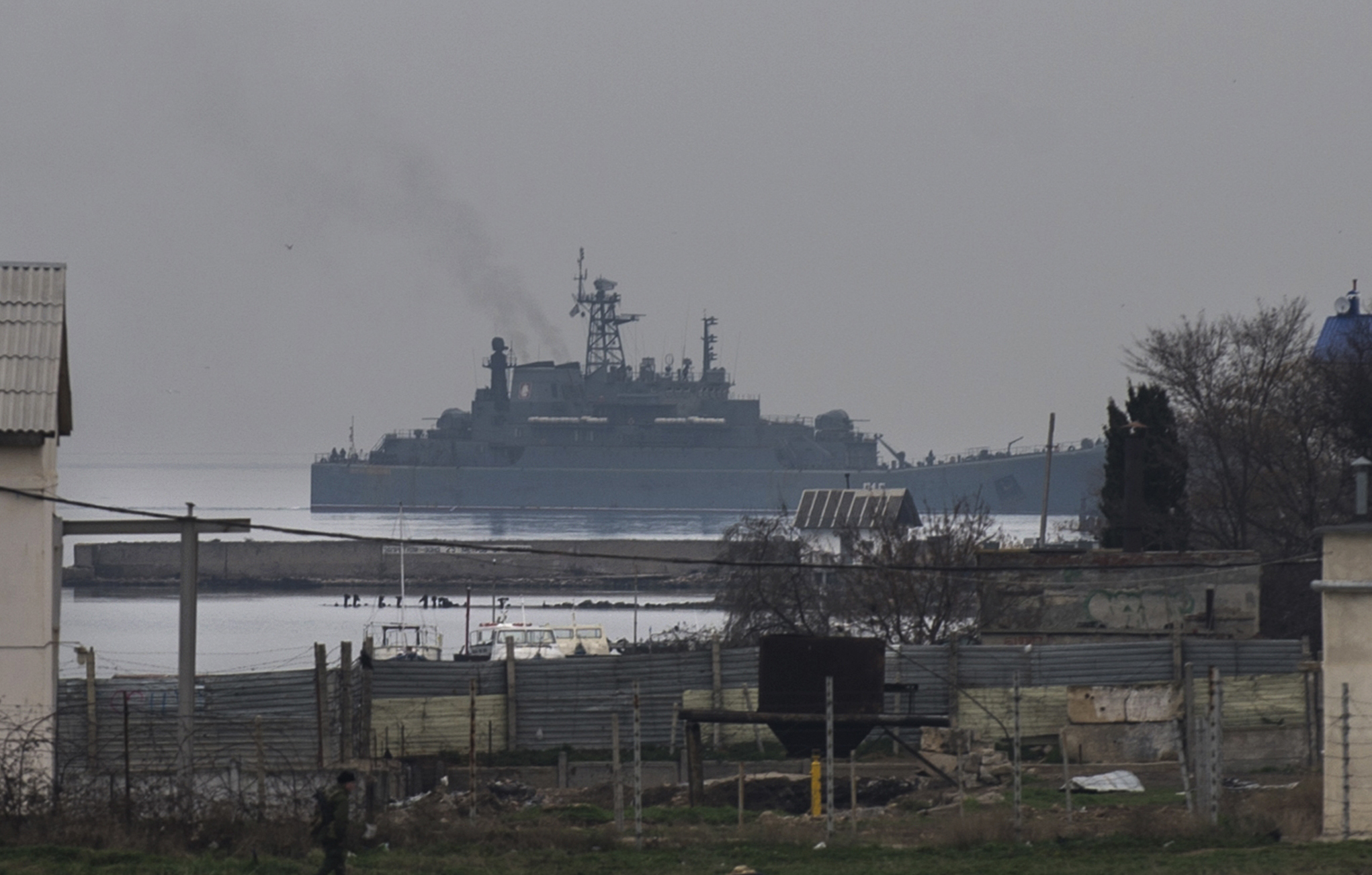
Conversely, key components of the carrier Varyag, afloat at Nikolaev, could not be delivered because they could not be paid for. The yard had no way to complete the carrier. Parts of her weapon system were visible for some years on the pier alongside, incomplete and hence impossible to install. In much the same way the Ukrainians had no way of completing a Slava class cruiser left nearly completed when the Soviet Union broke up. The carrier proved saleable — its transfer may have been the beginning of Ukrainian arms exports to China — but the cruiser did not. Even Ukrainian governments clearly favoring the Russians could not conjure up the resources to give the Russians weapon systems or platforms they wanted, because it took cash to move equipment over the border.

With their Russian (ex-Soviet) customers no longer paying, Ukrainian firms looked elsewhere, and they seem to have found their main customer in China — which certainly did have lots of cash. Exports were not so much finished equipment (which would probably have required components from elsewhere in the former Soviet empire) as innovative designs, such as the active phased-array radar. From time to time the Russians have tried to police the export of military data and know-how from their country, but once the Soviet Union broke up Ukraine must have made such controls a mockery in many cases. That might not have mattered had Russian military R&D kept advancing at its pre-collapse pace, but the cash shortage stopped most of that, too. Ukrainians who knew what the Soviet Union had developed by the time of its collapse could sell just about anything Russians could.

For a time, the Russians recovered to the point that they did have cash, but Russian military producers faced much higher costs at home, not least to feed an extremely corrupt political system. Now that a plunging oil price has cut Russian cash resources, it is even more difficult for them to buy from Ukrainian firms. It must be doubly difficult if they have to compete with much wealthier Chinese buyers. Theft is a much easier way to obtain the necessary products. Since it includes the theft of production tooling, the plants in question can be re-established in Russia, where their products will be far more affordable. Hence the systematic looting of plants in Ukraine. Looting also circumvents the effect of a falling price of oil, which drastically reduces hard-cash resources in Russia.

If the Ukrainian agony were all about money and access to technology, it would be unhappy enough. However, a major the driving force is nationalism. Vladimir Putin’s only important attraction for Russians is nationalistic: he is seen as a strong man who will restore the strength of the motherland, and he will also expunge all of those unhappy guilty memories of the Soviet past. In this narrative, the West is the enemy who broke up the Russian Empire and thus sought to crush Holy Russia. Anyone familiar with Russian history before the Revolution can recognize the sort of policy Mr. Putin is following. It takes a very committed Russian nationalist to say, as some have in recent days, that the falling price of oil is part of a deliberate plot on the part of ‘certain organizations’ in the West intended specifically to weaken Russia. Ukraine was the oldest part of the Empire, and its recovery excites Russian nationalists. Before he annexed Crimea, Mr. Putin was extremely unpopular. People in Russia saw him for what he was: a thief working with larger thieves to plunder their country. Afterwards his popularity soared, and old-style raw Russian nationalism became a ruling force.

Russian nationalism is opposed by Ukrainian nationalism. It may not be particularly powerful in the Eastern Ukrainian regions in which the Russians and their friends are operating, but in much of the country it is alive and well. Ukraine has a distinctive culture and language. The language and the alphabet are similar to Russian, but by no means identical. Ukraine enjoyed brief independence after the Russian Revolution. During the late 1920s and early 1930s the government in Moscow created a famine in Ukraine that killed 6 to 10 million people in the name of collectivizing farming. Ukraine had been the breadbasket of Europe, its wheat exports the major source of foreign currency to Czarist Russia. After collectivization, the Ukraine was badly enough ravaged that in the 1950s the Soviet Union found itself buying wheat abroad.

The horrors of the 1920s and 1930s remained fresh in Ukrainian minds when the Germans invaded the Soviet Union in June 1941. Initially Ukrainians understandably welcomed the Germans as liberators, only to discover that the racist Germans lumped them with the Russians as sub-human. Even so, they hated the Russians even more, and a low-level insurgency continued well into the 1950s. The Ukrainian view of the man-made famine is somewhat analogous to the Polish view of the Soviet massacre of Polish military officers in 1941 at Katyn. Each was a horrific crime committed by the Soviet Union and then buried. Under Soviet domination, denial that the Soviets had committed such crimes became a test of political loyalty. Once Ukraine and Poland were free of Soviet control, memory of such crimes helped generate nationalist hatred for the Soviets. When Mr. Putin glorifies the Soviet Union which produced him, he enrages those it tortured. Victims inside the Soviet Union are less than popular in the current nationalist climate, but victims outside are in a very different position.

To further complicate matters, another Soviet-era strategy for binding together the Soviet Union was to encourage ethnic Russians to settle in the various republics forming the Soviet Union. That produced large ethnic Russian minorities in countries like Latvia and Ukraine. Mr. Putin is encouraging the ethnic Russian minority in Eastern Ukraine to revolt against the government in Kiev. Although he is enjoying a short-term advantage, surely what he has done has made other post-Soviet governments uncomfortably aware that they may be harboring hostile minorities. They may decide to do something about them before they can revolt.

If that seems an extreme extrapolation, remember that before World War II Hitler exploited the manufactured resentments felt by a large ethnic German minority in Czechoslovakia (in the Sudetenland) to dismember that country (he did not have to resort to invasion or even to proxy invasion, as in Ukraine). Governments who remembered what minority Germans had done in the 1930s expelled them after Germany collapsed in 1945. Many Germans found themselves walking all the way across Poland from what had been East Prussia, and for years the cry to recover that territory resonated through German politics. What is likely to happen now in places like the Baltic states? Their governments lived through decades of repression in the name of the Soviet Union, but up to now they have been relatively restrained about the Russians in their midst.

Norman Friedman is author of The U.S. Naval Institute Guide to World Naval Weapon Systems. This article can be found in its original form at the Australian Naval Institute here and was republished by permission.

The Importance of Space in Maritime Security

Honorable Mention – CIMSEC High School Essay Contest

As long as man has walked the Earth and gazed into the stars, he’s asked “what’s out there what’s waiting for me?” Today, our country asks that very same question, although not for what we can find, but how we can use Space and its resources to advance our scientific and military might into, and hopefully beyond the 21st century.

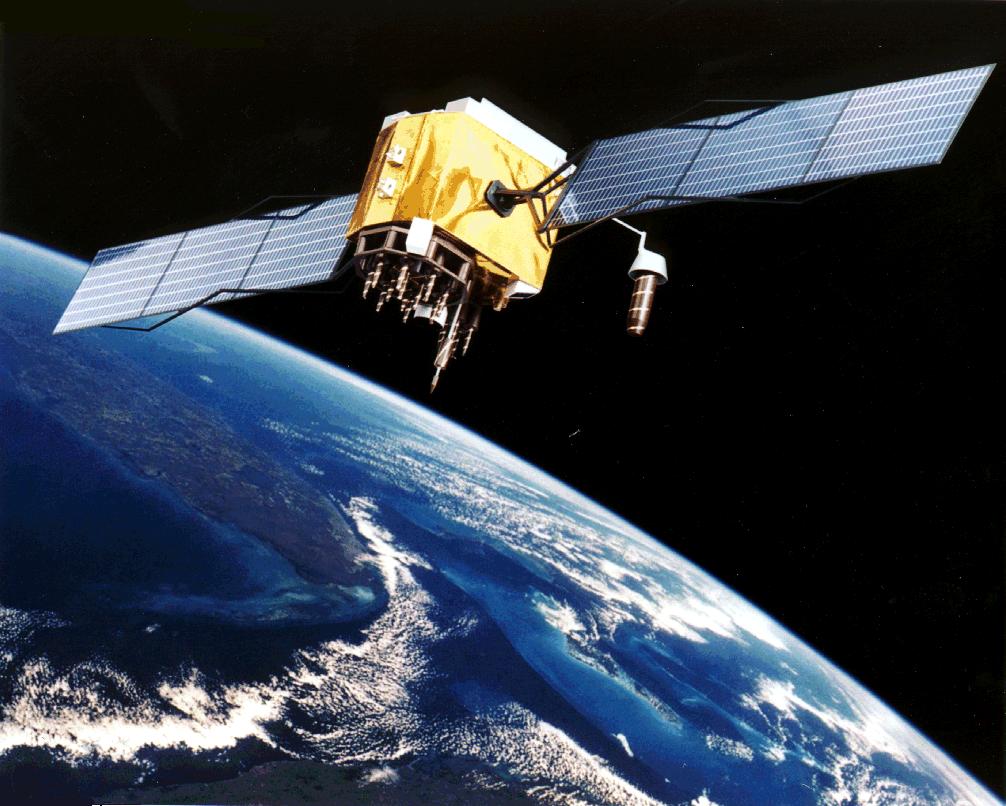
GPS_Satellite_NASA_art-iifWith the dawn of rockets and the nuclear confrontation between the United States and the Soviet Union during the height of the Cold War, Space would soon become a vital asset for the interests of both countries and other major players for the years to come (particularly China). With the sudden rise of China, and the reemergence of the Russia as a major military power, it is absolutely vital that the United States once again pursue Space for economic, political, and commercial purposes, as well as for strategic military purposes which will benefit not only the military, but the United States as a whole; and how our Navy can play a big role in helping us make this happen.

As of the time of this writing, the United States and other Western European Countries are currently embroiled in a geopolitical dispute with Russia over Ukraine and the rights of its territory such as Crimea and Eastern Ukraine. As a result of this, the United States and the European Union declared economic sanctions on Russia which are meant to cripple the Russian economy and force Russia out over its interference in Ukraine. In response to this, the Kremlin has threatened to stop shuttling Astronauts to and from the International Space Station, and cut off supplies to the ISS.  In 2007, the Chinese military carried out its first antisatellite missile test when it launched a ground based missile 500 miles to destroy an aging satellite of theirs.

Both of these events are very disturbing as they easily threaten the United States and its space capability to carry out intelligence gathering and reconnaissance missions in Space using the latest technology and satellites. If these satellites, whether civilian or military, ever happen to be threatened in a time of war, the results could be catastrophic. The Navy should invest in further developing laser weapons like the LaWS that are capable of punching holes through thick steel plates on ships as well as a countermeasure against any ballistic missile that may threaten our satellite capability in Space or onboard the ISS. Laser weapons are surprisingly very cheap and affordable. According to Rear Admiral Matthew Klunder in an interview for defense-aerospace.com, “with affordability a serious concern for our defense budgets, this will more effectively manage resources to ensure our sailors and marines are never in a fair fight.” The article goes on to claim that firing this type of weapon can cost less than $1 dollar per shot; a great bargain in a time that our military is starting to see a drawdown in military spending. Christopher Harrier, an analyst at the Institute for the Study of War was quoted as saying that: “The existing naval weapons systems, small-caliber cannons, large-caliber naval guns, and missiles, are at or near the limits of their potential capability. Guns and missiles just aren’t going to get much more accurate or lethal while lasers have significant potential for increases in range, accuracy, lethality, reliability, and cost-effectiveness.”

It is clear that if the Navy wants to confront new 21st Century threats, it must research and develop new combat systems, whether it is by land, sea, air, or space.  The Russians and the Chinese are also looking into developing similar weapons systems, while also trying to implement a missile defense system capable of intercepting and eliminating enemy targets. With a resurgent Russia and emerging China, this has become a must for defense of our allies and overseas military installations all around the world. It has been stated that an enemy country wouldn’t necessarily have to launch a direct nuclear strike if it wanted to destroy the United States. Countries like China and Russia could simply detonate a nuclear weapon in the upper atmosphere right over the Midwestern United States and knock out most, if not all, of the electrical power grids in the continental United States through an Electromagnetic Pulse Effect. An EMP would be devastating to the United States as it would cripple our infrastructure, down all of our technology, leave the US Government and military crippled and slow to react, and cause the global economy to collapse. It would be a scene right out of a post-apocalyptic film like The Postman or The Book of Eli. Not to mention the millions of casualties and deaths that would occur due to starvation or anarchy. It would truly be a shame and a complete lack of competence if our Government doesn’t have a contingency plan already in place for an event like this.

In order for this plan on space based missile defense to work however, it must learn from the mistakes made in the 1980’s when Ronald Reagan famously proposed in 1983 his SDI (Strategic Defense Initiative) or the “Star Wars Program”. As many people know, SDI was announced in 1983 by Ronald Reagan as a means of countering the Soviet threat with space based weaponry capable of shooting down any Soviet missile before it entered American airspace. Unfortunately, due to the slow technological development at the time of space based missile defense systems, as well as other factors including the Dissolution of the USSR, inefficiency, and overall lack of continued public support, SDI did not succeed in meeting its goals.

In comparison to the 1980’s-early 90’s, America does have the infrastructure in 2015 to support a new SDI type program. For starters, in 1983 something called: “private space companies” did not exist. With companies such as SpaceX, Virgin Galactic, Orbital Sciences, and Blue Origin starting to appear and establish themselves as legitimate companies in the aerospace sector, there’s no reason why they couldn’t be expected to help the American military develop a space based missile defense system. Similar to how other Aerospace contractors such as Boeing and Lockheed Martin have helped the Air Force in its development of their new aircraft and weapons systems, a joint government/private program with the DoD and Navy providing the funding, and the private companies will handle the testing and development could be developed. That way there won’t be as large of an outcry by the public as there was with SDI in the 1980’s and the politicians/military leaders don’t have to worry so much about any failures and the potential political backlash with the program, as it will fall on the shoulders of the private contractors. Plus, this program will be more affordable now than it ever was in the 1980s.

SpaceX is currently developing the Falcon-9 space rocket with the intention of making it reusable and cheaper to launch into orbit. According to NASA, the average typical launch cost for the Space Shuttle Program was $450 million dollars. With the SpaceX designed Falcon-9 rocket, that cost is now about 50-56 million USD, an absolute bargain when compared to how much NASA’s launches cost. The biggest obstacle to this plan would not necessarily be the technical or financial challenges involved, but compliance with international law such as the 1967 Outer Space Treaty. Article IV of the 1967 Space Treaty states: “States Parties to the Treaty undertake not to place in orbit around the earth any objects carrying nuclear weapons or any other kinds of weapons of mass destruction, install such weapons on celestial bodies, or station such weapons in outer space in any other manner.

The moon and other celestial bodies shall be used by all States Parties to the Treaty exclusively for peaceful purposes. The establishment of military bases, installations and fortifications, the testing of any type of weapons and the conduct of military maneuvers on celestial bodies shall be forbidden. The use of military personnel for scientific research or for any other peaceful purposes shall not be prohibited. The use of any equipment or facility necessary for peaceful exploration of the moon and other celestial bodies shall also not be prohibited. “

The key words in this text being: “Nuclear or any kinds of weapons of mass destruction.” WMD’s are most often defined as being either: Biological, Chemical, Radiological, or Nuclear.  Since lasers do not fall into either of these specifically defined categories (as lasers are electromagnetic), this would not violate international law regarding space and weapons of mass destruction. And their primary purpose would be defensive in nature. The Navy could easily place these interceptors on ships or in bases around the world in order to be alerted by any of these threats, as well as satellites which can track and locate enemy ships and submarines before they attack.

It is obvious that space will play a critical role in the development of naval affairs and maritime security through the use of satellites and space based defense which will be used to further America’s Naval supremacy in both the Sea and Space throughout the rest of the 21st century and beyond. As we can see, the Navy will not just be limited to the sea but will have an increasingly expanded role as technology and space travel progresses.

Citations:

http://bart.tcc.virginia.edu/classes/200R/Projects/fall_2002/nasa/casestudiessdi.html

http://www.fas.org/spp/starwars/offdocs/m8310017.htm,

http://history.nasa.gov/1967treaty.html,

http://www.spacex.com/falcon9

http://www.politico.com/story/2013/06/electromagneticpulsenewtgingrichempattack93002.html

About the Author 

Nolan McEleney was born in Jacksonville, Florida in 1996 and is a diehard fan of the Jacksonville Jaguars. His family moved to CT in 2005, before finally settling in MD in 2008. Nolan is currently a cadet officer in the Civil Air Patrol for the Bethesda-Chevy Chase Composite Squadron where he is currently assigned as a flight commander. Nolan currently attends The Avalon School in Gaithersburg where he is the Washington house captain. In extracurriculars, he is heavily involved with the Civil Air Patrol. Nolan is also a part of his squadrons cyberpatriot team which deals with cybersecurity and other threats as part of a nationwide competition. He has also taken online courses with the Cisco Networking Academy and Hillsdale College. 

 In the future, Nolan would like to work with NASA, a private space company, or any science and tech company. Whether it be in a technical or non-technical role, he feel like a lot of these companies such as SpaceX are on the cusp of history with proposed missions to the Moon, Mars, and beyond. He would also like to be a part of and contribute to that in any way he can. Nolan currently intends on going to the University of Washington and participating in ROTC so that he can become an officer.