Welcome back to another edition of the Members’ Roundup, where we share with the rest of the CIMSEC readership the great work that our members have produced elsewhere. From the geopolitical situation in the Indian Ocean region to military science-fiction, there will definitely be an article for every interest.
Automation has long colonised jobs that were once performed through manual labour; changes to military operations will be no less profound. In an article for a joint War on the rocks – Center for a New American Security on military robotics and autonomous weapons, Paul Scharre reminds us that beneath all of the technological developments is the human element driving the military application. Nations and militaries that are able to better understand the policy, strategic and operational challenges will be better placed to succeed on the battlefield. You can access his article here.
Over at Real Clear Defense, Emil Maine presents a stark assessment of the state of the United States’ munition stockpile. According to Maine: ‘unless policy makers act to raise discretionary caps on defense in the upcoming fiscal year, the severity of weapon shortfalls will only intensify.’ Given that the preference by coalition partners is to avoid committing boots on the ground, there will be a future need for a consistent supply of munitions in order to sustain the current rate of operations.
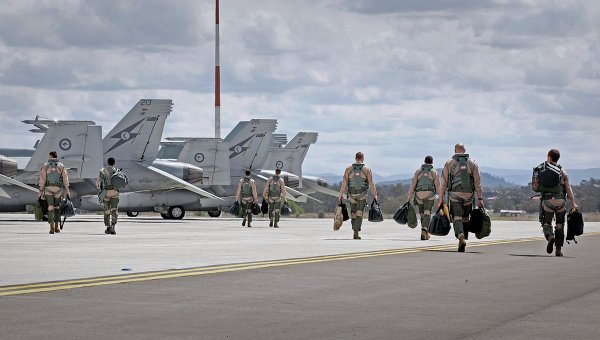
Royal Australian Air Force F/A-18 crews prepare for another mission against ISIS.
This week we have two contributions from Vijay Sakhuja. The first is an article for the National Maritime Foundation, based in India, and it analyses the bilateral relationship between India and the Seychelles. President James Michel’s Blue Economy project presents many opportunities for cooperation, but how this will be implemented is the challenge. The second article features in the Nikkei Asian Review; Vijay discusses the nature of Chinese infrastructure development in the Indian Ocean region and the ‘maritime silk road.’ In spite of growing tensions, many Asian countries continue to invite Chinese investment, leading to a win-win situation.
CIMSEC’s very own Scott Cheney-Peters features in this week’s edition of the Roundup with his short story “Red Light Challenge” published on the Atlantic Council’s Art of Future Warfare website. The story is about a start-up team’s journey, with undertones of a hacker counterculture amongst the members, as they begin designing a flight-capable exoskeleton for the military. Throughout the piece, however, we see the human side during the project development; each character has their own traits and reasons for participating in the challenge. You can read Scott’s story here, as well as a follow-up interview about it here.
The Indo-Pacific region is rapidly emerging as a key focus of maritime geopolitics. In June last year, the Stimson Center and the Observer Research Foundation co-hosted a three-day conference titled Sea Change: Evolving Maritime Geopolitics in the Indo-Pacific Region. Two CIMSECians were invited to speak at the event; Scott Cheney Peters presented a paper on U.S. security relationships in the regionand Nilanthi Samaranayake presented on the strategic importance of island states in a region of great powers. A copy of the publication can be accessed through the Stimson Center’s website.
In the latest Proceedings Magazine, John Morton explains that the Third Offset Strategy needs more Mahanian thinking than meets the eye. Mahanian doctrine holds that a properly conceived national interest reflects the foundational sinews and national establishment of the era and must inform implicit long-term grand strategy. Today, the information age and globalised economy are what is important for long-term prosperity. You can read more of John’s article here.
Over at The National Interest there are three CIMSECians whose work I wish to draw attention to for this week’s edition of the Roundup. Zachary Keck reports that most Chinese citizens believe the PLA could seize islands in the East and South China Seas, even if the U.S. military were to intervene in the conflict. Earlier in the week, Keck cited a Heritage Foundation report that assessed America only had ‘marginal’ capacity to defend vital interests in the current threat environment. You can access that post here.Harry Kazianis continues the theme with an assessment of sequestration’s affect on America’s military readiness. Across the board, munitions levels are considerably low and it risks putting lives in danger. It is not, however, all doom and gloom. You can read more of Harry’s article to find out why. Kyle Mizokami presents his own roundup of the Top 5 most deadly anti-ship missiles of all time.
Finally, a quick and shameless spruik for my own work over at Young Australians in International Affairs. Earlier this week I wrote a blog post posing the question of what Australia’s military would look like if there was an opportunity to start with a blank canvas. Many of us in the military understand that force structure and procurement are constrained by fiscal and structural realities, but sometimes it is important to break down the fundamental requirements of national defence to truly understand what is needed to achieve the task.
At CIMSEC we encourage members to continue writing, either here on the NextWar blog or through other means. You can assist us by emailing your works to dmp@cimsec.org.
Editor’s Note: The U.S. Navy, U.S. Coast Guard, and U.S. Marine Corps today released the revised maritime strategy, unveiling it at an event at CSIS. You can download it here, and access a fact sheet on it here.
By Joshua Tallis
A Cooperative Strategy Reboot
A Cooperative Strategy for 21st Century Seapower: Forward, Engaged, Ready (CS21R) is different from its 2007 predecessor in both tone and content in a number of critical ways. Some of the changes are merely those of diction, others those of new threats and previously ignored regions. Yet, all of these changes suggest an important evolution in the scope and attitude of the United States’ maritime services: the Navy, Marine Corps, and Coast Guard.
Parsing the Tone
The Tone of CS21R is set early on as the document’s authors seek to explain why an adapted strategy has become necessary. First and foremost on this list is the budget, a note that mirrors the tenor of more recent strategy documents (see the 2014 QDR, for example), but is absent from the original 2007 version. Before the end even of the preface, written by Secretary of the Navy Ray Mabus, the document makes reference to fiscal constraints. And this theme remains an undercurrent throughout the white paper.
In addition to budget, the document is quick to remark on the increasing complexity of the world’s dynamic threat environment. This too is found in Secretary Mabus’ preface, and continues through the foreword (signed by all three maritime service chiefs) and onward into the strategy itself. And again in this way CS21R sets itself apart from its predecessor. As the Chief of Naval Operation noted at the launch event at CSIS, the 2007 document was the product of a vastly different environment. Multiple conventional carriers were still afloat, the United States was heavily engaged on the ground in both Iraq and Afghanistan, and cyber was not yet the buzzword it has become in policy circles. In many ways the original document was a product of a wartime environment, one broad in scope but nevertheless clear in direction and purpose. The revised strategy favors the term complex where the earlier document uses evolved, a small change in diction that perhaps suggests a greater uncertainty in the future responsibilities of the maritime services. Yet, tone only suggests so much. The document, which is slightly longer than the original, provides greater content and thus a more sophisticated representation of its purpose than its predecessor.
Analyzing the Strategy
There are myriad ways one could parse the new document with respect to the old. It is vastly more robust in its attention to the cyber domain (which garners only side mentions in the 2007 version). It also pays far greater attention to Africa than the 2007 paper, which only mentions the continent once by name. In fact the revised version goes into far greater depth on all geographic regions, with a section (II) detailing each specifically. One unique change here is in a shift from the term ‘Asia-Pacific’ to a vastly more expansive ‘Indo-Asia-Pacific,’ defined as “spanning from the West Coast of the United States to the eastern coast of Africa.” (CS21R 3) This of course widely expands a geography the Navy in particular has had a growing interest in, though how it influences the rebalance to the Asia-Pacific is unclear. China still features heavily in the document, and the service chiefs all noted that the country weighed on their minds as the document evolved. It is likely in response to China, as well as threats posed by Russia and Iran, that induced one of the greatest changes to the document, the addition of “All Domain Access” as a pillar of seapower alongside the more traditional columns of deterrence, sea control, power projection, and maritime security. All domain access is defined as the “ability to project military force in contested areas with sufficient freedom of action to operate effectively.” (CS21R 19) This of course brings to mind anti-access/area denial (A2/AD) challenges posed chiefly by China, though the document indicates that this principle extends even into the cyber domain and the electromagnetic spectrum. (CS21R 21)
None of these changes will go unnoticed. Greater geographic specificity, the expansion of interest in securing the cyber realm, and the inclusion of a fifth pillar in the sea services’ conception of what seapower means are all ‘above the fold’ revisions to the original strategy. What may go unnoticed to those focused on traditional geopolitics is the documents marked increase in interest in maritime security. Human trafficking makes its debut in the revised document, while greater significance is given to those non-state threats mentioned in the 2007 white paper. The first section of the strategy detailing geopolitical changes since the publication of the first document is peppered with references not only to extremism and terrorism but also to transnational organized crime (TOC), the growing significance of population expansion in the littorals, and the threats posed by under-governed zones ashore.
As to be expected, each of the service chiefs highlighted certain portions of the cooperative strategy over others. When asked against what greatest threats the updated strategy was intended to prioritize, the Chief of Naval Operations pointed towards North Korea, Iran, Russia, cyber, and a host of non-state actors (mostly terror organizations such as Isis and Boko Haram). The Commandant of the Marine Corps also noted violent extremism, but leaned heavily on conventional threats such as Russia, China, North Korea and nuclear proliferation. The Commandant of the Coast Guard, however, highlighted throughout the launch event the primacy of a range of maritime security threats emphasized in CS21R. Chief among them was transitional crime, which the admiral estimates is worth $750 billion annually. The commandant also repeated the Coast Guard’s unique placement as a law enforcement operator with dozens of mutual legal assistance treaties negotiated across the world enabling easier Coast Guard access to littorals where other maritime forces may have operational restrictions.
International partners, most of whose navies are closer in scope and composition to the U.S. Coast Guard than the U.S. Navy, are a related component to this energized perspective on maritime security. The document makes continued reference to the need for partnerships, and Admiral Greenert noted at the launch that the document was already in the process of being translated to allow for greater dialogue with international partners. In West Africa, the Caribbean, Central America, the Middle East, and Southeast Asia in particular, many of these partners’ primary concerns are of matters of maritime security, terrorism, and organized crime. The Coast Guard’s partner programs in the South China Sea and its counter-narcotics mission in the Caribbean and Central America were highlighted in the event as examples of maritime security cooperation outside of the traditional navy-to-navy framework.
Finally, the document goes into greater detail than its predecessor with respect to implementation. Section IV on force design included components on force readiness and composition, personnel, strategic development, and capabilities. At the launch, Admiral Greenert noted that the strategy captures how the navy is organizing, equipping, and training its sailors in new ways. General Dunford made reference to personnel and training shifts to precipitate in the coming years, guided in part by CS21R, and Admiral Zukunft emphasized that the Coast Guard was on the threshold of the largest recapitalization effort in the service’s history.
Conclusion
In many of the most significant ways, A Cooperative Strategy for 21st Century Seapower: Forward, Engaged, Ready is not so much a revision but a replacement of its 2007 incarnation. Longer, more detailed, more expansive, and more inclusive, the revised document builds heartily on the framework established eight years ago, the result being a document distinctly different in both tone and content. While great attention will no doubt be paid to many of these differences, equally important if perhaps subtler changes were made regarding how the maritime services face non-state issues, including the illicit traffic in people, narcotics, and weapons. As CS21R continues the tropes increasingly familiar in strategy documents—budget uncertainty, evolving threat complexity, a shift towards the Asia-Pacific—it brings the maritime services into a more nuanced, if perhaps ambitious, vision of what seapower will mean in the future.
About the Author
Since 2011 Joshua has served as the manager for research and analysis at Security Management International (SMI), an intelligence services provider in Washington, DC. Josh has co-authored several articles in the Journal of Counterterrorism and Homeland Security International with SMI associates. Since 2013 Joshua has also been a frequent contributor to spaceflightinsider.com, a member of The Spaceflight Group’s community of aerospace news websites. He is a PhD candidate at the University of St. Andrews’ Centre for the Study of Terrorism and Political Violence, where he researches maritime security. Joshua is a Summa Cum Laude graduate of The George Washington University where he received a BA in Middle East Studies from the Elliott School of International Affairs.
Ed. note: VADM Thomas S. Rowden, USN, provided this update from San Diego after his original article received the most votes in the run up to CIMSEC’s Forum for Authors and Readers (CFAR)of those pieces our readers wanted to see discussed in person.
Congratulations to everyone involved in CIMSEC, and thank you for all you have done to advance understanding and debate about Seapower, especially American Seapower. I am grateful to your readers for their interest in the piece I submitted earlier this year, “Surface Warfare: Taking the Offensive”, and I only wish my schedule had allowed me to join you for the “Forum for Authors and Readers” on February 26th [Ed note:videos online now]. Hopefully, this update will keep me in good standing among CIMSEC boosters.
We in the Surface Force are embarking upon a serious intellectual deep dive into the very nature of what we do and what we CAN do, an inquiry that seeks to capitalize upon the two of the most important attributes surface forces possess—mobility and persistence. Part of this inquiry is concerned with a concept we are developing known as “Distributed Lethality”, an idea that we were still forming when I wrote the piece above and referred to it as “dispersed” lethality. You can learn more about Distributed Lethality by reading about it in the January issue of Proceedings, or by watching the second half of my Surface Navy Association 2015 speech beginning at the 25:45 mark. Properly understood, Distributed Lethality combines an opportunistic and steady increase in unit lethality over time with innovative methods of operating those units together, the goal of which is to create a new range of operational problems for potential adversaries and hold numerous and diverse targets he values at risk. As I have written, increasing unit lethality without new and innovative operating patterns sub-optimizes the investment, while new and innovative operating patterns without enhanced unit lethality assumes unacceptable risk. Both activities are required for Distributed Lethality to have impact.
Working across the Surface Force—the Fleet, OPNAV, the Systems Commands, the training organizations, and ONR—we are looking at ways of getting more combat punch out of the platforms and payloads we already field by asking simple questions and then aggressively seeking answers. We are applying elements of the thinking of talented navalists like Captain Wayne Hughes and Captain Jeff Klein at the Naval Postgraduate School, CDR Phil Pournelle at OSD, and Dr. Jerry Hendrix at the Center for a New American Security to the real problems of resource constraints and evolving threats.
We are taking the long view on Distributed Lethality, aiming at a horizon of 2030 for our planning purposes but with steady progress from year to year and POM to POM. I spoke at SNA of this being a “generational” effort, and I meant it. There will not be a lot of splashy, overnight successes along the way; rather, there will a series of opportunistic capability upgrades where they make the most sense at the right times. But first, we must lay the intellectual groundwork for moving in this direction, and that is what will comprise much of the work we do in 2015.
A team of surface warriors across the enterprise is working hard to put meat on the bones of the articles and speeches made thus far, fleshing out the concepts and supporting concepts of Distributed Lethality, not to mention identifying the overarching concepts into which it must fold. Eventually, a small team will begin traveling to the numbered fleets and COCOMS to engage in a two-way dialogue designed to expose planners to what our thinking is, and to vest our concept development team with an updated appreciation of the operational factors most at play in the various areas of responsibility (AOR).
Additionally, we are working with the Naval War College to frame appropriate war-games and analytical venues to allow us to identify near-term, high-impact lethality upgrades and to ensure that our thinking is not in violent conflict with established methods of doing business. I frame the previous sentence the way I do because I am not ignorant to the possibility that what we are suggesting with Distributed Lethality could be potentially disruptive to current thinking about large scale maritime campaigns and war-at-sea. I honestly don’t think we would be doing our jobs very well if we weren’t constantly evaluating the status quo in search of more effective and efficient methods of delivering Seapower from the Surface Force. I hope CIMSEC readers would agree.
In the meantime, little victories are accumulating, and the logic behind Distributed Lethality becomes clearer. Earlier this month, Naval Air Systems Command and Raytheon conducted a test demonstration of a Tomahawk Block IV missile that received off-board guidance to intercept a moving surface target. Getting back into the over-the-horizon ASuW game is a central thrust of Distributed Lethality, and this interesting re-purposing of the Tomahawk is exactly the kind of opportunistic, straightforward capability upgrade that we seek. Think about the utility and flexibility of a Tomahawk sitting in a VLS cell that can strike fixed land-targets, moving land targets, or moving maritime targets. One missile, three very different targets. Apply that thinking across other munitions and projectiles, and we really begin to provide gritty operational problems to adversaries grown used to our defense crouch.
Before I close, let me once again reinforce the centrality of high value unit defense and Strike Group operations to Surface Warfare. Nothing we do in Distributed Lethality should be seen as taking away from our historic and necessary role in enabling naval power projection by helping to protect CVN’s and ARG’s. We start from the proposition that HVU operations and defense is our main mission, and then work to create operational problems with more lethal and distributed surface forces from there. Our proposition is that the Surface Force can do more, and we’re going to take the time necessary to study and analyze that proposition in order to get it right.
Thanks again for the opportunity to provide this update, and keep up the great work. CIMSEC is establishing itself as an intellectual powerhouse in maritime matters, and I am proud to play a small part.
Vice Admiral Thomas S. Rowden is Commander, Naval Surface Forces. A native of Washington, D.C., and a 1982 graduate of the United States Naval Academy, VADM Rowden has served in a diverse range of sea and shore assignments.
Earlier this year, United States Naval Academy Museum hosted a debate on the future of aircraft carriers (with parallel debate on twitter under #carrierdebate). It is a timely debate as the utility of aircraft carriers is under review in the face of the proliferation of Anti-Access/Area Denial (A2AD) systems. Critics argue that current aircraft carriers are too vulnerable in highly contested environments and too crucial to lose. Indeed, ever more precise, maneuverable, and swift anti-ship missiles (ASM) and silent submarines make certain types of environments overly prohibitive for aircraft carriers. However, this is not an entirely new situation. In fact, sending aircraft carriers close to coastlines and into the littorals has always been dangerous and against their designed purpose.
Ever since the commissioning of the ex-Varyag into the People’s Liberation Army Navy (PLAN) as the Liaoning (CV-16), speculations have taken place as to its tactical, operational, and strategic implications. With Taiwan classified as one of China’s “core interests”, and due to the protection (however ambiguous) offered by the US under the Taiwan Relations Act of 1979, Taiwan remains a prime hotspots with the potential to escalate into an all-out great power war. Thus, various analysts have engaged in discussions on the Liaoning’s role in a potential crisis over Taiwan. However, in doing so, it is better not to fall for the allure of focusing on the hardware capability over doctrine, tactics and the nature of the specific theater.
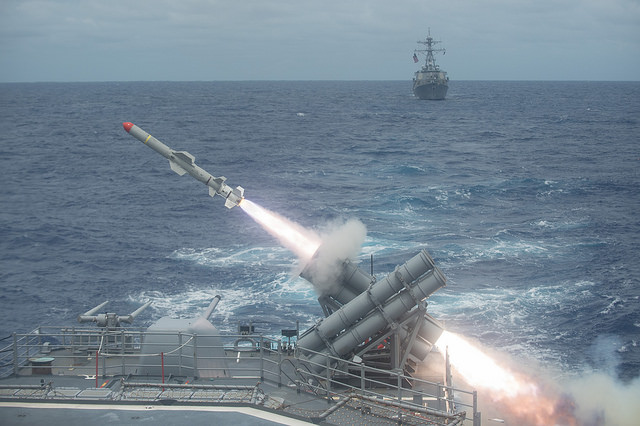
Harpoon anti-ship missile is launched from the Ticonderoga-class guided-missile cruiser USS Shiloh (CG 67) during a live-fire exercise. Shilih is part of Japan-based Carrier Strike Group Five. Taiwan and Japan also posses Harpoon ASMs. Image Credit: CC BY 2.0 Official U.S. Navy Page/Flickr.
An examination of tactical and operational situations encountered by Carrier Strike Groups (CSG) through the Taiwan Strait reveals that adding a hypothetical Chinese carrier group’s presence does not augment existing the People’s Liberation Army Navy (PLAN)’s strategy. Instead PLAN doctrine relies on assets in the form of saturation missile attacks, submarines, fast missile boats and other Chinese A2AD elements. It is worth mentioning that these capabilities were already present in the the Taiwan Strait during the 1995-96 missile crisis.Being close to an enemy’s land-based assets poses a severe risk to the CSG’s survivability. Its combat effectiveness, is significantly diminished in the narrow waters of Taiwan Strait during high intensity combat conditions. In essence, the PLAN already had sufficient capabilities in place in 1996 such that sending a CSG into the Taiwan Strait would be a suicidal endeavor. The situation has only become more challenging for the US Navy in recent years not because the PLAN has acquired an aircraft carrier of its own, but rather due to the fact that China has greatly enhanced and modernized its existing A2AD capabilities.
The common reference to the 1996 deployment of aircraft carriers during the Taiwan Strait Missile Crisis as an indication of what could happen should the situation between China and Taiwan escalate into a shooting war suggests that there are two common misconceptions about the 1995-96 crisis. In late December’s piece for The Diplomat, Vasilis Trigkas presented interesting argument on the presence of aircraft carriers in the Taiwan Strait. In particular, he notes:
Memories from 1996 – when Chinese missile tests in the strait prompted U.S. President Bill Clinton to order two fully armed carrier battle groups to pass through the Taiwan Strait – have shaped the strategic operational codes of the Chinese military and the Central Politburo. While China might have had the military resources to sink U.S. naval forces in its close periphery (quantity has a quality of its own) the strategic escalation that an attack against a U.S. carrier would trigger led Beijing to de-escalate. Since the importance of Taiwan’s reunification with the mainland remains an indispensible argument in the PRC’s rhetoric on the rejuvenation of the Chinese nation, China’s officials have long strategized about how to neutralize U.S. operational superiority in the event of a new strait crisis. The 2008 acquisition of an old Soviet aircraft carrier from Ukraine should be seen as an extension of this goal. This carrier is the missing piece in China’s strategic puzzle in its first island chain and adds new strategic variables to a Sino-U.S. clash over Taiwan.
First, contrary to popular belief, in March 1996 neither of the two deployed CSGs (Carrier Group Seven headed by CVN-68 Nimitz and Carrier Group Five centered around CV-62 Independence) entered Taiwan Strait (p. 110). Nimitz was deployed in the Philippine Sea ready to assist the Independence Battle Group deployed to the east of Taiwan. Indeed, earlier in December 1995 the Nimitz battle group did pass through the Taiwan Strait, but it was several months after Chinese first missile tests close to Taiwan in July 1995. Moreover, US officials back then believed that the passage went unnoticed by Beijing (p. 104).
Second, in 1995 and 1996, the issue at stake was Beijing displeasure with Taiwan’s effort to establish itself as a new democracy, demonstrated by then President Lee’s visit to Cornell University and the island’s first free presidential election in 1996. Beijing did not de-escalate because of the presence of the two CSGs but because it had made its point. However displeased the Chinese leadership was back then, no one has seriously contemplated further escalation. Moreover, China could very well have another motivation, testing the limits of US strategic ambiguity across the strait as they had tested the 1954 Taiwan-US defense alliance during the 1958 Taiwan Strait crisis. In that sense, deployment of two CSGs gave Beijing the indication that the US would indeed intervene should the Chinese Communist Party (CCP) decide to use deadly force against Taiwan.
Thus, the presence of the Nimitz and Independence CSGs in Taiwan’s proximity in 1996 should be understood as a symbolic gesture of the US commitment to the peaceful solution of cross-strait relations. It is doubtful that the acquisition of the Liaoning would deter Washington should it decide to demonstrate its resolve again. With the other assets that the PLA has been busy deploying in a meantime, now, that is all different story.
Trigkas argues that in 1996 the Chinese backed off because targeting US aircraft carriers would escalate the conflict out of proportion. Having an aircraft carrier and deploying it in advance of an intervening USN CSG would push the escalation ball to the US’ corner. Henceforth, it would be the US who would have to take the first shot because the Chinese CSG would block its way. Given that in 1996 the use of force was off the table and the crisis was all about making a political stance without intention to escalate, would a Chinese aircraft carrier prevent future US intervention by making itself too (politically) valuable to be attacked?
Not since World War II has the world seen any significant battle fought between rival carrier groups, and just as the carrier replaced the battleship through asymmetric means (the range of the onboard aircraft negated the firepower, speed and armor of a conventional battleship.), the effective counter to a CSG is unlikely another CSG, but instead a whole range of asymmetrical means such as strikes against its rear-echelon fast combat support ships (AOEs), land-based airpower or submarine warfare. Moreover, one need not send the aircraft carrier to the bottom, resulting in massive loss of lives of those on board, to neutralize the combat effectiveness of a CSG.
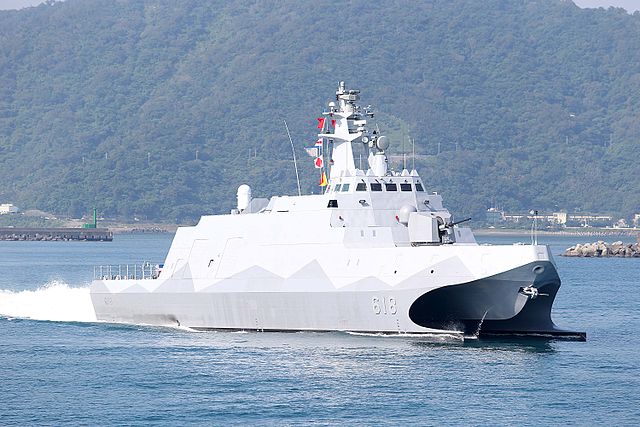
Tuo Jiang class missile corvette deployed by Taiwan could become major threat for PLAN’s aircraft carriers. Image Credit: CC BY-SA 4.0 Larry41028/Wikimedia Commons.
Even if Chinese aircraft carriers were to become targets of the USN’s CSG, it would still be an unequal encounter for the PLAN, facing much more experienced USN CSGs with superior sortie rate and integrated defense. In such an encounter, the US Navy could inflict sufficient damage to incapacitate a Chinese aircraft carrier without actually sinking it. The best way to render an aircraft carrier useless is to limit the effectiveness of its air wing. Liaoning’s air wing is in this respect very modest totaling 30 J-15s fighter jets with compromised range, endurance and armament resulting from a lack of catapult launch systems. This number will most likely be higher for Liaoning’s successors, but the sortie generation rate accumulated through operational experience will take a lot longer to equalize. In comparison, Nimitz and Ford-class supercarriers typically carry 70-80 fixed wing aircraft and helicopters and their designs are much more flexible to accommodate various mission requirements.
Furthermore, the employment of a CSG in an open confrontation would run contrary to the tactics and culture consistently displayed by a sea-denial mindset influenced by the tradition of people’s war that informs so much of the CCP’s naval strategy (p. 37), prominently displayed during the Battle of Dongshan on 6 Aug 1965, where 11 PLAN torpedo boats and 4 patrol boats sunk 2 Taiwanese capital ships in 3 consecutive waves, resulting in 171 missing and 31 deaths, including the commander of the ROCN Second Fleet. The PLAN’s efforts towards becoming a Blue-Water Navy have undoubtedly changed its tactical mindset, but even then deployment of a Chinese aircraft carrier against Taiwan (and presumably against the USN) does not offer advantages that would outweigh the potential costs. If deployed outside of the A2AD protective cover, a Chinese CSG would be too weak to counter its US counterpart, and when deployed within A2AD cover, its capabilities are largely redundant.
Moreover, while the debate focuses on the political significance of sinking a US aircraft carrier, Beijing itself could ill-afford the political consequences of its CSG rendered impotent during combat in or close to the Taiwan Strait where potential adversaries such as Taiwan’s recently introduced Tuo Jiang class missile corvette could fully exploit its weaknesses. Indeed, should China deploy its CSG near Taiwan as a part of combat operations, USN would not need to fire a single shot and China’s capital ship could still end-up incapacitated or sunk. Taiwan’s sea and land-based anti-ship missiles represent a reverse A2AD significant challenge for China.
Hence it is reasonable to conclude that the Chinese acquisition of the Liaoning and the further expansion of the Chinese aircraft carrier fleet, while significant, has very little direct impact on a potential crisis deployment in the Taiwan Strait. Instead one should look toward the prestige factor of presenting itself as a Blue Water Navy and a CSG’s value in prosecuting the territorial ambitions displayed by the Chinese government in recent times, e.g. in the South China Sea or the Diaoyutai/Senkaku Islands, where Chinese land-based airpower does not enjoy the same advantage as in the case of Taiwan-related contingency.
In a potential crisis across the Taiwan Strait, the PLAN’s goal would be better served through a deterrence formed by a combination of guided missiles destroyer-led surface action groups, land-based airpower utilizing supersonic ASMs coupled with over the horizon (OTH) targeting, and high-end attack submarines rivaling the low noise level of even US Seawolf-class SSNs. All of this could successfully prevent US reinforcements from accessing littoral regions of the theater (A2) and impede their movement along the First Island Chain (AD).
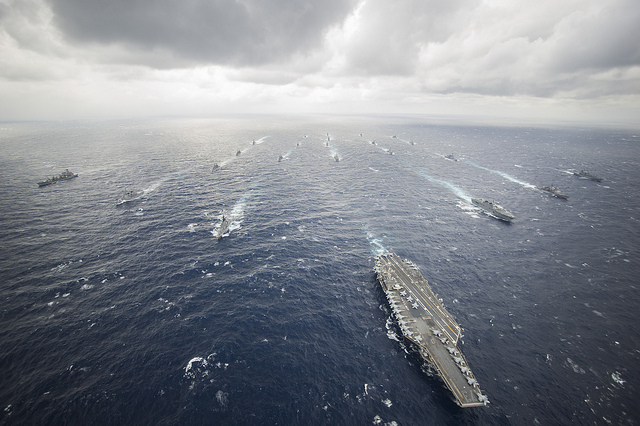
The aircraft carrier USS George Washington (CVN 73), center-right, leads the George Washington Carrier Strike Group and Japan Maritime Self-Defense Force ships in tactical maneuver training during Annual Exercise (AnnualEx) 13. Image Credit: CC BY 2.0 Official U.S. Navy Page/Flickr.
Aircraft carriers will maintain its role as a blue water force projector in the foreseeable future. Indeed, they are indispensable for a global sea-control navy tasked with missions to protect sea lines of communication. But the carrier battle groups were never meant to physically present itself in an environment similar to the Taiwan Strait. Granted, ASMs and submarines are problem on the open seas too but any potential opponents would be limited by the storage capacity of their onboard ordnance, with PLAN having limited ability of underway replenishment. In other words, open sea offers no advantage of a compressed engagement battlespace that littoral contestant such as China possesses against the limited range of present day CSG, bearing in mind that as China’s A2AD capabilities make it difficult for US Navy CSGs, PLAN’s own aircraft carrier faces the very same risk from the its neighbors, Taiwan included.
Michal Thim is a Ph.D. candidate in the Taiwan Studies Program at the China Policy Institute (CPI), University of Nottingham, a member of The Center for International Maritime Security, an Asia-Pacific Desk Contributing Analyst for Wikistrat and a Research Fellow at the Prague-based think-tank Association for International Affairs. Michal tweets @michalthim.
Liao Yen-Fan is Taipei-based defense analyst specializing in airpower and Taiwanese military. He can be reached for comment at charlie_1701@msn.com.

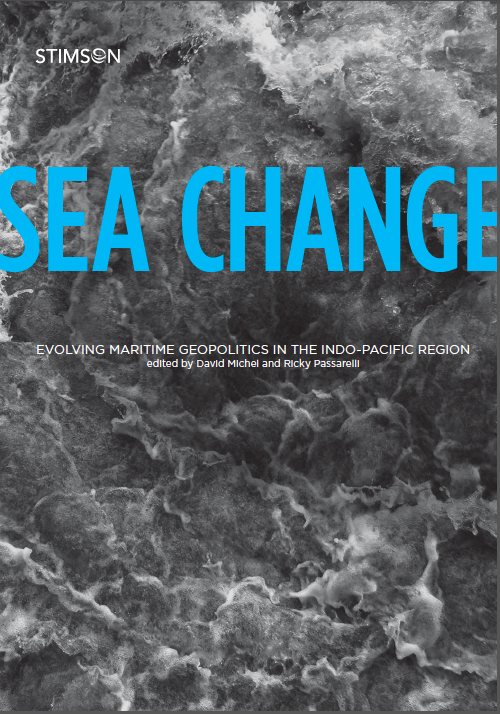 The Indo-Pacific region is rapidly emerging as a key focus of maritime geopolitics. In June last year, the Stimson Center and the Observer Research Foundation co-hosted a three-day conference titled Sea Change: Evolving Maritime Geopolitics in the Indo-Pacific Region. Two CIMSECians were invited to speak at the event; Scott Cheney Peters presented a paper on U.S. security relationships in the region and Nilanthi Samaranayake presented on the strategic importance of island states in a region of great powers. A copy of the publication can be accessed through the Stimson Center’s website.