Tag Archives: Strategy

American Strategy in the 21st Century: Maritime Power and China – Part I

Introduction
American strategic thought should center on war with China, a near-peer competitor who aims to expel U.S. military power from the Western Pacific in order to achieve regional hegemony.[1] U.S. leaders need strategic options on how best to engage, deter and ultimately defeat China. The geography of the region demands a maritime focus, and as policy makers have decided to “pivot” to Asia, it is incumbent on them to decide how best to posture American power. Maritime power will be the deciding factor in this conflict.
This is not to say that a conflict with China is inevitable or desired. Yet the responsibility of policy makers, military planners and national security experts is to consider and plan accordingly for conflict. Not assuming that war will come will mean the fight will be longer, harder and more costly – and more in doubt.

In the last half of the 20th Century, American maritime power was the centerpiece in a policy of containment against Communism. The collapse of the Soviet Union left the U.S. Navy as the uncontested power on the world’s oceans. [2] Power projection and unrestricted use of the sea lanes enabled the U.S. to fight two sustained land wars for more than ten years. Our pivot toward Asia, demands we build our future maritime power capabilities and platforms around our strategy.

War with China must be an immediate concern. The stage is already set for America to be drawn into conflict now, while she is underprepared. Consider the following scenario:

Late 2014
The conclusion of the 18th Chinese Party Congress in November 2012 did not soothe growing ethnic and economic tensions in China.[3] A stalled world economic recovery reduced demand for Chinese-made goods, creating an unemployment crisis in a country where employment is “guaranteed.” Ethnic tensions spilled over in many western and rural provinces and the state security and People’s Liberation Army (PLA) wavered between accommodating and cracking down. Sensing the Communist Party was losing its “Mandate from Heaven”,[4] it initiated a series of territorial disputes with Asian neighbors in the hopes of spurring nationalism. In late 2014, PRC law enforcement vessels of the China Marine Surveillance (CMS) agency placed water barriers around Scarborough Reef, a disputed shoal claimed by the Philippines and the PRC. An amphibious craft over the horizon with prefabricated construction materials set up a small “Maritime Surveillance Outpost” on pylons manned by marines and “fishery law enforcement” officers. Lacking a meaningful navy, and the stomach to fight, the Philippine government filed protests at the United Nations (UN) and the Association of Southeast Asian Nations (ASEAN). The U.S. ignored quiet feelers put out by the Philippine government about military support for a response, and the PRC noted the lack of a forceful U.S. reaction to the aid their treaty ally.
After a brief “high” from their triumph, the economic situation continued to worsen through 2015. The Communist leadership looked closer to home for another diversion. In the East China Sea, just north of Taiwan, the PRC and Japan were locked in a territorial dispute over the Japanese-administered Senkaku Islands. Noting the lack of support Washington gave the Philippines, China waited until the carrier USS George Washington was back in its home port of Yokosuka, Japan undergoing regular maintenance. With the absence of a transiting carrier strike group, hundreds of fishing boats loaded with PLA Navy [PLA(N)] marines come ashore and hastily build a “Maritime Surveillance Outpost” on two of the larger islands. The few Japanese Coast Guard ships could not prevent the landing and soon the islands were occupied with marines and light artillery. Tokyo showed more resolve, and vowed to retake the “home territory.” To the surprise of the American leadership, Japan invoked the mutual defense treaty with the United States, and America’s political leadership faced its worst nightmare: a conflict with China.[5]
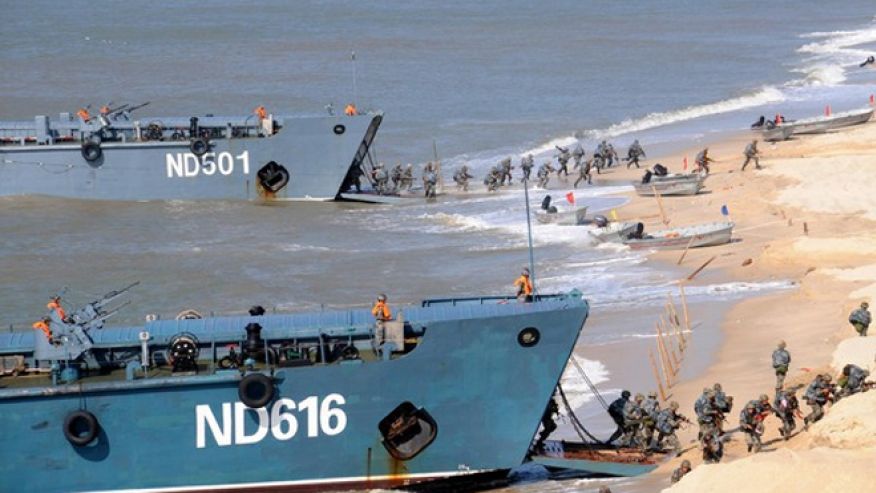
Chinese marine forces practice a beach assault during the Mission Action 2013 exercise.


Strategy and Maritime Power
We begin by making a series of assumptions. First, the policy of the United States is to remain the preeminent world power. Relative decline need not be indicative of retreat from global leadership; America will continue to oppose usurpation by one or more powers whose interests do not largely coincide with our own. A multi-polar world is more dangerous, not less.

Second, America will seek to maintain a qualitative military edge over peer competitors, enabling it to be capable of protecting national security interests worldwide. Finally, American policy will seek to ensure continued global economic integration and will fund a military large and capable enough to secure the global commons.
In order to meet these assumptions, U.S. strategy must navigate a series of challenges in North Africa, the Middle East and Iran, North Korea, Russia and China. All of these are potential flashpoints of military conflict that could escalate, but only one – China – has the ability to fundamentally alter America’s position in the world and take her place as the preeminent power. The ability of America to respond hinges on maritime power.

The nature of American maritime power has evolved over time, as outlined in 1954 by Samuel Huntington. During the Continental Phase, from the founding to 1890, the Navy played a subordinate role, primarily responsible for coastal defense, protecting American commerce and during the Mexican-American and Civil Wars, performing blockading functions and amphibious operations. Beginning in 1890 through the end of World War II, the Oceanic Phase, the United States began to project its power and interests overseas. Maritime policy and thinking was largely influenced by Alfred Thayer Mahan. He argued that the “true mission of the navy was acquiring command of the sea through the destruction of the enemy fleet.” To secure command of the sea, the nation required a stronger battle fleet. This doctrine was largely accepted by the Great Powers, including Japan.[6]

The third phase, the Transoceanic Phase, has seen maritime power orient away from the open ocean and toward the littorals. Even Admiral Nimitz would note that the reduction of enemy targets on land “is the basic objective of warfare,” not the destruction of the enemy fleet. The purpose of maritime power since the end of World War II is to “utilize command of the sea to achieve supremacy on the land.” In a sense, Mahan has been replaced by Sir Julian Corbett.[7]

Maritime power has distinct advantages for policy makers. It is the most politically viable option to posture military forces and respond to challenges without the need for a large land presence. Foreign powers, coalition partners and allies(and the local populations) prefer regular port visits, exercises and training engagements than the permanent stationing of troops. The American public has also cooled to the idea of large battalions stationed overseas. As the public has also grown more casualty-averse, policy makers need more time to prepare the public for the eventual introduction of land forces and the potentially large number of casualties. The nature of a maritime conflict – slow to escalate – provides the political leadership the most critical of elements in any conflict: time.
Maritime power should not be confused as “Navy-only,” or even “Navy-Air Force-only.” Land forces play a critical role. As Rear Admiral J.C. Wylie[8] noted, “The ultimate determinant in war is the man on the scene with the gun…This is the soldier.” Land operations are critical in a conflict where the littorals play a central role. The hypothetical scenario above is an example.

Space and cyberspace are newer elements of maritime power. Modern navigation, intelligence gathering and communication, including the Internet, rely on satellite technology and architecture. In the mid to late 1990s, the U.S. military began reconfiguring itself for network-centric operations, linking combat platforms and intelligence surveillance reconnaissance (ISR) assets. At sea, this is critical to Maritime Domain Awareness (MDA). The backbone of a networked military is the satellite and cyberspace architecture and is vital to joint operations.

The Dual Nature of War
Before considering conflict with China, we have to consider the nature of war itself. War is dichotomous, being fought principally on land, or with both land and maritime elements.[9] John Arquilla[10] identified that in land wars, skill was the primary factor which determined victory or defeat, while in wars involving land-sea powers, maritime power was the determining factor.

Land powers which initiate wars with land-sea powers tend to lose, often because they inflate their own naval capabilities and lack the requisite experience in naval operations. 16th Century France and 19th-20th Century Germany are two examples. Both were continental powers that began a program of naval expansion with the intent to challenge the British at sea and reach a position of dominance. Both entered conflicts with Britain, only to find that their newly expanded navies did not perform as expected. Their naval bureaucracies retreated from the offensive doctrines in order to protect their new – and very expensive – fleets. Once hostilities commenced, they turned from offensive operations to a guerre de course (commerce raiding), a defensive naval strategy. However, their peacetime advocacy of an offensive naval doctrine made conflict more likely, not less.[11]

About the Author
LT Robert “Jake” Bebber USN is an information warfare officer assigned to the staff of the United States Cyber Command. He holds a Ph.D. in Public Policy from the University of Central Florida. The views expressed here do not represent those of the Department of Defense, Department of the Navy or the U.S. Cyber Command. He welcomes your comments at jbebber@gmail.com.

Sources

[1] For a more thorough view, see John J. Mearsheimer’s article “Can China Rise Peacefully?” at The National Interest, April 8, 2014, available at: http://nationalinterest.org/commentary/can-china-rise-peacefully-10204.

[2] Peter M. Swartz, Center for Naval Analysis, personal communication, November 8, 2012.

[3] For example, see “China’s Achilles Heel” in The Economist, April 21, 2012: http://www.economist.com/node/21553056 ; “Unrest in China – A dangerous year” also in The Economist, January 28, 2012: http://www.economist.com/node/21543477. Also, see “Uighurs and China’s Xinjiang Region” in Council on Foreign Relations, May 29, 2012: http://www.cfr.org/china/uighurs-chinas-xinjiang-region/p16870.

[4] For more on the concept of the “mandate of heaven,” see Perry, E. J. “Challenging the mandate of heaven: popular protests in modern China.” Critical Asian Studies 33, no. 2 (2001): 163-180.

[5] See “Treaty with Japan covers islets in China spat: U.S. official” (Reuters) September 20, 2012, available at http://www.reuters.com/article/2012/09/20/us-china-japan-usa-idUSBRE88J1HJ20120920

[6] Huntington, Samuel P. “National Policy and the Transoceanic Navy. Proceedings 80 no. 5 (1954).

[7] Ibid.

[8] Wylie, J.C. Military Strategy: A General Theory of Power Control. Annapolis: Naval Institute Press, 1967. Pg. 72.

[9] Air power is a major component of both land and land-sea war and hence, is not treated separately.

[10] Arquilla, John. Dubious Battles: Agression, Defeat and the International System. Washington, DC: Crane Russak, 1992. Pg. 131.

[11] Ibid. pp. 99-129

The Future of Maritime Security Studies

As part of the Fourth Global International Studies Conference held in Frankfurt (Germany) 6-9 August 2014, a series of panels was organized on Maritime Securityscapes. One of the events was a roundtable on the future of the emerging, informal subdiscipline “Maritime Security Studies”, a rapidly growing field of analysis and research. The participants were asked to provide their comments along four broad questions. The following is one participant’s input to provide food for thought and a better understanding of maritime security as an academic field of interest and study. 

WISC Header

Frankfurt, site of the 4th WISC Global International Studies Conference (source: wikipedia).

What are the most pressing and important questions that Maritime Security Studies (MSS) need to answer?

There are four immediate aspects to this, two of which are more inward-looking and two of which are more outward-directed. First, students of maritime security must better utilize the momentum of conditions that are in favor of the thrust of the field (e.g., the littoralization of security, the maritime [and indeed naval] dimensions of climate change, the hypothesis of the increasing utility of naval forces in future conflict scenarios, the recent publication of a cross-sectoral European Maritime Security Strategy, etc.). Second, maritime security scholars must consider, and learn to mitigate, condisations that are seemingly at odds with the thrust of the field (e.g., current land-centric conflicts, continental geopolitical and strategic thinking in policy-making circles, etc.).

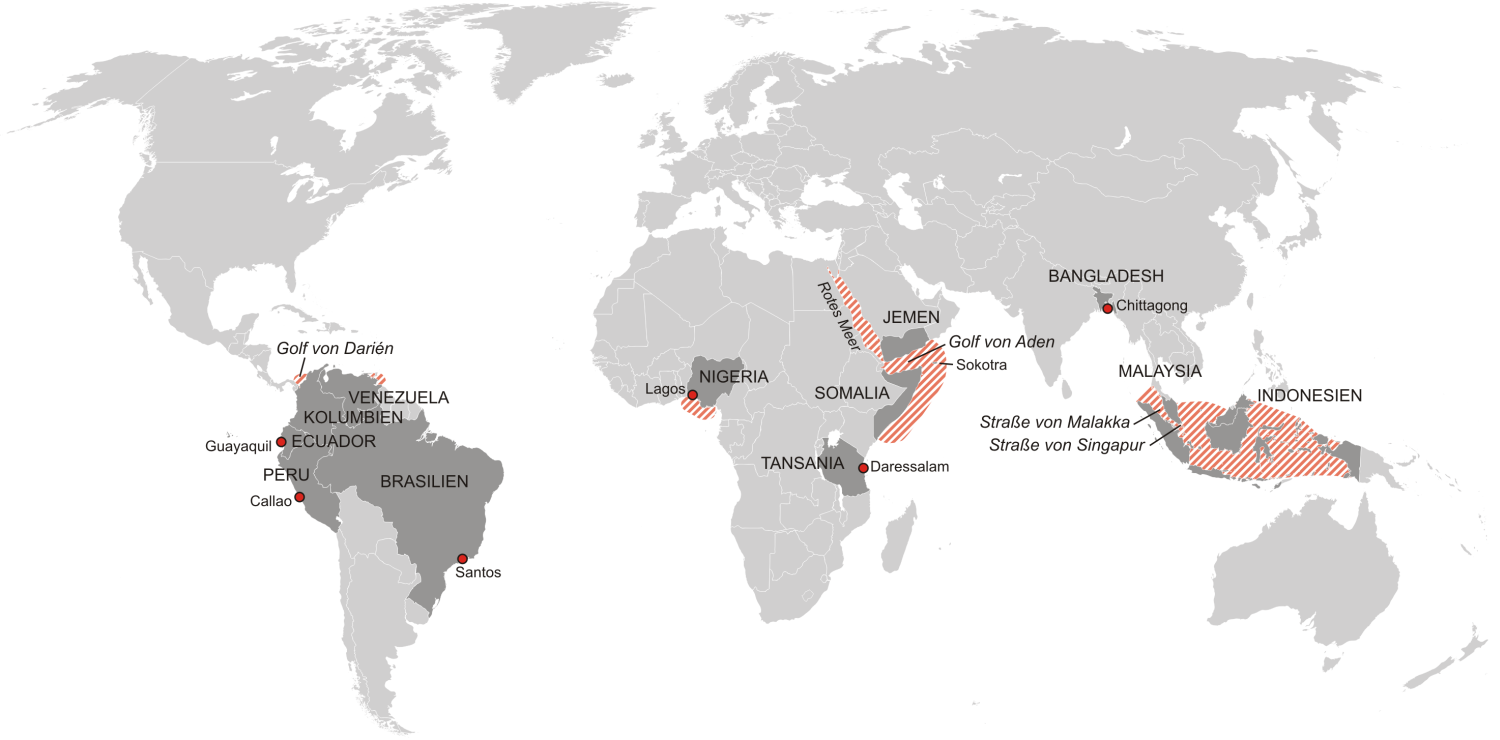
Third, there must be a consistent evaluation of the contemporary relevance of maritime security, especially in light of what will come after “anti-piracy”. The naval operations off the Horn of Africa have locked the theme of security at and from the sea in the minds of many policy-makers and analysts to the degree that maritime security is often seen as exclusively about counter-piracy. Naturally, this self-imposed limitation is neither desirable nor practical. Here, it is especially the strategic-minded researchers that have an obligation to make decision-makers aware of the broad security dimensions of the maritime sphere. While they cannot prevent the career of certain terms, they should at least attempt to manage it properly. Fourth, maritime security students must consider how policy-makers can be convinced that investments in maritime security capabilities and capacities at home and aboard is beneficial. This relates to the challenge of doing critical and pragmatic studies: traditional security studies are increasingly dominated and even overpowered by constructivist approaches. 

Piracy areas worldwide.

What issues should be prioritized? What are the top priorities?

As with many fields of study, the top three priorities are funding, funding, and funding. Beyond stating this obvious desire, there appears to be the need to sharpen arguments and understanding of the subject matter “Maritime Security”. For example, in Germany, “maritime security” (“maritime Sicherheit”) has become an all-encompassing term, meaing all kinds of things to all kinds of people. From a naval perspective, “maritime security” usually means just one set of missions among many others (for the U.S. Navy as laid out in the most recent U.S. Navy strategy “A Cooperative Strategy for 21st Century Seapower” from 2007; for the German Navy by default, i.e. the operational experience in counter-terrorism and anti-piracy operations since 2002/2008).

Disciples of the emerging field of study should also not forget to look at the field from a commercial and naval perspective. The defense industry, after all, is increasingly looking at littoral security and the emerging maritime safety and security missions, fishery surveillance, counter-piracy, drug interdiction, environmental protection, humanitarian aid, and SAR. Commercial shipping companies are increasingly looking at security in the littoral areas, the ports, and the choke point regions. This offers critical and pragmatic scholars an excellent starting point to link their academic work and insight with influence on actual events and developments.

Scholars should also consider to revive and revitalize the concepts of seapower/sea power in their institutional, function, and geographic dimensions (as British naval strategy dean Geoff Till reminded us once, sea power is something that certain states, or seapowers, have). In addition, it behooves to freshen up on the three uses of the sea for navies (developed by Ken Booth in 1977 and Eric Grove in 1990): diplomatic, constabulary, and military.

Boundaries are a necessary evil.
Boundaries are a necessary evil, but they help to frame our analytical approaches. 

What are the convergences between academic and policy needs in maritime security? Are there shared gaps and how could these be addressed?

The effects of sea power and the policies that make and shape it must ultimately be felt ashore. The same goes for maritime security studies; there are inherent limits to bemoaning “sea blindness” again and again. Policy and maritime security studies both need a better understanding and appreciation of the value and virtue of naval power, and the opportunities of naval forces (presence, flexibility, versatiltiy, modularity, speed, crisis response, etc.). To that end, Maritime Security Studies disciples must learn to embrace navies (even if it means learning some dreaded military lingo and going to acronym hell and back). Navies, in turn, should learn to reach out to the academia and ask hard questions and demand sustainable answers and solutions. Whereas many navies are more about operations than about strategy, and policy-makers often confront a whole host of demands and pressures that keep them from thinking (and acting) strategically, the ultimate goal must be a closer linkage between naval officers, policy-makers, and maritime security students. Those in every field that reach out to the other two players must be identified, and the relationship could even be deepend by way of reserve duty in a navy for civilians and academic fellowships for naval officers).

The secret fantasy of the Maritime Security Studies analyst.

How can the new maritime security studies be strengthened? What institutions will we need to undertake research collaboratively?

From a German perspective, there isn’t a single definitive center of gravity for maritime security (especially strategic) intellecutal thought, although there are a number of institutions that could collaboratively engage in maritime security studies (such as the Future Ocean cluster in Kiel, the Institute for Peace Research and Security Policy in Hamburg, and the University of the German Armed Forces).  Maritime Security Studies can only be strengthened in a comprehensive manner. Geramns love the comprehensive approach but too often quickly turn a blind eye toward the indispensable military component of that approach. This requires a mapping of institutions and actors who are into the subject. The Institute for Security Policy in Kiel, with its demonstrated experience in third-party research projects and maritime security and naval strategy expertise (one PhD completed in 2009, one to be completed this year, three more due between 2015 and 2018) would be another natural player. Last, but certainly not least, the Center for International Maritime Security itself could play a role.

Analyze this!
Analyze this!

What are plausible next steps for Maritime Security Studies?

There should be a drive for greater institutionalization of the field through dedicated conferences, journals, university chairs, summer schools (one such event was recently organized in Greece), M.A. and PhD courses, etc. There could be a biennial maritime security studies conference – not unlike the McMullen Naval History Symposium in Annapolis, MD – that brings together experts and students from different fields (e.g., naval strategy, recent naval history, etc.). The subject at hand is interesting and exciting enough to explore more dimensions and collaboratively engage in visits on ships, war games and simulations, etc.). In the end, the goal must be to move from maritime case studies such as the dominating anti-piracy operations to the larger trends.

Sebastian Bruns is a Research Fellow at the University of Kiel’s Institute for Political Science/Institute for Security Policy. He holds an M.A. in North American Studies (U of Bonn 2007). The views he presented in Frankfurt and here are his own.

Developing a Strategic Cadre in the Information Dominance Corps

“The EM-cyber environment is now so fundamental to military operations and so critical to our national interests that we must start treating it as a warfighting domain on par with – or perhaps even more important than – land, sea, air, and space.”

-Admiral Jonathan W. Greenert
Chief of Naval Operations
Proceedings Magazine, December 2012 (Vol 138/12)

EM War

The U.S. Navy has embraced the electromagnetic (EM)-cyber domain as a core warfighting domain, combining critical Navy communities in Information Warfare, Intelligence, Information Professional, Meteorology, Oceanography and Space Operations into an “Information Dominance” Corps. A series of policy statements and guiding documents have been recently published governing how the Navy will approach this domain, including the Information Dominance Roadmap (2013-2028), the Navy Information Dominance Corps Human Capital Strategy (2012-2017), and the Navy Strategy for Achieving Information Dominance (2013-2017). [1] These have been followed by the CNO’s Navigation Plan (2015-2019)  [2], which identifies combat maneuver capabilities in the EM-cyber domain as critical to the operating tenants of warfighting first, forward operating and readiness.

These all represent important steps in addressing the critical challenges we face globally as a Navy, especially from state and non-state actors who can complicate the ability of naval forces to move into a theater (anti-access) and maneuver within the theater (area-denial). We no longer occupy the “information high ground” in the EM-cyber domain, and our most advanced forces and weapons systems are held at risk not only by technologically advanced anti-ship missiles but also by inexpensive and readily available A2/AD strategies.

What is missing, however, from this plan of action is the development of a “strategic cadre” within the Information Dominance Corps, who can meet the CNO’s vision. The Human Capital Strategy identifies as its fourth goal “Create a Warfighting Culture,” which is certainly admirable and necessary. This goal is supported by two objectives: orient the “total Navy workforce to the IDC mission” and “leverage kill chain concepts (integrated fires) to depict and communicate the process through which the ID discipline contributes to the delivery of warfighting effects.” This implies an ID corps which is tactically proficient and the need for the Navy to recognize how it fits within warfighting. But it seems to skirt too close to suggesting the ID corps – and EM-cyber – enables the delivery of warfighting effects rather than delivering those effects itself. Weaponized cyber code is no different than a Tomahawk fired from a ship or submarine or a JDAM dropped from an F/A-18.

But to truly develop a warfighting culture, the IDC must have a strategic cadre within its community that develops tactics, operational concepts and strategies that blend kinetic and non-kinetic effects meeting combatant commander objectives. Surface warfare officers learn first how to “fight the ship,” and later how to “fight the Fleet.” The Information Dominance corps must learn to do the same.

maori-warriors
To become a strategic thinker, one must practice the art of strategy. Traditionally, this does not become a focus in the Navy until the more senior officer and enlisted ranks. Recently, I had the opportunity to discuss the state of Navy strategic thinking with other junior officers in the unrestricted line and land warfare communities. These brilliant young Navy and Marine Corps officers made a number of key points that apply as much to the nascent Information Dominance Corps as they do to traditional Navy warfighting domains:

• We are a Navy that emphasizes training over education. Training teaches you to fight the expected fight, but education teaches you to fight the unexpected fight.

• Administrative competency cannot replace the Clausewitzian “Genius for War” – the coup d’oeil that embodies the natural strategist. Mastering the endless checklists and standard operating procedures, while necessary, are the beginning of the journey to strategic thinking, not the culmination.

• We cannot “surge” strategic literacy, or even operational level thinking. If the talent is not there beforehand, it will not be there when we need it.

The Information Dominance Corps must take these lessons to heart and incorporate the development of a strategic cadre within the IDC. Currently the IDC emphasizes the technical skills and systems understanding to perform the individual tasks necessary to meet mission requirements. We must go a step further, cultivating the knowledge to not only operate the equipment but understand how to employ it to attack critical adversary vulnerabilities as part of the Joint Force.

Some items for consideration might be:

• Development of an Advanced Maritime EM-Cyber Operations Course, designed for junior officers who have completed their first tactical operations tour. By this point in his/her career, the young officer has qualified in their respective designator, qualified as an Information Dominance Warfare Officer and completed a forward, tactical operations tour (PCS Afloat, Direct Support, etc.). This course should provide the JO with an advanced understanding of the electromagnetic environment and how use it in various tactical and operational situations in wartime scenarios. The emphasis here, however, it not on the technical or scientific knowledge, but the employment of EM-cyber weapons during conflict. This perhaps could be the EM-cyber equivalent of a “Top Gun” school.

• Integration of EM-cyber warfare as a core component of Joint Professional Military Education (JPME) Phase I and the Naval War College / Naval Post-Graduate School programs.

• The Navy is considering the establishment of a formal Naval Strategic Enterprise to develop a cadre of naval strategic thinkers. At present, this program is only open to unrestricted line officers. Members of the Information Dominance Corps still remain restricted line officers and are ineligible to participate. The Navy Strategic Enterprise should be opened up to members of the IDC.

• Traditionally under the Composite Warfare Concept, the role Information Warfare Commander has been filled by an individual ship commanding officer. [3] This role should be redefined with an IDC officer principally assuming the IWC role.

To fully adopt a warfighting culture and treat the EM-cyber environment as a warfighting domain equivalent to, or more important than land, sea, air and space, the Information Dominance Corps must do more than develop tactical expertise in the use of specialized equipment. It must cultivate a new crop of strategic thinkers who are experts in the creative exploitation of the electromagnetic environment and blending of kinetic and non-kinetic fires to achieve warfighting effects. These new strategists must be grounded both in traditional military theory and history as well as the emerging operational concepts of fighting across the entire EM spectrum, in space and in cyberspace. Without strategic thinking, information dominance becomes impossible.

Author

LT Robert “Jake” Bebber USN is an Information Warfare officer assigned to the staff of Commander, U.S. Cyber Command. He holds a Ph.D. in Public Policy from the University of Central Florida. He is supported by his wife Dana and their son, Vincent. The views expressed here do not represent those of the U.S. Navy, U.S. Cyber Command or the Department of Defense. He welcomes your comments at jbebber@gmail.com.

References

[1] All of these documents are available at: http://www.idcsync.org/documents.

[1] http://www.navy.mil/submit/display.asp?story_id=82851

[1] The Free Library. S.v. Developing a new model for maritime tactical information dominance..” Retrieved Aug 23 2014 from http://www.thefreelibrary.com/Developing+a+new+model+for+maritime+tactical+information+dominance.-a0273903363

Learning Curve: Iranian Asymmetrical Warfare and Millennium Challenge 2002

By Brett Davis

Tension between U.S. and Iranian military assets in the Arabian Gulf are nothing new. Confrontations between Iranian Revolutionary Guard Corps Navy (IRGCN), the Islamic Republic of Iran Navy (IRIN) and U.S. Navy vessels in the Gulf, the Strait of Hormuz, and the Gulf of Oman are a regular occurrence for forward-deployed ships. Iran knows it cannot match the U.S. in a conventional confrontation, and focuses on an asymmetrical style of warfare to increase damage and costs of confrontation to the U.S.

In 2002, a joint war game exercise, known as Millennium Challenge 2002 (MC02), took place to gauge readiness in the event of a conflict with a hostile Middle Eastern nation. The results were disastrous for the U.S., with over a dozen ships destroyed and thousands killed or wounded as a result of asymmetric and unconventional naval warfare. 14 years later, Iranian asymmetrical warfare can still have a devastating effect on U.S. and allied forces in the Middle East. Unconventional warfare has been the Achilles Heel of the U.S. military for decades, and more gaming and training are needed to enhance U.S. capabilities in an asymmetric environment.

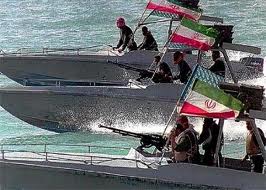
Just a relaxing day sailing the Persian Gulf.

A Combination of Threats

Following their lackluster performance during Operation Praying Mantis, in which the U.S. Navy laid waste to several conventional naval vessels, Iran began to focus on asymmetrical warfare. Tactics include Fast Inshore Attack Craft (FIAC), covert civilian craft, naval mines, and submarines.

The IRGCN utilizes swarming tactics as its method of choice. IRGCN bases are situated in various locations along Iran’s Gulf coast, from the Strait of Hormuz to the Northern Arabian Gulf. This is a key tenet in swarming attacks: packs of small attack craft covertly leave their bases at various times, all heading for the same target, i.e. a Carrier strike group operating in the Gulf. While this dispersed tactic may result in a weaker attack that is easier to repel, it is also much more difficult to detect, as the swarms don’t operate in a large formation. Also, craft equipped with torpedoes and anti-ship missiles can fire their payloads at a greater distance, ensuring survivability and destruction of their target.

Iran currently has the fourth-largest inventory of naval mines, as well as various platforms for deployment. Mines are a successful tool in the Gulf: USS Tripoli and USS Princeton struck Iraqi mines in the Northern Gulf during the Gulf War, and USS Samuel B. Roberts struck an Iranian-laid mine during the Tanker Wars of the 1980s. Iranian mines also dispatched large numbers of civilian merchant vessels in the same time period.

Iranian mines are largely cheap and unsophisticated. However, some Chinese and Russian variants, including the EM-52 multiple influence mine, are much more sophisticated and can be used in waters up to 600 feet – plenty deep to make the Central Gulf a dangerous place.

A majority of bottom-dwelling mines are designed for shallower waters. In some places, depths in the Strait of Hormuz are between 150-300 feet and are prime locations for these types of mines.

While the mines may not be sophisticated, deployment tactics are much harder to detect. IRGCN small craft are capable of laying mines, as are dhows, fishing boats and submarines. These platforms can carry up to 6 mines each and can be resupplied at sea. Mine laying platforms disguised as civilian craft would not raise suspicion on the part of Coalition forces while submarines can be quite difficult to detect by surface or air assets.

Iran operates several different types of submarines, all of the diesel variety. The Kilo-class are Soviet surplus that are nearing the end of their service life, but still require respect, especially in an asymmetrical warfare environment. Kilos can carry several dozen mines, laying them covertly beneath the waves and avoiding the overt detection by surface assets that endanger the mission of mine laying dhows and small boats. Kilos would also require an increase in anti-submarine warfare (ASW) platforms in theater for sub identification and prosecution, such as submarines and air and surface assets. They would also increase the standoff distance of high-value assets such as carriers and troop landing ships. These platforms would most likely not venture too close to a known hostile submarine operating area with few defensive weapons.

Iran’s mini-subs are another part of the undersea warfare threat worth considering. There are at least three separate classes of mini-sub in the Iranian inventory, all diesel operated. Their small size makes them difficult to detect, and their ability to operate in shallow waters makes them a perfect tool to target vessels in the littorals, such as amphibious assault ships and patrol craft, and any convoy of warships or shipping making its way through the Strait of Hormuz. They can also participate in mine laying operations  in shallower seas as a support asset.

Millennium Challenge 2002

MC02 was framed as a Red vs. Blue game depicting the invasion of a smaller Middle Eastern nation by a much larger and more capable adversary. It was the largest war game ever devised; 13,000 troops, aircraft and warships spread throughout the world, at a cost of $250 million. While it looked much like the upcoming invasion of Iraq, the tactics employed by Red closely resembled the nonlinear and asymmetric tactics of the IRGCN.

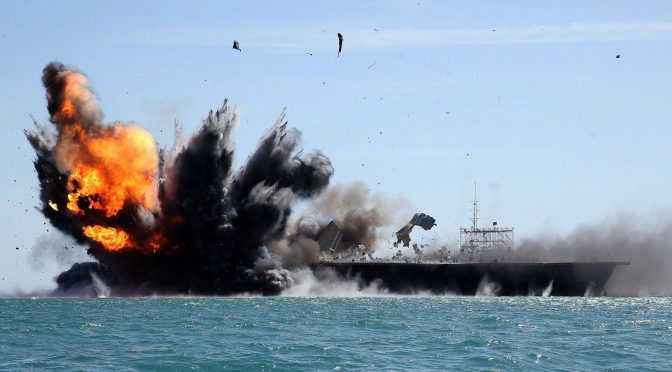
The Red forces, led by Marine Lieutenant General Paul van Riper, utilized several unorthodox measures and tactics to exploit the weaknesses of the Blue forces. When electronic warfare aircraft fried Red team communications sensors, van Riper used coded messages voiced from the minarets of Mosques at prayer times. This signaled the armada of civilian boats and light aircraft underway in the Persian Gulf to take action, conducting swarm and suicide attacks on U.S. warships and firing Silkworm missiles at high-value assets, claiming two amphibious assault ships and an aircraft carrier. At the conclusion of the attacks, 16 ships were sunk and thousands of servicemen were dead or wounded. Instead of digesting the results and using them to refine tactics and strategies in the face of a nonlinear threat, MC02’s controllers simply reset the problem – ensuring a Blue victory and “gaming” the most expensive and important war game in modern history.

Was anything learned from the surprise ending of MC02? It appears not. Iran’s tactics are nothing new; they have been using asymmetric warfare since the Iran-Iraq war. Iran’s weak Navy isn’t a new development either; most ships are decades old with few modern capabilities. What Iran does have, however, is a military strategy with a basis in unconventional warfare. Asymmetric tactics, like those described above, coupled with a decentralized command and control structure and semi-autonomous unit commanders make Iran survivable in the event of a first strike.

Unfortunately, the U.S. thinks of nations with weak conventional militaries as no match for the technological and modern behemoth that is the U.S. military. This was evident in Iraq and Afghanistan, where insurgents with little resources utilized out-of-the box thinking and nonlinear tactics to inflict heavy damage on U.S. forces, culminating in eventual retreats. U.S. strategy rests on technological and conventional dominance as well as engaging in non-traditional conflicts using traditional strategy and doctrine.

While Iran’s bluster regarding its eventual destruction of the U.S. fleet shouldn’t be entertained, the threat posed by Iran should be. Nonlinear and suicide attacks from the sea, increasingly capable long-range anti-ship missiles able to reach any vessel in the Gulf, and unconventional communications and command tactics are nothing to brush off. More exercises like MC02 are needed to adequately gauge the readiness of the U.S.’s land, sea and air forces to any asymmetric conflict with Iran. Where there are tactical and strategic gaps, a shift in training is required to prepare our forces for this type of conflict. A Blue defeat in a war game isn’t an embarrassment; it’s a chance to lean forward and become a well-rounded fighting force able to meet any challenge.

The chances of a major conventional conflict with another nation are extremely rare. Unconventional land and sea combat has been the norm for decades, and the U.S. needs more gaming and training in order to cope with the nonlinear threat.

Brett Davis is a U.S. Navy Surface Warfare Officer. He also runs the blog ClearedHot and occasionally navigates Twitter. His opinions are his own and do not represent the views of the U.S. Navy or Department of Defense.