In Prof. James Holmes’s recent CIMSEC review of CAPT Pete Haynes’s splendid new book on U.S. Navy strategic thinking since the end of the Cold War, he called for bringing the U.S. Coast Guard (USCG) into the Maritime Strategy narrative.
He’s in luck: The same set of CNA [Formerly Center for Naval Analyses] studies that CAPT Haynes used for his book also addresses that very issue. The CNA studies were written in 2007 in the wake of the publication of the U.S. Cooperative Strategy for 21st Century Seapower (CS21) maritime strategy and were completed in 2011, while CS21R (the maritime strategy’s revision) was in gestation. They cover the development of U.S. Navy strategy from 1970 to 2010, the context to same, and include sections on USN relationships with each of the other services, including the USCG.
As designed, the CNA studies are being used as an adjunct to the Navy’s current Strategic Enterprise initiative and as a basis for a burgeoning literature on recent U.S. naval strategy, including CAPT Haynes’s dissertation and book, and Dr. Sebastian Bruns’s masterful dissertation (in English) at the University of Kiel. A copy of the material on USN-USCG relationships, extracted from four of the studies and then integrated as a discrete stand-alone document, is available here.
Peter Swartz is a retired U.S. Navy Captain and for more than 20 years has been with CNA, which includes the Navy’s Federally Funded Research and Development Center (FFRDC). He is the author of the U.S. Navy Capstone Strategies series, a comprehensive analysis of the Navy’s capstone strategy, policy, and concept documents from 1970 to 2010. He has also authored other studies on U.S. Navy and U.S. Coast Guard plans, policy and operations, and is the CNA scientific analyst for the Navy’s OPNAV Strategy and Policy Division (N51).
Week Dates: 3-7 Aug 15 Articles Due: 29 Jul 15 Article Length: 500-1500 Words Submit to: nextwar(at)cimsec(dot)org
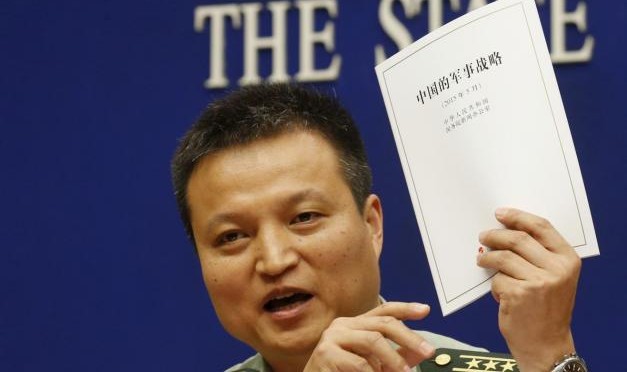
In a watershed moment, the Chinese Ministry of National Defense recently published a white paper on the Chinese Military Strategy(with an English-language version made available and published almost immediately by USNI News). This document lays out a policy for future Chinese military engagement with the world, proclaiming the centrality of active defense as the essence of the Chinese Communist Party’s military strategic thought and then describing an approach for implementing this military policy in the air, cyber, land, and maritime domains. This document comes at a particularly interesting time as General Martin Dempsey, Chairman on the Joint Chiefs of Staff, has since approved a new National Military Strategy for the United States, a strategy that names China explicitly as culpable for increased tension in the Asia-Pacific region and establishes an explicit interactive dynamic between the Chinese and U.S. strategies. While this is not the first time a U.S. National Military Strategy names China as a consideration, the shift in tone here is noteworthy.
During the first week of August, CIMSEC will host a series focused on exploring the relationship between the new Chinese military strategy and the strategic policies of the United States and others. Of particular interest are the dynamics of symmetry and asymmetry in their respective National Military Strategies (ideological, technological, doctrinal, coalitional, etc.); the implicit and explicit assumptions in each; the potentially divergent social and political purposes of such documents given their sources; and the implications for the other elements of national power in China, the United States, and the other actors (state and otherwise) in the international system. If the United States and China were to pursue their stated military strategies in whole or in part, what are the implications for their relative and absolute advantage? What are the acknowledged and unacknowledged risks for each in their stated policies?
Contributions should be between 500 and 1500 words in length and submitted no later than 29 July 2015. Publication reviews will also be accepted.
Eric Murphy is a Strategist and Operations Research Analyst with the United States Air Force and a graduate of the School of Advanced Air and Space Studies.
CIMSEC content is and always will be free; consider a voluntary monthly donation to offset our operational costs. As always, it is your support and patronage that have allowed us to build this community – and we are incredibly grateful.
Charles N. Edel. Nation Builder: John Quincy Adams and the Grand Strategy of the Republic. Harvard University Press. 392pp. $29.95.
Who knew that John Quincy Adams (1767-1848) was so interesting? Or that he was probably the most sleep deprived and crankiest U.S. President ever to live in the White House? Or that he wrote in a journal every day — totaling some 17,000 pages and 51 volumes — since he was twelve until the day he died on the floor of Congress in 1848?
The word “fascinating” doesn’t begin to describe this man. But unfortunately for John Quincy Adams, his father has seemed to eclipse him in many ways. David McCullough’s wonderful biography of John Adams, which was turned into a popular HBO series, cemented the founding father’s stature in the collective American conscience. Thus, many of us only know John Quincy as a sequel, a trivial pursuit question: “Which eighteenth-century U.S. President had a son who also became a U.S. President?” It is always, it seems, this way with sequels. They never quite measure up in our minds and in our hearts.
Yet recently, it looks like John Quincy is getting his due. In May of last year, Fred Kaplan released his biography of the sixth President of the United States, titled, John Quincy Adams: American Visionary, to a warm reception. And just this past January, Phyllis Lee Levin’s book, The Remarkable Education of John Quincy Adams, hit the shelves. Call it a John Quincy revival. Still, there is always room on the bookshelf for another well-written book on this overlooked and under-appreciated president. Enter historian and U.S. Naval War College professor Charles Edel’s excellent new book, Nation Builder: John Quincy Adams and the Grand Strategy of the Republic.
Edel’s book is not a biography per se, and nor is it a book about John Quincy’s character, his life and times, or a detailed discussion of his policies. Rather, Edel sets out and argues, and quite convincingly I might add, that John Quincy was a grand strategist — maybe America’s first. That is, he not only defined clear objectives for the United States, but he was also, as Edel says, able to leverage all the instruments of national power — military, economic, diplomatic, and moral — to ensure the future security and prosperity of the American people.
Edel begins his book with John Quincy’s formative years, traveling with his father (crossing the Atlantic during the Revolutionary War and barely evading capture by the British), dining with Jefferson, reading (his father insisted on Thucydides), writing, and learning languages — French, German, and Dutch, to name just a few — that he would eventually use as a teenage diplomat in Europe. It is in those early years where we see that John Quincy, through diligent study and the puritan ethic of public service before personal happiness, made himself.
The book is then divided into chapters that trace the highlights of his extraordinary career: his challenges with depression and seeking purpose in the late 1790s; his involvement in American diplomacy and his rise in politics in the early 1800s; his ideas and debates on territorial expansion and the Monroe Doctrine, and finally, the “slavery question.” Throughout all of this, though, John Quincy retains his priorities and his national objectives. Adams, Edel tells us, understands that for the U.S. to become a strong nation, we must expand our territory, increase our national resources, remain neutral in European affairs, and build up our defense forces to ensure that other countries — notably France and Britain — did not try to fracture American solidarity. These principles, these objectives, would remain in the forefront of Adams’s mind throughout his life.
As secretary of state under President James Monroe, Adams was responsible for negotiating the Adams-Onís treaty, thus giving Florida to the United States — in return the U.S. settled a border dispute with Spain along what is today areas of the Sabine river in Texas. Adams also wrote the Monroe Doctrine — a seminal document in American history that, in simple language, told all European powers (and others) stay out of our business.
Interestingly, John Quincy would be most remembered in his twilight years. The first (and only) U.S. President to be elected to the House of Representatives after leaving office. He famously argued a case in front of the U.S. Supreme Court, United States v. Libellants and Claimants of the Schooner Amistad. He won the case, successfully arguing that the Africans aboard that ship should be set free.But while Edel reminds us that John Quincy detested slavery, John Quincy was averse to critiquing slavery publicly, in fear of tearing the nation apart. While he would always, it seems, nip at the edges. For example, trying to find ingenious ways to get around the “gag rule” that barred discussions of slavery on the floor of Congress.
John Quincy’s path to American prosperity and security was not without stumbles. Edel says that, “Adams grand strategy included a clear vision of where the country needed to go and a detailed policy road map for how to get there. But in many instances he lacked the ability to convert that vision into political reality.” For instance, Adams tried, but failed to get enough votes for the creation of a U.S. Naval Academy. Legislators thought that it would cost too much, and “critics…argued that federal appointments to such an academy would become ‘a vast source of promotion and patronage’ which would invariably lead to ‘degeneracy and corruption of the public morality.'”
John Quincy was an impressive diplomat and intellectual giant, but he was also a conflicted man, a contrarian, and, in all honesty, not someone who you would want at your dinner table. As Edel says, “Adams was certainly most comfortable when he stood in opposition to something or someone. Intellectual and industrious, rigid in his beliefs, and with a propensity to see issues and people in stark terms, in many ways Adams was an odd fit for politics.” The Sage of Concord, Ralph Waldo Emerson, whom Edel quotes, also had a few choice words for John Quincy, saying:
He’s no literary old gentleman, but a bruiser and loves the melee…[he] must have sulfuric acid in his tea.”
Adams, then, did not suffer fools.
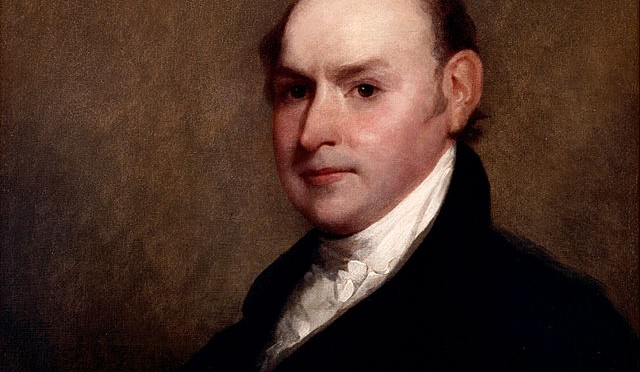
This is probably most easily seen in what is believed to be the first photograph ever taken of a living U.S. President. In 1843 Phillip Haas took a picture of the former president, who was then 76 years old. He is seen sitting, legs crossed, hands clasped, and head slightly down. His lips are pursed and he has an expression of impatience or frustration.
John Quincy Adams. Copy of 1843 Daguerreotype by Philip Haas.
In a recent interview with Edel, I asked him this question: “Do you think he was ever satisfied with is life?”
Edel said:
“…[A]t many points in his life he refers to himself as a Job like figure. In many ways, he sees his job as one of persistence and endurance. If he thinks about his policies, how his plans have gone awry, how others have distorted his policies, then he is rather less pleased with the result. But he’s not really someone who is satisfied – ever.”
There is only one small quibble I have with the book. At one or two points Edel repeats an idea within a chapter, or uses the same quote twice, making you pause for a moment in a sense of déjà vu, wondering if you had or had not just seen the same words pages prior. But again, this is a minor point. Overall, this is an excellent book. And whether you are new to John Quincy Adams or if you’ve read most of the current literature on this man and his presidency, I promise you’ll learn something new and interesting in these pages.
Lieutenant Commander Christopher Nelson, USN, is a career intelligence officer and recent graduate of the U.S. Naval War College and the Navy’s operational planning school, the Maritime Advanced Warfighting School in Newport, RI. LCDR Nelson is also CIMSEC’s book review editor and is looking for readers interested in reviewing books for CIMSEC. You can contact him at cimsecbooks@gmail.com. The views and opinions expressed here do not necessarily reflect those of the U.S. Navy or the Department of Defense.
Welcome back to another edition of the member roundup. We have a variety of topics covered by CIMSECians across the globe this week, ranging from the US Rebalance to the future of US air combat superiority.
On the US Naval Institute’s blog, Roger Misso writes a response to Anna Grenville’s blogpost at Task and Purpose. Titled ‘4 Reasons I Am Resigning My Commission As A Naval Officer,’ she provides some insight as to why her, and others, decide to leave the profession. Miss agrees on many points raised in the original article but offers a counter-narrative: junior officers can build the service we want. This, of course, is only facilitated if the junior officer corps reaches critical mass and carries their views through the ranks. You can access Roger’s post here.
Over at The National Interest, Dave Majumdar provides a roundup of the top five lethal American weapons of war. From the Gatling gun to stealth bombers, he analyses why these weapon systems make it onto the list. The second article questions whether the next generation of fighters will be capable of dominating the skies. The F-35 program has come under intense scrutiny over the years, ranging from project delays to criticisms over its air combat capability.
Dean of the Fletcher Law School, James Stavridis, returns in this week’s edition with two articles. The first titled ‘The Arab NATO’ appeared in Foreign Policy, and assesses the development of the 40,000-strong Arab League response force. It is clearly poised to counter Iran’s potential rise post-negotiations. In the second article, featured in The Hill, Stavridis explains why we need a ‘consumer protection act’ for the cyber threat data market. Given that cyber threats span public, private and non-profit sectors, it is time to adopt more appropriate measures for dealing with this commodity in less regressive terms. You can access both articles here andhere, respectively.
Zachary Keck returns in this edition with two articles in the past week. The first explores the future ofUS Air Combat superiority. Based on a new Center for Strategic and Budgetary Assessmentreport, Keck cites several dissenting claims against the findings of the report. Thesecond article reports that China’s anti-satellite capabilities are well on track to be able to destroy satellites beyond low orbit.
Lauren Dickey guest blogs with Janine Davidson over at the Council on Foreign Relations, this week, exploring the current state of the US Rebalance. There is a tendency in Washington circles to draw sweeping policy judgments with few facts to back them up. The actual numbers, however, indicate that the policy shift remains on track. You can access Lauren’s article here.
The U.S.-Australia Force Posture Agreement, part of the Rebalance, ensures both that 2,500 Marines rotate annually through Darwin for the next twenty-five years and that U.S. military and intelligence representation at Australian facilities continues.
At CIMSEC we encourage members to continue writing, either here on the NextWar blog or through other means. You can assist us by emailing your works to dmp@cimsec.org.