Tag Archives: Strategy

Where You Stand Depends on Where You Sit: U.S. & Chinese Strategic Views

Guest post for Chinese Military Strategy Week by Daniel M. Hartnett

A Comparison of U.S. and Chinese Views of the International Strategic Environment

Within approximately a month of each other this year, both China and the United States published official documents detailing their respective views of the current security environment.  China’s assessment was captured in its 9th biennial defense white paper, published in late May, and officially titled China’s Military Strategy. The U.S. view is presented in the National Military Strategy of the United States of America, 2015 (hereafter, U.S. National Military Strategy), published in June. The authoritative nature of each document provides an interesting opportunity to comparatively assess how both nations see the international military and security situation, more clearly understand their similarities and differences, and draw out any relevant implications.

Before comparing the views contained within the two documents, however, it is important to clarify that this is not a perfect comparison. Although both documents are official and therefore represent the approved views of the respective government, they are not exact equivalents. China’s defense white paper, while drafted by the Chinese military, the People’s Liberation Army (PLA), is actually coordinated with and vetted by China’s foreign policy making community, to most importantly include the Chinese Communist Party.1 Therefore, it represents the view of the Chinese Party-State, not just the PLA.  On the other side of the ledger, the Joint Chiefs of Staff is responsible for producing the U.S. National Military Strategy. This document draws closely from other U.S. government statements, most importantly from the President’s National Security Strategy. However, ultimately the U.S. National Military Strategy is a U.S. military document, not a whole-of-government product. As a result, comparing it with China’s Military Strategy is imperfect at best. However, such an exercise is still of value, particularly given the authoritativeness of the two documents combined with the general lack of publicly released official Chinese statements on national defense issues.    

Going forward with this imperfect yet still useful comparison of these two views on the international security situation yields four findings of interest. First, both documents describe the international security situation as experiencing great change. According to the U.S. National Military Strategy, “complexity and rapid change characterize the strategic environment, driven by globalization, the diffusion of technology, and demographic shifts.” China’s defense white paper paints a similar picture, stating that “profound changes are taking place in the international situation.” Although China’s Military Strategy is silent on what is causing these changes, it does assert that the changes in question are changes to the international balance of power, global governance structure, and Asia-Pacific geostrategic landscape, as well as an increase in international economic, military, and technological competition.

Second, although they both maintain the international system is in flux, the two documents disagree about the impact these changes will have.  The U.S. National Military Strategy takes a more pessimistic view, stating that these changes are giving rise to a host of problems. As General Martin Dempsey, Chairman of the Joint Chiefs of Staff, writes in the foreword to the U.S. National Military Strategy, “today’s global security environment is the most unpredictable I have seen in 40 years of service,” and that “global disorder has significantly increased while [U.S.] comparative military advantage has begun to erode.” Concerns noted include increasing societal tensions, resource competition, political instability, military challenges, and non-traditional security concerns. More concerning, the document also asserts that the risk of “U.S. involvement in interstate war with a major power is assessed to be low but growing” [emphasis added].
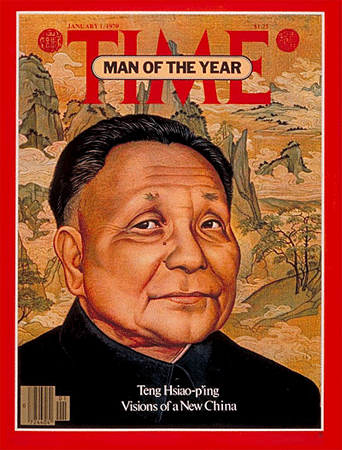
DengXiaopingTime_1979
Deng Xiaoping, Time Man of the Year in 1979

China’s assessment, on the other hand, is more positive. It asserts that overall the international situation is good, although it also recognizes that some problems exist. For example, the document maintains that “peace, development, cooperation and mutual benefit have become an irresistible tide of the times,” continuing a basic position held since the mid-1980s when then Chinese leader Deng Xiaoping took China off the constant pre-war footing of Mao Zedong.2 That doesn’t mean that China’s Military Strategy doesn’t recognize the existence of international problems; the document notes such issues as “hegemonism, power politics, and neo-interventionism,” as well as increasing competition for power and interests, international terrorism, and ethnic, religious, and territorial disputes. However, it does assert that “the forces for peace are on the rise, [and] so are the factors against war,” and as a result, a major war is unlikely and the “international situation is expected to remain generally peaceful”—although minor conflicts and wars can occur.  More importantly, China’s Military Strategy states explicitly that China confronts a “generally favorable external environment,” something the document claims is a prerequisite for China’s continued development.

Third, the two documents focus on different levels of the international system. The U.S. National Military Strategy, for example, squarely assesses the international situation from a global perspective. For example, the four countries mentioned by name as revisionist (Russia, Iran, North Korea, and China) span much of the globe. Similarly, when discussing the threat of violent extremist organizations, the document notes this is a global concern (although it does highlight the Middle East and North Africa for exceptional concern). Furthermore, the U.S. National Military Strategy explicitly rejects the notion of emphasizing any one region or issue, stating that “the U.S. military does not have the luxury of focusing on one challenge to the exclusion of others.”

In contrast, China’s Military Strategy emphasizes China’s periphery, and in particular the maritime areas of the western Pacific Ocean. Although global issues are mentioned, they are done so only briefly and ambiguously. Instead, China’s Military Strategy mainly discusses regional concerns. Concerns noted include the U.S. rebalance to Asia, especially efforts to strengthen the U.S. military presence and alliances in the region; Japan’s ongoing adjustments to its defense policy; tensions on the Korean Peninsula; relations with Taiwan; and extremist movements that could spill over China’s borders. Of particular note is China’s focus on maritime concerns, such as the growing tensions concerning its disputed claims in the East and South China seas, U.S. special reconnaissance operations, and alleged outside interference in China’s maritime disputes. The only non-peripheral concern expressly noted in the document reflects the recognition that China’s growing overseas interests are creating new security issues, such as sea lane security and the security of Chinese foreign investments and overseas citizens. 
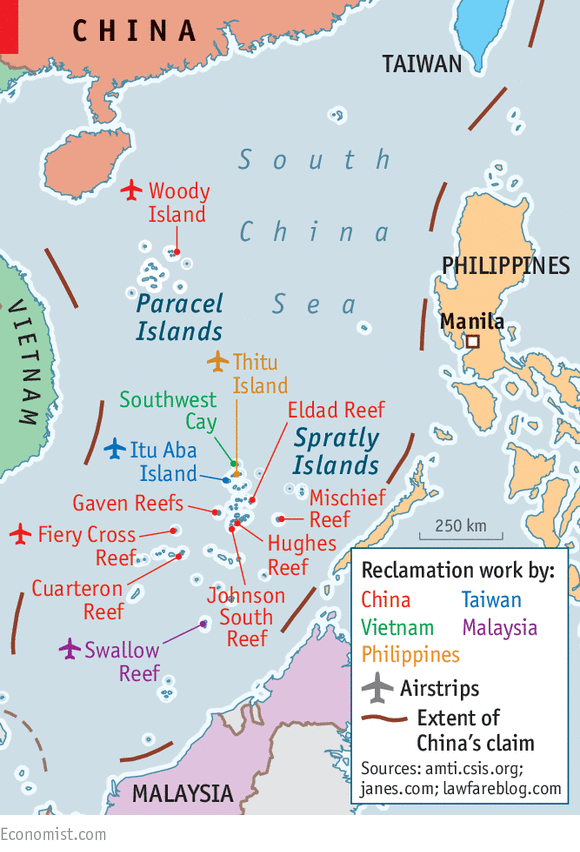
SouthChinaSeaReclamation-Economist
Land Reclamation in the South China Sea, Economist.

Fourth, each document portrays the other country as part of the problem.  According to China’s Military Strategy, the increase in China’s peripheral insecurity is partially due to U.S. actions in the region, such as the U.S. rebalance to Asia and its interference in China’s maritime disputes with other East Asia states. For its part, the U.S. National Military Strategy also explicitly calls out China, stating that its “aggressive land reclamation efforts” in the South China Sea could allow the PLA to position forces “astride vital international sea lanes.” As a result, “China’s actions are adding tension to the Asia-Pacific region.” This mutual finger pointing in order to assign blame for tensions in the South China Sea exemplifies what Dr. David M. Finkelstein, director of CNA’s China Studies division, has referred to as a “perception gap” between China and the United States on regional security concerns.

From this simple comparison of the two authoritative documents, it is easy to see that a large divide exists between the U.S. and Chinese views on security issues.  While the United States sees the rapidly changing international systems as a potential concern, China sees it as an opportunity for continued development. The U.S. focus on the global level is indicative of its position as an established global power with global interests. Conversely, China’s focus, although gradually expanding to the international level, emphasizes the East Asia region, reflecting that Beijing continues to be primarily concerned with its immediate periphery. Each country also sees the other as part of the problem, especially in the case of the South China Sea issue.

Ultimately this difference in views should not be shocking since both countries have their own set of national interests and related concerns. The more important questions, however, are: Is it possible, as some claim, to bridge these differences and build “mutual trust” between the two militaries? Or will asymmetries of interest on certain issues prevent reaching a peaceful accord? Can the two militaries reach a middle ground on issues where they see the other as the main culprit? For this author, it would seem a difficult challenge, for as the Truman-era senior bureaucrat Rufus F. Miles said in the late 1940s, “Where you stand depends on where you sit.”3

Daniel Hartnett is a research scientist with CNA’s China Studies division, as well as a member of the Truman National Security Project’s Defense Council. He can be followed at @dmhartnett. The views expressed in this article are his alone.

1 Daniel M. Hartnett, “China’s 2012 Defense White Paper: Panel Discussion Report,” CNA Conference Proceeding (September 2013), p. i.

2 For an interesting read on China’s military reforms during the Deng era, see Ezra Vogel, Deng Xiaoping and the Transformation of China (Cambridge, MA: Harvard University Press, 2011), pp. 523-552.

3 Rufus F. Miles, “The Origin and Meaning of Miles’ Law,” Public Administration Review Vol. 38, No. 5 (Sep. – Oct., 1978), pp. 399-403.
CIMSEC content is and always will be free; consider a voluntary monthly donation to offset our operational costs. As always, it is your support and patronage that have allowed us to build this community – and we are incredibly grateful.
Select a Donation Option (USD)

Enter Donation Amount (USD)

The Influence of Han Feizi on China’s Defence Policy

Guest post for Chinese Military Strategy Week by Paul Pryce

There is much of concern in China’s Military Strategy white paper released by the Chinese Ministry of National Defense in May 2015. In particular, the notion of active defense extolled in the document arguably poses a far greater threat to the stability of the Asia-Pacific region than the reinterpretation of Article 9 in Japan’s Constitution. Coupled with other recent developments in the formulation and expression of China’s defense policy, there is a startling willingness to resort to the threat of force in order to resolve disputes. In July 2015, a meeting of the Central Military Commission announced that the People’s Liberation Army Air Force (PLAAF) requires a stealth-capable strategic bomber with a minimum range of 8,000 kilometers and the capacity to carry a payload of more than 10 tons of air-to-ground munitions. Although this envisioned replacement to the Xian H-6K bomber would still have a range and payload capacity less than the Northrup Grumman B-2 Spirit that has been in service with the United States Air Force (USAF) for almost two decades as of this writing, the extended range would allow China’s bomber fleet to reach as far as Guam or Japan’s Northern Territories, also known as the Kuril Islands.

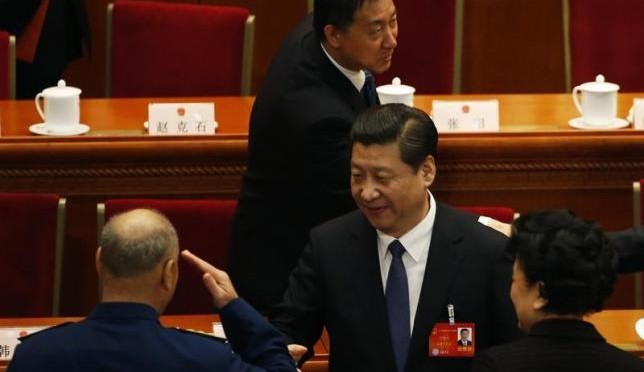
Xu Qiliang (L), vice Chairman of China's Central Military Commission, salutes China's President Xi Jinping (C) during the closing ceremony of the Chinese National People's Congress (NPC) at the Great Hall of the People, in Beijing, March 13, 2014. REUTERS/Kim Kyung-Hoon
Xu Qiliang (L), vice Chairman of China’s Central Military Commission, salutes China’s President Xi Jinping (C) during the closing ceremony of the Chinese National People’s Congress (NPC) at the Great Hall of the People, in Beijing, March 13, 2014.

This saber-rattling can be explained in part by examining a school of thought that has risen to prominence together with the People’s Republic of China’s fifth generation of leadership, of which Xi Jinping is a part. Since Mao Zedong, Chinese leaders such as Deng Xiaoping and Jiang Zemin promoted the virtues of Confucianism and frequently quoted from Confucian works in their public remarks. With an emphasis on community-mindedness and obligations to the authority of the state, Confucius seemed to offer the philosophical justification for the entrenchment of the Communist Party of China in all areas of Chinese life. But there has been a noticeable departure from this tradition under Xi Jinping, who has relied heavily upon references to the works of Han Feizi.

Han Feizi
Han Feizi, Public Domain

Believed to have lived from 280 to 233 BC, Han Feizi was one of the founding thinkers of Legalism, a meritocratic ideology that came into being during the Warring States period of China’s history and was formally adopted by the victorious Qin state. Han Feizi has been called China’s Machiavelli, concerned more so with the efficiency of the state than with any over-arching moral or ethical questions. One passage from Han Feizi’s essay “The Eight Villainies,” a quote the fifth generation of leadership has apparently taken to heart, reads, “It is customary with a ruler that, if his state is small, he will do the bidding of larger states, and his army is weak, he will stand in fear of stronger armies. When the larger states come with demands, the small state must consent; when stronger armies appear, the weak army must submit.” Han Feizi does not comment on whether the doctrine of might makes right ought to be; he simply regards it as a natural and unavoidable consequence of a system in which different actors hold varying levels of power. There is also no apparent role for soft power in Han Feizi’s worldview – the strength of a ruler and his state is directly tied to military strength.

The memory of foreign occupation looms large for many Chinese leaders. In 2010, a diplomatic spat emerged when Chinese officials asked visiting British dignitaries to remove their poppies, worn to commemorate Remembrance Day and the Commonwealth’s war dead, because it allegedly reminded them of the Opium Wars. Xi Jinping himself often evokes the century of humiliation and the supposed role of the Communist Party of China in restoring national independence. If we regard Chinese history from the 1840s to the 1940s in the Legalist context, China was made subservient because it was militarily weak in relation to global powers like the United Kingdom, France, Russia, the United States, and others. If the weak must do the bidding of the strong and China is militarily weak in comparison to American hyperpower, the conventional thinking among the members of the Central Military Commission is that the gap must be closed or else it will only be a matter of time before the United States dictates to China once again.

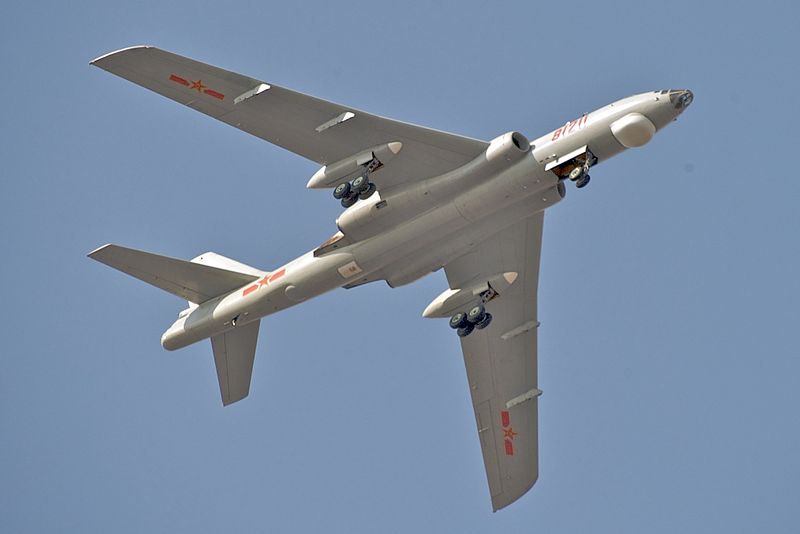
PLAAF Xian H-6M makes a turn over Changzhou city, Jiangsu. Creative Commons.
PLAAF Xian H-6M makes a turn over Changzhou city, Jiangsu. Wikimedia Creative Commons.

One need not look far for examples of this anxiety about the capability gap. Xu Qiliang, the vice chairman of the Central Military Commission, wrote in 2013 that the People’s Liberation Army cannot currently meet the needs of national security and requires rapid modernization to contend with “the world’s advanced militaries”. Even though China already possesses the means to deter military aggression from any of its neighbors, it is apparent that the fifth generation of leadership still regards China as vulnerable unless it has an equivalency to every tool in the United States’ security toolbox. After all, it is telling that Xu Qiliang does not regard China as one of the world’s advanced militaries even though the PLAAF’s contingent of Xian H-6K bombers places China in a very exclusive club – only the United States, the Russian Federation, and the United Kingdom can also boast having strategic bombers at their disposal.

It is also worth noting how the presentation of the most recent Chinese Military Strategy reflects Han Feizi’s thought. In another of his works, The Difficulties of Persuasion, Han Feizi writes that, “If you wish to urge a policy of peaceful coexistence, then be sure to expound it in terms of lofty ideals, but also hint that it is commensurate with the ruler’s personal interests.” Just as the white paper advances the ideas of active defense and bottom-line thinking, it also emphasizes China’s commitment to participating in United Nations peacekeeping missions, the role of the People’s Liberation Army Navy (PLAN) in counter-piracy efforts in the Gulf of Aden, and appeals to such values as “the peaceful settlement of disputes.” This reflects a growing awareness on the part of Chinese officials that the rest of the world is paying attention to what kind of actor China might become in the 21st century. The message, in many respects, is that the Chinese Dream is inclusive – other nations and societies can benefit from China pursuing its own national interests, such as the investment and increased security that might come to Djibouti through the proposed establishment of a PLAN base there.

It is vital that those studying or interacting with Chinese policymakers to consider the historical context for China’s policies and their ideological framework. The China threat narrative considers Chinese strategy within a strictly neo-realist prism that supposes conflict will inevitably arise from a shift in polarity in international politics. Rather, Xi Jinping and Xu Qiliang can be best understood by consulting Han Feizi. As such, the explicit reference to China in the United States’ most recent maritime strategy, A Cooperative Strategy for 21st Century Seapower, might not help matters. It indicates to the Chinese political leadership that Han Feizi’s view of international politics endures more than two millennia later – the strong will continue to dictate to the weak, and so the United States will continue to determine the outcome of any territorial dispute in the South China Sea or East China Sea so long as the capability gap with China persists. An appeal to lofty ideals in the U.S.-China relationship, rather than explicit reference to geopolitical changes, could have spoken to the fifth generation of leadership on a deeper level without alienating the US’ Asia-Pacific allies. For its part, the National Military Strategy of the U.S. released in June 2015 goes some way toward accomplishing this, balancing criticism of China’s actions in the South China Sea with assertions that the U.S. “support[s] China’s rise.”

It may be that the revised maritime strategy adopts a harsher tone toward China in order to generate political will among other countries to participate in what the original Cooperative Strategy termed the Global Maritime Partnership. By distinguishing the U.S. from China as far as adherence with international maritime law is concerned, the U.S. Navy demonstrates that it can be a more reliable partner than PLAN to such countries as the Philippines and Vietnam. Nonetheless, with China participating meaningfully in the Rim of the Pacific Exercise (RIMPAC) and other multilateral venues, there must be consistency in the message delivered by the U.S. at the strategic, tactical, and operational levels. Security in the Asia-Pacific region will not benefit from mixed signals delivered by any actor.

Paul Pryce is Political Advisor to the Consul-General of Japan in Calgary and a Research Analyst at the Atlantic Council of Canada. The views expressed in this article are his own.

CIMSEC content is and always will be free; consider a voluntary monthly donation to offset our operational costs. As always, it is your support and patronage that have allowed us to build this community – and we are incredibly grateful.
Select a Donation Option (USD)

Enter Donation Amount (USD)

China’s Yuan-class Submarine Visits Karachi: An Assessment

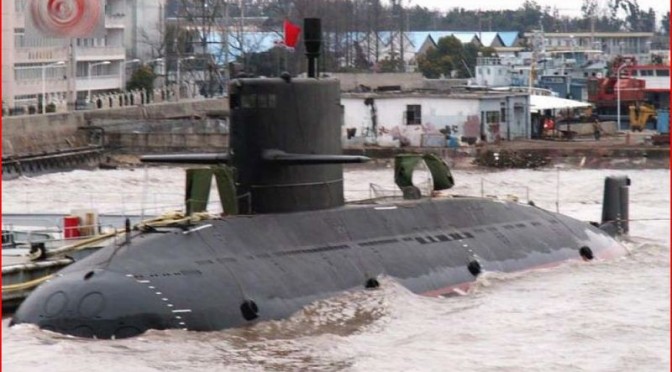
In May 2015, a Chinese Type 041 Yuan-class submarine (pennant number 335) entered the Indian Ocean and made a week-long port call at Karachi, Pakistan. This development caused alarm in India, at least in the media circles, particularly since it comes barely six months after the first-ever Indian Ocean deployment of China’s Song-class submarine between September and November 2014, and its docking in Sri Lanka’s Colombo port. Notably, following the Colombo docking, NMF view-point titled “PLA Navy’s Submarine Arm ‘Stretches its Sea Legs to the Indian Ocean” of 21 November 2014 had predicted future Chinese submarine dockings in Pakistan’s ports. These seminal developments call for an objective assessment in terms of China’s intent underlying its submarine deployments in the Indian Ocean and its implications for India.

Alike the port call in Sri Lanka, China is likely to justify the submarine visit to Pakistan as a replenishment halt enroute to PLA Navy’s ongoing counter-piracy mission in the Gulf of Aden. However, these deployments may be seen in context of the growing volatility of the security environment in the South China Sea, including the increasing brinkmanship between China and the United States. In case of a maritime conflict in the area, China’s energy shipments transiting the Indian Ocean are strategically vulnerable. Through its submarine deployments, China may be seeking to deter its potential adversaries against interdicting its Sea Lines of Communication (SLOC) in the Indian Ocean.

Route of the Yuan class submarine.

By virtue of its opaque operating medium, a submarine has always been a potent platform of war. The technological advances in satellite and air surveillance have not been able to offset the submarine’s inherent advantage of stealth. On the other hand, the advances in underwater weaponry – particularly submarine-launched anti-ship and land-attack missiles – have further enhanced the submarine’s lethality. The only constraint of a conventional (diesel-driven) submarine – like the Song-class – is to re-charge its batteries, for which its need to come up to the sea surface (for access to atmospheric oxygen) every two or three days, depending upon the usage of the batteries. This limits the submarine’s operational role and makes it highly vulnerable. However, Air Independent Propulsion (AIP) technology – such as on the Yuan class – has eased this constraint substantially, since its stored liquid oxygen enables the submarine to operate underwater for an extended durations of as much as two to three weeks.

Among the aims specific to the Yuan 335 call at Karachi, the foremost may be to showcase the Yuan to the Pakistan Navy. Notably, news-reports indicate that Pakistan Navy (PN) is likely to acquire up to eight Chinese Type 41 Yuan-class submarines. The contract between Karachi Shipyard and Engineering Works Limited (KSEW) and China Shipbuilding and Offshore International Co. Ltd. (CSOC) includes building some of these at KSEW. These submarines are equipped with Sterling AIP system, which the Chinese claim is more efficient than the AIP systems currently available in the world. The week-long docking of the Yuan at Karachi – too long merely for replenishment – may also have been utilised for training of the KSEW and PN personnel on the submarine, and its machinery and weapon systems, particularly the AIP system.

In broader terms, the two sets of Chinese submarine forays into the Indian Ocean (Colombo and Karachi) are likely to be ‘trial balloons’ for regular operational deployments of Chinese submarines in the region. The current deployments are also likely to be meant to familiarise the PLA Navy with the new operational environment in the Indian Ocean, train them for distant missions, collect intelligence, and collate hydrographic data specific to the Indian Ocean, which is essential for future submarine operations in the region. At present, the Chinese submarines need to replenish only fuel, food and fresh water. In the longer term, with the PN (and some other regional navies such as the Thai Navy) operating the same submarines, the PLA Navy is likely to benefit from a more comprehensive logistics support – technical services, machinery and equipment spare-parts and even ammunition. This will enable the Chinese submarines to remain deployed in the Indian Ocean for extended periods.

While China may continue to deploy its conventional submarines in the Indian Ocean, these are likely to be supplemented with the upgraded version of its new-generation Type 093 nuclear attack submarines (SSNs), whenever these are operationally deployable. These SSNs are likely to be armed with anti-ship and land-attack missiles, and capable of launching Special Operations Forces (SOF) via Swimmer Delivery Vehicles (SDV). Since SSNs do not need replenished, these submarines would not need to enter any regional port, unless China wants to demonstrate a deterrent posture.

China and India share a complex relationship, competitive, and even potentially adversarial. Hence, even if increasing Chinese submarine deployments in the Indian Ocean is not directly targeted at India, the development has severe national security implications for New Delhi. The response to increasing Chinese submarine forays in the Indian Ocean lies in developing affective air, ship and submarine based Anti-Submarine Warfare (ASW) capabilities, including sub-surface Maritime Domain Awareness (MDA).

Captain Gurpreet S Khurana, PhD is the Executive Director, National Maritime Foundation, New Delhi. The views expressed are his own and do not reflect the official policy or position of the Indian Navy, the NMF or the Government of India. He can be reached at gurpreet.bulbul@gmail.com.

CIMSEC content is and always will be free; consider a voluntary monthly donation to offset our operational costs. As always, it is your support and patronage that have allowed us to build this community – and we are incredibly grateful.
Select a Donation Option (USD)

Enter Donation Amount (USD)

Where is the Navy Going To Put Them All? (Part One)

Where is the U.S. Navy Going To Put Them All?

Part 1: More Drones Please. Lot’s and Lot’s of Them!

AORH class jpeg

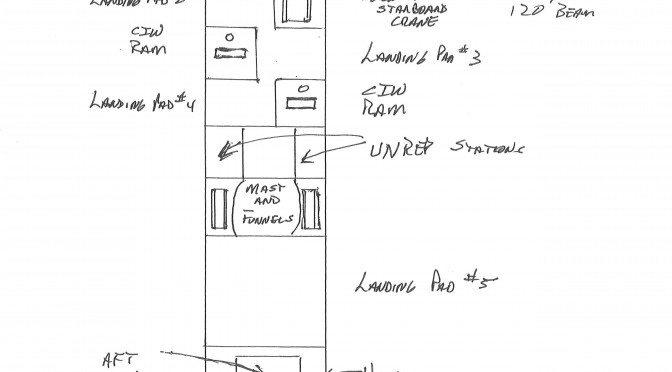
Sketch by Jan Musil. Hand drawn on quarter-inch graph paper. Each square equals twenty by twenty feet.

Recent technological developments have provided the U.S. Navy with major breakthroughs in unmanned carrier landings with the X-47B. A public debate has emerged over which types of drones to acquire and how to employ them. This article suggests a solution to the issue of how to best make use of the new capabilities that unmanned aircraft and closely related developments in UUVs bring to the fleet.

The suggested solution argues for taking a broader look at what all of the new aerial and underwater unmanned vehicles can contribute, particularly enmasse. And how this grouping of new equipment can augment carrier strike groups. In addition, there are significant opportunities to revive ASW hunter killer task forces, expand operational capabilities in the Arctic, supplement our South China Sea and North East Asia presence without using major fleet elements and provide the fleet with a flexible set of assets for daily contingencies.

These sorts of missions provide opportunities for five principal types of drones. Strike, ISR and refueling drones as winged aircraft to fly off fleet platforms, UUVs and the Fire Scout helicopter. So we have five candidates to be built, in quantity, for the fleet. Let’s examine each of the suggestions for what they should be built to accomplish, what sort of weapons or sensors they need to be equipped with and what doctrinal developments for their use with the fleet need to happen.

Strike drone

The current requirements are calling for long range, large payload, and the ability to aerially refuel and are to be combined with stealth construction techniques for the airframe, even if not stealth coated. These size and weight parameters mean this drone will require CATOBAR launching off an aircraft carrier’s flight deck. Which also means it will be supplementing, and to some extent replacing, the F-35C in the air wings for decades to come. The merits of how many strike drones versus F-35Cs, and the level of stealth desired for both, will be an ongoing debate for the foreseeable future.

Given that a strike drone built with these capabilities will be tasked with similar mission requirements to the F-35C, we will assume for now that the weapons and ISR equipment installed will be equivalent, if not exactly the same as the F-35C. This implies that whatever work the U.S. Navy has already done in developing doctrine for use of the long range strike capacity the F-35Cs brings to the fleet should only need to be supplemented with the addition of a strike drone.

It is worth remembering that while these drones are unmanned, since they are CATOBAR they will still require sailors on deck to move, reload and maintain them. Sailors who also need a place to eat, sleep, etc.

And the carriers are already really busy places. However welcome the strike drone winds up being, there is not going to be enough room on the carriers to be add even more equipment. Therefore each drone will be replacing something already there, both physically within the hangar bay and financially within the Navy’s budget.

ISR drone

Most of the current public discussion surrounding an ISR equipped drone is rather hazy about what sort of sensors, range and weapons, if any, are wanted. However, the philosophical debate over mission profile, including a much smaller size, localized range requirement and the presumed emphasis on ISR tasks is revealing. The key points to concentrate on for such a drone are the suggested set of missions to be conducted by an arc of ISR drones around a selected location, sensor and networking capabilities, range and durability requirements and a limited weapons payload.

The traditional use of aerial search capabilities onboard a carrier task force was over the horizon, well over the horizon thank you very much, locating of the opponents surface assets. Over the years the extended ranges of aircraft and the development of airborne ASW assets changed the nature of the search and locate mission and the assets being used to conduct it. Adding space based surveillance changed things once more. The coming improvements in networking and data processing capabilities inside a task force, a steadily rising need for over the horizon targeting information coupled with the need to function within an increasingly hostile A2AD environment has once more altered the requirements of the search and locate mission. Search and locate essentially has become search, locate, network and target.

Being able to fund as well as field large numbers of anything almost always means keeping it smaller, and deleting anything not strictly needed beyond occasional use is an excellent way to accomplish this. For the ISR drone, not arming it with anything beyond strictly self-defense weapons is an excellent way to keep size and costs down. Since the primary missions of the ISR drone will be the new search, locate, network and target paradigm, concentrating funding on those capabilities is an excellent way to limit both development and operating costs.

Particularly since putting a large number of the drones, each capable of at least 24-30 hours on station, supplemented by refueling, in an arc around a task force in the direction(s) of highest concern means that the SuperHornets of the fleet can largely be freed from the loiter and defend mission and return to being hunters.

Since I am assuming the railgun will also be joining the fleet in large numbers some discussion about the range of the search, locate, network and target arc suggested above as it relates to the railgun is in order. The publicly disclosed range of the railgun is 65 miles, so an arc of ISR drones needs to be farther out from the task force than that, quite some way beyond that to provide time to effectively network location and target data developed back to the shooters. In the anticipated A2AD environment the primary threat is very likely to be a missile, mostly subsonic but the potential for at least some of them being hypersonic exists. Therefore, the incoming missiles or aircraft will need to be located, networked information sent to the surface assets armed with railguns and the targeting information processed quickly enough that the bars of steel launched as a result will be waiting for the incoming missile at 65 miles. Precisely how far out beyond the railguns effective range the arc of ISR drones will need to be will almost certainly vary by circumstance and the nature of the opponent’s weaponry. Nevertheless, whether subsonic or hypersonic, missiles move rapidly and this means an effective arc of ISR drones will have to be a long distance out from the task force. The farther out the arc is, a higher number of drones will be needed to provide adequate coverage.

This implies a need for a minimum of 6-8 ISR drones on station, 24/7, in all kinds of weather. Since there are inevitable maintenance problems cutting into availability time, this implies a task force will need take twice that number to sea with it. Particularly if a second arc of two or three ISR drones is maintained just over the horizon, or simply overhead. This inner group can also provide local networking abilities for the ASW assets of the task force. Having at least one ISR drone close in to provide a rapid relay of information around the task force by its sub hunters should also be planned for as a doctrinal necessity.

This arc of ISR drones is a wonderful new capability to have, but…., but fifteen drones are not going to fit on a CVN. Not when an essentially equivalent number of something else needs to be removed to make room for the newcomers. Our carriers are packed as it is with needed airframes and trading out fifteen of them from the existing air wing is not going to happen.

Nor is there room elsewhere in the fleet. The CCGs and DDGs have limited space on their helo decks, but even if the new ISR drone were equipped with the modified VTOL engine from the Osprey program, there still wouldn’t be space for more than a few of them. Once more, it is a case of needing to take something out of the fleet to put the new capability in.

This means we have to build a new class, or classes, of ships to operate and house the quantities of drones desired, including operating space, hanger and maintenance space and sailor’s living spaces.

Refueling drone

A drone primarily dedicated to the refueling mission takes on another of the un-glamorous, but unending tasks involved in operating a task force. Instead of the proposed return of the S-3 Vikings as tankers, a somewhat larger drone can be designed from scratch to be a flying gas station with long range and loitering times, presumably with vastly more fuel aboard and built to only occasionally load weapons or sensors under the wings. It could have ISR capabilities or ASW weapons slung under the wings as distinctly secondary design characteristics. In understanding when to use manned versus unmanned systems obviously any extra weight and space gained by losing a cockpit allows for more fuel carried, longer loitering times and extra range. These advantages need to be balanced against the occasional need for a pilot’s skills on scene.

UUVs

As for the UUVs in development, much has been made of their ability to dive deeply and search for things as well as their ability to autonomously operate far out in front of a task force, including the possibility of submarine launched missions. While interesting a more incremental use of the roughly six feet long torpedo shaped UUV currently in use for deep diving missions might be more appropriate.

While we wait on further research developments to establish ways to effectively utilize a long range, long duration UUV reconnaissance drone, a more mundane use of what we have right now can readily be used for ASW purposes. We could equip a six-foot UUV with the sensors already in use for ASW purposes and cradle it in open sided buoy in order to hoist the UUV in and out of the water. This buoy could be used over the side, or far more usefully, launched and recovered by helicopter. Wave and say hello Fire Scouts.

Fire Scouts

Any helicopter asset that the U.S. Navy has can be used of course, but without a pilot aboard the Fire Scouts are much better suited for the long hours required to successfully prosecute ASW. Taking off with the UUV cradled inside it’s buoy, the Fire Scout can deploy the buoy, allow the tethered UUV to swim to the thermocline or other desired depth, hover while allowing the UUV to transmit or simply silently listen, wait for the resulting data that is collected to be reported via the tether and broadcast by an antenna on the buoy and then once the UUV has swum back into it’s cradle within the buoy, drop back down and relift the buoy and move it to the next needed position. This redeployment can be hundreds or thousands of yards away at the mission commander’s discretion. This cycle can be repeated as many times as wanted or fuel for the Fire Scout allows. A difficulty that can be resolved aboard the nearest surface ship with a helo deck, leaving the buoy drifting in place, UUV on station and transmitting as refueling takes place. Shift changes by pilots should not materially interrupt this cycle. The most likely limitation that will force the Fire Scout to lift buoy and UUV out of the water for return aboard will be the exhaustion of the power source aboard the buoy being used to operate the reel for the tether and broadcast the data collected to an overhead airframe. Which just happens to be another use for the ISR drone or a ScanEagle.

In the next article we will examine how the Navy can make profitable use of UUVs and buoys, deployed and maneuvered across the ocean by the Fire Scout helicopter, in quantity, in pursuit of the ASW mission. Read Part Two here

Jan Musil is a Vietnam era Navy veteran, disenchanted ex-corporate middle manager and long time entrepreneur currently working as an author of science fiction novels. More relevantly to CIMSEC he is also a long-standing student of navies in general, post-1930 ship construction thinking, and design hopes versus actual results and fleet composition debates of the twentieth century.

CIMSEC is and always will be free for everyone, but we would be grateful for those who wish to provide a modest regular donation to support our operations.
Select a Donation Option (USD)

Enter Donation Amount (USD)