Tag Archives: Space

The Final Frontier – The Future of Defending Space as a Global Commons (Pt. 2)

By Tuan N. Pham

Part 1 of this two-part series outlined a conceptual framework for characterizing the dynamics that contribute to instability and stability in the space domain. It made the case that instability arises when there is a real or perceived lack of order and security with the worst possible outcome being the “Thucydides Trap” – a rising power opposes a dominant power leading to a great power competition for space preeminence. On the flip side, it also made the case that stability arises when there is a real or perceived sense of order and security with the best possible outcome being the universal acceptance that “space is big enough for everyone and it is in everyone’s best interest to keep it free for exploration and use by all.” With this backdrop, Part 2 will focus on the ways and means the United States can employ to reduce instability and reinforce stability in the space domain while maintaining space preeminence into the 21st century.          

U.S. Space Stability Challenges

Preeminence Puzzle. As the guarantor of the global economy and provider of security, stability, and leadership because of its powerful military and vast network of allies and partners, the United States delivers global public goods that others cannot. A case in point is the current volatility of the South China Sea. Without the stabilizing presence of the U.S. Navy operating on the high seas there, Chinese assertiveness and unilateralism could destabilize the region, damaging both regional and global commerce and possibly leading to an unwanted conflict. Thus, there is a strong need going forward for a comparable guarantor of the freedom of space (a net provider of space security) to ensure the free flow of space commerce, a leadership role that calls out to the United States, supported by allies and partners, to fill.

Just as maritime preeminence is necessary to guarantee the freedom of the seas, so too is space preeminence needed to guarantee the freedom of space. By committing to space preeminence, America will better protect its critical strengths in space; enhance its space deterrence posture by being able to impose larger costs, deny greater benefits, and encourage more restraint; prolong its terrestrial preeminence; and reverse the growing perception of American decline.

Decline is a deliberate choice, not an inevitable reality. Having complementary policies and strategies in contested domains fosters unity of effort, optimizes resource allocation, sends a strong deterrent message to potential adversaries, and reassures allies and partners. To do otherwise invites strategic misalignment and miscommunication and encourages potential competitors to further advance their counter-balancing efforts. Put simply, if the United States does not preserve its current strategic advantages in space, a rising power like China may gradually eclipse America as the preeminent power in space which will have cascading strategic ramifications on earth.

This greater role will demand more analysis and planning to address the anticipated challenges of domestic fiscal constraints; emerging and resurgent space powers; potentially destabilizing space competition; escalation control; and establishing and maintaining partnerships for collective space security through risk sharing and burden sharing – similar to the challenges now facing the U.S. rebalance to the Indo-Asia-Pacific. The puzzle for American policymakers is whether it may be more cost-effective to invest now and maintain the current strategic advantage in space or pay more later to make up for diminished space capabilities and capacities while accepting greater strategic risk in the interim.
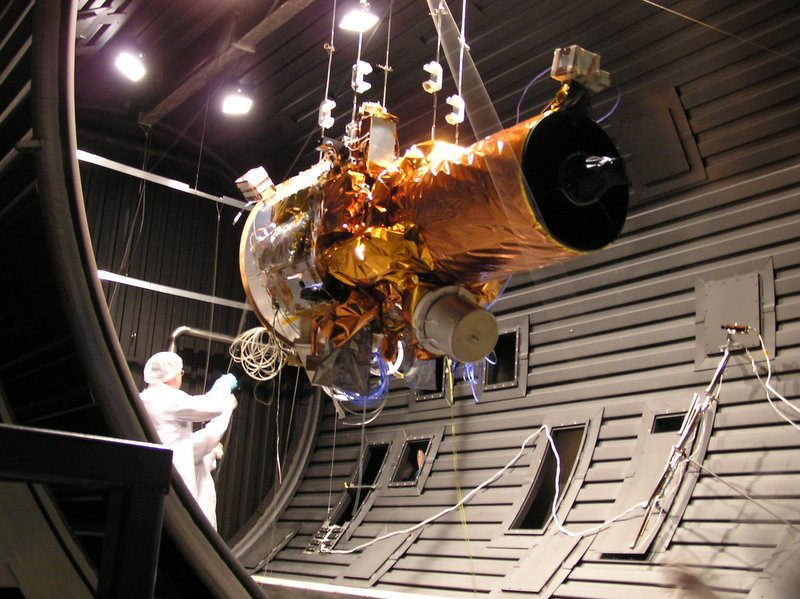
Workers prepare the TacSat-2 micro satellite for thermal vacuum testing at the Space Vehicles Directorate. (Air Force photo) 

Domain Dilemma. America fundamentally has two space deterrent and response options – (1) threaten to respond in the same domain; (2) threaten cross-domain retaliation to underwrite the deterrence of attacks on U.S. space capabilities. The former represents a vertical escalation if the response is disproportionate to the attack, and possibly “some” horizontal escalation depending on the target sets. This could result in large amounts of space debris and the resetting of international norms of behavior by legitimizing space attacks. The latter option represents a vertical escalation if the response is “perceived” as disproportionate to the attack, and horizontal escalation respective to the other domains. Nonetheless, the scope, nature, and degree of action must ultimately strike the delicate balance between the need to demonstrate the willingness to escalate and the imperative to not provoke further escalation in order to maintain space stability. The dilemma for the United States is where, when, and how best to deter; and if deterrence fails, where, when, and how best to respond.  

Reliance/Resilience Riddle. Enhancing and securing space-enabled information services (SEIS) is now essential to U.S. national security, a daunting task considering that space has become more and more “congested, contested, and competitive” and less permissive for the United States. Therefore, the current strategic guidance – 2010 National Space Policy (NSP), 2011 National Security Space Strategy (NSSS), and 2012 DoD Space Policy (DSP) – directs the U.S. government to reduce the nation’s disproportionate reliance on space capabilities and the vulnerability of its high-value space assets through partnerships and resiliency, respectively. The riddle for America is how best to manage the dichotomy between reliance and vulnerability through resilience.

Offensive Counter-Space (OCS) Conundrum. Space warfare is intrinsically offense-inclined due to the uncertainty, vulnerability, predictability, and fragility of space assets; and ever-increasing OCS capabilities to deceive, disrupt, deny, degrade, or destroy space systems. The latter can be destabilizing (warfighting capability) or stabilizing (deterrence) depending on one’s perspective. Hence, the conundrum for the United States is not whether or not to possess OCS capabilities – but how best to use them to deter and retaliate if deterrence fails; what type, how much, and to what extent should they be publicly disclosed; and how to leverage the existing international legal framework and accepted norms of behavior to manage them without constraining or hindering one’s own freedom of action.

Moreover, OCS capabilities continue to grow in number and sophistication driven by the “offense-offense” and “defense-offense” competition spirals influencing military space policies in Washington, Beijing, Moscow, and elsewhere. OCS developments to defeat defensive counter-space (DCS) measures drive further OCS developments for fear of falling behind in offensive capabilities and encouraging a first strike by an adversary, while DCS developments to mitigate OCS measures further drive OCS developments to remain viable as deterrent and offensive tools.     

Refining Military Space Capability  

Develop Cross-Domain Deterrence Options. Deterrence across the interconnected domains may offer the best opportunity to deter attacks on U.S. space capabilities, and if deterrence fails, retaliate across domains to deter further attacks. Prudence then suggests the need for some level of active planning prior to the onset of increased tensions and hostilities. American policymakers and defense planners should have on hand a broad set of potential cross-domain responses to the threats of space attack or the space attack itself. The responses should be organized by the levels of force application, provocation, and risk; dynamic enough to accommodate the ever-changing strategic, operational, and tactical conditions; and part of a larger menu of policy options to better manage tensions and escalation during pre-hostilities and identify off-ramps during hostilities. On balance, the decision on whether or not, when, and how to implement these responses should be viewed through the lens of cost and risk imposition, proportionality, strategic policy coherence, and desired outcome.        

Continue to Increase Resiliency. Strengthening the resiliency of the U.S. national security space architecture may offset the offensive inclination of space warfare by lessening the vulnerability and fragility of space assets, assuring retaliatory capabilities, and denying benefits of OCS operations.

Building up space protection capabilities will decrease the vulnerability and fragility of high-value space assets by presenting more targets (disaggregated space operations, micro-satellites), hiding targets (signature reduction), maneuvering targets (dynamic orbital profiles for unpredictability and threat avoidance), hardening targets (strengthened space assets and networks against kinetic and non-kinetic attacks), and complicating targets (hosted payloads on commercial, civil, and allied or partnered nations satellites).

Mission assurance can be sustained by responsive launch capabilities (launch-on-demand services for rapid reconstitution of degraded or lost space capabilities), Operationally Responsive Space (ORS) program (mass production of microsatellites in a short period of time), and “sleeper” orbiting satellites (standby spares that will activate when needed).
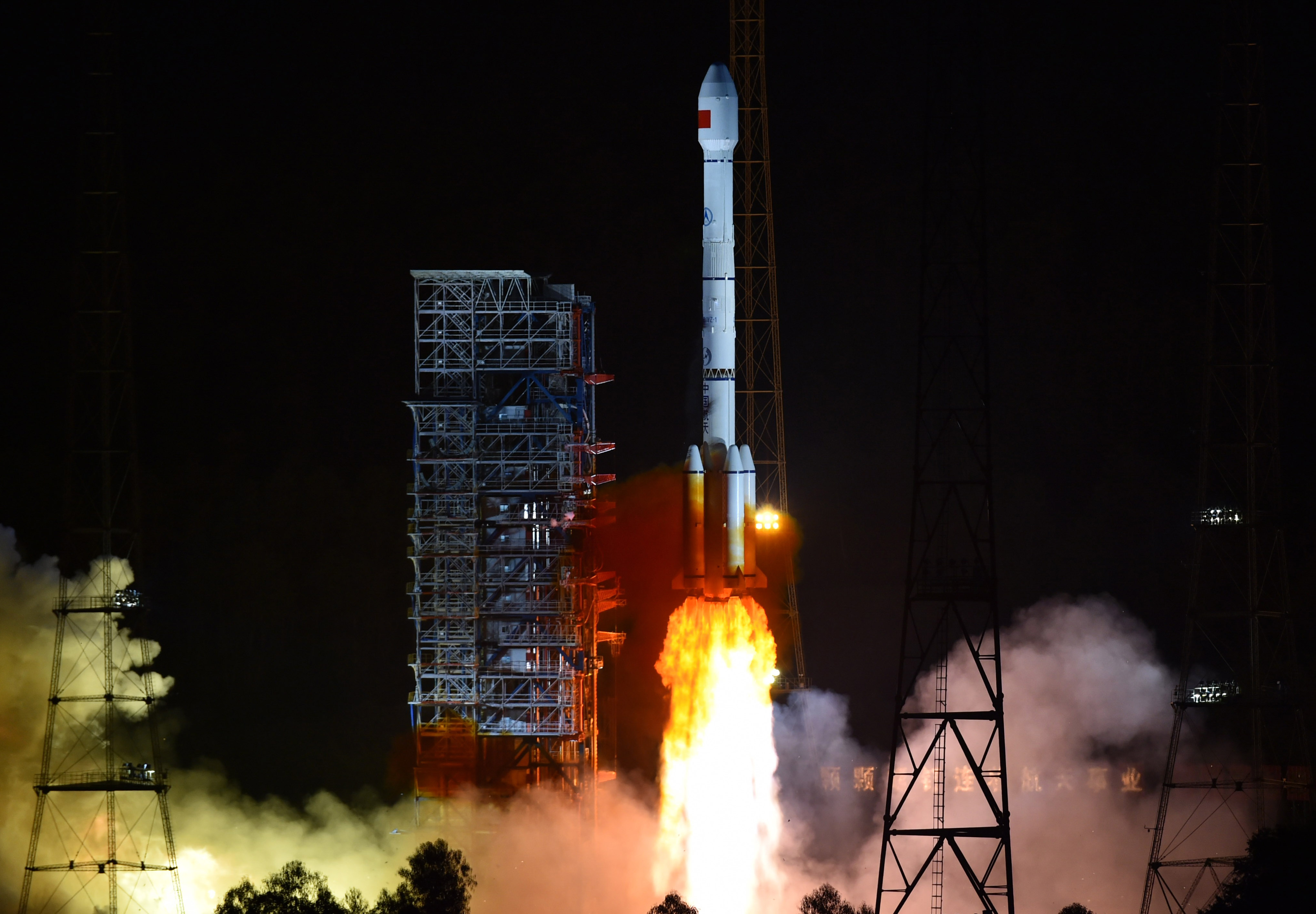
Launch of Chinese military communications satellite (Xinhua)

Mission continuity in a degraded, disrupted, or denied space environment can be ensured by the following measures: developing standard operating procedures for continuity of operations; hosting some SEIS in commercial, civil, and allied or partnered space systems as part of a surge in space capability and as a measure of redundancy; building and sustaining alternative terrestrial-based systems to reduce SEIS reliance – chip-scale combinatorial atomic navigator for precision, navigation, and timing services; high-altitude long-endurance unmanned aerial systems for persistent ISR; and fiber-optic cabling and terrestrial radio and microwave communications devices for secured C2.  

Continue to Invest in OCS Capabilities. The heart of the matter remains what type of OCS capabilities (reversible, irreversible, or both) and how much. Regarding the latter, some argue none or limited quantities are required while others call for robust OCS capabilities. Whatever the right answer may be, it is difficult to see how one can deter or retaliate if deterrence fails without “some” OCS capabilities, especially considering that potential competitors like China and Russia are actively developing their own OCS capabilities to challenge U.S. space preeminence, and by extension, terrestrial preeminence.

Strengthening Space Governance

Since the elimination of OCS capabilities is unlikely, attention and effort should be placed on managing them instead. The extant international legal framework and accepted norms of behavior offer some ways and means to reduce OCS capabilities to a manageable level, restrict their proliferation, and establish constraints and restraints on their employment. The space powers should review the existing international agreements and legal principles, and determine what additional conventions or provisions are needed. Goals can be to set acceptable limits of OCS capabilities; renounce the first-use of OCS; establish confidence-building measures; and limit the possession of OCS capabilities to select space powers and out of the hands of “pariah” states (North Korea and Iran) and undesirable non-state actors (terrorist, criminal, and business groups).  

Space powers should also review and update current treaties and legal principles to govern the changing strategic, operational, and tactical landscapes, particularly those overseeing activities in space, registration of space objects, and space sovereignty. States should negotiate new treaties to manage emerging space challenges like space debris, RF interference, and other space threats. Finally, parties must develop new capabilities and protocols for verifying treaty compliance and enforcement.               

The international community should seek to empower the United Nations (UN) governance of space and space activities, particularly in the areas of regulation, arbitration, and collaboration. The UN should consider further defining and codifying the rights and responsibilities of nation-states with respect to their activities in space through a UN Convention on the Law of Space (similar to the UN Convention on the Law of the Sea); establishing the International Space Authority (similar to the International Seabed Authority) for the regulation of space-based resources; and forming the International Tribunal for the Law of Space (similar to the International Tribunal for the Law of the Sea) for arbitration of space-related disputes. Transform the UN Office for Outer Space Affairs into an empowered World Space Council to promote international collaboration in space, manage emerging space challenges, and act as a forum for global contingency planning and preparedness for potential space threats.

Expand Partnerships. The 2010 NSP, 2011 NSSS, and 2012 DSP call for building enduring partnerships with other space-faring nations, civil space organizations, and commercial space entities to share benefits, costs, and risks; strengthen extant alliances through increased cooperation across the various space sectors; spread SEIS reliance to others; and provide greater space deterrence and stability through collective defense. That being said, partnerships also carry with them risks and concerns. Risks include the unpredictability of horizontal escalation (attack on U.S. space assets with hosted payloads involves other parties) and greater potential damages and unintended consequences (more interdependent players and things that can go wrong). Concerns center around autonomy (transparency, response, and responsiveness constrained by other parties), operational security (information sharing, technology transfer, and increased risk of insider threat), legality (intellectual property rights, loss compensation, and sovereignty), and the interoperability of disparate space systems (varying levels of sophistication amongst partners). All things considered, the benefits outweigh the risks, and concerns are manageable in varying degrees.

Partners should build on extant bilateral/multilateral partnerships to complement and supplement U.S. space capabilities. They must leverage emerging opportunities like the Memorandum of Understanding between the United States, Canada, United Kingdom, and Australia for joint space operations and Japan’s plans to develop a military space force by 2019. These partnerships may vary in nature, scope, and extent depending on the strategic and operational imperatives, costs, risks, and domestic legal constraints; and could involve capacity building, information sharing, technology transfer, interoperability, integration, and joint operations.   

Partners should promote international collaboration and foster shared reliance on space-enabled capabilities in the fields of scientific exploration (International Space Station, interplanetary probes, and manned space flights), commercial ventures (launch vehicles, micro-satellites, space tourism, and space mining), global positioning system or GPS interoperability (United States, Russia, European Union, and China), shared space situational awareness or SSA (Space Fence and Geosynchronous SSA Program), space-based observations (climate change, weather, and humanitarian assistance/disaster relief), space debris, and asteroid defense.

Conclusion

At the end of the day, space stability occurs when there is universal acceptance that “space is big enough for everyone and it is in everyone’s best interest to keep it free for exploration and use by all.” Moving forward, there is a common interest in safeguarding the collective need for guaranteed freedom of space under the imperative for all space-faring nations to support an international framework that encourages cooperation and manages competition in the space domain.  

Tuan N. Pham is widely published in national security affairs. The views expressed are his own and do not reflect the official policy or position of the U.S. Government

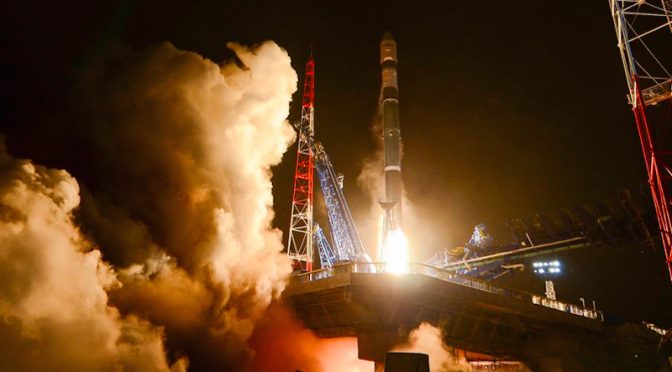
Featured Image: Launch of Russian military satellite (Russian Ministry of Defense)

The Final Frontier – The Future of Defending Space as a Global Commons

Space is big enough for everyone and it is in everyone’s best interest to keep it free for exploration and use by all. This is part 1 of a two-part series that outlines a conceptual framework characterizing the dynamics that contribute to instability and stability in the space domain. Part 2 will examine the ways and means the United States can lessen the former and strengthen the latter while maintaining space preeminence into the 21st century. Both parts are follow-on articles to a previously published piece on policy considerations for a deeper and more balanced U.S. space posture.  

By Tuan N. Pham

Many Americans view space through the prisms of history, entertainment, and exploration. Our parents grew up during the space race between the United States and the former Soviet Union, culminating in Neil Armstrong’s historic landing on the moon. We spent our youth watching popular movies and shows like Star Wars and Star Trek, while witnessing the realization of science fiction into science fact in the forms of the Space Shuttle, International Space Station, and unmanned interplanetary space travel. Our children may be the first space tourists, traveling to the heavens in commercial space vehicles. Our grandchildren may become the first space colonists, living in space and on the moon, an asteroid, or perhaps Mars. Our great grandchildren may even become the first interstellar space explorers, venturing beyond our solar system and possibly to the stars. Yet despite this popular conception of space, very few Americans know, understand, and appreciate the stark reality that we now live in a world where “space systems allow people and governments around the world to see with clarity, communicate with certainty, navigate with accuracy, and operate with assurance.” Space must be understood as a global commons – much like airspace, the oceans, and perhaps even cyberspace – where secure access and established norms ensure economic growth and political stability.

Indeed, the rapid growth and development of the global economy has heralded a new era where an ever-increasing number of nations and organizations use space for military, economic, commercial, and scientific benefits – making it more “congested, contested, and competitive.” The now pervasive and interconnected nature of space capabilities and the world’s growing dependence on them also mean that “irresponsible acts” in space can have worldwide, indiscriminate, and damaging consequences on earth. Therefore, space preeminence is that degree of preeminence in space of one force over another that permits the conduct of operations by the former at a given time and place without prohibitive interference by the opposing force (freedom of action). Such a preeminent position does not imply space dominance, a far more demanding position that would be difficult to sustain in any event, given globalized technology growth and offsetting space countermeasures.

Many space observers and pundits believe that within the next 5-10 years the evolving space environment may become increasingly destabilized due to the continued development, deployment, and proliferation of offensive counter-space (OCS) capabilities by various nations and perhaps some organizations. The unique dynamics of competition and cooperation in space must be thoroughly understood in order to shape a sustainable future in this domain that will be so critical to humanity’s future.

Dynamics of Space Instability

Instability arises when there is a real or perceived lack of order and security with the worst possible outcome being the “Thucydides Trap” – a rising power opposes a dominant power leading to great-power competition for space preeminence. The principal drivers of space instability include (but are not limited to) competing space powers, space-terrestrial preeminence linkage, the offensive-inclined nature of space warfare, and destabilizing partnerships.    

Competing Space Powers. The United States is the preeminent space power, and enjoys unprecedented and unrivaled national security advantages derived from its space capabilities. Other space powers have taken notice with some potential competitors (and possible future adversaries) developing significant capabilities to erode the U.S. strategic advantage in space and protect their own growing reliance on space capabilities. According to the 2015 United States-China Economic and Security Review Commission’s Report to Congress, Chinese military leaders regard the freedom to use space-based systems and deny the adversary access to space-based systems as central to enabling modern informationized warfare.

Space-Terrestrial Preeminence Linkage. Potential competitors are also acutely aware of U.S. terrestrial preeminence enabled by space preeminence, and see an opportunity to undercut the former through the latter. Of particular concern is a rising China, who appears to be asymmetrically targeting American dominant warfighting capabilities and exposed dependency on space assets. This is problematic for the United States who has more vulnerable high-value space assets and is more reliant on space capabilities than the other space powers. America has a disproportionate amount of vulnerable high-value space assets. Of the 1419 active satellites orbiting the earth, 576 are owned or affiliated with the United States. The next closest competitors are China (181) and Russia (140) with the former increasing rapidly in terms of quantity, quality, sophistication, and capability. America is also disproportionately dependent on space capabilities with its 278 government- or military-operated satellites, providing unmatched national security advantages in worldwide situational awareness, decision superiority, and military capability. Therefore, U.S. deterrent or response actions limited to just the space domain where the stronger power has more to lose than a weaker power may not be practical, sustainable, or even desirable.

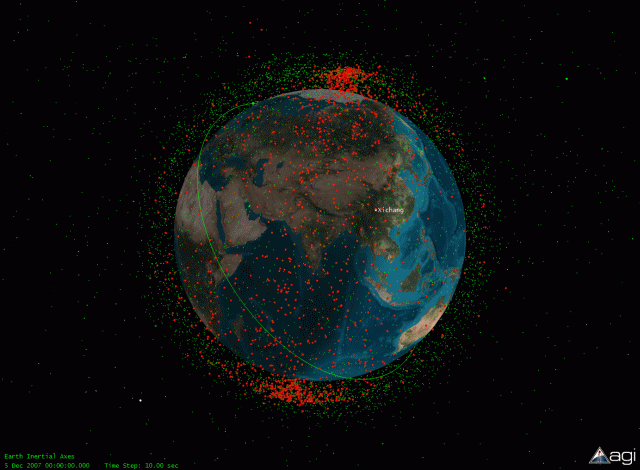
View of LEO Satellites (green) and Debris Ring (red) from the 2007 Chinese ASAT Test (AGI)

Offense-Inclined Nature of Space Warfare. “A space power that strikes aggressively should, in theory, have the advantage, or at least get the greatest possible use of whatever OCS capabilities it has invested in.” Ambiguous indications and warning, attack attribution, and battle damage assessment; uncertain resiliency and assured retaliation; and vulnerability, predictability, and fragility of space assets give the operational and tactical advantages to the attacker and increase the strategic temptation to attack. All in all, OCS capabilities are attractive options for a weaker power because they offer asymmetric means to undermine the terrestrial preeminence of a stronger power by exploiting its reliance on critically-enabling space capabilities.      

Destabilizing Partnerships. Exclusive enterprises can be perceived by excluded parties as indirect efforts to isolate and undermine them. Look how Beijing perceives Washington’s rebalance to the Indo-Asia-Pacific, Trans-Pacific Partnership, and efforts to strengthen and expand the principled network of economic and security relationships as part of the greater U.S. containment policy of China’s rise, and to a certain extent, justification for its regional assertive actions and validation of its sense of aggrieved historical victimhood (strategic narratives).     

Dynamics of Space Stability

Stability arises when there is a real or perceived sense of order and security with the best possible outcome being the universal acceptance that space is big enough for everyone and it is in everyone’s best interest to keep it free for exploration and use by all. The principal drivers of space stability include (but are not limited to) stabilizing partnerships, common space dangers, space deterrence, and space governance.     

Stabilizing Partnerships. The ubiquitous benefits of space affect the everyday lives of people around the world. Hence, multi-national corporations are collaborating more and more in space. They see vast business opportunities for shared profits and shared costs in the lucrative areas of space situational awareness, scientific exploration, commercial ventures, and space tourism. In the geopolitical realm, inclusive enterprises share risk and promote mutual trust and cooperation amongst the parties involved. If all share the same risk, then a space attack on one is a space attack on all.    

Common Space Dangers. There are over 60 nations and government consortia that own and operate satellites. All of whom share the same domain; common interest of stability, security, and sustainability; and desire for free access to and use of space for all. Space debris accumulated over six decades of space activities impacts current and threatens future space operations and activities. The U.S. Department of Defense tracks approximately 22,000 “man-made” objects in addition to the 1419 active satellites. Nonetheless, there may be as many as hundreds of thousands of additional pieces of debris that are too small to track with current sensors. There is also an increasing global awareness of potential catastrophic space threats (asteroid, solar events, cosmic radiation, etc.) and a growing interest for global contingency planning and preparedness.

Space Deterrence (Keeping the Peace). Many space strategists view deterrence through the doctrinal lens of imposing costs, denying benefits, and encouraging restraint to deter or make an adversary believe that starting a war or escalating a conflict would be worse than not doing so.     

Imposing Costs. OCS capabilities are necessary at some level to enable deterrence and retaliation if deterrence fails, unless space assets can be given far greater resilient capabilities than the little they have today. Moreover, OCS capabilities like nuclear and cyber (and developing hypersonic) weapons are now permanent fixtures of the strategic arsenal. In other words, the genie is out of the bottle. Those who possess OCS capabilities are unlikely to surrender them. Those who do not have OCS capabilities will try to acquire them, while those who do have OCS capabilities will try to prevent others from getting them.

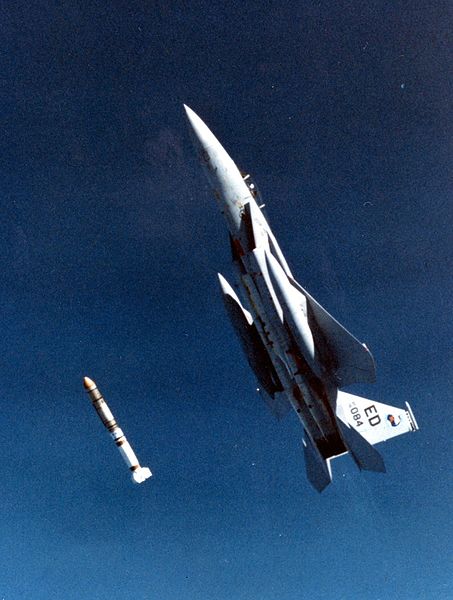
U.S. ASAT (Anti-satellite) missile launch on Sep. 13, 1985. Taken at the Pacific Missile Test Range in California. (USAF/Paul E. Reynolds)

Denying Benefits. Resilient space architecture “may” be able (in varying degree) to blunt the effectiveness of OCS capabilities; offset the offense-inclined nature of space warfare by lessening the vulnerability and fragility of space assets; reduce the temptation for a first strike; and assure a second strike capability.

Encouraging Restraint. Uncertain consequences in terms of second- and third-order effects and uncontrolled escalation may give pause to the attacker and possibly decrease the temptation to attack. A space attack can inadvertently impact the attacker as well in terms of degraded or lost global services, space debris, political costs, and indirect economic costs.     

Space Governance (Managing the Peace). An extant body of international agreements (treaties) and legal principles forms a framework of accepted norms of behavior for the space domain. However, more diplomatic and legal conventions are still needed to manage the constantly evolving strategic, operational, and tactical landscapes in space; and enhance the space stability thereof – particularly in the areas of space debris, space traffic regulation, resource exploitation, OCS capabilities, arms control, and arms reduction.

Conclusion  

This concludes the short discourse on the dynamics of space instability and stability; and sets the conditions for further discussion in Part 2 on the ways and means the United States can employ to reduce instability and strengthen stability in the space domain while maintaining space preeminence into the new century. Decline is a deliberate choice, not an inevitable reality.    

Read Part 2 here.

Tuan N. Pham has extensive and diverse experience in national security affairs. The views expressed are his own and do not reflect the official policy or position of the U.S. Government.

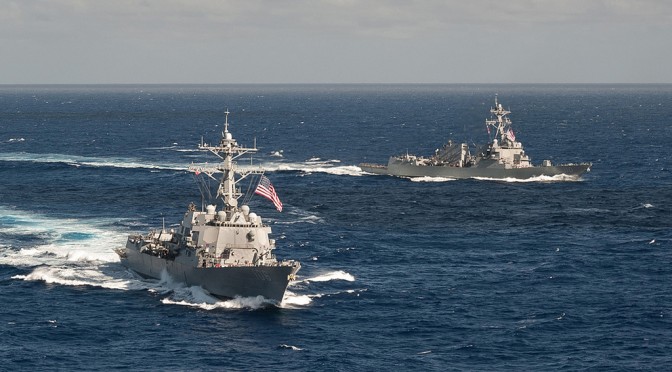
Featured: GULF OF ADEN (June 1, 2016) Guided-missile destroyer USS Gonzalez (DDG 66) transits the Gulf of Aden. (U.S. Navy photo by Mass Communication Specialist 3rd Class Pasquale Sena/Released)

The Strategic Support Force: China’s Information Warfare Service

This piece was originally published by the Jamestown Foundation. It is republished here with permission. Read it in its original form here.

By John Costello

Gao Jin (高津) is the PLASSF’s Commander. Note that he was promoted to major general in June 2006 and to lieutenant general occurred in July 2013. (Xinhua)

On December 31, 2015, Xi Jinping introduced the People’s Liberation Army Rocket Force (PLARF; 火箭军), Strategic Support Force (PLASSF; 战略支援部队), and Army Leadership Organ. The move came just within the Central Military Commission’s deadline to complete the bulk of reforms by the end of the year. Most media coverage has focused on the Rocket Force, whose reorganization amounts to a promotion of the PLA Second Artillery Force (PLASAF) to the status of a service on the same level of the PLA Army, Navy, and Air Force. However, by far the most interesting and unexpected development was the creation of the SSF.

According to official sources, the Strategic Support Force will form the core of China’s information warfare force, which is central to China’s “active defense” strategic concept. This is an evolution, not a departure from, China’s evolving military strategy. It is a culmination of years of technological advancement and institutional change. In the context of ongoing reforms, the creation of the SSF may be one of the most important changes yet. Consolidating and restructuring China’s information forces is a key measure to enable a number of other state goals of reform, including reducing the power of the army, implementing joint operations, and increasing emphasis on high-tech forces.

The Strategic Support Force in Chinese Media

Top Chinese leadership, including President Xi Jinping and Ministry of Defense spokesman Yang Yujun have not provided significant details about the operational characteristics of the SSF. Xi has described the SSF as a “new-type combat force to maintain national security and an important growth point of the PLA’s combat capabilities” (MOD, January 1).

On January 14, the SSF’s newly-appointed commander, Gao Jin (高津) said that the SSF will raise an information umbrella(信息伞) for the military and will act as an important factor in integrating military services and systems, noting that it will provide the entire military with accurate, effective, and reliable information support and strategic support assurance (准确高效可靠的信息支撑和战略支援保障) (CSSN, January 14). [1]

Senior Chinese military experts have been quick to comment on the SSF, and their interviews form some of the best and most authoritative insights into the role the new force will play in the Chinese military. For instance, on January 16th, the Global Times quoted Song Zhongping (宋忠平), a former PLASAF officer and a professor at the PLARF’s Equipment Research Academy, who described SSF as as a “fifth service” and, contrary to official reports, states it is not a “military branch” (兵种) but rather should be seen as an independent military service (军种) in its own right. [2] He continues by stating that it will be composed of three separate forces or force-types: space troops (天军), cyber troops (网军), and electronic warfare forces (电子战部队). The cyber force would be composed of “hackers focusing on attack and defense,” the space forces would “focus on reconnaissance and navigation satellites,” and the electronic warfare force would focus on “jamming and disrupting enemy radar and communications.” According to Song, this would allow the PLA to “meet the challenges of not only traditional warfare but also of new warfare centered on new technology” (Global Times, January 16).

By far the most authoritative description of the Strategic Support Force comes from People’s Liberation Army Navy (PLAN) Rear Admiral Yin Zhuo (尹卓). As a member of both the PLAN Expert Advisory Committee for Cybersecurity and Informatization (海军网络安全和信息化专家委员会) and the All-Military Cybersecurity and Informatization Expert Advisory Committee (全军网络安全和信息化专家委员会, MCIEAC) formed in May 2015, Yin is in the exact sort of position to have first-hand knowledge of the SSF, if not a direct role in its creation.

In an interview published by official media on January 5th, 2016, Yin stated that its main mission will be to enable battlefield operations by ensuring the military can “maintain local advantages in the aerospace, space, cyber, and electromagnetic battlefields.” Specifically, the SSF’s missions will include target tracking and reconnaissance, daily operation of satellite navigation, operating Beidou satellites, managing space-based reconnaissance assets, and attack and defense in the cyber and electromagnetic spaces” and will be “deciding factors in [the PLA’s] ability to attain victory in future wars” (China Military News, January 5).

Yin also foresees the SSF playing a greater role in protecting and defending civilian infrastructure than the PLA has in the past:

“[The SSF] will play an important role in China’s socialist construction. Additionally, China is facing a lot of hackers on the internet which are engaging in illegal activities, for example, conducting cyber attacks against government facilities, military facilities, and major civilian facilities. This requires that we protect them with appropriate defense. The SSF will play an important role in protecting the country’s financial security and the security of people’s daily lives” (China Military News, January 5).

Yang Yujun, MND spokesman, also suggested that civilian-military integration will form a portion of the SSF’s mission, but stopped short of clarifying whether this meant the force will have a heavy civilian component or will be involved in defending civilian infrastructure, or both (CNTV, January 2).

Yin noted that the SSF will embody the PLA’s vision of real joint operations. In Yin’s view, military operations cannot be divorced from “electronic space,” a conceptual fusion of the electromagnetic and cyber domains. The SSF will integrate “reconnaissance, early warning, communications, command, control, navigation, digitalized ocean, digitalized land, etc. and will provide strong support for joint operations for each military service branch.” Indeed, this view was also echoed by Shao Yongling (邵永灵), a PLARF Senior Colonel who is currently a professor at the PLA’s Command College in Wuhan. She suggested that the SSF was created to centralize each branch of the PLA’s combat support units, where previously each service had their own, resulting in “overlapping functions and repeat investment.” Consolidating these responsibilities in a central force would allow the military to “reduce redundancies, better integrate, and improve joint operational capabilities” (China Military News, January 5).

Taken together, these sources suggest that at its most basic, the SSF will comprise forces in the space, cyber, and electromagnetic domains. Specifically, sources indicate the SSF will most likely be responsible for all aspects of information in warfare, including intelligence, technical reconnaissance, cyber attack/defense, electronic warfare, and aspects of information technology and management.

Force Composition

Rear Admiral Yin’s comments in particular suggest that at a minimum the SSF will draw from forces previously under the General Staff Department’s (GSD) subordinate organs, to include portions of the First Department (1PLA, operations department), Second Department (2PLA, intelligence department), Third Department (3PLA, technical reconnaissance department), Fourth Department (4PLA, electronic countermeasure and radar department), and Informatization Department (communications).

The “Joint Staff Headquarters Department” (JSD) under the Central Military Commission will likely incorporate the 1PLA’s command and control, recruitment, planning, and administrative bureaus. Information support organs like the meteorology and hydrology bureau, survey and mapping bureau, and targeting bureau would move to the SSF.

The GSD’s intelligence department, the 2PLA will likely move to the SSF, although there is some question as to whether it will maintain all aspects of its clandestine intelligence mission, or this will be moved to a separate unit. The Aerospace Reconnaissance Bureau (ARB), responsible for the GSD’s overhead intelligence, surveillance, and reconnaissance mission will most likely form the center of the SSF’s space corps. The 2PLA’s second bureau, responsible for tactical reconnaissance, will also move to the SSF. This will include one of its primary missions: operating China’s long-range unmanned aerial vehicles (UAV).[3]

The SSF will unify China’s cyber mission by reducing the institutional barriers separating computer network attack, espionage, and defense, which have been “stove-piped” and developed as three separate disciplines within the PLA. The 3PLA’s technical reconnaissance and cyber espionage units will likely move, including the national network of infamous technical reconnaissance bureau’s (TRB), the most famous of which is Unit 61398. The 4PLA’s electronic countermeasures mission will likely form the core of a future electronic warfare force under the SSF, and the its secondary mission of computer network attack (CNA) will also likely also move under the SSF.

Finally, the entirety of the Informatization Department will likely move to the SSF. This will unify its mission, which has expanding over the years to include near all aspects of the support side of informatization, including communications, information management, network administration, computer network defense (CND), and satellite downlink.

Drawing the bulk of the SSF from former GSD organs and subordinate units is not only remarkably practical, but it is also mutually reinforcing with other reforms. Firstly, it reduces the power and influence of the Army by removing its most strategic capabilities. Previously the PLA Army was split into two echelons, its GSD-level headquarters departments (部门) and units (部队) and Military Region-level (MR; 军区) operational units. GSD units did not serve in combat or traditional operational roles, yet constituted some of China’s most advanced “new-type” capabilities: information management, space forces, cyber espionage, cyber-attack, advanced electronic warfare, and intelligence, reconnaissance, and surveillance. The creation of the Army Leadership Organ effectively split the Army along these lines, with lower-echelon forces forming the PLA Ground Forces and the higher-echelon units forming the Strategic Support Force.

Secondly, separating these capabilities into a separate SSF allows the PLA Army to concentrate on land defense and combat. Nearly all personnel staffing the supposedly joint-force GSD units were Army personnel and by-and-large these units were considered Army units, despite serving as the de facto joint strategic support units for the entire PLA military. Giving the SSF its own administrative organs and personnel allows the PLA Army to concentrate solely on the business of ground combat, land defense, and fulfilling its intended roles in the context of China’s national defense strategy.

Finally and most importantly, separating the second, third, fourth, and “fifth” departments—as the Informatization Department is sometimes called—into their own service branch allows them to be leveraged to a greater degree for Navy Air Force, and Rocket Force missions. More than anything, it allows them to focus on force-building and integrating these capabilities across each service-branch, thereby enabling a long-sought “joint-force” capable of winning wars.

In many ways, taking GSD-level departments, bureaus, and units and centralizing them into the Strategic Support Force is making official what has long been a reality. GSD-level components have nearly always operated independently from regional Group Army units. Separating them into a separate service is less of an institutional change and more of an administrative paper-shuffle.

Integrated Information Warfare

The Strategic Support Force will form the core of China’s information warfare force, which is central to China’s strategy of pre-emptive attack and asymmetric warfare. China’s new military reforms seek to synthesize military preparations into a “combined wartime and peacetime military footing.” These “strategic presets” seek to put China’s military into an advantageous position at the outset of war in order to launch a preemptive attack or quickly respond to aggression. [4] This allows China to offset its disadvantages in technology and equipment through preparation and planning, particularly against a high-tech opponent—generally a by-word for the United States in PLA strategic literature.

These presets require careful selection of targets so that a first salvo of hard-kill and soft-kill measures can completely cripple an enemy’s operational “system of systems,” or his ability to use information technology to conduct operations. Achieving this information dominance is necessary to achieve air and sea dominance, or the “three dominances.” [5] A PLA Textbook, The Science of Military Strategy, (SMS) specifically cites space, cyber, and electronic warfare means working together as strategic weapons to achieve these ends, to “paralyze enemy operational system of systems” and “sabotage enemy’s war command system of systems.” [6] This includes launching space and cyber-attacks against political, economic, and civilian targets as a deterrent. The Strategic Support Force will undoubtedly play a central role as the information warfare component of China’s warfare strategy, and will be the “tip of the spear” in its war-plans and strategic disposition.

Remaining Questions

Despite what can be culled and answered from official sources and expert commentary, significant questions remain regarding the structure of Strategic Support Force and the roles it will play. For one, it is unclear how the Strategic Support Force will incorporate civilian elements into its ranks. Mentioned in 2015’s DWP and the more recent reform guidelines, civilian-military integration is a priority, but Chinese official sources have stopped short in describing how these forces will be incorporated into military in the new order (MOD, May 26, 2015). Previously, the General Staff Department research institutes, known as the “GSD RI’s,” acted as epicenters of civilian technical talent for strategic military capabilities. If the Strategic Support Force is primarily composed of former GSD units, then these research institutes will be ready-made fusion-points for civilian-military integration, and may take on a greater role in both operations and acquisition. Even so, the civilian piece is likely to prove vital, as they will undoubtedly serve as the backbone of China’s cyber capability.

Secondly, it is unknown specifically what forces will compose the Strategic Support Force, or the full extent of its mission. When official sources say “new-type” forces, they could mean a wide range of different things, and the term can include special warfare, intelligence operations, cyber warfare, or space. At a minimum, a consensus has emerged that the force will incorporate space, cyber, and electronic warfare, but the full extent of what this means is unclear. It is also unknown, for instance, if the space mission will include space launch facilities, or whether those will remain under the CMC Equipment Development Department, a rechristened General Armament Department. Where psychological operations will fall in the new order is also up for debate. Some sources have said that it will be incorporated into the SSF while others have left it out entirely.

Finally, although it is clear that the SSF will act as a service, it remains unclear if the CMC will also treat it as an operational entity, or how the CMC will operationalize forces that are under its administrative purview. It is unlikely that the military theaters will have operational authority over strategic-level cyber units, electronic warfare units, or space assets. These capabilities will likely be commanded directly by the CMC. This logic flies in the face of the new system, which requires that services focus on force construction rather than operations and warfare. The solution may be that the SSF, as well as the PLARF, act as both services and “functional” commands for their respective missions.

Conclusion

Ultimately, the strategic support force needs to be understood in the broader context of the reforms responsible for its creation. On one hand, the reforms are practical, intending to usher China’s military forces into the modern era and transform them into a force capable of waging and winning “informatized local wars.” On the other hand, the reforms are politically motivated, intending to reassert party leadership to transform the PLA into a more reliable, effective political instrument.

The Strategic Support Force, if administered correctly, will help solve many of the PLA’s problems that have prevented it from effectively implementing joint operations and information warfare. The creation of an entire military service dedicated to information warfare reaffirms China’s focus on the importance of information in its strategic concepts, but it also reveals the Central Military Commission’s desire to assert more control over these forces as political instruments. With the CMC solidly at the helm, information warfare will likely be leveraged more strategically and will be seen in all aspects of PLA operations both in peace and in war. China is committing itself completely to information warfare, foreign nations should take note and act accordingly.

John Costello is Congressional Innovation Fellow for New American Foundation and a former Research Analyst at Defense Group Inc. He was a member of the U.S. Navy and a DOD Analyst. He specializes in information warfare, electronic warfare and non-kinetic counter-space issues.

Notes

1. A Chinese-media report on Gao Jin’s military service assignments can be found at <http://news.sina.com.cn/c/sz/2016-01-01/doc-ifxneept3519173.shtml>. Gao Jin’s role as commander of the SSF is noteworthy in two respects: One, he is a career Second Artillery officer, so his new role muddies the waters a bit in understanding whether the SSF will be a force composed of Army personnel but treated administratively separate from the Army—not unlike the former PLASAF-PLA Army relationship—or will be composed of personnel from various services and treated administratively separate from all forces. Secondly and more important to this discussion, before his new post as SSF commander, Gao Jin was head of the highly-influential Academy of Military Sciences (AMS) which besides being the PLA’s de facto think-tank (along with the National Defense University), is responsible for putting out the Science of Strategy, a wide-reaching consensus document that both captures and guides PLA strategic thinking at the national level. The most recent edition published in 2013 was released under his tenure as commandant of AMS and many of the ideas from that edition have found their way into the 2015 defense white paper, December’s guide on military reforms, and many of the changes made to China’s national defense establishment. His new role could be seen as CMC-endorsement of SMS’s views on China’s strategic thought.

2. Song’s description of the SSF contradicts official-media descriptions of the service, which had suggested that the service will occupy a similar echelon to that of the PLASAF before it was promoted to full military service status equal to the other branches.

3. Ian M. Easton and L.C. Russell Hsiao, “The Chinese People’s Liberation Army’s Unmanned Aerial Vehicle Project: Organizational Capacities and Operational Capabilities,” 2049 Institute, March 11, 2013. p. 14.

4. The Science of Military Strategy [战略学], 3rd ed., Beijing: Military Science Press, 2013. p. 320.

5. Ibid. p. 165.

6. Ibid. p. 164.

Featured Image: Soldiers of the Chinese People’s Liberation Army 1st Amphibious Mechanized Infantry Division prepare to provide Chairman of the Joint Chiefs of Staff Adm. Mike Mullen with a demonstration of their capablities during a visit to the unit in China on July 12, 2011. (DoD photo by Mass Communication Specialist 1st Class Chad J. McNeeley/Released)

Implementing Distributed Lethality within the Joint Operational Access Concept

Distributed Lethality Topic Week

By LCDR Collin Fox

If you look for “distributed lethality” in doctrine, you won’t find it.  It’s a concept that exists in articles, speeches and panel discussions, which paint the topic with broad strokes – easy to understand, but leaving plenty of room for forums like this one to flesh out details. Tempting as it is to think about a few Surface Action Groups (SAGs) heroically dominating the contested maritime battlespace with SM-6s hitting everything from FFGs to ASBMs, distributed lethality remains just one part of a larger joint fight. Distributed lethality, so far as it has been articulated, closely follows the Joint Operational Access Concept (JOAC).

Potential enemies – principally China and Russia – can hold our forces at risk in certain contested areas, denying freedom of action. JOAC starts at this hard truth of vulnerability and seeks to protect friendly forces operating within those contested areas. Conceptually, it all starts with force protection:

“A joint force will lessen its exposure by a combination of dispersion, multiple lines of operations, speed of movement, agile maneuver that reroutes around threats, deception, masking or other concealment techniques, and disruption of enemy intelligence collection through counterreconnaissance, countersurveillance, and other methods.” (JOAC Protection)

“[D]ispersion [and] multiple lines of operations” sounds a lot like the first part of distributed lethality, and in the naval context, it makes a lot of sense to spread out, hide, and try not to look too important when anticipating DF-21 and ASCM salvos. Dispersion has its own complications, though. Concentrated naval forces may be easier to target, but they generally have a more potent sensor and weapon mix, to say nothing of their C2. Dispersed forces must remain capable of self-defense and power projection, and so the second part of ‘distributed lethality’ follows from the first.  JOAC puts it this way:

“Once arrived in the objective area, joint force elements can no longer use some techniques to avoid detection and will therefore rely on active and passive defensive measures to defeat actual enemy attack.”  (JOAC Protection)

So far, distributed lethality resembles JOAC with naval characteristics, but JOAC keeps on going where the conceptual sketch of distributed lethality trails off. Distributed lethality, as a naval variation on a joint concept, should follow the conceptual path already beaten by JOAC.

Distributed lethality, like JOAC, requires reliable communications between sensor-shooter nodes.  The ranges between distributed units and the bandwidth requirements for responsive C4I and lethal, cooperative targeting will drive communications onto SATCOM nets, networks that remain vulnerable to anti-satellite missiles, directed energy weapons, and cyber-attacks. GPS and intelligence satellites face the same threats. JOAC recognizes this vulnerability, and directs the joint force to “develop systems, technologies, and warfighting techniques to ensure continued freedom of action and access to space, cyberspace, and the electromagnetic spectrum when and where needed.” Lacking that freedom of access, the implications are clear and dire for distributed lethality: the enemy would attack the distributed fleet sequentially, as it located ship groups, with locally massed fires. The distributed fleet, unable to communicate, could only respond with uncoordinated counterattacks. Sending a divided fleet with nothing but locally organic sensors and weapons deep inside an enemy threat WEZ courts disaster. In order to effectively implement distributed lethality, robust and resilient supporting networks are absolutely essential.

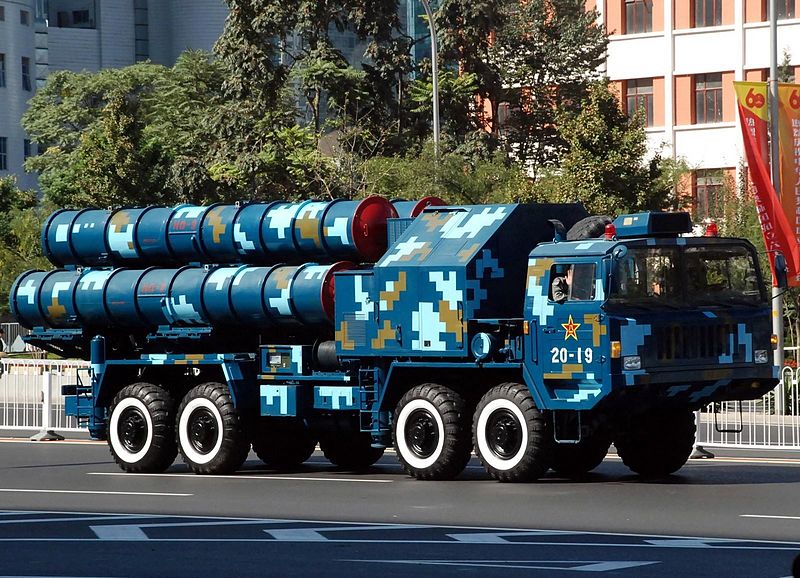
Chinese HQ-9 TEL on parade.

Satellites face the same persistent threat that prompted the concepts of JOAC and distributed lethality to begin with: the presence of friendly critical vulnerabilities inside the threat WEZ. The solution remains conceptually similar: increase the capability, type and number of available platforms such that the enemy never has the capability to decisively target and neutralize friendly critical capabilities. To that end, what naval “systems, technologies, and warfighting techniques” could change the sudden loss of our most important space-based assets from a travesty to a moderate inconvenience?  The remainder of this piece will depart the broad conceptual discussion and dive down to some very tactical level solutions.

Rather than present the killer app, silver bullet or what have you, I’ll briefly introduce a few capabilities that could take the sting out of losing the most important satellites in a region during the opening salvos. 

Navigation 

CosmoGator mitigates the loss of GPS by automating celestial navigation fixes and feeding them into the ship’s inertial navigation system, enabling weapons quality tracks even in a GPS denied or degraded environment – provided the stars remain visible. As anyone who has tracked a submarine with sonobouys can appreciate, imprecision in the sensor location yields imprecision in the target track and targeting solution.

Adding the capability to track non-U.S. commercial SATNAV constellations (Galileo, GLONASS, BeiDou, etc) would add navigational and time/time-interval redundancy to naval platforms.  The targeting of U.S. navigational satellites should be a forgone conclusion, but targeting satellites of non-belligerent states is anything but.

Local Communications

Currently, communicating within a SAG is relatively easy, but at the cost of a very distinctive electronic signature.  Distributed lethality requires low-observable and low-probability of attribution communications within the SAG.

First, low-attribution communications means taking existing commercial waveforms and using them to replace distinctively military signals. A DF scan for 2.4/5 GHz 802.11, CDMA, LTE or GSM signals in most contested areas would be overwhelmed by emitters.  Coastal residents, merchant mariners and local fishermen tend to use these signals rather a lot without much concern for EMCON. Coupling these frequencies and waveforms with stabilized, high gain directional antennas would enable high bandwidth, low-latency line-of-sight communications within the SAG while maintaining the electronic signature of a freighter or coastal village. When sneaking through a forest of transmitters, it’s best to look like a common electronic tree.

In an update on flashing light Morse signals, the ONR project for High-Bandwidth, Free-Space Optical Communications is designed to support Marines at austere FOBs, but could also offer unimpeded communications in a highly attenuated – and therefore difficult to intercept – part of the spectrum. Like celestial navigation, meteorological conditions may occasionally preclude this method, but for the rest of the time, it’s a good way to complicate enemy targeting.

Finally, better integration of automatic level control – adjusting transmit power based on signal-to-noise ratio (SNR) and signal-excess – could do much to reduce the probability of detection for existing RF transmitters.  Only transmit the power required to reliably reach the ship 10 miles away, not the ELINT aircraft 400 miles further.

Long-range communications

I’m not the first to think about making elevated nodes like satellites a bit more redundant for communications.  DARPA and ONR have been developing the Towed Airborne Lift of Naval Systems (TALONS), a towed shipboard parafoil system capable of lifting a 150 pound payload to 1,500 feet.  Unlike most aircraft (manned or unmanned), a towed system can remain aloft for days on end. Improving on the system that well-tanned parasailing operators have been using for decades, DARPA has made an automated launch and recovery system. In the context of distributed lethality, ships such as the LCS and EPF (formerly JHSV) could serve as communication nodes for ships with long-range weapons.

The Air Force has been using the Battlefield Airborne Communications Node  (BACN) for years as a communications Swiss army knife to connect disparate platforms, waveforms, and standards. The technology is platform agnostic – the Air Force operates it from modified business jets (E-11A) and UAVs (RQ-4); the Navy could just as easily operate the system from P-8As or MQ-4s.

TALONS and BACN have their appeal, but also their limitations.  A radar horizon of roughly 50 nautical miles limits TALONS, and on-station time limits BACN and systems like it. Counter targeting is a common threat to both. Ideally, a satellite replacement would be close to disposable and not so closely proximate to a manned and/or difficult to replace platform like the LCS, EPF, P-8A or MQ-4. Which brings us to lighter-than-air unmanned vehicles. 

A Google Project Loon internet balloon in flight. Photo credit: Google.

Google has deployed stratospheric balloons to bring internet services to remote locations, getting and keeping them on-station with altitude-picking algorithms.  Similarly, the Navy could rapidly deploy very high altitude, very high endurance vehicles – atmospheric satellites – in the immediate aftermath of an attack on regional communications satellites at a lower cost and greater quantity than the enemy’s inventory of high-altitude missiles capable of taking them down.  Much of the cost and difficulty of satellites is the launching part.  Launching a balloon from a ship consists of setting a course and speed for minimal winds, opening a valve to a helium tank and assisting the inflation with a crane and a crew of deck handlers – hardly rocket science.  Any naval platform with a flight deck could launch balloons on demand to fill in for neutralized satellites or to quickly add more C4ISR capabilities. While the time on station of roughly 100 days can’t match a satellite, it exceeds the state of the art for heavier-than-air vehicles by an order of magnitude.

It’s quite possible, even likely, that none of the particular solutions above have any place in the Navy’s future. I hope that the unifying theme, however, resonates: pragmatic over exotic, commercial off-the-shelf over bespoke military kit, and integration within a larger joint effort rather than a service specific attempt to win the next war singlehandedly.

Collin Fox is a Western Hemisphere Foreign Area Officer (FAO) assigned to U.S. Fleet Forces Command. In his former career as a SH-60F and MH-60S pilot, he flew over 1,400 flight hours and conducted three life-saving rescues. He earned a Master of Science degree in Systems Analysis from the Naval Postgraduate School, where his final project won the John Hopkins Applied Physics Lab Award for Excellence in Systems Analysis. The views expressed here are his own.