Tag Archives: Space

The Importance of Space in Maritime Security

Honorable Mention – CIMSEC High School Essay Contest

As long as man has walked the Earth and gazed into the stars, he’s asked “what’s out there what’s waiting for me?” Today, our country asks that very same question, although not for what we can find, but how we can use Space and its resources to advance our scientific and military might into, and hopefully beyond the 21st century.
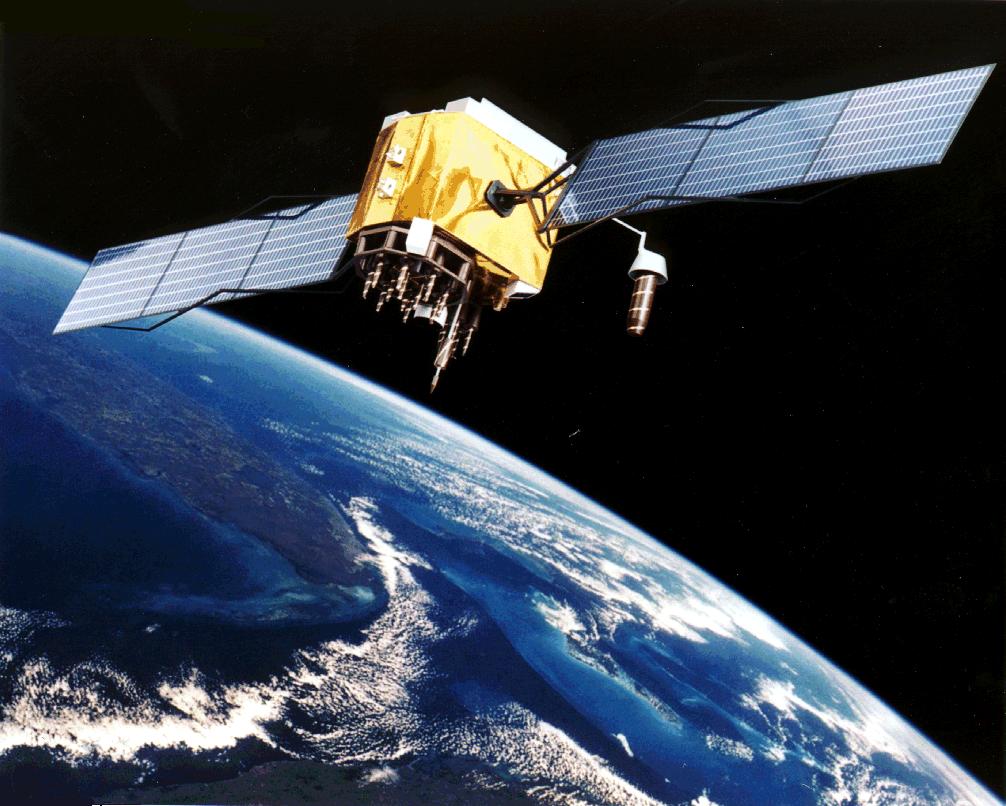
GPS_Satellite_NASA_art-iifWith the dawn of rockets and the nuclear confrontation between the United States and the Soviet Union during the height of the Cold War, Space would soon become a vital asset for the interests of both countries and other major players for the years to come (particularly China). With the sudden rise of China, and the reemergence of the Russia as a major military power, it is absolutely vital that the United States once again pursue Space for economic, political, and commercial purposes, as well as for strategic military purposes which will benefit not only the military, but the United States as a whole; and how our Navy can play a big role in helping us make this happen.

As of the time of this writing, the United States and other Western European Countries are currently embroiled in a geopolitical dispute with Russia over Ukraine and the rights of its territory such as Crimea and Eastern Ukraine. As a result of this, the United States and the European Union declared economic sanctions on Russia which are meant to cripple the Russian economy and force Russia out over its interference in Ukraine. In response to this, the Kremlin has threatened to stop shuttling Astronauts to and from the International Space Station, and cut off supplies to the ISS.  In 2007, the Chinese military carried out its first antisatellite missile test when it launched a ground based missile 500 miles to destroy an aging satellite of theirs.

Both of these events are very disturbing as they easily threaten the United States and its space capability to carry out intelligence gathering and reconnaissance missions in Space using the latest technology and satellites. If these satellites, whether civilian or military, ever happen to be threatened in a time of war, the results could be catastrophic. The Navy should invest in further developing laser weapons like the LaWS that are capable of punching holes through thick steel plates on ships as well as a countermeasure against any ballistic missile that may threaten our satellite capability in Space or onboard the ISS. Laser weapons are surprisingly very cheap and affordable. According to Rear Admiral Matthew Klunder in an interview for defense-aerospace.com, “with affordability a serious concern for our defense budgets, this will more effectively manage resources to ensure our sailors and marines are never in a fair fight.” The article goes on to claim that firing this type of weapon can cost less than $1 dollar per shot; a great bargain in a time that our military is starting to see a drawdown in military spending. Christopher Harrier, an analyst at the Institute for the Study of War was quoted as saying that: “The existing naval weapons systems, small-caliber cannons, large-caliber naval guns, and missiles, are at or near the limits of their potential capability. Guns and missiles just aren’t going to get much more accurate or lethal while lasers have significant potential for increases in range, accuracy, lethality, reliability, and cost-effectiveness.”

It is clear that if the Navy wants to confront new 21st Century threats, it must research and develop new combat systems, whether it is by land, sea, air, or space.  The Russians and the Chinese are also looking into developing similar weapons systems, while also trying to implement a missile defense system capable of intercepting and eliminating enemy targets. With a resurgent Russia and emerging China, this has become a must for defense of our allies and overseas military installations all around the world. It has been stated that an enemy country wouldn’t necessarily have to launch a direct nuclear strike if it wanted to destroy the United States. Countries like China and Russia could simply detonate a nuclear weapon in the upper atmosphere right over the Midwestern United States and knock out most, if not all, of the electrical power grids in the continental United States through an Electromagnetic Pulse Effect. An EMP would be devastating to the United States as it would cripple our infrastructure, down all of our technology, leave the US Government and military crippled and slow to react, and cause the global economy to collapse. It would be a scene right out of a post-apocalyptic film like The Postman or The Book of Eli. Not to mention the millions of casualties and deaths that would occur due to starvation or anarchy. It would truly be a shame and a complete lack of competence if our Government doesn’t have a contingency plan already in place for an event like this.

In order for this plan on space based missile defense to work however, it must learn from the mistakes made in the 1980’s when Ronald Reagan famously proposed in 1983 his SDI (Strategic Defense Initiative) or the “Star Wars Program”. As many people know, SDI was announced in 1983 by Ronald Reagan as a means of countering the Soviet threat with space based weaponry capable of shooting down any Soviet missile before it entered American airspace. Unfortunately, due to the slow technological development at the time of space based missile defense systems, as well as other factors including the Dissolution of the USSR, inefficiency, and overall lack of continued public support, SDI did not succeed in meeting its goals.

In comparison to the 1980’s-early 90’s, America does have the infrastructure in 2015 to support a new SDI type program. For starters, in 1983 something called: “private space companies” did not exist. With companies such as SpaceX, Virgin Galactic, Orbital Sciences, and Blue Origin starting to appear and establish themselves as legitimate companies in the aerospace sector, there’s no reason why they couldn’t be expected to help the American military develop a space based missile defense system. Similar to how other Aerospace contractors such as Boeing and Lockheed Martin have helped the Air Force in its development of their new aircraft and weapons systems, a joint government/private program with the DoD and Navy providing the funding, and the private companies will handle the testing and development could be developed. That way there won’t be as large of an outcry by the public as there was with SDI in the 1980’s and the politicians/military leaders don’t have to worry so much about any failures and the potential political backlash with the program, as it will fall on the shoulders of the private contractors. Plus, this program will be more affordable now than it ever was in the 1980s.

SpaceX is currently developing the Falcon-9 space rocket with the intention of making it reusable and cheaper to launch into orbit. According to NASA, the average typical launch cost for the Space Shuttle Program was $450 million dollars. With the SpaceX designed Falcon-9 rocket, that cost is now about 50-56 million USD, an absolute bargain when compared to how much NASA’s launches cost. The biggest obstacle to this plan would not necessarily be the technical or financial challenges involved, but compliance with international law such as the 1967 Outer Space Treaty. Article IV of the 1967 Space Treaty states: “States Parties to the Treaty undertake not to place in orbit around the earth any objects carrying nuclear weapons or any other kinds of weapons of mass destruction, install such weapons on celestial bodies, or station such weapons in outer space in any other manner.

The moon and other celestial bodies shall be used by all States Parties to the Treaty exclusively for peaceful purposes. The establishment of military bases, installations and fortifications, the testing of any type of weapons and the conduct of military maneuvers on celestial bodies shall be forbidden. The use of military personnel for scientific research or for any other peaceful purposes shall not be prohibited. The use of any equipment or facility necessary for peaceful exploration of the moon and other celestial bodies shall also not be prohibited. “

The key words in this text being: “Nuclear or any kinds of weapons of mass destruction.” WMD’s are most often defined as being either: Biological, Chemical, Radiological, or Nuclear.  Since lasers do not fall into either of these specifically defined categories (as lasers are electromagnetic), this would not violate international law regarding space and weapons of mass destruction. And their primary purpose would be defensive in nature. The Navy could easily place these interceptors on ships or in bases around the world in order to be alerted by any of these threats, as well as satellites which can track and locate enemy ships and submarines before they attack.

It is obvious that space will play a critical role in the development of naval affairs and maritime security through the use of satellites and space based defense which will be used to further America’s Naval supremacy in both the Sea and Space throughout the rest of the 21st century and beyond. As we can see, the Navy will not just be limited to the sea but will have an increasingly expanded role as technology and space travel progresses.

Citations:

http://bart.tcc.virginia.edu/classes/200R/Projects/fall_2002/nasa/casestudiessdi.html

http://www.fas.org/spp/starwars/offdocs/m8310017.htm,

http://history.nasa.gov/1967treaty.html,

http://www.spacex.com/falcon9

http://www.politico.com/story/2013/06/electromagneticpulsenewtgingrichempattack93002.html

About the Author 

Nolan McEleney was born in Jacksonville, Florida in 1996 and is a diehard fan of the Jacksonville Jaguars. His family moved to CT in 2005, before finally settling in MD in 2008. Nolan is currently a cadet officer in the Civil Air Patrol for the Bethesda-Chevy Chase Composite Squadron where he is currently assigned as a flight commander. Nolan currently attends The Avalon School in Gaithersburg where he is the Washington house captain. In extracurriculars, he is heavily involved with the Civil Air Patrol. Nolan is also a part of his squadrons cyberpatriot team which deals with cybersecurity and other threats as part of a nationwide competition. He has also taken online courses with the Cisco Networking Academy and Hillsdale College. 

 In the future, Nolan would like to work with NASA, a private space company, or any science and tech company. Whether it be in a technical or non-technical role, he feel like a lot of these companies such as SpaceX are on the cusp of history with proposed missions to the Moon, Mars, and beyond. He would also like to be a part of and contribute to that in any way he can. Nolan currently intends on going to the University of Washington and participating in ROTC so that he can become an officer.  

Space Power: The Buttress of the Modern Military

Introduction

The United States possesses the world’s leading military. It has the most sophisticated air, land, sea, and, now, cyber forces and wields them in such a manner such that no single nation, barring the employment of total nuclear war, approaches its destructive capability.

America’s military power in these realms is identifiable. Fighter jets, bombs, tanks, submarines, ships, and more — these are all synonymous with the Nation’s warfighting portfolio. And in the modern world, even though we cannot see a cyber attack coming, we can certainly see its results — as with the alleged Stuxnet attack on Iranian nuclear facilities. To the public, these tools together are America’s “stick” on the global stage, for whatever purpose its leaders deem necessary.

Space is different. There are no bombs raining from orbit, and no crack special forces deploying from orbital platforms. The tide of battle is never turned by the sudden appearance of a satellite overhead. In fact, no one in the history of war has ever been killed by a weapon from space. There are actually no weapons in space nor will there be any in the foreseeable future.

Yet, America is the world’s space power. The Nation’s strength in the modern military era is dependent on its space capabilities.

Yet, America is the world’s space power. The Nation’s strength in the modern military era is dependent on its space capabilities. Space is fundamentally different than air, sea, land, and cyber power, and at the same time inextricably tied to them. It buttresses, binds, and enhances all of those visible modes of power. America cannot conduct war without space.

Simply, space is inherently a medium, as with air, land, sea, and cyber, and space power is the ability to use or deny the use by others of that medium. The United States Air Force (USAF) defines military space power as a “capability” to utilize [space-based] assets towards fulfilling national security needs.[1] In this, space is similar to other forms of military projection. But, its difference comes in how it is measured. When viewed in this context, space power is thus the aggregate of a nation’s abilities to establish, access, and leverage its orbital assets to further all other forms of national power.

Big Brother is Watching

It is important to note that space power is inherently global, as dictated by orbital mechanics. It is essentially impossible to go to space without passing over another nation in some capacity. Thus, the concept of peaceful overflight was established with the launch of Sputnik 1 in 1957, when the United States did not protest the path of the satellite even as it passed over the Nation. This idea stands in contrast to traditional territorial rules in which it would be considered a violation of sovereignty to put a military craft on or above another nation without express permission.

This difference became especially obvious in 1960 when Francis Gary Powers was shot down in his U-2 spy aircraft above the Soviet Union. Prior to that, the U.S. recognized that its missions over Russia were certainly a provocation and against international norms, but felt that the U-2 aircraft were more than capable of evading Soviet ground-based interceptors. The imagery intelligence (IMINT), they thought, justified the risk.

The downing and subsequent capture of Powers was a significant embarrassment for the United States, and President Eisenhower immediately halted this practice. From that point forward, it became clear that the only viable way for the U.S. to gather substantial IMINT against an opponent with sophisticated anti-air capabilities was via satellite.

KH-4B, Corona

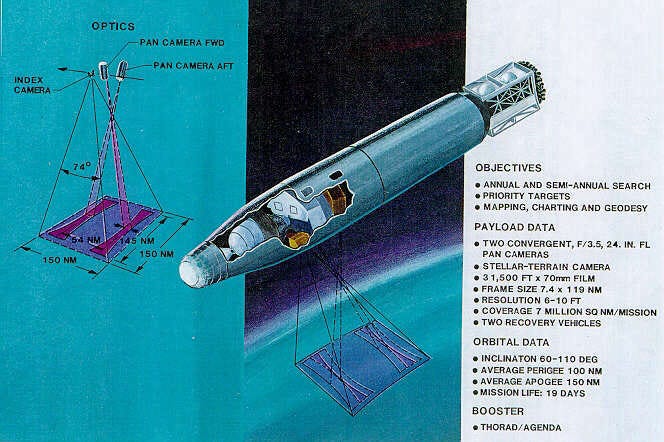
The best quantification of space power in its early days came just a few months after the Powers incident. The CIA-run Corona program produced the first successful IMINT satellite in history. This satellite, code-named Discoverer 14, obtained more photographs of the Soviet Union in just 17 orbits over the course of a day than all 24 of the previous U-2 flights combined. Electronic intelligence (ELINT) satellites, such as the early generation GRAB program (which actually launched before Corona), helped map Soviet air defenses by detecting radar pulses, which enabled strategic planners to map bomber routes. Although air-and-sea-based reconnaissance craft had the capability to also detect radar pulses, they could only identify targets at a maximum of 200 miles within the Soviet Union, far less than was needed to plan a secure route to interior targets. Space became more than just a one-to-one replacement of existing tools; it offered significantly more access to foes.

Superiority then became three-pronged: who had the broadest capabilities, who had the best technology in each form of space-based intelligence gathering, and who had the best coverage? Said another way, how well could a nation monitor all spectra in detail at all times everywhere that matters?

Nearly a decade after Corona transformed space into a viable form of power, the U.S. leveraged its first reliable weather monitoring and communications relay satellites in the Vietnam War. This expanded the role of space to that of an active component on the battlefield, rather than just a pre-conflict source of intelligence — an enormously important growth.

More than that, it represented a substantial evolution of war as a whole. The sudden enhancement of meteorological data due to dedicated satellites gave field commanders far greater clarity than in previous conflicts as to when would be the ideal windows to mount a strike or a longer campaign. This was especially important in Vietnam, which was often overcast.

The United States faces the greatest diversity of military threats in its history. At the same time, the military is undergoing a significant size reduction.

Satellite communications also made their wartime debut in Vietnam. This capability offered the first true live link between war planners and field commanders, for the conveyance of orders and the timely distribution of sensitive intelligence. Whereas intelligence satellites broadened the world by opening up vast new areas to prying eyes, communications satellites dramatically shrank it. However, this new channel was offered only to the top commanders in any region, due to limitations in infrastructure. Soldiers in the field still used radios to communicate with base.

All these space capabilities continued their evolutionary growth for the next few decades. But, it was Operation Desert Storm in 1990 and 1991 that marked space power as a revolutionary change in the conduct of war. Called the “first space war” by some, this conflict was the first time that satellite communications and new position, navigation, and timing (PNT) systems were utilized in direct concert with military forces to monitor and direct an ongoing campaign at all levels. Space-based intelligence-gathering satellites mapped Iraqi strategic installations well ahead of the first shots and continued to track changes in enemy force distribution. Satellite communications systems enabled ground forces to transmit targeting data to en-route aircraft, substantially improving the accuracy of dropped munitions. In addition, while the constellation was not yet fully deployed, the Global Positioning System (GPS) conveyed Coalition forces an enormous strategic advantage, by enabling ground forces to travel through previously unmapped territory and circumvent the heavily defended road system into Iraq.

Today

The United States faces the greatest diversity of military threats in its history. At the same time, the military is undergoing a significant size reduction. Yet, more so now than ever, it possesses the ability to strike anywhere in the world at a moment’s notice. It does not need to constantly maintain local forces when it has force projection. In the modern world, force projection would not exist without space power.

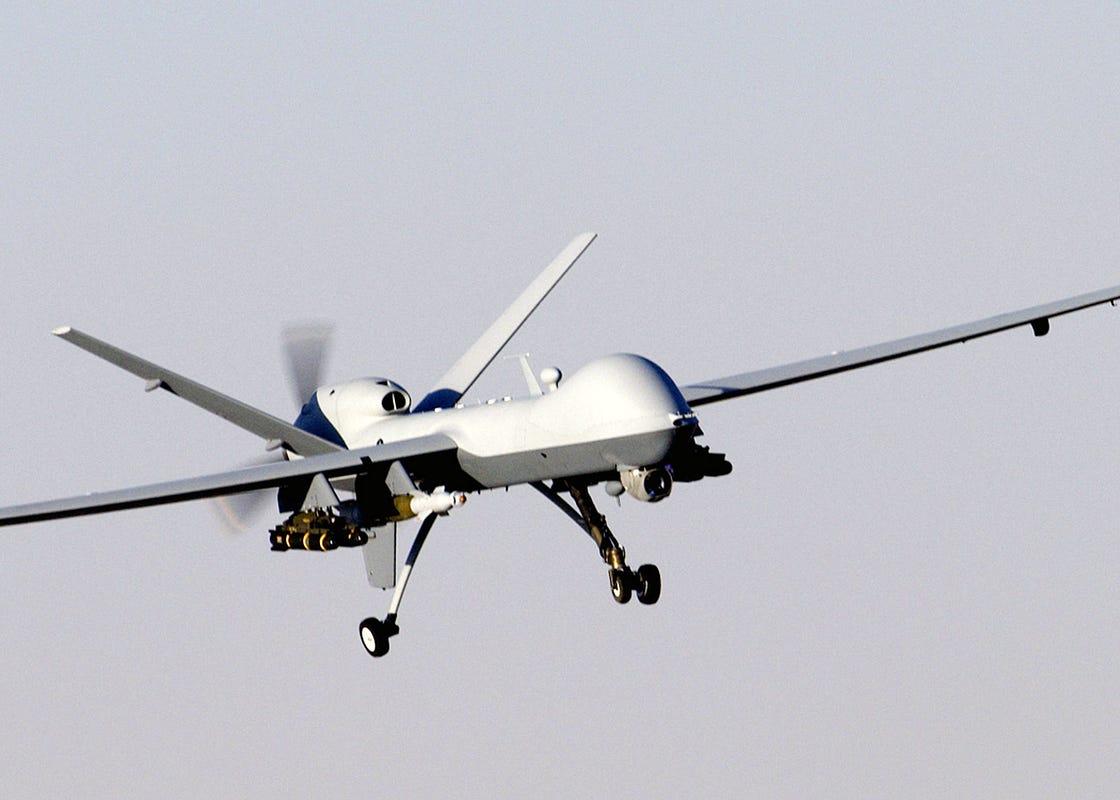
Special forces and drone operations have taken front stage in America’s Global War on Terror. IMINT and SIGINT satellites provide important intelligence about targets far below. GPS satellites enable drones to fly to areas of interest and, if necessary, guide their munitions to their final destinations with minimal collateral damage. Drone operators are often far away from the craft they are piloting, many times even in a different hemisphere. This capability is only possible by utilizing high throughput communications satellites. For special forces, GPS is used to get the teams quickly to their targets. Further, portable satellite communications units allow them to relay updates to their commanders and call in support if necessary.

These options are especially effective against non-space actors who do not have the capabilities to strike back. However, space is increasingly becoming “congested, contested, and competitive” — meaning a broader group of nations is doing more to leverage space for their own military power and deny others from doing the same. China stands out in this realm. While the nation (exclusive of nuclear weapons) stands no match against the United States in any conventional confrontation, it possesses counter-space technologies that would dramatically curtail America’s force projection strengths. In such a situation, America’s power abroad would decline dramatically, to such a point that along the Asian coasts, China may have local superiority.

As such, the definition of space power is expanding, to being the aggregate of a nation’s abilities to establish, access, leverage, and sustain its orbital assets to further all other forms of national power. Earth-shaking rocket launches aside, space is the silent partner in nearly American military endeavor today. Operations Enduring Freedom and Iraqi Freedom and the subsequent counterinsurgency operations that followed demonstrated that clearly enough. Space guides soldiers, sailors, airmen, and bombs to their targets, gives the photographs and signal intercepts to understand what enemies are planning, and provides secure, global communication in an era of global need.


[1] Air Force Basic Doctrine, Air Force Doctrine Document 1, U.S. Air Force Headquarters (Washington, DC: September 1997) 85.

Seasteaders: Mining the Sea, Mining the Future

Biomining the Sea
Seasteads are intended to be entrepot that trade in the capitol of the mind: new ideas, technologies, and management styles both public and private. Scarcity is the mother of invention, and on platforms with no natural resources, innovation and expertise are the only tradable commodity… but that will not be the case for long.

Innovations in the field of biotechnology are leading to the more efficient use of microorganisms to leach minerals straight from the sea as a byproduct of fresh-water production. I discussed biomining as a tool for commanders attempting to use battlefield refuse for 3D printing, but on a larger scale it produces a duel-win scenario for Seasteads looking for a supply of both water and profits to support their sea-borne society. While many nations have claims to the vast mineral wealth of the sea-floor, none lay claim to the water-borne mineral content of the high seas. UNCLOS does state in general terms the wealth of the sea being for all people’s, but such stipulations would be too vague to implement if even the institutions existed to enforce them. The minerals of the sea are an open resource, without claim or contract, to be claimed by seasteaders.

G’Day Shipmate
This brings to mind a society that may look very much like our friends, the Australians. Australia is an innovation hub, most recently producing the first single-atom transistor. This is the primary vision of today’s Seasteaders. Australia is also blessed with with abundant resources. The Australian mining industry is booming supported by the hardy entrepreneurial spirit of prospective miners. There is a hearty internal migration of workers out to isolated mining camps to make their fortune. However, most Seasteads will not be glorified roaming country clubs supported by the existent wealth of their monied passengers; they’ll be commercial experiments. No matter how advanced, they will be constrained and distant places like the FIFO camps of Australia. With sea mining, however, Seasteads can add the mineral wealth of the sea around them to the income from the advances developed onboard.

Glimpses of the Future
Seasteading will lead to a bevy of new technologies driven by self-sustainment and efficiency. From mining the sea to water production to electricity generation and retention to recycling. All these developments inadvertantly make Seasteading a model for future space travel. Although under far friendlier circumstances than a cold, radiation-bombareded death vacuum, the efficiencies found by communities living at sea will no doubt find application to our future missions in space. The same bio-mining procedures for the sea could be used on far-off bodies where it is easier to bring a small culture of microorganisims that can be grown to necessary size, rather than the bulky equipment necessary to process ore. As the conventional modes of business are overturned in an attempt to colonize new portions of our own planet, we will be preparing ourselves to colonize others.

Matt Hipple is a surface warfare officer in the U.S. Navy. The opinions and views expressed in this post are his alone and are presented in his personal capacity. They do not necessarily represent the views of U.S. Department of Defense or the U.S. Navy.

A Great Leap for Mankind Takes the Last Step for a Man

An accomplishment that should have never remained so unique.

Today, a piece of America’s soul has passed. Neil Armstrong, first of humanity’s representatives to stride upon a celestial body, has died. His passing is part of a greater trend, a legacy of starry-eyed optimism left behind in the morass of temporal practicality. Today, the first of our number to turn and look upon earth from a foreign body joins our manned mars program, our shuttle program, and the once unfettered collective dreams he carried with him.

CIMSEC is a blog about maritime security. Is not the maritime domain  primarily defined as a vast commons that hosts a sustained presence through buoyancy alone? An even greater commons awaits above, where although the vessels look far different, they are called ships nonetheless. Konstantin Tsiolkovsky, one of the fathers of modern rocketry, once said, “A planet is the cradle of mind, but one cannot live in a cradle forever.” Neil Armstrong took those first baby steps out of the cradle, learning to walk for us all. As our heroes fade away, we should keep their memories, and our future, alive… by learning to run.

Matt Hipple is a surface warfare officer in the U.S. Navy. The opinions and views expressed in this post are his alone and are presented in his personal capacity. They do not necessarily represent the views of U.S. Department of Defense or the U.S. Navy.