Tag Archives: shipbuilding

‘A Fiscal Pearl Harbor’

I will focus more of this discussion on the first 20 years of the Navy’s plan, covering the years 2016 through 2035, because the third decade of the Navy’s plan is necessarily quite speculative. Nevertheless, keeping an eye on the longer, 30-year perspective is important. While it is true that the nature of warfare, technology, and costs cannot be predicted decades into the future, it is today’s decisions that are most important for the long-run perspective. The President proposes a budget and Congress makes appropriations year-to-year. The Department of Defense provides Congress with a five-year Future Years Defense Program (FYDP), but without the presence of the 30-year plan, the long-range effect on the Navy of the incremental decisions made in each year’s budget cycle would not be understood. For example, in the 1990s, the service built an average of one submarine every other year, and that low rate of construction had no effect on the existing inventory, because coming off the boon years of the 1980s, the attack submarine force was young. Submarine procurement could be reduced during the 1990s without affecting the existing force structure at all. But in the next decade those decisions would manifest themselves in a declining SSN force in a world that today looks like it will get more dangerous and more competitive, not less, and for which some observers of international and naval affairs think having more submarines would be a valuable asset for the Navy.

What to Buy and at What Cost?

Between 2016 and 2035, the Navy plans to buy 178 ships, including 12 expensive Ohio -class replacement ballistic-missile submarines. The rest of those purchases comprise 4 aircraft carriers, 28 attack submarines, 40 large surface combatants, 35 littoral combat ships (LCSs) and frigates, 16 amphibious ships, and 43 combat logistics and support ships.
Screen Shot 2016-03-13 at 10.41.08 PM
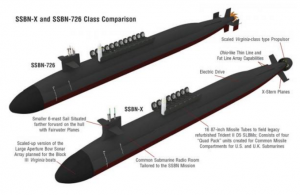
J. M. Caiella – The Ohio-class sub replacement (SSBN – X) is “the 800-pound gorilla in the room” when it comes to the Navy’s shipbuilding ledger. “At around $6 billion apiece, buying those new boomers poses a substantial fiscal and budgetary challenge to the Navy.”

The Congressional Budget Office, in a report that I authored, estimates the cost of building those ships at an average $18.7 billion per year in Fiscal Year 2015 dollars. 2 But that amount is for new construction only. It does not include all of the other activities that the Navy must fund from its shipbuilding account, such as refueling aircraft carriers, outfitting and post-delivery, and other items. They add another $2 billion to the Navy’s funding requirements, resulting in an average shipbuilding budget of $20.8 billion per year for the next two decades.

The dilemma the Navy faces is that in recent decades shipbuilding budgets have been much lower. Since 1986, the Navy has received an average of only $15.8 billion per year, after adjusting for inflation, for all of its shipbuilding activities. And in the most recent decade, 2006–2015, it was even less—$15 billion. Thus, in order to fund the Navy’s plan, the shipbuilding budget will need to increase by an average of 40 percent compared to the past ten years, or about $6 billion per year.

As readers of Proceedings will know, the 800-pound gorilla in the room is the Ohio Replacement Program. The Navy plans to replace its aging force of 14 Ohio -class ballistic-missile submarines with a new, as-yet unnamed class of 12 boats, with procurement funding starting in 2017 and continuing through 2035. At around $6 billion apiece, buying those new boomers poses a substantial fiscal and budgetary challenge to the Navy. Declared to be the Navy’s top budgetary priority, the question, in the view of some members of Congress, is not whether the Ohio replacements will be funded, but rather how they will be funded. Will the Navy receive increases in its shipbuilding budget to pay for the new submarines, or will the Navy have to buy those submarines from a budget that is not increasing? If so, what happens to the rest of the fleet?

Future Fleet, Historical Funding Level

In the 2014 National Defense Authorization Act, Congress directed the Navy to assess what would happen to its shipbuilding plan if, on average, future shipbuilding budgets matched historical budgets. So far, the Navy has not responded to that congressional directive.

The CBO’s analysis shows that constraining future shipbuilding budgets to an average of $16 billion per year results in a much smaller fleet over time. The assumptions that were made in doing such an assessment were as follows:

• The Navy builds all 12 Ohio replacement submarines.

• Production of aircraft carriers is not cut, because Congress mandates the 11-ship force level in law.

• All other ship programs are cut roughly proportionately.

With those assumptions and applying the budgetary constraint, the Navy would purchase 131 ships over the next 20 years, instead of the 178 in the 2016 shipbuilding plan. Specifically, those purchases would include:

• 4 aircraft carriers

• 12 ballistic-missile submarines

• 18 attack submarines

• 25 destroyers

• 25 LCSs and frigates

• 12 amphibious-warfare ships

• 35 combat logistics and support ships.

Reducing the shipbuilding program by 47 ships over 20 years results in a fleet no larger than today’s by 2035. Over the entire 30 years of the Navy’s plan, the fleet would drift down to 237 ships if the historical funding level does not budge much from $16 billion. (See the accompanying table). That is a reduction of 13 percent compared to today’s Navy and 22 percent compared to the fleet of 2045 projected under the 2016 plan.
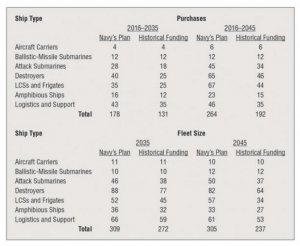
Screen Shot 2016-03-13 at 10.41.12 PM
Our future fleet.

Is There a Solution?

What are the alternatives to a decline of the Navy’s fleet? Are the alternatives viable? Let us consider each one in turn.

Increase the shipbuilding budget. The first and immediately obvious solution would be to increase the size of the Navy’s shipbuilding budget. Shipbuilding represents about 3 percent of the overall defense budget, a relatively small fraction. As my counterpart at the Congressional Research Service, Ron O’Rourke, has noted in his work, increasing ship construction by $5 billion per year would represent less than 1 percent of defense spending. Yet, even such a small increase faces three powerful headwinds—one short-term, one long-term, and one that is a constant—that are political and budgetary in nature. In the near term, any increase in the defense budget faces the caps imposed by the Budget Control Act (BCA) of 2011 and the various amendments, including the Bipartisan Budget Act of 2015. While the BCA says nothing about how much of the DOD budget may be spent on any particular account, the fact that the BCA caps defense spending below the President’s 2016 FYDP makes it extremely difficult to find the money to increase any category of spending, including shipbuilding. The 2016 FYDP allocated $121 billion more for defense spending over the years 2016 to 2020 than the amounts allowed under the revised caps of the BCA. Thus, widespread cuts are the order of the day, not funding increases.

Although the BCA is set to expire in 2021, presumably making it easier to increase the defense budget in the long term, the large fiscal challenges facing the United States will not. Between now and 2040, the CBO projects that the demands by a growing older population and rising medical costs will increase spending on Social Security and Medicare by 27 percent and 80 percent respectively. But the dedicated revenues that support those programs will remain nearly flat. 3 Because federal deficits over that period will persist and increase the national debt, the CBO also projects that spending on interest will increase by 230 percent; at the same time, revenues from federal income taxes will increase by only 25 percent. Stiff competition for federal resources will remain a fact of our budget debates for decades to come, and the Navy will not be immune.

Finally, within the defense budget itself are the competing demands and priorities of the services and their supporters. If the military branches were unified in the perspective that naval shipbuilding, including the Ohio replacement, should be the nation’s first military priority—or at least the first acquisition priority—it might be a relatively simple thing to shift 1 percent of the defense budget in its favor. But that is not a universally held view. As the threats to U.S. national security become more varied in this emerging new strategic era, the competing demands of all parts of the military for more resources make shifting even a small amount of the defense budget a difficult proposition, especially with the demands on federal resources continuing to grow. 4

Adopt alternative ship designs and fleet architecture. If more money does not flow into the Navy’s shipbuilding accounts, what are the other alternatives? Are there ways to squeeze more out of the current budget? Can you keep ships around longer and modernize them? Does the Navy really need to buy the fleet it is proposing, or would an alternative be better? These are large, wide-ranging questions that deserve serious attention and debate. My purpose in raising and discussing them briefly in this article is to show that even if such suggestions were adopted, they would have little effect on the fleet over the next 10 years and only a marginal effect over the next 20 years.

Let us very briefly consider two examples of alternative fleet architectures proposed by two knowledgeable and experienced men in the business of fleet design: Captain Arthur “Trip” Barber and Captain Wayne Hughes. 5Both are retired Navy officers who then spent many more years thinking about alternative fleet architectures and ship designs. They still do.

In a 2014 Proceedings article, Captain Barber recommends that the Navy do a number of things differently in what he sees as an unending period of federal fiscal constraint. He suggests changing the capabilities of existing ship platforms as well as changing the ways the Navy deploys or stations ships in order to get more deployed time out of these expensive capital assets. However, he also recommends exploring several alternative ship designs that, he argues, would reduce shipbuilding costs, including using a single new ship design for both aircraft carriers and large-deck amphibious-assault ships, developing several classes of surface combatant that perform different missions but share a common hull, and repeating that common-hull approach for various support-ship missions.
Screen Shot 2016-03-13 at 10.41.16 PM
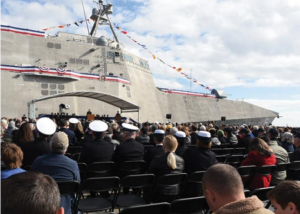
U.S. Navy (Sam Shavers) – Secretary of the Navy Ray Mabus delivers remarks at the christening of the USS Jackson (LCS-6) in December. The Secretary of Defense recently called for cuts to the LCS shipbuilding program, which might be said to have experienced its share of setbacks and controversy.

Captain Hughes equally reimagines the future fleet, although he believes his plan is affordable within existing shipbuilding budgets. The New Navy Fighting Machine, as Captain Hughes describes it, would develop even more new ship types than would Captain Barber’s. Specifically, Captain Hughes envisions new conventionally powered submarines, light aircraft carriers, small land-attack arsenal ships, and a substantial green-water force, as well as continuing to build numerous ship types that are already part of the Navy’s 2016 plan.

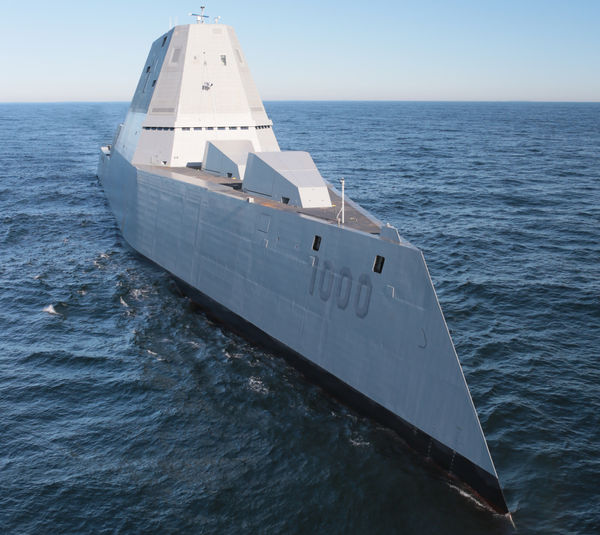
Nevertheless, however thought-provoking the suggestions offered by both men, making such major changes to the fleet will not be easy or quick. Alternative ship designs and fleet architectures take a long time to implement. For example, the LCS was first proposed in 2001. Fifteen years later the Navy has commissioned six of those small, relatively inexpensive 3,000-ton ships. A large all-new ship design, such as the DDG-1000 Zumwalt -class destroyer, has been in development, design, and construction for 20 years and won’t commission into the fleet until later this year. The same is true for the new Ford -class aircraft carrier. Under the Navy’s shipbuilding plan, in 15 years—2031—the Navy will have only eight new combat ships of entirely new design: three Ford -class carriers, three Zumwalt -class destroyers, and two Ohio replacement ballistic-missile submarines. Another 48 combat ships will be commissioned that have a modified design of existing warships: 21 Arleigh Burke –class Flight III destroyers, 20 frigates based on the LCS (or just 12 under Secretary Carter’s directive), and seven LX-R amphibious ships based on the existing LPD-17 hull. The Navy will also have another 28 combat logistics and support ships of some new type. Overall, in 2031 at least three-quarters of the fleet will still be composed of ships with designs that are in service today.

Thus, unless the ship-acquisition process can be changed such that it dramatically speeds up the introduction of new ship designs into the fleet, most of the suggestions by Captains Barber and Hughes would not have a meaningful effect on the composition of the fleet until, coincidentally, the Ohio Replacement Program is essentially completed in 2035. This is a point that Captain Hughes explicitly acknowledges and addresses (and one that Captain Barber recognizes but does not address), but, based on the Navy’s acquisition history, the former may be optimistic about what is achievable in 10–20 years. 6
Screen Shot 2016-03-13 at 10.41.23 PM
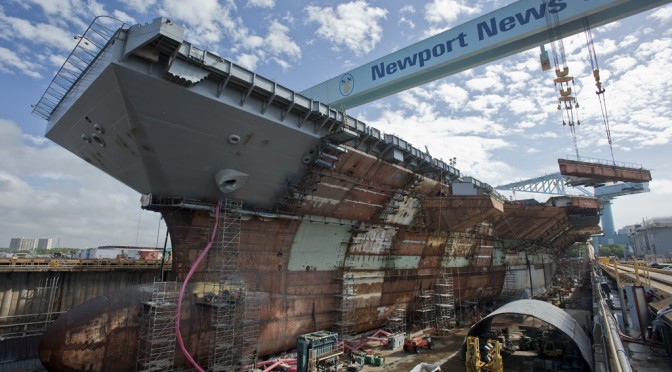
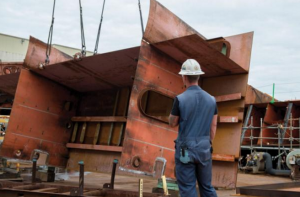
Huntington Ingalls – A rigger oversees a small-unit flip during construction currently underway on the second Gerald R. Ford-class aircraft carrier, the future USS John F. Kennedy (CVN-79) at Newport News Shipbuilding. “In 15 years – 2031 – the Navy will only have eight new combat ships of an entirely new design,” including three Fords.

Keep older ships in the fleet. A less time-intensive alternative to new ship designs or fleet architectures would be to modernize older ships and keep them in the fleet. But this approach has its own problems. Paradoxically, the Navy is already doing this to a large extent, so it is not clear that more can be done, but also historical experience suggests that the service dislikes doing so. Over the past 20 years, senior Navy leaders have extended the service lives of more than 100 submarines, destroyers, and amphibious ships relative to their original design lives. At the same time, the Navy retired dozens of ships that had many years of useful service life remaining, rather than purchasing slightly fewer new ships to pay for keeping the older ships in the fleet.

Specifically, in the early 2000s, the Navy increased the service life of the Ohio -class ballistic-missile submarines from 30 years to 42. If that had not been done, we would have debated the merits and means to pay for the Ohio replacement more than a decade ago, when the United States was fully engaged in two wars in Afghanistan and Iraq. Similarly, the service life of Los Angeles –class attack submarines was increased from 30 years to 33. The Navy now assumes its large-deck amphibious-assault ships will serve for 43 to 45 years, which is up from 40 years. And since the release of the 2009 shipbuilding plan, the Navy has assumed its Arleigh Burke –class destroyers would serve in the fleet for 40 years, rather than 35 years in earlier plans, which is up from the original design life of 30.

Extending the service lives of these ships further is impossible in some cases and questionable in others. The submarines will be at the limit for the number of cyclings (submerging and surfacing) that their pressure hulls can tolerate, and the energy in their reactors will be exhausted. Conventionally powered surface ships, however, could in theory be upgraded if the Navy chose to do so. Properly maintained, conventional hulls can last for many decades. Ships that were retired from the U.S. Navy and sold or transferred to other countries often serve for decades longer as a result. But at a certain point, a ship that is still useful in a South American or Asian navy would no longer be valuable to the U.S. Navy, because physical limitations may prevent a modernization of her combat systems to perform high-end missions. Further, keeping older ships in the fleet even longer would require the Navy to modernize combat systems and fully fund maintenance programs. But budgetary constraints and long, frequent deployments have made it hard for the service to do so. Thus, if it is not clear that Burkes can serve for 40 years, it seems even less likely they could serve for 45 to 50 years performing missions the Navy would find valuable.

At the same time the Navy was extending the service lives of some ships, it was retiring others well before the end of their design lives. In the late 1990s through the mid-2000s, the Navy retired the entire class of Spruance destroyers. To keep those ships in the fleet the Navy would have had to spend money on improving their material condition as well as upgrading their combat systems. It also would have cost money to continue to operate those ships. But a decade later, the surface-combatant force is overworked with long deployments because there are insufficient ships to meet the demand. In addition, the original plan was to retire the Oliver Hazard Perry –class frigates sooner and keep the Spruances around, but that decision was reversed because it was cheaper to operate the smaller ships. Relative capabilities apparently did not figure strongly in the decision.

Similarly, the Navy retired 17 Los Angeles –class attack submarines at an average age of 22 years, rather than pay to refuel those boats and keep them in the fleet. Paying for all 17 refuelings would have cost less than the price of two new Virginia -class submarines. Again, the Navy would have had to budget resources to operate those ships, but at about $40 million per submarine per year, that was not an insurmountable obstacle.

And more recently, the Navy proposed to retire seven Ticonderoga -class cruisers and two amphibious ships to help conform to the budgetary caps of the Budget Control Act, rather than reduce new ship purchases further. Congress intervened, however, directing the Navy to keep those ships in the fleet and provided additional appropriations to do so. But if the Navy had had its way two years ago, the fleet today would number 264 ships. In that event, the strain on large surface combatants and amphibious ships, which now routinely deploy for seven to ten months, would be even greater.

Size? Capabilities? Both?

One way for a policymaker or anyone interested in naval matters to think about these issues is to figure out what your objective is. Do you care most about the size of the fleet? Or are the capabilities of the fleet more important? Of course, both are important. But the tension between size and capabilities is in many ways a proxy for the tension between the Navy’s day-to-day responsibilities and its high-end warfighting requirements. In an unendingly tight fiscal environment, a larger Navy is one that is better able to provide overseas presence and perform the many, varied peacetime missions that our naval forces are routinely called on to conduct—without overly stressing the ships and crews. 7 However, ships with the high-end warfighting capabilities that would be needed in an unlikely, but far from impossible, future conflict with a peer or near-peer competitor are expensive. The Navy cannot afford to build as many of them as it would like under historical funding levels.

If this seems like a daunting set of challenges for shipbuilding, that’s because it is. Yet, it may be possible that a little bit of everything could close the gap. If the Congress can shift a fraction of 1 percent of the defense budget toward shipbuilding, if improving acquisition can squeeze a fraction of 1 percent of the defense budget toward more shipbuilding, and if the Navy invests in some of its older ships to keep them in service, then perhaps it can step off the path toward a fleet of 237 ships that history says it is on. But that combination of outcomes would be difficult to achieve.

Dr. Labs, writing here as a private citizen, is Senior Analyst for Naval Forces and Weapons at the Congressional Budget Office. He specializes in issues related to the procurement, budgeting, and sizing of the forces for the Department of the Navy. Dr. Labs has testified before Congress several times and published numerous studies under the auspices of the CBO as well as a number of articles and papers in academic journals and conferences.

1. Report to Congress on the Annual Long-Range Plan for Construction of Naval Vessels for Fiscal Year 2016 (Washington, DC: Department of the Navy, March 2015), http://tinyurl.com/ocrqtfc [8] .

2. Congressional Budget Office, An Analysis of the Navy’s Fiscal Year 2016 Shipbuilding Plan , October 2015, www.cbo.gov/publication/50926 [9] .

3. Congressional Budget Office, The 2015 Long-Term Budget Outlook , June 2015, www.cbo.gov/publication/50250 [10] , 3.

4. Ronald O’Rourke, A Shift in the International Security Environment: Potential Implications for Defense—Issues for Congress , Congressional Research Service, 20 November 2015,www.hsdl.org/?view&did=788858 [11] .

5. CAPT Arthur H. Barber, USN (Ret.), “Rethinking the Future Fleet,” U.S. Naval Institute Proceedings , vol. 140, no. 5 (May 2014), 48–52. CAPT Wayne P. Hughes, USN (Ret.), The New Navy Fighting Machine: A Study of the Connections Between Contemporary Policy, Strategy, Sea Power, Naval Operations, and the Composition of the United States Fleet , (Monterey, CA: Naval Postgraduate School, 2009). See also his “A Bimodal Force for the National Maritime Strategy,” Naval War College Review , vol. 60, no. 7 (Spring 2007), 29–47.

6. Megan Eckstein, “CNO: Navy Needs More Agile Procurement to Keep Pace with ‘4-Plus-1’ Threat Set,” USNI News, 7 December 2015, http://news.usni.org/2015/12/07/cno-navy-needs-more-agile-procurement-to… [12] .

7. Congressional Budget Office, Preserving the Navy’s Forward Presence With a Smaller Fleet , March 2015, www.cbo.gov/publication/49989 [13] .

Featured Image Credit: Chris Oxley.
That Sinking Feeling: Inflation and the National Shipbuilding Procurement Strategy

This post originally featured on the CDA Institute, and is republished with permission. You can read it in its original form here

CDA Institute guest contributor Ryan Dean, a PhD candidate at the University of Calgary, offers a reminder on the dangers of inflation in Canada’s defence procurement efforts.

A good portion of our future navy has been sunk on the drawing board by inflation.

Inflation is an economic term that encompasses all the variables that lead to a general price increase in a good or service. In the case of warships, inflation includes everything from technical issues related to the design of the ships to increases in the wages of the shipyard workers who build the ships. The longer a budget takes to be spent, the less that budget can buy.

Military inflation rates have a voracious appetite and can eat through capital budgets far faster than their civilian counterparts. American warships have historically inflated at an annual rate of 9 to 11 percent. The National Shipbuilding Procurement Strategy (NSPS), modeled on American shipbuilding practices, could suffer from even higher inflation rates as we are dealing with the additional time and costs of resurrecting a shipbuilding industry and we do not enjoy the same economies of scale as our southern neighbour in sustaining this strategic industry.

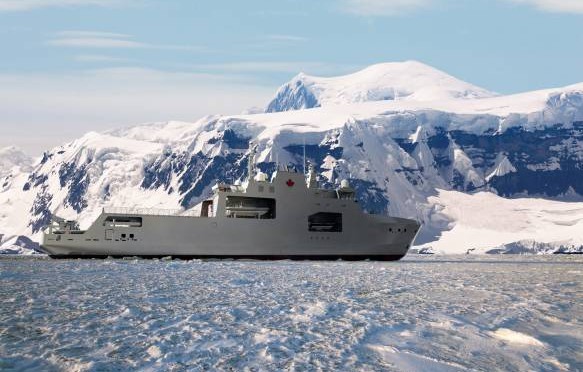
Long delays between the allocation of budgets for a class of warship and their actual construction allows for high inflation rates to halve these budgets. This has already happened with the Joint Support Ship (JSS) and the Arctic Offshore Patrol Ship (AOPS) procurements. It is now happening with the Canadian Surface Combatant (CSC) Project.

The time invested in designing the JSS to be a highly capable platform backfired. $2.9 billion was budgeted in 2006 to build three replenishment vessels by 2012. Internal pressure for a very ambitious ship led to sealift and command-​and-​control ashore capabilities being added to the original refueling and resupplies tasks of the proposed vessels. Three “big honking ships,” to borrow the term introduced by General Rick Hillier, with those capabilities could not be delivered within budget and the government rejected bids in 2008. The NSPS effectively pushed things back until 2011, at which time the procurement resumed. In 2013 the “off the shelf” German designed Berlin-​class, capable of refueling and resupplying but not sealift and command-​and-​control, was selected as Canada’s next replenishment vessels with construction beginning in 2016 and deliveries scheduled for 2019 and 2020. Instead of three of these vessels, now only two Queenston-​class ships are promised. The negative effects of inflation resulting from years of delays have sunk one of our replenishment vessels on the drawing board.

The AOPS was announced in 2007. $3.1 billion was budgeted to build six to eight ships with deliveries starting in 2013. Based on the Norwegian Svalbard-​class, much time and money was invested in attempting to increase the capabilities of the design, though it appears these efforts have largely failed. Time spent on this and the development of the NPSPpushed the AOPS delivery date back to 2018. As with the JSS, the years of delay allowed inflation to hollow out theAOPS budget. A report issued late 2014 by the Parliamentary Budget Officer (PBO) found that the AOPS budget could only afford four vessels at that point. In response, the government added an additional $400 million to the project and revised their official number of ships delivered down to five or six, though these numbers remain optimistic. Inflation has sunk nearly half the proposed AOPS.

$26.2 billion is budgeted to build up to 15 CSCs, at best a one-​for-​one warship recapitalization program to replace the Royal Canadian Navy’s destroyers and frigate fleet. Given that the AOPS was placed first in the NSPS construction queue, the first CSC will not be delivered for another 10 years with the rest following over a 2030 year period. This affords inflation plenty of time and opportunity to do its worst. A 2013 PBO report and recent news reports draw attention to this fact, with inflation placing nearly half the future CSC fleet in jeopardy. The financial situation is so grim that, as a cost saving measure, there has even been a proposal to start cannibalizing systems from our current fleet with which to outfit our future fleet.

The thrust of this short piece is that we must stay aware of the negative effects of inflation in our military procurements. Delays come with significant costs. In the cases of the JSS and AOPS, the costs are fewer and less capable ships.

How can inflation be addressed, aside from cutting numbers or capabilities to stay within eroded budgets? The best way is speed, something to keep in mind regarding the CF-​18 Replacement Project and proposals by the Opposition parties to restart an open bidding process. Would any benefits that could result from pressing the reset button on that procurement program again outweigh the high costs of additional time and inflation? Similarly, robbing the CF-​18 Replacement Project to pay for the CSC Project would only magnify the problems of the Royal Canadian Air Force’s recapitalization due to inflation. However, in the case of the CSC, speed is not an option due its place in the NSPS shipbuilding queue.

The other way to address inflation is to simply buy back time by increasing capital budgets. The Trudeau-era’s Defence Structural Review did this, increasing the military’s capital budgets which led to the purchases of the CF-​18s and the Halifax-​class frigates in the 1980s. This has historically been something that Canada has been adverse to do but times could be changing. As noted above, the AOPS budget was increased late last year by $400 million despite constraints on across the board federal spending. Additional monies will preserve not just CSC numbers, but their capabilities as well.

Ryan Dean is the winner of the 2015 Canadian Naval Memorial Trust Essay Competition and is a PhD candidate in the Department of Political Science, University of Calgary. (Image courtesy of the Royal Canadian Navy.)

Damen’s Presence in the Latin American and Caribbean Market, Part 2

By W. Alejandro Sanchez

Selling To Everyone

The list of Damen’s current clients in the Western Hemisphere highlights one curious fact about this company: the Dutch company sells its equipment to both U.S. allies and foes alike. Certainly, Washington sees no fault in Damen’s decision to upgrade Mexico’s naval equipment. On the other hand, the U.S. government probably frowns at Damen equipping countries that Washington is at odds with, such as Venezuela (which was declared a national security threat by the White House this past March). Similarly, Damen’s shipyard in Cuba, a country that was on the U.S. State Department’s list of states that sponsor terrorism until this past May, is not considered a positive development in Washington.

Nevertheless, Damen has remained neutral in Western Hemisphere geopolitics, as it has dealt with any government willing to pay. This issue deserves further analysis by stating two obvious facts: the U.S. and the Netherlands have generally enjoyed good security relations over the past decades, and Damen is a privately-owned company, which means that the Dutch government has limited influence in the contracts and initiatives it chooses to carry out. With that said, it is bizarre that Damen chose to build a shipyard in a country that has been at odds with the U.S. for decades, and is also selling vessels to countries like Ecuador and Venezuela, which have become a thorn on Washington’s side for years (in the case of Caracas’ for a decade and a half). Certainly, Damen does not need to take into account U.S. foreign policy in its business decisions, but it is nevertheless important to keep in mind how the sale of military equipment can upset regional geopolitics, particularly if this equipment is sold to nations that have carried out aggressive foreign policies in recent years (i.e. Venezuela).

Damen is Important, But Not A Pillar

While Damen has made a name for itself in the Latin American and Caribbean market, the shipbuilding company has not fully cornered this market, as it still faces a number of competitors.

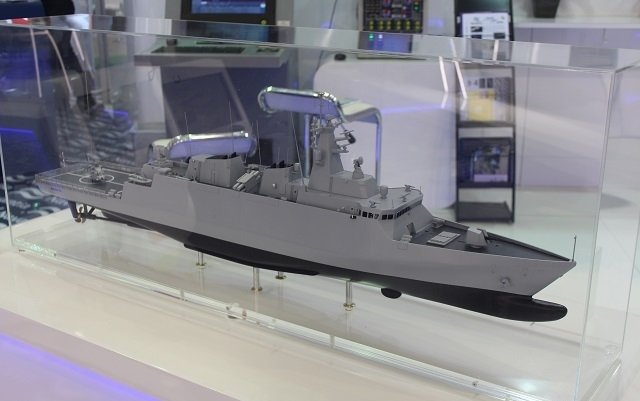
One of Damen’s major competitor is Navantia. The Spanish company has been trying to sell Peru its frigate F-538 model as well as attempting to sell Colombia (and Peru) its F-110 frigate. The company already has a strong presence in the region, best exemplified by a 2013 contract to upgrade the motor system of a Brazilian corvette, the “Julio de Noronha.” Government-to-government exchanges are also common as South Korea has donated one of its corvettes, the now-called “ARC Nariño,” to Colombia. The Donghae-class vessel served in the Republic of Korea Navy for 27 years before it was given to the South American state.

Navantia Warship. Source: Navyrecognition.com.

Finally, the know-how of Latin American military industries is improving. Case in point, the Peruvian shipyards Servicios Industriales de la Marina (SIMA) is currently constructing a new training vessel for the Peruvian Navy, the “BAP Union” – a project worth around $50-55 million USD. Moreover, with support from the Daewoo International Corporation and the Korea Trade-Investment Promotion Agency, SIMA is building a new multi-purpose vessel for its Navy.

These examples stress how competitive the shipbuilding industry is in Latin America. Not only are there several major companies trying to sell brand new warships, but governments are also donating surplus naval technology. Furthermore, regional shipyards are rapidly improving their knowledge when it comes to shipbuilding, as we now have modern shipyards in countries like Colombia, Ecuador, Mexico, Peru and Venezuela  that are constructing their own vessels.

In fact, countries like Ecuador, Mexico and Venezuela want Damen to construct some vessels in their own shipyards in order for local technicians to learn from Damen’s experts. Certainly, none of these facilities are in a position to build a ship as complex as a carrier, but they can now construct smaller vessels, like patrol boats or support ships.

What this means for a company like Damen is that while it will continue to enjoy new contracts for the immediate future, it will have to continue developing more modern and improved equipment that its Latin American and Caribbean clients cannot purchase, maybe at a better price, from other suppliers, or even construct themselves in the not-so distant future.

A Need for Stronger Naval Forces

As transnational crime over the Caribbean Sea and other maritime crimes, such as illegal fishing, continue throughout Latin America and the Caribbean, it has become a major priority for regional states to have modern and capable navies and coast guards in order to protect their exclusive economic zones.

Certainly, it can be argued that the current purchases of some naval technologies are generally unnecessary, given that the region has enjoyed inter-state peace for decades (the last inter-state war in the region was in 1995 between Peru and Ecuador, while the last conflict with naval warfare was the 1982 Falklands/Malvinas War between Argentina and the United Kingdom). Moreover, while transnational crime remains a persistent problem, Latin America has enjoyed cooperation at the inter-state level for two decades (the 2008 Colombia-Venezuela incident notwithstanding). Given this period of peace, some may argue that these defense dollars would be better spent in social programs, especially since many Latin American nations, including Damen-clients like Honduras, are very poor and underdeveloped.

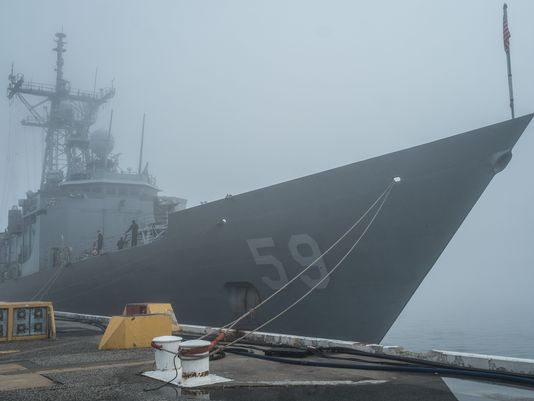
Unfortunately, the reality is different. First, Latin American and Caribbean nations must have some capabilities for deterrence as inter-state tensions continue, such as between Peru and Chile or even the aforementioned 2008 incident between Colombia and Venezuela. Second, transnational drug trafficking remains a major problem from Mexico to Argentina, particularly throughout the Greater Caribbean waters as cocaine is transported from Colombia and Venezuela to the U.S. and Mexico markets. Just last May, the U.S. Coast Guard and the USS Kauffman (FFG 59) interdicted almost 1,800 kilograms of cocaine in the Eastern Pacific.

USS Kauffman. Source: Mark D. Faram/Staff.

Hence, it is necessary for Latin American and Caribbean naval forces, including their coasts guards, to have fast and technologically advanced vessels for both internal and regional security – which in turn would diminish their dependence on U.S. security aid. In this sense, the involvement of companies like Damen and Navantia in the Western Hemisphere is a necessity (at least until regional states can build their own high-tech vessels).

Final Thoughts

In recent years the Dutch shipbuilding company Damen has made a name for itself as a provider of high-tech, fast vessels, from multipurpose boats to coast guard speedboats, for various Latin American and Caribbean states. Their clients include nations with small defense budgets like Honduras and Trinidad & Tobago, to major buyers like Mexico and Venezuela. Nevertheless, Damen has not cornered these region’s shipbuilding markets, as there are several other companies selling their products, such as the Spanish Navantia, in addition to regional states enjoying growing maritime defense industries.

Moreover, while Damen’s sales to the region have generally controversy-free, the incident over the overpriced vessels sold to Honduras highlights the potential for corruption, i.e. kickbacks, in countries renowned for lacking good governance. I have been unable to confirm if there were other similar discrepancies in Damen’s other contracts in the Western Hemisphere. Nevertheless, countries like Venezuela are known for their lack of transparency (case in point, the billions of petro-dollars spent by Caracas to purchase Russian military technology) while Mexico is infamous for its corrupt state-run oil company, PEMEX. Given these precedents, there are valid reasons for concern over Damen’s deals with its Latin American and Caribbean clients.

Ultimately, the question comes down to whether the region requires new vessels. Inter-state conflict may be scarce, but it remains a possibility given recent tensions between regional nations (i.e. Venezuela and Colombia, Peru and Chile or currently between Venezuela and Guyana). Thus, it is necessary for nations to maintain capable deterrent capabilities. Additionally, these states must have strong navies and coast guards to crack down on maritime crimes that range from illegal fishing to transnational drug trafficking.

In 2015, the waters along Latin American and Caribbean states are far from peaceful and Damen’s vessels, while not the cornerstone of regional navies, are an important addition to hemispheric maritime security.

Read Part One here.

W. Alejandro Sanchez is a Senior Research Fellow at the Council on Hemispheric Affairs (COHA) where he focuses on geopolitics, military and cyber security issues in the Western Hemisphere. His research interests include inter-state tensions, narco-insurgent movements and drug cartels, arms sales, the development of Latin American military industries, UN peacekeeping operations, as well as the rising use of drones (UAVs) for civilian and security uses in Latin America. Twitter: @W_Alex_Sanchez

Damen’s Presence in the Latin American and Caribbean Market, Part 1

By W. Alejandro Sanchez

Though shipbuilding is a competitive global industry, one company has become a major provider to the naval forces (coast guards included) of various Latin America and Caribbean states: Damen Shipyards Group. Damen is now a household name among Latin American and Caribbean navies as it provides multi-purpose vessels, patrol boats and speed boats. These sales have enhanced the capabilities of Damen’s clients as they face transnational threats.

While the defense budgets of Latin American and Caribbean states cannot be compared to those of the usual suspects (i.e. the U.S., Russia or China), a significant number of weapon deals have occurred in recent years between the Dutch-based company and these two regions.

Damen’s sale of technologically advanced vessels is a positive development for the region for a variety of reasons. Most notably, since Latin America and the Caribbean are enjoying a marked lack of inter-state conflict  (the last war between two regional states was in 1995), the region’s security forces are now focused largely on transnational crimes, particularly drug trafficking. Thus, it appears that Damen’s clientele will continue to grow for the immediate future as the company is looked upon as a reliable supplier of vessels necessary to combat criminal activities that occur at sea, particularly in the Greater Caribbean region.

Recent Sales

In order to discuss Damen’s effect on the shipbuilding industry and naval defense sector in Latin America and the Caribbean, a brief enumeration of confirmed deals and equipment delivery is necessary. This will also give us a clearer view of Damen’s clients.

  • The Caribbean

Damen has a number of clients in the Caribbean whose naval forces are more akin to coast guards rather than traditional navies. One good example is the Bahamas, which formalized a deal with Damen in 2014 for a variety of vessels, including four Stan Patrol 4207, four SPa 3007, and one roll-off ship Stand Lander 5612. The shipbuilding portion of this multi-faceted contract is valued at around $149 million.

The company has already delivered the four 4207 patrol boats. Moreover, this past January the Damen Gorinchen shipyard in the Netherlands received the hull for the Stan Patrol 3007. It is important for the 3007 to become operational soon as this vessel is urgently needed by Nassau to combat narcotics trafficking, a further example of how Damen technology is being utilized for positive security initiatives.

Another one of Damen’s clients in the Caribbean is Trinidad & Tobago. This past May, the government in Port-of-Spain ordered 12 new vessels for its coast guard, including four type Stan Patrol 5009, two Fast Crew Supply 5009 and six Interceptor speedboats. The deal is worth $189 million USD. In early June, the “TTS Point Lisas” (GC 23), one of the FCS ships, was delivered to the Caribbean government.

  • Latin America

When it comes to the mainland, several Latin American states are turning to Damen for naval equipment. For example, the Colombian Navy purchased one of Damen’s Swath-type vessels, which was constructed in Singapore.  Additionally, in 2014, Ecuador signed a deal with Damen to obtain two Stan Patrol 5009 for the country’s coast guard. The vessels are being constructed in Ecuador by the country’s shipyard, Astilleros Navales Ecuatorianos, under the oversight of Damen technicians. Additionally, Damen obtained a contract in early 2014 to construct a fourth Stan Patrol 2606 (the country already operates three),  which will also be built in Ecuador.

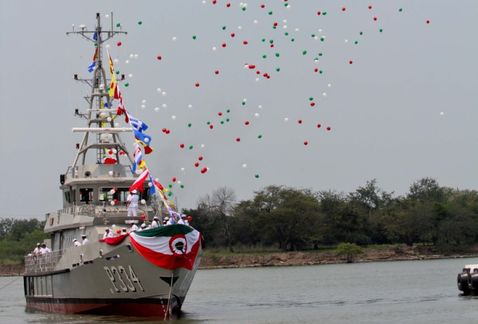
Additionally, Mexico and Venezuela have purchased various types of Damen’s vessels. Just this past January, the Mexican Navy received the Coast Guard vessel Tenochtitlan-class “ARM Mitla” (PC-334), which was constructed as a joint project between the shipyards of the Secretaria de Marina (the Mexican Navy) in Tamaulipas and Damen. The “Mitla” is based on the Stan Patrol 4207 model. This is the second of two vessels that Mexico and Damen are building together following a 2014 agreement. The other vessel is a supply variant of the Fast Crew Supplier 5009. Like the “Mitla,” it is also being constructed in Mexico’s Sonora state. These developments suggest that Damen has become an integral part of the country’s naval shipbuilding. Apart from the aforementioned vessels, SEMAR and Damen jointly constructed three other patrol vessels based on the 5009 model.

 Mexico’s new “ARM Mitla." Source: Cuartooscuro / Milenio.com.
Mexico’s new “ARM Mitla.” Source: Cuartooscuro / Milenio.com.

As for Venezuela, Caracas has ordered a number of new vessels for its Navy including a 2014 deal for 18 type Interceptor 1102 speedboats. The speedboats are being constructed in Cuba under the Havana-Caracas cooperation agreement. The first of these vessels arrived this past May and is currently undergoing testing. In addition, Damen has also constructed four support vessels for the South American nation based on the Stan Lander 5612 model. On February 2014, a new contract was signed for an additional eight vessels, a deal worth around $132 million USD. Finally, Venezuela’s military complex (UCOCAR) in Puerto Cabello is building five patrol boats based on the Stan Patrol 2606 model. The country’s navy already has one operational vessel based on that model, the “Pagalo” (PG-51).

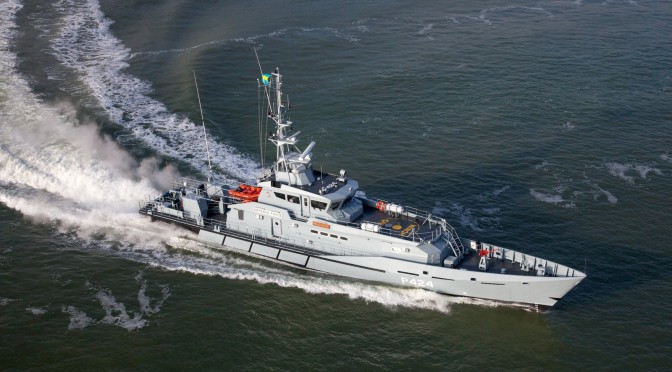
Damen Interceptor 1102. Source: Damen.com.
  • Cuba’s Shipyards

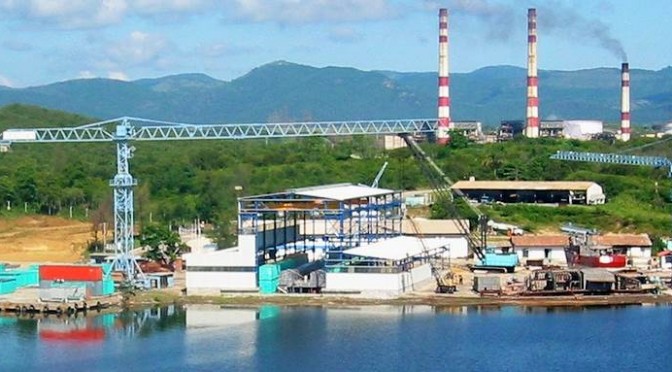
It is important to note that Damen has a construction facility, Damex Shipbuilding & Engineering, in Cuba. The facilities, which were established in 1995, are located in the bay of Santiago de Cuba. Damen’s website explains that “the yard is equipped with one slipway provided with transverse parking facilities for new buildings and repairs and a lateral slipway for new buildings of up to 100 metres.” As previously noted, the shipyards have constructed vessels for Venezuela.

  • The Honduran Affair

It is important to stress that not all Damen deals have been scandal-free. This is best exemplified by a 2013 contract via which the government of Honduras purchased six Interceptor speedboats and two Stan Patrol 4207. The contract deal was reportedly worth almost $62 million. However in late 2013, the Honduran judiciary investigated it due to various irregularities, specifically the accusation that the vessels were overpriced  – according to the Honduran newspaper La Prensa, the vessels were overpriced by some $29 million. The newspaper argued that the Honduran Secretariats of Defense and Finance created a paper company called “Servicios Maritimos S.A.,” which was utilized by Florentius Antonious Florentius Kluck,  a Dutch citizen and honorary consul, as the intermediary for the sale.

In spite of these accusations, the deal ultimately went through, and the Honduran Navy has begun to receive the vessels. This is an important deal for Honduras since drug traffickers utilize the country’s coast for transporting illegal narcotics, and thus it is especially necessary for small Central American country to have vessels that can locate and seize the infamous narco-speedboats. Nevertheless, the details of the deal themselves are problematic, as the question its transparency and whether the Honduran government could have obtained similar vessels at a cheaper price. Even more, even though the Honduran judiciary never passed judgment on the  deal, scandals like the Honduran affair throw into question whether other contracts gained by Damen were due to shadowy middle men and nefarious deals.

Read Part 2 here.

W. Alejandro Sanchez is a Senior Research Fellow at the Council on Hemispheric Affairs (COHA) where he focuses on geopolitics, military and cyber security issues in the Western Hemisphere. His research interests include inter-state tensions, narco-insurgent movements and drug cartels, arms sales, the development of Latin American military industries, UN peacekeeping operations, as well as the rising use of drones (UAVs) for civilian and security uses in Latin America. Twitter: @W_Alex_Sanchez

Fostering the Discussion on Securing the Seas.