
Tag Archives: Russia

The Russian Navy: A Historic Transformation

By David Roush

Russian cover
Click to read.

In a continuing series, the Office of Naval Intelligence (ONI) released an analysis of the status and changes of an adversarial navy. They have released reports on Iran, two on China, and now Russia. As is typical with ONI, the analysis is thorough, thought provoking, and well researched, not to mention that the graphics are well made. The authors took their tried and true approach to these analyses, examining three pillars of effective military analysis: strategy, leadership, and platforms/personnel.  In general, it is best to think of the Russian Navy as four distinct fleets (Pacific, Baltic, Northern, and Black Sea) along with the Caspian Flotilla. Each must be capable of operating independently of the others.

The introduction is a history of the Russian Navy from Peter the Great to the present day. The authors spend a good deal of time on the shift from a coastal littoral force during the Second World War, Great Patriotic War to the Russians, and a global blue-water force during the Cold War with the United States and the West. Of particular import is the effect that the Soviet Navy years has had on the current Russian Navy.

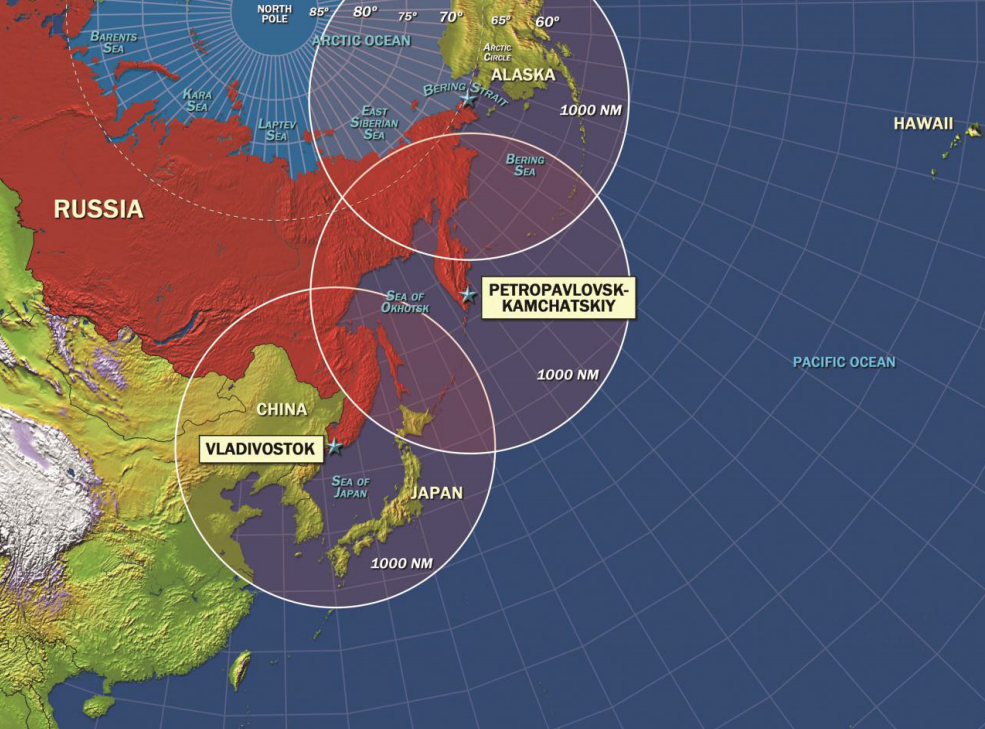
Strategically, the Soviet Navy was concerned with protecting the motherland from Western incursion. A two prong approach was conceived to accomplish this task utilizing the the principle of layered defense and nuclear deterrence. Layered defense was designed to decrease the likelihood of a Western strike, according to the report, the defense perimeter was set at 1000 kilometers or Tomahawk cruise missile range. Pages four and five have a graphic that emphasizes the areas of concern to the Russians to this day. The Russians achieved nuclear deterrence by putting their nuclear missiles out to sea on ballistic missile submarines of the NOVEMBER, DELTA, and TYPHOON class vessels.
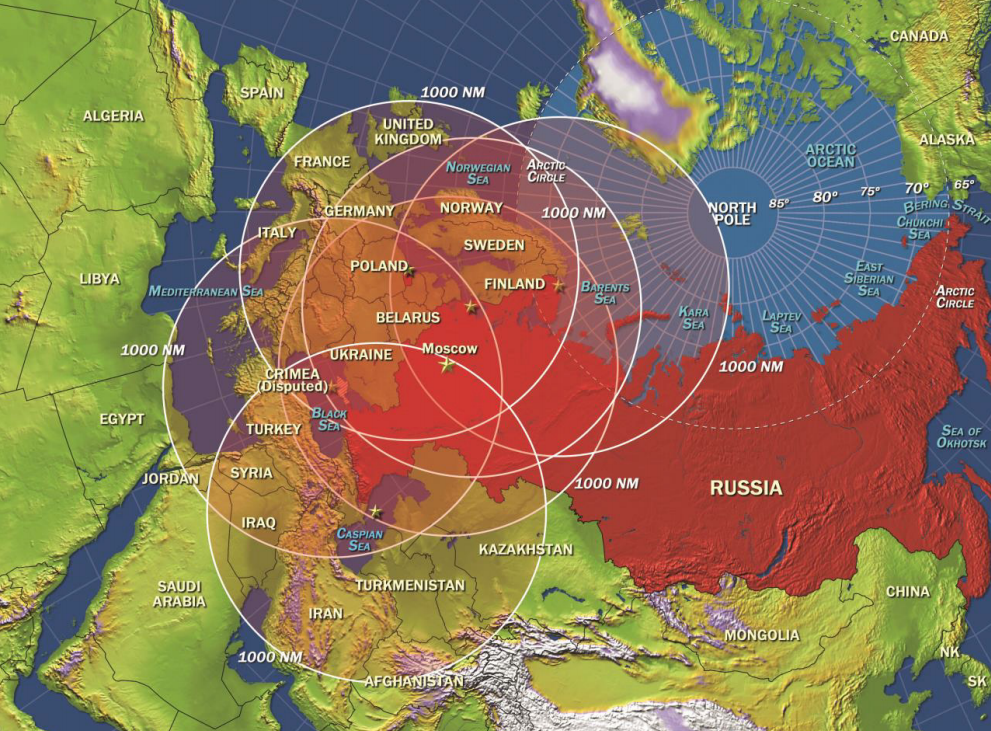
1000 nm rings, perceived TLAM threat to Russian homeland.
1000 nm rings, perceived TLAM threat to Russian homeland. (Office of Naval Intelligence)
FireShot Capture 91 - - https___fas.org_nuke_guide_russia_historic.pdf
1000 nm rings, perceived TLAM threat to Russian homeland (Pacific). (Office of Naval Intelligence)

The second section deals with the leadership of the current Russian Navy. Their analysis examines the current organizational structure from the Admiralty in St. Petersburg, all the way down to the command of a single ship in the Caspian Sea. Particular attention is paid to the career of the current Navy Commander-In-Chief, Admiral Viktor Chirkov. The authors examined the career path for officers in the Russian Navy. It is interesting to note that the majority of the formative years in an officer’s career can be spent in the same fleet, if not the same ship, including schooling in an academy nearest to their home.

Sections three and four examine platforms and personnel. In the aftermath of the collapse of the USSR, almost two-thirds of the Soviet fleet was written off, according to the report. As such, the navy shrunk significantly. What is in place now are legacy platforms from the end of the USSR buttressed by a gradual acquisition of modern platforms. The nucleus of the Russian Navy remains the submarine. Core to that is the new DOLGORUKIY-class SSBN, supplanting the older TYPHOONS and DELTAS, with eight units planned by 2020.
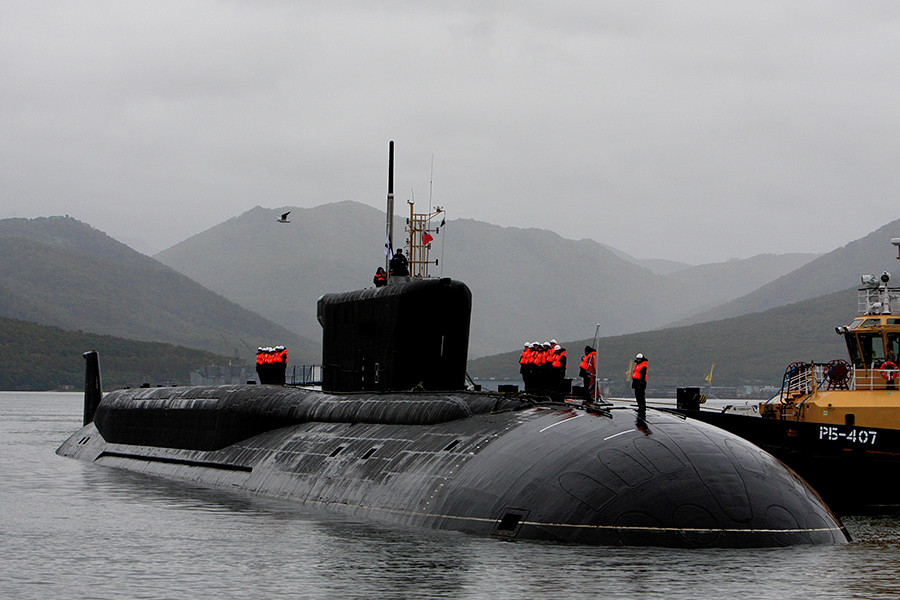
A Borei-class Russian submarine like the Alexander Nevsky (pictured) will be used to fire a new type of submarine-launched ballistic missile in an upcoming test. (Mil.ru/Wikimedia Commons)
Borei-class ballistic missile submarine.  (Mil.ru/Wikimedia Commons)

Surface combatants are also being upgraded, moving from single mission platforms to multi-mission ones. The report indicates that Russia will have a problem acquiring German-made diesel engines for the new platforms due to the invasion of Crimea. This report also presents a thorough overview of maritime aircraft and munitions both in active service and in development. The Russian Navy is shifting to a service based around quality platforms rather than quantity. This logically means as with most modern militaries the number of platforms will shrink as more capable platforms are brought online. Regarding personnel, the entire Russian military is moving from a conscript-based force to an all-volunteer force.

The report concludes with an overview that sees Russia moving to a modern naval force, albeit slowly. ONI predicts that the Russian Navy will have trouble recapitalizing their fleet due to problems with funding, acquisition of needed materials and parts, and new personnel training regimens. “Barring unexpected changes in the global political and economic environment, the Navy’s missions are expected to remain the same: to deter potential adversaries with strategic sea-based nuclear forces, to defend the nation and its interests using the Navy’s general purpose forces, and to use the Navy as an ‘instrument of state’ to support Russia’s diplomatic efforts, initiatives, and national interests.”
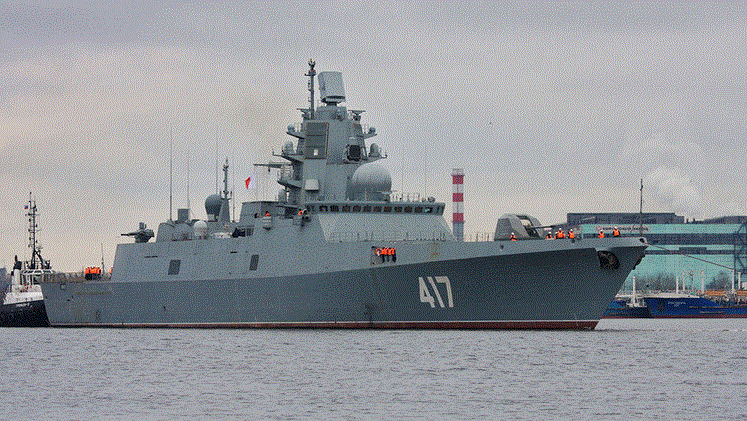
Admiral Gorhskov Frigate. (Wikimedia Commons)
Admiral Gorhskov class frigate. (Wikimedia Commons)

This report, as with the majority of ONI products, is a well-researched and worthwhile read for anyone interested in the current status of the Russian Federation Navy. If there was one aspect lacking, it would be an absence of legacy platform analysis as was done with the emerging platforms. Read the full report here.

David Roush received his Master’s degree in National Security Affairs emphasizing naval affairs from the Institute of World Politics. He also holds a bachelor’s degree from Western Michigan University in Political Science. David currently serves as CIMSEC’s Director of Content Management.

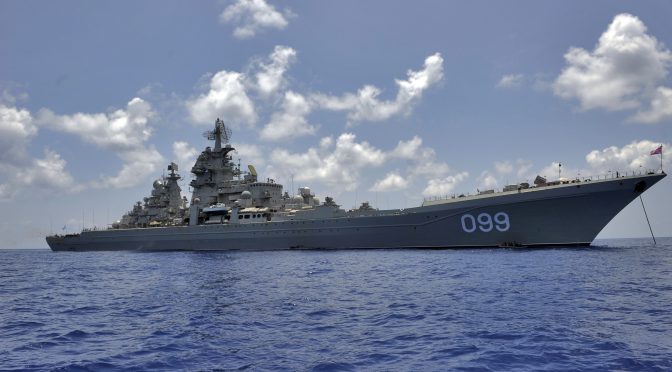
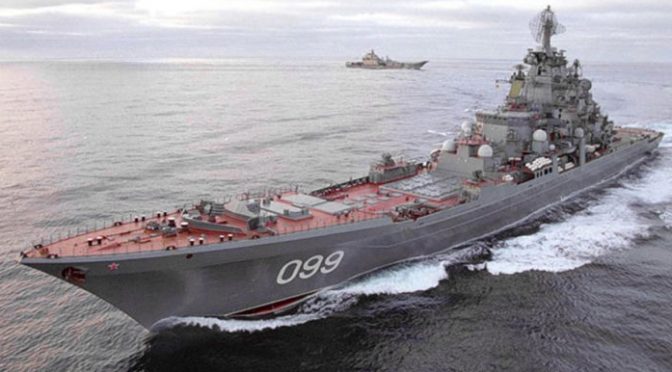
Featured Image: Russian Federation Navy Kirov-class battlecruiser Peter the Great (Grigoriy Sisoev/RIA Novosti)
Members’ Roundup: April 2016

By Sam Cohen

Welcome to the April 2016 members’ roundup. Over the past month CIMSEC members have examined several international maritime security issues, including the strategic implications of China’s land creation in the South China Sea, Russia and China’s testing and deployment of offensive hypersonic weapons, the U.S. Navy’s development of the Next Generation Air Dominance (NGAD) program, India’s maritime ambitions in the Asia-Pacific and finally, increasing maritime tensions between African coastal countrie,s and the resulting naval build-up taking place on the continent.

Beginning the roundup in the Asia-Pacific, Lauren Dickey for the Asia Unbound Series at the Council on Foreign Relations analyzes the current political turmoil challenging the stability of Taiwan’s government. Ms. Dickey explains that Taiwan’s ruling Kuomintang (KMT) party has retreated from an agreement with the country’s opposition Democratic Progressive Party (DPP) to conduct an item-by-item review of a service trade pact arranged with mainland China. The resulting breakout of severe protests by citizens, unions, and the DPP have demonstrate the harmful affects approval of the trade pact would have on Taiwan, including an increase in Beijing’s influence over domestic Taiwanese policy and the ability for large corporations to increase control over Taiwanese industry at the expense of local enterprises. Ms. Dickey highlights the perspective that the KMT party’s decision is one that has and will continue to challenge democratic principles within Taiwan while also creating a public atmosphere non-conducive to cooperative cross-strait relations.

Kyle Mizokami, at Popular Mechanics, discusses the test of China’s new hypersonic weapon, the DF-ZF, at the Wuzhai missile test center in central China. The DF-ZF is likely launched by a DF-21 IRBM, which releases a Hypersonic Glide Vehicle (HGV) just before leaving the atmosphere. Mr. Mizokami explains how the HGV released in the upper atmosphere is capable of travelling at speeds from 4000-7000 miles an hour making it difficult to intercept and capable of reaching almost any target in the world within an hour. In a second article at Popular Mechanics, Mr. Mizokami continues the discussion on hypersonic weapons with Russia’s continued development of its Zircon anti-ship missile. He explains how the missile will increase the surface warfare capabilities of Russia’s aging battlecruisers by providing a new offensive capacity capable of penetrating sophisticated air-defense systems. Dave Majumdar, at the National Interest, also discusses the technicalities and implications of Russia’s development of the Zircon anti-ship missile, which you can find here.    

Harry Kazianis, at The National Interest, highlights China’s primary strategic objective in the South China Sea; that Beijing views complete control of the waters from Taiwan to Malaysia as imperative to supporting regional Chinese sovereignty. Mr. Kazianis notes that Beijing has used a process of incremental aggression throughout the region to slowly, and perhaps unnoticeably, challenge the status-quo maintained by the U.S. with the ultimate goal of achieving regional hegemony. However, as outlined by Mr. Kazianis, there is potential for the U.S. and regional allies to limit and even halt this Chinese aggression at Scarborough Shoal just West of the Philippines, where the U.S. has already begun operations with A-10 Warthogs and Sikorsky HH-60 helicopters providing air and maritime situational awareness to local forces while also articulating to China that reclaiming the reef will not be tolerated.

In a second article at The National Interest, Mr. Kazianis provides a list of different methods for confronting Chinese antagonism in the South China Sea, including a joint U.S. and allied A2/AD strategy, utilizing media and communications to demonstrate a clear U.S. regional objective and lawfare – the notion that the U.S. and regional allies should coordinate legal actions and claims against China to maximize their effectiveness.

James Goldrick, at The Interpreter, discusses the impact China’s artificial island construction in the South China Sea will have on peace and stability in the region when combined with its aggressive territorial claims under a pretense of sovereign rights. He outlines how China’s objective of creating a safe haven for its naval forces in the region will collide with the national interests of the rest of maritime Southeast Asia. He suggests that Beijing should adapt a more sensitive approach to their regional claims as to not risk international, kinetic conflict.

Alex Calvo, for the University of Nottingham’s China Policy Institute Blog, examines the sinking of a Chinese fishing vessel by an Argentinian Coast Guard vessel and highlights the incidents’ significance should China succeed in breaking out of the First Island Chain and seek an expanded posture in the Southern Atlantic. He notes that China operates the world’s largest long-distance fishing fleet and its interaction with foreign nations and their waters should merit appropriate attention considering how similar fishing related events have contributed to an increasingly tense political and security environment in the East and South China Seas.

To conclude the April 2016 Members’ Roundup, Paul Pryce at Offiziere discusses Africa’s rapidly growing naval forces in relation to the rise of piracy threats in the Gulf of Aden and the Gulf Guinea while also noting an increase in maritime boundary disputes rooted in contested off-shore oil deposits. While identifying several examples, Mr. Pryce notes increased tensions between Ghana and Cote d’Ivoire and the corresponding procurement of 40 patrol vessels by Ivorian defense officials in response as a primary example of the new arms-race on the continent. He also mentions the procurement of three HIS 32 interceptor patrol vessels and three Ocean Eagle 43 OPVs by the Mozambican Navy in addition to the procurement of seven Macaé-class OPVs by Angola.

Members at CIMSEC were active elsewhere during the month of April:

At CIMSEC we encourage members to continue writing, either here on CIMSEC or through other means. You can assist us by emailing your works to dmp@cimsec.org.

Sam Cohen is currently studying Honors Specialization Political Science at Western University in Canada. His interests are in the fields of strategic studies, international law and defense policy.

Members’ Roundup: March 2016 Part One

By Sam Cohen

Welcome to part one of the March 2016 members’ roundup. Over the past month CIMSEC members have examined several international maritime security issues, including an increase in Russian naval activities and deployments, recent U.S. naval exercises demonstrating the Fleets’ application of the distributed lethality concept, laser technologies and the U.S. defense acquisition program and as usual, the increasingly tense security environment in the Asia-Pacific.  

Paul Pryce begins the roundup in the Asia-Pacific with a discussion, on what he refers to as, the new era in Singaporean defense procurement. In his article at Offiziere, Mr. Pryce highlights that previous procurement strategies for the country’s Navy have focused on acquiring mainly European designed vessels, either built specifically for Singapore or purchased following a short period of service in the initial European country. However, the planned construction of eight indigenous Independence-class littoral mission vessels beginning in 2016 and the expected procurement of a domestically built light aircraft carrier through 2021 suggests that the Singapore’s shipbuilding capacity and overall maritime force projection capabilities are becoming increasingly strengthened – a significant implication for Singapore’s role in South East Asian security dynamics.

[otw_shortcode_button href=”https://cimsec.org/buying-cimsec-war-bonds/18115″ size=”medium” icon_position=”right” shape=”round” color_class=”otw-blue”]Donate to CIMSEC![/otw_shortcode_button]

Alex Calvo, for Asian Military Review, discusses the challenge Taiwan faces in securing a replacement for its four aged hunter-killer submarines (SSKs), two of which are vintage Tench-class World War II boats while the other two were commissioned in the Netherlands in 1987 and 1988. Mr. Calvo explains how Europe has become reluctant to support Taiwanese military procurement needs for fear of angering China while the United States no longer produces SSKs. He suggests that Taiwan may look to Japan as an alternative source for its SSK replacement largely due to recent efforts by the Japanese shipbuilding industry to win the contract for the Royal Australian Navy’s SSK procurement requirements while also noting a lack of other feasible alternatives.

Kyle Mizokami, for Popular Mechanics, discusses China’s plans to establish aircraft carrier battle groups tasked with defense of the country’s territorial sovereignty, maritime rights and overseas interests both regionally and perhaps globally. Mr. Mizokami highlights the nature of China’s first operational aircraft carrier, the Liaoning, as he explains its training role and limited capacity to carry large numbers of combat capable aircraft. However, he also notes that China has confirmed the construction of the Dalian carrier, which will have more hangar space for support and combat aircraft – but will still only displace about 50 000 tons, or half that of a modern U.S. carrier.

Leaving the Asia-Pacific, Dave Majumdar outlines the implications of Russia’s planned massive live-fire nuclear exercise being conducted by two Project 955 Borei-class ballistic missile submarines deployed with the Northern Fleet. In his article at The National Interest, Mr. Majumdar explains how one of the missile boats will sequentially launch all sixteen of its RSM-56 Bulava missiles at a depth of 164ft while highlighting that such an exercise, whether a U.S. or Russian ballistic missile boat, would only launch their entire payload in conflict as part of full-scale retaliatory or offensive nuclear strike. In a second article at The National Interest, Mr. Majumdar discusses the spotting of a Russian Project 667 BDRM Delfin-class ballistic missile submarine near French territorial waters – the boat carries sixteen missiles capable of carrying four nuclear warheads each with a range of 7500 miles.

Bryan McGrath, for the War on the Rocks, provides the ‘First Principles’ that will help guide the difficult task of structuring the U.S. Navy’s future fleet. Mr. McGrath emphasizes that the Navy must be sized and shaped into a fleet that allows for both combat-credible and presence forces to be positioned globally in a manner that secures national interests while effectively deterring major power conflict. He also mentions the implementation of the distributed lethality concept, where individual platform lethality is increased even as the force becomes geographically dispersed. On this point, Mr. McGrath argues that an individual combat capacity increase should not compel policy makers to reduce the size of the fleet, as one does not necessarily balance the others strategic importance. On the same topic at The National Interest, Dave Majumdar describes a recent test of the SM-6 missile where it was revealed that the system now retains effective anti-surface capability, a major step for distributed lethality implementation across the fleet.

Members at CIMSEC were also active elsewhere during the first part of March:

CIMSEC has also recently (February) published a compendium discussing a range of strategies, challenges and policy options concerning Distributed Lethality. You can find a download link for all of the articles here.

At CIMSEC we encourage members to continue writing, either here on CIMSEC or through other means. You can assist us by emailing your works to dmp@cimsec.org.

Sam Cohen is currently studying Honors Specialization Political Science at Western University in Canada. His interests are in the fields of strategic studies and defense policy and management.

[otw_shortcode_button href=”https://cimsec.org/buying-cimsec-war-bonds/18115″ size=”medium” icon_position=”right” shape=”round” color_class=”otw-blue”]Donate to CIMSEC![/otw_shortcode_button]

Sea Control 107 – CAPT Heritage & Navy Cyber Defense Operations Command

seacontrol2CAPT Sean Heritage, CO of Navy Cyber Operations Defense Command, joins us to discuss the responsibilities of his command, the Navy cyber defense enterprise,  institutional innovation, and working as EA to ADM Rogers, Director NSA.

DOWNLOAD: CAPT Heritage and Navy Cyber Defense Operations Command

[otw_shortcode_button href=”https://cimsec.org/buying-cimsec-war-bonds/18115″ size=”medium” icon_position=”right” shape=”round” color_class=”otw-blue”]Donate to CIMSEC![/otw_shortcode_button]