The Law of Counter-Piracy Operations: From Hollywood films to some Chinese popular perceptions of their Eastern neighbors, piracy and pirates retain a powerful hold in contemporary culture. However, it is their most recent incarnation in areas like the Gulf of Guinea, the Malacca Straits, and the Horn of Africa, that is carefully followed by anybody involved in maritime affairs, from ship owners and operators to naval officers and international lawyers. Among other aspects of piracy, the legal regime of pirates and operations against them is of the foremost importance, and therefore any volume devoted to them proves a welcome addition to the literature on the sea and what Julius Caesar labeled as “hostis humani generis,” or the enemies of humankind. This is exactly what Piracy and Armed Robbery at Sea purports to be, and actually is: a single-volume treaty on the law applicable to counter-piracy operations, with a regional focus on Somalia and the Gulf of Aden. The book achieves the goals of providing a comprehensive approach to the subject, with plenty of primary sources, case law where applicable, and legal commentary on controversial or unclear aspects. While readers may note the absence of topics such as the rights of victims, the ransom industry, and non-Western legislation, this does not detract from the overall quality of the work, which furthermore contains a number of sources in its appendixes which can be very useful to the practitioner.
[otw_shortcode_button href=”https://cimsec.org/buying-cimsec-war-bonds/18115″ size=”medium” icon_position=”right” shape=”round” color_class=”otw-blue”]Donate to CIMSEC![/otw_shortcode_button]
As clear from the title, the subtitle, and introduction, this book seeks to provide the reader with a detailed explanation of the different legal regulations and principles under which piracy is fought in one of the corners of the world where it is most pervasive, and which, crisscrossed by myriad SLOCs (sea lanes of communication), no major power can ignore it. In connection to this, the first aspect of the text we should note is that this is indeed a law book, and perhaps more accurately a “black letter law” book, in the sense that it focuses on positive law, with just the minimum amount of social, economic, and other considerations provided in Chapter one and later interspersed in the text. When the authors delve outside the strict borders of the law, it is to better explain the rationale behind legal rules, a good example being their discussion of judicial and prison capacity in- countries like Kenya (p. 174-179) and the Seychelles, which supports and complements their explanation of the agreements signed between them and the European Union for the local trial and imprisonment of pirates. Having said that, they also discuss possible future developments of the law, such as specialized international tribunals to deal with piracy (p. 179-184).
A second important characteristic we may stress is the logical fashion in which the text is divided into parts, and then subdivided into chapters, which very much aids for the reader who wishes to go through the text from beginning to end, and those who prefer to go straight to one of the issues discussed in the volume. A third strong point is that, while focused on positive law, the authors stop to discuss areas where applicable rules may not be clear or even be controversial, providing a summary of arguments and their own views. An example is the practice of embarking law-enforcement personnel from one country on a naval (or state) ship of another, with the associated legal complexities.
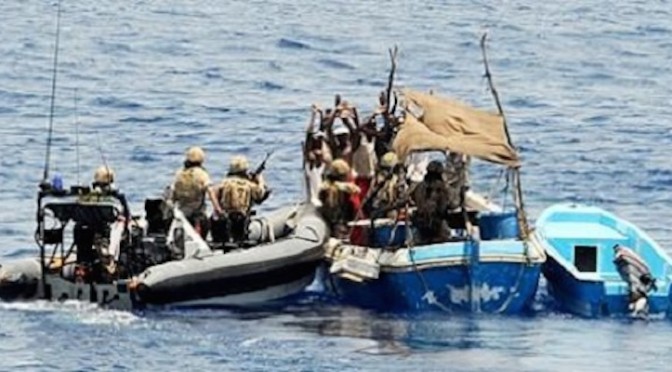
This photo taken Sunday, Jan. 4, 2009 provided by French Defense Minister shows suspected pirates arrested by Marine commandos of the French Navy in the Gulf of Aden, off Somalia coasts. French government officials say the Jean de Vienne intercepted and captured 19 pirates Sunday as they tried to take over two cargo ships, one Croatian and the other Panamian. French Navy vessel Jean de Vienne is seen on background. (AP Photo/French Navy/French Defense Minister/HO)
The Book’s Strong Points: The text provides a comprehensive look at applicable legislation and extensive discussion of unclear aspects. As noted, the authors make an extensive effort to cover the different legal aspects of the fight against piracy, adding their commentary and summaries of other views where positive law is unclear or developing. Examples include three possible interpretations of Article 105 UNCLOS, providing universal or limited criminal jurisdiction, a conflict-of-law rule, or a reaffirmation “that prosecution is based on domestic criminal law and procedure” (p. 149-151), and a discussion of the differences between transfers and extradition, noting how generally speaking “in the piracy context, the change in custody is not brought about by the formal means of extradition” and “transfers in the piracy context do not fulfill the characteristics of deportations or exclusions.” (p. 192-194)
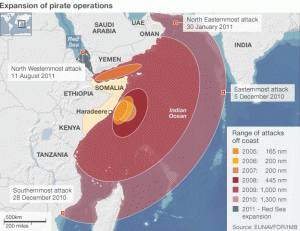
The Expanding Range of Somali Piracy
Three gaps: Non-Western Views, Piracy Victims, and the Ransom Industry and Middlemen
There are three aspects that, if incorporated in future editions of the book, may make this work even more complete. First of all, we should note a lack of Chinese, Indian, Japanese, Russian, and South Korean views, even though all these countries contribute to the struggle against piracy in the Horn of Africa. It would be interesting to find some legal commentary, domestic legislation, or actual cases, from these jurisdictions. Second, we cannot fail but note a complete and utter disregard for piracy victims, who are basically absent from the text. While the death penalty, torture, and the principle of “non-refoulement” are dealt with extensively (p. 210-220), there is no discussion of reparations for victims, and of their procedural standing other than when serving as a connection point for states to exercise jurisdiction.
The authors’ concern with the human rights of alleged and convicted pirates is commendable, and so is their extensive treatment of those rights in their book, but caring about the rights of the accused should not be seen as incompatible with at least providing some cursory explanation of those of the victims. Finally, another notable absence is that of the “middlemen” and more widely the “industry” managing ransoms, and their possible criminal liabilities. No look at the legal framework of the fight against piracy is complete without an examination of the rules and practice designed to strangle their finance, but despite the subject occasionally emerging in the pages of the book, there is no section specifically dealing with it. Is it perhaps too sensitive?
Conclusions: It is a useful and quite comprehensive study, though suffering from some gaps. We can thus conclude that this is a book that anybody interested in piracy and counter-piracy operations, the law of the sea, and more generally maritime and naval affairs, will find useful, both as a detailed introduction to the legal rules applicable to counter-piracy operations, and as a reference work. It is to be hoped, however, that future editions incorporate non-Western views, victims’ rights, and the law applicable to pirate financing.
Alex Calvo is a guest professor at Nagoya University (Japan) focusing on security and defence policy, international law, and military history in the Indian-Pacific Ocean. Region. A member of the Center for International Maritime Security (CIMSEC) and Taiwan’s South China Sea Think-Tank, he is currently writing a book about Asia’s role and contribution to the Allied victory in the Great War. He tweets @Alex__Calvo and his work can be foundhere.
[otw_shortcode_button href=”https://cimsec.org/buying-cimsec-war-bonds/18115″ size=”medium” icon_position=”right” shape=”round” color_class=”otw-blue”]Donate to CIMSEC![/otw_shortcode_button]
A popular quote reads “A ship in port is safe. But that’s not what ships are made for.” Correspondingly, one could quip “Navies are very good in constabulary tasks. But that’s not what they’re maintained for,” echoing noted political scientist Samuel Huntington in the process. More than sixty years ago, Huntington wrote about the purpose of naval forces in the early Cold War, yet some of his thoughts have an enduring value for 2016. In the Mediterranean, not one but two naval task groups are working hard to contain a humanitarian crisis at sea. While their service is admirable and strictly necessary, even as it is only a drop in a bucket, naval capabilities which are in high demand elsewhere are bound in a mission that is only a secondary role for navies. Instead, Germany should lead the way in investing in an EU auxiliary force.
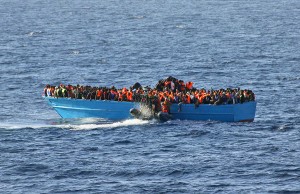
A crowded boat with migrants awaits rescue by EU NAVFOR MED.
In May 2015, the German Navy began participating in the search and rescue mission in the Central Mediterranean north of the Libyan coast, dubbed EU NAVFOR MED (Operation “Sophia”) shortly thereafter. The pressure to act had become unbearable for political decision-makers in Berlin and Brussels after yet another devastating humanitarian catastrophe which occurred somewhere on the High Seas between Libya and Italy. An overloaded boat sank during the night of 18/19 April, costing the lives of up to 800 migrants. Hundreds others had perished in the Mediterranean during the months before. Following a European Council decision and a parliamentary green light, the German Navy dispatched the frigate Hessen (F221) and the combat support ship Berlin (A1411) to provide a presence north of Libyan territorial waters. At the time, both ships were operating off the Horn of Africa and in the Easter Mediterranean to provide the German Navy with an operational reserve. Hessen and Berlin joined a number of other EU vessels, which ranged from warships to auxiliary and coast guard ships. EU NAVFOR MED was just the latest mission that the German government engaged its shrinking military forces in; on the maritime domain alone, Germany is continuously involved in naval operations in the central Mediterranean (ACTIVE ENDEAVOUR, since 2002), off the coast of Lebanon (UNIFIL, since 2006), and on the Horn of Africa (EU NAVFOR Atalanta, since 2008). German Navy participation in one or often two of the four Standing NATO Maritime Groups, exercises, training, and out-of-the-schedule naval operations such as providing cover for the destruction of Syrian chemical weapons at sea in 2014 have added pressure to (wo)men and material.
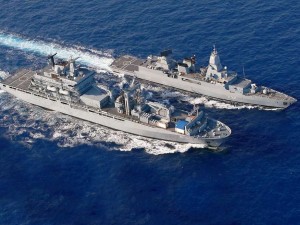
Combat support ship Berlin and frigate Hessen steam side by side in the initital provision of humanitarian assistance on the Southern flank.
Cue: Queen, “Under Pressure”
Since the summer of 2015, rotating up to two ships in and out of the EU NAVFOR MED mission – such as the Berlin’s sister ship Frankfurt (A1412), or the tender Werra (A514) – put a truly severe strain on German military-operational planning. It goes without saying that adapting these venerable warships and supply vessels, which are optimized for many things other than housing, feeding, and medically caring for hundreds of castaways on board, has put a strain on the Deutsche Marine. The noble task of saving lives at sea has challenged the well-trained crews of the ships, but it hardly obscured the fundamental problem that more than two decades of defense budget cuts, strategic disorientation, and a larger disinterest in all things hard power by the German public (and most of its political masters) have caused. By default, the German Navy has turned into a low-end, operationally-minded force, where high intensity should be a design guide.
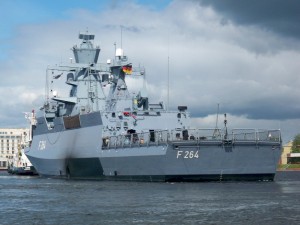
The German Navy’s dilemma, at 16,000 people and just 62 vessels at the smallest it has ever been by a December 2015 count, was illustrated best right before Christmas. In response to the November attacks in Paris, the frigate Augsburg (F213) was re-assigned from EU NAVFOR MED to provide air defense for the French aircraft carrier Charles de Gaulle in the Eastern Mediterranean and Persian Gulf. The mine hunter Weilheim (M1059), en route to return from UNIFIL to its homeport on the Baltic Sea right in time for the holidays (and probably the least-capable vessel to offer space for potentially hundreds of migrants), was tasked to remain in the Central Mediterranean. It joined the corvette Ludwigshafen am Rhein (F264), another warship tasked with a humanitarian assistance task that was hardly envisioned by strategic and operational planners in Berlin and Rostock, site of the naval command. Samuel Huntington, who warned that navies should concentrate on providing high end options and not be used for low-end missions, would probably turn over in his grave. This is not to say that other countries did not have their own challenges in providing assets to the mission, but some of them are better equipped to attend to low-end missions. The Royal Navy, for instance, dispatched HMS Enterprise (H88), a multi-role hydrographic oceanographic vessel.
The corvette Ludwigshafen am Rhein is currently part of Germany’s contribution to EU NAVFOR MED. Germany’s naval missions can sometimes be as complicated as its ship-naming policy.
When all you have is a hammer, every problem looks like a nail
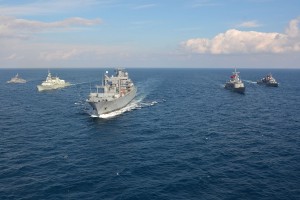
In February 2016, the German Navy is still tied up in the EU NAVFOR MED. Privately owned platforms such as the Phoenix, operated by the Malta-based Migrant Offshore Aid Station (MOAS), and two vessels operated by Doctors without Borders (Medicines Sans Frontiers, MSF), the offshore supply ships Bourbon Argos and Dignity 1, have also at some point joined the operation (although they are not integrated into the EU force). At the same time, the Aegean Sea, which offers the shortest distance between Turkey and Greece, has moved into focus for human trafficking. The cold of winter has hardly deterred the refugees from mounting unseaworthy dinghies, rubber boats, or derelict fishery vessels that the criminal networks of human traffickers operate. In response, NATO stepped in and dispatched its Standing NATO Maritime Group 2 (SNMG2). The task force is commanded by the German rear admiral Jörg Klein and currently consists of the German Navy combat support Ship Bonn (A1413) and four frigates from Turkey, Italy, Greece, and Canada. As the New York Times noted in an article on 11 February,
“while the hastily made decision reflected the growing urgency of the situation, it was not clear that it would have much practical effect on the flow of refugees fleeing Syria’s five-year civil war: The alliance said it would not seek to block the often rickety and overcrowded migrant vessels or turn them back, and military officials were scrambling to determine precisely what role their warships would play.”
Standing NATO Maritime Group 2, seen here steaming in formation, is currently tasked with operating on the Aegan Sea refugee route.
A European Auxiliary Navy
Granted, the political leverage for European integration is low at the moment. The European Union is struggling to fend off tendencies that call not for an ever closer union, but in fact work towards dismantling some of the EU’s accomplishments in the wake of the refugee crisis. Still, with security and defense in increasing demand, including maritime security from on Europe’s southern flank, there need to be fresh ideas that can be operationalized quickly. In the face of the deteriorating relations between the West and Russia and the disintegrating Middle East, warships should contribute to the more robust stance against political aggression and hard threats, thus focusing on more of their core tasks (no doubt requiring doctrinal and conceptual re-assessments in some European capitals). This would give NATO a stronger role, and leave the EU to take care of the low-end maritime task. It could thus serve as an example of burden-sharing between the two entities.
Germany could play a leadership role in drawing up a European auxiliary navy, reenergizing the European spirit of cooperation in the process. Such a task force could have a number of political advantages. First, it would send a strong signal that European nations are willing to work together to address the ramifications of maritime trafficking. Second, Germany would address calls from inside and outside to do more. As a maritime nation with strong normative impulses, the Federal Republic would also demonstrate to the electorate (long weary of military engagement) that it is aware of the utility of naval forces in crisis response. Naturally, German investment into an auxiliary EU navy should not come at the expense of more robust naval tasks with the German Navy, but these could be better tailored if the combat support ships, frigates, and corvettes need not be used in lesser operations. Third, if and when the current migrant crisis ebbs, the European auxiliary navy could concentrate on the public diplomacy role of naval forces, providing anything from humanitarian assistance to the provision of medical services on goodwill tours around the world (like the U.S. Navy and the Chinese PLAN routinely do already). This auxiliary navy could also lend a hand to regional coastal and constabulary navies and coast guards (e.g. in West or East Africa) to train and exercise.
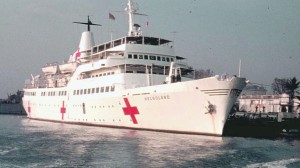
The last dedicated German hospital ship was the MS Helgoland, which saw extensive action in Saigon (South Vietnam) between 1966 and 1972. The ship was operated by the German Red Cross.
To this end, it is strictly necessary to inject some fresh thinking into how such as force could be tailored. It is imperative that an idea such as this can be put into action rather quickly before being brought to grinding snail speed by bureaucrats in Brussels or Berlin. First, one should look at the market of commercial vessels. Ro/Ro ships or offshore supply ships are available, usually even on short notice. They could be painted gray or white, manned by a mixed civilian-military crew, and quickly form the backbone of an auxiliary navy.
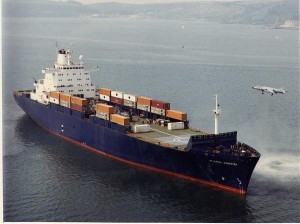
The Royal Navy used the Ro/Ro vessel Atlantic Conveyor in the 1982 campaign to retake the Falkland Islands from Argentina. The makeshift helicopter and Harrier carrier was sunk by Argentine forces in the course of the conflict.
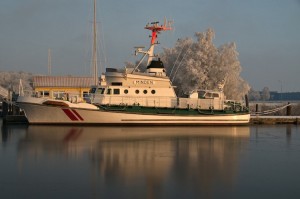
Other opportunities arise as well. The offshore patrol vessel L’Adroit (P725) is a demonstrator vessel built by French shipbuilder DCNS and was placed at the disposal of the French Navy for three years, a period that is now drawing to a close. The ship could be introduced as a French contribution to the auxiliary navy, which need not limit itself to state-run ships. If done properly, NGOs like SOS Mediterranee could be integrated (the non-profit organization operates the MS Aquarius, a former German fishery protection vessel). The former rescue cruiser Minden, built in 1985 and serviced by volunteers from the German Maritime Search and Rescue Service, will join what is already emerging as a multinational, civilian, and military task force in the Mediterranean.
The former SAR cruiser Minden, for thirty years operated in the North Sea and Baltic Sea by an NGO, will soon begin rescue operations in the Mediterranean.
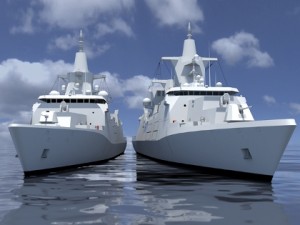
In the medium term, one could consider the charter of vessels which could be converted quickly as dedicated hospital ships, also crewed by civilian mariners and military. A logistics ship would also come in handy, as well as a simplistic command platform. To provide range, ships taken up from trade (not such a novel concept after all) could be selected if they provide the opportunity to operate reconnaissance drones or helicopters. In the long term, there are even further ideas that could be floated. For example, the 2016 German federal budget has earmarked the procurement of three new patrol vessels for the Bundespolizei See, Germany’s quasi Coast Guard. It is entirely plausible that these ships could also be detached as part of the EU’s auxiliary fleet, akin to NATO’s SNMGs – that is, if Germany politically resolves its constitutional conflict between police and military jurisdiction and respective responsibilities. To go even further, the German Navy is currently in the early stages of procuring the future multi-role combat ship MKS180, designed as a modular warship. Is it too far-fetched to consider adding a civilian variant, a MKS180CIV, for the auxiliary “Great EU White Fleet”?
The German Navy’s next project: Multi-role combat ships MKS180 (artist conception).
To be clear: Such an auxiliary navy would have to be organized, trained, and equipped properly. This requires financial and political investments. The task force, more of a 10-ship navy than a 100- or even 1000-ship navy, would provide a vision for European cooperation. EU or United Nations mandates would be desirable. It appears that it is also a much more sensible road leading to further defense and security cooperation than political soap-box oratories about the need for a European army could ever do. Politically and operationally, it could provide Berlin with a sense of regaining some degree of initiative when it comes to maritime security.
Sebastian Bruns directs the Center for Naval Strategy and Security at the Institute for Security Policy, University of Kiel (Germany). He is the editor of “The Routledge Handbook of Naval Strategy and Security”(Routledge: London 2016).
This article originally appeared in the National Defense University’s Joint Forces Quarterly 80, and is republished with permission. It can be read in its original form here.
By John F. Morton
Under defense strategic guidance, U.S. combatant commanders have been rebalancing joint forces along the Asia-Pacific Rim with recalibrated capabilities to shape the regional security environments in their areas of responsibility. The mission of what the 2012 guidance calls “Joint Force in 2020” is to project stabilizing force to support our allies and partners, and to help maintain the free flow of commerce along sea lines of communication in the globalized economic system.1
Forces postured forward for deterrence and conflict prevention are a substantial component to U.S. global engagement. The combatant commanders, joint community, and Services are working together to plan and resource this joint force with credible, effective, and affordable warfighting capabilities that assure friends and deter adversaries—should deterrence and conflict prevention fail.
Complicating the combatant commanders’ calculus are the advancing antiaccess/area-denial (A2/AD) capabilities in the hands of potential adversaries and rogue states that pose a major challenge to the maritime domain. From the Arctic to the Arabian Gulf, Russia, North Korea, China, India, Pakistan, and Iran all have to varying degrees either deployed or are developing nuclear weapon and ballistic missile capabilities. Combined with other A2/AD capabilities that include sea-skimming and high-diving supersonic cruise missiles, these threats to the global maritime commons translate into powerful tools for diplomatic coercion.
The 2014 Quadrennial Defense Review put specific priority on increasing overall joint force capabilities to counter growing A2/AD challenges. In what the Pentagon characterizes as the A2/AD environment, defense officials are now conceptualizing the high-end level of the warfighting spectrum around the integrated air and missile defense (IAMD) mission. In December 2013, General Martin Dempsey, then Chairman of the Joint Chiefs of Staff, released his Joint Integrated Air and Missile Defense: Vision 2020 that spoke of the need for IAMD to “be even more Joint—advancing interdependence and integrating new capabilities.”2
Senior military officials conceive of high-end operations as IAMD-centric. They view IAMD as a joint capability to be employed at the tactical, operational, and strategic levels of war. Competitive IAMD strategies for today’s A2/AD environments are comparable to those strategies formulated during the Cold War with reference to the Fulda Gap, such as the Follow-on Forces Attack subconcept. The strategies inform IAMD requirements generation and acquisition, as well as the Planning, Programming, Budgeting, and Execution process for systems and architectures.
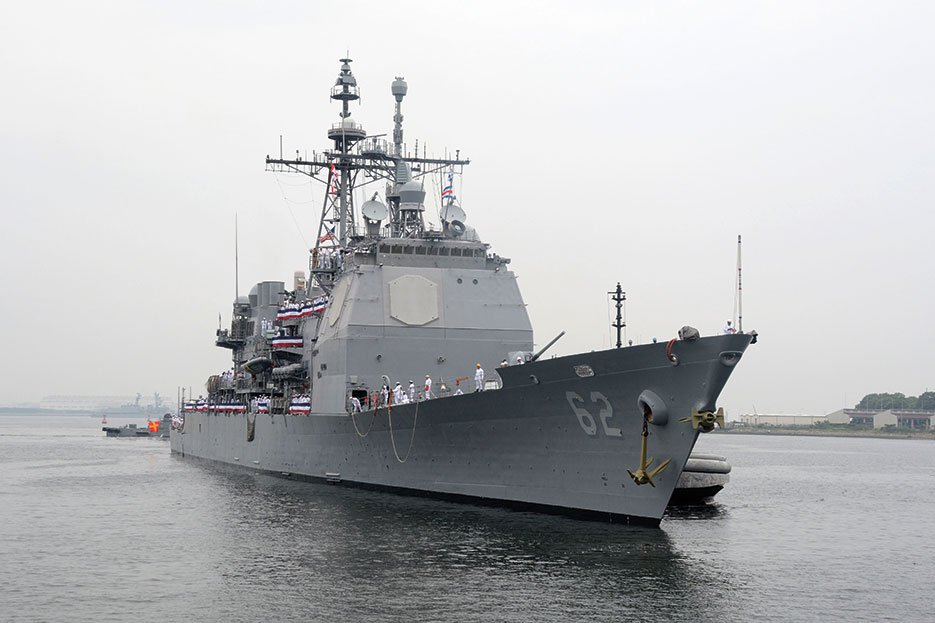
Ticonderoga-class guided-missile cruiser USS Chancellorsville recently completed combat systems update with latest Aegis Baseline 9 combat system, June 18, 2015 (U.S. Navy/Peter Burghart)
Joint IAMD describes the IAMD environment as an expanding battlespace requiring plans and operations that range across global, regional, transregional, and homeland domains. “The regional and intercontinental reach of ballistic missiles,” it continues, “alters the strategic and operational decision space.”3 IAMD forces in a specific theater can extend to regional, transregional, and homeland operations. As such, combatant commander plans must allow for coordination and handoff across combatant command areas of responsibility.
Since May 2013, the Missile Defense Agency (MDA) has had technical authority over the IAMD mission. MDA now leads all joint IAMD engineering and integration efforts, including defining and controlling the IAMD interfaces and the allocation of IAMD technical requirements. MDA’s current director is Vice Admiral James Syring, the first Navy head of the agency. His arrival in 2012 coincided with a time when the Aegis ship-based combat system came to be seen as a core element of U.S. and partner nation efforts in ballistic missile defense (BMD) in line with the European Phased Adaptive Approach (EPAA), the administration’s missile defense strategy for Europe.4 Syring previously served as the program executive officer for integrated warfare systems (PEO IWS) in the Navy office that was responsible for modernization of Aegis cruisers and destroyers, new construction, and ongoing baseline upgrades to their combat systems.
Working with MDA in driving IAMD jointness is the Joint Staff’s Force Structure, Resources, and Assessment Directorate (J8), specifically the Joint Integrated Air and Missile Defense Organization (JIAMDO). This group leads in developing and fielding a comprehensive, integrated joint and combined air and missile defense force in support of Joint IAMD. Since June 2014, JIAMDO directors have been two other Navy flag officers, Rear Admiral Jesse A. Wilson, Jr., and his recent successor, Rear Admiral Ed Cashman. They have led JIAMDO in planning, coordinating, and overseeing joint air and missile defense requirements, operational concepts, and operational architectures. They have also headed the U.S. delegation to the North Atlantic Treaty Organization (NATO) Air and Missile Defense Committee that develops and steers Alliance IAMD policy, all the more important in view of the current situation in the Eastern Mediterranean.
These Navy appointments to the joint community reflect the reality that the foundational maritime IAMD enablers for active defense will be the surface Navy’s modernized fleet of Aegis-equipped warships. Mobile, forward-deployed Aegis cruisers and destroyers, variously upgraded, will serve as the combatant commanders’ net-enabling nodes for globally integrated joint force operations for access control. (Augmenting the missile defense capability of at-sea Aegis platforms in the NATO area of responsibility will be the land-based Aegis Ashore variant. Under EPAA Phase II, Aegis Ashore is in Romania with a technical capability declaration that came at the end of 2015; the Office of the Secretary of Defense for Policy has planned for initial operational capability [IOC] in July 2016. Phase III Aegis Ashore is due in Poland in 2018.)
Modernized Aegis as the IAMD Game Changer
The linchpin of regional IAMD is surface warfare, then-Captain James Kilby wrote in April 2014.5 The deputy for ballistic missile defense, Aegis combat systems, and destroyers in the Office of the Chief of Naval Operations (OPNAV) Surface Warfare Directorate (N96), Kilby explained that the surface Navy’s fleet of 30 Aegis cruisers and destroyers is capable of conducting ballistic missile defense. His main points, however, addressed how a host of additional Aegis ships are undergoing modernization and will be equipped with a new combat system baseline that provides advanced IAMD capabilities. Now a rear admiral, Kilby became the first commander of the newly established Naval Surface and Mine Warfighting Development Center in San Diego in mid-2014. Prior to his OPNAV service, he commanded the cruiser USS Monterey (CG 61), the first Aegis BMD ship to deploy to the Mediterranean in March 2011 to support EPAA.
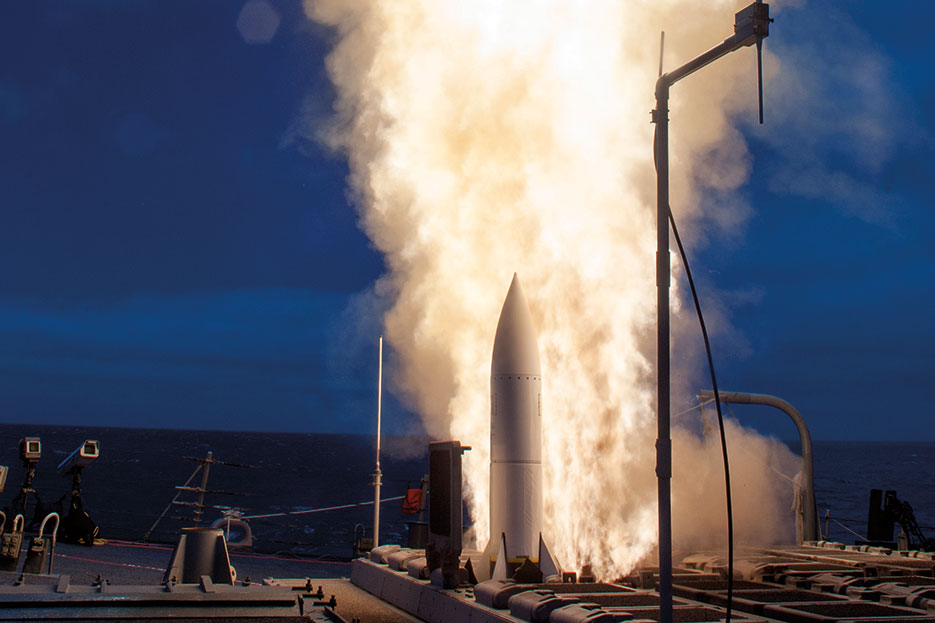
Crew of guided-missile destroyer USS John Paul Jones successfully engaged 6 targets with 5 Standard Missiles during live-fire test, June 19, 2014 (U.S. Navy)
Kilby stated that the key feature of Aegis IAMD modernization is the Baseline 9 combat system upgrade that provides the ability to conduct integrated fires via a sensor net linking ships and aircraft. Four Baseline 9 ships—two cruisers and two destroyers—underwent certification in 2015. An additional BMD destroyer, the lead Baseline 9 destroyer USS John Paul Jones (DDG 53), is homeported in Hawaii. In August 2014, the John Paul Jones replaced the Aegis cruiser USS Lake Erie (CG 70) as the deployable BMD test ship assigned to the Barking Sands Pacific Missile Range Facility on Kauai to support MDA and Navy testing of IAMD capabilities. (The John Paul Jones Baseline 9 upgrade was co-funded by the Navy and MDA. Although the ship is an “integrated baseline ship” that is also deployable, it is not a combatant command asset.) John Paul Jones has to date successfully completed four flight test events intercepting both short-range ballistic missile and cruise missile targets using the Standard Missile (SM)-6 Dual I and SM-2 Block IV missiles.
The most complex variant of integrated fires, wrote Kilby, is the emerging Navy Integrated Fire Control–Counter Air (NIFC-CA) capability that dramatically extends the sensor net to allow for missile engagements beyond the radar horizon. NIFC-CA provides integrated fire control for theater air and antiship cruise missile defense in the tactical environment. The capability greatly expands the over-the-horizon air warfare battlespace for surface combatants to enable third-party targeting and use of smart missiles. “If properly employed with the right tactics,” Kilby wrote, NIFC-CA, the SM-6 surface-to-air/space missile, the E-2D Hawkeye with the Cooperative Engagement Capability (CEC), and 5th-generation F-35 fighter aircraft will be “IAMD game changers.”
OPNAV’s Surface Warfare Directorate is working to enhance the utility of NIFC-CA. Among the concepts considered is making the Baseline 9 ships less reliant on assets of the carrier strike group by using an organic unmanned aerial vehicle with the necessary data links to provide the tracking and targeting information to the ship’s system as a way forward for Aegis in its IAMD role.
In 2013, then–Chief of Naval Operations Admiral Jonathan W. Greenert directed the Service to accelerate NIFC-CA’s fielding, achieving IOC of Increment 1 with the E-2D in 2014. The Theodore Roosevelt carrier strike group deployed with a squadron of E-2Ds and the USS Normandy (CG 60), a Baseline 9 cruiser. The lead Baseline 9 cruiser, USSChancellorsville (CG 62), is now under operational control of U.S. 7th Fleet. The third Baseline 9 cruiser, USS Princeton (CG 59), underwent combat system ship qualification trials and integrated testing in July 2015. The initial NIFC-CA concept of operations, however, still requires additional testing and refinement as the Navy delivers the tactics, techniques, and procedures (TTPs) needed to exploit the new IAMD capabilities.
While the Baseline 9 cruisers go by the name “air defense cruisers,” the Baseline 9 destroyers will be full-up IAMD Aegis ships with both NIFC-CA and BMD capabilities. The Baseline 9.C1 destroyers USS John Paul Jones, USS Benfold (DDG 65), and USS Barry (DDG 52) were slated to achieve Navy certification in 2015 with open architecture BMD 5.0 combat system computer software. Benfold is now on station with the 7th Fleet’s Forward Deployed Naval Forces in Yokosuka, Japan. Barry will follow by 2017.
Based on the tactical threat picture, Baseline 9 Aegis destroyers will be able to allocate their computer resources more dynamically in a single computing environment to maximize their BMD performance without degrading their air defense role. The principal enabler of this capability is the multi-mission signal processor (MMSP) for the Aegis SPY-1D radar. Earlier BMD computing suites for the radar used a separate signal processor, meaning a BMD-equipped surface warship could engage either a ballistic missile or an aircraft/cruise missile threat, but not both threats simultaneously. This situation resulted in difficult trade-offs that limited the system’s anti-air warfare (AAW) capability to an unknown extent. The MMSP, however, effectively integrates signal-processing inputs from the BMD signal processor and the legacy Aegis in-service signal processor for the radar. This integration enables the SPY radar to go from single-beam to dual-beam capability to meet the power resource priorities for simultaneous anti-air warfare and BMD sector coverage. The MMSP’s up-to-date commercial off-the-shelf hardware and software algorithms control radar waveform generation and allow for simultaneous processing of both AAW and BMD radar signals.
Critically, the MMSP improves Aegis SPY radar system performance in littoral environments, for example, against sea skimmers in a high-clutter environment. For BMD, the processor also enhances search and long-range surveillance and tracking and BMD signal processor range resolution, discrimination, and characterization, as well as real-time capability displays.
The Navy’s PEO IWS strategic vision for Aegis modernization is simple. Smaller and more frequent upgrades to modular combat systems with open architecture and standard interfaces will best enable the surface Navy to maintain operational superiority in support of the joint force in the A2/AD environment.
Aegis baseline upgrades strive for commonality to reduce the combat system footprint onboard ships. Future baselines will bring additional IAMD capabilities, notably, integration of additional off-board sensors as the joint force “sensor-shooter” networks mature and A2/AD counters in the access environment. A key developmental focus is determining what other off-board elements can integrate into the fire control loop and federated network to increase overall affordability and lethality.
JIAMDO: An Ally for Driving Data-Sharing over the Sensor-Shooter Net
Guided-missile cruiser USS Lake Erie equipped with second-generation Aegis BMD weapon system used launch-on-remote doctrine to engage target from Pacific missile range facility, February 12, 2013 (U.S. Navy/Mathew J. Diendorf)
The good news is that the question of how to share data is no longer a “cultural issue.” The Joint Integrated Air and Missile Defense Organization is helping to forge strong relationships across PEO IWS, MDA, combatant commands, and the Services. The bad news, however, is that going from interoperable to integrated systems that seamlessly share data will require investments in systems testing and evaluation among the Services. The era of declining defense budgets and increasing demand from combatant commanders for capacity as well as capability provides impetus to leverage efficiencies with joint and possibly Allied systems. “Importantly, IAMD will need to be even more Joint—advancing interdependence and integrating new capabilities,” states the Joint IAMD.6 Affordability is key to the joint IAMD vision for fielding more systems. The JIAMDO Vision and Roadmap describe the “to be” goals and desired states of IAMD in 2020 and 2020–2030, respectively. Not anticipating a quantum leap to interoperability, JIAMDO is working closely with MDA’s IAMD technical asessment to determine what interoperability is possible given Service budgets and willingness.
Modernized Aegis cruisers and destroyers will plug into the strategic-level network of national sensors for missile defense. This sensor-shooter net will ultimately provide them with a flexible, combined launch-on-remote/engage-on-remote capability along the area and regional missile defense continuum, potentially extending to select homeland defense missions in the future.
The potential for further IAMD sensor-shooter networks to counter A2/AD capabilities is leading both combatant commanders and JIAMDO to focus on track correlation and data links. From an Aegis-platform perspective, the farther out the sensor-shooter mix, the more crucial the resolution of track correlation issues. Tracks and data are provided, for example, by Link 16, CEC, and the Command and Control Battle Management and Communications network, the integrating element of the ballistic missile defense system.
JIAMDO has been pushing the Services to share common tracks for a shared-picture, integrated fire control (IFC) and operational-level joint engagement zones (JEZs). JIAMDO funds and runs exercises for combatant commands and the Services to test TTPs for joint IAMD missions. The annual Black Dart exercises, for example, test countermeasures against unmanned aerial systems. Joint IAMD challenges JIAMDO to leverage ongoing efforts to improve the air picture (the common operational picture [COP] for wide-area surveillance and battlespace awareness), combat identification (CID), discrimination (for ballistic missiles), and IFC and battle management, for example, via automated battle management aids (ABMA). Having embraced the joint IAMD vision, the Office of the Secretary of Defense and combatant commanders have accepted localized JEZ integrated air and missile defense. JIAMDO is thus active in developing its JEZ approaches and their COPs. Indeed, it regards COPs as one of the so-called pillars of IAMD, along with CID, IFC, and ABMA.
JIAMDO has the responsibility for developing the IAMD operational architecture—the broad-based description of how things work conceptually over the entire IAMD mission area. A fully functional joint IAMD architecture supports execution of current and future concepts with operationally representative positions for these systems. Applying a systems-agnostic approach, a JIAMDO technical committee takes that architecture and then defines IAMD system requirements in concert with the MDA Joint Service Systems Engineering Team (JSSET), now that MDA has the responsibility over IAMD technical assessment.
Having technical authority over IAMD missions, MDA approaches interoperability architecture first by building on legacy systems that will then inform ground-up design for future systems. To execute the joint IAMD architecture requirements for Aegis, MDA works with its Aegis BMD component and the Navy’s PEO IWS 7.0 (Future Combat Systems). IAMD interoperability requirements also apply to the Army Terminal High Altitude Air Defense and Patriot missile systems, the Air Force Airborne Warning and Control System, F-15 and F-22 aircraft, the Navy E-2 and F/A-18 aircraft, and the Army Joint Land Attack Cruise Missile Defense Elevated Netted Sensor system, among others.
The JSSET is the specific MDA entity that coordinates the work on the architectures. This team serves as a joint acquisition effort to build the future framework for the near-term joint track management capability (JTMC) and long-term joint IAMD capabilities. JSSET now has a business structure for outreach as well as traction for the system architecture products that are releasable to NATO Allies and industry for the requirements definition process.
A priority product is the Army/Navy JTMC Bridge. JSSET is continuing development of the JTMC Bridge, which has been in the works for several years. Representing a successful translation of operational needs into joint requirements, the Bridge is in fact the only system architecture for an entire mission area. A hardware solution specific to connecting two systems—the Army Integrated Fire Control Network and the Navy CEC—the JTMC Bridge has the potential to enable additional kill chains. At this point, however, JIAMDO and the JSSET recognize the value of the Bridge. JIAMDO would like to see a broader, future-looking effort toward an IAMD-wide systems architecture based on the operational architecture. Studies are ongoing, including an operational benefits analysis and cost benefit analysis.
Looking Ahead
Joint Integrated Air and Missile Defense: Vision 2020 aspires to integrate policy, strategy, concepts, tactics, and training. The overarching imperative that supports integration must incorporate:
Creating an awareness of the IAMD mission and the benefits of its proper utilization across the Department of Defense, to include the development of the enabling framework of concepts, doctrine, acquisition, and war plans that support full integration of IAMD into combat operations. Commanders must understand and embrace every weapon and tool available to them.
Educating personnel at every level on the need to integrate our capabilities into an interdependent joint force, how to employ joint elements together, how to employ elements in a joint engagement zone, what combinations create which capability, and which are ineffective when employed on a stand-alone basis.7
In his April 2014 commentary, Rear Admiral Kilby wrote, “Efficient and effective command and control (C2) of IAMD forces ensures that we employ these new capabilities to their maximum effectiveness, which requires moving beyond the C2 approach under which we currently operate.”8 To exploit the Navy’s revolutionary Aegis IAMD capabilities, the admiral observed that, “Surface Warriors must embrace the art and science of IAMD. . . . We require pioneering naval officers to master 21st-century warfighting technology, discard outdated ideas, and generate, sometimes from scratch, the tactics, techniques and procedures essential for effective employment of new weapons systems.”
Kilby wants the Navy to assemble Strike Group Staffs, ship crews, and Air Wing personnel to do the significant, dedicated planning and integration essential for putting NIFC-CA, SM-6, Aegis Baseline 9, CEC, E-2D, and F-35 to sea. “This execution is operational rocket science,” he concluded. “Those who master it will be identified as the best and brightest.”
Under command of the best and brightest, modernized Aegis NIFC-CA and IAMD warships will enable the Navy to maintain its historical role as the Nation’s provider of general purpose fleets operating away from American shores to maintain maritime access and the security of the maritime commons. JFQ
John F. Morton is a Senior National Security Analyst for TeamBlue National Security Programs, Gryphon Technologies LC.
Notes
1Sustaining U.S. Global Leadership: Priorities for 21st Century Defense (Washington, DC: Department of Defense, January 2012), 3, available at <www.defense.gov/news/defense_strategic_guidance.pdf>. Referencing U.S. engagement in the Asia-Pacific, the 2014 Quadrennial Defense Review speaks of “our commitment to free and open commerce, promotion of a just international order, and maintenance of open access to shared domains.” Quadrennial Defense Review 2014(Washington, DC: Department of Defense, 2014), 4, available at <http://archive.defense.gov/pubs/2014_Quadrennial_Defense_Review.pdf>.
The US Navy is investigating distributed lethality as a potentially game changing approach for the conduct of naval warfare. Exploration of the concept has progressed considerably since the previous CIMSEC distributed lethality week. The US Navy’s Distributed Lethality Task Force partnered with CIMSEC to co-launch the February 2016 Distributed Lethality topic week, and released a call for articles outlining specific lines of inquiry. Contributors included active and retired US naval officers representing various communities in the Fleet, as well as civilians with relevant experience. This compendium consists of the articles that featured during the topic week.
Authors: Jeff E. Kline, CAPT, USN, (ret) Matthew Hipple LCDR Chuck Hall with
LCDR David T. Spalding LCDR Chris O’Connor Anthony Freedman with Mark Rosen Chris Rawley LCDR Collin Fox LCDR Josh Heivly John Devlin LCDR Christopher Moran with LT Ryan Heilmann Alan Cummings ENS Daniel Stefanus
Editors: Dmitry Filipoff Matthew Merighi
John Stryker Sally DeBoer