Davy Jones Isn’t Done with Us Yet

The following essay is the second place finalist for CIMSEC’S 2017 Commodore John Barry Maritime Security Scholarship Contest

By Chris Rielage

Cheaper, deadlier A2/AD weapons make a strong Navy a necessity, not a luxury.

The broad reasons for having a strong Navy remain the same as in past generations: the Navy protects U.S. trade; projects power from our isolated continent; and through ship deployments and port calls, adds weight to our diplomatic efforts. While these missions remain constant, the nature of piracy and area denial will evolve rapidly: weapons are becoming more capable and widespread, and the rise of unmanned ships will shift the focus of piracy and blockades from crews to cargo and hulls. If the U.S. intends to maintain open trade and a peaceful world order, it will need a Navy prepared to confront these changes.

New Weapons

On October 1 2016, the former HSV-2 Swift was hit and nearly sunk off Yemen by an anti-ship missile fired by Houthi rebels. Though the actions of a U.S. task force, led by the USS Mason and USS Ponce, over the following month prevented the rebels from blocking the passage, it ended up exchanging further fire with the Houthi three different times. While this particular incident ended well, the mere fact that a non-state actor had the resources, training, and will to use anti-ship cruise missiles to try and block a vital strait represents a shift in naval warfare.

While those particular missiles were likely provided by Iran, other, more threatening weapons are available on the free market. For example, a major Russian arms manufacturer offers the Club-K missile system: a matched set of four Kalibr anti-ship cruise missiles, a modern and widely used design, ready to launch in a standard 40-foot shipping container. This class of weapons can allow their users to threaten major surface vessels for as little as $10-20 million.

These types of deadlier, cheaper, and more independent weapons are the future of anti-access/area denial (A2/AD) technology. Once limited to great powers, serious area denial capability will soon be open to any minor power with ready cash. These new actors need not even invest in extensive systems; using a few Club-K-like systems hidden among more mundane shipping, they would be able to threaten wide areas with relatively few actual weapons.

The intelligence needed to target these weapons effectively is also growing more widespread. Since detailed and up-to-date shipping information, based on public AIS data, can be pulled from the internet, initial-stage targeting is a relatively simple matter. Additionally, firms like IHS Jane’s track military deployments and provide detailed analysis of satellite imagery to their customers. As launch prices drop below $1000 per pound and electronics further shrink, satellites are likely to become even more open to small actors. The French Spirale system, for example, recently demonstrated a ballistic missile detection network with only two 120 kg orbiters. As launch technology continues to mature, led by private firms like SpaceX and Blue Origins, it is only a matter of time before satellite surveillance networks come within the reach of small nations and powerful non-state actors.

In other words, the resource threshold to blockade or interfere with sea lanes is going down. Weapons are becoming cheaper, better hidden, and less dependent on a large infrastructure. The required intelligence is cheaper, and in many cases, freely available. This evolution comes at a particularly bad time, as sea lanes are becoming both more vital and more vulnerable.

New Weaknesses

The long-term, multi-century shift towards globalization continues relatively unabated. In the year 1600, the entire annual sum of trade between Scandinavia and the Baltic region was about 90,000 tons, spread out over a thousand freighters; in 1940, moving that same mass of cargo required only nine Liberty Ships, while today, the same amount of goods would barely half-fill a Chinamax.

It is worth addressing, while protectionism and insularity are popular buzzwords, they don’t reflect a realistic long-term approach. With the unique exception of North Korea, economic insularity has always proven temporary throughout history. The global economy is not shaped like a chain, but a spiderweb; trade will continue organically even if individual nations are removed from the network.

As resources move over the sea, they naturally tend to travel through dangerous areas, because of cost and time concerns. Shipping routes have always been dictated by geography; this is why Iran could threaten fuel routes during the Tanker Wars in the 1980s, why Somali pirates have been such a priority, and why control of the First Island Chain is such a concern for China and its competitors. The future will be no different. Whether the waters off the Middle East, or unstable portions of East Asia and Central America, the most popular sea lanes and bottlenecks are in the most dangerous areas of the world.

Unlike in the past, though, freighters of the future may have no crew to protect the ship or to be ransomed. Though automated container ships may seem far off, building drone or autonomous ships is simpler and cheaper than self-driving cars. While the unmanned ships will have to deal with the same problems, like corrosion and storms, that mariners have always confronted, the sea is an environment with few of the obstacles, such as pedestrians and speeding neighbors, that make land vehicles so difficult to automate. This will lead to a different model of piracy and blockades. With no crew to capture or ransom, there will be less incentive not to simply liquidate cargoes or destroy vessels.

Globalization will only continue in the long-run, sending more riches over the sea. Shipping lanes will take the same dangerous courses they always have, and ships will have no crew to protect them. While the potential reward to blockading or interfering with sea lanes will go up, the fact that drone ships have no crew to endanger will vastly simplify the process of doing so.

New Challenges

Up until now, commerce raiding (or its illegal twin, piracy) had to be one of three things: 1) limited in scope, like Confederate raiders or the Emden; 2) coastal, as in Somalia or Indonesia; or 3) carefully targeted, like the English hunts for Spanish treasure galleons. Proper blockades could only be accomplished by major powers with large, professional navies. In the near future, that will no longer be the case.

Any nation, from North Korea to South Sudan, will have the resources to institute an effective blockade; if Yemen is any example, even rebels and non-state actors could have power over sea lanes. However, these small A2/AD forces will always have fewer resources than the peer-level A2/AD we face in Russia and China. As the USS Ponce and USS Mason proved in October, U.S. task forces can defeat them. However, if current trends of fleet readiness and ship numbers continue, that edge will not last long; we will simply run out of ships to send. If we intend to maintain superiority, the U.S. will need to be deliberate about building a better Navy, soon.

Chris Rielage is an incoming midshipman at Stanford University.

Citations:

LaGrone, Sam. “USS Mason Fired 3 Missiles to Defend From Yemen Cruise Missiles Attack.” USNI News, 12 Oct. 2016, news.usni.org/2016/10/11/uss-mason-fired-3-missiles-to-defend-from-yemen-cruise-missiles-attack. Accessed 15 Apr. 2017.

Stott, Michael. “Deadly New Russian Weapon Hides in Shipping Container.” Reuters, Thomson Reuters, 26 Apr. 2010, www.reuters.com/article/us-russia-weapon-idUSTRE63P2XB20100426. Accessed 15 Apr. 2017.

LaGrone, Sam. “USS Mason ‘Appears to Have Come Under Attack’.” USNI News, 15 Oct. 2016, news.usni.org/2016/10/15/cno-richardson-uss-mason-attacked-cruise-missiles-off-yemen. Accessed 15 Apr. 2017.

Kramer, Herbert J. “SPIRALE.” EoPortal Directory – Satellite Missions, 2012, directory.eoportal.org/web/eoportal/satellite-missions/s/spirale. Accessed 15 Apr. 2017.

Jane’s Satellite Imagery Analysis. IHS Markit, www.ihs.com/products/janes-satellite-imagery-analysis.html. Accessed 15 Apr. 2017.

Großmann, Harald. “Perspectives for Maritime Trade – Cargo Shipping and Port Economics.” Maritime Trade and Transport Logistics, hdl.handle.net/10419/102539. Accessed 15 Apr. 2017.

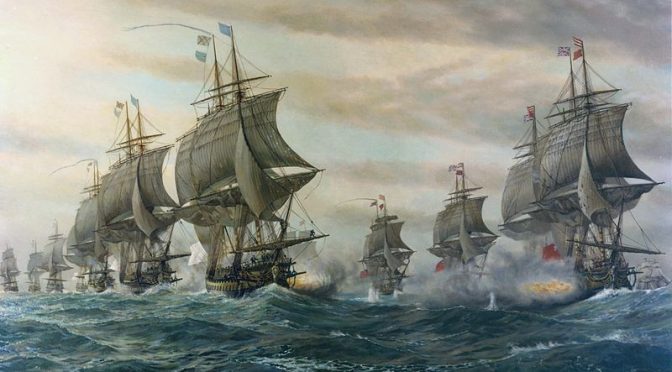
Featured Image: Battle of the Chesapeake (Wikimedia Commons)
Naval Power in the 21st Century

The following essay is the third place finalist for CIMSEC’S 2017 Commodore John Barry Maritime Security Scholarship Contest

By Matthew Lidz

The United States is a continental land power bridging the earth between two mighty oceans. Through our presence at home ports in both the Atlantic and Pacific and forward deployed forces in Asia and Europe we can rapidly project naval power to virtually any spot on the globe. Our naval forces deter threats, support economic growth, maintain global political stability and perform vital counterterrorism missions. These missions are essential to 21st century national security. 

Despite the myriad threats that face our nation in this complex and volatile world, it is difficult to build consensus for United States foreign policy. There are some that argue that we should withdraw to our borders and focus solely on our own interests. However, I argue that this instinct denies a fundamental truth of global security; security is achieved through engagement and not through isolation. 

As the United States was emerging from its tradition of isolationism in the late nineteenth century, President Theodore Roosevelt, himself a former Assistant Secretary of the Navy, viewed the Navy as the big stick of American foreign policy. President Roosevelt recognized the ascendancy of America on the world stage and saw the Navy as an effective instrument through which we could visibly demonstrate our commitment to peace, protection, and prosperity.

If war is diplomacy by other means, then the intelligent, strategic use of naval power is a key instrument for both deterrence and war fighting. The presence of the U.S. Navy off a hostile coastline visibly demonstrates national resolve and, through their presence alone, may prevent future hostile attacks against the U.S. or its allies. Through its ability to launch operations with aviation assets and cruise missiles the Navy can strike deep and with lethal force into hostile territory without the need to commit ground troops to a protracted conflict.

90 percent of world trade travels via the seas.  Maintaining safe passage for international trade is in the vital economic interest of the United States and its allies. International Waters or the High Sea is defined by the United Nations Convention on the Law of the Sea as “all parts of the sea that are not included in the exclusive economic zone, in the territorial sea or in the internal waters of a State.” The treaty also says “The exclusive economic zone shall not extend beyond 200 nautical miles.” To simplify, international waters are all waters that are 200 nautical miles outside a country’s exclusive economic zone. By maintaining a constant presence in the world’s shipping lanes, the United States Navy plays a critical role in ensuring free trade throughout the world.

I was born 18 months before the events of September 11, 2001. Like me, every member of my generation has no memory of life before September 11. The global war on terror was a constant presence in our collective consciousness and will continue to shape the world in which we take our place as adults. Maintaining a strong Navy is imperative for the continued economic and military security of the United States in the 21st century. The Navy’s abilities to project force, apply lethal force and deter threats are essential to the maintenance and protection of vital U.S. interests throughout the world.

Matthew Lidz is from Basking Ridge, New Jersey. He is currently a freshman at the University of Richmond 

Works Cited

“Business.un.org.” United Nations. United Nations, 1 Jan. 2017. Web. 20 Mar. 2017.

“Commodities: Latest Crude Oil Price & Chart.” NASDAQ.com. NASDAQ, Jan. 2017. Web. 2 Apr. 2017. <http://www.nasdaq.com/markets/crude-oil.aspx>.

Iata. “Search.” IATA – Price Analysis. International Air Transport Association, 1 Jan. 2017. Web. 2 Apr. 2017. <http://www.iata.org/publications/economics/fuel-monitor/Pages/price-analysis.aspx>.

Perlman, Howard. “How Much Water Is There On, In, and above the Earth?” How Much Water Is There on Earth, from the USGS Water Science School. United States Geological Survey, 2 Dec. 2016. Web. 18 Mar. 2017.

Petty, Dan. “Navy.mil Home Page.” The US Navy — Fact File: Aircraft Carriers – CVN. United States Navy, 31 Jan. 2017. Web. 2 Apr. 2017. <http://www.navy.mil/navydata/fact_display.asp?cid=4200&tid=200&ct=4>.

Stavridis, James, and Frank Pandolfe. “From Sword to Shield: Naval Forces in the War on Terror.” Naval Forces in the War on Terror. The Naval Institute: Proceedings, 1 Aug. 2004. Web. 2 Apr. 2017. <http://www.military.com/NewContent/0,13190,NI_Navy_0804,00.html>.

“United Nations Convention on the Law of the Sea.” (2013): n. pag. United Nations. United Nations, 1 Jan. 2016. Web. 25 Mar. 2017. <http://www.un.org/depts/los/convention_agreements/texts/unclos/unclos_e.pdf>.

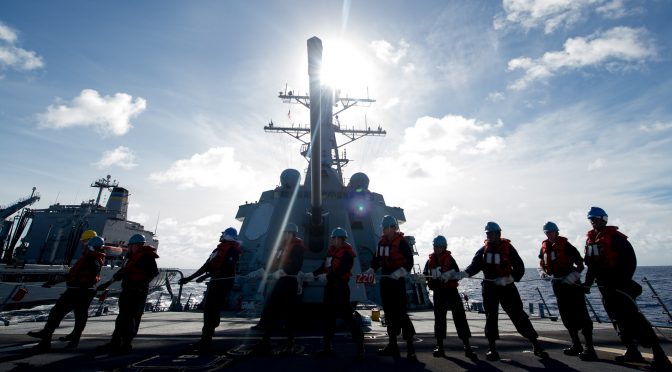
Featured Image: PHILIPPINE SEA (Sep. 20, 2016) Sailors assigned to the forward-deployed Arleigh Burke-class guided-missile destroyer USS McCampbell (DDG 85) man a phone and distance line while conducting a replenishment-at-sea with the Military Sealift Command fleet replenishment oiler USNS Rappahannock (T-AO 204) during Valiant Shield 2016. (U.S. Navy photo by Mass Communication Specialist 2nd Class Christian Senyk/Released) 

After the Shangri-La Dialogue – For China, So What and Now What?

By Tuan N. Pham

Singapore hosted the 2017 Shangri-La Dialogue (SLD) from June 2-4. The dialogue was well attended by defense ministers from the United States, Japan, Australia, New Zealand, Philippines, Indonesia, Malaysia, Singapore, Canada, and France, with other regional countries sending varying levels of defense representation. One conspicuous divergence from previous dialogues was the Chinese delegation, who curiously sent a relatively low-ranking representative. From 2013 to 2016, the Chinese delegation was led by a deputy chief-level People’s Liberation Army (PLA) general officer. This year, Beijing sent Lieutenant General He Lei, the Vice President of the PLA’s Academy of Military Science.

Many have speculated about China’s motives, and Shannon Tiezzi of The Diplomat offers one of the best analyses to date. The focus of this article is to build on the extant analysis and explore whether the deliberate choice produced a diplomatic win or loss for Beijing. To do so, I will recap some of the rhetoric aimed at China during the SLD along with the Chinese response.     

China’s Decision

Why did China send a “lower-ranking” representative with no formal government position and no apparent defense credential to lead its delegation to Asia’s premier security forum? Tiezzi provided some possible explanations (analytical baseline) in her well-written article titled “Why is China Downgrading Participation in the Shangri-La Dialogue?”  She suggested that Beijing’s decision was a preemptive and subtle refutation of the SLD’s agenda, and pointed to a deeper problem that China has with the annual dialogue itself. The stated agenda of “upholding the rules-based regional order, practical measures to avoid conflict at sea, and nuclear dangers in the Asia-Pacific,” made Beijing an easy target of reproach for its provocative actions in the South and East China Seas (ECS/SCS) and perceived inability to curtail Pyongyang’s nuclear and ballistic missile development ambitions. Beijing also chooses not to discuss its maritime disputes in any multilateral forum, asserting that bilateral negotiations are the appropriate mechanism debating such contentious issues. The SCS is a recurrent SLD topic – and China, much to its chagrin, has little influence over the non-friendly –and the Chinese might say hostile – agenda.

Besides a desire for bilateral negotiations, other explanations for the lower-ranked SLD representation include Beijing not wanting to undermine its public diplomacy campaign of global governance and desire to extend its strategic momentum from the inaugural Belt and Road Forum (BRF) in Beijing 14-15 May and the 19th China-European Union (EU) Summit (CES) in Brussels 1-2 June. Since the release of a white paper outlining its updated foreign policies on “Asia-Pacific Security Cooperation” last January, Beijing has pushed a harder strategic narrative of global benevolence. China’s guiding principles for its new altruistic foreign policy are based on its Confucian culture of universal peace and sharing, and are rooted in its belief that the 21st Century is an epoch of globalization and economic interdependence. Ideally, a strategic network will be established in all the regions of the world to achieve “universal peace, international order, and global prosperity.”

China will increasingly be called upon to find solutions to global challenges (and opportunities), such as terrorism, climate change, free trade, and economic development. In his opening BRF remarks, President Xi Jinping stated that “we should build the Belt and Road into a road for peace, road of prosperity, road of opening up, road of innovation, and road for connecting different civilizations.” While at the CES, Premier Li Keqiang said that China and the EU are “contributors and beneficiaries of world multipolarization and process of economic globalization, and under the current situation, China and the EU should confront the instability of the international situation with a stable bilateral cooperation.” 

Note: On 2 June, Beijing unexpectedly announced the cancellation of the 2017 Xiangshan Forum – annual regional security conference organized by China and widely seen as a rival (counter) to the SLD – due to pressures at home and abroad. Cited reasons include major leadership reshuffles, clashes with other events, and a desire to allay fears of Asian neighbors.            

Rhetoric Aimed at China

Beijing’s decision to downgrade its footprint at the SLD may not be so surprising considering the keynote speech by Australian Prime Minister Malcolm Turnbull, remarks by American Secretary of Defense James Mattis during the first plenary session (United States and Asia-Pacific Security), and comments by Japanese Minister of Defense Tomomi Inada during the second plenary session (Upholding the Rules-based Regional Order). Important highlights from these speeches include:

– Turnbull asserted that Asia’s future peace and prosperity depend on preserving the rules-based regional order that has worked so well for so long. He suggested that China can only expand its strategic influence to match its economic might within the bounds set by the same rules-based regional order; implied that Beijing was undermining that order in Asia by unilaterally seizing or creating territory and militarizing disputed areas; warned that a coercive China would drive its regional neighbors to bolster alliances and partnerships between themselves and the United States; and exhorted his regional neighbors to assume greater responsibility for their own security and prosperity.

– Mattis called out China for disregarding other nations’ interests and international law, militarizing the SCS, and undermining regional stability. He reiterated that the United States would continue “to fly, sail and operate wherever international law allows, and demonstrate resolve through operational presence in the SCS and beyond”; urged China to recognize that North Korea has become a strategic liability and cautioned Beijing that seeking cooperation on Pyongyang did not mean Washington would not challenge Chinese activities in the SCS; and restated the United States’ steadfast commitment to the defense of Taiwan as outlined in the Taiwan Relations Act (TRA). 

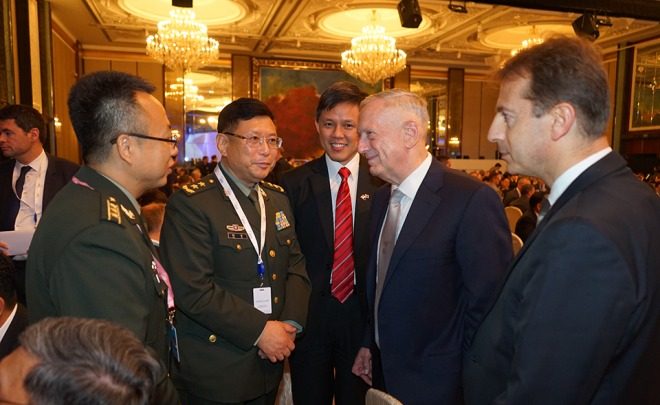
Lieutenant General He Lei, vice-president of the Chinese PLA Academy of Military Science, talks with foreign officials during this year’s Shangri-La Dialogue in Singapore. (chinamil.com)

– Inada leveled similar criticism against China in her speech. She implied that Beijing bore most of the responsibility for the extant regional instability; criticized China for “unilaterally” altering the status quo in the ECS and SCS and undermining the rules-based regional order; called out China for its continued destabilizing militarization of the SCS; urged Beijing to follow international law and respect last year’s tribunal ruling on the SCS; and expressed support for U.S. freedom of navigation operations in the SCS.

Chinese Response

The Chinese response was expectedly swift and coordinated, but ultimately uninspiring. The Chinese delegation held a media briefing on the summit’s sidelines at the end of the second day, defending China’s position as a rising power that abides by international law and the United Nations Convention on the Law of the Sea; repeating longstanding policy positions on Taiwan, North Korea, and SCS; and expressing frustration that Beijing is unfairly singled out for criticism. China’s Ministry of Foreign Affairs followed the tepid response the next day and called out Mattis and Inada’s statements on the SCS and Taiwan as “irresponsible” and recycled previous talking points:

– China has indisputable sovereignty over the Spratly Islands and their adjacent waters, and stays committed to peacefully resolving disputes with countries directly concerned through negotiation and consultation and upholding peace and stability of the SCS with Association of Southeast Asian Nations countries.

– China respects and safeguards all countries’ freedom of navigation and overflight in the SCS under international law, but definitely opposes certain country’s show of force in the SCS under the pretext of navigation and overflight freedom, challenging and threatening China’s sovereignty and security.

– China builds relevant facilities on the islands and reefs of the Spratly Islands for the purpose of improving the working and living conditions for people stationed there, and better defending its sovereignty and performing China’s international obligations and responsibilities.

– Thanks to the efforts of countries in the region, the situation in the SCS Sea has calmed down and turned positive.

– The Senkaku Islands have been part of China’s territory since ancient times; patrol and law enforcement activities by Chinese government vessels in the relevant waters are justified and legitimate; China is resolute in safeguarding its territorial sovereignty and maritime rights and interests, and will continue with its patrol and law enforcement activities in the future.

– China’s position on the Taiwan question is clear-cut and consistent; China stands firmly against the so-called “TRA” unilaterally made by the United States and requires the United States to honor the One-China policy and the three China-U.S. joint communiqués.

– China is clear and consistent about opposing relevant countries’ deployment of the Terminal High Altitude Area Defense system, and again urge them to immediately stop the deployment.  

So What and Now What

Given the circumstances, Beijing may have miscalculated. By downgrading its presence at the SLD, China ceded the strategic narrative and initiative to the United States. Specifically, Beijing yielded Washington and its regional allies and partners a public platform to stake out their strategic positions, counter the Chinese strategic messaging, and further encourage China to become a more responsible global stakeholder that contributes positively to the international system.

To date, Beijing has “2 (wins), 2 (losses), and 1 (tie), and 1 (undetermined)” in major international affairs for 2017 – Xi underperformed at the Trump-Xi Summit; Xi recovered and outperformed at the BRF; Li acquitted himself (and China) well at the CES; the SLD delegation seemingly did not; and the inaugural U.S.-China Diplomatic and Security Dialogue (D&SD) resulted in no joint U.S.-China readout, fact sheet, or outcomes document – indications suggest dialogue made no significant progress on North Korea or the SCS; and the G20 Summit outcomes are still being ascertained. Next up are the Asia-Pacific Economic Cooperation (APEC) Leaders Meeting in Danang (Vietnam) 11-12 November, and the East Asia Summit (EAS) in Manila (Philippines) 13-14 November, and the second Trump-Xi Summit in Beijing (TBD).

All in all, the apparently poor showing at the SLD was a setback for Xi’s 2017 strategic agenda. He wants and needs a successful diplomatic year to build political capital and momentum leading into the 19th National Congress of the Communist Party of China (CPC) in late 2017. There is widespread speculation that Xi is trying to promote more members of his faction to the Central Committee and the Politburo, a necessary interim step if he wants to change CPC’s rules to serve an unprecedented third term as president (and/or retain his other two titles of general secretary of the CPC and chairman of the Central Military Commission) and maintain power and influence beyond 2022.

Tuan Pham has extensive experience in the Indo-Asia-Pacific, and is widely published in national security affairs. The views expressed therein are his own and do not reflect the official policy or position of the U.S. Government. 

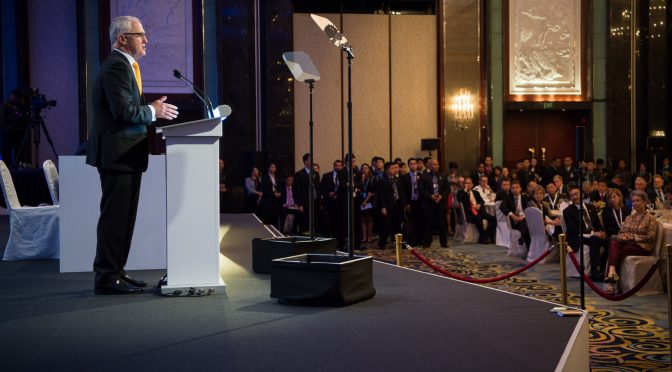
Featured Image: Australia’s Prime Minister Malcolm Turnbull speaks during the International Institute for Strategic Studies 16th Asia Security Summit in Singapore on June 2, 2017. (DOD photo by U.S. Air Force Staff Sgt. Jette Carr)

Institute for Future Warfare Studies Wants Your Writing on the Capital Ship of the Future

By Bill Glenney

Articles Due: August 21, 2017
Week Dates: August 28 – September 1, 2017

Article Length: 1000-3000 Words
Submit to: Nextwar@cimsec.org

In its final report to the CNO in July 2016, the Strategic Studies Group 35 concluded that that the “Navy’s next capital ship will not be a ship. It will be the Network of Humans and Machines, the Navy’s new center of gravity, embodying a superior source of combat power.”

The U.S. Naval War College’s Institute for Future Warfare Studies is partnering with CIMSEC to solicit articles putting forth concepts for the U.S. Navy’s capital ship of the future and its potential complement of unmanned and manned systems. 

The Institute’s mission is as follows:

“The mission of the Institute for Future Warfare Studies (IFWS) is to serve as the focal point for the U. S. Naval War College (NWC) actions to support identifying and defining the future warfare trends, and associated roles and missions for the future Navy. The IFWS will contribute to the analysis by thinking about future warfare and the potential impact on the naval services.”

Within the DC Beltway in the past year or so, most of the conversation surrounding the size of the U.S. Navy was focused on the “number of ships” or “ship goal.” The Navy formally started the discussion with its 2016 Navy Force Structure Assessment establishing the need for 355 ships compared to the official requirement of 308 ships set in 2014. MITRE Corporation concluded that the Navy needed 414 ships while CSBA set their number at 340 ships. In attempting to project the force of the Navy for 2030-2045 and beyond, all of these studies have made a critical, and unproven, assumption that the aircraft carrier remains the capital ship in the future supported by large, multi-mission surface ships and submarines. By making this assumption, the studies further assume that the combat potential and combat power of the USN is and will continue to be measured by the size and number its capital ships.

As long as the Navy conceptualizes and communicates fleet combat power solely in terms of warship inventory – manned ships and submarines – the basis for Navy capabilities and future fleet force structure will not change and continue to be built upon a logic that, while important for many reasons, is also increasingly anachronistic. Furthermore, this fixation on ship inventory is not reflective of the afloat combat power that adversaries have and will deploy in the not-too-distant future as unmanned systems and automation proliferate. The result will be a comparative, and potentially dangerous, mismatch in capabilities and combat power between the USN and potential adversaries.

Counting hull numbers today is comparable to using numbers of guns, numbers of sailors, or gross tonnage displaced all from the past. In the 1800s, the Royal Navy’s rating of their ships was based on the number of guns and number of sailors onboard. In the early 1900s, the U.S. Navy’s rating system was based on gross displacement. Assuming a modern warship that displaces 10,000 tons delivers five times the combat power of a hull displacing only 2,000 tons is no longer valid. Guns, sailors, gross displacement, and numbers of hulls served the navies of their time well. But this obviously no longer holds true.

Combat power in future navies will not merely be a function of the size of the ship. Technological and operational advancements have changed the calculus. Properly designed, outfitted and operated, today’s smaller ships can carry and deploy weaponized unmanned vehicles, capable of combat under, on, and above the sea. The imperative for modernizing naval power emerges when combat power is severed from the hull with unmanned systems.

Consider one example: a nuclear-powered aircraft carrier, the U.S. Navy’s principal capital ship since the 1940s, has no appreciable inherent combat power despite displacing approximately 100,000 tons. Its significant combat power emerges from the embarked air wing. The air wing’s combat power leaves the hull for the fight for sea control or projecting power ashore.

Yesterday’s “unmanned future,” coming for a decade or longer, has already arrived. Any discussion of future Navy force structure must explicitly and substantively address unmanned systems in a force where 25 percent to 50 percent of the combat power and 50 percent to 75 percent of surveillance capabilities could potentially reside in unmanned systems. Additionally, today’s discussion of Navy force structure must also explicitly and substantively address the network of humans and machines that enable the capabilities of these unmanned systems. Without unmanned systems and their associated network of humans and machines, the U.S. Navy could well fall short against many adversaries, most of whom could have smaller fleets than even planned for in USN force structure documents, but may punch well above their weight and in ways that contemporary ship-counting paradigms do not see coming.

While programmatic, fiscal, and bureaucratic pressures may demand such measures of naval power, it fails to provide a non-linear vision; one of “families” of modular unmanned systems – micro, small, medium, large and extra-large; air, ground, surface, sub-surface, and seabed – all disconnecting combat power from the ships and with the capability to disaggregate and re-aggregate capabilities to meet warfighting needs. Such potential could allow a future fleet to have reach and effect well beyond the numbers of ships and hulls that are used to describe the fleet of today.

Getting to a more powerful fleet for the 2020s and 2030s by following a path toward more traditional capital ships will be increasingly challenged to succeed, especially in an operating and warfighting environment characterized by rapid technological change. Rather, embracing unmanned systems – hundreds and even thousands of unmanned systems – may achieve the U.S. Navy needed for the future. Any vision for the future Navy must address unmanned systems as strongly and forthrightly as it does manned systems.  

Authors are invited to write on what should be the capital ship of the future Navy and concepts of employment for myriad types of unmanned systems, both hypothetical and real. Authors should send their submissions to Nextwar@cimsec.org.

This Topic Week has since concluded and submissions may be viewed here.

Professor William G. Glenney IV is a part of the Institute for Future Warfare Studies at the U.S. Naval War College.

The views presented here are personal and do not reflect official positions of the Naval War College, DON, or DOD.

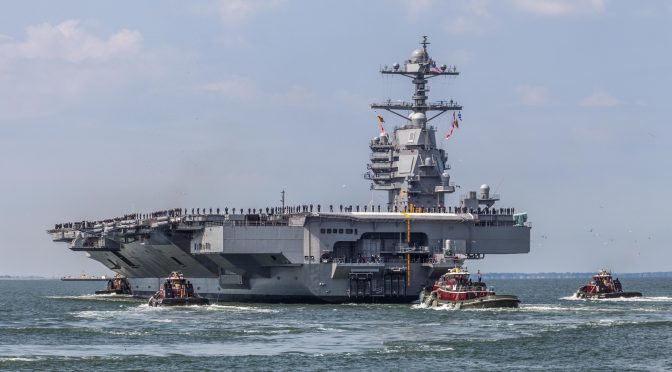
Featured Image: Norfolk, Va. (April 14, 2017) The future USS Gerald R. Ford turns into the lower Chesapeake Bay while to port after a successful week of builder’s trials in the Atlantic Ocean. (Photo: Mark D. Faram/Navy Times)

Fostering the Discussion on Securing the Seas.