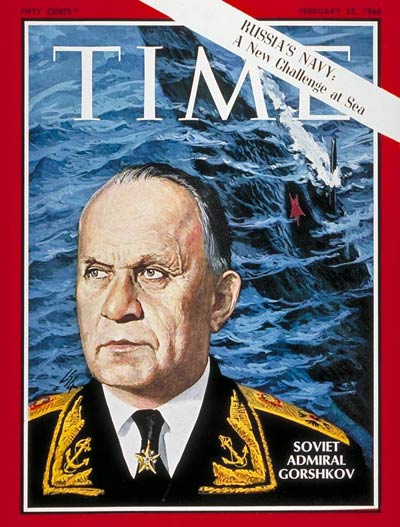
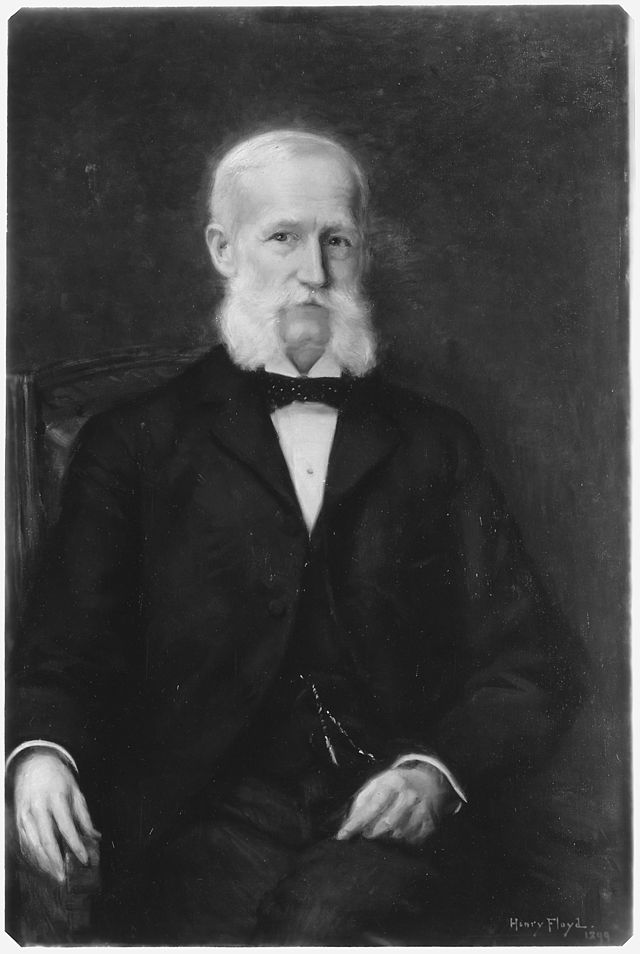
Admiral Sergei S. Gorshkov’s legacy as a naval leader and strategic thinker has not been entirely forgotten. Reports of his death, however, were not greatly exaggerated. Largely ignored by the NATO navies that once studied him so intently as the head of the Soviet Navy for much of the Cold War, Gorshkov remains an inspirational symbol in the two countries that should come as no surprise: Russia and China.
Earlier this year, Admiral Viktor Chirkov, the current commander-in-chief of the Russian Navy, pointedly chose the 105th anniversary celebration of Gorshkov’s birthday in his childhood home of Kolomna to make some bold statements about the navy’s future in the 21st century. After laying flowers at Gorshkov’s monument, Chirkov formally announced that Russia will be back in the aircraft carrier business with plans to build a new-generation one comparable in size to a U.S. supercarrier. Given the current state of Russian shipyards and the tremendous costs involved, defense analysts greeted the announcement with skepticism. There was good reason to doubt this most recent news: Russia had already announced in 2005, and again in 2008, that it would begin to build carriers by 2010. According toJane’s Defence Weekly, the new multipurpose, dual-design (two ski-jump ramps and electromagnetic catapults each) carrier is called Project 23000E or Shtorm (Storm).
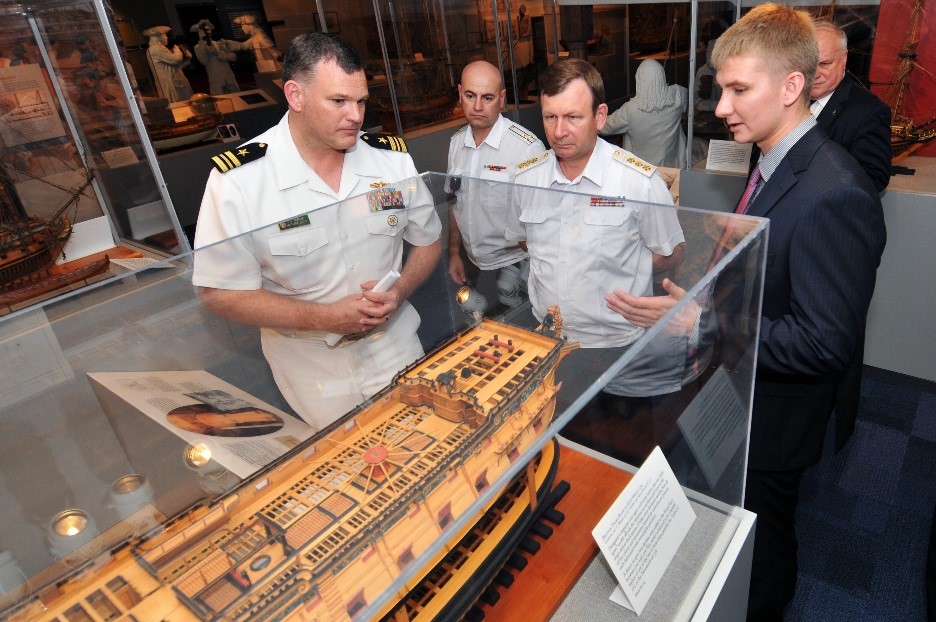
17th-19th C. Sea Power of the State: Admiral Chirkov getting a tour of USNA Museum in 2013 from CIMSEC member Claude Berube. Was the Russian navy chief trying to get advance info on the #CarrierDebate? (Photo credit: USNA PAO)
Of course, Admiral Gorshkov once promoted the virulent anti-carrier stance of the Soviet Union. He mocked the platform as too expensive and too vulnerable and echoed Premier Nikita Khrushchev’s view that they were “floating coffins.” Yet, the Soviet Navy’s need to be untethered from the sole support of land-based naval aviation first resulted in helicopter carriers for anti-submarine warfare and amphibious operations in 1967, then eventually in large-deck carriers for fixed wing aircraft toward the end of the Cold War – the Kuzntesov (still in service, although with considerable time in the repair dock, in the Russian fleet) and the Gorshkov (sold to India).
Gorshkov would likely have applauded Chirkov’s ambitious50 ship building plan for 2015 that included a mixture of surface and subsurface vessels. In particular, the resurgence of nuclear submarine production, especially the Borei-class ballistic missile sub, is a reminder of how Gorshkov once used submarines as the cornerstone of Soviet naval power and prestige for decades.
Chirkov also announced that 30 ships and submarines were currently deployed around the world, which indicated a modest but nonetheless significant return to the pattern of out-of-area patrols and presence missions for the Soviet Navy that Gorshkov introduced to much fanfare in the mid-1960s. This May’s joint Russian-Chinese naval exercises in the Mediterranean also supports the views that the Russian Navy is “rebalancing” to the region while the Chinese Navy may intend to secure its energy supply lines at the western edge of the “New Silk Road.”
Above all, Gorshkov would probably have approved of Chirkov’s vision: the adoption of an “ocean strategy” that will seek to reestablish Russia’s global reach and promote its political and economic interests. Chirkov’s choice of language harkened back to the efforts of his Cold War-era predecessor to justify a blue-water navy. Notably, Chirkov did not directly challenge the supremacy of the U.S. Navy as Gorshov did in the late 1960s. Rather, Admiral Chirkov’s mission, at least for the moment, is to put Russian naval forces back on the path to restoration, not on one toward great power rivalry.
Gorshkov was associated with the phrase “’better’ is the enemy of ‘good enough.’” In other words, Chirkov must get the Russian Navy back to Gorshkov-era “good enough.”
There is also nothing revolutionary in Chirkov’s pronouncements. The navy’s primary missions are still, as in the Cold War, strategic deterrence and defense. It will likely not be as rapid as the transformation after the Cuban Missile Crisis, either. The Russian Navy, according to defense analyst Dmitry Gorenburg, will slowly grow through a phased recapitalization scheme that will unfold over 20 years. The pace of naval construction is, of course, subject to change based on evolving political and economic imperatives.
To further underscore that Admiral Gorshkov has not passed entirely into irrelevance, a pair of Russian military writers (one a retired navy captain) paid homage to him in a recent article for Voyennaya Mysl [Military Thought], the elite journal of Russia’s Defense Ministry for nearly a century. In “The Sea Power of the State in the 21st Century,” the authors noted that Gorshkov’s seminal 1976 book, The Sea Power of the State, took an expansive view of sea power that included naval, merchant, fishing, and exploration capabilities. Gorshkov envisioned the World Ocean as one immense domain upon which to assert Russian national power. These authors, however, wished to scope the definition of “the country’s sea power” down to “the navy’s real combat power” in order to illustrate the special place that navies hold in geopolitics.
A central theme of their essay, based on historical examples, was that countries without sea power do not have “a decisive voice in world affairs.” Russia used a strong navy in the past, the authors argued, to maintain its place in the top tier of nations. The blow to Russian prestige was great at the end of the Cold War with the demise of the Soviet Navy:
… the loss of the core of its powerful oceangoing navy during the political and economic reforms in the late 1980s and early 1990s cost the country dearly. It caused other nations, Russia’s neighbors and rivals on the high seas, in the first place, to rethink their attitude to this country. It was deserted by many allies and friends, and its image of a great sea power has faded.
Thus, the article indirectly endorsed Admiral Chirkov’s current strategy of “looking to the ocean” and his plan for a navy that can once more defend Russia’s national interests and secure it against threats. The authors acknowledged, however, the huge lead by the U.S. Navy in air-sea battle concepts and that of American expertise in network-centric naval warfare. Indeed, “it is difficult, even hopeless at times, for Russia to take up this challenge for economic considerations.” Nonetheless, they concluded, it is a price that must be paid for the return to greatness on the world stage.
Writers in Chinese open source literature have also found reasons for optimism in the example set by Admiral Gorshkov during the Cold War. According to Lyle J. Goldstein at the Naval War College’s Chinese Maritime Studies Institute, some naval analysts in China “are extremely interested in Gorshkov, his legacy, and Soviet naval doctrinal development in general” [per his correspondence with this author]. They are impressed by the rapid transformation of Soviet naval power under Gorshkov as well as his ability to check U.S. power with his own oceangoing navy. Moreover, they also appreciated, based on Gorshkov’s lesson, that a “balanced fleet” can also emphasize undersea platforms while never reaching parity with U.S. carriers.
China’s recent strategy white paper elevated the PLA Navy’s status and explicitly tied naval power to China’s geopolitical ambitions and economic development with the navy’s dual missions of “open seas protection” and coastal defense. Indeed, sea power will play a central role for the Chinese state in the 21st century:
The seas and oceans bear on the enduring peace, lasting stability and sustainable development of China. The traditional mentality that land outweighs sea must be abandoned, and great importance has to be attached to managing the seas and oceans and protecting maritime rights and interests.
On the other hand, Gorshkov’s legacy shows that sea power, once achieved, can be transitory due to geographic, economic, and political factors. His is also a cautionary tale, for Russians and Chinese alike, not to pursue sea power beyond what a nation can support. As Goldstein noted, “… the [Chinese] authors do indeed directly connect the all-out Soviet naval expansion of the later Cold War, and the commensurate enormous investment of Russian national resources, to the demise of the USSR.” Moreover, there is the potential riskinvolved in Russia’s attempt under Vladimir Putin to return to the past glories of the Soviet superpower era yet fall well short of his goals. This naturally includes naval ambitions for aircraft carriers that never make it beyond the concept stage. Even the modernization of smaller surface ships such as frigates (including the new Admiral Gorshov-class) is now endangered by Russian actions in the Ukraine.
Both Russia’s and China’s navies may also face the same dilemma as that of the Soviet Navy by the mid-1960s if naval construction outpaces professional knowledge and practical experience. As Robert Farley noted, the Soviet Union “built blue water ships long before it built the experience needed to conduct long range, blue water operations.”A more provocative and aggressive stance toward the U.S. Navy, coupled with the deficiencies in Soviet training and this lack of a “blue water look,” resulted in repeated incidents at sea such as collisions that many feared might escalate during the Cold War.
Ultimately, sea power as an expression of great power status is beginning to look in the early 21st century much as it did in the 20th century. The investment in costly blue-water navies still speaks volumes about a country’s geopolitical ambitions and its strategic calculus – where it sees itself in the world and hopes to be in the future. The writings and accomplishments of Admiral Sergei Gorshkov are also a timeless reminder that in order to assess navies, one must still look at what they say, what they build, and what they do. In Gorshkov’s case, what he did remains much more memorable than anything he wrote.
Jessica Huckabey is a researcher with the Institute for Defense Analyses (IDA) and a retired naval reserve officer. She is writing her doctoral dissertation on American perceptions of the Soviet naval threat during the Cold War. The opinions are her own and not those of IDA or the Department of Defense.
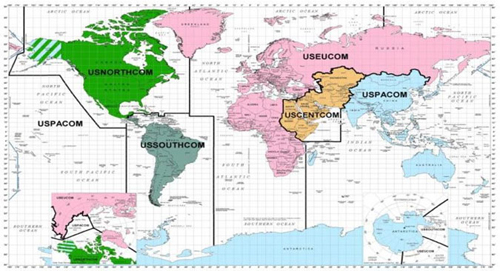
The new 2015 Maritime Strategy demands a significant part of the Navy be forward based or operated in order to achieve national goals. The current number of ships and their present deployment pattern may not support the new strategy’s goals. Several recent articles have bemoaned the Navy’s shrinking surface ship fleet, or sought to make light of the overall number of ships as a significant determinant of strategic naval power. Both are, in a way, incorrect. The number of ships does matter, but wishing for a return of the halcyon 1980’s and the 600 ship navy is a futile hope in the face of the present budget deficit and growing welfare state. The post World War 2 U.S. Navy deployment structure has been based on the maintenance of a specific number of total ships in order to maintain a consistent overseas naval peacetime presence and credible war fighting force if required. The solution to this combination of forward deployment requirements on a limited budget is a fundamental change to the post-1948 U.S. naval deployment scheme through a global redistribution of U.S. naval assets. Potential threats, strategic geography, and support from potential coalition partners should govern this effort. The Navy should also seek new technologies to reduce overall budget costs. If this sounds familiar, it is not a new concept. Great Britain’s Royal Navy, under the leadership of the fiery transformationalist Admiral Sir John Fisher, executed a similar successful change just over a century ago in a similarly bleak financial environment. A modified version of Fisher’s scheme represents the U.S. Navy’s best hope to assign relevant naval combat power where it is most needed and at the best cost.
Britain’s Successful Rebalance
Like the U.S. today, Great Britain at the turn of the last century was a nation in rapid relative decline. British industry and its share of the world economy were shrinking in response to the rise of Germany, Japan, and the United States. The navies of those nations, as well as traditional enemies like France and Russia were growing in size and capability. Great Britain had just concluded the financially taxing and internationally embarrassing Boer War, which strained the nation’s tax base and earned it international opprobrium for harsh treatment of Boer combatants and civilians. The concept of a British Welfare state had gained significant support, and expenditures for this new government responsibility threatened the budgets of the Army and the Navy; both of which required significant modernization.
Admiral Fisher was selected by the Conservative Party’s First Lord of the Admiralty, Lord Selborne, specifically for his daring pledge to cut naval spending, while increasing the power and overall capability of the Royal Navy (RN). Fisher scrapped large numbers of older warships; created a ready reserve of minimum manned, older, but still capable combatants; reformed the RN’s personnel structure; and argued for the adoption of revolutionary technologies such as turbine engines, oil fuel for ships, director-based gun firing, submarines, and naval aircraft. A succession of Navy civilian leaders from both of the large British political parties supported his efforts. Most importantly, Fisher presided over the biggest re-balancing of British naval assets since the end of the Napoleonic wars. Before Fisher the RN was divided amongst various colonial stations around the world. Its most significant operational commands were the Atlantic and the Mediterranean Fleets that protected Britain’s line of communication to India via the Suez Canal. Although Fisher’s initial strategy was to counter France and Russia, the concentration of British naval strength in home waters allowed it to counter rising German threats. Britain sought simultaneous colonial agreements with France and Russia to reduce tension, and signed an official alliance with the emerging Japanese Empire to secure communications with its Pacific possessions. It also unofficially acquiesced to U.S. naval domination in the Western Hemisphere to eliminate any tensions with the other great English-speaking nation. All told, these efforts allowed Fisher to keep British naval spending at 1905 levels until 1911.1 They also ensured that a significant British naval force was in place for war with Germany in 1914.
Conditions for U.S. Rebalance
The U.S. would be well served to create a global re-balance program along the lines of Admiral Fisher’s for its own Navy. In reverse of Fisher, however, the bulk of America’s naval strength must move from bases in home waters to the periphery of the nation’s interests. Some reductions in overall naval strength will be required to ensure that forward forces are well trained and equipped for both peacetime presence and wartime combat functions. Assignment will depend on regional geography, threat level and the availability of coalition partners to augment, or in some case replace U.S. naval assets.
The large deck nuclear aircraft carrier and its associated air wing are best employed in locations where land-based aviation assets are vulnerable or scarce due to geographic location. For this reason, the bulk of the carrier force should be assigned to distributed bases in the Indo-Pacific region. A force of six large carriers would serve as the core of the Pacific naval component. The surface combatant and attack submarine force based in the Pacific would be a commensurate percentage of its overall strength. They should be sufficient in number to support carrier escort, independent operations, and surface action groups as recommended for the emerging strategy of distributive lethality. This force would be large enough to conduct meaningful fleet and large scale joint exercises in a number of warfighting disciplines.
The carrier’s assignment to the largest ocean area of responsibility (AOR) best supports a joint commander’s warfighting requirements in a predominately maritime environment. The caveat with the assignment of carriers geographically is that the post-1948 deployment pattern of ‘three aircraft carriers equal one forward deployed, active carrier’ must be scrapped. This means retiring two carriers, perhaps the two oldest Nimitz class when the USS Gerald R. Ford is commissioned in next year. One carrier strike group costs $6.5 million dollars a day to operate.2 The funds saved in the retirement of two carriers could be directed toward the maintenance of and operational costs of the remaining eight, with the proviso that these be consistently ready for service as required.
The Eurasian littoral areas historically supported by east coast naval forces would receive smaller, tailored force packages in this new organization scheme. Given that Eurasian littoral operations can be supported by land-based air units, only two carriers need be assigned to the Atlantic coast with perhaps a third designated as a training carrier.
A Substitute for a Carrier Strike Group
Under this arrangement the Mediterranean and Persian Gulf areas would not see regularly deployed large deck carriers. To offset their absence, it is proposed that two light carrier groups be forward-based on the Mediterranean and Indian Ocean respectively. Such a group would each be centered on an LHA-6 class amphibious warship configured as a light carrier with an airwing of 20+ F-35 Lightning II strike aircraft. The CVL-configured LHA, too small to support the full traditional carrier wing of both attack and support aircraft, would be supported by land-based assets that would provide airborne early warning (AEW), tanking, and other strike missions. Each group would contain three DDG-51 class destroyers for offensive and defensive roles including missile defense, a DDG-1000 class destroyer for surface strike and other warfare roles, and a flotilla of four to six littoral combat ships (LCS) or similar frigates (FF’s) for a variety of low intensity combat and surface strike missions. Attack submarines may be included as needed and an amphibious warfare group similar to the present 7th fleet formation based in Sasebo, Japan round out the numerical assignments. A full amphibious ready group (ARG) with associated Marine Expeditionary Force (MEU) based at Rota could exploit NATO/EU capabilities in the region as well. Most of these rebalancing efforts can be completed between 2020 and 2025, with the fight light carrier group ready by 2017. It may begin operations with the AV-8B II Harrier, but later transition to the F-35B Lightning II. After 2020, an international carrier strike group (CSG) presence might be maintained in the Eastern Mediterranean with British, French, Italian, and Spanish carriers playing a role.3
The Mediterranean offers a number of ports that together are capable of hosting such a force including Rota, Spain, Sigonella, Sicily, and Souda Bay, Crete. The Western Pacific/Indian Ocean represents a more complicated basing picture, but a combination of facilities in Singapore, Darwin, and Perth, with a forward anchorage in Diego Garcia might offer sufficient space to support to forward deployed forces. Both regions offer a number of land-based aviation facilities to support a light carrier formation.
The navies of friends and formal allies offer additional support to this strategy. The U.S. has consistently sought and depended on coalition allies in the conflicts it has engaged in since 1945, and especially since 1990. European fleets have changed from antisubmarine Cold War forces to smaller, but more deployable, larger combatants capable of global operations. Resident European force in the Mediterranean and deployed forces in the Persian Gulf region might augment U.S. efforts in those regions. The Libyan Operation of 2011 (Operation Odyssey Dawn for the U.S.), showcased what a U.S. light carrier group, as centered then on USS Kearsarge, and European forces might accomplish. The British Defence Secretary’s recent announcement that the Royal Navy will develop a base in Bahrain suggests that at least British and perhaps other Commonwealth nations’ navies might support U.S. efforts in the Persian Gulf region.
Options for Cooperation and Technological Offset
Strong U.S. relationships with Western Pacific nations are essential to any re-balancing strategy in that region. The adoption of AEGIS systems by the Japanese Maritime Self Defense Force, the South Korean, and Australian navies significantly aids in cooperative efforts. Close U.S. ties with Singapore, the Philippines, and other regional naval forces are also essential to U.S. efforts. One method of achieving this might be a Western Pacific version of the Standing NATO Maritime Groups. An international squadron with rotating command responsibilities would be useful in easing old tensions and promoting better relations amongst this diverse group of nations.
The “long pole in the tent” of such a re-balancing strategy is how to manage the personnel disruptions such a change would cause. The CONUS-based U.S. deployment strategy, and dependent housing agreements in Japan and some Mediterranean nations has allowed for a great deal of family stability. Sailors can remain reasonably close to their families, even when forward deployed. There is no guarantee that Pacific or Mediterranean nations would accept large increases in the population of U.S. naval personnel and their dependents resident within their borders. In addition to the foreign relation concerns, such additions would cost a considerable amount of money and involve greater security risks in protecting a larger overseas American service and dependent population. The answer to this problem is to ‘dust off’ some of the reduced and creative manning projects of the last decade. While not ideal in many ways, reduced manning, crew swaps, and longer, unaccompanied deployments may become the norm, rather than the exception for American sailors.
Unfortunately, this is the price of putting more credible combat power in forward areas at present or even reduced costs. The U.S. will be hard-pressed to duplicate Admiral Fisher’s other revolutionary changes. The U.S. Navy has retired nearly all of its outdated warships, and further reductions of newer platforms will harm overall naval capabilities. Revolutionary changes in armament such as the rail gun and other directed energy weapons, and continued advances in the electric drive concept may allow for some cost reductions in naval expenditures, but they remain far from mature development. The rail gun is slated for additional afloat testing, but with a barrel life of only 400 rounds, it represents a 21st century equivalent of the arquebus.4 Fisher, by contrast, had relatively mature technological solutions in propulsion, and rushed fire control, aircraft, and submarine advances into full production with mixed results. The present U.S. test and evaluation culture would not permit such bold experimentation.
The U.S. can, however, improve its overall forward naval posture by re-balancing its force structure along geographic lines to better support national interests and regional commanders’ requirements. Additional force structure will be difficult to achieve in the face of present budget woes. Transformational technology is moving toward initial capabilities, but is not yet ready for immediate, cost savings application. The post-1948 CONUS-based deployment system is becoming more difficult to maintain with fewer ships and persistent commitments. Despite these dilemmas, the U.S. must fundamentally change the deployment and basing structure of the fleet in order to provide credible combat power forward in support of joint commander requirements. The new 2015 Maritime Strategy will not achieve many of its goals using the present CONUS-based deployment construct. Geographic re-balance of the fleet will provide strength were it is most needed.
1. A detailed explanation of the Fisher/Selborne re-balance strategy may be found in Aaron Friedberg’s The Weary Titan, Britain and the Experience of Relative Decline, 1895-1905, pages 135-208.
2. Captain Jerry Hendrix, USN (ret), PhD, “At What Cost a Carrier”, Center for New American Security (CNAS), March 2013, p. 7.
3. Conversation with retired NSWCCD Senior Warfare Analyst James O’Brasky.
4. 15 February statement of Statement of Rear Admiral Mattew L. Klunder, USN, Chief Of Naval Research before the Intelligence, Emerging Threats and Capabilities Subcommittee of the House Armed Services Committee on the Fiscal Year 2015 Budget Request, 26 March, 2014.
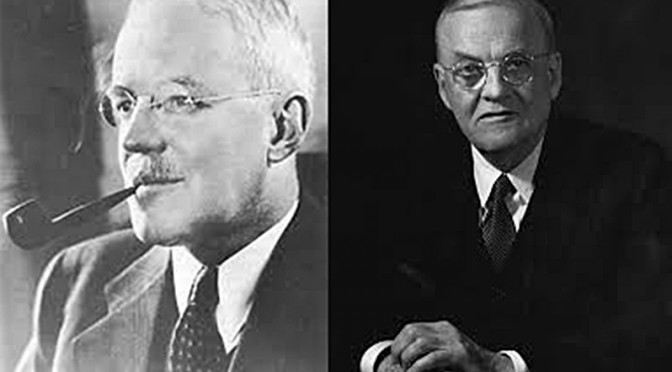
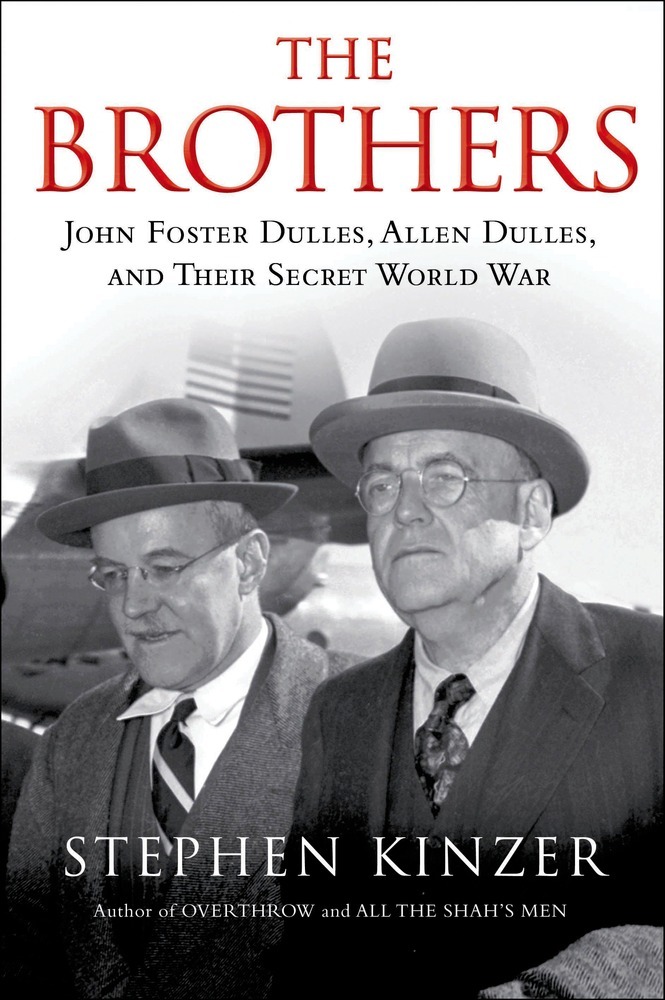
Back in March, I had the opportunity to listen to a panel at Brown University on civilian-military relations, titled, “In and Out of Uniform: Civilian Military Relations Reconsidered.” The panel was born from the provocative piece by James Fallows in The Atlantic magazine, titled, “The Tragedy of the American Military.” It was an interesting discussion. One of the highlights that day, at least for me, was walking away with a book. I happened to sit next to journalist and author Stephen Kinzer during a lunch that preceded the panel. We got to talking, and eventually he brought up his book The Brothers: John Foster Dulles, Allen Dulles, and their Secret World War. Later that day he gave me a copy. A few weeks later I read it. It was a fascinating book on two men that, unknown to me, had a big impact on American foreign policy during the Cold War. Recently I had the chance to chat with Stephen about the Dulles brothers and their legacy in U.S. foreign affairs.
Stephen Kinzer, welcome. I enjoyed the opening anecdote of your book about the naming of the Dulles airport and how you “found” the bust of John Foster Dulles. How did that come about?
This is a fascinating story and there is actually a footnote that you probably don’t know. So as you say, I do start out my book with this anecdote about Dulles airport. So of course, John Foster Dulles was the secretary of state during the 1950s when his brother Allen was head of the CIA. The new airport being built outside of Washington D.C. was being named after John Foster Dulles. In 1962 there was a big ceremony at the airport. I watched a video on YouTube which showed when the airport was inaugurated. President Kennedy was there, former President Eisenhower was there, Allen Dulles was there. And a curtain was pulled back to reveal a bust of John Foster Dulles. The bust was placed in the center of the airport.
While I was writing this book I decided I want to go to the airport and find the bust. I wanted to commune with it in a sense; I wanted to see what it looked like. But I couldn’t find it. I asked around and nobody knew where the bust was. It’s a long story, but ultimately I found it in a closed conference room. And I used this story as a kind of a nice metaphor for how much we have forgotten John Foster Dulles. I repeated that story during my book tour. I probably gave 100 talks about this book over the last year or two and that was often the way it would start out. This story about how this guy was so famous and now how you can’t even find his bust. So that’s the story, but here’s the footnote.
President John F. Kennedy and former President Dwight Eisenhower at the opening of the Dulles Airport.
Not long ago I got a phone call from one of my friends who said, “You are not going to believe this. I’m calling you from Dulles airport. The bust is back.” And sure enough, they’ve taken the bust out of the private conference room and put it back on public display. So first I wondered if this had something to do with the fact that I had pointed out what had happened with the bust. I thought I had achieved something great that showed the massive power of the press. But now I realize that it’s not so good because I have brought him out of the obscurity which into it had fallen, but without any context, so he is essentially being portrayed as a heroic figure. I am wondering whether I couldn’t set up a little booth next to the bust and sell copies of my book so people could understand who he really was.
Why the Dulles brothers? What interested you about them to write a book on those two men?
I am interested in the question of American intervention overseas. One thing I often ask myself is Why are Americans like this? Why do we do this? Why are we so eager to intervene in the affairs of other countries? I concluded that the story of the Dulles brothers and what they did in the 1950s would help explain some of that. The forces that created the Dulles brothers are the forces that created America. If you can understand those sources you can understand a good deal about this country. And they left us some important lessons that are still relevant. So I am presenting a biography here: this is the story of these two immensely powerful brothers who helped shape the world in the 1950s. But in the larger sense I am using the framework of biography to ask larger questions about the way the United States behaves in the world.
It seems like John Foster Dulles, and Allen Dulles to a certain extent, were very religious. And as I read your book, it appeared that their religious background colored their world view. Did it not?
They were brought up in a particular Calvinist religious tradition and came from a long line of clergymen and missionaries. They were taught, first of all, that the world was divided between good and evil and that there was one true religion, that all the other religions were wrong and evil. If you believe that about religions, it is a very short step to believing the same thing about world politics — that there is one political system that’s the right and good system for people to live under rather than all the other systems which are wrong and evil. In addition, they grew up with a strong admiration for the missionary idea, which tells you that a good Christian should not simply stay home and hope that good triumphs over evil, but now he has to go out and wage the fight on behalf of good. This is another religious precept that is easily transferable to the political realm. You begin to believe that it isn’t enough for us to enjoy the blessings of freedom at home. We need to go out into the world and liberate others who are not enjoying what we consider the blessings that they deserve.
While the brothers do share similar traits, they did have different temperaments. Is that correct?
It is quite a remarkable feature, their personalities. Politically and professionally they were identical. They saw the world the same way. They had grown up intimately, shared a worldview and hardly ever disagreed about anything. That was one reason it was so dangerous to the United States to have the two of them in power. They never felt the need to consult any experts other than the two
of them. So politically they were peas in a pod. In their private lives however, in their personalities, they were direct opposites. Foster Dulles was dour and gruff and socially inept. I have a whole page in my book about all the awkward things he would do. Even his friends didn’t like him. Allen Dulles, the CIA director, was just the opposite. He was a sparkling personality with an endless supply of stories. He had a wine cellar; he was a tennis player; he had a 100 mistresses; he was a wonderful addition to the Washington dinner scene.
Allen Dulles, as you say in your book, was intrigued with Rudyard Kipling’s Kim. Do you think this paved the way for him to become a spy. Is this something that he was incredibly intrigued with?
I think there was a kind of romantic fascination on the part of Allen Dulles in the idea of covert action. He read Kim when he was a young man and he kept it with him his whole life. It was on his bed table when he died. I would go on to another equally romanticized version of the espionage trade that Allen Dulles came to appreciate later in life. That was the novels of James Bond. Those novels have nothing to do with real life intelligence work. They show that the work of a single intrepid agent can change the course of history and that there are never any long term effects as soon as the bad people are done away with. This is a very dangerous mindset for intelligence agents to get into because the real world is not like that. At some point Allen Dulles even asked his tech division at the CIA to duplicate some of the gadgets that James Bond used. He was told that those were not realistic. It shows a little bit of the danger of mixing reality and fiction. I think Allen Dulles fell into that sometimes.
The First Edition of Rudyard Kipling’s Kim. First published in book form in 1901.
The Dulles family, specifically their grandfather and their uncle, had a lot to do with their path in life. I thought it was fascinating that John Watson Foster, their grandfather, is responsible for the concept of defense attachés in our embassies. Could you expound on that?
I mentioned a moment ago that one of the factors that shaped the Dulles brothers was their religious background. A second factor is the family background to which you refer. Their uncle was secretary of state — Robert Lansing — but their grandfather, John Watson, was also secretary of state. So as kids they grew up with these two remarkable relatives. John Watson Foster was a remarkable paragon of the American experience during the age of Manifest Destiny. He grew up on the frontier and made a business for himself, ingratiated himself to powerful men, rose through politics and became an ambassador, and then became secretary of state. Doing among other things, he modernized the state department and began the practice of systemic research into
John Watson Foster. The thirty-second US Secretary of State and Grandfather of John Foster Dulles and Allen Dulles.
foreign embassies and advances in foreign weaponry military tactics. He sent messages to all American legations asking them to send people to libraries and bookstores to look for anything new that was being developed in these fields. John Watson Foster was also the secretary of state who presided over the first American overthrow of a foreign government — that was Hawaii — in 1893. He would have later understood the role John Foster Dulles played, almost half a century later in overthrowing governments in Iran, Guatemala, and other places. I began to wonder if there wasn’t some genetic predisposition to regime change in the Dulles family.
The Dulles brothers seemed to jump back and forth between public service and the private sector — particularly back to the law firm Sullivan & Cromwell. Was this a trend throughout their lives?
Now you are putting your finger on what I think is the third most important factor in shaping the Dulles brothers. Religious belief was one, family and class background was the second, and certainly the third was the decades that the brothers spent working for the remarkable law firm of Sullivan & Cromwell in New York. This was not a law firm like any other. It had its speciality. Its speciality was helping big American companies pressure foreign governments into doing what they wanted. Virtually every large American multi-national corporation retained Sullivan & Cromwell. Every time those companies had trouble in some other country they would turn to Sullivan & Cromwell. Sullivan & Cromwell found ways to make offers to those countries that they couldn’t refuse. It means that the Dulles brothers understood the world from the perspective of their Wall Street clients. It also means that at an early age they became experienced in the technique of pressuring foreign governments. The skills that they learned at Sullivan & Cromwell would serve them well when they came into power in the 1950s.
Both men went to law school. Was the law just a stepping stone for those men in that age?
John Foster Dulles was the highest paid lawyer in America during the peak of his career. He was a masterful servant of the plutocracy, although he was not a plutocrat himself. I think their service in that world gave them a certain perspective about what should motivate American foreign policy. They saw a world in which a great force was arrayed against the United States. And they took this back to the experiences they had at the law firm and they felt that foreign governments were always seeking to use pressure on American companies as a way to pressure the United States. It was not possible for them to imagine that foreign governments would take steps that would be harmful to American companies. This was strictly out of reasons that came from domestic politics; not because they had been ordered to do so by the Kremlin or that it was some part of a broader geopolitical plot. So they came to office with a narrow vision that I do think came from their legal work.
Something that surprised me to learn was that John Foster Dulles was supportive of National Socialism in the early thirties.
John Foster Dulles was quite sympathetic to the Nazi party in the 1930s. He spent a lot of time in Germany. He was an admirer of Hitler in the 1930s. John Foster Dulles became the principal broker in the United States for German bonds that supported the municipalities and corporations. He also weaved the Krupp iron works company into an international nickel cartel that gave the Nazis access to nickel, which of course is important in warfare. He continued to visit Germany all the during the 1930s. His law firm closed its office in Germany but he was against it. So Foster Dulles did have a history of sympathy for the Nazis. I think part of the reason for that was he saw them as a bulwark against the Communists.
What is happening during the brothers during the 30s? When did they figure out that they would have to fight the Nazis? Did John Foster change his thinking?
In the mid-1930s Sullivan & Cromwell took a vote to close their Berlin office. As I said, Foster Dulles opposed that. But once the Nazis invaded Poland in 1939 it became impossible to paint them as peace lovers. And certainly after the American declaration of war everything became quite clear. It was after that declaration that Allen Dulles was named head of the OSS station out of Bern,
Allen Dulles CIA ID card.
Switzerland. It was a very important post because it was one of the last remaining neutral outposts in Europe. Allen had a quite an adventure getting into Bern. He had a lot of fun times in Switzerland. It was his second tour there, he had been an intelligence officer in Bern during the First World War.
Let’s fast forward a little bit to the 1940s and 1950s. Tell us what operation Ajax was and please, if you could, tell us about Allen Dulles and John Foster Dulles roles in that operation.
When the Dulles brothers came into office in the early 1950s, Iran was establishing its democracy and had propelled this interesting leader — Mohammed Mossadegh — to the prime ministers job. Mossadegh had persuaded the Iranian parliament to vote for the nationalization of the Iranian oil industry. This industry had been previously owned by one British company which was in turn owned principally by the British government. So the nationalization of Iranian oil was quite the topic at the time the Dulles brothers came into power. And they had relations with Iran in the years before that. The Dulles brothers, when in Sullivan & Cromwell, represented the bank for the British oil company that operated in Iran, and that bank lost its interest. So the Dulles brothers came into office with a grudge against Mossadegh. Mossadegh had also helped kill a big development for American engineering firms that Allen Dulles had helped broker. His threats to the international oil cartel was thought of as dangerous, not just to oil but to all international and multinational businesses because they challenged the concept that rich countries are entitled to resources from poor countries at the price that they want to pay. So once in power, the Dulles brothers began immediately plotting against Mossadegh, and he was overthrown eight months later and Iran never recovered from it.
President Eisenhower and John Foster Dulles in 1956.
Communism was also a driving concern for the Dulles brothers at this time as well, correct?
Certainly the way the Dulles brothers saw the world was a great confrontation between Communism and capitalism. That would have been the way most Americans saw the world. Most of our major institutions saw the world through that prism. The Dulles brothers believed that everything that happened in the world was in some way related to this conflict. People in other parts of the world saw the global situation differently. In much of Asia and Africa and Latin America the world looked like it was divided in a different way. It seemed to be divided between dozens of new nations that were trying to find their place in a turbulent world on the one hand. And then there were the old traditional ruling powers that were trying to keep them back and prevent their nationalism from flowering into projects of development at home and neutralism abroad. So the world looked very clear to the Dulles brothers, and everything that happened in it seemed to be part of the Cold War struggle. That’s why they found so many enemies in the world; they were loose in their interpretation what constituted an enemy or hostile activity.
They didn’t necessarily agree with some of the other big names back then that also didn’t like Communism — John Foster Dulles was not a big fan of George Kennan, was he?
No, as a matter of fact it was Dulles who forced George Kennan out of the state department. Kennan didn’t see the world in as clear black and white terms as Dulles did. And I think the state department was not big enough for both of them. It was clear that Dulles could not run the state department listening to Kennan. And Kennan didn’t want to be there giving advice to someone who saw the world so differently.
The famous theologian and philosopher Reinhold Niebuhr also disagreed with Dulles, didn’t he?
Niebuhr warned against nations becoming too arrogant. He felt if the United States was faced with extinction as a country it wouldn’t be from a foreign threat; it would be from our own hubris and self-destructive impulses. That was not the way John Foster Dulles saw the world. So they were critics of each others visions.
Is it true that the birth of the U2 program started at a dinner party?
Allen Dulles was having a dinner with some scientists and they spoke about some advances in high-altitude photography. This led him to call a few people into his office and ultimately produced what became the U2 project. That was particularly important in those days. One reason the Cold War became so intense was our absolute ignorance on what was going on inside the Soviet Union. Because we were allies during WWII we hadn’t really concentrated on building intelligence networks inside the Soviet Union. So when the war was over we were really shut out; it was a denied area to Americans. One of the very first flights that the U2 took brought back information that we had greatly overestimated the number of fighter jets that the Soviets had. This kind of information came back repeatedly from U2 flights. That did play a role, I think, in calming some overblown fears.
Let me close with one more question. What do you think the Dulles brothers biggest effect was on US foreign policy? What is their legacy look like today?
The Dulles brothers approach to the world did not work out well for the United States. Rather than confront that fact and see what lessons we can draw from that experience, we find it easier to forget about them and move on. That’s one reason why these brothers who were so famous in the 1950s are now effectively forgotten. They did however leave some very important legacies. One is that they were strongly opposed to negotiation with our enemies. John Foster Dulles always opposed summit meetings between the U.S. President and leaders of the Soviet Union or Communist China. Nations should first show some sympathy toward us or be friendly toward us or we should not negotiate with them. That tendency is still strong in the United States today.
A second tendency that they felt was an absolute lack of understanding of the nature of Third World nationalism. They saw every assertion of nationalism by countries in other parts of the world as defiant to the United States. They wanted countries to be subservient to the United States. They couldn’t understand the desire for countries to make their own choices, even if they were not good ones.
The finally legacy they left us is that they had no idea of what today we would call “blowback.” It never occurred to them that their operations would have such long term consequences. Perhaps, like James Bond, they kept this idea that you go out in the world and you violently intervene in the political process of another country and then everything will go back to normal, with no serious effect. It never occurred to them that by destroying democracy in Iran it would send that country into a spiral of dictatorship and religious rule that would last for generations. When they overthrew the democratic government of Guatemala that a genocidal civil war would break out in which hundreds of thousands of people would be killed. When they decided to pursue Ho Chi Minh after the British and French decided he could not be defeated, it never occurred to them that it could trigger a war that cost so much pain and horror for Vietnam and the United States. That’s a good lesson for us to learn from them — I think all three of those are. Never negotiate with your enemies. Don’t recognize the nationalist sentiments of people of other countries. And delude yourself into believing that there will never be any long term effects to foreign intervention. Those would be the three lessons from the Dulles brothers that we would be wise to learn from.
Thank you very much Stephen, what’s next for you?
I am working on a book about the period when the United States first became involved in taking overseas territories, which was around 1898. Maybe we can get together for another chat then.
That sounds great. Thank you Stephen Kinzer, it was a pleasure talking with you.
Thank you.
Stephen Kinzer is an award-winning foreign correspondent whose articles and books have led the Washington Post to place him “among the best in popular foreign policy storytelling.” Kinzer spent more than 20 years working for the New York Times, most of it as a foreign correspondent. He was the Times bureau chief in Nicaragua during the 1980s, and in Germany during the early 1990s. In 1996 he was named chief of the newly opened Times bureau in Istanbul. Later he was appointed national culture correspondent, based in Chicago.Since leaving the Times, Kinzer has taught journalism, political science, and international relations at Northwestern University and Boston University. He has written books about Central America, Rwanda, Turkey, and Iran, as well as others that trace the history of American foreign policy. He contributes to the New York Review of Books and writes a world affairs column for the Boston Globe. Currently, he is a Fellow at the Watson Institute of International Studies at Brown University.
Lieutenant Commander Christopher Nelson, USN, is a naval intelligence officer and the book review editor for the Center for International Maritime Security. He is a recent graduate of the U.S. Naval War College and the Navy’s operational planning school, the Maritime Advanced Warfighting School in Newport, RI. Those interested in reviewing books for CIMSEC can contact LCDR Nelson at books@cimsec.org The views expressed in this paper are those of only the authors and do not express the official views of the US Navy, the DoD or any agency of the US Government.
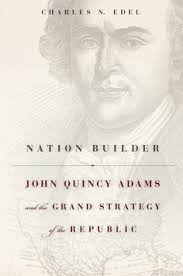
Charles N. Edel. Nation Builder: John Quincy Adams and the Grand Strategy of the Republic. Harvard University Press. 392pp. $29.95.
Who knew that John Quincy Adams (1767-1848) was so interesting? Or that he was probably the most sleep deprived and crankiest U.S. President ever to live in the White House? Or that he wrote in a journal every day — totaling some 17,000 pages and 51 volumes — since he was twelve until the day he died on the floor of Congress in 1848?
The word “fascinating” doesn’t begin to describe this man. But unfortunately for John Quincy Adams, his father has seemed to eclipse him in many ways. David McCullough’s wonderful biography of John Adams, which was turned into a popular HBO series, cemented the founding father’s stature in the collective American conscience. Thus, many of us only know John Quincy as a sequel, a trivial pursuit question: “Which eighteenth-century U.S. President had a son who also became a U.S. President?” It is always, it seems, this way with sequels. They never quite measure up in our minds and in our hearts.
Yet recently, it looks like John Quincy is getting his due. In May of last year, Fred Kaplan released his biography of the sixth President of the United States, titled, John Quincy Adams: American Visionary, to a warm reception. And just this past January, Phyllis Lee Levin’s book, The Remarkable Education of John Quincy Adams, hit the shelves. Call it a John Quincy revival. Still, there is always room on the bookshelf for another well-written book on this overlooked and under-appreciated president. Enter historian and U.S. Naval War College professor Charles Edel’s excellent new book, Nation Builder: John Quincy Adams and the Grand Strategy of the Republic.
Edel’s book is not a biography per se, and nor is it a book about John Quincy’s character, his life and times, or a detailed discussion of his policies. Rather, Edel sets out and argues, and quite convincingly I might add, that John Quincy was a grand strategist — maybe America’s first. That is, he not only defined clear objectives for the United States, but he was also, as Edel says, able to leverage all the instruments of national power — military, economic, diplomatic, and moral — to ensure the future security and prosperity of the American people.
Edel begins his book with John Quincy’s formative years, traveling with his father (crossing the Atlantic during the Revolutionary War and barely evading capture by the British), dining with Jefferson, reading (his father insisted on Thucydides), writing, and learning languages — French, German, and Dutch, to name just a few — that he would eventually use as a teenage diplomat in Europe. It is in those early years where we see that John Quincy, through diligent study and the puritan ethic of public service before personal happiness, made himself.
The book is then divided into chapters that trace the highlights of his extraordinary career: his challenges with depression and seeking purpose in the late 1790s; his involvement in American diplomacy and his rise in politics in the early 1800s; his ideas and debates on territorial expansion and the Monroe Doctrine, and finally, the “slavery question.” Throughout all of this, though, John Quincy retains his priorities and his national objectives. Adams, Edel tells us, understands that for the U.S. to become a strong nation, we must expand our territory, increase our national resources, remain neutral in European affairs, and build up our defense forces to ensure that other countries — notably France and Britain — did not try to fracture American solidarity. These principles, these objectives, would remain in the forefront of Adams’s mind throughout his life.
As secretary of state under President James Monroe, Adams was responsible for negotiating the Adams-Onís treaty, thus giving Florida to the United States — in return the U.S. settled a border dispute with Spain along what is today areas of the Sabine river in Texas. Adams also wrote the Monroe Doctrine — a seminal document in American history that, in simple language, told all European powers (and others) stay out of our business.
Interestingly, John Quincy would be most remembered in his twilight years. The first (and only) U.S. President to be elected to the House of Representatives after leaving office. He famously argued a case in front of the U.S. Supreme Court, United States v. Libellants and Claimants of the Schooner Amistad. He won the case, successfully arguing that the Africans aboard that ship should be set free.But while Edel reminds us that John Quincy detested slavery, John Quincy was averse to critiquing slavery publicly, in fear of tearing the nation apart. While he would always, it seems, nip at the edges. For example, trying to find ingenious ways to get around the “gag rule” that barred discussions of slavery on the floor of Congress.
John Quincy’s path to American prosperity and security was not without stumbles. Edel says that, “Adams grand strategy included a clear vision of where the country needed to go and a detailed policy road map for how to get there. But in many instances he lacked the ability to convert that vision into political reality.” For instance, Adams tried, but failed to get enough votes for the creation of a U.S. Naval Academy. Legislators thought that it would cost too much, and “critics…argued that federal appointments to such an academy would become ‘a vast source of promotion and patronage’ which would invariably lead to ‘degeneracy and corruption of the public morality.'”
John Quincy was an impressive diplomat and intellectual giant, but he was also a conflicted man, a contrarian, and, in all honesty, not someone who you would want at your dinner table. As Edel says, “Adams was certainly most comfortable when he stood in opposition to something or someone. Intellectual and industrious, rigid in his beliefs, and with a propensity to see issues and people in stark terms, in many ways Adams was an odd fit for politics.” The Sage of Concord, Ralph Waldo Emerson, whom Edel quotes, also had a few choice words for John Quincy, saying:
He’s no literary old gentleman, but a bruiser and loves the melee…[he] must have sulfuric acid in his tea.”
Adams, then, did not suffer fools.
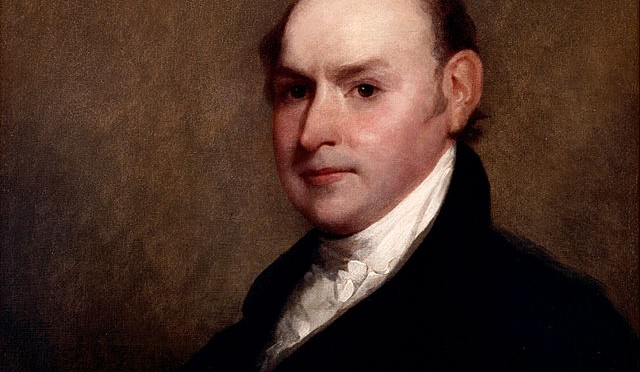
This is probably most easily seen in what is believed to be the first photograph ever taken of a living U.S. President. In 1843 Phillip Haas took a picture of the former president, who was then 76 years old. He is seen sitting, legs crossed, hands clasped, and head slightly down. His lips are pursed and he has an expression of impatience or frustration.
John Quincy Adams. Copy of 1843 Daguerreotype by Philip Haas.
In a recent interview with Edel, I asked him this question: “Do you think he was ever satisfied with is life?”
Edel said:
“…[A]t many points in his life he refers to himself as a Job like figure. In many ways, he sees his job as one of persistence and endurance. If he thinks about his policies, how his plans have gone awry, how others have distorted his policies, then he is rather less pleased with the result. But he’s not really someone who is satisfied – ever.”
There is only one small quibble I have with the book. At one or two points Edel repeats an idea within a chapter, or uses the same quote twice, making you pause for a moment in a sense of déjà vu, wondering if you had or had not just seen the same words pages prior. But again, this is a minor point. Overall, this is an excellent book. And whether you are new to John Quincy Adams or if you’ve read most of the current literature on this man and his presidency, I promise you’ll learn something new and interesting in these pages.
Lieutenant Commander Christopher Nelson, USN, is a career intelligence officer and recent graduate of the U.S. Naval War College and the Navy’s operational planning school, the Maritime Advanced Warfighting School in Newport, RI. LCDR Nelson is also CIMSEC’s book review editor and is looking for readers interested in reviewing books for CIMSEC. You can contact him at cimsecbooks@gmail.com. The views and opinions expressed here do not necessarily reflect those of the U.S. Navy or the Department of Defense.

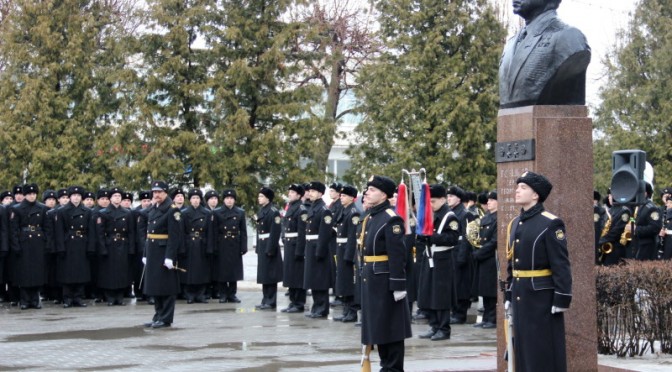
 17th-19th C. Sea Power of the State: Admiral Chirkov getting a tour of USNA Museum in 2013 from CIMSEC member Claude Berube. Was the Russian navy chief trying to get advance info on the #CarrierDebate? (Photo credit: USNA PAO)