Category Archives: History

Naval and maritime history section.

Declassified: US Nuclear Weapons At Sea

This piece was originally published by the Federation of American Scientists.  It is republished here with the author’s permission.  Read it in its original form here.

By Hans M. Kristensen
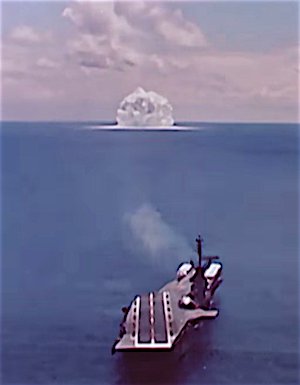
ASROC nuclear test.
ASROC nuclear test.

Remember during the Cold War when US Navy warships and attack submarines sailed the World’s oceans bristling with nuclear weapons and routinely violated non-nuclear countries’ bans against nuclear weapons on their territories in peacetime?

The weapons were onboard ballistic missile submarines, attack submarines, aircraft carriers, battleships, cruisers, destroyers, frigates and supply ships. The weapons were brought along on naval exercises, spy missions, freedom of navigation demonstrations and port visits.

Sometimes the vessels they were on collided, ran aground, caught fire, or sank.

Not many remember today. But now the Pentagon has declassified how many nuclear weapons they actually deployed in the Atlantic, Pacific, and Mediterranean. In our latest FAS Nuclear Notebook published in the Bulletin of the Atomic Scientists we review this unique new set of declassified Cold War nuclear history. 

The Numbers

The declassified documents show that the United States during much of the 1970s and the 1980s deployed about a quarter of its entire nuclear weapons stockpile at sea. The all-time high was in 1975 when 6,191 weapons were afloat, but even in 1990, after the fall of the Berlin Wall, there were 5,716 weapons at sea. That’s more nuclear weapons than the size of the entire US nuclear stockpile today.

The declassified data provides detailed breakdowns for weapons in the Atlantic, Pacific, and Mediterranean for the 30-year period between 1961 and 1991. Prior to 1961 only totals are provided. Except for three years (1962, 1965 and 1966), most weapons were always deployed in the Atlantic, a reflection of the focus on defending NATO against the Soviet Union. When adding the weapons in the Mediterranean, the Euro-centric nature of the US nuclear posture during the Cold War becomes even more striking. The number of weapons deployed in the Pacific peaked much later, in 1987, at 2,085 weapons.

afloat_table
Click to view full size

The declassified numbers end in 1991 with the offloading of non-strategic naval nuclear weapons from US Navy vessels. After that only strategic missile submarines (SSBNs) have continued to deploy with nuclear weapons on board. Those numbers are still secret.

In the table above we have incorporated our estimates for the number of nuclear warhead deployed on US ballistic missile submarines since 1991. Those estimates show that afloat weapons increased during the 1990s as more Ohio-class SSBNs entered the fleet.

Because the total stockpile decreased significantly in the early 1990s, the percentage of it that was deployed at sea grew until it reached an all-time high of nearly 33 percent in 2000. Retirement of four SSBNs, changes to strategic war plans, and the effect of arms control agreements have since reduced the number of nuclear weapons deployed at sea to just over 1,000 in 2015. That corresponds to nearly 22 percent of the stockpile deployed at sea.

The just over 1,000 afloat warheads today may be less than during the Cold War, but it is roughly equivalent to the nuclear weapons stockpiles of Britain, China, France, India, Israel, Pakistan and North Korea combined.

Mediterranean Mystery

The declassification documents do not explain how the numbers are broken down. The “Atlantic,” “Pacific,” and “Mediterranean” regions are not the only areas where the U.S. Navy sent nuclear-armed warships. Afloat weapons in the Indian and Arctic oceans, for example, are not listed even though nuclear-armed warships sailed in both oceans. Similarly, the declassified documents show the number of afloat weapons in the Mediterranean suddenly dropping to zero in 1987, even though the U.S. Navy continued so deploy nuclear-armed vessels into the Mediterranean Sea.

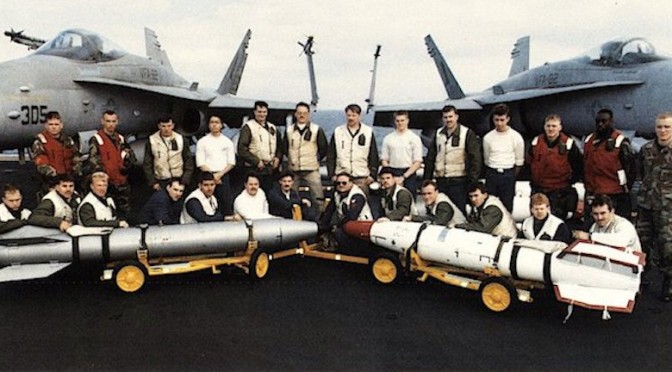
During the naval deployments in support of Operation Desert Storm against Iraq in early 1991, for example, the aircraft carrier USS America (CV-66) deployed with its nuclear weapons division (W Division) and B61 nuclear strike bombs and B57 nuclear depth bombs. The W Division was still onboard when America deployed to Northern Europe and the Mediterranean in 1992 but had been disbanded by the time it deployed to the Mediterranean in 1993.
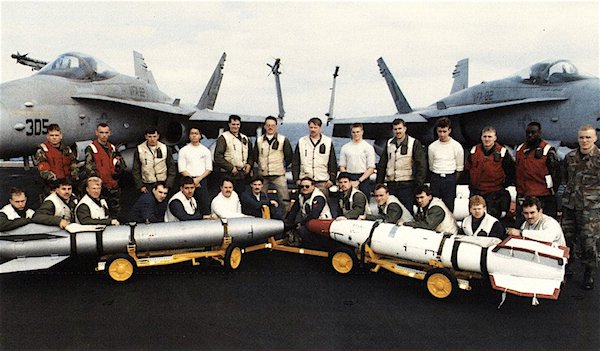
B61 and B57 nuclear weapons are displayed on board the USS America (CV-66) during its deployment to Operation Desert Storm in 1991. The nuclear division was also onboard in 1992 but gone in 1993.

As ships offloaded their weapons, the on-board nuclear divisions gradually were disbanded in anticipation of the upcoming de-nuclearization of the surface fleet. One of the last carriers to deploy with a W Division was the USS John F. Kennedy (CV-67), which upon its return to the United States from a Mediterranean deployment in 1992-1993 ceremoniously photographed the W crew with the sign: “USS John F. Kennedy, CV 67, last W-Division, 17 Feb. 93.” The following year, the Clinton administration publicly announced that all carriers and surface ships would be denuclearized.

afloat_last_carrier_1993
The last nuclear weapons division on the USS John F. Kennedy (CV-67) is disbanded in February 1993. The following year the entire surface fleet was denuclearized.

Since nuclear weapons clearly deployed to the Mediterranean Sea after the declassified documents showing zero afloat nuclear weapons in the area, perhaps the three categories “Atlantic,” “Pacific,” and “Mediterranean” refer to overall military organization: “Atlantic” might be weapons under the command of the Atlantic Fleet (LANTFLT); “Pacific” might refer to the Pacific Fleet (PACFLT); and “Mediterranean” might refer to the Sixth Fleet. Yet I’m not convinced that organization is the whole story; the Atlantic numbers didn’t suddenly increase when the Mediterranean numbers dropped to zero.

The declassified afloat numbers end in 1991. After that year the only nuclear weapons deployed at sea have been strategic weapons onboard ballistic missile submarines. Most of those deploy in the Atlantic and Pacific but have occasionally deployed into the Mediterranean even after the declassified documents list zero afloat weapons in that region, and even after the surface fleet was denuclearized.

In 1999, for example, the ballistic missile submarine USS Louisiana (SSBN-743) conducted a port visit to Souda Bay on Crete with it load of 24 Trident missiles and an estimated 192 warheads. The ship’s Command History states that the port visit, which took place December 12-16, 1999, occurred during the “Alert Strategic Deterrent Patrol in support of national tasking” that included a “Mediterranean Sea Patrol.”

Risks of Nuclear Accidents

accident_belknap1975_brokenarrowflash

Deploying nuclear weapons on ships and submarines created unique risks of accidents and incidents. Because warships sometimes collide, catch fire, or even sink, it was only a matter of time before the nuclear weapons they carried were threatened, damaged, or lost. This really happened.

During night air exercises on November 22, 1975, for example, the aircraft carrier USS John F. Kennedy (CV-67) and cruiser USS Belknap (CG-26) collided in rough seas 112 kilometers (70 miles) east of Sicily. The carrier’s flight deck cuts into the superstructure of the Belknap setting off fires on the cruiser, which burned out of control for two-and-one-half hours. The commander of Carrier Striking Force for the U.S. Sixth Fleet on board the Kennedy issues a Broken Arrow alert to higher commands stating there was a “high probability that nuclear weapons (W45 Terrier missile warheads) on the Belknap were involved in fire and explosions.” Eventually the fire was stopped only a few meters from Belknap’s nuclear weapons magazine.

accident_belknap1975
The fire-damaged USS Belknap (CG-26) after colliding with USS John F. Kennedy (CV-67) new Sicily in 1975. The fire stopped a few meters from the nuclear warhead magazine.

The Kennedy also carried nuclear weapons, approximately 100 gravity bombs for delivery by aircraft. The carrier caught fire but luckily it was relatively quickly contained. Another carrier, the USS Enterprise (CVN-65), had been less fortunate six years earlier when operating 112 kilometers (70 miles) southwest of Pearl Harbor, Hawaii. A rocket on a F-4 Phantom aircraft exploded puncturing fuel tanks and starting violent fires that caused other rockets and bombs to explode. The explosions were so violent that they tore holes in the carrier’s solid steel deck and engulfed the entire back of the ship. The captain later said: “If the fire had spread to the hangar deck [below], we could have very easily lost the ship.” The Enterprise probably carried about 100 nuclear bombs and was powered by eight nuclear reactors.

accident_enterprise1969
The nuclear-armed and nuclear-powered USS Enterprise (CVN-65) burns off Hawaii on January 14, 1969. The carrier could have been lost, the captain said.

Dozens of nuclear weapons were lost at sea over the decades because they were on ships, submarines, or aircraft that were lost. On December 5, 1965, for example, while underway from operations off Vietnam to Yokosuka in Japan, an A-4E aircraft loaded with one B43 nuclear weapon rolled overboard from the Number 2 Elevator. The aircraft sank with the pilot and the bomb in 2,700 fathoms (4,940 meters) of water. The bomb has never been recovered. The Department of Defense reported the accident took place “more than 500 miles [805 kilometers] from land” when it revealed the accident in 1981. But Navy documents showed the accident occurred about 80 miles (129 kilometers) east of the Japanese Ryukyu Island chain, approximately 250 miles (402 kilometers) south of Kyushu Island, Japan, and about 200 miles (322 kilometers) east of Okinawa. Japan’s public policy and law prohibit nuclear weapons. (For a video if B43 aircraft carrier handling and A-4 loading, see this video.)

accident_ticonderoga1965
An A-4 Skyhawk with a B43 nuclear bomb under its belly rises on an elevator from the hangar deck to the flight deck on the USS Independence (CV-62) in an undated US Navy photo. In December 1965, a B43 attached to an A-4 rolled off the elevator on the USS Ticonderoga (CVA-14) while the carrier was on its way to Yokosuka in Japan.

Three years later, on May 27, 1968, the nuclear-powered attack submarine USS Scorpion (SSN-589) suffered an accident and sank with all 99 men on board in the Atlantic Ocean approximately 644 kilometers (400 miles) southwest of the Azores. The Department of Defense in 1981 mentioned a nuclear weapons accident occurred in the Atlantic in the spring of 1968 but continues to classify the details. It is thought that two nuclear ASTOR torpedoes were on board the Scorpion when it sank.

accident_scorpion1968
The USS Scorpion (SSN-589) photographed in the Mediterranean Sea in April 1968, one month before it sank in the Atlantic Ocean. The Navy later located and photographed the wreck (inserts).

Risks of Nuclear Incidents

Another kind of risk was that nuclear weapons on board US warships could become involved in offensive maneuvers near Soviet warships that also carried nuclear weapons. Sometimes those nuclear-armed vessels collided – sometimes deliberately. Other times they were trapped in stressful situation. The presence of nuclear weapons could significantly increase the stakes and symbolism of the incidents and escalate a crisis.

Some of the most dramatic incidents happened during the Cuban Missile Crisis in 1962 where crisis-stressed personnel on Soviet nuclear-armed submarines readied nuclear weapons for actual use as they were being hunted by US naval forces, many of which were also nuclear-armed. At the time there were approximately 750 U.S. nuclear weapons deployed in the Atlantic Ocean.

Less serious but nonetheless potentially dangerous incidents continued throughout the Cold War. In May 1974 the nuclear-powered attack submarine USS Pintado (SSN-672) collided almost head-on with a Soviet Yankee I-class ballistic missile submarine while cruising 200 feet (60 meters) below the surface in the approaches to the Petropavlovsk naval base on the Kamchatka Peninsula. The collision smashed much Pintado’s bow sonar, jammed shut a starboard side torpedo hatch, and damaged the diving plane. The Pintado, which probably carried 4-6 nuclear SUBROC missiles, sailed to Guam for seven weeks of repairs. The Soviet submarine, which probably carried its complement of 16 SS-N-6 ballistic missiles with 32 nuclear warheads, surfaced immediately and presumably limped back to port.

accident_pintado1974

On August 22, 1976, for example, US anti-submarine forces in the Atlantic and Mediterranean had been tracking a Soviet nuclear-powered and nuclear-armed Echo II-class attack submarine for ten days. The Soviet sub partially surfaced alongside the US frigate USS Voge (FF-1047), then turned right and ran into the frigate. The collision tore off part the Voge’s propeller and punctured the hull. The Voge is thought to have carried nuclear ASROC anti-submarine rockets. At the time there were around 430 U.S. nuclear weapons deployed in the Mediterranean Sea. The Soviet submarine suffered serious damage to its sail and some to its front hull section. (For a US account of the incident, see here; a Russian account is here.)

Even toward the very end of the Cold War in the late-1980s, nuclear-capable warships continued to get involved in serious incidents at sea. During a Freedom of Navigation exercise in the Black Sea on February 12, 1988, the cruiser USS Yorktown (CG-48) and destroyer USS Caron (DD-970) were bumped by a Soviet Krivak-class frigate and a Mirka-class frigate, respectively. Both U.S. ships were equipped to carry the nuclear-capable ASROC missile and the Caron had completed a series of nuclear certification inspections prior to its departure from the United States. Yet the W44 warhead for the ASROC was in the process of being phased out and it is possible that the vessels did not carry nuclear warheads during the incident. The declassified data shows that the number of U.S. nuclear weapons in the Mediterranean dropped to zero in 1987. The Soviet Krivak frigate, however, probably carried nuclear anti-submarine weapons at the time of the collision.

accident_blacksea1988
The nuclear-capable USS Caron (DD-970) and USS Yorktown (CG-48) are bumped by Soviet frigates during Freedom of Navigation operations inside Soviet territorial waters on February 12, 1988. For a video of the Caron collision, see here, and the Yorktown collision, see here.

Nuclear Diplomacy Headaches

In addition to the risks created by accidents and incidents, nuclear-armed warships were a constant diplomatic headache during the Cold War. Many U.S. allies and other countries did not allow nuclear weapons on their territory in peacetime but the United States insisted that it would neither confirm nor deny the presence of nuclear weapons anywhere. So good-will port visits by nuclear-armed warships instead turned into diplomatic nightmares as protesters battled what they considered blatant violations of the nuclear ban.

The port visit protests were endless, happening in countries all over the world. The national governments were forced to walk a fine line between their official public anti-nuclear policies and the secret political arrangements that allowed the weapons in anyway.

Public sentiments were particularly strong in Japan because it was the target of two nuclear weapon attacks in 1945. Japanese law banned the presence of nuclear weapons on its territory and required consultation prior to introduction, but the governments secretly accepted nuclear weapons in Japanese ports.

During the 1970s and early-1980s, opposition to nuclear ship visits grew in New Zealand and in 1984 culminating in the David Lange government banning visits by nuclear-powered and nuclear-armed vessels. The Reagan administration reacted angrily by ending defense cooperation with New Zealand under the ANZUS alliance. Only much later, during the Obama administration, have defense relations been restored.

afloat_SSN604_Oakland1979
The nuclear-powered and nuclear-armed attack submarine USS Haddo (SSN-604) is barraged by protestors during a port visit to Oakland in New Zealand in 1979.

The treatment of New Zealand was partially intended to deter other more important allies in Europe from adopting similar anti-nuclear legislation. But not surprisingly, the efforts backfired and instead increased opposition. In Denmark the growing evidence that nuclear weapons were actually being brought into Danish harbors despite its clear prohibition soon created political pressure to tighten up the ban. In 1988, this came to a head when a majority in the parliament adopted a resolution requiring the government to inform visiting warships of Denmark’s ban. The procedure did not require the captain to reveal whether his ship carried nuclear weapons, but the conservative government called an election and asked the United States to express its concern.

afloat_DDG17_Aalborg1988
The crew of the nuclear-armed destroyer USS Conyngham (DDG-17) uses high-pressure hoses to wash anti-nuclear protestors off its anchor chain during a standoff in Aalborg, Denmark, in 1988.

Across the Danish Straits in Sweden, the growing evidence that non-nuclear policies were violated in 1990 resulted in the government party deciding to begin to reinforce Sweden’s nuclear ban. The policy would essentially have created a New Zealand situation in Europe, a political situation that was a direct threat to the US Navy sailing its nuclear warships anyway it wanted.

These diplomatic battles over naval nuclear weapons were so significant that many US officials gradually began to wonder if nuclear weapons at sea were creating more trouble than good.

After The Big Nuke Offload

Finally, on September 27, 1991, President George H.W. Bush announced during a prime-time televised address that the United States would unilaterally offload all non-strategic nuclear weapons from its naval forces, bring all those weapons home, and destroy many of them. Warships would immediately stop loading nuclear weapons when sailing on overseas deployments and deployed vessels would offload their weapons as they rotated back to the United States. The offload was completed in mid-1992.

Two years later, the Clinton administration’s 1994 Nuclear Posture Review, decided that all surface ships would lose the capability to launch nuclear weapons. Only selected attack submarines would retain the capability to fire the nuclear Tomahawk land-attack sea-launched cruise missile (TLAM/N), but the weapons would be stored on land. Sixteen years later, in 2010, the Obama administration decided to retire the TLAM/N as well, ending decades of nuclear weapons deployments on ships, attack submarines, and on land-based naval air bases.

After the summer of 1992, only strategic submarines armed with long-range ballistic missiles have carried U.S. nuclear weapons at sea, a practice that is planned to continue through at least through the 2080s. These strategic submarines (SSBNs) have also been involved in accidents and incidents, risks that will continue as long as nuclear weapons are deployed at sea. Because secrecy is so much tighter for SSBN operations than for general naval forces, most accidents and incidents involving SSBNs probably escape public scrutiny. But a few reports, mainly collisions and groundings, have reached the public over the years.

accident_VonSteuben1968
USS Von Steuben (SSBN-632) after collision with tanker Sealady.

During a strategic deterrent patrol on August 9, 1968, the USS Von Steuben (SSBN-632) was struck by a submerged tow cable while operating submerged about 40 miles (64 kilometers) off the southern coast of Spain. As it surfaces, the submarine collides with the tanker Sealady, suffering damage to the superstructure and main deck (see image right). The submarine carried 16 Polaris A3 ballistic missiles with 48 nuclear warheads.

Two years later, on November 29, 1970, a fire breaks out onboard the nuclear submarine tender USS Canopus (AS-34) at the Holy Loch submarine base in Scotland. Two nuclear-powered ballistic missile submarines (USS Francis Scott Key (SSBN-657) and USS James K. Polk (SSBN-645)) were moored alongside Canapus. The Francis Scott Key cast off, but the Polk remained alongside. The fire burns out of control for four hours killing three men. The submarine tender carried nuclear missiles and warheads and the two submarines combined carried 32 Polaris A3 ballistic missiles with a total of 96 nuclear warheads.

Four years later, in November 1974, after having departed from its base at Holy Loch in Scotland, the ballistic missile submarine USS James Madison (SSBN-627) collides with a Soviet submarine in the North Sea. The collision left a nine-foot scrape in the Madison, which apparently dove onto the Soviet submarine, thought to have been a Victor-class nuclear-powered attack submarine. The Madison carried 16 Poseidon (C3) ballistic missiles with 160 nuclear warheads. The Soviet submarines probably carried nuclear rockets and torpedoes. Madison crew members called the incident The Victor Crash. Two days after the collision, the Madison enters dry dock at Holy Loch for a week of inspection and repairs.

accident_madison1974
The missile submarine USS James Madison (SSBN-627) in dry dock in Scotland in 1974 only days after it collided with a Soviet Victor-class nuclear-powered attack submarine in the North Sea.

After nuclear weapons were offloaded from surface ships and attack submarines in 1991-1992, nuclear-armed ballistic missile submarines have continued to run aground or bump into other vessels from time to time.

On September 24, 1993, for example, after conducting a medical evacuation for a suck crew member, the ballistic missile submarine USS Maryland (SSBN-738) ran aground at Port Canaveral, Florida. The submarine was on a strategic deterrent patrol with 24 missiles onboard carrying an estimated 192 warheads. The Maryland eventually pulled free and continued the patrol two days later.

On March 19, 1998, while operating on the surface 125 miles (200 kilometers) off Long Island, New York, the ballistic missile submarine USS Kentucky (SSBN-737) was struck by the attack submarine USS San Juan (SSN-751). The Kentucky suffered damaged to its rudder and San Juan’s forward ballast tank was ruptured. In a typical display of silly secrecy, the Navy refused to say whether the Kentucky carried nuclear weapons. But it did; the Kentucky was in the middle of its 21st strategic deterrent patrol and carried its complement of 24 Trident II missiles with an estimated 192 nuclear warheads.

accident_kentucky1998
In 1998, the USS Kentucky (SSBN-737) carrying nearly 200 nuclear warheads collided with an attack submarine less than 230 miles (378 kilometers) from New York City.

Conclusions and Recommendations

The Obama administration has made an important contribution to nuclear policy by declassifying the documents with official numbers of US nuclear weapons deployed at sea during the Cold War. This adds an important chapter to the growing pool of declassified information about the history of the U.S. nuclear arsenal.

The new declassified information helps us better understand the extent to which nuclear weapons were involved in day-to-day operations around the world. Every day, nuclear-armed warships of the US and Soviet navies were rubbing up against each other on the high seas in gong-ho displays of national determination. Some saw it as necessary for nuclear deterrence; others as dangerous nuclear brinkmanship. Many of those who were on the ships submarines still get goosebumps when they talk about it and wonder how we survived the Cold War. The tactical naval nuclear weapons were considered more acceptable to use early in a conflict because there would be few civilian casualties. But any use would probably quickly have escalated into large-scale nuclear war and the end of the world as we know it.

The declassified information, when correlated with the many accidents and incidents that nuclear-armed ships and submarines were involved in over the years, also helps us remember a key lesson about nuclear weapons: when they are operationally deployed they will sooner or later be involved in accidents and incidents.

This is not just a Cold War lesson: thousands of nuclear weapons are still operationally deployed on ballistic missile submarines, on land-based ballistic missiles, and on bomber bases. And not just in the United States but also in Britain, France, and Russia. Some of those deployed weapons will have accidents in the future. (See here for the most recent)

Moreover, growing tensions with Russia and China now make some ask if the United States needs to increase the role of its nuclear weapons and once again equip aircraft carriers with the capability to deliver nuclear bombs and once again develop and deploy nuclear land-attack sea-launched cruise missiles on attack submarines.

Doing so would be to roll back the clock and ignore the lessons of the Cold War and likely make the current tensions worse than they already are.

Instead, the United States should seek to work with Russia – even though it is challenging right now – to reduce deployed nuclear weapons and jointly try to persuade smaller nuclear-armed countries such as China, India, and Pakistan from increasing the operational readiness of their nuclear forces. That ought to be one thing Russia and the United States could actually agree on.

Background information:

Hans M. Kristensen is the director of the Nuclear Information Project at the Federation of American Scientists where he provides the public with analysis and background information about the status of nuclear forces and the role of nuclear weapons.

The research for this publication was made possible by a grant from the New Land Foundation, and Ploughshares Fund. The statements made and views expressed are solely the responsibility of the authors.
Book Review: Andrew Gordon’s The Rules of the Game

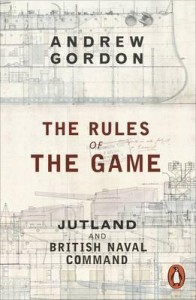
Gordon, Andrew. The Rules of the Game: Jutland and British Naval Command. Annapolis: Naval Institute Press, 2013, reprint ed. 708pp. $34.95

9780141980324

By Captain Dale Rielage

There is always interest, and usually value, in reading what the boss is reading. Since General Al Gray established the Marine Corps reading list in the late 1980s, reading lists have proliferated across the military services. The Marine Corps Library website lists more than twenty. While the original Marine Corps reading list bore General Gray’s own unique stamp, today most military reading lists feel like the product of a committee – because most are – developed with an eye towards representing every facet and constituency in their institution. What has personally informed and moved a thoughtful warrior, however, is more interesting than the consensus of any committee…which is why, for example, Admiral Stavridis’s reading recommendations are always worth taking aboard. Earlier this month, one of my colleagues made reference to the classic work The Rules of the Game. His comment sent me back to my bookshelf. There, in the recent Naval Institute reprint edition, I noticed an epigraph that escaped my attention years ago:

This edition has been brought to publication with the generous assistance of VADM John M. Richardson, USN, Commander, Submarine Force, and VADM Peter H. Daly, USN (ret.) CEO, US Naval Institute, in the interest of helping put this book in the hands of current and future naval professionals.

It is one thing for a book to make an official reading list, but when the (then) future Chief of Naval Operations is willing to help a book to remain in print, it bears a second look. What any particular senior officer saw in this volume I can only speculate, but a couple lost weekends later, it is clear that Rules of the Game speaks to the most profound challenges facing the U.S. Navy.

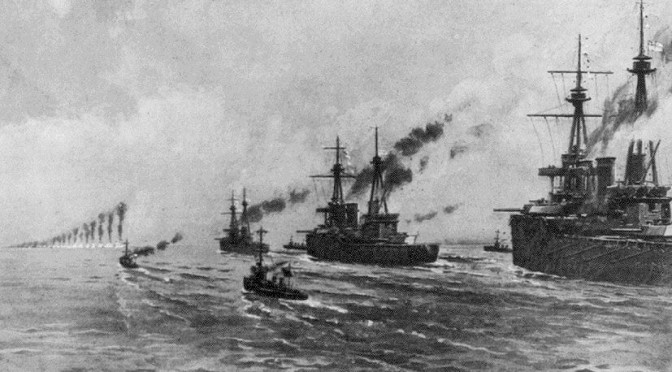
On the surface, a 600-plus page (708 pages with notes and appendixes) book about the Battle of Jutland seems an unlikely means to examine the established order of U.S. Navy command and control. The fight between the British Royal Navy and the German High Sea Fleet in the North Sea on 31 May and 1 June 1916 was the largest naval battle of World War I. This epic clash of dreadnought battleships is widely regarded as a draw, with neither side achieving clear victory. Gordon, however, turns the Royal Navy at Jutland into a long case study of the role of doctrine, training, centralization, initiative, and institutions in naval warfare. He begins his analysis as the fleet engagement at Jutland is starting, with the Battle Fleet and the Battle Cruiser Fleet, the two key combat formations that comprised the Royal Navy’s Grand Fleet, getting underway from their respective homeports 200 miles from each other. So good was British naval intelligence in this era that the Grand Fleet weighed anchor in response to a planned German sortie more than four hours before the German High Sea Fleet reached the open sea.

As the narrative arrives at the moment enemy forces are in contact and key tactical decisions are being made, Gordon shifts his view back a century. In a 200 page excursion, he introduces the competing naval schools of thought and the resulting institutional habits and personal relationships that led to the British fleet acting as it did at Jutland.

Britain left the Napoleonic Wars with a navy second to none and a tradition of victory built on the aligned independence of Nelson’s band of brothers. Nelson’s famous flag hoist opening Trafalgar was the last he made during that battle – not because of his death, but because he needed no other. Shortly after the war, however, new visual signaling systems promised increasing control over the movements of forces in combat. In peacetime drills, these systems yielded reliable execution of complex maneuvers. However, the reality of how this signals system would work in combat was lost over decades. In the breach, smoke from engineering and gunnery, signal masts and halyards destroyed by gunfire, signalmen lost to shot and shell, and the sheer volume of communications in a fleet engagement would conspire to negate centralized command and control. The promise of centralized control and effective coordinated combat action, however, produced a deep influence on the Royal Navy.

In what Gordon memorably dubbed “the long lee of Trafalgar,” the Royal Navy continued to dominate the seas. Its officers retained the expectation of victory bequeathed them by their predecessors. That there had been no major fleet action in living memory was discussed, but rarely with concern. The French or Russian navies occasionally caused alarm, but no “peer competitor” called into question the fundamentals of the system – the rules of the game.

There was good reason for this comfort. By almost every metric, the Royal Navy in the second half of the nineteenth century was extraordinarily successful. Its officers were masters of seamanship and navigation and created the standard for contemporary and modern navies. Operating forward in defense of a worldwide empire, many Royal Navy officers had seen combat and had demonstrated personal courage and resourcefulness. Beatty, commander of the Battle Cruiser Fleet at Jutland, had earned distinction – and favorably impressed a young Winston Churchill – in littoral action using river gunboats to support ground forces in Egypt. Work to understand and incorporate new technologies proceeded apace, with a limited cadre of specialists articulating the new technology to the fleet at large. There were efforts to change operational culture, most prominently spearheaded by the driven and charismatic Admiral Sir George Tyron. Tyron advocated a looser form of control, emphasizing formations following the Commander’s intent as understood or expressed in the movements of his flagship. His untimely death in a collision at sea – ironically and unfairly blamed on his style of signaling – arrested reform efforts for decades.

Having allowed the German Fleet to avoid decisive battle and escape home, the Royal Navy left the field at Jutland with a sense of failure that grew as the war concluded. Denied the decisive fleet action they expected, senior British commanders engaged in decades of controversy over what signals were sent, received, intended, and expected. This controversy colors any discussion of the battle to this day. Gordon, however, seeks to move this discussion to a more profound level. While individual commanders executed the action at Jutland, their failure to exercise initiative at key moments was not truly an individual act. Indeed, Gordon asserts that the sudden exercise of tactical initiative would have been an unnatural rejection of the culture that had nurtured them through their entire professional lives.

In his final chapter, Gordon draws twenty-eight specific observations from the Jutland experience. They are directed toward the Royal Navy of the early 1990s, but will resonate with serving officers today. Gordon rails against command and control being driven by the tools of information processing. Absent deliberate restraint, every increase in the capacity to transmit information produces an increase in the amount of information transmitted – with the capacity of the senior to send information, rather than the capacity of the junior to assimilate information, driving the flow. The focus too easily becomes getting the mechanisms of communications right, believing that with that information dominance achieved, success in command and control ensues. Ready access to information and the ability to transmit orders raises the level of decision making further from the point of action. When these links fail – today from jamming, cyber attack, or destruction of communications satellites – it is folly to expect naval commanders in combat will suddenly be able to shed the culture in which they have been trained.

Gordon also highlights the difficulty of integrating new concepts and technologies into a peacetime navy. In the Royal Navy of 1900, enthusiasts for new technologies drove the stated purpose and design of new weapons – much like our navy today. Their specialized focus ignored or obscured real operational challenges to their systems. Once a new system or platform arrived in the Fleet, however, its integration and employment became the business of fleet officers who were and are often working from different approaches than the cadre of experts who designed it. As practical naval officers, they rarely set a capability aside as too flawed for use, but rather would often “make the best of it,” sometimes using the ship for an entirely different purpose than intended. At Jutland, the Royal Navy Battle Cruiser Fleet consisted of ships designed to mount heavy guns but limited armor. Their superior speed was intended to allow them to manage their range to more heavily protected enemies. In actual combat, managing this thin envelope of safety proved too difficult. 3,300 British sailors died in these ships – ten percent of all the British sailors who participated in the battle – in what Gordon aptly calls “a costly rediscovery of the designer’s terms of reference.”

That insight brings us to Gordon’s overarching theme – how the Royal Navy dealt with a long peace, technological change, and an emerging German challenge to its comfortable dominance of the maritime domain. It is a short leap to ask to what extent the U.S. Navy remains, to paraphrase, in the long lee of Midway. It is a question the service must be comfortable asking, whether or not the answers are comfortable.

Aside from its impact and insight, The Rules of the Game is delightfully written. Gordon has a knack for memorable turns of phrase and admirable clarity (if not economy) of expression that makes the long journey through his thinking as enjoyable as it is intriguing. Every naval professional’s bookshelf should have a well-thumbed copy of this volume.

Captain Rielage serves as Director for Intelligence and Information Operations for U.S. Pacific Fleet, the headquarters where the Midway operation was commanded and controlled. He has served as 3rd Fleet N2, 7th Fleet Deputy N2, Senior Intelligence Officer for China at the Office of Naval Intelligence and Director of the Navy Asia Pacific Advisory Group. His opinions do not represent those of the U.S. Government, Department of Defense, or Department of the Navy.

Twenty-Eight Observations from The Rules of the Game
by Andrew Gordon

Lessons from the Battle of Jutland
31 May to 1 June 1916

1) In times of peace, empirical experience fades and rationalist theory takes its place.
2) The advent of new technology assists the discrediting of empirical doctrine.
3) The purveyors of new technology will be the most evangelizing rationalists.
4) Rationalism, unlike empiricism, tends to assume an accretion of vested interests.
5) The training establishment may try to ignore short bouts of empirical experience to preserve its ‘rationalist’ authority.
6) Military cultures impart doctrine by corporate ambience as much as by explicit teaching.
7) In long periods of peace, ‘ambient’ doctrine may be no more than the habits of years in which war has been forgotten.
8) If doctrine is not explicitly taught, vested interests will probably ensure that wrong doctrine is ambiently learned.
9) In peacetime, doctrine is vulnerable to commandeering by ‘systems lobbyists.’
10) Innovations adopted in accordance with peacetime doctrine may lock the Fleet into both systems and doctrine which will fail the empirical test of war.
11) Purveyors of technical systems will seek to define performance criteria and trials conditions.
12) A service which neglects to foster a conceptual grasp of specialized subjects will have too few warriors able to interrogate the specialists.
13) The volume of traffic expands to meet capacity.
14) Signals ‘capacity’ tends to be defined by how much the senior end can transmit rather than how much the junior end can conveniently assimilate.
15) Signal prioritizing mechanisms become dislocated in times of overload.
16) Incoming traffic can act as a brake on decision-making.
17) The more signals, the more the sun shines on signalers.
18) The ‘center’ must subject its own transmissions to the strictest self-denying ordinance.
19) Signaling promotes the centralization of authority.
20) There is an inverse law between robust doctrine and the need for signaling.
21) Heavy signaling, like copious orders, is symptomatic of doctrinal deficiency.
22) The promise of signaling fosters a neglect of doctrine.
23) War-fighting commanders may find themselves bereft of communications faculties on which they have become reliant in peacetime training.
24) Properly disseminated doctrine offers both the cheapest and the most secure command-and-control method yet devised by man.
25) Every proven military incompetent has previously displayed attributes which his superiors rewarded.
26) Peacetime highlights basic ‘primary’ skills to the neglect of more advanced, more lateral ‘secondary’ abilities, the former being easier to teach, easier to measure, and more agreeable to superiors.
27) The key to efficiency lies in the correct balance between organization and method.
28) Doctrine draws on the lessons of history.

Neither Side Appears Ready for War: Falklands/Malvinas Islands Analysis

By W. Alejandro Sanchez

Argentina has requested that the United Kingdom engage in diplomatic talks regarding control of the Falkland Islands, or Islas Malvinas, depending on which side you support. As the islands will not change hands anytime soon, with London citing a 2013 referendum as proof of the Falklanders’ desire to remain in the UK, the dispute will continue. Nevertheless, in spite of occasional aggressive statements or alarmist media reports from either London or Buenos Aires, it is important to highlight that neither side has significantly increased their defense spending vis-à-vis the islands.

[otw_shortcode_button href=”https://cimsec.org/buying-cimsec-war-bonds/18115″ size=”medium” icon_position=”right” shape=”round” color_class=”otw-blue”]Donate to CIMSEC![/otw_shortcode_button]

The War

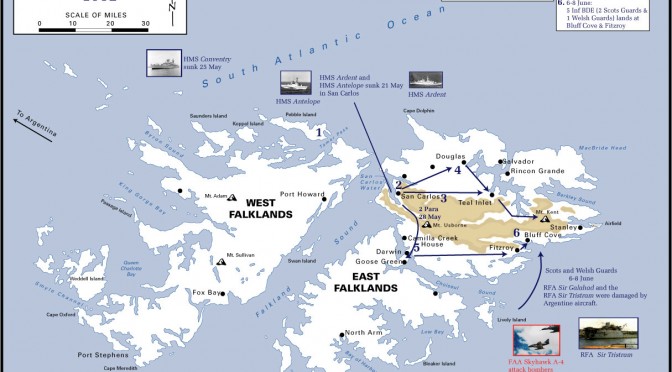
In 1982, Argentina launched an invasion of the islands, as the military government in Buenos Aires wanted to distract the Argentine population from the country’s crumbling economy and unite the citizenry behind the junta. The Falklands War has been extensively analyzed (see such essays as “Delayed Reaction: UK Maritime Expeditionary Capabilities and the Lessons of the Falklands Conflict,” and “Facts Influencing the Defeat of the Argentine Air Power in the Falklands War”) but a word must still be said about the conflict. The war is significant because, as Dr. Ian Speller explains, it “was the first time since 1945 that a major western navy had come under sustained air attack at sea [and] it was the first time that a nuclear-powered hunter killer submarine conducted a successful attack on enemy surface units.”

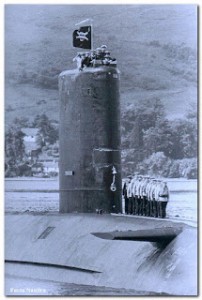
The navies and air forces from both sides were actively engaged in the battle to control the Falklands. As for successful attacks, aircraft from the Argentine Air Force and Navy managed to sink British vessels like the warships HMS Sheffield and HMS Ardent, and the supply ship MV Atlantic Conveyor, among others. Meanwhile, a British nuclear submarine, the HMS Conqueror, sank the Argentine Navy’s flagship, the ARA General Belgrano.

The HMS Conqueror flies the Jolly Roger after sinking the Belgrano.

Official Statements

To this day, Argentina continues to claim ownership of the islands. Case in point, now former-President Cristina Fernandez de Kirchner, declared this past April that she foresaw that one day the islands would be under Argentine control. A month earlier, UK Defence Secretary Michael Fallon announced that “we are going to beef up the defence of Falkland Islands,” the obvious assumption being that the islands need protection from a possible Argentine attack. These statements come to no surprise, as over the past years Buenos Aires and London claim that the “other side” is taking aggressive steps regarding the islands.

The islands, particularly after the war, are a key part of Argentine nationalism, hence it should not be surprising that Argentina’s new head of state, President Mauricio Macri, will give the occasional nationalistic statement over the islands or call for negotiations. Nevertheless he also wants U.S. and European investment to jump start the country’s economy, so he may not be overly aggressive (after his electoral victory in November, Macri and Prime Minister David Cameron held a telephone discussion in which they agreed on forging closer commercial ties). I would argue that nationalistic statements or calls for dialogue with London from Buenos Aires are mostly for internal consumption, as a way for President Macri to show his people that he has not forgotten about the islands. After all, it would be political suicide for any Argentine president to not make the occasional patriotic declaration regarding the Falklands.

Defense Realities

Provocative calls for negotiations aside, the Argentine Navy is in no particular shape to engage in a new conflict over the islands. The Navy’s biggest acquisition in recent years was that of four Russian multipurpose ships (Aviso/Neftegaz-class), which will be utilized for search and rescue operations and scientific projects around the Antarctic. The vessels arrived to the South American nation this past December. Theoretically, the Navy could install weapons systems aboard the vessels, but it is unlikely that this will happen due to budgetary

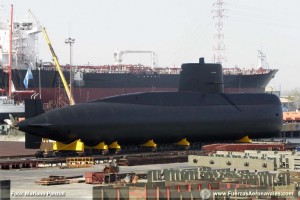
The ARA San Juan
The ARA San Juan

limitations. Regarding submarines the only new development is that in 2014 the ARA San Juan (a diesel TR-1700-class) was finally returned to the Navy after it underwent repairs that had taken several years to complete.

As for the Air Force, which was a critical factor in Argentina’s victories at sea during the Falklands War, just this past November it decommissioned its aging Mirage warplane fleet. The problem is that the Air Force does not have a new warplane to replace the Mirage. Over the past years there were rumors that Buenos Aires would acquire Russian Sukhoi warplanes (hence the need for London to “beef up” the defense of the islands) but this deal never materialized. Similarly, a recent deal for Israeli Kfir warplanes has been put on hold. For the time being, Argentina will have to rely on trainers, such as the Pampa III, and various, also aging, aircraft to protect its airspace.

The Air Force’s situation is so dismal that during the December 2015 inauguration ceremony of President Macri, Argentina requested that Uruguay have three of its own Cessna Dragonfly planes on alert, ready to support Buenos Aires if some crisis occurred. While this request speaks well of Argentina-Uruguay defense relations, it highlights that the Argentine military is hardly in any shape to attempt a renewed operation to take over the Falklands.

As for the UK Navy, the big news is that it is constructing two new carriers, one of which, the HMS Queen Elizabeth, should be operational by 2020. The new vessels are part of a push for greater defense spending by London. Just this past December, Secretary Fallon declared that “we have said we will maintain a minimum fleet of 19 destroyers and frigates, but as the older frigates are retired we also hope to add a lighter frigate between the offshore patrol vessel and Type 26 and to build more of those as well.” Additionally, the Royal Air Force and Royal Navy will benefit from having the new F-35 warplanes in their inventory, as “the Lightning II will be the backbone of Britain’s future carrier operations.” (Of course, how long it will take for the F-35 to be delivered is another question).

Regarding the Falklands themselves, the Royal Navy maintains the HMS Clyde stationed there as part of its South Atlantic Patrol program (in November 2015, the HMS Clyde assisted in rescuing tourists trapped in a sinking cruise ship close to the Falklands). Additionally, the British daily Express reported that this past April British troops carried out exercises in the Falklands which simulated an invasion of the islands. As for new equipment, the only major ongoing acquisition program seems to be additional Giraffe AMB radars, manufactured by Saab.

One could argue that the British military is suffering from exhaustion due to the multiple operations it carries out around the world, from the wars in Iraq and Afghanistan to security operations in the Mediterranean and the Horn of Africa. Just this past December, the destroyer HMS Defender was deployed to the Mediterranean to support the French carrier Charles de Gaulle. Given its multiple ongoing operations, it’s difficult to say how long it would take London to organize a new expeditionary force that would be sent to the Falklands, should another conflict occur. (Daniel Gibran’s The Falklands War, 1998, provides a great summary of the logistical success of deploying over 50 warships, over 50 support vessels, aircraft, troops, ammo and other supplies to the South Atlantic – p. 80-83).

Conspiracy Theories/Exaggerations

Finally, a word must be said about accusations originating in both London and Buenos Aires concerning the other’s intentions regarding the Falklands. As previously mentioned, while there has not been another war over the islands since the early 1980s, just about every year there are accusations that either the Argentine or British government are behaving in an aggressive manner. For example, in 2012 Argentina accused the UK of “militarizing” the South Atlantic. Moreover, the Argentine media widely reproduced the March 2015 comments by Secretary Fallon about “beefing up” of the defenses in the Falklands. In particular the Argentine media quoted and discussed a March 23, 2015, report by the British tabloid The Sun that London feared an imminent attack by Argentina, with Russian support. At the time, the ongoing theory in the British media was that, due to the close relations between Moscow and Buenos Aires (largely due to the friendship between President Vladimir Putin with then-President Kirchner), Russia would somehow support Argentina’s military in the islands.

Final Thoughts

As a reminder, Argentina did not purchase the Russian or Israeli planes while, apart from one military exercise and new radars, the British have yet to significantly beef up their security of the islands. Thus, I would argue that currently the possibility of a renewed war remains extremely low, particularly now that the new Argentine President Macri is actually trying to approach the West (meaning the U.S. and Europe) for investment in order to improve the country’s economy. The British government seems to have a similar assessment of the situation as the Strategic Defense and Security Review 2015 explains that “we judge the risk of a military attack [against the Falklands] to be low, but we will retain a deterrence posture, with sufficient military forces in the region, including Royal Navy warships, Army units and RAF Typhoon aircraft.”

The information presented in this analysis argues that in spite of the occasional alarmist report, neither side has actually carried out major military-related initiatives that could be labeled as aggressive. Argentina has not acquired significant military equipment aside from four Russian research vessels and its repaired old submarine, while the UK, apart from one military exercise, does not seem to have sent additional troops or vessels to the islands. While diplomatic tensions will remain for the immediate future, as Buenos Aires will not give up its claim to the islands and London will not negotiate their fate, hopefully we will not witness another war over the Falklands. Then again, as Gibran states “predicting state behavior is not an exact science, especially in conflict situations. The assumption of a rational behavior on the part of a country, however desirable this idea may appear, is not a given state of affairs” (The Falklands War, p. 89).

As a corollary to this analysis, in early January the oil and gas company Rockhopper announced that it had discovered oil in its Isobel Deep well in the Falklands. The potential of big oil reserves is another reason for Argentina’s claim on the islands, and the recent discovery will give new impetus for calling for negotiations. If nothing else, we can be thankful that both militaries, particularly their navies, are hardly in a position to participate in another war just yet.

W. Alejandro Sanchez is a researcher who focuses on geopolitics, military and cyber security issues in the Western Hemisphere. His research interests include inter-state tensions, narco-insurgent movements and drug cartels, arms sales, the development of Latin American military industries, UN peacekeeping operations, as well as the rising use of drones in Latin America. The views presented in this essay are the sole responsibility of the author and do not necessarily reflect those of any institutions with which the author is associated. Follow him on Twitter @W_Alex_Sanchez

[otw_shortcode_button href=”https://cimsec.org/buying-cimsec-war-bonds/18115″ size=”medium” icon_position=”right” shape=”round” color_class=”otw-blue”]Donate to CIMSEC![/otw_shortcode_button]

History and the Sea: Interview with Sarah Ward, Marine Archaeologist

Interview performed by Alex Calvo

The sea is a vital venue for trade and national security, and also holds the key to understanding much of our past. From the dispute over the South China Sea, to the protection of sea graves such as HMS Prince of Wales and HMS Repulse, maritime archaeology matters. Sarah Ward, a maritime archaeologist, diver, and outreach specialist, who works for ArchaeoMar Australasia (a cultural heritage practice based in Sydney Australia) and has her own blog, has kindly agreed to tell CIMSEC a bit more about her work.

[otw_shortcode_button href=”https://cimsec.org/buying-cimsec-war-bonds/18115″ size=”medium” icon_position=”right” shape=”round” color_class=”otw-blue”]Donate to CIMSEC![/otw_shortcode_button]

CIMSEC: When did you decide to become a maritime archaeologist and why?

Ward: As a child I had a fascination with the sea. I grew up on my parent’s boat, diving and exploring the shipwrecks of Tangalooma Island (near Brisbane, Australia). I was obsessed with Jacques Cousteau and when not splashing about in the water, would spend hours poring over his books and films. Then having worked in finance for a number of years, and with an MBA under my belt, I decided that life was too short and it was time that I did what I loved. A water baby with a passion for the past, I eventually abandoned my desk job, took the plunge and proved that it is possible to turn your passion into a challenging and rewarding career.

CIMSEC: What kind of training is needed for this job? What are the main skills required?

Ward: To become a maritime archaeologist, you would generally need to complete an undergraduate degree in archaeology, followed by a masters degree in maritime archaeology. You might also like to complete studies in the time period or geographic region you are interested in e.g. Roman History or Asian studies, and, if you wish to teach at tertiary level, a relevant PhD. If you wish to work underwater (which not all maritime archaeologists do), this will need to be topped off with commercial diving certification (e.g. from the HSE in the UK or ADAS in Australia).

With regard to the core skills of a maritime archaeologist, these fall into three main areas: intellectual, practical, and administrative.

  1. Intellectual skills include (but aren’t limited to):
    • an understanding of the history, languages, and culture of the period and area/site in which you work;
    • an understanding of the theory and concepts of archaeological practice, such as sequence, relation, association, chronology, observation, synthesis, interrogation, and interpretation;
    • a sound understanding of the ethical considerations and applications and an ability to understand and respond to the context in which archaeological work is conducted.
  2. Practical or technical skills include:
    • diving (for those working under water);
    • diving supervision (for those leading work under water);
    • an understanding of geophysical and other prospection methods;
    • data collection and retrieval, such as survey, recording, excavation, and pre-excavation and post-excavation data analysis;
    • historical, archival, and topic-based research;
    • first aid for finds and a basic understanding of preliminary conservation;
    • an understanding of a broader scientific methods.
  3. Administrative/managerial skills are standard across any business or project management, including:
    • remote area logistics (field & diving);
    • financial and information management.

If you would like more details on the skills required, I led a study on benchmarking competency in maritime archaeology for the NAS a number of years ago; the study is online here.

CIMSEC: How does maritime archaeology differ from the more traditional, land-based variety?

Ward: The intellectual requirements are the same, however there are two key differences: the theme of study (human relationship with the sea); and the environment in which we work (intertidal zone or underwater). The environment brings its own challenges as the the tools, techniques, equipment and training required when working underwater, for example, can vary substantially to that employed on land.

CIMSEC: Which project are you currently working on? Could you tell us a bit about it?

Ward: My current research work is focused on the maritime archaeology of China, the maritime silk route and the early Ming Navy, notably the voyages of Zheng He and the resulting connections with Africa. I’m currently investigating evidence suggesting that one of the Zheng He fleet wrecked on the East African coast. This is significant as it could be the first vessel relating to the voyages that has been found. If so, it would give us an incredible insight into the expansionist Ming maritime policy and today’s parallels.

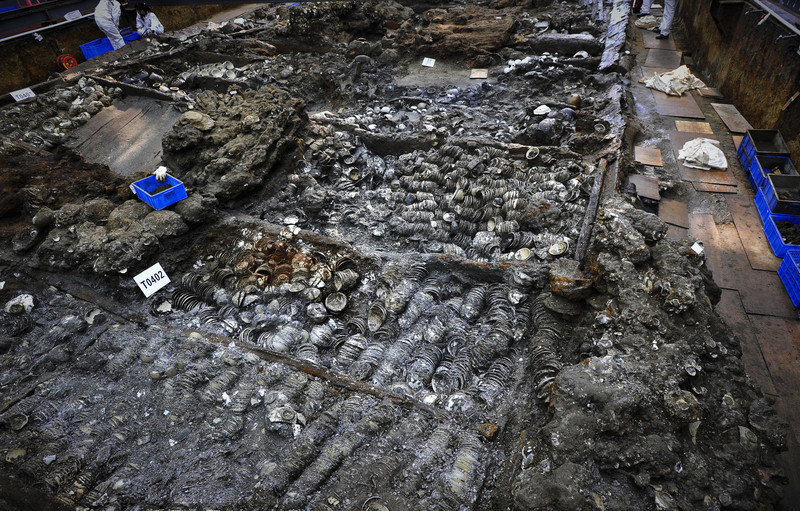
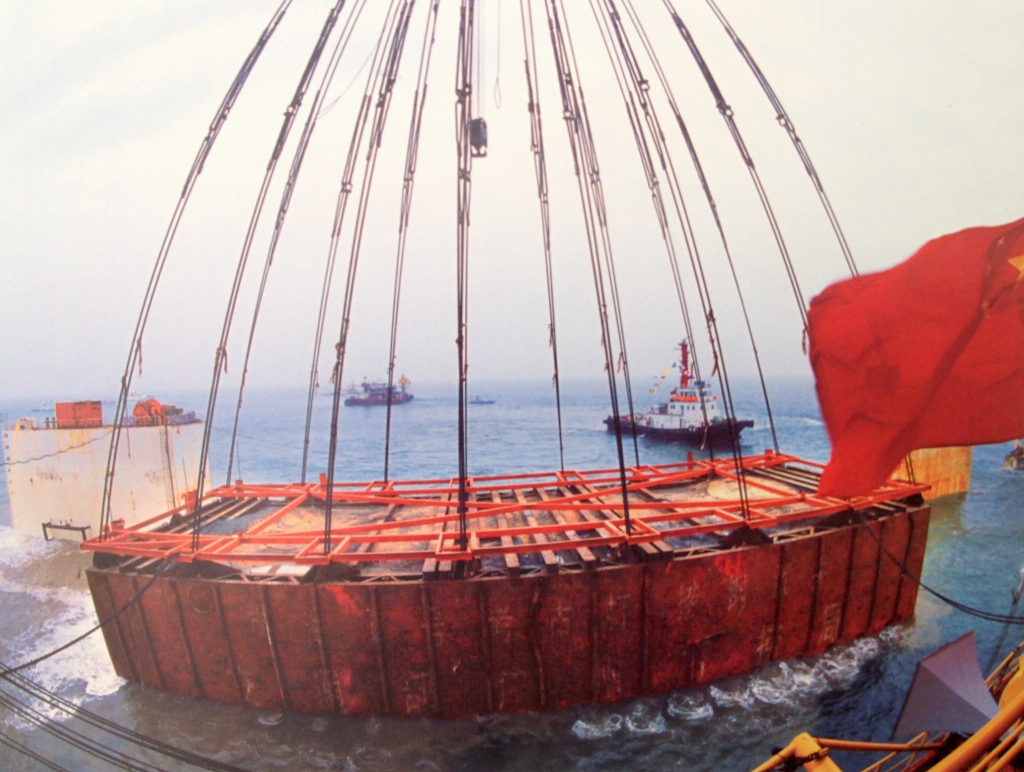
Nanhai1 excavation.
Nanhai1 excavation. Maritime Silk Road Museum of Guangdong and the Peoples Republic of China.

CIMSEC: What is your favorite past project and why?

Ward: Asking me to chose a favourite project would be like asking a mother to chose her favourite child! That said I have been fortunate enough to work on some incredible projects, with some incredible people. Present research excluded, here are a few of my favourites:

  • Excavation of the a settlement on Gask Ridge, Scotland’s Roman Frontier, with Drs Brigitta Hoffman and David Woolliscroft of the Roman Gask Project – the information gained from the dig changed our understanding of the history of Roman Scotland;
  • Excavation of King Henry VIII’s Tudor flagship the Mary Rose, when the sternpost and anchor was lifted;
  • remote sensing survey of the Late Bronze Age, early Iron Age settlement at High Past Cave, on the Isle of Skye;
  • Excavation of Kizilburun Roman Column Wreck on the Aegean Coast of Turkey with the Institute of Nautical Archaeology; and
  • Excavation of the Scottish settlement of the Isthmus of Panama, the failure of which lead to the Union of the Crown in 1707.

CIMSEC: The dispute over the South China Sea has seen some claimants use archaeological evidence to support their claims. Is there a danger of the discipline being politicized? Could this result in restrictions on archaeological work?

Ward: The South China Sea dispute is an interesting situation. China claims sovereignty over almost 90% of the South China Sea, and has done since ancient times. To an extent, this claim is made on the basis that way back in China’s first dynasty, the Xia (c. 2070 – c. 1600 BC), China was apparently the first state to discover, name, explore, and exploit the contested Spratly (Nansha) and Paracel (Xisha) Islands. This claim is based more on historical, rather than legal grounds, and China is looking to the past to create a future – to the Han ceramics found on Taiping Island, Nanhai 1 off Hainan 20 nm off Dongping, the 200 submerged prehistoric sites identified between the Spratly and Paracel Islands, and to early maps and documents which support historic Chinese ownership.

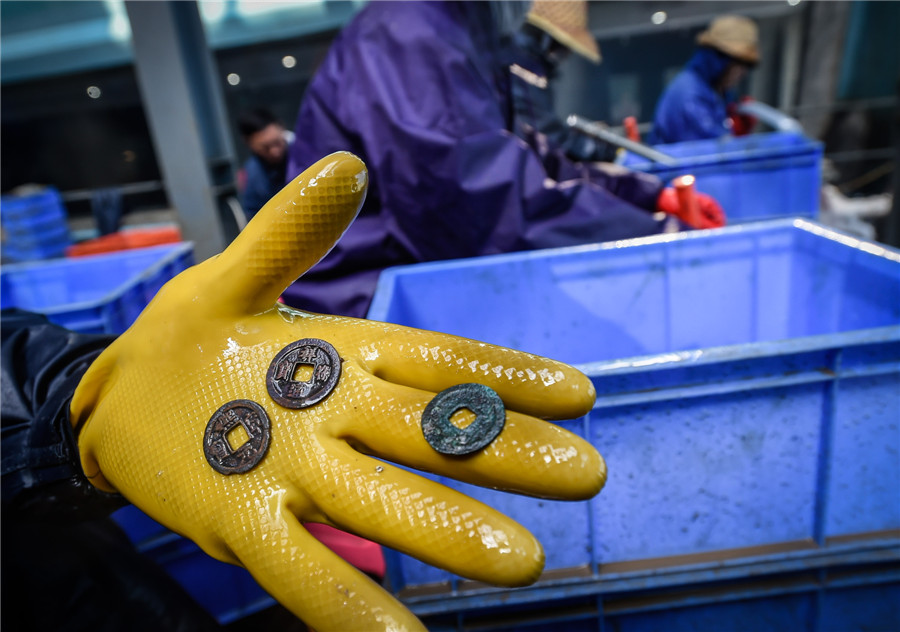
Coins from Nanhai 1.
Coins from Nanhai 1. Maritime Silk Road Museum of Guangdong and the Peoples Republic of China.

For China, this is a nation-building exercise. It’s also not the first time archaeology has been put to overt political use. In 1914, Leonard Woolley and Thomas (TE) Lawrence provided archaeological camouflage for a British military survey of the Turkish-controlled Sinai Peninsula. During World War I, Sylvanus Morley used his investigations of Mayan sites in the Yucatán as a cover to negotiate with rebel Mayan leaders for their support of U.S. interests.

Archaeology often reveals a contested space, a battleground for struggles over economic gain, heritage, and identity, and its practice often carries with it profound political implication. In China’s case, it can and has resulted in restrictions on archaeological work, such as when a French team working on a Chinese shipwreck off the Philippine coast was turned back by the Chinese on the basis of their sovereign claims.

CIMSEC: On the other hand, could international cooperation in maritime archaeology be part of confidence-building measures in disputed sea areas?

Ward: Absolutely. Confidence is the result of a dynamic process, based on past experiences, present perceptions, and future expectations, and affected by a multitude of elements. As confidence is especially sensitive to the behaviour of States, cooperation in maritime archaeology, which is a tenant of the UNESCO 2001 Convention, would be an excellent confidence-building measure.

China, Vietnam, Taiwan, Philippines, and Malaysia have a mutual, shared maritime heritage and our appreciation of the past determines how we shape our future. A shared heritage not only reminds us of our collective identity and cultural diversity, it also nurtures social belonging, promotes economies amongst local communities, and it deepens mutual understanding of each other’s values, histories, and traditions.

CIMSEC: Do you use unmanned submarines in your work? Do they offer the potential to radically transform our understanding of the maritime past?

Ward: Yes, quite often. In the past, for example, I’ve worked with the Australian Centre for Field Robotics at the University of Sydney to carry out a high-resolution shipwreck survey in deep water using Sirius, an autonomous underwater vehicle (AUV). The submersible is equipped with a full suite of oceanographic instruments, including a high-resolution stereo camera pair and strobes, a multibeam sonar, depth and conductivity/temperature sensors, Doppler Velocity Log (DVL) including a compass with integrated roll and pitch sensors, Ultra Short Baseline Acoustic Positioning System (USBL), and forward looking obstacle avoidance sonar. The result is effectively a 3D map of the shipwreck site to millimetric accuracy.

Nanhai-Shipwreck.
Nanhai-Shipwreck. Maritime Silk Road Museum of Guangdong and the Peoples Republic of China.

This technology allows us to locate, identify and survey submerged sites with greater accuracy than ever before, in smaller timeframes, in deep water and other environments not previously accessible to divers. The result is high quality, often real time data that can be used for interpretation, education, dissemination, and site monitoring in new and exciting ways.

CIMSEC: What is the best approach to protect sea graves? How to combine our thirst for knowledge about our past with the necessary respect for those who fell at sea?

Ward.- War graves at sea is a very sensitive issue, and one on which an international consensus has not been reached – in spite of the Geneva Conventions, their additional protocols, and international humanitarian law. The treatment of human remains in maritime museums was discussed at the ICMM in Hong Kong recently and there were as many opinions on what is appropriate, as there were people in the room.

The same diversity of opinion applies to war graves at sea. In the UK for example, the Protection of Military Remains Act 1986 protects human remains associated with the remains of military aircraft and vessels that have crashed, sunk or been stranded, from unauthorised interference. Australia on the other hand, has no such legislation.

Personally, I believe that the best approach is protection via the UNESCO Convention on the Protection of Underwater Cultural Heritage 2001. Underwater cultural heritage means all traces of human existence (including human remains) having a cultural, historical or archaeological character, which have been partially or totally under water, periodically or continuously, for at least 100 years.

The Convention sets out basic principles for the protection of underwater cultural heritage:

  • an obligation to preserve underwater cultural heritage;
  • in situ preservation as first option (note first, not best option; this allows for recovery in certain situations);
  • no commercial exploitation;
  • training and information sharing.

It also provides a detailed State cooperation system; widely recognized practical rules for the treatment and research of underwater cultural heritage; and for public access to sites up to the point where it becomes detrimental to the site.

With regard to war graves, first and foremost, the personal dignity of the deceased must be safeguarded, as must the relatives’ right to know the fate of their next of kin. Mechanisms must also be established for relatives to access the burial place and for their interest in recovering the dead to be registered.

Lifting items from Nanhai 1.
Lifting items from Nanhai 1. Maritime Silk Road Museum of Guangdong and the Peoples Republic of China.

CIMSEC: You have recently attended the International Congress of Maritime Museums (ICMM) in Hong Kong, could you tell us about the work of this organization? What were the highlights of the congress?

Ward.- ICMM was an absolutely fantastic event an one which I thoroughly enjoyed.

To give you some background, ICMM is a biennial congress attended by maritime archaeologists, maritime museum directors, and related maritime professionals from around the world. The aim of the congress is for delegates to network, share expertise and resources, and to learn about the international best practices in the capacity of maritime museum operations and management, and it certainly achieved that.

This was both the first ICMM in Asia and quite possibly the best conference I have ever attended. Our friends at the Hong Kong Maritime Museum really know how to put on a good show!

The two keynotes − Lincoln Paine, author of the acclaimed Sea and Civilization, and Fred Kenny, Director External and Legal Affairs at the IMO − were excellent. As were the presentations by my old friends and mentors, Fred Hocker, Director of Research at the Vasa Museum, and Christopher Dobbs, Head of Maritime Archaeology and Interpretation at the Mary Rose Museum. The excursions to The Peak, Tai O, Jao Tsung-I Academy, Hong Kong Museum of History, and Macau Maritime Museum were all enlightening, but for me the real treat was meeting new friends from China, and to hear about the incredible work being undertaken at both the China Maritime Museum and visiting the Nanhai 1 Song Dynasty shipwreck at the Maritime Silk Road Museum of Guandgong. Fascinating!

Sarah Ward is a maritime archaeologist, diver, and outreach specialist. She works for ArchaeoMar Australasia (a cultural heritage practice based in Sydney Australia) and is a regular blogger and tweeter.

Alex Calvo is a guest professor at Nagoya University (Japan) focusing on security and defence policy, international law, and military history in the Indian-Pacific Ocean. Region. A member of the Center for International Maritime Security (CIMSEC) and Taiwan’s South China Sea Think-Tank, he is currently writing a book about Asia’s role and contribution to the Allied victory in the Great War. He tweets @Alex__Calvo and his work can be found here..

[otw_shortcode_button href=”https://cimsec.org/buying-cimsec-war-bonds/18115″ size=”medium” icon_position=”right” shape=”round” color_class=”otw-blue”]Donate to CIMSEC![/otw_shortcode_button]