Category Archives: History

Naval and maritime history section.

Coming Soon: Information Dissemination’s Jon Solomon Crossposting Series

By Sally DeBoer

CIMSEC is just one of many voices in the discussion of international maritime security and naval affairs.  To enrich our content and expand our own horizons, we’ve developed content sharing relationships with similarly focused organizations.  Information Dissemination: The Intersection of Maritime Security and Strategic Communications consistently provides thought-provoking, meticulously researched, and deeply interesting analysis on naval affairs. On that note, CIMSEC is proud to announce an upcoming series featuring one of ID’s most prolific and interesting voices: Jon Solomon. 

In the coming months, CIMSEC will be crossposting selections from Jon’s portfolio, including his excellent three-part series 21st Century Maritime Operations Under Cyber-Electromagnetic Opposition, in which Jon deftly challenges conventional wisdom and popular understanding of Electronic Warfare (EW) and cyber-warfare as it relates to tomorrow’s conflicts.  In the series, Solomon explores the efficacy of judging a force network’s combat vitality by solely the number of nodes, the unique challenges of identifying and classifying potential targets, and considerations of network geometry/network degradation in times of combat.  Readers can look forward to enjoying Jon’s technical-but-understandable writing style and will likely come away with a broader, more nuanced understanding of the realm (and realities) of EW in modern conflict. This eye-opening series serves as an excellent primer for readers wishing to better grasp the possible practicalities of future high-end naval warfare.

Further, CIMSEC will also be re-publishing Jon’s engrossing series Deception and the Backfire Bomber: Re-examining the Late Cold War Struggle Between Soviet Maritime Reconnaissance and U.S. Navy Counter-targeting.  With a careful eye to detail and a reverent eye to history, Solomon discusses the most compelling aspects of the rarely-discussed (and still largely classified) relationship between U.S. EW assets and Soviet long-range maritime strike capabilities in the period between 1970 and the collapse of the Soviet Union in the early 1990s.  Jon evaluates the evolution of Soviet reconnaissance support for Backfire forces (from pathfinders to overhead) and the U.S. Navy’s counter-targeting efficacy.  Further, the series explores possible deception tactics that may have been used by Backfires and concurrent counter-deception measures.  Current Russian strategies being what they are, Solomon’s analysis seems especially timely and relevant.

In addition to the above series, CIMSEC will include additional re-publications of Solomon’s other exemplary work.  We hope you, the readers, are as excited as we are for this timely, intriguing new series. Look for the ID’s Jon Solomon series in your inbox and featuring on the homepage in the coming weeks.

Sally DeBoer is an Associate Editor and the Book and Publication Review Coordinator for CIMSEC.  She can be reached at sally.l.deboer(at)gmail(dot)com.

Naval Cryptology and the Cuban Missile Crisis

The following article series appeared on Station Hypo and is republished with permission.  

By David T. Spalding

The Vindication of Right: Battlespace Awareness in the Cuban Missile Crisis
1

“Our goal is not the victory of might but the vindication of right-not peace at the expense of freedom, but both peace and freedom, here in this Hemisphere and, we hope, around the world. God willing, that goal will be achieved.” — JFK

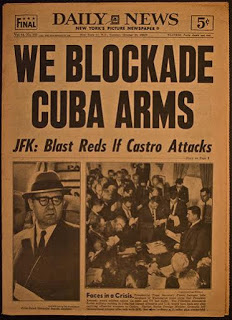
Such was the goal of President John F. Kennedy in the Cuban Missile Crisis on the eve of October 22, 1962 – “the vindication of right”.  In the preceding months and years, signals intelligence — provided in large part by cryptologists of the Naval Security Group — revealed that the Soviet Union had been building up troops, aircraft, and air defense and missile sites in Cuba under the guise of self-defense.  When intelligence indicated that the buildup was more than just defensive in nature, JFK put the Soviet Union on notice in front of a watching world.

On the brink of thermonuclear war, the President of the United States initiated a quarantine in the waters off of Cuba to intercept, search, and turn back USSR cargo vessels destined for Cuban ports.  Russia responded with rhetoric of open defiance.  The days that followed would prove that their bark was bigger than their bite.  As early as October 23rd, U.S. Navy listening posts and direction finding stations along the Atlantic periphery collected on, and geo-located, Soviet ship-ship and ship-shore communications, indicating that the Soviet vessels had stopped or reversed course prior to reaching the ring of surface ships forming the blockade.  Communications intelligence collected by naval cryptologists also provided insight into Soviet and Cuban commanders’ intentions, force alert posture and levels, and previously unidentified Soviet submarine activity.  Though tensions would remain high for some time, the potential for total war between the world’s two superpowers had been averted.

Fifty years ago, the short narrative above would have said nothing of the role of signals intelligence.  Today, we know more.  In 1998, 35 years after the crisis, the National Security Agency declassified many documents and reports that revealed the critical role that naval cryptology played not only in defusing the crisis, but in providing Battlespace Awareness to decision makers as early as 1960 and continuing on through the end of the crisis.

Fast-forward to present day — the Navy’s Strategy for Achieving Information Dominance 2013-2017 lists Battlespace Awareness as one of its three fundamental capabilities along with Assured Command and Control and Integrated Fires.  As described in the strategy, Battlespace Awareness “is the traditional mission of the Information Dominance Corps and the constituent components of meteorology, oceanography, intelligence, cryptology, communications, networks, space, and electronic warfare.” 

Though the Cold War would continue for nearly three more decades — Battlespace Awareness — providing commanders with persistent surveillance of the adversary’s activities, penetrating knowledge of the USSR’s capabilities and intentions, and expertise within the electromagnetic spectrum enabled those very commanders to make informed decisions ensuring that the war did not progress from cold to hot.

*In the pages below, are short vignettes and historical documents related to the signals intelligence and cryptologic efforts which provided Commanders with time-critical Battlespace Awareness — contributing significantly to the de-escalation of one of the potentially most dangerous stand-offs in history.

Thirteen Days? The Naval Security Group in the Cuban Missile Crisis
1

History has recorded the Cuban Missile Crisis as having occurred October 16, 1962 – October 28, 1962:  a total of thirteen days.  October 16th being the day after photographic intelligence confirmed the existence of Soviet medium-range ballistic missiles in Cuba and October 28th being the day Khrushchev directed the dismantling, and return, of offensive weapons in Cuba.   In reality, the story began long before October 1962.

Two years earlier in September 1960, communications intelligence, collected by the National Security Agency along with its three Service Cryptologic Agencies – to include the Naval Security Group, provided the first indications that Soviet arms were being transported to Cuba via multiple cargo ships.   Similar reports revealed high-level visits from a Soviet arms export chief to Havana as well as the purchase of Soviet helicopters by Cuba.

In 1961, persistent surveillance would further confirm suspicions of a significant Soviet military buildup in Cuba.  In February, signals intelligence indicated Cuban pilots were training in Czechoslovakia; in May, communications intelligence revealed Cuban air force personnel were learning Russian; in June, radars were being installed for possible use with artillery units…all the while Soviet cargo ships continued to dock in Cuban ports and unload their cargo under the cover of night. 

Continued collection efforts by the Naval Security Group, et. al., in 1962 would paint an even clearer picture of Soviet capability and intent in Cuba.  Of particular note were successes in the area of electronic intelligence.  In May of 1962, electronic intelligence provided the first evidence of the use of SCAN ODD, a Soviet airborne intercept radar associated with MiG-17 and MiG-19 aircraft, in Cuba.  Later in the year, electronic intelligence would provide another key development.  According to the Center for Cryptologic History’s NSA and the Cuban Missile Crisis:  “Human sources and photography could spot SA-2s, but signals intelligence would provide the first indicator of their operational status… NSA reported the first operation of a SPOON REST radar, associated with the SA-2.  The SA-2 was operational and could shoot down a U-2.  Subsequent overflights would be at risk.”  The Department of Defense was not going to sit idly by while Khrushchev continued to increase his footprint in the western hemisphere.  

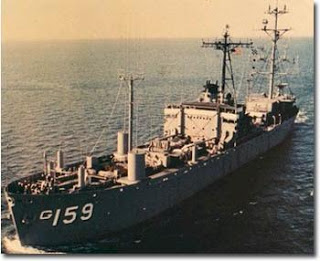
On 16 July 1962, the Secretary of Defense, Robert McNamara, directed an increase in the signals intelligence program to combat the Cuban problem.  Three days later, in a Memorandum for the Secretary of the Navy, the Naval Security Group (OP-94G) was specifically directed to “realign its resources to provide greater coverage of Cuba in response to highest priority intelligence requirements.” 

The memorandum recognized that such realignment would have some degree of impact on naval intelligence collection and acknowledged that loss would occur in other collection efforts.  To try to mitigate this deficit, the Naval Security Group would coordinate with DIRNSA in utilizing personnel from her sister agencies — the Air Force Security Agency and the Army Security Agency – to man her stations.  The memorandum also discussed several other measures by which the Naval Security Group would meet the SECDEF’s requirements:

(1) Provide an additional 20 officers and men to two undisclosed locations.

(2) Extend the interim shipborne intercept capability (USS Oxford) through approximately Dec 1962.

(3) Arrange directly with Commander, Military Sea Transportation Service (MSTS) — now known as Military Sealift Command (MSC) — for an MSTS ship to relieve USS Oxford to continue the SIGINT effort off Havana no later than 1 Dec 1962.

What most label as a crisis is more accurately described as a persistent effort against a formidable adversary over the course of two years.  Such was the experience of the cryptologists of the Naval Security Group.  Their round-the-clock efforts helped to ensure that the crisis was not unnecessarily prolonged beyond what most remember as thirteen days. 

USS Oxford: The Largest Producer of SIGINT in the Cuban Missile Crisis
1

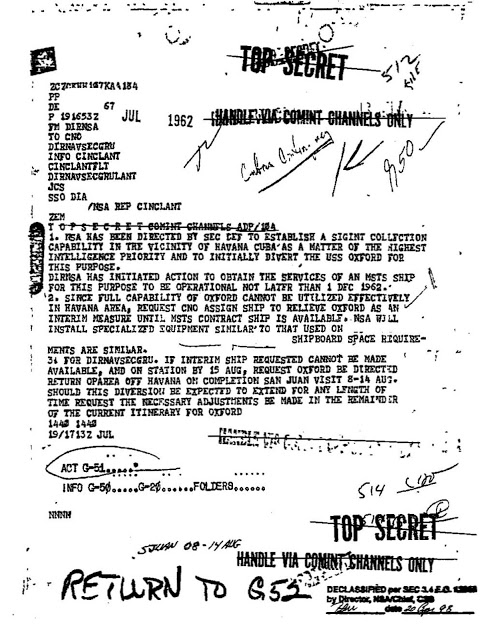
The USS Oxford (AG 159) was originally commissioned a Miscellaneous Auxiliary ship in July 1961 in New York.  She was immediately outfitted to participate in the National Security Agency’s Technical Research Ship (TRS) program — though she would not be redesignated an Auxiliary Technical Research Ship (AGTR-1) until years later in 1964. 

The Center for Cryptologic History’s Almanac 50th Anniversary Series article, “The TRS Program Part I:  The Beginning,” describes perfectly the Oxford’s significant contribution to the Cuban Missile Crisis.

The Oxford was officially known as a Technical Research Ship.  Its initial mission was a training cruise.  This gave the crew a chance to familiarize themselves with equipment on board and to identify any problems with the newly refurbished, redesigned ship before traveling to the Middle East.  Although several features were identified that required change or improvement, overall the test proved to be a great success.  For example, the Oxford recorded frequencies and collected a large number of other transmissions.  As the capabilities of the Oxford became clear, the list of potential targets for these ships quickly expanded to include countries all over the globe.

In August 1962, as relations between the United States and the Soviet Union over Cuba grew increasingly tense, the Oxford was diverted to the Caribbean.  Its mission was to collect the communications coming out of Cuba, used by both Soviet and Cuban entities.  The Oxford proved to be the largest producer of SIGINT during the Cuban Missile Crisis [emphasis added].  The communications it collected provided a great quantity of information which, when combined with the photographs from the U2 overflights, provided a very good picture of what was happening in Cuba.

USS Oxford’s success in the Cuban Missile Crisis “demonstrated the value of the TRS program” and paved the way for naval cryptology aboard future Technical Research Ships:  Georgetown, Jamestown, Muller, Belmont, and Liberty.

Find and Fix: Direction Finding in the Cuban Missile Crisis
1

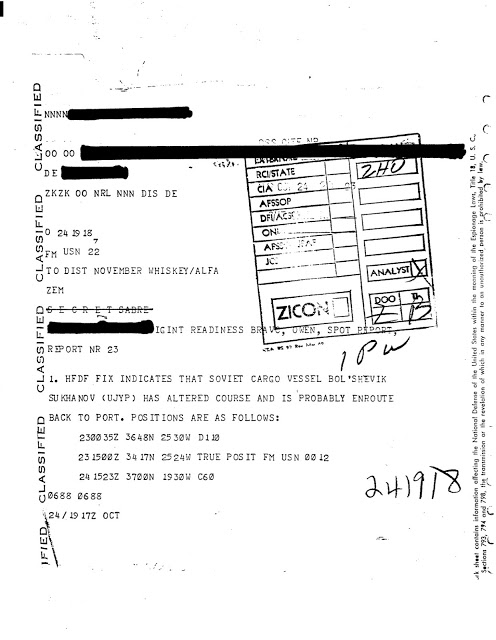
The high frequency direction finding (HFDF) fix in the above message was one of many prosecuted by dozens of U.S. Navy, British, and Canadian direction finding stations in the Atlantic periphery on the days following the President’s initiation of a naval blockade.  Matthew M. Aid, in his book, The Secret Sentry, writes:

“The two dozen or so U.S. Navy, British, and Canadian direction-finding stations ringing the Atlantic continuously monitored every radio transmission going to or from the twenty-two Soviet merchant ships approaching the Cuban quarantine line, in order to track the movements of the Russian ships…  The U.S. Navy’s direction-finding stations began reporting to NSA that their tracking data indicated that some of the Russian merchant ships had stopped dead in the water, and that it seemed that at least eight of the ships had reversed course and were headed back toward Russia.”

The value in such collection is not in the finding and fixing of the ships’ positions alone, but rather in the ability ofsuch information to indicate that the ships had either stopped or reversed course.  That is actionable intelligence.

Such knowledge affords key leadership the time and the ability to make informed decisions.  The message above, combined with many others like it, painted a clear picture of the Soviet’s intentions to not challenge the blockade in full force.

Such is one of the primary roles of a naval cryptologist — to find and fix the adversary.  The fix part of this equation is primarily accomplished via direction finding.  As demonstrated, direction finding provides specific actionable intelligence to warfighters on the ground, in the air, at sea, and on our networks.  It contributes directly to providing Battlespace Awareness to the operational commander.  Battlespace Awareness is, amongst other things, an understanding of when, where, and how our adversary operates.  This understanding, combined with persistent surveillance, penetrating knowledge, and expertise within the electromagnetic spectrum provides the commander with time and “the target acquisition and targeting solutions necessary to apply force, both kinetic and non-kinetic.”

17 November 1962: A Letter of Commendation and Thanks
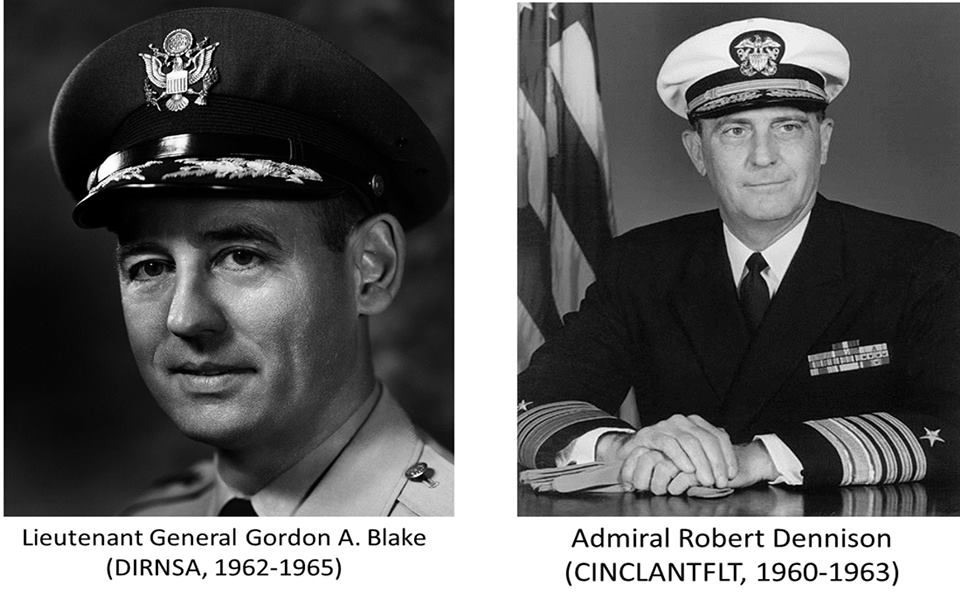
Blake and Dennison

The following is an excerpt from a previously classified letter written by Admiral Robert Dennison (CINCLANTFLT, 1960-1963) to Lieutenant General Gordon A. Blake (DIRNSA, 1962-1965) on 17 November 1962 regarding the contribution of SIGINT during the Cuban Missile Crisis.

“I should like to take this opportunity to mention the very significant contribution which SIGINT in general – and the National Security Agency in particular – have made toward support of Atlantic Command.  The unique and vital intelligence made available as a result of the national SIGINT effort frequently finds its end use and final justification at the level of the Unified Commander.  In the present situation SIGINT has been one of the most important single factors in supporting our operations and improving our readiness.  Your fine support is much appreciated.” 

DIRNSA responded:  “While you mentioned NSA in particular…the Naval Security Group…deserve[s] a lion’s share of the credit for their work in the fields of collection and direct processing to our customers.  I have taken the liberty of passing on your kind remarks to both NSA personnel and the Service Cryptologic Agencies as kindred elements of our SIGINT team.”

*The letter can be read in full here.

V/r

David

LCDR David T. Spalding is a former Cryptologic Technician Interpretive.  He was commissioned in 2004 as a Special Duty Officer Cryptology (Information Warfare/1810) and currently serves as the Officer in Charge of Navy Information Operations Detachment Kaneohe Bay, Hawaii.

Sources:

https://www.nsa.gov/public_info/_files/crypto_almanac_50th/The_TRS_Program_Part_I.pdf

http://www.public.navy.mil/fcc-c10f/Strategies/Navy_Strategy_for_Achieving_Information_Dominance.pdf

The Secret Sentry:  The Untold Story of the National Security Agency, Matthew M. Aid (pp. 74-77)

https://www.nsa.gov/public_info/_files/cuban_missile_crisis/11_december_cover_letter.pdf

Four Carrier Crises, but yet No Funeral for the Large Flattop

By Steven Wills

The arguments deployed in the latest debate over the aircraft carrier’s place in the U.S. Navy’s force structure have a familiar ring. That is perhaps because they have been very similar criticisms in every carrier debate going back to the 1920’s. While every weapon system undergoes re-evaluation and criticism over its service life, the large aircraft carrier has been the subject of four significant debates in the 20th and 21st century. Each has involved questions of the large carrier’s cost relative to the capability it delivers; the range of the carrier’s embarked air wing; and the vulnerability of the carrier itself to threats. In each case, the carrier and its embarked air wing have proved reliable, cost effective ordnance delivery systems in comparison with other naval weapon systems. The carrier’s air wing has at times been deficient in range and/or combat capability, but has upgraded to meet threats. The carrier has always been a very vulnerable type of warship due to the nature of its mission. Decision-makers have repeatedly accepted this vulnerability as an acceptable price for the capabilities the large deck flattop delivers. The present carrier debate has all of these same components, and while not all solutions to the present round of carrier criticisms are not in place, they are in sight and can be achieved. The aircraft carrier replaced the battleship as the principal capital ship of the world’s navies because, “It was far more capable than the battleship of inflicting damage on the enemy.”[1] Some other naval weapon system will eventually replace the aircraft carrier, but that platform and payload combination has yet to manifest its presence on, above or beneath the world’s oceans.

[otw_shortcode_button href=”https://cimsec.org/buying-cimsec-war-bonds/18115″ size=”medium” icon_position=”right” shape=”round” color_class=”otw-blue”]Donate to CIMSEC![/otw_shortcode_button]

The first U.S. carrier controversy dates to the decades of the 1920’s and 1930’s when the carrier first entered the world’s navies in its present recognizable form and in numbers beyond mere experiment. The main concern was that the carrier’s air wing was too weak and short-ranged to prevent an attack by a powerful surface force. A force of battleships and cruisers might travel a distance longer than the range of the carrier’s aircraft under the cover of darkness when carrier aircraft could not then operate.

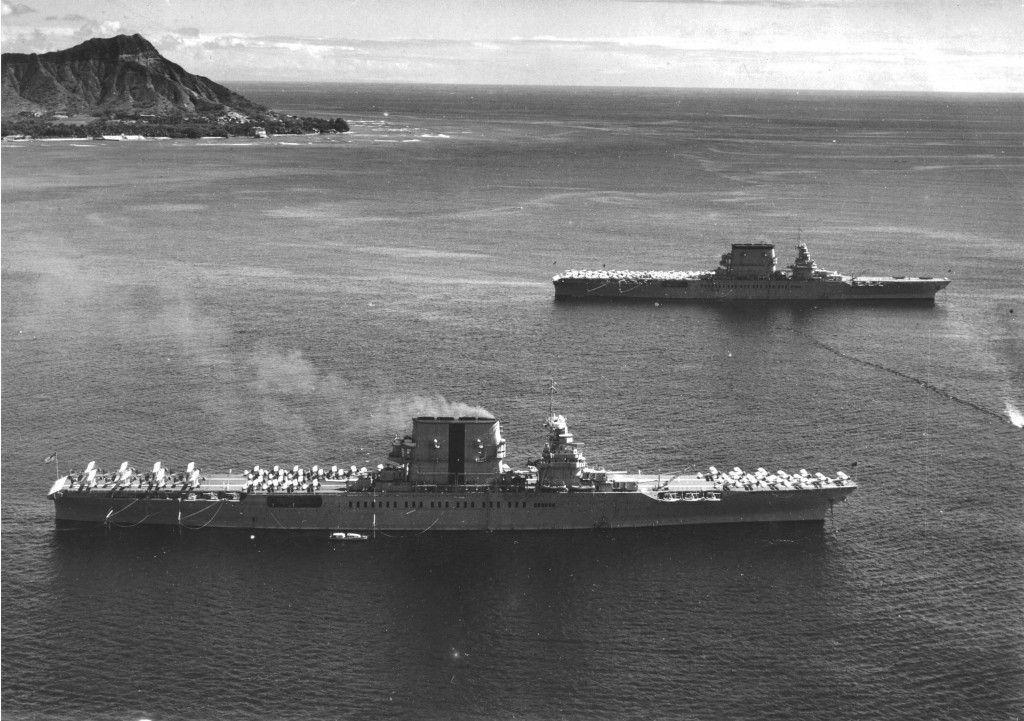
There were also concerns that the first two significant carriers, USS Lexington (CV 2), and USS Saratoga (CV 3), were too large, too expensive (at $45 million dollars a unit without aircraft), and placed too much of the fleet’s air strength in too few platforms. The concept of a hybrid “flying deck cruiser” with cruiser size guns and an airwing optimized for scouting was proposed as an augment to the carrier fleet to counter these concerns.[2]

CV-2 Lexington and CV-3 Saratoga.

These concerns, however, evaporated with technological advances. The range of carrier aircraft increased over the 1930’s and that change eliminated the threat from surface forces approaching in hours of darkness. New U.S. carriers of the Yorktown class were much less expensive at $19 million a copy, but still supported air wings in size and capability approaching the larger, previous Lexington class. House Naval Affairs Committee Chairman Carl Vinson confirmed the carrier as the fleet’s new capital ship even before Pearl Harbor in the signing statement of the $8.5 billion dollar Two Ocean Navy Act of July 1940. He stated, “The modern development of aircraft has demonstrated conclusively that the backbone of the Navy today is the aircraft carrier. The carrier, with destroyers, cruisers and submarines grouped around it is the spearhead of all modern naval task forces.”[3]

The second carrier controversy began in the immediate aftermath of the carrier’s greatest triumph. The end of the Second World War and with it the navies of the fascist powers caused many to question the need for carrier aviation in what appeared to be a new age of predominately atomic warfare. Notable Army Air Corps (now Air Force) and Army officers dismissed the aircraft carrier as unnecessary in an age of intercontinental aircraft like the B-36 bomber. Army Chief of Staff General Omar Bradley dismissed the “super” (large) carrier as the Navy’s tool to employ long-range bombers, a role already covered by the Air Force.[4] Air Force Chief of Staff General Hoyt Vandenberg said the carrier was of “low military value” and that “land based air power was of far greater military usefulness.”[5] Defense Secretary Louis Johnson, with the strong support of President Harry Truman, cancelled the first postwar “supercarrier” in May 1949 based largely on these Army and Air Force opinions. Attempts by Navy Department civilians to discredit the B-36 before Congressional hearings further damaged the Navy’s case for the aircraft carrier in the emerging Cold War.

The carrier survived its second controversy thanks to the Korean War.  The conflict on the Korean peninsula demanded close air support for ground troops desperately in need of firepower to drive back larger North Korean formations. This was a mission that the Air Force had generally ignored and allowed to degrade in the aftermath of World War 2. The Navy was used to providing air support to Marine units from aircraft carriers and quickly demonstrated its ability to step up for post-World War 2 “small wars.” Naval strikes from carriers were crucial in repelling the initial North Korean attack and carrier-based Navy and Marine Corps aviators eventually flew 41% of all air combat missions in the Korean War.[6] The carrier would go on to similar strike missions in the Vietnam War and in other U.S. power projection efforts. Even President Truman came around to the carrier’s combat potential and endorsed the Forrestal class super carriers with the first commissioning in 1954.[7]

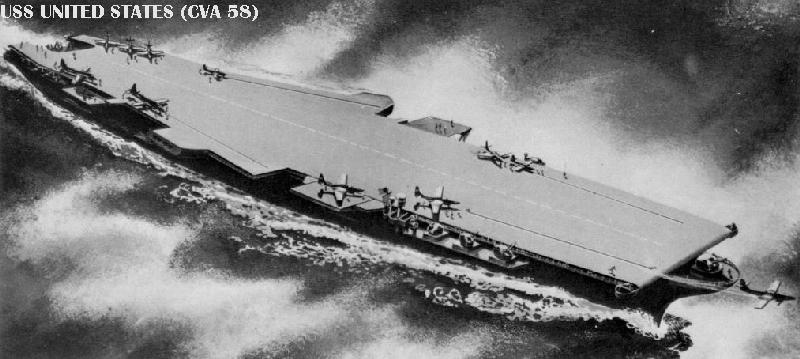
A drawing of CVA 58 the proposed USS United States which was later cancelled.
A depiction of the proposed CVA 58, USS United States, which was later cancelled.

The most recent carrier controversy had its roots in post-Vietnam war budget cuts and a misunderstanding of the operational design for the emerging Soviet Navy of the early 1970’s. The projected $2 billion dollar price tag of the fifth nuclear-powered carrier (the eventual USS Theodore Roosevelt) made the Carter administration reluctant to authorize such an expensive vessel.[8] The Congressional Budget Office produced documents suggesting that the carrier was not “survivable” in a modern battle, which further suggested that a $2 billion dollar price tag for a failed weapon system was the wrong choice.[9] Finally, NATO advocates in the Carter administration such as Robert Komer wanted the U.S. for focus the bulk of its defense expenditures on the defense of the Fulda gap against the possibility of Soviet invasion. The Navy’s chief task in this mission was sea control and protection of the vital supply lines between North America and Europe. Komer believed large carrier battle groups were unneeded for this mission and the large outlays required for their construction were better spent on land warfare equipment.[10] Some former officers including former USS Nimitz commander Admiral Eugene Carroll, and CIA director and naval strategist Admiral Stansfield Turner joined the chorus of carrier doubters. Politicians such as Colorado Senator Gary Hart, who in his book America Can Win and in other writings proclaimed, “like the battleship the carrier replaced, its magnificence cannot nullify basic changes in the nature of war at sea.”

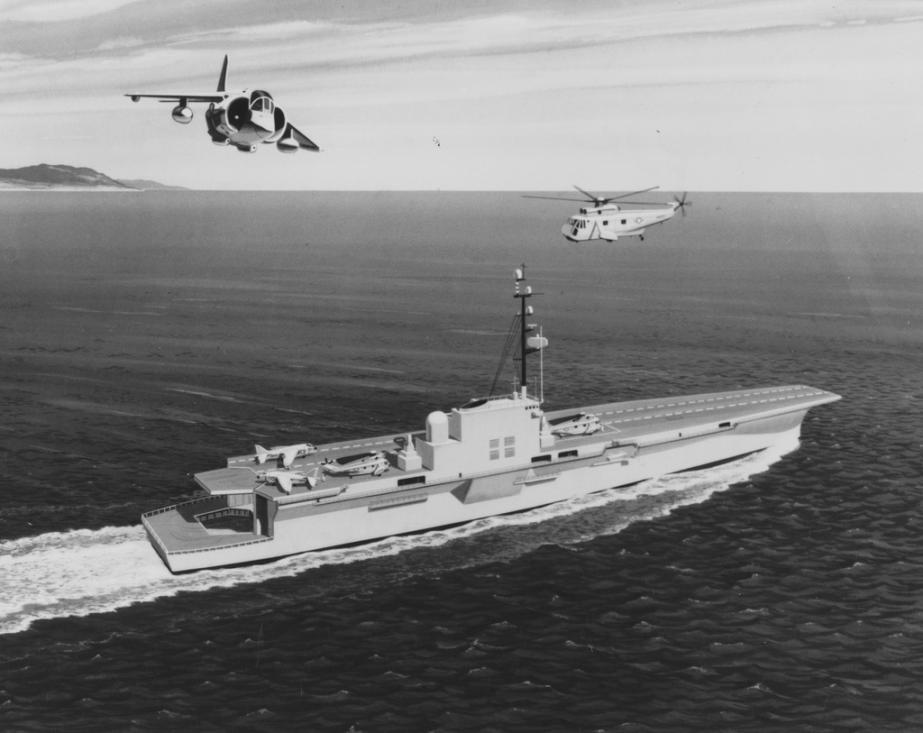
Ironically, this carrier controversy disappeared more rapidly than the previous two. Significant analysis from disparate sources appeared in defense of the large flattop and its capabilities. Future Chief of Naval Operations Admiral Carlisle Trost in conjunction with the CNA Corporation produced the 1978 Sea Based Air Platform Study at the behest of Congressional Committees, “at loggerheads over whether the next carrier would have a nuclear or conventional power plant.”[11] Large nuclear and  smaller conventional carriers designed to operate vertical take off and landing (VSTOL) aircraft were studied. While all three types of carrier had positive attributes identified by the study, the 30 year life cycle cost of the nuclear carrier was only slightly more than that of its conventional equal. Both carried significantly more aircraft than the smaller VSTOL ship. Based on this, according to naval tactics expert (then executive assistant to Under Secretary of the Navy James Woolsey), Captain Wayne Hughes, “With total ownership costs so close, it was reasonable to let the Navy’s preference be decisive. The next year Congress authorized a CVN!”[12]

sea control ship
The proposed Sea Control Ship (SCS) which was later cancelled.

John Lehman’s 1978 Aircraft Carriers, The Real Choices came to similar conclusions. Lehman examined seven basic points concerning sea-based aviation including: (1) what should sea-based aviation do?; (2) what can land-based air do better?; (3) how vulnerable are carriers?; (4) how many carriers are needed and what do they cost?; (5) how essential is nuclear propulsion for carriers?; (6) what are the practical options for size of future carriers?; and (7) how will VSTOL technologies affect future air power at sea? [13] Lehman found that sea-based aviation was a useful companion to its land based equivalent in that carrier aviation allowed the US greater geographic freedom to strike targets out of range of land-based air. Larger carriers were less vulnerable (historically) than their smaller cousins. The examples of large carriers surviving significant accidents (USS Forrestal and USS Enterprise) was important to this determination. Enterprise survived the equivalent of six Soviet SSN-3 cruise missile hits but resumed flight operations several hours later.[14]

Lehman was also an analyst who contributed to the Sea Plan 2000 analysis that first recommended 15 aircraft carriers as the minimum number needed by the US for both peacetime presence and minimal wartime operations against the Soviet Union. His suggestion for carrier strength of 13-17 carriers as the right number was in keeping with the general Navy assumptions of the time. Lehman, like the analysts who completed the Sea-Based Air Platform study found that nuclear carrier costs over the lifespan of the ship were within 2.5% to 3% those of a large conventional carrier and worth the Navy’s investment.[15] Lehman’s analysis determined a number of significant problems associated with small carriers. Accident rates were significant in smaller ships. Over a 10 year period the smaller Midway class carrier suffered 10% greater flight deck accidents than did the larger flattops.[16] Larger carriers with 4 catapults could also put more aircraft in the air at a faster rate; a capability crucial to defense of the flattop against surprise air attack. Lehman also suggested that VSTOL aircraft held little promise of further advance and while many could be carried on a smaller aircraft carrier, their utility in high end warfare was limited.

Finally, naval intelligence efforts in the late 1970’s and early 1980’s determined that the Soviet Navy likely had no plans to significantly interdict NATO convoys to Europe in the event of a major war. U.S. taps on Soviet naval communications pods revealed that the Soviets most important fleet mission was defense of their ballistic missile submarines based in “bastions” within the Barents Sea. This intelligence confirmed what analysts like Robert Herrick and CNA’s James McConnell had said throughout the 1970’s; that the Soviet’s had a generally defensive naval strategy.[17] This revelation gave further support to the idea that an offensive naval strategy was the best choice for naval conflict with the USSR. An offensive war concept was better suited to large carrier operations than the small flattops conceived to fight antisubmarine and anti-surface battles in defense of NATO resupply convoys. Together the analysis and intelligence work of the late 1970’s and early 1980’s effectively ended the third carrier crisis of the 20th century.

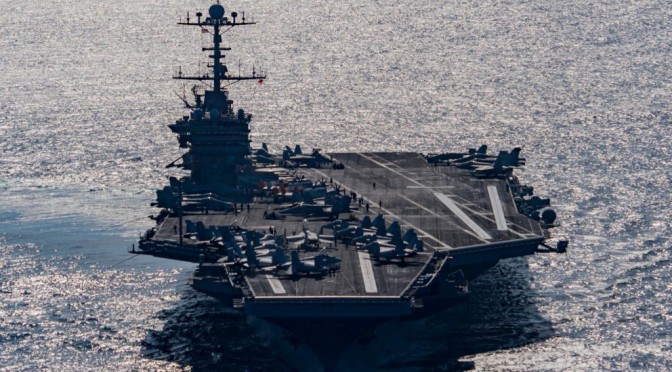
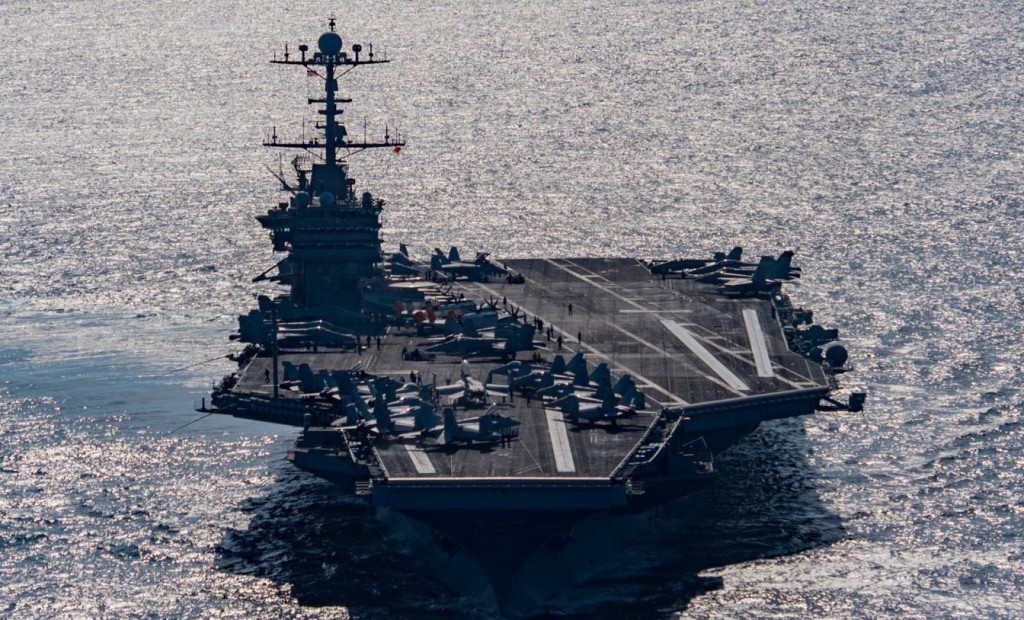
USS Harry Truman.
USS Harry Truman.

The present carrier “crisis” contains many elements of these past examples. As in the 1920’s, the current carrier air wing is too small and lacks the range necessary to effectively strike opponents without facing a significant response. Many assumptions in the wake of the First Gulf War of 1991 suggested that future conflicts would be joint and combined air/ground task force operations against rouge states and non-state actors around the Eurasian littoral. Land-based air support would always be nearby and plentiful. These assumptions, however, should be discarded in a new age where peer competitors and non-state actors exist side by side and carrier-based aviation may be the only component in the air component commander’s arsenal.

The budget is again tight as it was after the Second World War and in the late 1970’s. The nation cannot sustain another military buildup funded on debt and no miracle growth in the economy appears certain on the horizon. The other services will fight with equal vigor to keep their own assets and popular social spending programs are hard to curtail, let alone eliminate. The Navy will need creative ways to get more out of the carriers it has. The carrier force must be re-balanced with some regions getting more than others dependent on the availability of land-based aviation. Some carriers could be placed in reserve status in order to ensure that those that remain are fully capable of high-end warfare against peer competitors.

The range and strike capability of current carrier-based aircraft is substantially diminished in comparison with its late Cold War incarnation. Today’s carrier air wing boasts 62 aircraft as compared with the 80-90 aircraft wing of the Cold War.[18] The carrier air wing will need to be increased with longer range, manned or unmanned aircraft to return it to the capability of the late 1980’s/early 1990’s.

Despite these problems, no one weapon system appears poised to relieve the carrier as the primary U.S. naval offensive component. A mass of missile-shooting ships and submarines is required to achieve the same level of consistent ordnance delivery provided by a large carrier. Surface ship missile shooters may be affected by adverse weather conditions. An increase in the percentage of U.S. strike capability concentrated in submarines could result in equally rapid opponent advances in antisubmarine warfare. It is very difficult to retain technological advantages given the global diffusion of knowledge enabled by the information age. Future naval victories are more likely to depend on superior operational and tactical employment of existing platforms and payloads rather than technological superiority.

The carrier remains a flexible, re-configurable platform with significant potential going into the 21st century. The U.S. may have to reduce the overall number of large carriers it actively employs and tailor that presence to specific geographic areas where carrier-based airpower is an advantage. There has not yet been an active demonstration of a superior strike platform/system as there was in the war games of the 1920’s and 1930’s. The large U.S. aircraft carrier will likely survive this fourth challenge to its place atop the naval hierarchy, but it must increase the range and capability of its attendant air wing to achieve this goal.

Steve Wills is a retired surface warfare officer and a PhD student in military history at Ohio University. His focus areas are modern U.S. naval and military reorganization efforts and British naval strategy and policy from 1889-1941. 

[otw_shortcode_button href=”https://cimsec.org/buying-cimsec-war-bonds/18115″ size=”medium” icon_position=”right” shape=”round” color_class=”otw-blue”]Donate to CIMSEC![/otw_shortcode_button]

[1] David K. Brown, Nelson to Vanguard, Warship Design and Development, 1923-1945, Annapolis, Md, Naval Institute Press, 2000, p. 39.

[2] John Kuehn, Agents of Innovation, The General Board and the Design of the Fleet that Defeated the Japanese Navy, Annapolis, Md, The Naval Institute Press, 2008, pp. 102, 103.

[3] 8 1/2 BILLION IS VOTED FOR 1,500 WARSHIPS; House Passes Bill for Great Carrier Force and Escorts, With Battleships Left Out, New York Times, June 18, 1942. 

[4] Jeffrey Barlow, From Hot War to Cold, The U.S. Navy and National Security Affairs, 1945-1954, Standford, CA, Stanford University Press, 2009, p. 212.

[5] Ibid.

[6] George W. Baer, One Hundred Years of Seapower, Stanford, CA, Stanford University press, 1994, p. 328.

[7] Paul B. Ryan, First Line of Defense, The U.S. Navy Since 1945, Stanford, CA, The Hoover Institute Press, 1981, p. 14.

[8] Ryan, p. 104.

[9] Congressional Budget Office, The U.S. Sea Control Mission: Forces, Capabilities, and Requirements, June 1977. 

[10] Frank Leith Jones, Blowtorch, Robert Komer, Vietnam and American Cold War Strategy, Annapolis, Md, Naval Institute Press, 2013, pp. 251, 252.

[11] Wayne P. Hughes, Jr., (2002) Navy Operations Research. Operations Research. p. 7.

[12] Ibid.

[13] John F. Lehman, Aircraft Carriers, The Real Choices, Washington D.C., Center for International and Strategic Studies, Georgetown University, 1978, p. 11.

[14] Ibid, p. 41.

[15] Ibid, p. 52.

[16] Ibid, p. 57.

[17] Christopher Ford and David Rosenberg, The Admiral’s Advantage, U.S. Navy Operational Intelligence in World War 2 and the Cold War, Annapolis, MD, Naval Institute Press, 2005, p. 79.

[18] Jerry Hendrix. “The Future of the Aircraft Carrier looks Dim,” War on the Rocks, October 21, 2015. 

Communist China’s Approach to Force: 1962 Lessons for the Senkaku Islands?

By Alex Calvo

Given the continued tensions in the East and South China Seas, and the constant speculation on whether Beijing may choose to escalate, it can be useful to have a look at how the PRC has traditionally resorted to force, and in particular the 1962 Sino-Indian War.

[otw_shortcode_button href=”https://cimsec.org/buying-cimsec-war-bonds/18115″ size=”medium” icon_position=”right” shape=”round” color_class=”otw-blue”]Donate to CIMSEC![/otw_shortcode_button]

Professor Brahma Chellaney wrote an interesting summary of Communist China’s approach to war, based on that conflict, which saw the Chinese Army penetrate deeply into India for 32 days, after which “Beijing announced a unilateral ceasefire, and the war ended as abruptly as it had begun. Ten days later, the Chinese began withdrawing from the areas they had penetrated on India’s eastern flank, between Bhutan and Burma, but they kept their territorial gains in the West—part of the original princely state of Jammu and Kashmir. India had suffered a humiliating rout, and China’s international stature had grown substantially”. The six principles displayed were:

  • Surprise. As already advised by Sun Tzu, who wrote that all warfare was “based on deception”.

  • Concentration, “hitting as fast and as hard as possible”.

  • First Strike.

  • Waiting, and choosing the right moment.

  • Camouflaging offence as defence, engaging in “defensive counterattacks”.

  • Daring. A tendency to gamble and take risks.

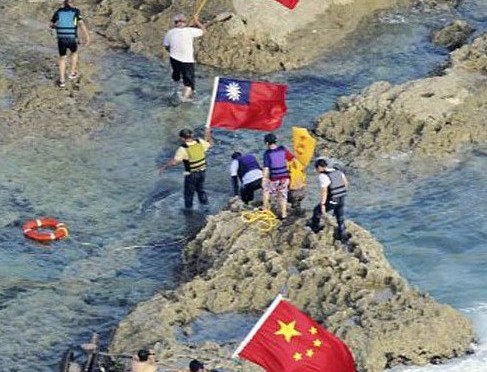
When it comes to the Senkaku Islands, a question is whether these principles may be employed, in the form of an airborne or seaborne landing of troops or a mixed force of military personnel and “activists”, bypassing the Coastguard units shielding them and taking advantage of the lack of land forces.

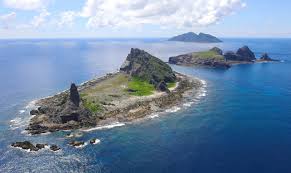
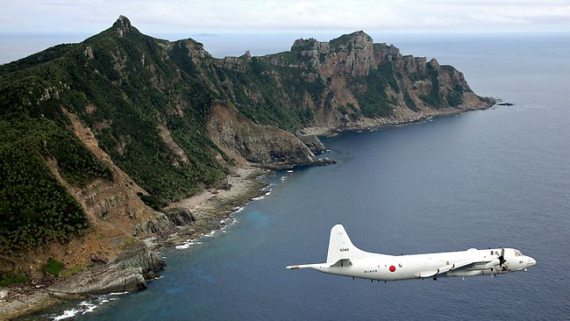
Aerial view of the Senkaku Islands

Concerning surprise, we can see a clear distinction between 1962 and this scenario in terms of strategic surprise. Beijing is announcing every day that she wants the Senkaku, and not making any effort at all to pretend that she is only ready to resort to non-violent means. No ambiguity here, therefore no strategic surprise is being sought. At the tactical level, on the other hand, there is no surprise either in the constant harassment at the hands of paramilitary assets or “civilian” expeditions, but this could be a cover behind which to prepare a landing by military or other government personnel. It is here that surprise may lie, since Beijing may try to take advantage of the presumption that it is only unarmed activists who try to land, inserting an armed force, maybe by air.

With regard to concentration, the nature of the islands means that this principle would not be applicable in exactly the same sense as it was in 1962. Rather than hitting “as fast and as hard as possible”, as Chellaney explains China did against India, the goal would be still be to do it as swiftly as possible but not as hard as possible, rather the contrary, since the idea would be to avoid a clash with the Japanese Coast Guard or other government agencies. Beijing’s goal would be to force Tokyo to take the always difficult decision in a democracy to fire the first shot.

When it comes to striking first, again we have to note an essential difference. Beijing would still be interested in surprise, as already noted, that is she would try to make the first move (and by definition she would, since the islands are already in Japanese hands) but not to shoot first. This would be a major difference with 1962 or with the 1979 “lesson” against Vietnam.

The idea that an attack should be launched at the right time, with a view to a favourable worldwide state of affairs, remains as relevant as ever. This is linked to one of Beijing’s imperatives, preventing the US from coming to Japan’s aid. It would also involve other, regional, powers however. China has a need to keep an eye on Russia, Vietnam, the Philippines, and India, among others. It must be said, concerning this, that while it is true that Beijing has usually been smart to launch its limited offensives at the right time (this includes the seizure of the Paracel Islands, occupation of Johnson Reef, and capture of Mischief Reef), when it comes to Japan she miscalculated in 2010. Beijing imposed an embargo on rare earths exports in reaction to the arrest of a trawler’s skipper, not only failing to secure any objective beyond his release but unleashing a major effort to implement alternative technologies, recycle, seek new suppliers, and even explore seabed deposits. The result is that Japan has significantly cut down her dependence on Chinese rare earths.

Japanese air patrol over the Senkaku Islands

The tendency to carry out “defensive counterattacks” seems to be a constant in Chinese behaviour, which Chellaney reminds his readers had already been noted by the Pentagon in its 2010 report on “Military and Security Developments Involving the People’s Republic of China” to Congress. This report lists a number of instances where Beijing chose to seize the initiative, while framing her actions in a “response” narrative. In a way this is already been happening in the Senkaku Islands, since after each incident Beijing not only rejects Japanese protests but actually issues her own, saying that they are part of her territory and that therefore it is Japanese units which are trespassing. The text also points out how Chinese doctrine calls for waiting for the enemy to strike first, while defining that first strike in political, not necessarily military, terms. Thus it is fine to be the first to resort to force in reaction to a political offensive. The report quotes from “the authoritative work, Science of Military Strategy,” to explain that “Striking only after the enemy has struck does not mean waiting for the enemy’s strike passively.… It doesn’t mean to give up the ‘advantageous chances’ in campaign or tactical operations, for the ‘first shot’ on the plane of politics must be differentiated from the ‘first shot’ on that of tactics… if any country or organization violates the other country’s sovereignty and territorial integrity, the other side will have the right to ‘fire the first shot’ on the plane of tactics.'”

Would this doctrine be compatible with a sneak landing on the Senkaku Islands? It could fit with it if we expanded it to comprise three, as opposed to two planes. The first one would still be the political, with Beijing claiming (as she does) that the islands are hers and that therefore the Japanese are invaders, a position made much easier to sustain by Tokyo’s reluctance to develop the islands, thus contradicting her claims that not only do they belong to the country but that there is no territorial dispute. The second one, where Beijing would be taking the initiative, would be the “tactical-cold” one, that is the employment of force (in the sense of deploying military or paramilitary personnel in violation of Japan’s borders but without inflicting casualties). Finally, the third would be the “tactical-hot,” that is the actual employment of weapons with live fire, where China would rather have Japan be the first to shoot, in the knowledge that it is difficult for democracies to take such decisions and thus in the hope that Tokyo would refrain from doing it or that, if she did, this could be used to Beijing’s advantage on the propaganda and diplomacy fronts.

Finally, with regard to China’s tendency to gamble and take risks, Chellaney notes that this could be furthered by her “second-strike nuclear capability and unprecedented economic and conventional military strength.” In addition to these two powerful factors, we could perhaps mention two additional ones, whose impact is less clear cut but which may nevertheless have some influence: a possible economic crisis and popular demand for the seizing of the Islands. Concerning a crisis, a growing number of voices are alerting about the possibility that the country’s uninterrupted economic growth may sooner or later be brought to a halt. Whether that would prompt a more cautious foreign policy or on the contrary whet Beijing’s appetite for adventures is open to debate. With regard to her domestic public opinion, Beijing is playing a dangerous game by pushing so hard for the Senkaku Islands and thus risking becoming a prisoner of her own narrative. This brings to mind Hugh Bicheno’s comment, in his unofficial history of the Falklands War, that territorial conflicts may be useful to “distract the masses,” but that this “creates an issue others will exploit to question the Nationalist credentials of whoever is refraining from recovering the lost lands.”

We can thus conclude that Communist China’s traditional approach to force, as exemplified by the 1962 War, means a clear danger that Beijing will try to seize the Senkaku Islands by inserting forces and daring Tokyo to be the first to open fire.

Alex Calvo is a guest professor at Nagoya University (Japan) focusing on security and defence policy, international law, and military history in the Indian-Pacific Ocean Region. A member of the Center for International Maritime Security (CIMSEC) and Taiwan’s South China Sea Think-Tank, he is currently writing a book about Asia’s role and contribution to the Allied victory in the Great War. He tweets @Alex__Calvo and his work can be found here.

[otw_shortcode_button href=”https://cimsec.org/buying-cimsec-war-bonds/18115″ size=”medium” icon_position=”right” shape=”round” color_class=”otw-blue”]Donate to CIMSEC![/otw_shortcode_button]