
Category Archives: Asia-Pacific
Analysis relating to USPACOM.
Charting a Closer Course: Obama’s Trip to India
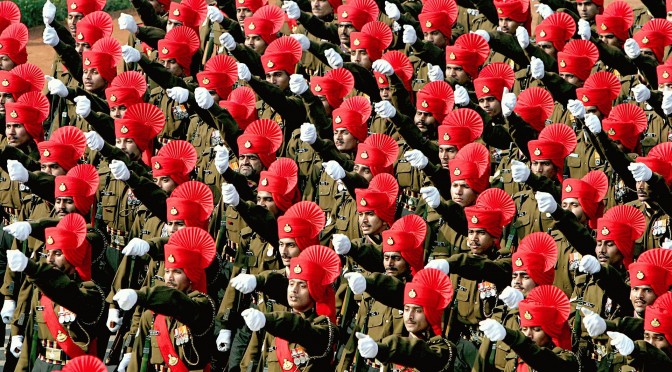
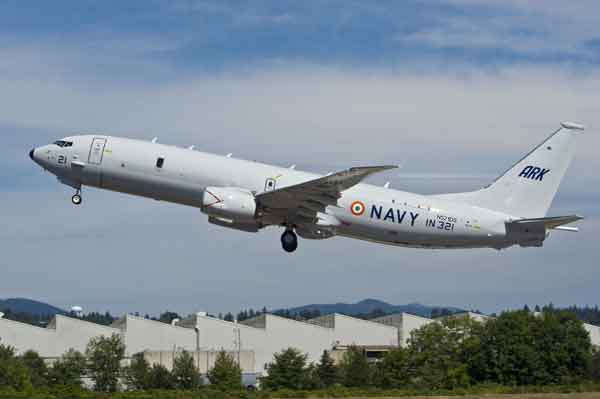
When President Obama next week attends India’s Republic Day festivities, celebrating the 65th anniversary of the country’s constitution, he’ll be the first U.S. President invited as the guest of honor and treated to a spectacle rife with symbolism. In addition to floats, bands, and regiments parading along the Rajpath on everything from mounted camel to motorcyle representing the diversity of India, the President will also witness a ceremonial flyover of a P-8I maritime patrol aircraft (MPA) in formation with two MiG-29K fighter jets (pending security concerns). This flight is symbolic in its own right for several reasons.
A Maritime Renewal
On the face of it, the flyover celebrates the induction of both aircraft into the Indian Navy. But their inclusion, the only other time than the display of Harriers in 1984 that naval aviation has taken part in the flyover, also highlights India’s renewed emphasis on bolstering its status a maritime power. India’s confidence in its naval service was shaken in the wake of a spate of nearly a dozen terrible accidents over a roughly the past year-and-a-half, resulting in the loss of more than 20 lives and significant damage to several vessels.
 Despite adopting a “Look East” policy in 1991, India has in large part to this day viewed its strategic choices through the prism of its contentious relations with its neighbor to the northwest, Pakistan, promoting its air and ground forces at the expense of its naval. After Prime Minister Narendra Modi declared in November that he would follow through on the previous policy’s promise by setting out to actually “Act East,” observers are beginning to see signs of action. Modi has boosted ties with Vietnam and Japan, including inviting the latter to return last summer for its U.S.-India naval exercise Malabar and last week agreed to further strengthen US-India-Japan trilateral ties, although the effective result of this sentiment is unclear at this point. Early this year India may have also (but denies having) played a role in reversing China’s influence in Sri Lanka, seen as a key node in China’s Maritime Silk Road concept and playing host to Chinese submarine port calls to India’s displeasure, through aiding the surprise defeat of President Rajapaksa.
Additionally, the increased investments India has made of late in the sea services are starting to bear fruit, as evidenced by more than just the new aircraft. The sea trials begun in December of India’s first indigenous nuclear ballistic missile submarine, the commissioning of its first indigenous guided-missile destroyer in August, and the construction underway of its first indigenous aircraft carrier also demonstrate – despite schedule slippages – the increased priority in funding the sea services are receiving. On New Year’s Day, India received another confidence boost, reporting that its coast guard succeeded in intercepting a fishing boat operated by terrorists before they were able to execute another “Mumbai-style attack.”
Opportunities
 However there is another view of the symbology of the flyover. It will not be lost on most observers that the MiG is of Russian origin, and the P-8 hails from the United States. As such, the flight represents the choice for India between its traditional weapon supplier, Russia, and new options. These alternatives include India itself, as it looks to produce as much domestically as it can, at times in partnerships with those willing to share technologically advanced designs, but also those with whom it would like to cement friendships. In the Indo-Pacific such as Japan, which is attempting to finalize a deal over US-2 amphibious aircraft.
This presents the United States with several opportunities. During his trip President Obama is expected to renew a defense cooperation framework with India for another 10 years. But this is more or less the continuation of the status quo. At the same time, India is seeking suppliers of drones, and is likely to get the RQ-11 Raven, but would be well suited for sale of larger drones for maritime surveillance or as strike aircraft. Further, India is reportedly weighing the benefits of nuclear propulsion for its second indigenous carrier.
Both drones and nuclear propulsion are fields in which the United States excels, yet selling either carries risks. The sale of armed and larger drones, which U.S. export controls currently restrict, would if nothing else pique other partners already turned down from purchases. If lax safety standards led to an accident aboard a nuclear vessel, public opinion could call into question the U.S. Navy’s use of it. But the bigger risks are those of missed opportunity, the opportunity not only for business, but for binding ties between two maritime powers with much to gain through increased cooperation.
Scott Cheney-Peters is a surface warfare officer in the U.S. Navy Reserve and the former editor of Surface Warfare magazine. He is the founder and president of the Center for International Maritime Security (CIMSEC), a graduate of Georgetown University and the U.S. Naval War College, and a member of the Truman National Security Project’s Defense Council.
Another Unsinkable Aircraft Carrier
By Ian Sundstrom
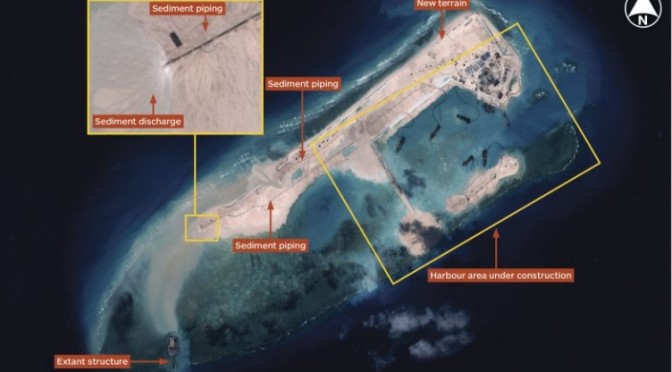
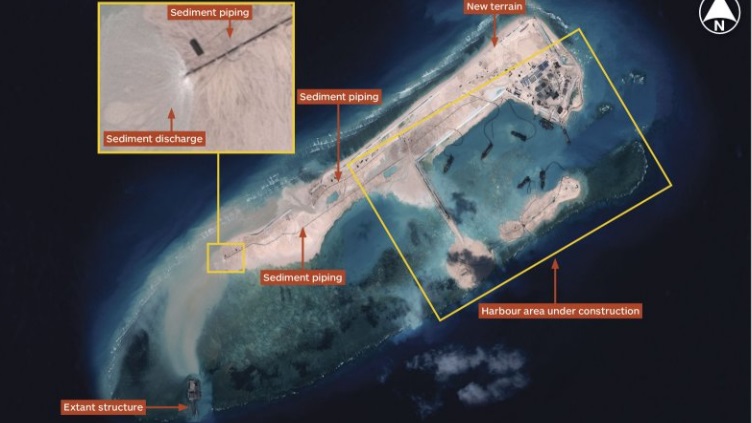
As part of a broader project of land reclamation, beginning in November China started efforts to develop Fiery Cross Reef in the Spratly Islands. As of late November the reef had been built up to 3,000 meters long and between two and three hundred wide. This makes it large enough, in the assessment of analysts with IHS Jane’s and the US-China Economic and Security Review Commission, to argue that China’s first airstrip in the Spratly Islands might be under development. China already has a growing airfield on Woody Island in the Paracels a several hundred miles north, and this would not be the first airstrip in the Spratly Islands; Taiwan, the Philippines, and Malaysia all have airstrips of their own. If a runway is truly planned for Fiery Cross Reef, what does this mean for the region’s security environment?
Given the distances involved, and the PLA’s relatively limited aerial refueling capabilities, Chinese forces stationed on or operating near the Spratly Islands cannot currently count on sustained air coverage from mainland China. The USCC report notes that an airstrip on Fiery Cross Reef would allow the PLA to project air power much further out to sea than current possible. Initially, an airstrip would allow for aerial replenishment of the small garrison on Fiery Cross Reef. The airstrip could also almost immediately be used for emergency landings or refueling, both of PLA aircraft and any civilian aircraft in distress. The PLAN or PLAAF could also deploy ISR assets, most probably unmanned, increasing PLA situational awareness for minimal footprint. This idea is supported by a statement made by Jin Zhirui, an instructor at the Air Force Command School.
 The airstrip would additionally enable parts or stores to be flown to the reef and then dispatched to local PLAN vessels via helicopter. This is, for example, an advantage that the island of Bahrain provides for US Navy operations in the Persian Gulf and Diego Garcia provides in the Indian Ocean. In fact, Andrew Erickson speculates development may lead to an island twice the size of Diego Garcia. This would partly address the PLAN’s deficiency in replenishment ships and allow quick turnaround for critical repair parts to maintain vessels at sea even in the face of inevitable equipment breakdown. These uses for an airstrip are relatively benign compared with how the airstrip could develop.
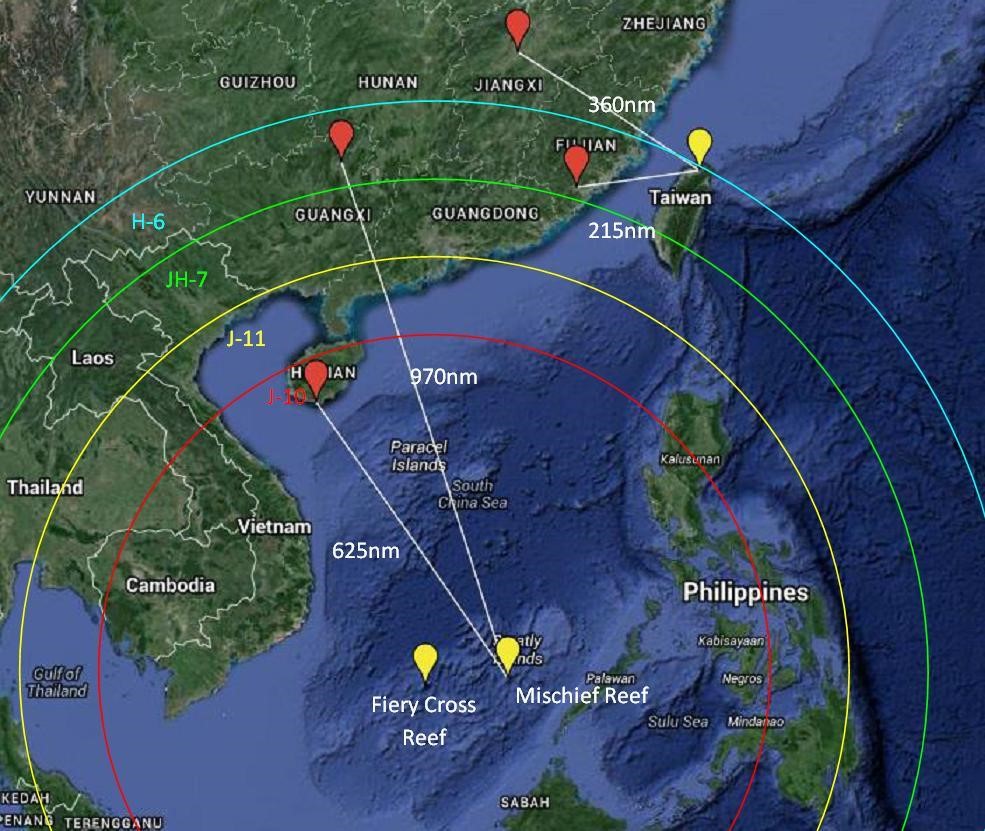
If the reef is expanded sufficiently it could serve as a platform for permanent basing of PLA combat aircraft which would alter the military balance of the region. China would be able to sustainably project air power further into the South China Sea than currently possible. The reef – or to use the potentially loaded term island, as it would realistically be – would also serve as an unsinkable adjunct to the Liaoning (CV-16). David Shlapak argues that Liaoning will significantly improve Chinese combat capabilities in the South China Sea; an island airstrip would do the same and would not have to return to the mainland for maintenance. The island could also support larger aircraft with heavier payloads than the PLAN’s carrier. Candidates for basing on Fiery Cross Reef include the J-10 air superiority fighter with a roughly 600nm operational radius, J-11 air superiority fighter with a 700nm radius, or the JH-7 attack aircraft with a 900nm range. All are capable of carrying anti-aircraft and anti-ship missiles with varying degrees of capability. A 3,000 meter runway could also support aerial refueling aircraft or the H-6 bomber, further increasing the PLA’s options for aerial patrols and strikes.
The satellite imagery of the reclamation work originally published by IHS Jane’s also shows work progressing on a port facility. The progress to date on the port does not give a concrete indication of its final size or depth, but even a rudimentary logistics base would give the PLAN greater sustainability for operations in the area. While the airstrip would allow parts and stores delivery to PLAN vessels, pier facilities would allow more intensive repairs to be conducted in theatre, further extending the staying time of ships in the area. The port could also facilitate the permanent or rotational stationing of China Coast Guard vessels or small combatants like the Houbei-class fast attack craft, giving Beijing a more durable maritime presence.
If development of the reef plays out as current evidence indicates, it would alter the military situation by allowing Chinese aircraft and ships to more sustainably project power further from mainland China. This affects regional navies’ contingency plans for conflict in the South China Sea. They have to anticipate that Chinese maritime operations will have near-continuous air coverage throughout the area. The construction of an airstrip on Fiery Cross Reef also impacts US Navy planning for any possible conflict with China as it extends China’s A2/AD umbrella several hundred miles. Deploying air and surface search radars to the reef alongside air superiority and maritime strike aircraft would add another layer of defense capability that the US Navy or Air Force would have to account for. It is too early to say how the developments on Fiery Cross Reef will unfold, but the development of an airstrip and port facility on Fiery Cross Reef would yield significant operational benefits for Chineseforces in the South China Sea and complicate matters for Taiwan, the Philippines, and Malaysia in their disputes with China over ownership of the Spratly Islands.
Ian Sundstrom is a surface warfare officer in the United States Navy and holds a master’s degree in war studies from King’s College London. The views expressed here are his own and do not represent those of the United States Department of Defense.
Forecast 2015: Maritime Challenges in the Indian Ocean
Guest Post by Vijay Sakhuja
What could be the trend lines for 2015 in the Indian Ocean? A quick survey of events, incidents and trends in the Indian Ocean during 2014 suggests that the region witnessed cooperation, competition and inclusiveness among the littoral states.
Three baskets could be identified: geopolitical, geostrategic and geo-economic, to help forecast trends in 2015. However, a caveat is in order i.e. these baskets can spring a number of surprises, given that ‘prediction is a risky business’.
IORA: Moving from Australia to Indonesia
In the geopolitical domain, the region remained peaceful and pan-Indian Ocean multilateral organizations such as the Indian Ocean Rim Association (IORA) and Indian Ocean Naval Symposium (IONS) were proactive and provided the platform and leadership to address issues of common interest among the partner states. The Perth Communiqué released in September 2014 reinforced the Association’s commitment to ‘building a more stable, secure and prosperous Indian Ocean region’ and promote the IORA’s six priority areas of cooperation. The regional navies met under the IONS banner and addressed a number of common security issues confronting the region.
Later in 2015, the IORA baton will pass from Australia to Indonesia who would continue to carry the great work done by the earlier Chair – India. The new government in Jakarta led by President Joko Widodo has endorsed the importance of maritime matters through the establishment of a new Coordinating Ministry for Maritime Affairs and announced the doctrine of ‘global maritime axis’ (poros maritim dunia). In addition, South Africa, the next Vice Chair of IORA, will prepare to take the leadership role in 2017. These provide ‘continuity and purpose’ to the IORA.
China and the Maritime Silk Road: Increasing footprints in the Indian Ocean
China would continue to make attractive offers to Indian Ocean states and seek support for the MSR. Its forays in the Indian Ocean can potentially sharpen difference between China and India and may even lead to these powers becoming more assertive.
During 2014, the Indian Ocean geostrategic environment, though peaceful, was a bit tenuous. The presence of Chinese submarines in the Indian Ocean created unease in New Delhi. Though predicted, it surprised the Indian strategic community and the Indian Navy is beefing up capabilities to respond to the Chinese forays in the Indian Ocean.
India was also ruffled by the Chinese Maritime Silk Road (MSR) initiative and its growing popularity among a number of Indian Ocean states particularly Bangladesh, Sri Lanka and Maldives. New Delhi believes that the MSR can potentially help China consolidate its naval / maritime strategy of access and basing in the Indian Ocean in support of PLA Navy’s future operations.
Continuing US Anchor
The US will continue to be the strategic anchor and security provider in the Indian Ocean and its role welcomed by the regional countries to ‘correct security imbalances, challenge the hegemony of any dominant power and ensure regional stability’.
Likewise, the UK decision to permanently position a number of power projection platforms in the Persian Gulf prompted New Delhi to recall the idea of Indian Ocean ‘Zone of Peace’ and withdrawal of extra regional naval powers from the Indian Ocean.
2015: End of Piracy, Attractiveness of Drug smuggling and Re-emergence of Maritime Terrorism in the Indian Ocean
One of the important positive developments in the Indian Ocean was the near total suppression of piracy in the Gulf of Aden / Somali coast. It took eight years for the naval forces from nearly two dozen countries including a number of UN Security Council resolutions, to send pirates back home.
However, another ugly face of illegal activities at sea i.e. drug smuggling appears to have caught the attention of the Indian Ocean countries. During 2014, the multinational forces operating in the Indian Ocean intercepted a number of dhows/boats carrying narcotics from South Asia bound for destinations in East Africa. Perhaps what is more disturbing is that east coast of Africa emerged popular among drug smugglers from Colombia. Kenyan President Kenyatta’s initiative to oversee the destruction of a vessel carrying about 370 Kilograms of heroin worth US $ 11.4 million in international market exhibited Indian Ocean countries resolve to counter global trade in narcotics.
The rise of the Al Qaeda in the Indian Subcontinent (AQIS), the new wing of the Al Qaeda, has already raised a new threat whether Pakistan will become a haven for maritime terrorism.
Will 2015 see the idea of “Blue Economy” leaping forward?
The geo-economic environment in the Indian Ocean witnessed the emergence of a new concept ‘Blue Economy’ led by Seychelles and Mauritius. The idea is resonating among a number of Indian Ocean littorals including Australia, Indonesia, Bangladesh, South Africa to name a few. The leaders are committed to the sustainable development of living and non-living marine resources to enhance food and energy security.
Will 2015 ensure better Search and Rescue Coordination?
Perhaps the most traumatic and heartrending events in 2014 were the tragic loss of Malaysian Airlines flight MH 370 in the southern Indian Ocean, which still remains a mystery, and the more recent loss of Air Asia flight QZ 8501 in the Java Sea. These were stark reminders of the need to develop robust search and rescue (SAR) mechanism in the Indian Ocean. Yet, these incidents exhibited the Indian Ocean countries’ commitment to provide ‘public goods at sea’ and a number of navies deployed their navies for SAR.
Dr Vijay Sakhuja is the Director, National Maritime Foundation, New Delhi. The views expressed are those of the author and do not reflect the official policy or position of the National Maritime Foundation. He can be reached at director.nmf@gmail.com.
This article is courtesy Institute of Peace and Conflict Studies (IPCS), New Delhi and originally appeared at http://www.ipcs.org/article/