Category Archives: Asia-Pacific

Analysis relating to USPACOM.

The Potential for Panshih: Taiwan’s Expanding Maritime Role

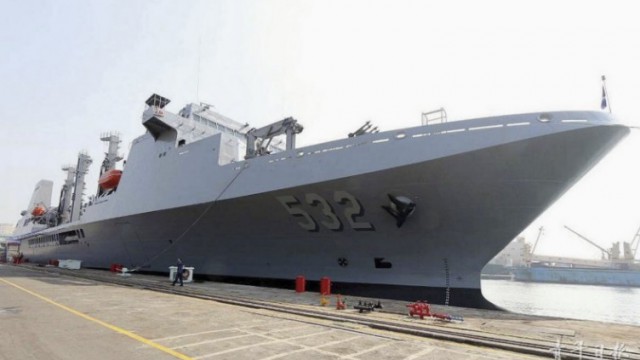
Taiwan has long enjoyed a robust maritime force, intended to defend the island nation from threats both real and perceived across the Taiwan Strait. An arrangement under which the United States will deliver four Oliver Hazard Perry-class frigates for use by the Republic of China Navy (ROCN) will only serve to further enhance the country’s maritime power. But perhaps the most interesting development for maritime affairs in the Asia-Pacific region so far in 2015 is the delivery of the ROCS Panshih.

With a total displacement of 20,000 tons and a range of almost 15,000 kilometers, the supply ship Panshih will greatly contribute to the ROCN’s expeditionary capabilities, allowing Taiwan to contribute meaningfully to disaster relief or humanitarian operations anywhere in the region. Historically, Taiwan has lacked this capability, fielding only the ROCS Yuen Feng, a troop transport. Although the ROCN has operated another supply ship for some years, ROCS Wu Yi, the Panshih is significantly larger and possesses much more advanced medical facilities. Reportedly, the Panshih is also only the first of its class – a second ship of an identical design is expected for the ROCN in the next few years.

These ships may soon cruise the seas in a Taiwanese effort to replicate the successes of China’s maritime diplomacy. The Peace Ark, a hospital ship in service with the People’s Liberation Army Navy (PLAN), has toured extensively since its commissioning in 2008. For example, the Peace Ark was deployed to assist the Philippines in recovering from Typhoon Haiyan in November 2013, and later was an important component of the Chinese participation in the Rim of the Pacific Exercise (RIMPAC) 2014. Port visits and participation in such multilateral operations enhance China’s “soft power”, whereas observers note that Taiwan has been sidelined for the most part in regional diplomatic affairs. Pursuing a similar theme to China’s charm offensive could be just the remedy to Taiwan’s isolation.

A port of the flight deck on the Panshih.

Yet there is one catch to the Panshih’s particular design. The vessel boasts some offensive capabilities, including a Phalanx close-in weapons system, a 20mm Gatling gun, short-range Sea Chaparral surface-to-air missiles, several .50 calibre machine guns, and 30mm turrets. In contrast, the Berlin-class auxiliary ships employed by the Germany Navy, and which the Royal Canadian Navy will also soon employ as the Queenston-class, have only four MLG 27mm autocannons for defence. China’s Peace Ark is entirely unarmed. While the Panshih’s armaments grant it operational flexibility, they also undermine the vessel’s capacity to act as a soft power tool.

Perhaps the most ideal role for this vessel in the future will be to join relief operations in unstable environments. Taiwan has not contributed much in this area in previous years, with the ROCN focusing almost entirely on defending the Taiwanese coastline from threats across the strait. But there is one success story: in 2011, Taiwan initiated some participation in the European Union’s Operation Atalanta. This constituted an important contribution to international efforts against piracy in the Gulf of Aden and the Indian Ocean. But this is the lone case of active engagement by the ROCN in any initiative beyond the Taiwan Strait. The Panshih could grant Taiwan more options in this regard, since the deployment of fully fledged combat vessels to an area like the Gulf of Aden could be viewed by domestic audiences as weakening Taiwan’s coastal defenses or otherwise as a misuse of Taiwanese defense resources. A supply ship could be more readily spared so far as the public is concerned.

Lending credence to the idea that the Panshih will be used to support humanitarian operations in failed or failing states, the vessel also has impressive hangar space, capable of storing up to three helicopters. The Taiwanese media has focused on the capacity for the ship to serve as a takeoff and landing platform for anti-submarine helicopters, but it is also certainly possible for the ship to serve as a base for transport helicopters ferrying supplies and specialized personnel to inland locations, while also bringing back patients requiring intensive care at the Panshih’s onboard medical facilities. The ROCN’s 19 Sikorsky S-70C(M) Thunderhawk helicopters offer some possibilities in this regard.

In any case, the ROCN now has in its possession a versatile ship. What remains to be seen are how the ROCN will put it to use in the coming years and to what extent this will reflect Taiwanese foreign policy priorities. With such a sophisticated vessel, it would be a shame for Taiwan to keep it docked as backup for a regional conflict that might never, and hopefully will never, come.

Paul Pryce is a Research Analyst at the Atlantic Council of Canada. His research interests are diverse and include maritime security, NATO affairs, and African regional integration.

This article can be found in its original form at offiziere.ch and was republished by permission.

Toward a Harmonious Pacific through China-led, Confucian-based Maritime Law

What goals should the United States seek in the South China Sea?  Trying to preserve the status quo – hoping that each country be ever content with its historic resources and territory – is simply unrealistic, as demographics alter populations and climate change alters fish stocks, river flows, and even the land under one’s feet, as sea levels rise.  The U.S. feints at regional stability; yet advocating for peace while conducting military exercises with China’s neighbors, and arming those neighbors while proposing détente to their larger Pacific roommate, do nothing to turn down the temperature in an already overheated region.

Is there another way?

Interestingly, in response to China’s most recent provocative (or expansive, “salami-slicing”) efforts in the South China Sea, the affected countries have neither used, nor threatened, retaliatory military force.  Perhaps they saw the lack of international military response to Russia’s actions in the Crimea and realized the futility of might against might, facing such a stronger force as China.  Or perhaps they drew lessons from the international community’s decade-plus-long quagmire in the Middle East.  At any rate, they went, instead, to the law, and to the United Nations, with the Philippines filing a 4,000-page case in March 2014, and Vietnam joining the case in early December.  The case pends.

Chinese law is often seen by the Western world as a punitive weapon, wielded bluntly to reinforce the power of those with authority.  I came face-to-face with this stereotype in 2010, when, aboard a U.S. Coast Guard high-endurance cutter, we hosted two Chinese shipriders from the Fisheries Law Enforcement Command (now part of the China Coast Guard), to cooperatively enforce an international moratorium on high-seas driftnet fishing.  The shipriders’ knowledge of Pacific fisheries was extensive, and their insight into local fishing practices highly revealing; yet they were surprised by the professional and non-aggressive way we conducted fisheries boardings.  Excessive force was unnecessary; the rule of law enabled us.

They were not the first shipriders I’ve met who were used to maritime law enforcement being far more aggressive in their home countries. The FLEC shipriders were fascinated to learn that the law not only empowered, but also restrained us: that it protected citizens’ rights, and even the rights of non-citizens.  This is powerful.

Sunset on the South China Sea off Mui Ne village on the south-east coast of Vietnam (Author MikeRussia; Wikimedia Commons)

Whence the origins of Chinese law?  The legal tradition in China has grown, over centuries, from two roots: Legalism, which results in the often brutal applications of punishment seen in Western media; and, curiously, Confucian philosophy.  While Legalism posits tough laws and harsh sentences to keep the populace controlled, Confucianism holds that laws should help a community achieve harmony (or “Li”); and that leaders are expected, by virtue of their status, to model the moral behaviors they want their people to emulate.  This Confucian strain in Chinese thought provides an interesting and useful opening for influencing development in a new direction, toward a cooperative and harmonious maritime code of conduct in the Pacific.

How might China be convinced to develop such a code?  After all, they are stronger than their neighbors: why handicap themselves?  Yet economics suggests that selfish or destructive behaviors net a country less long-term economic growth and geopolitical power than mutually beneficial international actions.1 This is the angle to play, enhanced by emphasizing the inherently Chinese flavor of a Confucian-based legal code.  China has much to benefit by spending less on a military arms race and more on economic development: by cultivating harmonious relationships with their neighbors, they will create a stronger and more willing market for their goods, to keep driving the massive yet near-solitary economic growth engine keeping their political party empowered.

This is, perhaps, an audacious proposal, for it seeks through persuasion and a bit of flattery to encourage China to become a responsible maritime actor, on its own terms, by appealing to its history and pride. The U.S. could say: We can help you develop a comprehensive Pacific maritime legal framework; China-led, Confucian-based, for harmonious interaction with your neighbors and comprehensive regional prosperity.

Overly optimistic?  Not impossible.

It is important here to focus not just on maritime law tactics (how to conduct a law enforcement boarding; how to apply various levels of force) but on strategy: how to build a framework for long-term, harmonious international maritime interaction.  This could start at the military-to-military level, through engagements between China Coast Guard and U.S. Coast Guard counterparts.  China Coast Guard leaders would be invited to observe, not only tactical-level boardings and operational-level maritime law enforcement planning; but also the legal aspects of preparing case packages, reviewing case law, and arguing cases in U.S. court.  Discussions would cover both strengths and shortfalls of the existing U.S. and international maritime legal systems, expanding to cover differences between the type of maritime law enforcement the U.S. Coast Guard conducts, and the similar-but-different, non-law enforcement Maritime Interdiction Operations (MIO) conducted by both the U.S. Navy and U.S. Coast Guard to enforce UN resolutions.  What elements of each should be integrated into a Pacific maritime “code of conduct”?

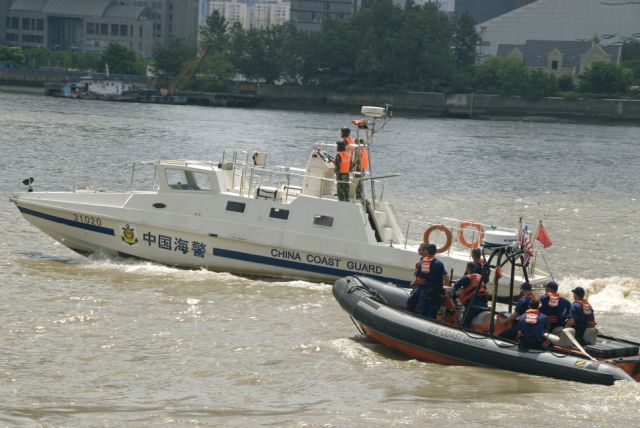
(Aug. 18, 2007) SHANGHAI, China - The crew from the U.S. Coast Guard Cutter Boutwell trains with the China Coast Guard during the North Pacific Coast Guard Forum. (Coast Guard photo by Petty Officer Jonathan R. Cilley)
(Aug. 18, 2007) SHANGHAI, China – The crew from the U.S. Coast Guard Cutter Boutwell trains with the China Coast Guard as part of the North Pacific Coast Guard Forum. (Coast Guard photo by Petty Officer Jonathan R. Cilley)

One of the benefits of a Confucian-based code of conduct for South China Sea ship interactions would be to assume all parties’ good intentions, rather than their ill-will.  In a specific maritime rulebook supporting this code, potentially aggressive actions would be presumed, unless meeting certain hostile tripwires, to be honest mistakes, prompting mutual retreat.  Furthermore, in order to discourage intentional “gray area” behavior, the tripwires would specifically reflect hostile intent – regardless of whether a military or civilian actor cross them.

Additionally, again based on Confucian philosophy, the greater the power, the more the responsibility to model ideal behavior.  Thus, as the leading power in the region, the onus is on China to set the most moral and harmonious example in its maritime interactions.

This code of conduct would both complement, and expand upon, the existing COLREGS: for where the COLREGS guide navigational interactions, the expanded code of conduct would also cover “exploratory interactions” – when ships are not simply navigating from one port to another, but exploring, patrolling, conducting research, or otherwise operating intentionally but non-navigationally.

Concurrent U.S. Defense-State strategic regional engagement is also recommended, in which reductions in maritime tensions are coupled with increased diplomatic development, where the U.S. encourages countries with competing resource claims to develop bilateral or multilateral agreements for resource sharing and protection.  The goal is to convince Pacific nations that sharing the pie doesn’t mean going hungry: instead, cooperation can reduce each country’s individual share of defense and production, while promoting labor specialization and national pride.2  As a bonus for regional stability, the more countries invested cooperatively in an area, the greater their individual and collective desire to avoid any sort of conflict that might harm those resources, or take their production off-line.

Both the U.S. combatant commander and his country team counterparts should cooperatively emphasize Chinese-influenced, Confucian-based legal bases throughout the spectrum of their “defense, diplomacy, and development” engagements, as an overarching strategic theme.  This is one way the U.S. can face China down in their game of “Go”:3 from every angle, at every opportunity, seeds of a harmonious rule of law will be planted.  While some efforts will be stymied or stifled, some seeds will grow, and ideally, this concept of law will begin to permeate Chinese society deeply enough that it cannot quickly be uprooted.  And why should the Chinese tear it out?  It will underpin their economic growth, protect their military from engagement, and cement their moral status as a 21st-century great power.

Engagement surrounding the rule of law is a long-range play.  The goal is not only a more peaceful, China-influenced, legal framework for the Pacific; but also to sow seeds of change for democratic evolution within China itself.  Raising awareness within Chinese leadership that laws are not just sticks with which to beat opponents, but beacons of moral empowerment; that laws should guide leaders to act justly; that the rule of law can inspire a peaceful, communal patriotism; and that people at all levels of society can trust the law to protect them – these powerful democratic concepts can, over time, drive significant positive change within Chinese society: change that traditional military might not and political posturing never could achieve.

Facilitating a China-led, Confucian based, cooperative maritime-based rule of law could eventually be expanded to other contentious and competitive domains, including space, cyberspace, and even intellectual property – all areas that could benefit from an improved, shared, legal basis. And perhaps, success in this region of the world could be expanded to locally-led and -derived, rule-of-law-based engagements in other combative areas.  After having seen such conflict and destruction on its many shores, we could at last look forward to a new era in which the Pacific is finally peaceful enough to be worthy of its name.


Lt. Heather Bacon-Shone serves in the United States Coast Guard, and has operational afloat experience throughout the Pacific.  The views expressed herein are those of the author and are not to be construed as official or reflecting the views of the U.S. Coast Guard or Department of Defense.

1 In economic terms, rent-seeking versus profit-seeking.

2 In other words, a non-zero-sum game.

3 “To update an old saying, ‘Russians play chess, Chinese play “go,” and Americans play poker.”  In Reveron, Derek S. and James L. Cook.  “Developing Strategists: Translating National Strategy into Theater Strategy,” Joint Force Quarterly, Issue 55, 4th Quarter 2009, p. 21.

Stumbling on Peace: The exposition of strategic misstep

This article is part of a series hosted by The Strategy Bridge and CIMSEC, entitled #Shakespeare and Strategy. See all of the entries at the Asides blog of the Shakespeare Theatre Company. Thanks to the Young Professionals Consortium for setting up the series.

Siward confronts GruachDavid Greig’s Dunsinane, while set in the centuries-ago land of Scotland, offers a modern perspective on the nature of war, peace, language, and politics. The events of the production explore the interplay between Siward, commander of English forces in Scotland, Malcolm, the English-installed King of Scotland, and Gruach, formerly both Lady Macbeth and queen of Scotland. Through several rounds and layers of intrigue, Gruach sows enough discord and mayhem to keep English forces at bay. Malcolm, for his part, does his best to engage with Siward in an attempt to illustrate that the use of overwhelming force is not always tenable. After a betrayal late in the first act, the second act functions as an extended denouement, with less action and less emotion. Indeed, the conclusion of the play, with a wandering Siward numbly stumbling out of the scene, parallels the endings to French and U.S. operations in Vietnam, Russian and ISAF campaigns in Afghanistan, UN experiences in Somalia, and the US adventure in Iraq.1

Nuanced allegiances come to the fore in the first act when Siward and Malcolm discuss their own perceived strengths. Siward wishes for Malcolm to act forcefully and seriously, rather than be thought of as a drunken playboy. Malcolm’s subsequent lecture on the desirability of being perceived as weak while operating from a position of strength mirrors current discussions on the rise of Chinese power in the Pacific, echoing Sun Tzu’s exhortation to “appear weak when you are strong.”

The arbiter of the legitimate exercise of violence in Scotland owes more effort than simply appreciating Gaelic songs and lilts.

That Malcolm channels Sun Tzu is not an accident — throughout the play, Malcolm uses a longer, strategic vision of conflict, whereas Siward focuses on the operational level. Siward initially senses that, having “ended” the fighting through the regime change at the end of Shakespeare’s Macbeth, peace is nigh for Scotland and its clans. Throughout the play, Siward’s lack of vision and misunderstanding of the country that he now occupies enables Gruach and the Scottish clan leaders to undermine the English vision for peace. Gruach’s admonition at the end of the play — “you’ve been in Scotland a year, and you still don’t know the language!” — drives home the point that Siward, as the arbiter of the legitimate exercise of violence in Scotland, owes more effort than simply appreciating Gaelic songs and lilts.

Siward’s lieutenant, the tactical supervisor, has no appreciation for Scotland beyond its resources and his survival. He realizes through collaboration with his ostensible foes along with exploitation of war trophies that he has no investment in Scotland, and indeed survives through tactical fits of inaction. His inaction comes back to haunt him at the end of the first act, when, after witnessing a brutally treacherous and suicidal act, he helplessly cries out “we have got to get the fuck out of here,” an exclamation that could be heard on any of a dozen fields of quagmire.2


The slower, more deliberate second act has a scene with the line

“We win because if we don’t win – we lose – and if we lose – then what?”

Here again the play foreshadows discourse about assumptions of a zero-sum world of power. In instances such as China’s increasing influence in the Pacific and the adventures of Vietnam, Iraq, and Afghanistan, there exists a tendency to leave alternatives to military-centric actions on the table. This unexamined default course of action leads to a path dependency wherein strategic leaders are stuck; they cannot simply withdraw, nor can they simply win. Strategic leaders in those situations, as Malcolm remarks about the English in Scotland, are committed to an extended dance of saving face. In this case — as well with Vietnam, Iraq, Afghanistan, et al — peace operations entail vastly increased losses of materiel, personnel, and treasure.

Greig acknowledges the creeping existential dread that has accompanied interventions since Korea.

Put another way, assumptions of power as a zero-sum game are increasingly outmoded.3 Dunsinane anticipates requirements for transitioning towards alternative concepts of power and peace. Interestingly, through Siward’s downward spiral, Greig acknowledges the creeping existential dread that has accompanied interventions since Korea. In doing so, he makes the case that hard, coercive methods may only have existed as an effective means of exerting power and making peace for a narrow slice of the early 20th century.

Dunsinane’s last and most vivid impression — that of the formerly upright and powerful Siward stumbling around a frozen loch, trying to “find a new country” — conjures images of Africa, Southeast Asia and the Indian subcontinent in the mid 20th century, with former powers retreating from far-flung lands and their subsequent search for a new identity. At the same time, Siward’s search for “a new country” calls to mind Hamlet’s “undiscovered country” of a life after death. Judging from Grieg’s narrative, newly post-colonial countries may indeed have to undergo a rebirth if their Siwards are to find peace.


LT Vic Allen serves at the U.S. Naval History and Heritage Command and serves as CIMSEC’s Director of Social Media. He can be followed at Medium here. All posts contain the authors’ opinions alone and do not represent any of the military services or the Department of Defense.

1. Ramberg, B. (2009). The Precedents for Withdrawal: From Vietnam to Iraq. Foreign Affairs, 88, 2.

2. The mostly civilian audience laughed at this line, which struck me as oddly incongruent with the sad and violent end of the first act.

3. Read, J. H. (2012). Is Power Zero-sum or Variable-sum? Old Arguments and New Beginnings. Journal of Political Power, 5(1), 5-31. Retrieved from http://papers.ssrn.com/sol3/papers.cfm?abstract_id=1900717

Naval Build-Up in the Philippines

Like many of its regional peers, the Philippines is in the midst of a defense buildup, motivated in no small part by China’s assertive moves in the western Philippine Sea and the resource-rich Spratly islands. 
              
The donation this week of two Balikpapan-class Landing Craft Heavy (LCH) from Australia was the most recent boost to Philippines defense efforts. 
        
The LCH donation is particularly timely, as it complements the upcoming pair of Strategic Sealift Vessels (SSV), being built by PT PAL Indonesia. Based on the Indonesian navy’s successful Makassar-class Landing Platform Dock (LPD), the 8,600-ton amphibious lift ships can transit to remote areas and serve as a mobile base for helicopters and smaller landing craft. As evidenced during Typhoon Haiyan, the dearth of such assets hampered the Philippine government’s aid response to the hardest-hit parts of the country. 
          
As gifts stand, the donation of ex-HMAS Tarakan and Brunei is particularly generous – the Royal Australian Navy will hand them over fully refurbished with new safety and navigation components, plus spare parts packages. Manila is considering purchasing the three remaining LCHs as well. 
       
While the media focus of Manila’s defense acquisitions under the Capability Upgrade Program has been centered on big-ticket items to restore basic conventional force capabilities, there have been other, quieter acquisitions that directly support war-fighting and maritime domain awareness (MDA). 
         
Notably, the service signed a Memorandum of Understanding in 2014 with the Philippine National Oil Company to transfer three retired 2,500 ton petroleum tank ships. This acquisition would enable fuel replenishment at sea and increase on-station time for high-endurance assets like the patrol frigates Ramon Alcaraz and Gregorio Del Pilar, both formerly U.S. Coast Guard Hamilton-class cutters.  
Another low-profile capability is the National Coast Watch Center program—a surveillance system designed to monitor oceanic traffic in the western Philippine Sea.
              
As expected, details of this national intelligence capability are closely held, but much of it is likely based on the successful implementation of the earlier Coast Watch South program. With heavy U.S. assistance, the Philippines created a network of monitoring stations combining radar, maritime surveillance and radio/data networks that provides a real-time strategic and tactical “picture” of oceanic traffic in the Southern Philippines—the so-called Sulawesi Sea Triangle. That area is a hotbed of illicit trafficking by sea and a favored logistical trail for transnational insurgent forces that prowl the region. When completed in 2015, the west-facing Coast Watch chain will monitor the Philippines’ Exclusive Economic Zone (EEZ), extending 200 nm into the contested Spratly Islands group. In the future, additional monitoring chains will cover the Northern and Eastern facing portions of the country as well. 
           
The most recent, visible and well-publicized modernization program has been the integration of the multipurpose helicopter program with the patrol frigate force. Five Augusta-Westland A109s twin-engine helicopters equipped with forward-looking infrared have been delivered to the fleet to replace long-retired BO-105s. From an operational perspective, the navy has made quick strides to integrating the air asset with ships of the line. The AW109s had a maiden deployment on board Ramon Alcaraz during the Australian multinational military exercise Kakadu 2014, approximately eight months after receiving the first helicopters. 
          
Out of all the projects to restore capabilities, the navy is still awaiting final determination of its premier acquisition – the multi-role frigate. The Philippines wants to buy two units to serve as major and modern combatants of the patrol frigate force. While the negotiations have been stymied by a complex two-phase process, a list of qualified bidders has emerged, including well-known Spanish shipbuilder Navantia and several South Korean firms, among others. A winning bid was to be selected in late 2014, but the acquisition process reportedly has been complicated by efforts to separate the tracks of selecting a ship from the embedded weapon systems. This may have to do with current challenges of the Philippines not being easily cleared for purchases of regional-balance changing weapons, such as a long-range surface-to-surface missile, with which this ship class is normally equipped.  
          
The Armed Forces of the Philippines has benefited under President Benigno Aquino III’s administration. To date, multiple modernization programs have either reached significant acquisition stages or have been completed entirely during his tenure. 
         
However, as the new paint smell wears off for the navy, the historical challenges that have haunted its past acquisitions and programs loom. It is critical that the next presidential administration continue to support the acquisitions, as well as the services, both politically and fiscally. The navy needs to ensure that internal expertise among the ranks to maintain their newly acquired equipment is present and sustainable. Above all, operating effectively and efficiently at sea continues to be the primary objective. The nation’s seafaring history and ties to the maritime culture give impetus to the current goals of ensuring territorial integrity and establishing a credible defense. Given the relatively rapid pace of modernization, the Philippine navy is well on the road to restoring the capabilities necessary to meet those demands. 
                               
Armando J. Heredia is a civilian observer of naval affairs. He is an IT Risk and Information Security practitioner based in New England, with a background in the defense and financial services industries. He is a regular contributor to the Center for International Maritime Security’s NextWar blog.  
                             
This article can be found here in its original form on the USNI website and was republished by permission.