Category Archives: Asia-Pacific

Analysis relating to USPACOM.

New Ship Boosts Taiwan’s HADR Capabilities

By Michael Thim

What are the most important warships of the World nations’ respective navies? A single nuclear-powered aircraft carrier of the US Navy boasts greater firepower than most national air forces, and the combined strength of a carrier and other warships assigned to protect it present force to be reckoned with. China, too, has been acquiring modern combat vessels, including the People’s Liberation Army (PLA) Navy’s latest generation of guided missile destroyers, the Type 052D. As for Republic of China Navy (ROCN) protecting Taiwan, the leading ships of the ROCN’s Surface Action Groups (SAG) are Keelung-class (ex-USS Kidd-class) destroyers, originally built for the pre-revolution Iranian Navy and transferred to Taiwan in 2005-2006. If not the Keelung-class destroyer then maybe the French-built Lafayette-class frigates would be considered the most important (or most modern) assets of the navy. Some would perhaps single out the new stealthy fast missile corvettes of the Tuo Jiang class that do not impress much in terms of total displacement, but pack a formidable punch with 16 anti-ship missiles on board.

However, what if we rephrase that question and ask instead what are the most indispensable warships— the most useful ones? There is not an easy answer to that question either, however, as it encourages a focus on more than impressive weaponry and sleek design. Perhaps, then, a whole different class of ships will catch our attention: combat support ships or replenishment ships, to put it in more general terms. Combat support ships (known by the acronym AOE used by the US Navy) along with other types of replenishment ships usually do not get the same amount of attention that major combat ships do. However, they are absolutely critical for keeping a fleet on the open sea, especially under combat conditions when replenishment in port may be restricted. This is why the US Navy keeps a large fleet of replenishment ships, and why China is expanding its own. Until January 2015, the ROCN had one such vessel in its inventory: the AOE 530 Wuyi. Since the beginning of this year, the ROCN’s ability for replenishment underway have greatly expanded.

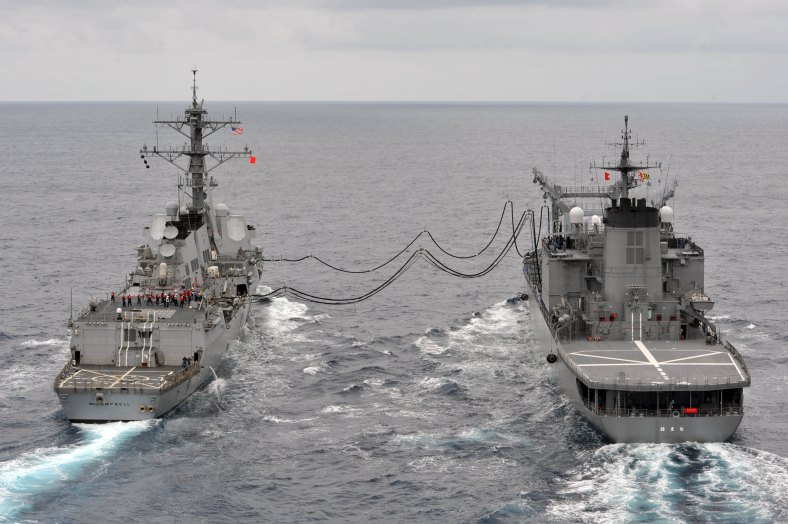
The guided missile destroyer USS McCampbell (DDG 85), left, conducts a replenishment at sea with Japan Maritime Self-Defense Force fast-combat support ship JS Hamana (AOE 424) during Pacific Bond 2012 June 7, 2012, in the East China Sea. Pacific Bond is a U.S. Navy, Royal Australian Navy and Japan Maritime Self-Defense Force maritime exercise designed to improve interoperability and further relations between the nations. (U.S. Navy photo by Mass Communication Specialist Seaman Declan Barnes/Released)
The guided missile destroyer USS McCampbell (DDG 85), left, conducts a replenishment at sea with Japan Maritime Self-Defense Force fast-combat support ship JS Hamana (AOE 424) during Pacific Bond 2012 June 7, 2012, in the East China Sea. Pacific Bond is a U.S. Navy, Royal Australian Navy and Japan Maritime Self-Defense Force maritime exercise designed to improve interoperability and further relations between the nations. (U.S. Navy /Wikimedia Commons)

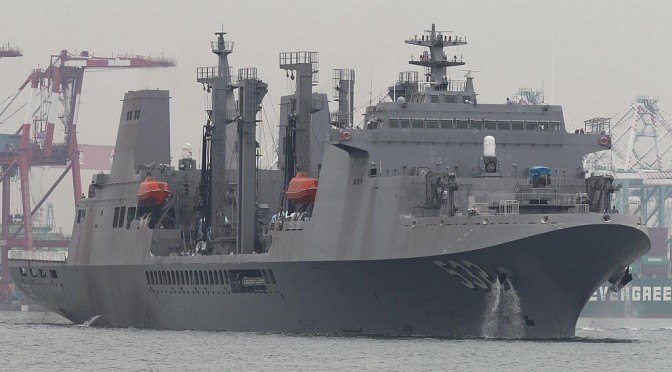
The new, locally-built (by Kaohsiung-based CSBS Corporation) fast combat support ship the AOE 532 Panshih officially entered ROCN service for initial sea trials on January 23, 2015. The basic characteristics of the new vessel speak to its size and utility. The Panshih is 196 meters long with a full load displacement of 20,800 tons, and a light displacement of around 10,000 tons. For comparison, the ROCN’s biggest warships, the Keelung-class destroyers, are 172m long and have a full displacement of 9,783 tons. Considering the ship’s displacement and purpose, its maximum speed can reach an impressive 22 knots (40 kph). Perhaps more important is its range, which can reach 8,000 nautical miles (over 14,000 km). In executing its main duties, the Panshih is able to replenish two ships at the same time.

In terms of onboard weapons systems, the Panshih is indeed equipped modestly, mostly for defensive purposes. Based on various reports, it appears that Taiwan’s new AOE has two 40mm cannons, two 20mm Phalanx close-in weapon systems (CIWS) and, strangely enough, an antiquated short-range air-defense system Sea Chaparral (based on the AIM- 9 Sidewinder), whose efficiency in combat is questionable (the model of the Panshih suggested that the front deck would have a 76mm multi-purpose canon that can be used against incoming aircraft and missiles). In addition, Taiwan’s new combat support ship does not only carry vital supplies for ROCN warships but its hangar is also able to accommodate two SH-60 (S-70) Seahawk or CH-47D helicopters.

Now that the ROCN has its new combat support ship, what use could it possibly find for it? With two AOEs in its inventory, the ROCN can conduct missions far from its shores without significantly jeopardizing homeland defense. Such missions could include anti-piracy patrols around the Horn of Africa, in line with the broader international effort to weed out threats to commercial shipping—something that is a matter of crucial interest to Taiwan, with its export-oriented economy. Other options include support for friendly port visits or participation in bilateral and multilateral exercises. For example, the participation of the Panshih in the biannual RIMPAC exercise could be less controversial than sending destroyers or frigates.

During wartime, both AOEs would present crucial capabilities to sustain ROCN operations under conditions where replenishment in home bases would become impossible due to PLA missile strikes and blockade efforts. Keeping the ROCN surface fleet operational would in turn enable it to conduct anti-blockade operations, including providing escort for vital supplies. Granted, the ROCN would still have to operate in an extremely hostile environment, likely forcing the bulk of the fleet to operate east off Taiwan. The crucial question is where the AOEs themselves would replenish, once their own supplies run out.

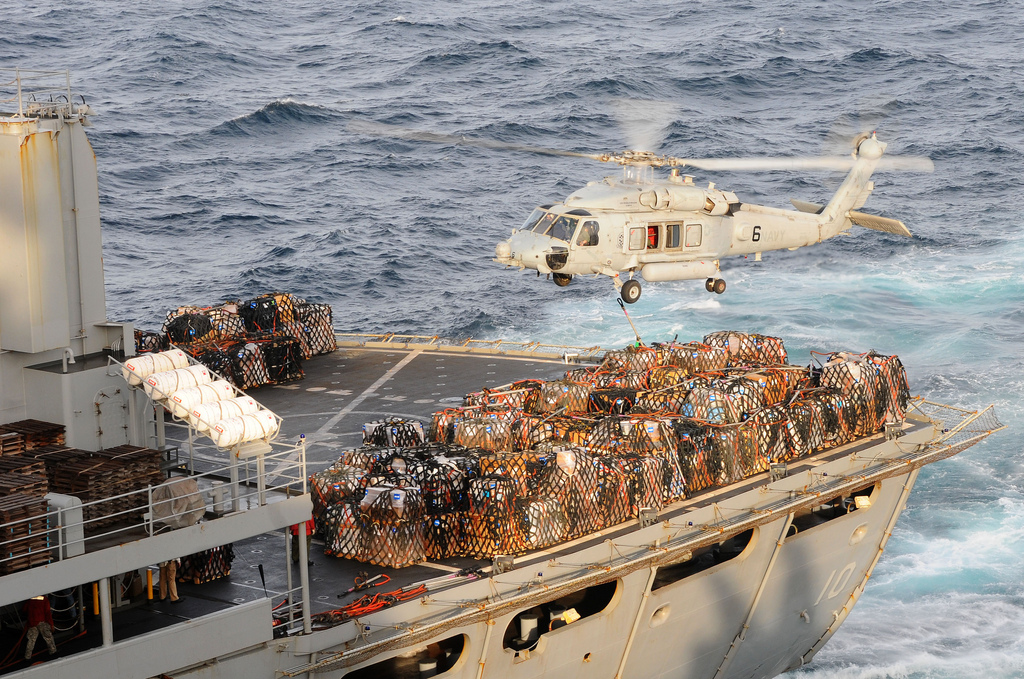
An HH-60H Sea Hawk helicopter assigned to the Black Knights of Helicopter Anti-Submarine Squadron (HS) 4 transfers pallets of supplies from the Military Sealift Command fast combat support ship USNS Bridge (T-AOE 10) during a replenishment at sea. Image Credit: CC by Official U.S. Navy Page/Flickr.
An HH-60H Sea Hawk helicopter assigned to the Black Knights of Helicopter Anti-Submarine Squadron (HS) 4 transfers pallets of supplies from the Military Sealift Command fast combat support ship USNS Bridge (T-AOE 10) during a replenishment at sea. (Official U.S. Navy Page/Flickr)

These are all important tasks for the new (as well as the old) AOE. Nevertheless, the versatility of the new vessel could materialize under conditions other than participation in broad international anti-piracy efforts (the politics that could prevent that is well-known) or wartime operations. Apart from the capability to sustain warship operations without need of resupply in home ports, the Panshih is also equipped with state-of-the-art medical facilities, including an operating room, an isolation ward, and three regular wards. That makes the Panshih well-equipped for humanitarian assistance and disaster relief (HADR) operations. This is an important capability considering how prone Taiwan’s immediate neighborhood is to various kinds of natural disasters: earthquakes and typhoons (and the resulting floods and landslides) being the most common.

Taiwan has not been a shy actor in offering and providing humanitarian assistance and disaster relief. For example, in January 2010 Taiwan sent rescue teams to Haiti, and its military C-130s conducted a record-breaking flight with much needed supplies on board. In March 2011, in the aftermath of the Tohoku earthquake and tsunami, Taiwan again sent rescue teams and released significant financial aid to Japan. In November and December 2013, Taiwan again was among the first responders to typhoon-struck Philippines. Efforts at the governmental level dovetail well with private relief efforts, as time and again the will of the Taiwanese public to help people in need has been demonstrated. Taiwan’s already significant monetary and material contribution to Japan in 2011 was given a boost via various activities ranging from individual donations to organized efforts at the NGO level.

The Panshih has a great utility to enhance Taiwan’s government HADR efforts, which are greatly supported by the public’s own efforts and the activities of private aid groups like the Buddhist Compassion Relief Tzu Chi Foundation. After all, using military capabilities for HADR is already a well-established pattern globally. During relief operations in the Philippines following the disastrous typhoon Haiyan that caused massive landslides, the United States, Japan, and China were among the nations that sent elements of their naval power to provide assistance. US relief efforts were assisted by the USS George Washington aircraft carrier battle group and a detachment of 12 MV-22 Ospreys along with US Marines. Japan, too, dispatched warships and troops to a disaster area, and Beijing ordered its hospital ship Peace Ark to be deployed to the Philippines.

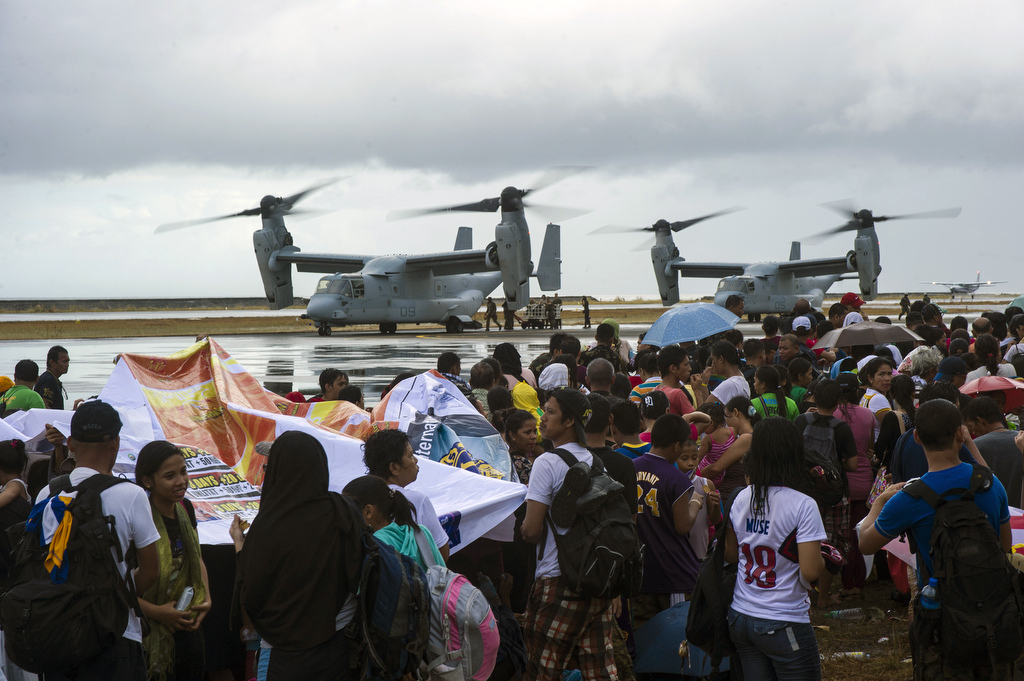
MV-22 Ospreys assigned to the Marine Medium Tiltrotor Squadron 261, 1st Marine Aircraft Wing, take on supplies to provide aid during "Operation Damayan." The George Washington Strike Group supports the 3rd Marine Expeditionary Brigade to assist the Philippine government in response to the aftermath of Super Typhoon Haiyan/Yolanda in the Republic of the Philippines. Image Credit: CC by U.S. Pacific Command/Flickr.
MV-22 Ospreys assigned to the Marine Medium Tiltrotor Squadron 261, 1st Marine Aircraft Wing, take on supplies to provide aid during “Operation Damayan.” The George Washington Strike Group supports the 3rd Marine Expeditionary Brigade to assist the Philippine government in response to the aftermath of Super Typhoon Haiyan/Yolanda in the Republic of the Philippines. (U.S. Pacific Command/Flickr)

In contrast, Beijing did not do itself much service in the aftermath of typhoon Haiyan when it was criticized for its sluggish response, initially releasing US$1.4 million worth of relief supplies, an amount that paled in comparison with donations from the United States (US$20 million), Japan (US$10 million, later increased via various assistance mechanisms), Australia (US$28 million) or even Taiwan (US$12 million). This is not to suggest that HADR activities should serve as part of some cynical calculation in pursuit of bettering one’s national image. Nevertheless, being an active supporter of HADR activities and strengthening the capacity to help with rapid response allowing for a physical presence in an affected area creates good will on all levels of relations, from the person-to-person to the governmental. After Taiwan was shown to have been the largest donor (government and private financial aid combined) to Japan in 2011, Japanese citizens have not missed a chance to express their gratitude, and Japan’s government later defied the expected angry reaction from Beijing when it invited Taiwan to be represented on an equal footing with other nations to a commemorative event in March 2013. Financial and material aid is well complemented by having the capability to put boots on the ground, and the Panshih is a great platform from which both search and-rescue teams and medical teams can operate independently in a disaster area.

Taiwan is an active and significant contributor to HADR efforts. By including the Panshih in its fleet, the ROCN has significantly boosted its capability to be an active element in rapid response in a region that is plagued by frequent emergence of typhoons and earthquakes. Granted, politics might always prevent Taiwan from fully utilizing its potential. A neighboring nation that just suffered a disastrous calamity may feel hesitant to accept assistance presented by ROCN warship deployment, succumbing to likely pressure from Beijing. However, it is as likely that politics will give way to immediate need, and Beijing would be hard-pressed not to openly oppose Taiwan’s participation. Unfortunately, recent events suggest this latter is not an unlikely scenario, as the disaster this April in Nepal illustrated, when when China allegedly pressured the government in Kathmandu to refuse entry to a Taiwanese rescue team after Nepal experienced an extraordinarily deadly and destructive earthquake.

Whatever way future events go, the Panshih’s presence in the fleet should not be judged only against its role as a support ship for combat operations during wartime. However important such missions are, the first deployment of the Panshih is more likely to be much more benign, and much more appreciated on the receiving end.

Michal Thim is a postgraduate research student in the Taiwan Studies Program at the China Policy Institute (CPI), University of Nottingham, a member of CIMSEC, an Asia-Pacific Desk Contributing Analyst for Wikistrat and a Research Fellow at the Prague-based think-tank Association for International Affairs. Michal tweets @michalthim. This piece was originally published in Strategic Vision vol. 4, no. 21 (June, 2015).

The Future of China’s Military Innovation


Forging China

Forging China’s Military Might: A New Framework for Assessing Innovation, edited by Tai Ming Cheung. Johns Hopkins Press, 2014. 304pp. $24.95

Review by Dr. Jeffrey Becker

Can China’s defense industry take the next step in supporting the country’s military modernization? Can it progress beyond a few well-known pockets of excellence in space and missiles to the point where the industry writ-large is capable of truly radical innovation? The CCP leadership clearly recognizes the importance of developing the nation’s defense science and technology industry, and defense industry reforms appear to be an integral part of the larger ongoing military reform process initiated at the 3rd Plenum of the 18th Party Congress in 2013. One need only look at recent Chinese writings on adjustment to weapons and equipment procurement and a growing focus on civil-military integration to see that the current leadership understands the importance of this issue to China’s future status as a military great power.

It is this context that we should view Tai Ming Cheung’s recently released edited volume, Forging China’s Military Might (2014, Johns Hopkins University Press). The results of a 2011 conference examining the Chinese defense economy held at Berkeley’s Institute on Global Conflict and Cooperation, the book tackles the question of how we should view China’s defense industry within a global comparative perspective. While the relatively long time from conference to publication is lamentable, the volume contains many essays which remain highly relevant and cover a range of topics, including analytical models designed to better understand important drivers of innovation, trends in the direction of China’s defense industry development, and detailed case studies examining important organizations within the Chinese military and defense establishment.

The volume is anchored by the theoretical chapter authored by Tai Ming Cheung, Thomas G.  Mahnken, and Andrew L. Ross. The chapter lays out a general model that allows for comparing innovation in national defense industries across countries. The details of the model are far too complex to do justice in the space here, but are certainly worthy of more in-depth examination.  In sum, the model attempts to place national defense innovation on a spectrum ranging from simplistic and duplicative imitation, to disruptive and radical innovation. Where a country falls on this spectrum depends on a number of factors, including the state’s level of technological development, their security situation, and level of global integration. The authors find that most advances in the Chinese defense industry have been more incremental than disruptive to date, a finding likely true in most countries. While this is non-controversial, the chapter also notes that China’s innovative success has been more a function of technological advancements rather than doctrinal reform or organizational change, a point some may argue given the amount of ink spilled over the past twenty years examining PLA reforms in training, organization, and doctrine. 

Of the remaining chapters, two are likely of greatest interest to CIMSEC readers in that they deal directly with issues of concern to the PLA Navy. 

The first is an examination of China’s Military Representative Offices (MROs) by Susan M. Puska et. al. China’s MRO system is the PLA’s attempt to ensure quality at all stages of weapons and equipment production. Like previous studies of this system, the authors find it to be redundant, fragmented, and largely ineffectual. However, the chapter provides useful information on relatively recent (2010-2011) attempts to experiment with changes to the PLAN’s MRO system, with the goal of incorporating them into other MRO systems once they have been deemed successful. 

Like many experiments within the Chinese military and government, reforms to the MRO system appear to have gone nowhere. However, given that the PLA now appears to be undertaking some of the widest ranging and most serious reforms in decades, it will be extremely interesting to see whether they provide an impetus to finally bring the MRO system more in line with the PLA’s current needs and requirements. Added incentive to change how the PLA manages weapons development and procurement has also come from the ongoing anti-corruption campaign, which has already taken down a number of military officials – including those involved in weapons logistics and procurement. 

The second chapter likely to be of greatest interest to CIMSEC readers is the examination of China’s place in the global defense industry by Richard A. Bitzinger et. al. The authors compare and contrast the accomplishments of China’s defense industries in the field of shipbuilding, aviation, and space launch vehicles.  The examination of China’s shipbuilding industry provides some useful detail regarding the sectors’ accomplishments and challenges. Despite the dramatic achievements made over the past two decades, the authors find the continued reliance on foreign technology to be problematic, especially should China need to ramp up production during conflict, when access to needed foreign material and components may be in short supply. The authors conclude that China’s naval shipbuilding has been “remarkable, yet short of impressive,” a more somber assessment which contrasts with some of the more optimistic predictions regarding China’s naval shipbuilding capacity over the near term.   

So what are we to expect from China’s defense industry in the near future? The assessment here is that results are likely to be mixed. Pockets of excellence in areas such as missiles, space and cyber are likely to expand and will continue to improve. Other areas such as aviation – particularly the aero-engine sector – will continue to face challenges. Key for China analysts and those who focus specifically on China’s defense industry will be to identify well in advance those early warning indicators that will allow us to determine the extent to which real change in the industry is occurring, and how to determine how much of an impact it is having on China’s ability to close the defense technology gap. This book helps to advance that conversation by providing a number of ways to look at China defense industry in comparative perspective, which will be of value to anyone seeking to answer these questions for some time to come.

Jeffrey Becker is an analyst in the CNA China Studies Division. Dr. Becker’s published books and monographs include From Peasants to Protesters: Social Ties, Resources, and Migrant Labor Contention in Contemporary China (Lexington Books, 2014), and Behind the Periscope: Leadership in China’s Navy (CNA, 2013). His current research interests include Chinese maritime issues and Chinese foreign policy in the Asia-Pacific. Dr. Becker holds a Ph.D. in political science from the George Washington University, an M.A. in political science from Columbia University, and a B.A. in international relations and Asian studies from Colgate University.

Readers interested in reviewing books for CIMSEC can contact the book review editor at books@cimsec.org.

CIMSEC content is and always will be free; consider a voluntary monthly donation to offset our operational costs. As always, it is your support and patronage that have allowed us to build this community – and we are incredibly grateful.
Select a Donation Option (USD)

Enter Donation Amount (USD)

Call for Articles: Chinese Military Strategy Week, 3-7 Aug 15

Week Dates: 3-7 Aug 15
Articles Due: 29 Jul 15
Article Length: 500-1500 Words
Submit to: nextwar(at)cimsec(dot)org

In a watershed moment, the Chinese Ministry of National Defense recently published a white paper on the Chinese Military Strategy (with an English-language version made available and published almost immediately by USNI News). This document lays out a policy for future Chinese military engagement with the world, proclaiming the centrality of active defense as the essence of the Chinese Communist Party’s military strategic thought and then describing an approach for implementing this military policy in the air, cyber, land, and maritime domains. This document comes at a particularly interesting time as General Martin Dempsey, Chairman on the Joint Chiefs of Staff, has since approved a new National Military Strategy for the United States, a strategy that names China explicitly as culpable for increased tension in the Asia-Pacific region and establishes an explicit interactive dynamic between the Chinese and U.S. strategies. While this is not the first time a U.S. National Military Strategy names China as a consideration, the shift in tone here is noteworthy.

During the first week of August, CIMSEC will host a series focused on exploring the relationship between the new Chinese military strategy and the strategic policies of the United States and others. Of particular interest are the dynamics of symmetry and asymmetry in their respective National Military Strategies (ideological, technological, doctrinal, coalitional, etc.); the implicit and explicit assumptions in each; the potentially divergent social and political purposes of such documents given their sources; and the implications for the other elements of national power in China, the United States, and the other actors (state and otherwise) in the international system. If the United States and China were to pursue their stated military strategies in whole or in part, what are the implications for their relative and absolute advantage? What are the acknowledged and unacknowledged risks for each in their stated policies?

Contributions should be between 500 and 1500 words in length and submitted no later than 29 July 2015. Publication reviews will also be accepted.

Eric Murphy is a Strategist and Operations Research Analyst with the United States Air Force and a graduate of the School of Advanced Air and Space Studies.

CIMSEC content is and always will be free; consider a voluntary monthly donation to offset our operational costs. As always, it is your support and patronage that have allowed us to build this community – and we are incredibly grateful.
Select a Donation Option (USD)

Enter Donation Amount (USD)

Distributed Basing: The Key to Distributed Lethality’s Success in the Western Pacific

The following is a submission from guest author Eric Gomez for CIMSEC’s Distributed Lethality week.

The distributed lethality concept that was unveiled in Proceedings at the start of this year represents a new way of using naval forces against an adversary attempting to deny the U.S. Navy access to a combat area. Simply put, distributed lethality calls for creating hunter-killer surface action groups (SAG) consisting of a handful of surface combatants that conduct offensive anti-submarine and anti-surface operations.

In the Western Pacific, the greatest challenges to the U.S. Navy’s surface fleet are the air, naval, and missile forces of the People’s Republic of China, which are supported by a growing array of surveillance and reconnaissance systems. However, China’s ability to track and target American surface ships is still relatively weak and could be the “Achilles’ heel” of China’s anti-access/area-denial (A2/AD) strategy. Distributed lethality seeks to exploit this surveillance weakness by putting more targets into a combat area, making tracking and targeting a more complex problem.

If implemented as intended, distributed lethality will likely succeed at making it difficult for the Chinese military to target U.S. Navy surface ships that are underway. However, the ports and base facilities in the region that the Navy depends on to keep it surface forces in the fight would be at risk. For example, the naval base at Yokosuka, Japan, the only base west of Hawaii that can repair aircraft carriers, lies within the range of Chinese land-based missiles. Bases that are protected by distance from Chinese attack, such as Guam, are too far away to play a major role in the distributed lethality concept that calls for fast tempo offensive operations.

A look at US bases in the Western Pacific (2011)

In order for distributed lethality to work, the U.S. Navy and government must start reaching out to Western Pacific partners to expand American access to naval bases and port facilities. Realistically, “expanded access” would probably look like the Enhanced Defense Cooperation Agreement with the Philippines, or the stationing of Littoral Combat Ships in Singapore. These are not full-fledged U.S. bases, but there is an expanding American military presence that should include more of the surface combatants that are the lynchpin of distributed lethality. The best way to implement the distributed lethality concept in the Western Pacific is through distributed basing, expanding the number of facilities where U.S. surface combatants can be based.

Distributed basing gives strategic heft to the distributed lethality concept in two ways. First, distributed basing increases the credibility of American extended deterrence in the Western Pacific by creating more “tripwires” similar to the token American forces stationed in Berlin during the Cold War. Second, distributed basing raises the costs of Chinese attacks by placing U.S. surface combatants alongside the military equipment of host countries. If the Chinese military wants to inflict a crippling first strike on U.S. Navy surface combatants in port, it will risk destroying the equipment and killing the personnel of another country’s military. This would likely draw that country into military conflict with China, thereby raising the economic, political, and military costs of the Chinese decision to strike.

However, no military decision comes without negative consequences, and it is important to consider the costs or pitfalls of distributed basing. Bases and other facilities will have to be able to withstand attacks. There has been much discussion about hardening U.S. Air Force bases against Chinese missile attacks. Similar hardening efforts or installing the Aegis Ashore missile defense system would be two examples of American efforts to keep a

A depiction of Aegis Ashore (USNI)

distributed surface combatant force alive in the opening stages of a conflict. Fully implementing such base defenses will take time and resources, both of which might be in short supply. This could create a “window of opportunity” for Chinese military action in which the distributed lethality concept will be less effective as bases and facilities are upgraded.

Additionally, there is no guarantee that other states will allow the U.S. to implement distributed basing. Even in Japan, a U.S. treaty ally, there is considerable popular opposition to the basing of American forces. An increasingly threatening China could provide a compelling rationale for allowing American warships to be put back into bases and ports, but distributed basing is by no means a political slam dunk.

The distributed lethality concept does provide a new and potentially effective way for the U.S. Navy to respond to A2/AD threats, but more work needs to be done on the logistical side. In order for distributed lethality to be most effective, U.S. surface combatants should be distributed at more locations throughout the Western Pacific. This would enable them to get to their combat areas faster and would present more targets for the Chinese to engage in the early stages of an armed conflict. However, expanding access and distributing surface combatants across more facilities in the Western Pacific will not be easy tasks. Having the U.S. Navy spread across more facilities will not be beneficial unless those facilities can be adequately defended. Bringing many facilities up to an acceptable standard of protection will require an investment of time and resources that create a “window of opportunity” for Chinese action.

Having the distributed lethality concept is a good start because it shows the Navy is thinking creatively about new ways to counter the A2/AD strategy. However, more thinking and writing on the logistics aspect of distributed lethality needs to be done in order for distributed lethality to reach its full potential.

Eric Gomez is an independent analyst and recent Master’s graduate of the Bush School of Government and Public Service at Texas A&M University. He is working to develop expertise in regional security issues and U.S. military strategy in East Asia, with a focus on China. Eric can be reached at gomez.wellesreport@gmail.com.

CIMSEC content is and always will be free; consider a voluntary monthly donation to offset our operational costs. As always, it is your support and patronage that have allowed us to build this community – and we are incredibly grateful.

Select a Donation Option (USD)

Enter Donation Amount (USD)