Category Archives: Asia-Pacific

Analysis relating to USPACOM.

The Future of China’s Military Innovation


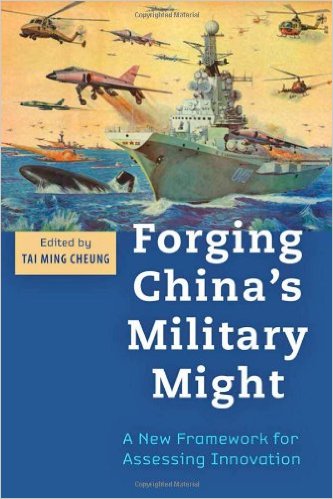
Forging China

Forging China’s Military Might: A New Framework for Assessing Innovation, edited by Tai Ming Cheung. Johns Hopkins Press, 2014. 304pp. $24.95

Review by Dr. Jeffrey Becker

Can China’s defense industry take the next step in supporting the country’s military modernization? Can it progress beyond a few well-known pockets of excellence in space and missiles to the point where the industry writ-large is capable of truly radical innovation? The CCP leadership clearly recognizes the importance of developing the nation’s defense science and technology industry, and defense industry reforms appear to be an integral part of the larger ongoing military reform process initiated at the 3rd Plenum of the 18th Party Congress in 2013. One need only look at recent Chinese writings on adjustment to weapons and equipment procurement and a growing focus on civil-military integration to see that the current leadership understands the importance of this issue to China’s future status as a military great power.

It is this context that we should view Tai Ming Cheung’s recently released edited volume, Forging China’s Military Might (2014, Johns Hopkins University Press). The results of a 2011 conference examining the Chinese defense economy held at Berkeley’s Institute on Global Conflict and Cooperation, the book tackles the question of how we should view China’s defense industry within a global comparative perspective. While the relatively long time from conference to publication is lamentable, the volume contains many essays which remain highly relevant and cover a range of topics, including analytical models designed to better understand important drivers of innovation, trends in the direction of China’s defense industry development, and detailed case studies examining important organizations within the Chinese military and defense establishment.

The volume is anchored by the theoretical chapter authored by Tai Ming Cheung, Thomas G.  Mahnken, and Andrew L. Ross. The chapter lays out a general model that allows for comparing innovation in national defense industries across countries. The details of the model are far too complex to do justice in the space here, but are certainly worthy of more in-depth examination.  In sum, the model attempts to place national defense innovation on a spectrum ranging from simplistic and duplicative imitation, to disruptive and radical innovation. Where a country falls on this spectrum depends on a number of factors, including the state’s level of technological development, their security situation, and level of global integration. The authors find that most advances in the Chinese defense industry have been more incremental than disruptive to date, a finding likely true in most countries. While this is non-controversial, the chapter also notes that China’s innovative success has been more a function of technological advancements rather than doctrinal reform or organizational change, a point some may argue given the amount of ink spilled over the past twenty years examining PLA reforms in training, organization, and doctrine. 

Of the remaining chapters, two are likely of greatest interest to CIMSEC readers in that they deal directly with issues of concern to the PLA Navy. 

The first is an examination of China’s Military Representative Offices (MROs) by Susan M. Puska et. al. China’s MRO system is the PLA’s attempt to ensure quality at all stages of weapons and equipment production. Like previous studies of this system, the authors find it to be redundant, fragmented, and largely ineffectual. However, the chapter provides useful information on relatively recent (2010-2011) attempts to experiment with changes to the PLAN’s MRO system, with the goal of incorporating them into other MRO systems once they have been deemed successful. 

Like many experiments within the Chinese military and government, reforms to the MRO system appear to have gone nowhere. However, given that the PLA now appears to be undertaking some of the widest ranging and most serious reforms in decades, it will be extremely interesting to see whether they provide an impetus to finally bring the MRO system more in line with the PLA’s current needs and requirements. Added incentive to change how the PLA manages weapons development and procurement has also come from the ongoing anti-corruption campaign, which has already taken down a number of military officials – including those involved in weapons logistics and procurement. 

The second chapter likely to be of greatest interest to CIMSEC readers is the examination of China’s place in the global defense industry by Richard A. Bitzinger et. al. The authors compare and contrast the accomplishments of China’s defense industries in the field of shipbuilding, aviation, and space launch vehicles.  The examination of China’s shipbuilding industry provides some useful detail regarding the sectors’ accomplishments and challenges. Despite the dramatic achievements made over the past two decades, the authors find the continued reliance on foreign technology to be problematic, especially should China need to ramp up production during conflict, when access to needed foreign material and components may be in short supply. The authors conclude that China’s naval shipbuilding has been “remarkable, yet short of impressive,” a more somber assessment which contrasts with some of the more optimistic predictions regarding China’s naval shipbuilding capacity over the near term.   

So what are we to expect from China’s defense industry in the near future? The assessment here is that results are likely to be mixed. Pockets of excellence in areas such as missiles, space and cyber are likely to expand and will continue to improve. Other areas such as aviation – particularly the aero-engine sector – will continue to face challenges. Key for China analysts and those who focus specifically on China’s defense industry will be to identify well in advance those early warning indicators that will allow us to determine the extent to which real change in the industry is occurring, and how to determine how much of an impact it is having on China’s ability to close the defense technology gap. This book helps to advance that conversation by providing a number of ways to look at China defense industry in comparative perspective, which will be of value to anyone seeking to answer these questions for some time to come.

Jeffrey Becker is an analyst in the CNA China Studies Division. Dr. Becker’s published books and monographs include From Peasants to Protesters: Social Ties, Resources, and Migrant Labor Contention in Contemporary China (Lexington Books, 2014), and Behind the Periscope: Leadership in China’s Navy (CNA, 2013). His current research interests include Chinese maritime issues and Chinese foreign policy in the Asia-Pacific. Dr. Becker holds a Ph.D. in political science from the George Washington University, an M.A. in political science from Columbia University, and a B.A. in international relations and Asian studies from Colgate University.

Readers interested in reviewing books for CIMSEC can contact the book review editor at books@cimsec.org.

CIMSEC content is and always will be free; consider a voluntary monthly donation to offset our operational costs. As always, it is your support and patronage that have allowed us to build this community – and we are incredibly grateful.
Select a Donation Option (USD)

Enter Donation Amount (USD)

Call for Articles: Chinese Military Strategy Week, 3-7 Aug 15

Week Dates: 3-7 Aug 15
Articles Due: 29 Jul 15
Article Length: 500-1500 Words
Submit to: nextwar(at)cimsec(dot)org

In a watershed moment, the Chinese Ministry of National Defense recently published a white paper on the Chinese Military Strategy (with an English-language version made available and published almost immediately by USNI News). This document lays out a policy for future Chinese military engagement with the world, proclaiming the centrality of active defense as the essence of the Chinese Communist Party’s military strategic thought and then describing an approach for implementing this military policy in the air, cyber, land, and maritime domains. This document comes at a particularly interesting time as General Martin Dempsey, Chairman on the Joint Chiefs of Staff, has since approved a new National Military Strategy for the United States, a strategy that names China explicitly as culpable for increased tension in the Asia-Pacific region and establishes an explicit interactive dynamic between the Chinese and U.S. strategies. While this is not the first time a U.S. National Military Strategy names China as a consideration, the shift in tone here is noteworthy.

During the first week of August, CIMSEC will host a series focused on exploring the relationship between the new Chinese military strategy and the strategic policies of the United States and others. Of particular interest are the dynamics of symmetry and asymmetry in their respective National Military Strategies (ideological, technological, doctrinal, coalitional, etc.); the implicit and explicit assumptions in each; the potentially divergent social and political purposes of such documents given their sources; and the implications for the other elements of national power in China, the United States, and the other actors (state and otherwise) in the international system. If the United States and China were to pursue their stated military strategies in whole or in part, what are the implications for their relative and absolute advantage? What are the acknowledged and unacknowledged risks for each in their stated policies?

Contributions should be between 500 and 1500 words in length and submitted no later than 29 July 2015. Publication reviews will also be accepted.

Eric Murphy is a Strategist and Operations Research Analyst with the United States Air Force and a graduate of the School of Advanced Air and Space Studies.

CIMSEC content is and always will be free; consider a voluntary monthly donation to offset our operational costs. As always, it is your support and patronage that have allowed us to build this community – and we are incredibly grateful.
Select a Donation Option (USD)

Enter Donation Amount (USD)

Distributed Basing: The Key to Distributed Lethality’s Success in the Western Pacific

The following is a submission from guest author Eric Gomez for CIMSEC’s Distributed Lethality week.

The distributed lethality concept that was unveiled in Proceedings at the start of this year represents a new way of using naval forces against an adversary attempting to deny the U.S. Navy access to a combat area. Simply put, distributed lethality calls for creating hunter-killer surface action groups (SAG) consisting of a handful of surface combatants that conduct offensive anti-submarine and anti-surface operations.

In the Western Pacific, the greatest challenges to the U.S. Navy’s surface fleet are the air, naval, and missile forces of the People’s Republic of China, which are supported by a growing array of surveillance and reconnaissance systems. However, China’s ability to track and target American surface ships is still relatively weak and could be the “Achilles’ heel” of China’s anti-access/area-denial (A2/AD) strategy. Distributed lethality seeks to exploit this surveillance weakness by putting more targets into a combat area, making tracking and targeting a more complex problem.

If implemented as intended, distributed lethality will likely succeed at making it difficult for the Chinese military to target U.S. Navy surface ships that are underway. However, the ports and base facilities in the region that the Navy depends on to keep it surface forces in the fight would be at risk. For example, the naval base at Yokosuka, Japan, the only base west of Hawaii that can repair aircraft carriers, lies within the range of Chinese land-based missiles. Bases that are protected by distance from Chinese attack, such as Guam, are too far away to play a major role in the distributed lethality concept that calls for fast tempo offensive operations.

A look at US bases in the Western Pacific (2011)

In order for distributed lethality to work, the U.S. Navy and government must start reaching out to Western Pacific partners to expand American access to naval bases and port facilities. Realistically, “expanded access” would probably look like the Enhanced Defense Cooperation Agreement with the Philippines, or the stationing of Littoral Combat Ships in Singapore. These are not full-fledged U.S. bases, but there is an expanding American military presence that should include more of the surface combatants that are the lynchpin of distributed lethality. The best way to implement the distributed lethality concept in the Western Pacific is through distributed basing, expanding the number of facilities where U.S. surface combatants can be based.

Distributed basing gives strategic heft to the distributed lethality concept in two ways. First, distributed basing increases the credibility of American extended deterrence in the Western Pacific by creating more “tripwires” similar to the token American forces stationed in Berlin during the Cold War. Second, distributed basing raises the costs of Chinese attacks by placing U.S. surface combatants alongside the military equipment of host countries. If the Chinese military wants to inflict a crippling first strike on U.S. Navy surface combatants in port, it will risk destroying the equipment and killing the personnel of another country’s military. This would likely draw that country into military conflict with China, thereby raising the economic, political, and military costs of the Chinese decision to strike.

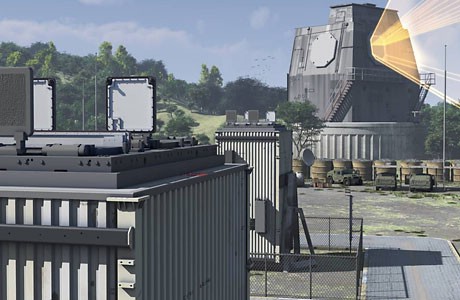
However, no military decision comes without negative consequences, and it is important to consider the costs or pitfalls of distributed basing. Bases and other facilities will have to be able to withstand attacks. There has been much discussion about hardening U.S. Air Force bases against Chinese missile attacks. Similar hardening efforts or installing the Aegis Ashore missile defense system would be two examples of American efforts to keep a

A depiction of Aegis Ashore (USNI)

distributed surface combatant force alive in the opening stages of a conflict. Fully implementing such base defenses will take time and resources, both of which might be in short supply. This could create a “window of opportunity” for Chinese military action in which the distributed lethality concept will be less effective as bases and facilities are upgraded.

Additionally, there is no guarantee that other states will allow the U.S. to implement distributed basing. Even in Japan, a U.S. treaty ally, there is considerable popular opposition to the basing of American forces. An increasingly threatening China could provide a compelling rationale for allowing American warships to be put back into bases and ports, but distributed basing is by no means a political slam dunk.

The distributed lethality concept does provide a new and potentially effective way for the U.S. Navy to respond to A2/AD threats, but more work needs to be done on the logistical side. In order for distributed lethality to be most effective, U.S. surface combatants should be distributed at more locations throughout the Western Pacific. This would enable them to get to their combat areas faster and would present more targets for the Chinese to engage in the early stages of an armed conflict. However, expanding access and distributing surface combatants across more facilities in the Western Pacific will not be easy tasks. Having the U.S. Navy spread across more facilities will not be beneficial unless those facilities can be adequately defended. Bringing many facilities up to an acceptable standard of protection will require an investment of time and resources that create a “window of opportunity” for Chinese action.

Having the distributed lethality concept is a good start because it shows the Navy is thinking creatively about new ways to counter the A2/AD strategy. However, more thinking and writing on the logistics aspect of distributed lethality needs to be done in order for distributed lethality to reach its full potential.

Eric Gomez is an independent analyst and recent Master’s graduate of the Bush School of Government and Public Service at Texas A&M University. He is working to develop expertise in regional security issues and U.S. military strategy in East Asia, with a focus on China. Eric can be reached at gomez.wellesreport@gmail.com.

CIMSEC content is and always will be free; consider a voluntary monthly donation to offset our operational costs. As always, it is your support and patronage that have allowed us to build this community – and we are incredibly grateful.

Select a Donation Option (USD)

Enter Donation Amount (USD)

East Asian Security in the Age of the Chinese Mega-Cutter

By Ryan D. Martinson

On May 19th, a formidable new Chinese ship put to sea for the first time.  As it left its berth at Jiangnan Shipyard, its onboard automatic identification system (AIS) transmitted signals for anyone who cared to receive them.  Its identity, Zhongguo Haijing 2901.  Its purpose, sea trials.  Its heading, somewhere in the East China Sea.

This was not the voyage of the Red October.  Zhongguo Haijing 2901 is not a stealthy nuclear submarine able to menace foreign capitals, or sink foreign fleets.  Nor is it a sister ship to China’s Liaoning (CV-16), that other potent symbol of sea power, the aircraft carrier. Indeed, by naval standards, its combat capabilities belong to an earlier age—the 19th century.

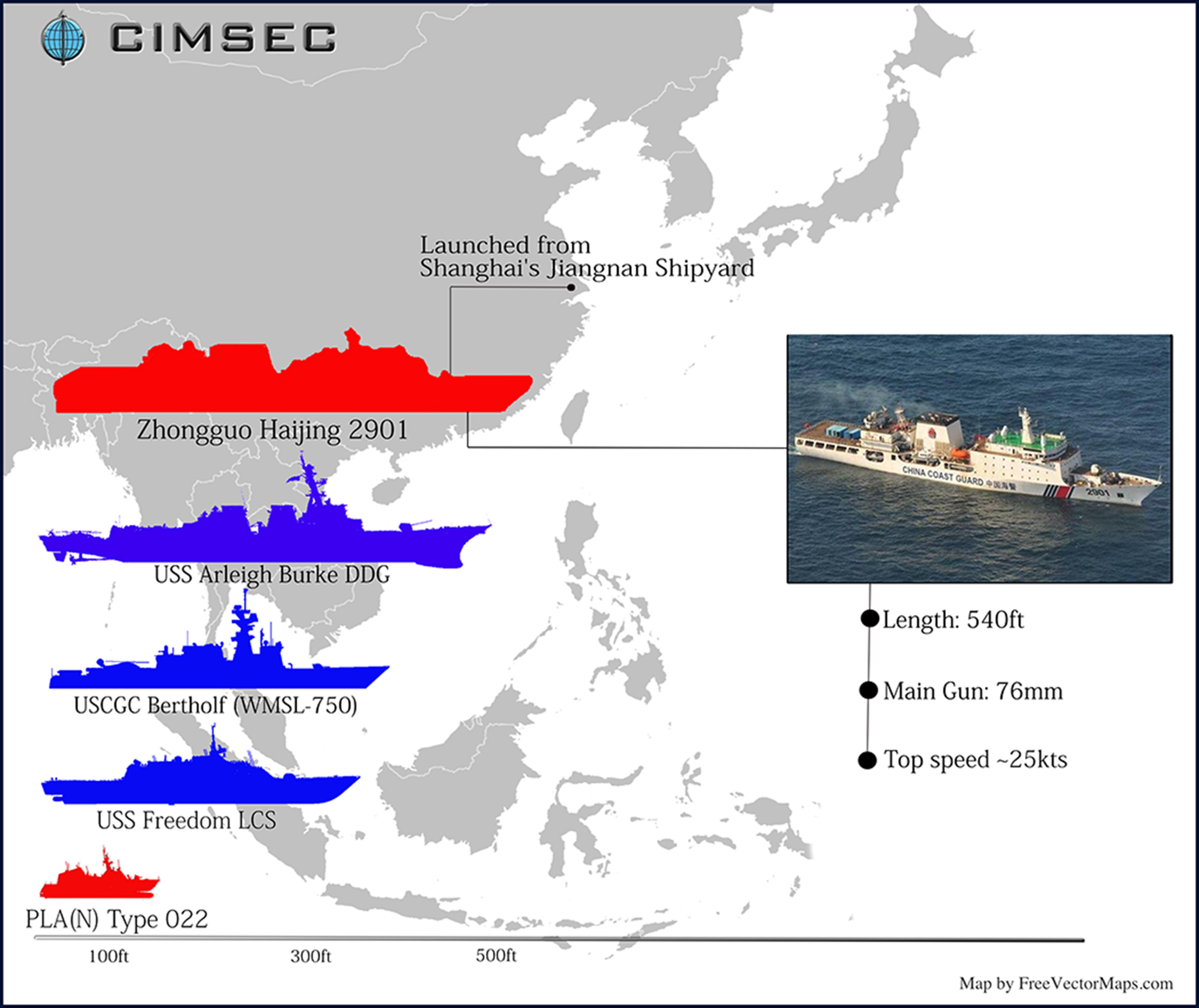
However, Zhongguo Haijing, or China Coast Guard (CCG) 2901, was not built to fight wars.  At over 10,000 metric tons, it is by far the world’s largest constabulary vessel, a class of ship operating at the vanguard of China’s peacetime expansion in maritime East Asia. When it is commissioned sometime in the coming weeks, it will provide a huge advantage to China in the battle of wills taking place along its maritime periphery.

The New Chinese Coast Guard Mega-Cutter/FreeVectorMaps.com

Building the Mega-Cutter

During the 2010-2012 period, Chinese policymakers made a series of decisions to vastly expand the capabilities of the country’s maritime law enforcement agencies.  They envisioned a great fleet of ships charged with advancing Beijing’s claims to waters and islands hundreds of miles away from the mainland coast, performing what Chinese texts euphemistically refer to as “rights protection” operations.  In the last two years, the China Coast Guard has received dozens of new ships, many of which have been used to buttress new footholds at Scarborough Reef, the Second Thomas Shoal, the Luconia Breakers, and the Senkaku Islands, and underwrite economic activities in disputed waters, most notably the two-month drilling operations of HYSY 981 in 2014.  CCG 2901 is an outcome of this surge in shipbuilding.

That CCG 2901 would someday put to sea was not a secret. In July 2013, the head of China State Shipbuilding Corporation, Hu Wenming, declared that his company would “accelerate research and development” of maritime law enforcement cutters displacing between 4,000-10,000 metric tons.  In January 2014, the research affiliate of another state shipbuilding firm revealed that the previous year it had signed a contract to do design work for this new ship class.  By late 2014, Chinese netizens were posting photos of the ship in the latter stages of construction.

That CCG 2901 would be studded with deck guns was not a given. Indeed, it represents a noteworthy breach of precedent: almost all of the new ships procured by the China Coast Guard have been unarmed.  This allows Chinese ships to aggressively engage the state and private craft of other countries without conjuring images of gunboat diplomacy or precipitating a war. With CCG 2901, the deterrent value of deck guns trumps these old aversions.

When it is commissioned, 2901 will be based at one of three cities with direct access to the East China Sea. Most likely it will be stationed along Shanghai’s Huangpu River, a hub of Chinese coast guard activity.  It may eventually find a home at a large new base to be built further south in Wenzhou.  It will primarily conduct missions to areas China disputes with Japan, including the sovereign waters adjacent to the Senkaku Islands. However like other ships based in these ports it will no doubt periodically patrol the South China Sea, working with sister units in Guangxi, Guangdong, and Hainan to impose the Chinese legal order in disputed waters.

CCG 2901 is the first, but not the last, of its class.  A second ship is in the latter stages of construction at Jiangnan Shipyard.  It will almost certainly be based at a facility with easy access to the South China Sea, probably on the banks of the Pearl River in the city of Guangzhou (Guangdong).

Sprinting to Superiority

Just a few years ago, the idea of Chinese maritime predominance was pure fantasy.  This is illustrated in a little-remembered confrontation between Japanese and Chinese forces that took place in 2002.  In December of the previous year, the Japan Coast Guard sank an armed North Korean trawler operating near the Japanese coast, an encounter that Wikipedia grandiosely calls the Battle of Amami-Ōshima.

After hours of fight and flight, the trawler ultimately went down in Chinese jurisdictional waters.  Japanese policymakers decided to raise the wreck, causing consternation among Chinese leaders.  The operation would involve questions of Chinese rights and interests embodied within the United Nations Convention on the Law of the Sea (UNCLOS), which China ratified six years earlier.  In response, Chinese policymakers instructed the China Marine Surveillance (CMS), a maritime law enforcement agency, to deploy a task force of ships to monitor the Japanese operations.

The CMS task force was ordered to “maintain presence and show jurisdiction,” that is, to be present to remind the Japanese who had authority.  But if the Chinese record is any guide, it was clear that the Japanese were in charge. According to the recollections of the CMS task force commander, Liu Zhendong, Japan created a security perimeter around the site, barring Chinese access to the salvage operations.  It could do so because it was able to muster many more ships: as many as 19 vessels, while CMS could send at most four, cobbled together from units from all over the country.  Moreover, Japan’s cutters were much larger than China’s. Among the ships buttressing Japan’s security perimeter was the 6,500 ton Shikishima (PLH-31)—the world’s largest coast guard ship. In the end, China was forced to resort to guile to gain access to the salvage operations: it accused a Japanese ship of leaking oil, a violation of China’s environmental protection laws.

In little more than a decade, the tables have completely turned. While Japan has a much more capable coast guard in many respects—it operates far more and better aircraft; its ships are more capable, their crews better trained—its white fleet is now much smaller than China’s, at the same time that the area of waters under its administration is far larger. And of course, with the commissioning of CCG 2901, China, not Japan, will own the world’s largest coast guard cutter.

Bigger is Always Better

In the type of missions China’s coast guard is asked to perform, ship size is a key determinant of capability. This differs from modern naval combat, where a 225 ton boat firing long-range cruise missiles might level a 100,000 ton super carrier. While the China Coast Guard does use water cannons, sirens, and other non-lethal measures to cow foreign mariners, the primary instrument of coercion is the ship itself.

This advantage was illustrated in a May 2012 encounter between a Chinese maritime law enforcement vessel—the 4,000 metric ton Haijian 83—and a much smaller foreign ship, probably Vietnamese.  As Haijian 83 sailed through disputed waters in the South China Sea, it was approached and ordered to leave by personnel on the foreign patrol vessel.  As the two ships got closer, the Chinese commander requested permission from superiors ashore to engage.  When this was granted, he ordered his ship to steam “full speed ahead” (kaizu mali), directly at the other craft. Given the size differential, the foreign ship had no choice but to retreat, which is what happened.

As this example shows, the type of confrontation taking place between non-naval vessels is akin to a game of chicken.  When two ships are close in size, nerve and seamanship go a long way, since neither side wants a collision.  When there is a major size disparity, the larger ship can simply drive others away. Indeed, when advantages in speed are combined with advantages size, a big ship can even sink a smaller craft.  At least one Vietnamese boat suffered this fate during contentious encounters in waters surrounding HYSY 981 in mid-2014.

The Implications of China’s Maritime Megalomania

When CCG 2901 does eventually deploy to disputed waters in the East China Sea, Japan may have few options. Because of its enormous size, this ship will sail and operate at will. Japan will be forced to either accept its unfettered movements, or escalate the conflict, which it will naturally be reluctant to do. During a moment of bilateral friction, CCG 2901 may even attempt to expel Japanese Coast Guard ships operating near the Senkaku Islands. Again, in that case Japan’s decision makers, beginning with front line commanders, will be faced with very difficult choices.  Chinese policymakers may assume Japan will back down no matter what China does. That would be a grave misjudgment.  Thus, with the commissioning of CCG 2901, the possibility of a shooting war in the East China Sea increases.

The Chinese mega-cutter will play a different role in the South China Sea, where Chinese forces already outmatch other disputants.  With its range and carrying capacity, it will be able to easily sail the great distances to China’s most remote claims and remain in disputed waters for long periods of time. Of most concern, these ships may engage foreign naval vessels, including those of the U.S. Navy.  In April 2014, both China and the U.S. approved a Code for Unplanned Encounters at Sea (CUES), an agreement to ensure professional behavior when foreign warships unexpectedly meet while on deployment.  However, the document only applies to naval vessels: the ships of the China Coast Guard and other maritime law enforcement entities are not required to adhere to its provisions.  Thus, U.S. naval commanders now must prepare for the possibility of testy encounters with Chinese mega-cutters on the high seas in peacetime, when their advanced weapons systems will do them little good.  This is an uncomfortable prospect given that China’s mega-cutters are larger than most U.S. surface combatants and positively dwarf the 3,500-ton USS Forth Worth (LCS-3) that recently patrolled waters near the Spratly Islands.

The strategic and operational implications of CCG 2901 should be the primary concern of other states. But it is also important to reflect on the chain of policy decisions that willed CCG 2901 into being. China has invested hundreds of millions of yuan to design and build this ship, and will spend hundreds of millions more to man, maintain, and replenish it over the course of its lifetime. Yet it exists for a single reason: to help China achieve peacetime dominance in Chinese-claimed waters.  Thus, the decision to build a class of 10,000-ton cutters should be seen as a measure of China’s resolve to prevail in its disputes.

Foreign states will no doubt react with fear and suspicion to the commissioning of these two armed mega-cutters. Chinese leaders must know this.  Just as they must have known that placing HYSY 981 in Vietnamese-claimed waters and building bases in the Spratly Archipelago would result in handwringing among its neighbors.  Not long ago, policies that risked inducing these emotions abroad found few supporters in Chinese councils of state.  The decision to build these ships, then, is another brushstroke in the portrait of a leadership operating on new assumptions, a state that does not fear the costs of its expansionary behavior, or one that believes they can and should be borne for the rewards they redeem.

Ryan D. Martinson is research administrator at the China Maritime Studies Institute (CMSI). He holds a master’s degree from the Tufts University Fletcher School of Law and Diplomacy and a bachelor of science from Union College. Martinson has also studied at Fudan University, the Beijing Language and Culture University, and the Hopkins-Nanjing Center. He edits the CMSI Red Book series and researches China’s maritime policy. The views expressed are those of the author and do not reflect the official policy or position of the US Navy, Department of Defense or the US Government.

CIMSEC is and always will be free for everyone, but we would be grateful for those who wish to provide a modest regular donation to support our operations.
Select a Donation Option (USD)

Enter Donation Amount (USD)