Category Archives: Asia-Pacific

Analysis relating to USPACOM.

The Nature of the PRC’s National Defense and Military Reform

By Ching Chang

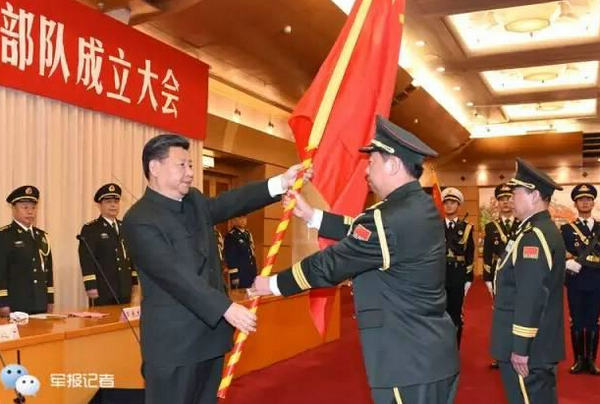
Last November, after an augmented meeting on reformed policies hosted by the Central Military Commission in Beijing, the longtime prepared and formulated reform of the People’s Liberation Army was eventually activated. This Meeting was assembled on November 24, 2015, and attended by all the major senior cadres of the defense establishment and various services. 

Many features of the coming national defense and military reform were disclosed through the defense spokesmen system right after the meeting. Given the length of the meeting and the scale of participants, it is believed that directives of the reform were already settled by high authorities. No substantial discussion likely took place in this significant gathering of defense elites. Flag officers and commanding generals are only told the predetermined implementation plan. Somehow this reform may seemingly be like the traditional saying, “Theirs not to reason why. Theirs but to do and die.”

IMG_6650
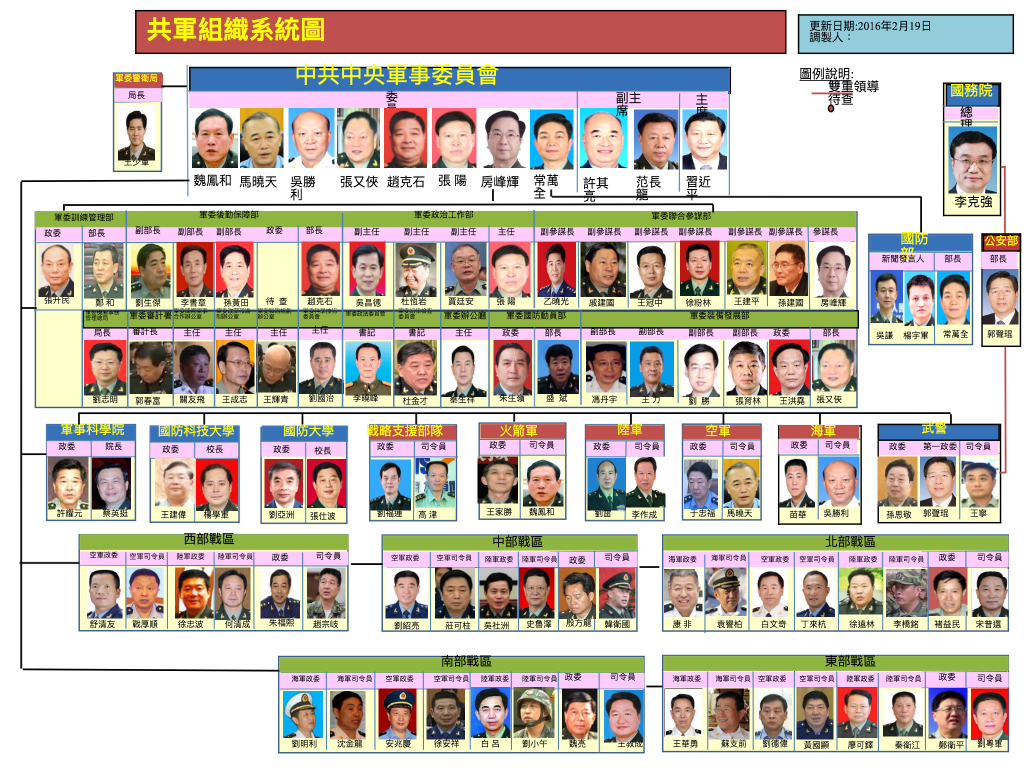
The new PLA leadership after reorganization. Edited by LTC. Huang, W. Y., ROCA, a teaching staff of the National Defense University, Republic of China

Later at the end of 2015, the Central Military Commission of the People’s Republic of China released a guideline known as “The Opinions of the Central Military Commission on Deepening the National Defense and Military Reform” (中央軍委關於深化國防與軍隊改革的意見), which provided more detail information about items of the inevitable restructuring process. Many political commentators and military observers put their efforts on features subsequently announced by the Chinese military including establishing new units, redefining AORs (Areas of Responsibility) and name list of the freshly appointed military leadership.

Indeed, grasping the progress of the reorganization can be very helpful to acquire information about many features but it is less productive for us to understand the logic behind the reform process. Understanding the nature of the PRC’s national defense and military reform is more valuable to access the thinking behind the decision making modus operandi of the People’s Liberation Army leadership or even their political masters. By reviewing the history of the military reform planning process started right after Mr. Xi Jinping inaugurated the Chairman of the Central Military Commission until now and the contents of the associated policy documents, we may conclude key attributes regarding the nature of the PRC’s national defense and military reform.

First, this reform is parallel to the tempo of Chinese society by its essence. It is only a part of the overall reform in Xi’s political engineering blueprint. All the issues noted in this deepening national defense and military reform process not only reflect demands from the external strategic environment but also attempt to satisfy the expectations originating from the People’s Liberation Army elites.

Deepening national defense and military reform is a political engineering parallel with the tempo of the whole society. The military can not proceed the reform tasks all by itself.

Why may it take more than two years to formulate a guideline for substantiating the military reform? The answer is simple and straightforward. The defense and military reform itself does not act alone. There are many factors associated with other governing mechanisms in Chinese society. The military reform is only a segment of the overall reform endeavor advocated by the Chinese Communist Party. As the defense authority would like to proceed with its reform efforts, it is necessary for them to acquire mature social prerequisites and suitable political conditions.

The overall reform policy was actually settled by the Third Plenary Session of the Eighteenth Chinese Communist Party Central Committee. On November 12, 2013, a policy document known as “The Decision on Major Issues Concerning Comprehensively Deepening Reforms” (中共中央關於全面深化改革若干重大問題的決定) was approved by the Central Committee of the Chinese Communist Party. In the document containing sixteen chapters, Chapter Fifteen includes Point 55 to 57 which present the following directives:

Chapter XV—National defense and military reform

The People’s Liberation Army must be loyal to the Chinese Communist Party, be able to win and be persistent with its good traditions.

  1. Deepen the reform of the military’s composition and functions. Improve the combined combat command systems of the Central Military Commission and military commands. Push forward reform of training and logistics for joint combat operations. Optimize the structure and command mechanism of the Armed Police Force. Adjust the personnel composition of the military and reduce non-combatant departments and staff members.
  2. Boost the adjustment of military policies and mechanisms. A modern personnel system for officers will gradually take shape with the establishment of an all-volunteer officer system as the initial step. Improve management of military expenditures.
  3. Boost coordinated development of military and civilian industries. Reform the development, production and procurement of weapons. Encourage private businesses to invest in the development and repair sectors of military products.

Given the complexity and the structure of this policy document, this is why it took such a long period of time after Xi was elected to chair the Central Military Commission and declare his intention of military reform in the first Central Military Commission Standing Committee Meeting. Further. The People’s Liberation Army needs resources granted by the whole of society to support its own reform. Chinese society must accommodate decommissioned manpower released by the military during this reform process. The military reform is therefore a segment in the larger social and political reform project. How can you put your eyes only on a single branch but ignore the whole tree?

The leadership of the communist party is unchallengeable in the military reform process.

Second, the military reform in the PRC once again reaffirmed the Chinese Communist Party’s leadership over the People’s Liberation Army. Although many features exposed by the reform themselves are seemingly promoting the military professionalism, nevertheless, according to the decision-making procedures, the political masters of the military still hold a tight grip on the armed forces in China as always addressed by the tradition known as “the party commands the gun.”

As already mentioned, Mr. Xi has clearly blown the trumpet of military reform right after taking the power of military command in the First Plenary Session of the Eighteenth Chinese Communist Party Central Committee. No key decision had been made nor was clear policy declared on military reform until the eventual policy of a comprehensive social and political reform project was settled by the Chinese Communist Party in its Third Plenary Session of the Eighteenth Central Committee occurring 9–12 November 2013.

The Leading Group for the National Defence and Military Reform of the Central Military Commission (中央軍委深化國防與軍隊改革領導小組) was immediately organized and personally chaired by Mr. Xi, the Chairman of the Central Military Commission, and held its first meeting in early 2014. The second meeting of this leading group was held on January 17, 2015. At the moment, it was known that the military had already successfully coordinated with other government departments and local governments to support their reform tasks through party arbitration mechanisms. Expected resistance within the military was also eliminated by these external sponsorships. It vividly indicates the role played by the communist party within the reform process.

IMG_6662
The national defense and military reform is in essence an issue very transparent to the Chinese society.

The Proposal of Deepening National Defense and Military Reform Overall Plan (深化國防與軍隊改革總體方案建議) eventually completed drafting in the third meeting of the Leading Group for National Defence and Military Reform of the Central Military Commission on July 14, 2015. It is essential to note that this proposal still needs to be reviewed by the Central Military Commission Standing Committee by July 22 even though both mechanisms are chaired by Mr. Xi. Finally, the proposal was approved by the Political Standing Committee of the Chinese Communist Party, again chaired by Mr. Xi, later on July 29.

After the political decision was made by the party decision-making mechanism, the Central Military Commission Standing Committee in its routine meeting on October 16 started to inspect the Implementation Plan for Administration and Command Structure Reform (領導指揮體制改革實施方案) submitted by the Leading Group for National Defence and Military Reform of the Central Military Commission according to the party-approved proposal. All features of the PRC’s military reform presented to the public was actually settled by this implementation plan, not from any discussion in the augmented meeting assembled on November 24, 2015. In this decision process proceeding between party and military decision making system, even these mechanisms are basically chaired by Xi. There is no doubt the Chinese Communist Party is still effectively exercising its leadership over the People’s Liberation Army. Regardless of the military professionalism indicated by the features shown in the military reform, the party is still the boss of these military professionals.

Last but not the least, the transparency of the military reform is unquestionably significant. There is a general trend of accusing the transparency of Chinese policies or actions in the community of Chinese observers. Rarely do Chinese experts ever thoroughly read these documents openly released by the communist authorities before criticizing transparency. As noted in this article, dates of decision making meetings and documents of reform policies are essentially quite transparent. At least in two documents already mentioned, the Decision on Major Issues Concerning Comprehensively Deepening Reforms and the Opinions of the Central Military Commission on Deepening the National Defense and Military Reform, are openly available. All features attracting media concern are already listed by these two documents.

IMG_6663
Many military professionals’ careers will be undermined by the reform process.

This military reform may affect the careers and families of many military personnel. It may also undermine interests of defense industries and local economies. Social engineering of this scale cannot be totally concealed. Three hundred thousand military personnel will be decommissioned by this reform. Many units will be eliminated and their assets need to be disposed of. It is impossible to shut the door and engage with the reform only by the military itself. Can Chinese military experts know the right sources to understand the nature of the People’s Liberation Army’s reform?

The content of these two documents not only address the tasks that need to be done but also consequences that should be actively prevented. This position is considerably pragmatic. Many possible corruptive actions are warned of. To some extent, no intention to ignore the dark side of the human nature that possibly fishing in the trouble water is also evidently presented by the texts of the policy document. These possibly embarrassing issues can be noted by texts with no preservation. The degree of transparency should be undeniable.

However, it is necessary to remember that the title of the Opinions of the Central Military Commission on Deepening the National Defense and Military Reform implies that there are still many uncertainties existing within the future reform process. According to Article Nine of the Procedures for Handling Official Documents in the Administrative Departments of the Government for the PRC, the definition of a document with the title of “opinion” is “An opinion shall be given when providing opinion over important issues and the solutions thereof.” Unlike “decision” its definition is “A decision shall be given in the following situation: deciding on important issues or actions, granting citations to relevant work units and personnel, changing or cancelling inappropriate decisions made by sub-branches.” Are the solutions of all the PRC’s military reform tasks completely settled? Obviously not! Otherwise, the document would be titled with “decision,” not “opinion.”

The features of the military reform involve much information to analyze, but to understand the nature of the People’s Liberation Army reform is the essential foundation to solve this game of jigsaw. Without knowing the fundamental characteristics of this reorganization process, we may only act like a dog chasing its own tail with no result at all.

Chang Ching is a Research Fellow with the Society for Strategic Studies, Republic of China. The views expressed in this article are his own.

A Comparative View of the Ancient and 21st Century Maritime Silk Roads

By Mohid Iftikhar and Dr. Faizullah Abbasi

From a historical perspective, the term Silk Road was not commonly used until it was coined by German Geographer Ferdinand von Richthofen in 1877. The ancient Silk Road continues to captivate various fields of study including history, sociology, archeology, politics, and international relations. In a general sense, the Silk Road is known as a series of routes that connected Asia, Europe and Africa, both through land and the sea. The 20th Century brought about various debates for the Silk Road and its revival. In 2013, Chinese Presient Xi Jinping advocated for the revival of the New Silk Road under objectives of regional cooperation and harmony. The 21st Century Maritime Silk Road is a revitalized phenomenon under the ancient concept that promotes globalization under the principles of peace, mutual economic benefits, and sustainable development in the maritime sphere. This article aims to offer a comparative view between the ancient and 21st Century Maritime Silk Road.

Ancient Maritime Silk Road

In the book “The Silk Road: Travel, Trade, War and Faith” Whitefield and Williams (2004) argue that some discrepancy exists with regard to names and places associated to the Silk Road. Any form of text relating to the Silk Road is on account of human narratives, where myths play an equally important role. Exchange between civilizations (religion art, trade, etc.) has contributed to this variety of viewpoints. One of the most integral elements of the Silk Road was the maritime domain. The ancient maritime Silk Road emerged as a new economic architecture that was beyond trade, embryonic to social interaction, political dependence, and a shift in power relations. However, counterintuitive arguments have been introduced in the 20th century from scholars that reflect upon dimensions of imperialism.

Geographically, the ancient maritime Silk Road had two routes, one from China to the East China Sea linking to the Korean peninsula, and the second from China to South China Sea, Southeast Asia, South Asia, Arabian Sea, Indian Ocean and the Persian Gulf. Archeological evidence suggests maritime transportation dates back to thousands of years before inception of the Silk Road.  However, the seaborne trade routes for the Silk Road strengthened during the time of Han Dynasty in China.  In an article by Koh (2015) “21st Century Maritime Silk Road,” it is suggested that one important aspect of the ancient maritime Silk Road was freedom and autonomy of navigation, which remains the prime reason for exploration of the seas and close contact of civilizations leading to cooperation and trade.

Until the 7th Century, land routes were preferred and profitable. It was an era where Chinese, Romans and Parthians flourished. But later, new powers emerged, and Arabs played a central role in the rise of the maritime Silk Road.  The maritime route gained favor over land due to the capacity for greater volume of shipments and relative safety compared to the looting and thefts on land routes. Historical notes on the ancient maritime Silk Road define constituents of peace beyond commerce. Hence art, culture, and religion were the key factors for co-existence and tolerance amongst various civilizations. But there were noticeable drawbacks to the ancient maritime Silk Road, including unpredictable weather and harsh storms that vanished wreckage of ships. Further, there were dangerous straits which were crucial in relation to navigational expertise and control for power, and later the rise in piracy emerged as a result of Mongol dominance of the Silk Road.

The 21st Century Maritime Silk Road

MSR

The 21st Century Maritime Silk “Road” (MSR) will begin from China, moving on to the South China Sea and then Southeast Asia, the Indian Ocean, Africa, and Europe. The southern extension of the route offers access to the South Pacific. According to the National Development and Reform Commission of China (2015), the New Silk Road is based on five principles of the United Nations charter: mutual respect, mutual non-aggression, mutual non-interference, equality and mutual benefit, and peaceful coexistence. The MSR would play a vital role for development in the seas through regional cooperation based on infrastructure development, financial integration, free trade, and scientific and human exchanges. The same is supported by academic literature and government reports that how the MSR may evolve newer patterns of regional trade and diplomacy.

China’s ambitions support a multilateral approach under international relations where cooperation is promoted on common interests. On similar lines, many experts have raised speculations towards ownership, governance, geo-politics, and prevailing conflicts in the South China Sea.  Can initiatives such as the Asian Infrastructure Investment Bank (AIIB) indicate practical steps from China that defy perceptions limiting political constructs towards hegemony? What is important to understand in today’s context is that development and harmony would fail through a bilateral or a unilateral approach.  Collaboration between states through the MSR not only produces economic gains, but results in greater exchange between societies that will promote culture rooted in harmony and cooperation.

A comparative view of the Ancient and 21st Century Maritime Silk Road includes varying perspectives. However, common grounds are based on principles of economic exchanges through  peace in a humanistic approach that strengthens regional integration through cooperation and cultural avenues. The significant difference for MSR today falls under freedom of navigation. International laws and regulations have defined boundaries, which was not the case in ancient times. Another prominent facet of ancient times was the draw of exploration of the seas. Civilizations wanted to get in contact for trade, prosperity, and learning. What remains a question with regard to today’s geo-political dynamics is the following: can great powers co-exist, especially with today’s complex political dynamics? The rhetorical debate over the 21st Century Maritime Silk Road has ambiguities, but participating nations from Europe, Africa and Asia must realize the need for an integrated network. Like ancient times, states need their economic expertise to be promoted, which not only manifests itself in monetary value, but also in mutually cooperative societies that may initiate a sustainable track towards global peace.

Mohid Iftikhar has a Masters of Philosophy in Peace & Conflict Studies from National Defence University, Pakistan and a Bachelors in Business Administration from University of Southern Queensland, Australia. He has completed a short course on Defence & Security Management in collaboration with Defence Academy, UK, Cranfield University and NDU, PK.  He is a member of Center for International Maritime Security and Associate member, the Corbett Centre for Maritime Policy Studies, King’s College London. At present he is a Deputy Director at Center of Innovation, Research, Creativity, Learning & Entrepreneurship (CIRCLE) at Dawood University of Engineering & Technology Pakistan. His views are his own.

Dr. Faizullah Abbasi has a Masters in Production Management and Manufacturing Technology from Strathclyde, UK, and PhD from University of Sheffield, UK. He is a distinguished Professor and expert on Industrial Growth and Oil and Gas Development. Currently, he is the Vice Chancellor Dawood University of Engineering & Technology Pakistan. His views are his own.

Distributed Lethality: China is Doing it Right

Distributed Lethality Topic Week

By Alan Cummings

Distributed lethality is about “increasing individual warship lethality and then combining surface warships in innovative ways.” We can add some 21st Century flair to the details, but the premise remains the essence of warships since time immemorial: go to sea and kill your enemy. Frankly, the U.S. Navy’s (USN’s) surface fleet is playing catch-up after the post-Cold War/ low-naval-threats era of the 1990s and 2000s. The fact that we needed to verify the value of capable warships with “a rigorous program of analytics” and numerous war games seems a poignant expression of the tactical and bureaucratic disconnect in the past decades. So for now, check out China and the People’s Liberation Army (Navy) (PLA(N)) if you want an example of Distributed Lethality in action.

The PLA(N) began building modern warships in the 1990s when they laid the keels for their first Luhu, Luhai, and Jiangwei-class vessels. Those vessels and every class of surface combatant since have counted anti-ship cruise missiles (ASCMs) as their primary armament. Which is to say they were each deadly in the anti-surface warfare (ASuW) arena from day one. Ironically, as China was ramping up production of lethal surface combatants, the U.S. was ramping down. The last Arleigh Burke to incorporate the RGM-84 HARPOON (USS Porter, DDG 78) slid off the blocks in 1997 and every U.S. destroyer built since has been oriented around air defense. What little ASuW capability these later destroyers have is reliant on firing an SM-2 missile designed for air warfare in a secondary ASuW mode.

Fast forward to 2015, and you have two comparisons of the USN and PLA(N)- first by tonnage, then by strike-mile lethality.

Chart 1
USN vs PLA(N) Surface Combatants by Tonnage
chae
USN vs PLA(N) Surface Combatants by ASuW Strike-Mile

As you can see, the USN may have the edge in tonnage but the PLA(N) takes the prize for lethality. It turns out the PLA(N) also has more hulls- which means their tonnage and armament are more, wait for it, distributed.  Granted, a lot of that distribution resides in their Houbei PTGs. But if you’re focused on regional sea control, say like the South China Sea and Western Pacific, then those low-cost/high-lethality combatants are the perfect thing to disperse across contested locations, key transit areas, and chokepoints.

Today’s bottom line is that the PLA(N) can field more ASCMs and a wider variety of platforms than the USN. For most of the PLA(N), that lethality comes in the form of a warship with at least four YJ-83s, each delivering a 419-lbs warhead up to 100NM (some vessels have ASCMs with even longer ranges, like the YJ-18 and YJ-62). This means combatants with YJ-83s can hold a 200NM-diameter circle (or 31,400NM2) at risk of lethal effects. The Spratly Islands for example claim 120,000NM2; strategic distribution of a four-ship PLA(N) surface action group (SAG) gives ASCM coverage to 125,600NM2.  Raising the hull count or employing multiple SAGs makes the situation all the more frightening. Cue these vessels with rough targeting data (a.k.a. maritime domain awareness) from a Fiery Cross-based patrol aircraft and the PLA(N) has a full-blown system of distributed lethality.

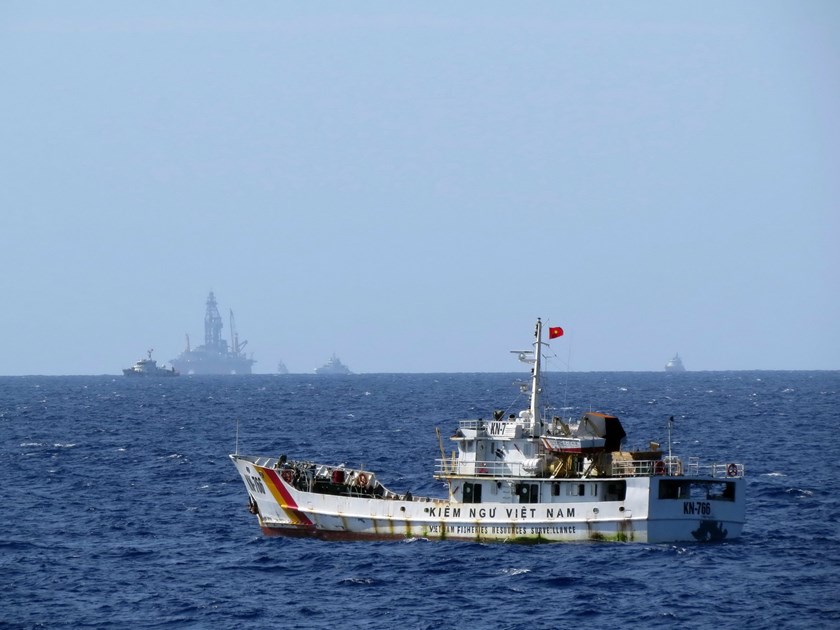
Holding short of a war at sea, PLA(N) combatants are the muscle behind China’s maritime presence and influence operations. PLA General Zhang Zhaozhong implied this in early 2013, calling it a “cabbage strategy” to surround contested maritime claims (like Second Thomas Shoal) with layers of civilian, government, and military vessels. Then in 2014, PLA(N) vessels helped escort the Haiyang Shiyou 981 drilling rig in 2014 despite Chinese statements to the contrary. Talk about “combining surface warships in innovative ways,” China is using them as part of a layered politico-military offense to advance their maritime claims, one that easily transitions to combat operations if things deteriorate.

Implementing distributed lethality requires sound doctrine and a practiced C2 structure. That’s where the USN carries the advantage (for now) while we implement expedients like the modified TLAM and SM-6. However, much of our doctrine is either available via open source research or may have been compromised by cyber warfare. For example, the majority of our own textbook on “Surface Tactics 101” is available via a quick Google search for MTP-1D (the Multinational Maritime Tactical Signal and Maneuvering Book). Paired with the equally available NWP 3-56 Composite Warfare Doctrine, and five minutes of Google research has provided the fundamentals of distributed tactics.

Whether the PLA(N) has incorporated U.S. C2 doctrine or developed a native system is likely hidden in classified reporting. However, we can look at broader open source examples to evaluate how practiced they are at operating warships together. For instance, rehearsals of combat resupply demonstrate coordination amongst combatants and the entire logistics train. Recent exercises with Russia, Australia, and the U.S.  illustrate that the PLA(N) has become a capable partner for live fire exercises, amphibious landings, and maneuvering drills amongst other evolutions. I was once told that the key to combat at sea is showing up to the right location, on time, with weapons and radios that work (which may have been borrowed from someone else). I believe that is a valid definition, particularly in the context of distributed lethality, and one that the PLA(N) appears to be meeting.

If one is inclined to dismiss exercises and drills as liable to heavy scripting, then the PLA(N)’s blue water deployments show their C2 abilities are no fluke. These complicated operations (and the C2 required for them) are one snapshot in an evolution of PLA(N) doctrine that runs concurrent with their progress in warship technology. Even the larger Chinese defense organization is adapting to facilitate coordinated operations. Two of the five newly inaugurated theater commands will likely be tasked with maritime-centric missions in the East and South China Seas. More important than today’s snapshot, these trends indicate where China wants to take their C2 ability tomorrow. So what do these strategic moves mean for distributed tactics? If China has the C2 infrastructure, logistics support, and trust in its commanders to operate independently around the world then it stands to reason they can operate together in China’s near abroad.

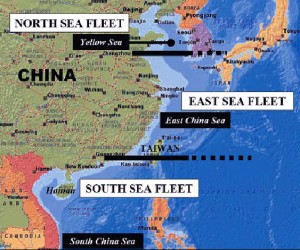
Which brings up my last point on distributed lethality in the PLA(N): they win by implementing it locally. Warships from China’s East Sea Fleet at Ningbo need to cover 400NM to be in the disputed Senkaku Islands, while South Sea Fleet ships from Zhanjiang are 700NM from the Spratly Islands. PLA(N) vessels can cycle through combat patrols, maintenance periods, training evolutions, and resupply hops in 1/3 the distance a U.S. destroyer covers transiting from San Diego to Hawaii. Meanwhile, the USN still needs the missiles, variety of hulls (small, medium, and large combatants), and regional partners to make distributed lethality work in the Asia Pacific. China need only cast off lines.

Tactics come down to your ability to shoot, move, and communicate. Most of the USN surface fleet can move and communicate around the world, but can’t authoritatively prosecute a surface engagement. The PLA(N) is working on the skills to communicate in a coordinated attack, but they can move with ease in their near seas and they designed their surface combatants as shooters from the beginning. Both sides have identified where they are and where they want to go as far as tactical capability (which, for good or ill, seems to be similar places). So which challenge is easier- learning C2, or refitting and retraining a fleet? I guess the race is on.

Alan Cummings commissioned from Jacksonville University in 2007 and served as a Surface Warfare Officer in the USN until 2013. The opinions here are his own and do not represent the position of the U.S. government. Some material used here is drawn from research being considered for publication elsewhere. Original data is available via valid requests submitted to nextwar@cimsec.org.

Publication Release: Chinese Military Strategy Week

Released: February 2016

The CIMSEC Chinese Military Strategy topic week ran from August 3-7, 2015 and featured shortly after a new Chinese Military Strategy white paper was released in May 2015, and after a new U.S. National Military Strategy was released in July 2015. Authors sought to identify key takeaways from the new Chinese white paper, establish historical context, and several compared the new Chinese document to the American strategy. 

Authors:Screenshot_1
Paul Pryce
Sherman Xiaogang Lai
Chad M. Pillai 
Jack McKechnie
Jan Stockbruegger
Chang Ching
Eric Gomez
Debalina Ghoshal
Amanda Conklin
Justin Chock
Xunchao Zhang

Editors:
Eric Murphy

Dmitry Filipoff
Matt Hipple
Matt Merighi
John Stryker

Download Here

Articles:
The Influence of Han Feizi on  China’s Defence Policy By Paul Pryce

From Expediency to the Strategic Chinese Dream? By Sherman Xiaogang Lai
Where You Stand Depends on Where You Sit: U.S. & Chinese Strategic Views By Daniel Hartnett
Bear, Dragon & Eagle: Russian, Chinese & U.S. Military Strategies By Chad M. Pillai
Avoiding Conditions for an Asia-Pacific Cold War By Jack McKechnie
Beyond the Security Dilemma? De-Escalating Tension in the South China Sea By Jan Stockbruegger
A Grain of Contextual Salt in the Chinese Military Strategy By Chang Ching
Deep Accomodation: The Best Option for Preventing War in the Taiwan Strait By Eric Gomez
Assessing China’s Nuclear Ambitions By Debalina Ghoshal
The Unnamed Protagonist in China’s Maritime Objectives By Amanda Conklin
A Pacific Rebalance with Chinese Characteristics By Justin Chock
Becoming a Maritime Power? The First Chinese base in the Indian Ocean? By Xunchao Zhang

Be sure to browse other compendiums in the publications tab, and feel free send compendium ideas to Publications@cimsec.org.

[otw_shortcode_button href=”https://cimsec.org/buying-cimsec-war-bonds/18115″ size=”medium” icon_position=”right” shape=”round” color_class=”otw-blue”]Donate to CIMSEC![/otw_shortcode_button]