Category Archives: Asia-Pacific

Analysis relating to USPACOM.

US Department of State Seeks to Clarify Meaning of China’s 9-Dash Line: Finale

By Alex Calvo

This is the fifth installment in a five-part series summarizing and commenting the 5 December 2014 US Department of State “Limits in the Seas” issue explaining the different ways in which one may interpret Chinese maritime claims in the South China Sea. It is a long-standing US policy to try to get China to frame her maritime claims in terms of UNCLOS. Read part one, part two, part three, part four

[otw_shortcode_button href=”https://cimsec.org/buying-cimsec-war-bonds/18115″ size=”medium” icon_position=”right” shape=”round” color_class=”otw-blue”]Donate to CIMSEC![/otw_shortcode_button]

Whereas the assertion that China has not actually made a claim may not be shared by everybody, in particular given the language flowing from Beijing which the DOS report itself cites, the reference to the “high seas” between mainland China and some islands seems stronger proof that Beijing was not making a historic claim. However, we must again stress that this would be the case if we followed the prevailing interpretation of the law of the sea, but there is no reason why China should adhere strictly to it, and even less that Beijing should not have changed her mind since 1958, when she had little more than a coastal navy and her economy was closed and in tatters. It may be true, as the report notes, that the 1958 Declaration only made a historic claim to the Bohai (Pohai) gulf in northeastern China, but again this should perhaps be judged from a wider historical perspective. After 1949 the PRC took a much more uncompromising stance concerning its North-East than its South-East (and wider maritime) borders. With a pragmatic arrangement in place with the United Kingdom concerning Hong Kong, and a strong economic and political relation with the Soviet Union, it was at the other end of the country where, in 1950, Beijing (not without an intense internal debate given the state of the country), decided to resort to force to prevent the presence of hostile forces close to her border, intervening in the Korean War, pushing back the advancing Allied forces and reversing the impact of the Inchon landing, ultimately forcing a stalemate on the ground. In 1958, just five years after the Korean armistice, nearby waters may have thus been much more present in Chinese leaders’ minds. In addition, these were also the waters directly leading to Tianjin and Beijing, the venue for foreign interventions in both the Opium Wars and the Taiping Rebellion. It would not be until the late 1970s that China’s South-Eastern flank would begin to receive more attention, in part thanks to the rapprochement with the United States and in particular once economic growth and the country’s move to become a net energy and commodity importer turned the waters of the South China Sea into a vital venue and potential choke point. It is true that in December 1941 the loss of HMS Prince of Wales and HMS Repulse in the South China Sea had enabled the Japanese to land in Malaya and ultimately conquer Burma, closing the last land route to besieged Nationalist China, but this did not result in a comparable imprint on China’s historical consciousness, among other reasons because the episode did not involve Chinese naval forces and was subsumed into a much larger, dramatic, and quickly-developing picture.

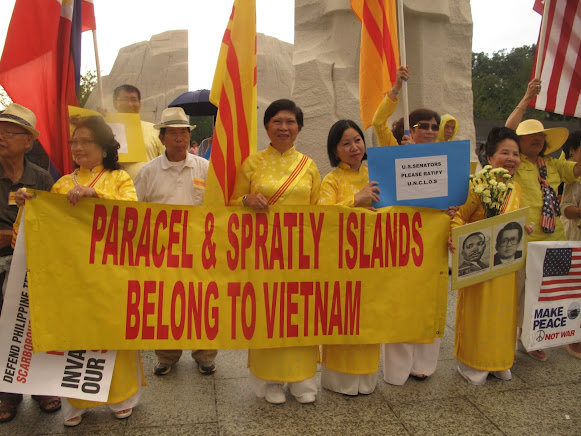
Vietnamese-Americans demonstrating against Chinese claims in the South China Sea. Note the banner in favor of US ratification of UNCLOS.

Rejecting the validity of a possible historic claim by China. Concerning whether, if China “Made a Historic Claim”, it would “have Validity”, the DOS paper insists that “such a claim would be contrary to international law”, stressing the limited degree to which UNCLOS recognizes this category of claims, as evidenced by its “text and drafting history”. The text argues that “apart from a narrow category of near-shore ‘historic’ bays” in Article 10, and “historic title” concerning “territorial sea boundary delimitation (Article 15)”, “modern international law of the sea does not recognize history as the basis for maritime jurisdiction”, citing the Gulf of Maine ICJ case. It also underlines the fact that UNCLOS provisions concerning the EEZ, continental shelf, and the high seas “do not contain any exceptions for historic claims” to the detriment of coastal states and all estates enjoying certain freedoms. Concerning fisheries, the report acknowledges that UNCLOS refers to “the need to minimize economic dislocation in States whose nationals have habitually fished” in the EEZ (Article 62(3)) and to “traditional fishing rights and other legitimate activities” (Article 51), but restricts the impact to the possible granting by one state to another of fisheries resources “based on prior usage”. The text stresses that no such traditional fishing practices can “provide a basis for sovereignty, sovereignty rights, or jurisdiction,” adding that UNCLOS rules on oil and gas development contain no “exception for historic rights in any context.” Again we note how a purely legal report like this may be missing part of the picture, given the great importance that fishing vessels have in the ongoing conflict over the South China Sea, where they are one of the pillars of asymmetric naval warfare.

Chinese scholars Gao and Jia have argued that UNCLOS does not regulate “historic title” and “historic rights,” which fall instead under the purview of general international law. In their view, UNCLOS “was never intended, even at the time of its adoption, to exhaust international law. On the contrary, it has provided ample room for customary law to develop and to fill in the gaps that the Convention itself was unable to fill in 1982” as clear from its preamble, which reads “matters not regulated by this Convention continue to be governed by the rules and principles of general international law.” The DOS report explicitly rejects this position, saying that “it is not supported by international law” and goes against the “comprehensive scope of the LOS Convention.” Experts like Mark Valencia, on the other hand, hold that China’s posture may be compatible with the international law of the sea.

The text does not stop at arguing that it is not open to a state to make historic claims based not on UNCLOS but on general international law, laying down a second line of defense. It explains that, “even assuming that a Chinese historic claim in the South China Sea were governed by ‘general international law’ rather than the Convention,” it would still be invalid since it would not meet the necessary requirements under general international law, namely “open, notorious, and effective exercise of authority over the South China Sea,” plus “continuous exercise of authority” in those waters and “acquiescence by foreign States” in such exercise of authority. Furthermore, it explains that the United States, which “is active in protesting historic claims around the world that it deems excessive,” has not protested “the dashed line on these grounds, because it does not believe that such a claim has been made by China,” with Washington choosing instead to request a clarification of the claim. Whether this view is also meant to avoid a frontal clash with Beijing, in line with the often state policy goal of “managing” rather than “containing” China’s rise, is something not discussed in the text.

The report concludes by criticizing another view put forward by Gao and Jia, namely the relevance of claims made before the advent of UNCLOS. While these two scholars argue that “In the case of the South China Sea as enclosed by the nine-dash line, China’s historic title and rights, which preceded the advent of UNCLOS by many years, have a continuing role to play,” the DOS paper says that “The fact that China’s claims predate the LOS Convention does not provide a basis under the Convention or international law for derogating from the LOS Convention,” adding that “permitting States to derogate from the provisions of the Convention because their claims pre-date its adoption is contrary to and would undermine” the convention’s “object and purpose” stated in its preamble to “settle … all issues relating to the law of the sea.”

Conclusions. Long-standing American policy towards China stresses the need to manage the latter’s rise, so that it does not threaten the post-Second World War system, based among others on freedom of navigation and a ban on territorial expansion as a legitimate causus belli. As a result, Washington has often called on Beijing to clarify her claims on the South China Sea, in an attempt to constrain them while avoiding a frontal clash. This position also seeks to reinforce the perception that the United States focuses on the rule of law at sea, rather than on supporting one claimant against the other over disputed waters. The DOS document, in line with this approach, carefully dissects Chinese claims, analyzing whether they may be compatible with standard American interpretations of international Law of the Sea. The conclusions are rather pessimistic, exposing how, despite having ratified UNCLOS, the Convention’s provisions are not seen in the same light by Beijing and Washington. This should not surprise us, since international law seeks to constrain power but at the same time it is shaped by it, thus as countries rise they seek to play a greater role in the fate of rules and principles. In the case of China this is even clearer due to historical perceptions that it was to a large extent seaborne power which subjected the country to a semi-colonial status for a whole century. If Beijing’s claims in the South Chinese Sea cannot be seen in the light of UNCLOS, the question arises what ultimate Chinese goals are. Could this be the subject of a future paper by the Department of State? Or does Washington prefer to wait until the international arbitration case launched by Manila concludes? While the second option seems more likely, as time goes by the idea that China’s rise may be shaped, rather than constrained, increasingly seems less and less realistic. However, if the time comes to draw a line in the sand, a whole of government effort will be needed, going beyond the naval circles that to date have been most vocal in articulating the need to resist Chinese expansion.

Alex Calvo is a guest professor at Nagoya University (Japan) focusing on security and defence policy, international law, and military history in the Indian-Pacific Ocean. Region. A member of the Center for International Maritime Security (CIMSEC) and Taiwan’s South China Sea Think-Tank, he is currently writing a book about Asia’s role and contribution to the Allied victory in the Great War. He tweets @Alex__Calvo and his work can be found here.

[otw_shortcode_button href=”https://cimsec.org/buying-cimsec-war-bonds/18115″ size=”medium” icon_position=”right” shape=”round” color_class=”otw-blue”]Donate to CIMSEC![/otw_shortcode_button]

North Korea and Asymmetric Naval Warfare

By Paul Pryce

In recent years, several detailed analyses have been produced on Iranian efforts to develop the doctrine and capabilities necessary to wage ‘asymmetric naval warfare.’ This has involved preparing the Islamic Republic of Iran Navy (IRIN) and Iranian Revolutionary Guard Corps’ Navy (IRGCN) to wage a kind of insurgency in the Strait of Hormuz and the Persian Gulf, employing ‘swarming’ tactics with well-armed small boats and fast-attack craft along with naval mines, submarines, and anything else that might allow Iran to exploit the vulnerabilities of a technologically superior enemy like the United States Navy (USN). In 2008, the Washington Institute for Near East Policy released an excellent example of this analysis less than a year after IRGCN forces captured 15 British Royal Navy personnel that had been operating in Iraqi waters.

Yet there are few detailed analyses of whether the Korean People’s Navy (KPN) – the maritime force of the Democratic People’s Republic of Korea (DPRK) – could similarly employ asymmetric warfare to counter the technological superiority of the Republic of Korea (ROK) and its US allies. This is particularly surprising when one considers how Iran has only recently begun to develop such asymmetric capabilities since its mining of the Persian Gulf during the Iran-Iraq War, which saw significant damage to the guided missile frigate USS Samuel B. Roberts in April 1988. The DPRK, meanwhile, has been contending with a capability gap against its southern adversary for far longer. Although IRIN must divide its attention somewhat between the Persian Gulf and the Caspian Sea, the KPN is truly split into two distinct fleets, one concerned with the Yellow Sea to the west and the other concerned with the Sea of Japan to the east. Simple geography prevents the KPN from ever truly consolidating its forces. This extends, of course, even to shipbuilding, with many vessels in the Eastern Fleet originating at Wonsan Shipyard and much of the vessels in the Western Fleet originating at Nampo Shipyard.

Helped along by the dissolution of the Soviet Union and the decline in availability of Russian military equipment, it seems the DPRK has set about developing its own defence industry and is producing new vessels that, while clearly unable to square off against ROK counterparts, could prove effective at waging asymmetric warfare at sea. Well-suited to swarming, the Nongo-class fast attack craft, which appears to be 35 metres long and displace 200 tons, could harass ROK and USN vessels. Rare glimpses of this vessel in DPRK propaganda footage suggest that the Nongo-class is equipped with a turret-mounted 76mm gun, possibly reverse-engineered from the Italian-designed OTO Melara 76mm, along with a complement of Russian-produced Zvezda Kh-35U subsonic anti-ship missiles.

Nongo class missile boat.

The prominence of submarines in KPN modernization efforts is also telling. The old Romeo- and Whiskey-class diesel-electric submarines received from the Soviet Union are being phased out in favour of some domestically produced designs. Satellite imagery as recent as July 2014 indicates North Korea is building a submarine with a length of 65.5 metres and a displacement of between 1,000 and 1,500 tons, which has been dubbed the Sinpo-class, for addition to its East Fleet. South Korean media sources, such as Yonhap News, claim that the design is reverse-engineered from a Soviet Golf-II diesel-electric submarine and could deploy ballistic missiles. Others, like the US-Korea Institute at Johns Hopkins University’s School of Advanced International Studies, believe the design to be based on older Yugoslavian designs like the Heroj- and Sava-classes. However, little else can be discerned about the lone vessel of this class spotted in satellite imagery.

The most compelling aspect of KPN asymmetric warfare to date is the continued prevalence of the Yeono-class midget submarines. First introduced in 1965, these vessels require a crew of only two to operate but can carry six or seven passengers, proving useful for DPRK covert operations against South Korea and Japan. With a submerged displacement of 130 tons and a length of approximately 20 metres, each is armed with two 533mm torpedo tubes. It is believed that a Yeono-class submarine fired the torpedo that sank ROKS Cheonan, one of South Korea’s Pohang-class corvettes, in March 2010. Although the KPN reportedly has only ten Yeono-class submarines left in operation, the attack on ROKS Cheonan demonstrates how such a weapon, deemed obsolete by Western standards, might still present a very real threat to network-centric navies like that of the ROK.

CNO Admiral Jon Greenert visits the Cheonan memorial in May 2013. U.S. Navy photo.

The North Koreans are not alone in recognizing the potency of midget submarines like the Yeono-class. Since 2007, Iran has acquired 14 submarines of this class and is domestically producing its own derivative of the design, known as the Ghadir-class. The convergence of Iranian and North Korean naval doctrine underscores the need for further analysis of the latter’s intentions, capabilities, and potential impact on the security of the Korean Peninsula’s littorals. The KPN’s Soviet submarines and swarms of small Kusong-class torpedo boats might have once seemed to American and South Korean defence planners to be sufficiently straightforward a threat to counter. But the vessels described here demonstrate that the DPRK is adapting to its strategically disadvantaged position and lack of technological sophistication.

This is particularly problematic for the ROK Navy, which has focused so heavily in recent years to attain blue-water status. According to the analysis of Vice Admiral (retired) Yoji Koda of the Japan Maritime Self-Defense Force, the ROK has limited anti-submarine warfare capabilities. In this sense, the Yeono-class perfectly exploits one of the ROK Navy’s most glaring capability deficits. Satellite imagery may have picked out a vessel as substantial as the Sinpo-class, but what might it miss? Based on the successful engagement against ROKS Cheonan, it would not be a surprise if the DPRK were actively working on a new design based on the Yeono-class. Such small vessels would not be spotted as readily as a 1,500 ton submarine openly berthed at Sinpo South Shipyard.

Another area of some uncertainty regarding DPRK asymmetric capabilities is minelaying. Naval mines were of significant importance to the KPN during the Korean War – so much so that 70% of the casualties suffered by USN vessels during that conflict were due to mines laid by DPRK forces. Yet subsequent research suggests those mines were laid with significant Soviet guidance and training, and it would be a stretch to assume DPRK mine warfare has gained much in sophistication since then. There are also no indications whether the KPN currently operates dedicated minelaying vessels. In the absence of such, DPRK mine warfare would certainly be inefficient but it could, in the most desperate of circumstances, even employ civilian vessels in such a role. For example, during the Korean War blockade of Wonsan, the DPRK made use of local sampans as minelayers. It would be wise of the ROK Navy to not bet on that scenario and invest in improved mine countermeasures.

The DPRK is among the most secretive regimes and so detailed information on its military capabilities is scarce as has been indicated here. Yet what little can be prised from open source information shows that the DPRK is at least as advanced as Iran in its ability for asymmetric warfare at sea. It is vital that further attention be paid to the evolution of the KPN so that, first and foremost, incidents like the sinking of ROKS Cheonan are not repeated, but also to ensure that any potential intervention by the international community against the DPRK proceeds without significant loss of life or assets for the ROK and its allies.

Paul Pryce is Political Advisor to the Consul General of Japan in Calgary and a long-time member of the Center for International Maritime Security (CIMSEC). He has previously written as the Senior Research Fellow for the Atlantic Council of Canada’s Maritime Nation Program.

China’s Middle East Balancing Act

This article originally featured at the Conference of Defense Associations Institute, and is republished with permission. Read it in its original form here

CDA Institute Security & Defence Blogger Adam MacDonald, an independent scholar on Canadian foreign policy and Asia-​Pacific security, examines China’s role in the Middle East.

Turmoil in the Middle East has motivated most of the world’s major powers to become increasingly involved in stabilizing the region while progressing their own geopolitical agendas. Both the United States, trying to foster local solutions that would allow them to reduce their involvement and refocus energies elsewhere, and a Russia that senses an opportunity for increased influence in a theatre long outside its reach, have a number of strategic and security interests in the region. But it is China which has the most to lose (and gain) from a stable Middle East. Despite the strategic importance of the Middle East, Beijing has been cautious in engaging the region – an approach informed by higher level considerations underpinning their global engagement strategy as a whole.

China’s increasing reliance on Middle Eastern oil imports is becoming the Achilles Heel of Beijing’s energy security interests, owing to the disruption risks associated with ongoing regional volatility and the fact oil shipments travel on lengthy Sea Lanes of Communications (SLOCs). Despite diversification efforts (including closer energy partnerships with Russia and Central Asia), China receives 51 percent of its imported oil from the Middle East, with estimates projecting this value to increase to 60 percent by 2030. China is currently taking advantage of current low oil prices to build up its National Strategic Reserve, resulting in major shortages in storage capacity. Of course, Beijing also assesses supply disruptions as a realistic concern, and is cautiously beginning to become more diplomatically involved in strengthening relations with major oil suppliers as well as supporting conditions maintaining the general stability of the region writ large.

China’s Middle East engagements have stressed the importance of peaceful resolutions to conflicts and political tensions, fearing that a region-​wide conflict would paralyze desperately needed oil supplies and justify foreign interventions to remove regimes friendly to Beijing. China’s foreign policy privileges incumbent governments (regardless of the ways in which they access, wield, or maintain power) and pledges ‘non-​interference’ in their internal affairs, offering a counter-​balance (along with Russia) to regional players wary of Western calls for democratic development and political pluralism. Western powers have been frustrated by Russian and Chinese vetoing of numerous United Nations Security Council Resolutions (UNSCR) to end the Syrian civil war, but these obstructions largely stem from their experiences in supporting UNSCR 1973 in 2011 that imposed a No-​Fly Zone over Libya but quickly morphed into a military régime change campaign.

China and Russia, thus, only agreed to the latest UNSCR pertaining to Syria when explicit assurances were made that the Assad régime could remain in power until elections are scheduled. Within such negotiations China has played a supportive role, allowing Russia (which whom they share many broad strategic and regional interests), to be the face of opposition to the West. Beijing, however, has taken the initiative on some fronts, such as offering to host cease-​fire talks. As it pertains to the Iranian nuclear deal, Beijing has also played a low-​key diplomatic role but emphasized the need to reach a peaceful resolution to reduce the likelihood of conflict between Tehran, a major oil partner, and the West.

China is slowly beginning to augment bilateral diplomatic relations with regional partners, moving beyond collective action as part of their role as a permanent member on the UNSC. President Xi’s recent trip to the Middle East, the first by a Chinese president since 2009, included visits to its three largest trading partners in the region (Egypt, Saudi Arabia, Iran), signing dozens of new economic deals, particularly with Tehran. Sino-​Iranian relations in particular have been strengthened, with Tehran now named a ‘great neighbour’ in Chinese foreign policy – a term denoting a state which shares similar economic, political, and strategic interests with Beijing. China, however, must balance its interests in Iran with those in Saudi Arabia, their largest oil partner, particularly as tensions have been rising dramatically with both powers supporting opposing sides in various regional conflicts. One can also add the cessation of diplomatic relations between the two, when Saudi Arabia’s Iranian embassy was sacked following Riyadh’s execution of a prominent Shia Cleric.

Beijing remains reluctant to fully engage in the region, especially on the military front. Much of this apprehension stems from the United States’ expected reaction of more comprehensive Chinese involvement in an area historically defined by heavy American influence. Despite protests for Beijing to become more of a ‘responsible stakeholder’ in providing public security goods in support of the international system, China believes the deployment of military forces, regardless of their composition or purpose, would create anxiety in Washington, thereby drawing their strategic focus towards them vice their current fixation with Russia and its recent activities in Ukraine and Syria.

Chinese concerns regarding the lack of influence over their SLOCs including oil supply routes from the Middle East has motived the military, particularly the People’s Liberation Army Navy (PLAN), to focus towards expeditionary operations under the new mandate of ‘Open Seas Protection’ as opposed to their traditional role of coastal defence. The PLAN will continue to remain mostly active and focused in their immediate environment but have begun operating abroad in new theatres, most recently in the Bering Sea which drew much interest (and concern) in the US media. Beijing, wanting to avoid the strategic gaze of the West, has been surgical in employing them abroad, especially the Middle East. To date, Chinese military deployments have focused on protection of commercial traffic from piracy in the Gulf of Aden; assisting in the evacuation of citizens (and other foreign nationals) from conflict zones such as Yemen; and non-​combat units participating in UN peacekeeping missions. China, therefore, despite their fury following the execution of a Chinese journalist by ISIS, will most likely not deploy military assets in any large measure to the region anytime soon, especially in a combat role.

Beijing has pursued a low-​profile role in the region’s complicated political environment to avoid comprising other aspects of their foreign policy, not least relations with other major powers, most importantly the United States. Chinese leaders have and will avoid calls from some within the region, such as Egypt (which admires and wants to emulate Beijing’s successful development model of economic modernization without political pluralism), for a greater Chinese presence and leadership role to counterbalance the West. China does not necessarily lack the capacity to assume such a role (even if it lacks experience in global leadership) but will continue to play more a supporting role and rely on the other major powers to do the heavy lifting in maintaining regional stability.

Throughout this process, Beijing will continue to position itself in a supportive and non-​threatening role, allowing Russia to assume the mantle of the geopolitical ‘destabilizing other’ displacing American leadership and influence in the region. China will continue to expand its diplomatic engagements throughout the region, specifically on a bilateral level with Iran and Saudi Arabia, but these shall not result in any comprehensive change in Beijing’s current regional strategy. Assisting (but not leading) in regional stability efforts; building strong and reliable economic partnerships; and avoiding the entanglements of great power competition over influence and leadership between Russia and the United States will remain Beijing’s main objectives in the Middle East.

Adam P. MacDonald is an independent academic whose work focuses on Canadian foreign policy in Asia, Chinese naval developments, and the ongoing political transition in Myanmar. He can be reached at adampmacdonald@gmail.com. (Image courtesy of Reuters.)

US Department of State Seeks to Clarify Meaning of China’s 9-Dash Line Part 4

By Alex Calvo

This is the fourth installment in a five-part series summarizing and commenting the 5 December 2014 US Department of State “Limits in the Seas” issue explaining the different ways in which one may interpret Chinese maritime claims in the South China Sea. It is a long-standing US policy to try to get China to frame her maritime claims in terms of UNCLOS. Read part one, part two, part three

[otw_shortcode_button href=”https://cimsec.org/buying-cimsec-war-bonds/18115″ size=”medium” icon_position=”right” shape=”round” color_class=”otw-blue”]Donate to CIMSEC![/otw_shortcode_button]

3.- “Dashed Line as a Historic Claim”

The third way to see the dashed-line, according to the Limits in the Seas series paper, would be as a historic claim. Under UNCLOS this can take two forms, “one of sovereignty over the maritime space (‘historic waters’ or ‘historic title’)” or “some lesser set of rights (‘historic rights’) to the maritime space.” The paper devotes much more room to discussing this possibility than to the two previous alternative interpretations. It begins by pointing out that “some Chinese government statements and acts could be read to support a version of this historic claim interpretation”, and by noting that given that “the dashed-line maps pre-date the People’s Republic of China, the views of Taiwan are also of interest.” Concerning the Island’s claims, the text underlines that while in 1993 its “Policy Guidelines for the South China Sea” said that the dashed lines enclosed a “’historic water limit’ within which Taiwan ‘possesses all rights and interests’” (see K-H. Wang, “The ROC’s Maritime Claims and Practices with Special Reference to the South China Sea,” Ocean Development and International Law, Volume 41, 2010, pp. 237-252), Taipei has not stuck to this view. “Subsequent maritime legislation enacted by Taiwan and subsequent public statements, however, suggests that this view may no longer be officially held,” noted the State Department in another Limits on the Seas series issue, published in 2005, devoted to Taiwan. While the text refers to this 2005 paper, the latter’s contents do not discuss in depth ROC claims on the South China Sea, as clear from the fact that the term “South China Sea” only appears three times, whereas “dash” is not to be found. Thus, while the assertion that in studying PRC claims one should pay attention to ROC claims seems logical, this is not followed up, either in the 2005 Limits on the Issues paper devoted to Taiwan, or in the 2014 one dealing with China. In other words, the Department of State does not follow its own advice. How should we read this? On the one hand, the preeminent use of “Taiwan” may seem to amount to a limited recognition of political realities on the ground, in opposition to Beijing’s views, further contradicted by the scant regard for ROC practice as opposed to the PRC’s emphasis on administrative and international legal continuity with the Nationalist regime. An alternative, more Beijing-friendly, interpretation of the DOS approach may be that it is treating Taipei as the de facto authority on the Island, also for law of the sea purposes, while restricting its role in the South China Sea, where the PRC has consistently sought to exclude Taiwan from regional fora, in line with its traditional policy towards the Island. More generally, this may reflect the complex and ambiguous status of Taiwan, with neither the Island itself nor countries like the United States completely sure what it is. To add to the confusion concerning Taiwan in the DOS paper, it states on page 21 that “Many islands and other features in the South China Sea are occupied not just by China, but by … Taiwan,” yet again this is not followed by any detailed examination of Taipei’s claims.

Going back to evidence for the possible interpretation of Beijing’s claims as historic, the report cites as “most notable” China’s “1998 EEZ and continental shelf law, which states [in Article 14] without further elaboration that ‘[t]he provisions of this Act shall not affect the historical rights of the People’s Republic of China’” (emphasis added in the DOS report). China’s 2011 Note Verbale says that Beijing’s claims are supported by “historical and legal evidence,” but while the DOS report adds emphasis to “historical”, one should be careful not to confuse a historical claim with a claim supported by history. A country may put forward historical evidence in both negotiations and arbitration or adjudication in areas where UNCLOS refers to “equitable” solutions. The text also notes how many “Chinese institutions and commentators have considered that the dashed-line maps depict China’s historic title or historic rights.”

The DOS reports explains that “some” Chinese Government actions and statements which are “inconsistent with” UNCLOS, while not amounting to “express assertions of a historic claim, they may indicate that China considers that it has an alternative basis – such as historic title or historic rights – for its maritime claims in the South China Sea,” and provides some examples, such as the assertion by Foreign Ministry Spokesperson Qin Gang on 10 March 2014 that the Second Thomas Shoal (Ren’ai Reef) was under Chinese “sovereignty.” Qin Gang said “It is known to all that China has sovereignty over the Nansha Islands and their surrounding waters, including the Ren’ai Reef.” This mantra about sovereignty, together with repeated appeals to history, could indeed be considered as evidence that what Beijing has in mind is a historic claim. Furthermore, it may well be a claim going beyond the provisions for such term in UNCLOS. The report provides further evidence, beyond statements, to support the view that China may be making a historical claim. First of all, the “periodic oath-taking ceremonies at James Shoal” by Chinese naval vessels “to affirm ‘sovereignty’ over this bank” and the 2012 introduction by the China National Offshore Oil Corporation (CNNOC) of lease blocks in front of Vietnam’s central coast, in “waters under jurisdiction of the People’s Republic of China” according to the company yet with “portions of two of these blocks (BS16, DW04)” extending “without explanation to waters that are beyond 200 nm from any Chinese-claimed island.” The DOS report stresses that the resulting “assertion of maritime jurisdiction … exceeds what is provided for under” UNCLOS.

“Coat of arms of USS Lassen (DDG 82), which has conducted FONOPS in the South China Sea. Experts have criticized their ambiguity and are still debating their exact nature.”
Coat of arms of USS Lassen (DDG 82), which has conducted FONOPS in the South China Sea. Experts have criticized their ambiguity and are still debating their exact nature.

The idea that Chinese claims are “separate from, and additional to” UNCLOS is also suggested by domestic legislation, the DOS report notes. As an example it cites China’s 1999 Law on Marine Environmental Protection, which describes its geographical scope as extending to the country’s “internal waters, territorial sea, contiguous zone, exclusive economic zone, continental shelf of the People’s Republic of China and other sea areas under the jurisdiction of the People’s Republic of China” (emphasis in the DOS report). According to the text, UNCLOS is restricted to maritime zones mentioned in the law, and not to any “other sea areas under the jurisdiction” of the PRC, and “perhaps” this is a reference to “areas where China considers that it has historic claims.” Again, we must remember that this could be understood in two different ways, either China making a claim based on historic facts (recognized to a limited degree by UNCLOS) or China laying down sovereignty over certain areas of the sea based on principles and rules outside UNCLOS, or outside the prevailing interpretation of UNCLOS.

Has China made a historic claim? Next the DOS report examines two issues: whether China has actually “Made a Historic Claim”, and whether it would “have Validity.” Concerning the former, the text states that “China has not actually made a cognizable claim to either ‘historic waters’ or ‘historic rights,’” the reasons being a lack of “international notoriety” and the statement in her 1958 Territorial Sea Declaration that “high seas” separate the Chinese mainland and coastal islands from “all other islands belonging to China”. The text admits that the expression “historic waters” appears in some Chinese legislation and statements, and actually cites some of them, but believes that this does not amount to “notoriety” to a degree sufficient to “at the very least” allow “other states” to “have the opportunity to deny any acquiescence with the claim by protest etc.” (Taken from C.R. Symmons, Historic Waters in the Law of the Sea: A Modern Re-Appraisal, (Leiden: Martinus Nijhoff Publishers, 2008), p. 145) since “no Chinese law, declaration, proclamation, or other official statement” exists “describing and putting the international community on notice of a historic claim.” The text dismisses references to “historic rights” in the 1998 EEZ and continental shelf law as “a savings clause” and “not a statement of a claim itself.” An additional reason put forward by the text is that these could be references to “China’s sovereignty claim to the islands, and not the waters.” The 1947 map does not constitute either, according to the DOS report, a claim, and furthermore even if one had been made, the fact it was published domestically “in the Chinese language” would not amount to “an act of sufficient international notoriety to have properly alerted the international community.” More generally, the text considers that no subsequent Chinese map can be treated as having made a claim either, since they all “lack the precision, clarity, and consistency that could convey the nature and scope of a maritime claim” and cites in support of this view the ICJ “statement of principle” in the Frontier Dispute case between Burkina Faso and Mali, which says that “Whether in frontier delimitations or international territorial conflicts, maps merely constitute information which varies in accuracy from case to case; of themselves, and by virtue solely of their existence, they cannot constitute a territorial title, that is, a document endowed by international law with intrinsic legal force for the purpose of establishing territorial rights.”

Read the next installment here

Alex Calvo is a guest professor at Nagoya University (Japan) focusing on security and defence policy, international law, and military history in the Indian-Pacific Ocean. Region. A member of the Center for International Maritime Security (CIMSEC) and Taiwan’s South China Sea Think-Tank, he is currently writing a book about Asia’s role and contribution to the Allied victory in the Great War. He tweets @Alex__Calvo and his work can be found here.

[otw_shortcode_button href=”https://cimsec.org/buying-cimsec-war-bonds/18115″ size=”medium” icon_position=”right” shape=”round” color_class=”otw-blue”]Donate to CIMSEC![/otw_shortcode_button]