Week Dates: July 18-22, 2016 Articles Due: July 17, 2016 Article Length: 800-1800 Words (with flexibility) Submit to: Nextwar@cimsec.org
In mid-July CIMSEC will be launching a topic week on the security situation in the South China Sea. Tensions are on the rise as China continues to defend its nine-dash claim in the South China Sea while most other claimants and regional powers strengthen security cooperation agreements with the United States. Rules based international order is being challenged as numerous militaries in the region modernize with growing defense budgets.
How may South China Sea disputes animate the geopolitics of the Asia-Pacific region? How may crises and flashpoints come about, be diffused, or escalate? How can claimants restore trust? How is the regional military balance of power trending, and what would conflict look like? How can rules based order be preserved in Asia’s maritime domain, and what does its violation warrant for the future?
Contributors are encouraged to answer these questions and more as they seek to understand the complexity of the strategic crossroads that is the South China Sea. Please submit draft contributions to Nextwar@cimsec.org.
Editor’s Note: This topic week has since concluded and the writings submitted in response to this call for articles may be viewed here.
Dmitry Filipoff is CIMSEC’s Director of Online Content. He may be contacted at Nextwar@cimsec.org.
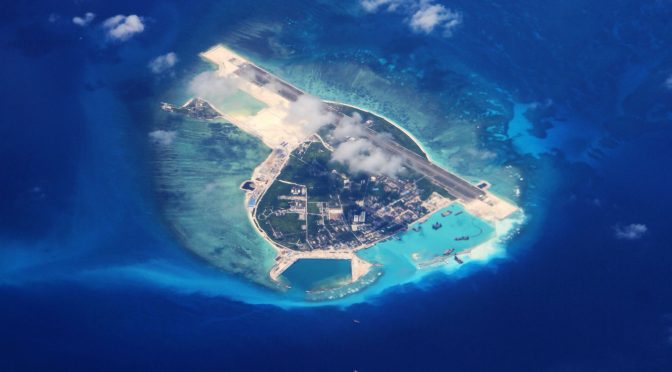
Featured Image: Aerial view of the Yongxing Island, also known as Woody Island in the South China Sea on June 19, 2014 in Sansha, Hainan Province of China. ChinaFotoPress/Getty Images
The following piece was originally published on 31 May 2016 by The Straits Times. It is republished here with the authors’ permission. It may be read in its original form here.
Ambassador Xu accused the United States of being the “driving force” behind increased tensions in the region, but his rhetoric is based on faulty assumptions and misinterpretations of the facts and the law.
Mr. Xu suggests that after U.S. Secretary of State Hillary Clinton visited the region in 2009, the region “evolved into a disturbing… hot spot,” and that her visit encouraged states to change their policies to confront China.
But China’s problems in the South China Sea were created by conscious decisions in Beijing to insistently use coercion to advance its expansive and unlawful claims, alarming China’s neighbours. And the Philippines and Vietnam clarified their claims in the South China Sea not because of Mrs. Clinton’s visit, but to comply with international law – something China might well consider for itself.
The Philippines did not enact a new baseline law in March 2009 “to claim sovereignty over… Huangyan Island (Scarborough Shoal) and some of the Nansha (Spratly)Islands.”
In fact, Republic Act 9522 was passed to bring the Philippines’ archipelagic baseline system into full compliance with the United Nations Convention on the Law of the Sea.
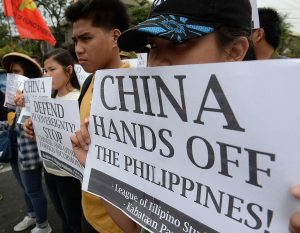
Filipino students holding anti-Chinese placards during a rally in Manila in March against Chinese vessels reportedly dropping anchor near a South China Sea atoll also claimed by the Philippines. Photo: Agence France-Presse.
Philippine sovereignty over Scarborough Shoal can be traced back to 1800, when the Philippine-based Spanish frigate Santa Lucia surveyed the shoal. Colonial Spain, and later the U.S., effectively administered the shoal and its surrounding waters until the Philippines gained its independence in 1946. Philippine claims to the Spratlys’ Kalayaan Island Group (KIG) date back to 1956; the KIG was formally annexed by Philippine Presidential Decree No. 1599 in 1978.
Similarly, Mr. Xu asserts that Vietnam’s May 2009 submission to the Commission on the Limits of the Continental Shelf, in which Hanoi claimed an extended continental shelf in the South China Sea and reaffirmed its sovereignty over the Paracel and Spratly islands, was somehow linked to Mrs. Clinton’s visit. In fact, Vietnam submitted its claim on May 6 and 7 in order to meet the UN-established deadline – May 13, 2009. Vietnam’s title to the Paracel and Spratly islands is well founded in history and law. Vietnam exercised peaceful, effective and continuous administration of the Paracel Islands from the early 18th century until 1974, when Vietnamese forces were ejected in a short, bloody attack by China – a violation of Article 2(4) of the UN Charter.
Similarly, Vietnamese sovereignty over the Spratlys can be traced to French annexation and peaceful occupation of the archipelago in the 1930s. Taiwan’s illegal seizure of Itu Aba Island in 1956 and China’s invasion of the Spratlys in 1988 violate Article 2(4) and do not confer lawful title to the Spratlys to either nation.
Turning to Coercion
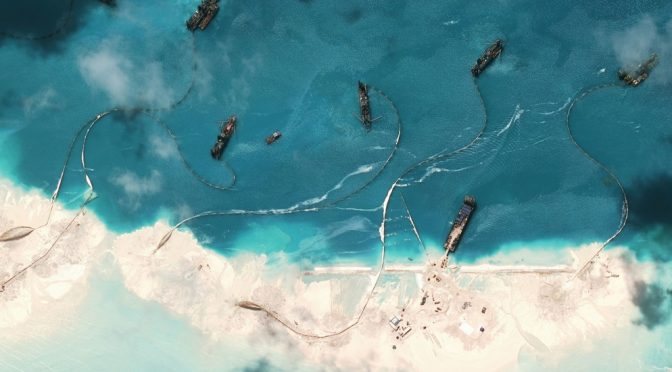
The wedge between China and Asean with regard to the South China Sea emerged from China’s end to its “peaceful rise,” as it turned towards coercion to bully its neighbours. Noteworthy examples of Chinese aggression include – harassing Vietnamese and Philippine seismic survey ships by cutting their seismic cables and threatening use of force (2011-2012); preventing Vietnamese and Filipino fishermen from pursuing their livelihood in their own exclusive economic zone (EEZ) by ramming and sinking their boats (2014-2016); seizure of Scarborough Shoal (2012) and Jackson Atoll (2015); conducting military exercises on James Shoal (2013-2014); interfering with the humanitarian resupply of Filipino marines aboard the BRP Sierra Madre at Second Thomas Shoal (2014) – a submerged feature on the Philippine continental shelf; conducting oil exploration with the deepwater oil rig Haiyang Shiyou 981 in Vietnam’s EEZ (2014-2016); construction of massive, mid-ocean artificial islands (2013-2016); establishing military installations and radar sites on them, and building airstrips on the features capable of accommodating every military aircraft in the People’s Liberation Army (PLA) inventory (2015-2016); and stationing surface-to-air missiles in the Paracels in order to expand its anti-access/area denial envelope (2016).
China took all of these actions and more despite its obligation to comply with the 2002 Declaration on the Conduct of Parties, in which the parties pledge to exercise self-restraint in conducting activities that could complicate or escalate disputes and affect peace and stability, and to refrain from action of occupying presently uninhabited features.
While all South China Sea claimants reclaimed land to artificially enhance islands in the region, the speed and scale of China’s campaign, combined with aggressive policing of its extravagant nine-dash line claim, have inspired fear.
Since December 2013, China has reclaimed more than 1,295ha of artificial territory. By comparison, Vietnam has reclaimed approximately 32ha; Malaysia, 28ha; the Philippines, 6ha; and Taiwan, 3ha.
In other words, China has reclaimed 17 times more artificial land in two years than the other claimants combined over the past 40 years, which accounts for nearly 95 per cent of all reclaimed land in the Spratly Islands.
Mr. Xu also claims Washington encouraged the Philippines to abandon bilateral negotiations with China in favour of litigation at the Permanent Court of Arbitration. The Philippines, however, neither sought nor needed U.S. approval, and was driven by its own frustration over 20 years of failed bilateral consultations and negotiations with China. The tribunal concurred, noting that “despite years of discussions aimed at resolving the… disputes, no settlement has been reached. If anything, the disputes have intensified.”
Freedom of Navigation Threat
The Ambassador suggests that the U.S. fabricated a threat to freedom of navigation and overflight, which he claims has never been at risk in the South China Sea. Since 2001, however, Chinese ships and aircraft have conducted countless provocative, dangerous and unprofessional challenges and intercepts of U.S. surveillance/ reconnaissance aircraft (such as EP-3 incident 2001, P-8 incident 2014, EP-3 incident 2016); U.S. warships (such as USS John S. McCain 2009, Cowpens 2013, Chancellorsville 2016); and U.S. military survey ships (such as USNS Bowditch 2001/2008, Sumner 2002, Impeccable 2009/2013, Victorious 2009).
China has also issued grave warnings to Indian warships (INS Airavat 2011 and Shivalik 2012) and Australian surveillance aircraft and warships (2015-2016) exercising high sea freedoms in the South China Sea.
Ironically, China is completely hemmed in by neighbouring EEZs, and the PLA Navy operates freely in its neighbours’ EEZs, as well as conducts spying in the U.S. EEZ off Hawaii and Guam.
The U.S. is a treaty alliance partner with five nations in the region – Australia, Japan, the Philippines, South Korea and Thailand.
Ambassador Xu claims that these long-standing relationships are militarising the region. But American naval force levels and those of its allies are essentially unchanged for 20 years.
Over the past five years, the U.S. transferred three repurposed U.S. ships to the Philippine Navy – BRP Gregorio del Pilar (2011), Ramon Alcaraz (2013) and Gregorio Velasquez (2016), while China launched three new warships in a single day last year! Likewise, the recent agreement between the U.S. and the Philippines to permit American forces occasional access to a handful of Philippine bases is part of the modest rebalance that arose after 15 years of breathtaking increases in the quality and quantity of Chinese warships and military aircraft.
The economic prosperity of the people of South-east Asia is best assured by the peace and security of enduring partnerships between the United States and its friends and allies, and a commitment by all states to a rule-based order in the world’s oceans.
If China is indeed a “strong supporter of a rule-based international order,” as the Ambassador claims, then Beijing has to act as though international law binds and restrains powerful states as well as the weak.
Until that occurs, China will never win the respect of those responsible nations who truly seek peace and prosperity in the Indo-Asia Pacific region.
Raul Pedrozo is a non-resident scholar in the Stockton Centre for the Study of International Law at the US Naval War College. James Kraska is a professor in the centre.
Featured Image: DigitalGlobe, via CSIS Asia Maritime Transparency Initiative.
By Vidya Sagar Reddy and Rajeswari Pillai Rajagopalan
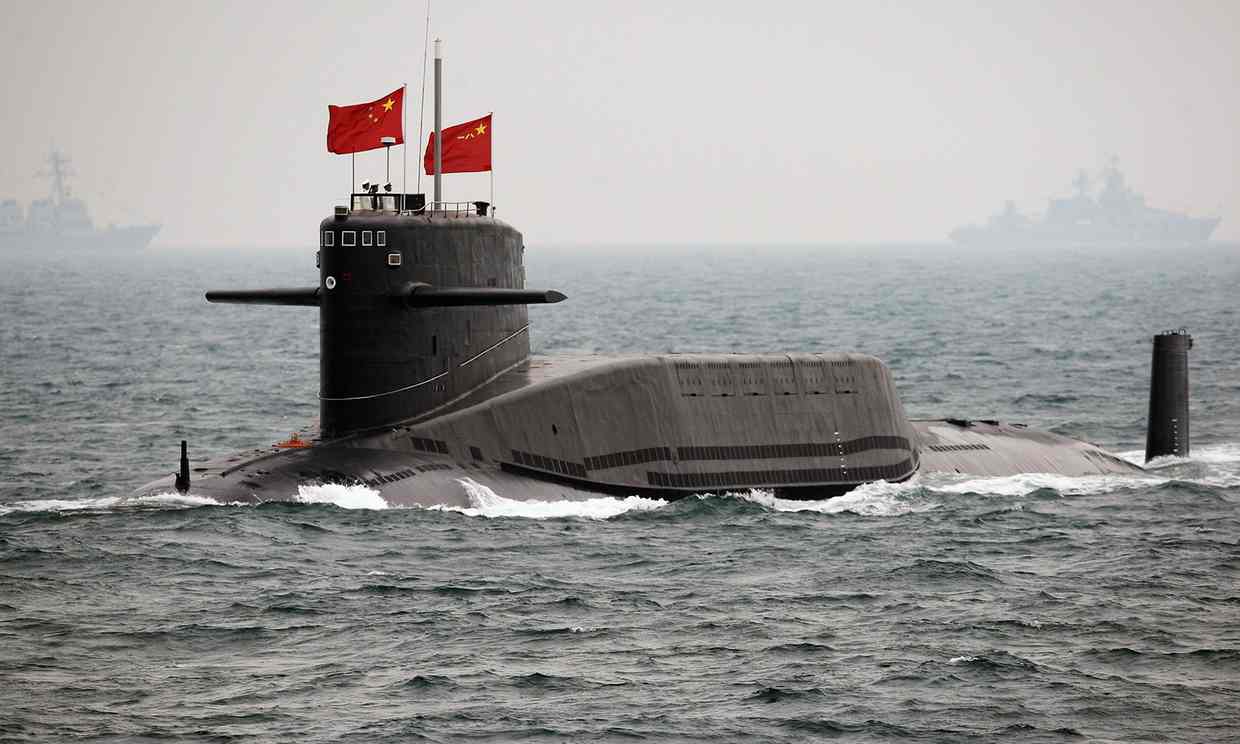
Two events set the stage for India-China strategic competition going underwater – one is the docking of China’s submarine in Sri Lanka’s Colombo port and the other is the loss of India’s submarine INS Sindhurakshak in a major fire incident.. These and subsequent events showed that China is signalling its strategic intentions in the Indian Ocean via its submarines while the resident power is scrambling.
The claim by China that its submarines are deployed as part of anti-piracy operations in the Gulf of Aden has been refuted on the grounds of overmatching capability of these platforms and the timing when piracy is coming down.
Protection of sea lines of communication in the vast Indian Ocean region is in the interest of every state and therefore naval cooperation would be both economical and reassuring. Such an outlook is however not forthcoming from China. Rather it is undertaking unilateral actions without establishing proper communication with other navies in the region.
The submarine deployments can therefore be considered as geopolitical signalling of a rising China. First, the long range deployments showcase the capabilities of a blue water navy. The Indian and Pacific Oceans are the primary theatres of such deployments. Second, the timing of deployments showcases intent.
A Chinese submarine docking in Colombo coincided with the visit of Japan’s Prime Minister Shinzo Abe to Sri Lanka. The docking in Karachi came on the heels of India’s Prime Minister Modi’s first official visit to China. It sent warships inside the U.S. territorial waters off Alaska when President Obama was visiting.
A People’s Liberation Army Navy ballistic missile submarine . Photograph: Guang Niu/Getty Images.
The intent behind these strategic signals cannot be missed. China consistently opposes any partnership between the navies of India, Japan, and the U.S. given their capacity to challenge its unlawful assertions in the East and South China Seas.
India’s economic growth and influence in the international order are dependent on the reawakening of its maritime culture. Accordingly, it is taking a number of policy and investment actions in this direction.
The success of these initiatives is dependent on a peaceful and stable neighborhood along with a secure Indian Ocean region. China’s presence and intentions in this region carried out through its submarine deployments signals the contrary. It even finalized a dealto sell eight submarines to Pakistan with little regard to India’s sensitivities.
Considering these developments, India decided to augment its current underwater fleet of only 13 aging diesel-electric (SSK) submarines (nine of Soviet and four of German origin). These submarines constructed during the Cold War have already reached their replacement period. Commissioning new submarines into the force is critical at this juncture as India’s national interests expand and threats multiply across the Indian Ocean.
India therefore initiated Project 75 and Project 75(I) to strengthen its submarine arm. The Project 75 will deliver six SSK of French Scorpene design with the last two added with indigenously developed air-independent propulsion system (SSP). There is also a provision for adding three more platforms.
The Project 75(I) is follow-on to the Project 75 to build six advanced SSP submarines fitted with vertical launch systems to fire BrahMos supersonic cruise missiles and torpedo tubes. India is also designing six nuclear powered attack submarines.
The first of Project 75, INS Kalavari, is undergoing sea trails and is expected to be commissioned by 2016. The remaining five boats will be delivered by 2020. Unfortunately, the INS Kalavari will be commissioned without its main weapon, the torpedo, since the government decided against buying them from a company under investigation.
It will be quite some time before these projects mature and the submarine arm of the Indian navy operates at its full potential. The Project 75 itself is running almost four years behind schedule. Additional Poseidon P-8I anti-submarine warfare (ASW) aircraft can be acquired to fill the gap initially and to later form a three dimensional force to counter submarine threats.
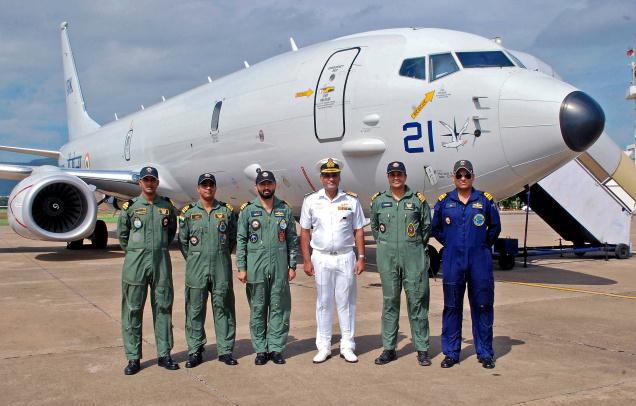
The P-8I is the Indian variant of P-8A Poseidon operated by the U.S. Navy for long range maritime reconnaissance and ASW requirements. India contracted Boeing to build eight of these aircraft for the Indian Navy. Indeed, the first platform arrived in 2013 just as the Indian Ocean’s subsurface started heating up.
Its speed, range and endurance enables India to mount rapid surveillance missions deep into the Indian Ocean. It was deployed recently for surveillance in the exclusive economic zone of Seychelles and had been pressed into action to hunt for Chinese submarines probing near the strategically located Andaman and Nicobar islands. The P-8I boasts advanced sensor and communication suites and is armed with missiles, torpedoes, and depth charges.
Boeing P8I long range maritime reconnaissance and anti-submarine warfare aircraft of the Indian Navy being welcomed at INS Dega in Visakhapatnam. Photo by The Hindu.
The P-8I is a key platform enabling interoperability with the U.S. Navy that shares India’s concerns in the Indian Ocean. Both countries have decidedto upgrade their defense relationship to include submarine tracking, communication, and ASW capabilities. The next joint naval exercise will see enhanced ASW practice.
India should also enhance its submarine interoperability with Vietnam, Indonesia, and Australia while extending the scope of partnership beyond the Indian Ocean. Australia recently finalized an agreement with the French firm DCNS to deliver 12 submarines to replace its aging Collins class submarines. Vietnam and Indonesia are set to acquire six and at least two Russian Kilo submarines respectively.
India has already trained Vietnam’s submariners and is in talks with Russia to establish Kilo class submarine maintenanceand modernization infrastructure in the country. South East Asian countries are weary of China’s intentions and are visibly frustrated with its use of force in the South China Sea (SCS). Vietnam is on the frontline while Indonesia is closely monitoring the situation but is also perturbed.
China’s turning out of large number of submarines each year and the associated basing facilities in Hainan and their proximity to SCS islands easily overwhelms other claimants and concerned parties in and beyond the region.
It is absolutely essential to exchange information for forming a joint operational picture of the undersea domain of the Indo-Pacific. Submarine interoperability between the concerned parties is critical to deter and defeat fast emerging threats. India should take advantage of its diplomatic and material capabilities to realize these objectives for the purpose of maintaining peace and stability in the region.
Vidya Sagar Reddy and Rajeswari Pillai Rajagopalan is a Research Assistant and Senior Fellow respectively at the Observer Research Foundation, New Delhi.
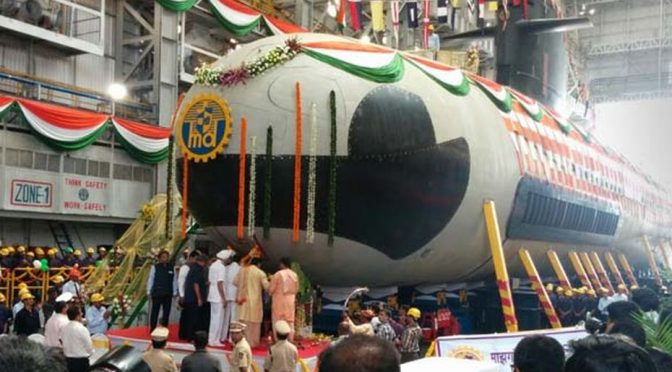
Featured Image: Indian Navy’s first Scorpene submarine being launched in Mumbai, April 2015. Photo: Reuters.
By Vice Admiral Pradeep Chauhan AVSM & Bar, VSM, IN (Ret.)
Conceptual Underpinning
The concept of Constructive Engagement is foremost amongst the various strategies that India has adopted in the furtherance of her security. Consequently, this is a strategic concept that shapes much of India’s geopolitics.
Traditionally, security used to be thought of only in terms of the defense of territory within a state system whose defining characteristic was an incessant competition for military superiority with other nation-states, all lying within a classic state of anarchy, devoid of superior or governing authority. Today, however, India and her Navy have swung around to a far more holistic approach. This changed approach finds its historical moorings in the famous “Common Security” report that had been authored as long ago as 1980 by the “Independent Commission on Disarmament and Security Issues” chaired by the late Prime Minister of Sweden, Mr. Olaf Palme. This report emphatically drew attention to alternative ways of thinking about peace and security by formally acknowledging that common security requires that people live in dignity and peace, that they have enough to eat, and are able to find work and live in a world without poverty.
While military maritime security does, of course, continue to enjoy primacy for India, existing as it does in a world-system defined by Westphalian concepts of national sovereignty, new terms such as ‘Non-Traditional Security’ and ‘Human Security Issues,’ largely drawn from the 1994 Report of the UNDP, have made their way into maritime India’s contemporary security-lexicon and lodged themselves within its collective security-consciousness. Maritime Security is now firmly established within a new construct that incorporates military, political, economic, societal, and environmental dimensions, and recognizes the many linkages between them.
Thus, threats to human-security, such as religious extremism, international terrorism, drug and arms smuggling, demographic shifts — whether caused by migration or by other factors, human trafficking, environmental degradation, energy, food, and water shortages, all now figure prominently as threats that are inseparable from military ones. These have led to the formulation of new concepts such as ‘comprehensive security’ and ‘cooperative security.’ Clearly, however, security issues within the maritime domain need to be referenced more towards common interests rather than threats. At a regional level, it is these very Human Security issues that have been mentioned above that constitute common interests. It is a common regional interest to create and consolidate a region in which the comity of nations is both intrinsic and assured and where every nation, big or small, is treated as an equal. Multiple options of governance must be recognized functions of the independent choice of the people of each nation-state. The state protects the individual and the individual preserves the state in a symbiotic relationship designed to establish and spread stability across the region where malevolent non-State entities should find neither spatial nor temporal room for maneuver. In sum, then our common interests are the absence-of or freedom-from threats. It is therefore appropriate that within the maritime domain, the concept of Maritime Security is increasingly being described as a condition characterized by “freedom from threats arising either in or from the sea.”1 These threats could arise from natural causes or from manmade ones, or from the interplay of one with the other, as in the case of environmental degradation or global warming. Insofar as the targets of such threats (arising from a lack of maritime security) are concerned, these could be individuals themselves — or ‘groupings’ of individuals, such as societies and/or nation-states. When these threats address the regional fabric itself, nation-states find themselves increasingly enmeshed in a complex web of security interdependence, which tends to be regionally focused and a robust regional initiative ought to be a logical outcome of this regional focus.
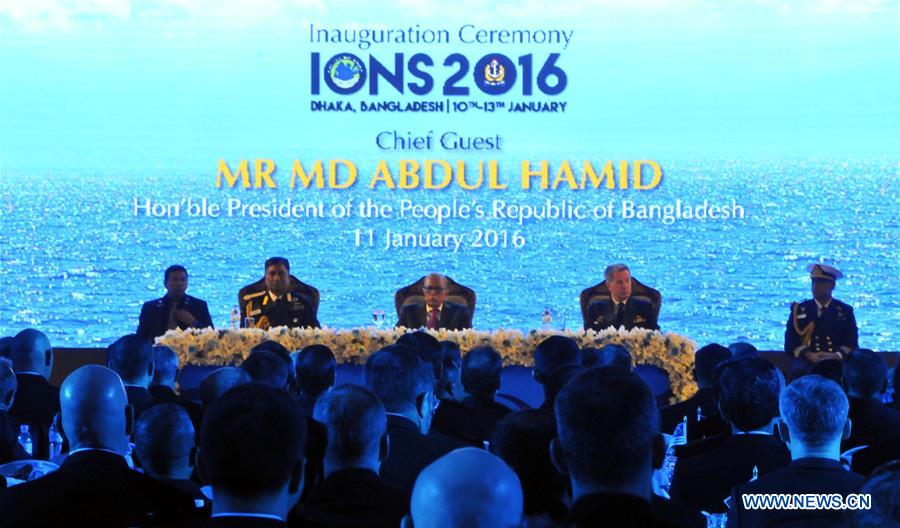
DHAKA, Jan. 11, 2016 (Xinhua) — Photo taken on Jan. 11, 2016 shows a scene of the fifth biennial assembly of Indian Ocean Naval Symposium (IONS) in Dhaka, Bangladesh. The fifth biennial assembly of IONS kicked off here on Monday. (Xinhua/Shariful Islam).
Multilateral Maritime-Security Constructs
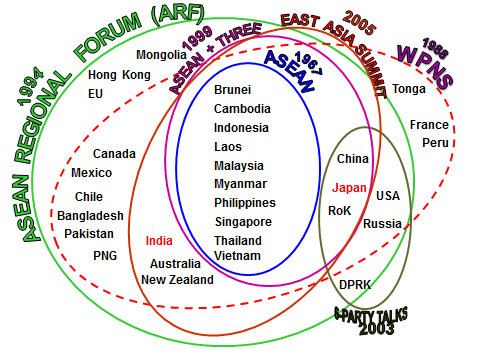
Although the Indo-Pacific region has several manifestations of the regional drive towards cooperative security through Constructive Engagement, most of them lie in the Pacific. Examples include ASEAN, ASEAN+3, APEC, ARF, the 6-Party Talks, the East Asia Summit, etc. At the Navy level, the Western Pacific Naval Symposium (WPNS) is clearly an important multilateral security construct.
A visualization of member states of regional forums in the Asia-Pacific.
The Indian Ocean segment of the Asia-Pacific littoral is now beginning to catch up. However, for much of the Twentieth Century such sub-regional geopolitical constructs that did emerge within the Indian Ocean remained limited to West Asia and southern Africa (the Arab League in 1945, the SADC in 1980 and the GCC in 1981). There was nothing to be found at a pan-regional level that might knit together at least a significant proportion of the 37 littoral nation-states of the Indian Ocean and its rim. It was not until the closing years of the Twentieth Century that a Mauritian-led initiative fructified and led to the launch, in March of 1997, of the clumsily-named ‘Indian Ocean Rim – Association for Regional Cooperation’ (IOR-ARC). However, for the first decade-and-a-half of its existence, this grouping confined itself purely to economic cooperation and specifically abjured security issues. It must, of course, be admitted that in 1997, the notion of security within the collective minds of the countries of the Indian Ocean was still very strongly biased towards military security alone. 2013 was a watershed for the organization, for in that year, the IOR-ARC was renamed ‘Indian Ocean Rim Association’ (IORA)2and identified six priority areas to promote the sustained growth and balanced development of the region, of which ‘maritime safety and security’ is the first priority3. The IORA also indicated that it was important that its work on maritime security and safety and disaster management should be aligned with and complement possible IONS (Indian Ocean Naval Symposium) initiatives in these areas. However, not much seems to have been done to date. The IORA does not have a working group to deliberate on these issues, nor does it have an institutional link with IONS4.
IONS: Development
In February of 2008, driven by the need to address regional vulnerabilities by capitalizing upon regional strengths, the Indian Navy made a stupendous effort to assemble in New Delhi the Chiefs-of-Navy of very nearly all littoral states of the Indian Ocean Region. Sitting and discussing together — for the first time ever — both in ‘assembly’ and in ‘conclave,’ the chiefs launched the Twenty First Century’s first significant international maritime-security initiative — namely, the Indian Ocean Naval Symposium, or ‘IONS.’ That the launch of so important a regional initiative was able to meet with such wide acceptance across the length and breadth of the Indian Ocean was in itself a unique phenomenon — but one representative of a region that is beginning to come into its own and seems ready to evolve a broad consensus in facing the myriad security challenges within the maritime domain.
The acronym ‘IONS’ is an appropriate one, since the etymology of the English word ions is drawn from the Greek word ienai meaning go, and implying movement. The fundamental concept of IONS, too, remains one of ‘moving’ together — as a region. Under the IONS construct, the 37 littoral states of the Indian Ocean Region have been geographically grouped into four sub-regions, as depicted:
West Asian Littoral
East African Littoral
South Asian Littoral
South-East Asian & Australian Littoral
1
Bahrain
1
Comoros
1
Bangladesh
1
Australia
2
Iran
2
Djibouti
2
India
2
Indonesia
3
Iraq
3
Egypt
3
Maldives
3
Malaysia
4
Israel
4
Eritrea
4
Pakistan
4
Myanmar
5
Jordan
5
France
5
Seychelles
5
Singapore
6
Kuwait
6
Kenya
6
Sri Lanka
6
Thailand
7
Oman
7
Madagascar
7
Timor Leste
8
Qatar
8
Mauritius
9
Saudi Arabia
9
Mozambique
10
UAE
10
Somalia
11
Yemen
11
South Africa
12
Sudan
13
Tanzania
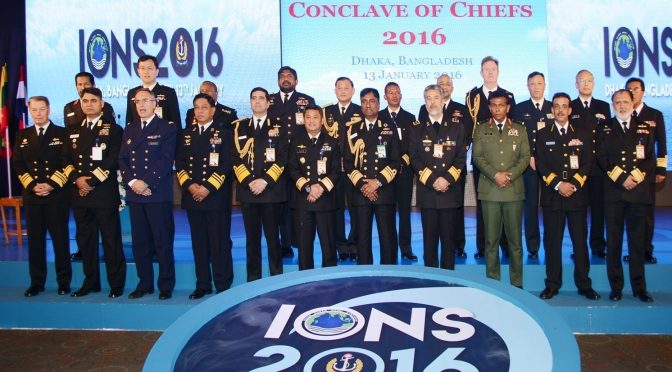
The formal launch of the IONS initiative was effected through the inaugural ‘Conclave-of-Chiefs.’ This conclave is held once every two years, with a new chairperson at the helm. As had been the intention from the start, it is at this ‘Conclave-of-Chiefs,’ removed from the glare of the media, that the most meaningful progress occurs in accordance with a formalized ‘Charter of Business.’ It is a matter of very great satisfaction that the Charter-of-Business has already been adopted, especially if it is recalled that the WPNS Charter took 12 years (from 1988 to 2000) to receive formal approval from all its constituent members.
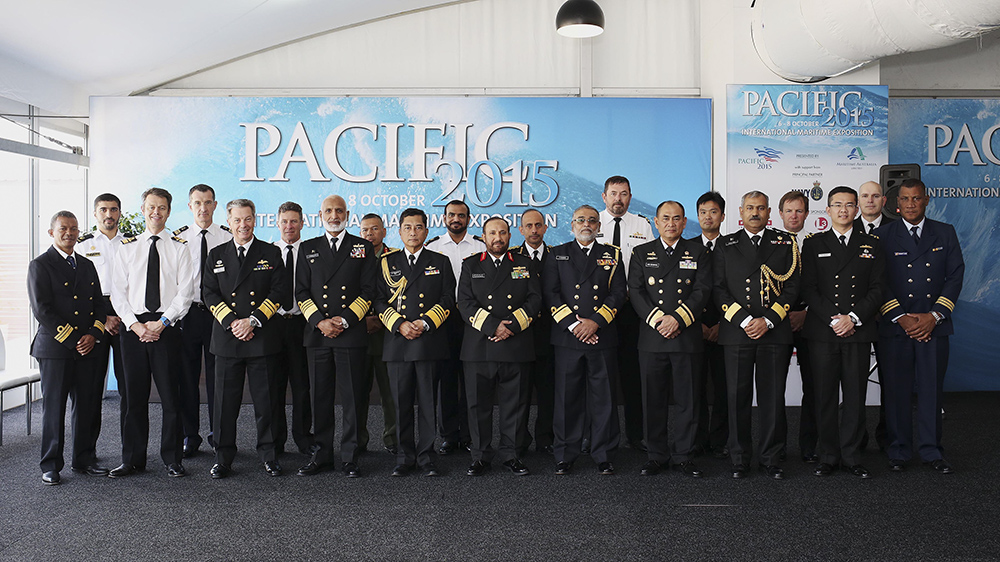
Delegates pose for a photograph before the Indian Ocean Naval Symposium (IONS) Conclave of Chiefs. The regional forum was held during Sea Power 2015. Photo Source: Royal Australian Navy.
Every Conclave-of-Chiefs — there have been eight held thus far — is supplemented by an IONS Seminar, which the Chiefs also attend, along with a galaxy of luminaries in various disciplines relevant to security within the maritime domain. The inaugural IONS Seminar was jointly conducted by the Indian Navy and the National Maritime Foundation (NMF), at the Vigyan Bhavan, New Delhi, on 14 and 15 February 2008. The theme of that seminar was “Contemporary Transnational Challenges — International Maritime Connectivities” — a subject that has grown in relevance over the years.
IONS is a unique regional forum through which the Chiefs-of-Navy of all the littoral states of the IOR can periodically meet to constructively engage one another through the creation and promotion of regionally relevant mechanisms, events, and activities related to maritime security. Yet, given the diversity of the region as a whole, there has been an acute awareness of the need to make haste slowly. Successive Conclaves-of-Chiefs have, therefore, very deliberately spent time and great effort in building the foundation of the construct through an incremental series of small but crucial confidence-building steps.
Although IONS was an Indian initiative, it was designed from the very beginning to be a pan-regional construct rather than a country-specific one. Hence, the chairmanship of IONS rotates sequentially through each of the four sub-regions. This also ensures that the somewhat different priorities given even to common challenges, and, of course, such maritime-security challenges as are unique to a given sub-region, are all given the emphasis and attention they deserve. The first rotation through all sub-regions has already been completed with the Chiefs of Navy of India (2008-2010), the UAE (2010-2012), South Africa (2012-2014), Australia (2014-2016) all having sequentially chaired IONS. The chairmanship is currently held by the Chief of the Navy of Bangladesh (2016-2018). Pakistan participated for the first time at the level of its Navy Chief in 2014.
Conscious of the need to avoid being perceived as merely a one-in-two-years talk-shop, each Conclave-of-Chiefs sets forth a consensual agenda of specific activities designed to keep the region involved and engaged with various elements of maritime security. Some activities — such as the IONS Essay competition — might appear unduly humble in their scope, but they are essential to sustaining awareness of this regional construct and what it stands for, especially amongst younger generations of maritime security experts whose involvement will be crucial for IONS to continue to be perceived as relevant across generational shifts of personnel.
The Need for more Proactive Initiatives
And yet, it must be admitted that the movement has sometimes erred on the side of excessive caution. As the midwife of the IONS construct and its permanent secretariat, India must take its fair share of blame for allowing the movement to drift. Indeed, it has appeared — on more than one occasion — that the Indian Navy, having created such a fine instrument, has demonstrated a certain lack of initiative and dexterity in wielding it. Opportunities have consequently been lost. For instance, the anti-piracy missions stretching from the Gulf of Aden all the way to the waters of Seychelles and Maldives, were an excellent opportunity for national maritime security agencies — even while operating essentially alone — to have done so under a nominal IONS-umbrella.
Likewise and more recently, in January 2016, the U.S. Combatant Command AFRICOM, sponsored a maritime exercise named CUTLASS EXPRESS, whose scenarios were designed to test the ability of participating naval ship-crews to respond to illicit trafficking, piracy, illegal fishing, and search-and-rescue (SAR) situations. While there is little doubt that this is beneficial for stability as a whole, it also represents yet another lost opportunity for India to have taken the initiative to leverage IONS into undertaking activities that go beyond baby-steps.
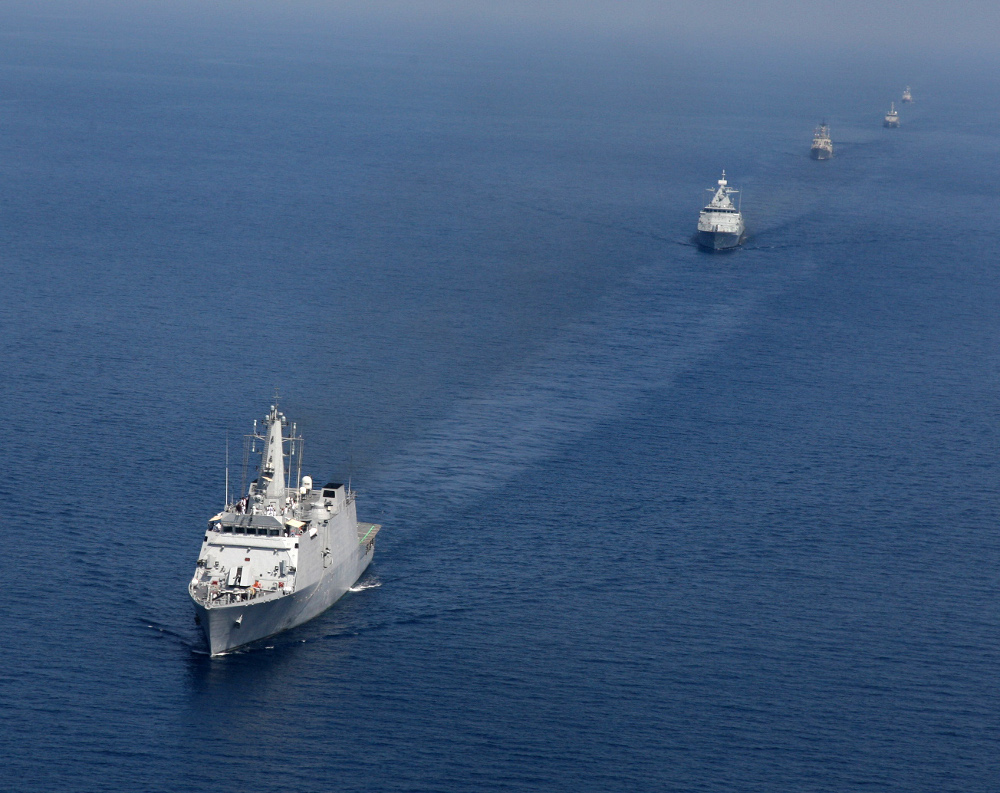
Exercise Milan 2014 for 17 navies of the Indian Ocean Naval Symposium, organised by Indian Navy, at the Andaman and Nicobar Command of the Indian Armed Forces.
Even in a region as sensitive (if not outright ‘prickly’) as the Indo-Pacific, HADR (Humanitarian Assistance and Disaster Relief) exercises and operations are amongst the most readily acceptable and regionally useful activities. Building upon the effectiveness of the humanitarian relief provided by the hospital ship, the USNS Mercy in the aftermath of the tsunami-earthquakes of 2004 (Indo-Pacific) and 2005 (Java, Indonesia), the Hawaii-based headquarters of the U.S. Pacific Command (PACOM) launched “Pacific Partnership” HADR missions to provide succor and relief across the PACOM ‘Area of Operations’ (AOR). It invited the militaries of all nations within its AOR to partner in these annual humanitarian missions. The Mercy deployed on these missions every alternate year, while the US Navy deployed an LPD in the ‘gap’ years. India initially responded admirably, sending multi-disciplinary medical and associated support-personnel, drawn from all three Armed Forces, aboard the USNS Mercy and the USS Peleliu, for three years — 2006, 2007, and, 2008. The contribution of Indian Armed Forces medical and support personnel in providing medical succor and humanitarian relief to stricken people in Bangladesh, Indonesia, the Philippines, Timor-Leste, the Marshall Islands, Vietnam, Papua New Guinea and Micronesia, over the last three years has been both significant and extremely well-appreciated. However, even the noblest of initiatives are subject to political and perceptual vicissitudes. Thus, after these three years, Indian participation ceased — presumably because the exercise, no matter how regionally relevant in terms of humanitarian assistance and no matter what the fringe benefits were, was a U.S.-Flag multilateral-construct and not a UN-Flag one. As a result, from 2009 onward, India was conspicuous by its absence and lost a host of opportunities to showcase its Armed Forces in their most acceptable role to a regional audience. In seeking to avoid being ‘seen’ as a partner-nation to the U.S. Navy even within a humanitarian paradigm, India chose not to be ‘seen’ at all — thereby throwing out the baby with the bathwater!
This shortsightedness is doubly ironic because, as outlined in the foregoing paragraphs, the Indian Navy had already launched IONS in a hugely successful manner and, in the ensuing years the country had a golden opportunity to leverage the enormous potential of regional HADR maritime missions by launching HADR Missions within the Indian Ocean region under the aegis of IONS. Several IONS navies could meaningfully sustain such missions by sequentially (or simultaneously) fielding one or more of their amphibious ships. The Indian Navy has several large Landing Ships — including the LPD, INS Jalashwa — one or more of which could be deployed. Despite several such opportunities having been lost in the past, there is some solace in knowing that in Dhaka this year the Indian Navy presented a guidance document on HADR to the assembled Chiefs of Navy — and not a day too soon!
Would the U.S. Navy be willing to partner such an IONS-led series of maritime HADR missions? The answer is an emphatic Yes. This is borne out by the continuing U.S. keenness to engage with India. Witness the U.S. DoD’s 2011 “Report to Congress on U.S.-India Security Cooperation,” Page 7 of which states, “In the next five years, theUnited States will continue to request India’s participation in future PACIFIC PARTNERSHIP missions, the annual U.S. Pacific Fleet HA/DR event in the USPACOM area of responsibility. Indian inclusion would provide an opportunity to apply HA/DR lessons learned in other forums to a humanitarian civil assistance scenario with overlapping skill set requirements, and prepare for combined operations in an actual HA/DR event.”5
Finally, it is well to recall that in the late 1980s, the eminent strategic analyst and prolific writer, Barry Buzan, articulated the concept of a ‘Regional Security Complex’ to describe “…a group of states whose primary security concerns link together sufficiently closely that their national securities cannot realistically be considered apart from one another.”6It is probably premature to apply this term in its entirety to the Indo-Pacific but we certainly appear to be heading that way, and movements such as the IONS might well end-up consolidating the region into a ‘Maritime Regional Security Complex.’ Governments of the region and their Foreign Offices must provide the maximum possible traction to the IONS construct as this is the only one likely to yield regional coherence on issues of maritime security.
Vice Admiral Pradeep Chauhan retired as Commandant of the Indian Naval Academy at Ezhimala. He is an alumnus of the prestigious National Defence College.