Written by Vidya Sagar Reddy, The Red Queen’s Navy will discuss the influence of emerging naval platforms and technologies in the geostrategic contours of the Indo-Pacific region. It identifies relevant historical precedents, forming the basis for various maritime development and security related projects in the region.
“Now, here, you see, it takes all the running you can do, to keep in the same place.”– The Red Queen, Through the Looking Glass, Lewis Carroll.
By Vidya Sagar Reddy
A recentRAND report underscored the significance of the strategy by certain states of employing measures short of war to attain strategic objectives, so as to not cross the threshold, or the redline, that trips inter-state war. China is one of the countries cited by the report, and the reasons are quite evident. The employment of this strategy by China is apparent to practitioners and observers of geopolitics in the Indo-Pacific region. The diplomatic and military engagements in this region call attention to the South China Sea, where China’s provocative actions continue to undermine international norms and destabilize peace and security.
Vietnam and the Philippines are the two claimants determined to oppose such actions with the support of other regional security stakeholders. They intend to shore up their military strength, especially in the maritime domain. The Philippines decided to upgrade military ties with the U.S. through an agreement allowing forward basing of American military personnel and equipment. It will receive $42 million worth of sensors to monitor the developments in West Philippine Sea. Additionally, India emerged as the lowest bidder to supply the Philippines with two light frigates whose design is based on its Kamorta class anti-submarine warfare corvette.
The recent visit of US. President Obama to Vietnam symbolizes transformation of the countries’ relationship to partners and opened the door for the transfer of lethal military equipment. Vietnam is considering the purchase of American F-16 fighters and P-3C Orion maritime patrol aircraft. Its navy is already undergoing modernization with the induction of Russian Kilo class submarines. India, which uses the same class of submarines, helped train Vietnam’s submariners. Talks with Vietnam to import India-Russia joint BrahMos supersonic anti-ship cruise missiles seem to be in an advanced stage.
But, this military modernization is concentrated on strengthening the conventional domain of the conflict spectrum, while China accomplishes its objectives by using sub-conventional forces. China’s aggressive maritime militia and coast guard are the real executors of local tactical contingencies, while its navy and air force provide reconnaissance support and demonstrate muscle power.
This June 23, 2014 handout photo from Vietnam’s maritime police shows a Chinese boat (L) supposedly ramming a Vietnamese vessel (R) in contested waters near China’s deep sea drilling rig in the South China Sea. (MARITIME POLICE / AFP – Getty Images)
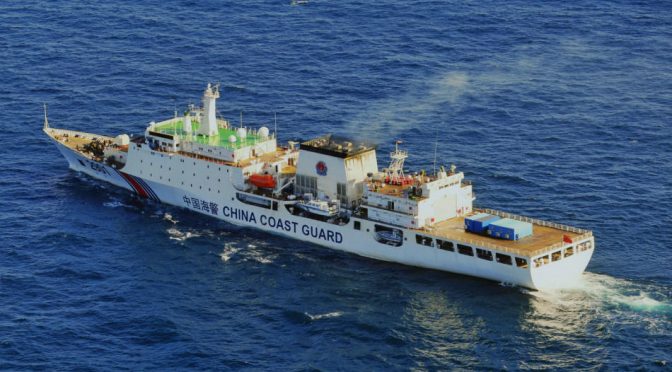
The 2014 HYSY 981 oil rig stand-off, when China’s vessels fired water cannons and rammed into Vietnamese boats, serves as a classic example of China’s use of sub-conventional forces. Some of these platforms are refitted warships, and the total vessel tonnage has far exceeded the cumulative tonnage of neighboring countries. China has also deployed coast guard cutters weighing more than 10,000 tonnes, the largest in the world. They cover maritime militia’s activities like harassing Vietnamese and other littoral fishermen from exercising their rights or defend China’s illegal fishing activities in the exclusive economic zones of other countries. Recently, they have forcefully snatched back a Chinese fishing vessel that had been detained by the Indonesian authorities for transgression.
Such provocative actions to forcefully lay down new rules on the ground need to be challenged, but using conventional air and naval assets will only lead to escalation. It is advisable to learn from China’s strategist himself in this context, Sun Tzu, who counsels that it is wise to attack an adversary’s strategy first before fighting him on the battlefield.
Therefore, both Vietnam and the Philippines must also concentrate on building up the capacity of respective coast guards and maritime administration departments with relevant assets like offshore patrol vessels (OPV) to secure the islands and exclusive economic zones. Operating independently in these areas inevitably hedges against China’s proclamation of South China Sea as its sovereign territory and requiring its consent to operate in.
Vietnam is inducting patrol boats furnished by local industries as well as depending on the pledge from the U.S. to provide 18 patrol boats. The Philippines contracted a Japanese company to build 10 patrol vessels on a low-interest loan offered by Japan’s government. It is also set to receive four boats from the U.S.
India should also take a proactive position and join its regional security partners in extending its current efforts in the Indian Ocean to the South China Sea. India has built high level partnership programs to build the capacity of its neighboring Indian Ocean countries to ensure security of their exclusive economic zones. In the process, it delivered some of its OPVs to Sri Lanka. Recently, Mauritius became the first customer of India’s first locally built OPV Barracuda. India is now building two more for Sri Lanka. Additionally, Vietnam has contracted an Indian company to build four OPVs using the $100 million line of credit offered by the Indian government.
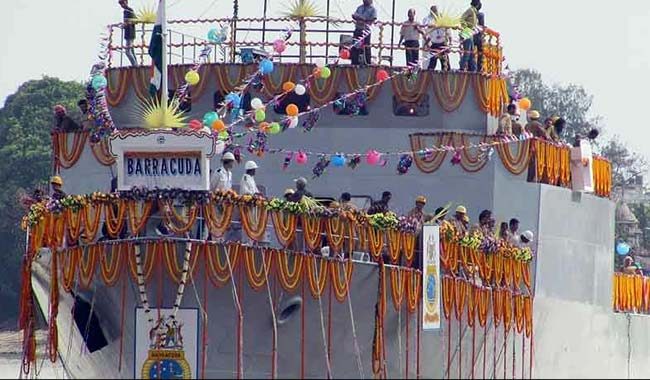
Warship Barracuda docked in Kolkata. (Garden Reach Shipbuilders and Engineers Ltd)
Thedemand for these vessels will only grow as the strategic competition in the South China Sea escalates. India enjoys better political, historical, and security relations with the South East Asian countries, especially Vietnam. The Philippine government has underscored this relationship between India and Vietnam as the foundation for its own relations with India. Taking advantage of this situation not only improves India’s strategic depth in the region but also enhances its manufacturing capacity that is at the core of Make in India initiative.
The specific requirements like range, endurance, and armament depend on the customer countries. The more critical question at play is whether the regional security stakeholders are comfortable with the idea of upgunned coast guards along the South China Sea littoral.
The U.S. has forward deployed four of its Littoral Combat Ships (LCS) to Singapore to tackle a variety of threats emanating in the shallow waters. The ships are smaller than a frigate but larger than an OPV in terms of sensor suites, armament, mission sets, and maintenance requirements. War simulations proved that upgunned LCS can cross into blue water domain with ease and complicate an adversary’s order of the battle.
Vietnam and the Philippines could specify higher endurance, better hull strength and advanced water cannons for their OPVs to defend proportionally against Chinese vessels. In addition to manufacturing ships, India should also train Vietnamese and Philippine forces on seamlessly integrating intelligence from different assets for maritime defense.
Over time, a level of parity in the sub-conventional domain needs to be achieved and maintained to force China to either shift its strategy or escalate the situation into conventional domain whereupon the escalation dominance will shift to status quo countries.
Vidya Sagar Reddy is a Research Assistant at the Observer Research Foundation, New Delhi.
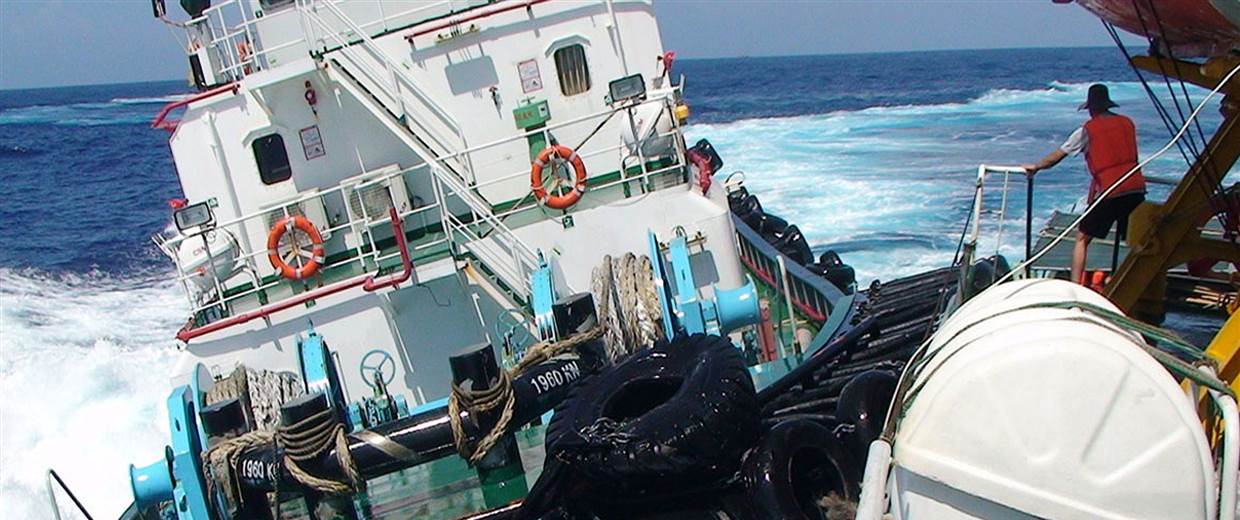
Featured Image: Chinese 10,000 ton coast guard cutter, CCG 2901. (People’s Daily Online)
A spate of shipjackings and kidnapping-for-ransoms has imperiled regional trade in Southeast Asia and prompted calls for trilateral maritime policing in the waters between the Philippines, Malaysia, and Indonesia. Though an important first step, this will not end the kidnappings or lead to an overall improved security situation.
The Context
Starting on 26 March 2016, militants from the Abu Sayyaf Group (ASG) began a spate of maritime kidnappings. Three Indonesian vessels and a Malaysian tugboat were hijacked, and some 18 sailors were taken hostage.
A screen capture from Abu Sayyaf’s fifth video of Norwegian, Kjartan Sekkingstad (l), and Canadian, Robert Hall (r), released on 14 May 2016.
Their treatment was very different than the three Western hostages abducted from a Davao resort in September 2015. The two Canadians, Norwegian, and Filipina were held incommunicado for a period of time, with six videos demanding ransoms issued over seven months. The hostages were filmed in all but one video in front of the black flag of the Islamic State, and in the last two wearing orange T-Shirts, representing the ubiquitous orange jumpsuit of Islamic State (IS) prisoners. The two Canadian hostages were executed when their ransom deadline, already extended and reduced, were not paid, on 25 April and 13 June. On 24 June, the ASG released the Filipina hostage as an “act of good will,” though, at the time of this writing they still hold the Norwegian prisoner.
Photograph of the four Malaysian sailors, released via Facebook, on 15 April 2016.
The Malaysian and Indonesian sailors, by contrast, were quickly put in contact with their families and companies to arrange ransom payments. Although the ASG threatened to behead the four Malaysian sailors if no ransom was paid, there was no IS imagery in the photo posted on Facebookin the proof of life picture that the ASG released. In all three cases, ransoms were paid and the suspects released. Various press reports indicate that the four Malaysians were released with the payment of 140 million pesos ($2.97 million), while ten Indonesians were released following a50 million pesos ($1.06 million) ransom, and the final four released with a15 million pesos ($319,000) ransom. The payment of ransoms was always officially denied. While governments may have not paid the ransom, family members, shipping firms, friends, and insurance companies appear to have come up with the requisite funds. Malaysian Home Minister Ahmad Zahid Hamidi acknowledged that money changed hands, but “channeled not as ransom, but to a body in the Philippines which assists in an Islamic struggle.” There is no ideology here, this is abject criminality.
Not surprisingly, with the payment of large ransoms, shipjackings/kidnappings have continued. On 20 June another Indonesian tugboat was boarded and seven of its thirteen crew members taken hostage. Though the remaining six were able to steer the ship to a safe port, the ASG is demanding $4.8 million in ransom for the release of the seven. Within days of the hijacking the captain was able to call his wife and convey the ransom demand.
The Costs
These shipjackings/maritime kidnappings imperil regional trade. While only a small amount of the $40 billion in regional maritime trade passes through these waters, it is not insignificant. Indonesian coal exports from East Kalimantan account for 70 percent of total Philippine coal imports, worth over $800 million. There are an estimated 55 million metric tons of goodsthat transit these waters annually. These exports are all the more important as Chinese imports of raw materials from Southeast Asia continue to fall with China’s economic slowdown. On 21 April 2016, Indonesian authorities temporarily blocked ships from sailing to the Philippines, warning that the waters were becoming the “New Somalia.” The small shipping companies run on thin margins, and the millions of dollars in ransoms pose a threat to the small-vessel maritime shipping that dominates the region. Following the 20 June kidnapping, the Indonesian Foreign Minister, Retno Marsudi, announced a ban on licenses to ship coal to the Philippines from Indonesian ports, “The moratorium on coal exports to the Philippines will be extended until there is a guarantee for security from the Philippines government.”
Calls for Trilateral Maritime Policing
For the first time in many years, Malaysian and Indonesian leaders have been speaking of the Southern Philippines as being theweak link in regional security and began to call for trilateral maritime policing in waters to the north and northeast of Sabah. There was a most un-ASEAN drumbeat of threats by Indonesian civilian and military leaders to engage in unilateral military operations to rescue their sailors. On 27 April, Philippine President Aquino acquiesced to Indonesian and Malaysian calls for joint maritime patrols based on the joint operations in the Strait of Malacca.
On 5 May, the three foreign ministers met and issued a communique “recognized the growing security challenges, such as those arising from armed robbery against ships, kidnapping, transnational crimes and terrorism in the region, particularly in reference to the maritime areas of common concern.”
To conduct patrol among the three countries using existing mechanisms as a modality;
To render immediate assistance for the safety of people and ships in distress within the maritime areas of common concern;
To establish a national focal point among the three countries to facilitate timely sharing of information and intelligence as well as coordination in the event of emergency and security threats; and,
To establish a hotline of communication among the three countries to better facilitate coordination during emergency situations and security threats.
They instruct the relevant agencies of the three countries to meet as soon as possible and subsequently convene on a regular basis to implement and periodically review the above-mentioned measures and also to formulate the Standard Operating Procedure (SOP).
With the agreement in principle, the sides had to negotiate a standard operating procedure, which had to have more teeth than a poorly implemented 2002 trilateral agreement to respond to Abu Sayyaf attacks.
On 20 June, the Malaysian, Indonesian, and Philippine Defense Ministers agreed to establish transit corridors. “The ministers have agreed in principle to explore the following measures, including a transit corridor within the maritime areas of common concern, which will serve as designated sea lanes for mariners,” they said in a joint statement. In addition, they pledged to increase the number of air and sea patrols as well as maritime escorts.
Most controversially, the draft SOP will allow for the right of hot pursuit, something that the Indonesians insisted on. The Indonesian Minister of Defense, Ryamizard Ryacudu told the media “We’ve agreed that if another hostage situation occurs, we will be allowed to enter [Philippine territory].” His Philippine counterpart, Voltaire Gazmin, who was in the last week of his job, qualified the agreement: the hijacking/kidnapping must have taken place in Indonesian waters, before Indonesian vessels could enter Philippine territory, and Philippine security forces would have to be immediately informed so that a “coordinated and joint operation could immediately be undertaken.”
Limitations
Even if the three countries implement the SOP and begin implementing trilateral policing, there would be serious limits for seven key reasons.
First, this is not the Strait of Malacca, one of the most critical maritime straits in the world. Those patrols, now in their 11th year, have been successful and resulted in a dramatic drop in piracy and shipjackings. But they have benefited from members with very robust capabilities, such as Singapore and Malaysia, a critical international chokepoint, and with technical support from the United States, which made it clear that if the littoral states did not increase patrols it would. The Strait of Malacca has the most sophisticated network of radars and maritime domain awareness capabilities in the region.
Second, sovereignty remains the paramount concern. No country will allow “joint” patrols in their territorial waters. They might do “coordinated patrols” in their respective national waters, but there will be no joint patrols. Each country has been adamant on this point. As the Philippines said, “’joint exercises” can only take place “in the high seas and not within [Philippine] territorial waters.” As Indonesian Foreign Minister Retno Marsudi put it, any joint actions “must be agreed on without any of them sacrificing their sovereignty.”
Even the agreement on hot pursuit seems problematic. While Malaysia and Indonesian may be keen to have the right to hot pursuit into Philippine waters, it is hard to see them accepting one another exercising this right. Second, the incoming Duterte administration has not signaled their approval of this agreement. It is possible that they do not feel bound by agreements signed by the outgoing Aquino administration.
Third, and more to the point, this really requires Indonesian leadership. As we have seen, President Widodo’s Maritime Fulcrum Strategy has been terribly implemented, and he has shown little interest in compelling his various services and ministries to come up with an integrated implementation strategy, let alone serve as a regional leader of ASEAN. The Indonesian military’s threat perception and budgetary allocation priorities have returned to an inward focus, after nearly a decade of maritime orientation.
Fourth, the capabilities of all three remain very limited. There is an asymmetry between the threat and the capabilities deployed to this region. Even though Malaysia has beefed up maritime policing off of Sabah, especially following the incursion by Sultan of Sulu-backed gunmen in 2013, it has not been enough to prevent the ASG from still launching kidnappings. Malaysia and Indonesia have only limited naval, coast guard, and maritime law enforcement capabilities, and this region has not been a priority. The Strait of Malacca and increasingly the South China Sea have been far greater priorities. But those limited capabilities are exactly why cooperation is so necessary.
Fifth, there are still significant suspicions between the countries and lingering border disputes. The Indonesians remain distrustful and angry towards the Malaysians over the maritime demarcation between Sabah and East Kalimantan in the Ambalat region. On 26 June, Indonesian jet fighters intercepted a Malaysian military cargo plane flying too close to Natuna Island. While Indonesia and the Philippines successfully demarcated their maritime boundary in 2014, Malaysia and the Philippines do not have a formally demarcated maritime border owing to the disputed claim over Sabah. That may possibly worsen as president elect Duterte stated that he would revive the Philippine claim to Sabah which had been dormant for number of years.
EEZ demarcation between the Philippines and Indonesia. The total length of the line is 627.51 nautical miles or 1,162.2 kilometers from points 1 to 8. (Government of the Philippines/Government of Indonesia)
Sixth, one needs to study a map of the trade routes to understand that even if there is international cooperation as well as designated corridors, they will only have a limited impact.
A majority of Abu Sayyaf operations occur in Philippine waters, and only a small portion occur in waters that may have joint patrols. If militants want to avoid Indonesians exercising their right to hot pursuit, they merely have to wait for targets to enter Philippine waters. Manila is unlikely to allow armed convoys from Malaysia or Indonesia, to continue into Philippine waters, let alone ports, even if they do not have the assets in place to receive the handoff. The weak link remains the limited capabilities of the Philippine Navy, Coast Guard, and law enforcement authorities. What little the Philippines actually has is primarily focused on their maritime claims in the South China Sea.
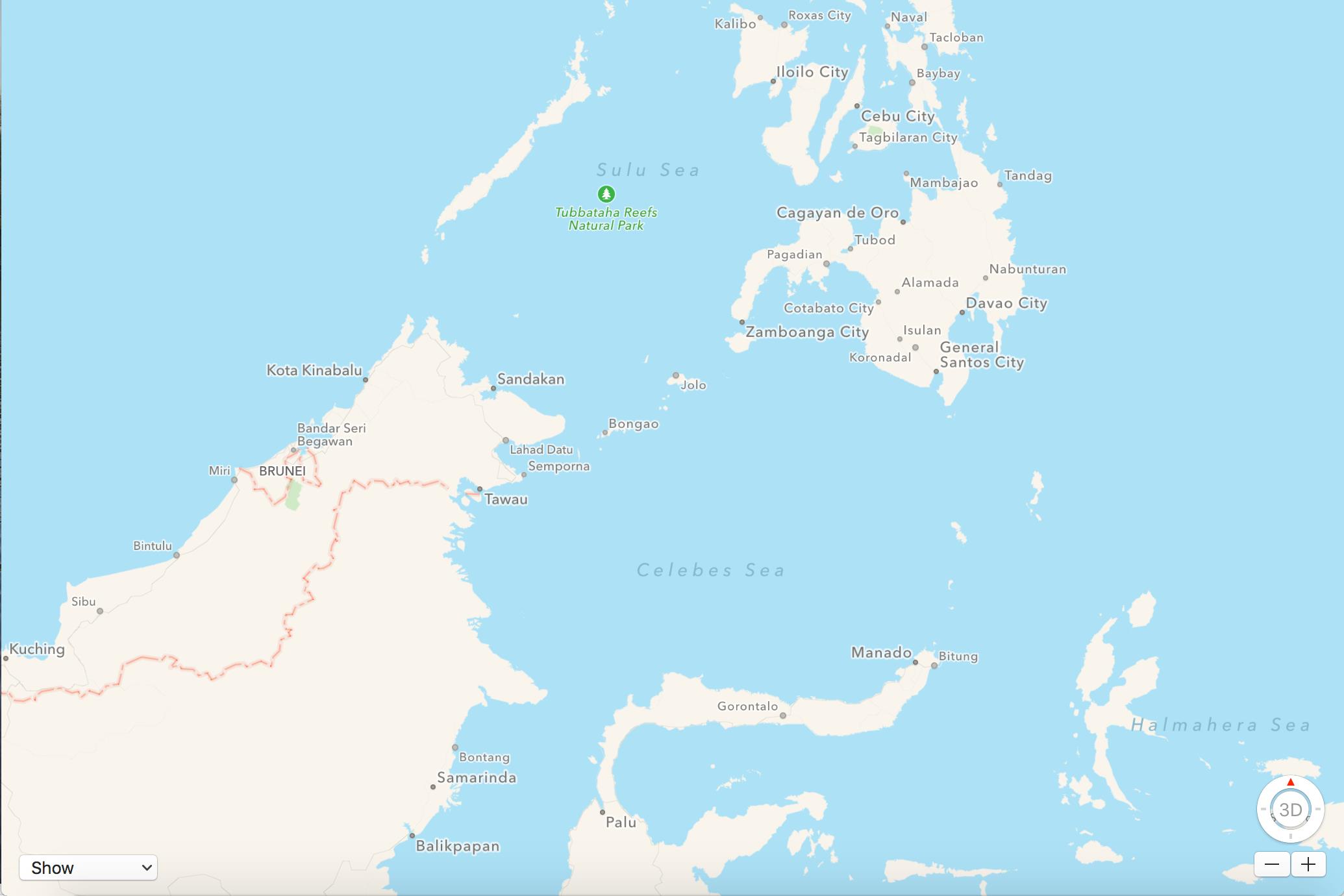
The Sulu and Celebes Seas. (Image courtesy of author)
Even if we take away the large LNG tankers and large container ships that come up through the Lombok and Makassar Straights, which then either continue on to Northeast Asia to the east of the Philippines or cut through the deep waters between the Malaysian state of Sabah and the Tawi Tawi Islands of the Philippines, there are simply too many small tugboats, small bulk cargo ships, and tramp steamers that ply those waters to protect.
Ships coming out of Balikpapan and Samarinda in East Kalimantan or Makassar and Monado on Sulawesi traveling across the Celebes Sea to General Santos or Davao in the Philippines could be better protected. Yet, ships leaving any of those four ports traveling to Cebu, Cagayan d’Oro or Manila must transit the waters around Jolo, Tawi Tawi and Basilan, the Abu Sayyaf’s heartland. Likewise, ships sailing out of Western Sabah or Sarawak states traveling to Manila, Cebu, or ports in northern Mindanao can operate at the furthest edges of Abu Sayyaf capabilities. But ships from there or from the port of Sandakan going to Zamboanga or east to General Santos or Davao must transit the pirate infested waters between Tawi Tawi and Basilan. Abu Sayaf can launch quick attacks from their hideouts along this poorly policed coastline throughout the archipelago.
Again, the ASG can operate close to shore, in Philippine waters, without triggering the right of hot pursuit. And even if Indonesian or Malaysian forces were able to operate in hot pursuit, only on sea; they can do nothing when the Abu Sayyaf reach shore.
Finally, the lesson of Somalia is that international maritime cooperation cannot defeat piracy. Piracy is defeated on land, not sea. Despite ample support from the United States since 2002, the Armed Forces of the Philippines has proven unable and unwilling to defeat the Abu Sayyaf group. This is a small group, geographically contained, and enjoys little popular appeal. Yet, they endure. There are simply too many vested interests in keeping the thuggish militants around. The ransoms not only go to bribing local officials, military, and law enforcement despite their vociferous denials, but local communities profit from the kidnappings as well. The proceeds have gone not just to buy new weapons and ammunition from the black market, but to support a sub-economy.
Indeed, there is growing evidence that new kidnap for ransom gangs are carrying out operations, and then selling their captives to ASG leaders such as Al Habsyi Misaya. The six Indonesian sailors who were not taken hostage on 20 June recounted that their seven colleagues were taken by two separate groups with very different behavior and professionalism.
It is yet to be seen what approach president-elect Duterte will take. Like most issues, he has said one thing and immediately contradicted himself. He has has prided himself on the use of extra-judicial killings to eliminate Davao of crime and drugs, and said that Abu Sayyaf should be liquidated. He brashly warned the ASG that “there will be a time, there will be a reckoning,” but then said that it was not his “top priority,” and announced a willingness to negotiate with them. There is no evidence that they will accede to his demand that they “surrender unconditionally, release your prisoners, your hostages.” His messaging on the Bangsamoro peace process has likewise been contradictory, which has added to the sense of regional insecurity.
Duterte recently warned that he would not continue the Armed Forces of the Philippines modernization program, re-orienting the security forces back to an internal security focus. The limited Philippine naval modernization program, may be very short-lived. But then his Secretary of National Defense Delfin Lorenzana stated that the ASG was the country’s primary security threat, whose “illegal activities, including kidnapping, must stop,” Delfin warned: “We have to end this once and for all. This problem is giving us a very bad image abroad.”
In short, trilateral policing can only deliver so much until the capabilities of the Philippines improve. Delfin announced that military spending would be diverted from acquiring assets for use in the South China sea to fast patrol craft and helicopters for counter-terrorist operations. But it is hard to imagine that China will not act aggressively and start reclamation of Scarborough Shoal following an adverse ruling from the Permanent Court of Arbitration, set for 12 July. Perhaps they will try to leverage that for further maritime assistance from the United States and other partners such as Australia and Japan.
Tempered Expectations
The frustration on the part of the Indonesian and Malaysian governments is palpable. In addition to hurting trade, a number of land-based kidnappings in Sabah since 2013, have impacted tourism. Malaysian Foreign Minister Datuk Seri Anifah Aman was blunt in calling for a meeting with his new Philippine counterpart following the 30 June inauguration of President Duterte:
“We need to have this urgent meeting. I would like to stress upon the seriousness of this problem that involves Filipino nationals. We accept that it is a complex issue. The Philippines military has been going after these people with limited success. The question now is how can we work together.”
So what can we expect? There may be some coordinated patrols,but expectations about what these entail should be low. These navies and maritime law enforcement organizations do not have a great track record of working together in this area, which for all three countries has received a disproportionately low share of their respective maritime security budgets.
That they are even discussing them and trying to come up with standard operating procedures is well and good. But this will need to be routinized and taken to a higher level if it is to succeed. Perhaps external actors, including the United States, Australia, Japan, and even Singapore, can help bridge some of the gaps.
The three sides are discussing database and intelligence sharing on local extremists and militants. There have been suggestions of establishing joint military command posts, yet undefined. But an actual fusion center as what was established in Singapore seems a long way off, and the reality is that none of the three has adequate maritime domain awareness capabilities.
With regional trade dominated by slow tugboats and tramp steamers, even groups with limited capabilities such as Abu Sayyaf can wreak havoc in the Sulu and Celebes Seas. With limited capabilities amongst the three littoral states, there is an imperative to cooperation, especially considering the importance of regional trade. Yet a history of mistrust, continued border disputes, a fixation on sovereignty, and a lack of leadership is making the necessary cooperation more difficult to achieve.
Zachary Abuza, PhD, is a Professor at the National War College where he specializes in Southeast Asian security issues. The views expressed here are his own, and not the views of the Department of Defense or National War College. Follow him on Twitter @ZachAbuza.
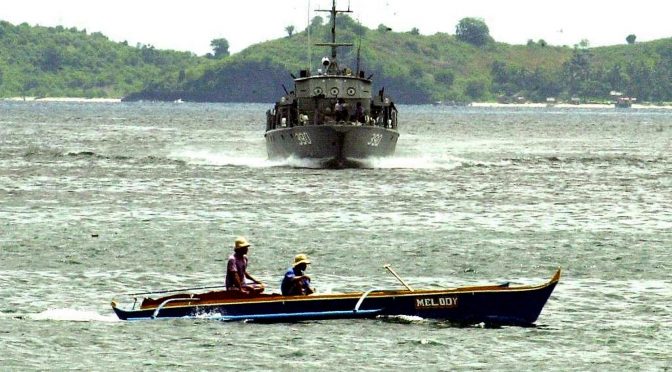
Featured Image: A navy cutter patrols the shores of a fishing village near the capital town of Jolo in the southern Philippine province of Sulu 30 June 2000 as an outrigger races across its path. (AFP PHOTO)
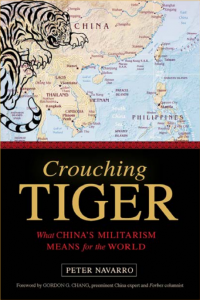
Those focused on the realm of maritime security have watched China’s actions in the East and South China Seas with some combination of fascination and trepidation over the past several years. From land reclamation efforts on Johnson South Reef to “cabbage” strategy successes around Scarborough Shoal, the People’s Republic of China (PRC) has repeatedly defied convention, their neighbors’ sovereignty, and yes, international law in their expansive effort to exercise control over the seas about the first and second island chains under the guise of historical righteousness. The impending arbitration ruling from the United Nations has tensions in the region at a fever pitch. Questions abound: Will China declare an ADIZ in the South China Sea, as they did in the East China Sea in November of 2013? Will a ruling in the Philippines’ favor spur China to double down on its expansion activity and militarism? Will there be war with China, and what might such a conflict look like? It is this last question, an overarching theme in any discussion of China’s militarization and the international community’s efforts to reckon with it, that author Peter Navarro seeks to address in his book Crouching Tiger: What China’s Militarism Means for the World.
Author Peter Navarro. Image courtesy of the author.
Navarro, a bestselling author and professor at the University of California Irvine’s Merge School of Business, takes a holistic and comprehensive approach to answering the question of whether or not a war with China will occur and, in the event of war, what form such a conflict might take. Perhaps most importantly, Navarro also details pathways to avoid conflict through means of diplomacy and deterrence. Navarro’s prose is engaging and moves at a rapid pace. Styled as a “geopolitical detective story,” Crouching Tiger’s text is widely accessible and consistently clear, making an issue that is opaque to most readers digestible. Each chapter begins with a multiple-choice question about the subject matter, which readers (detectives, as the book calls them) themselves are equipped to answer by its conclusion. The direct tone of the book should not be confused for simplicity, however. Navarro does not shy away from detail, addressing the complexity of great power politics head-on. Navarro’s argument is strengthened by the opinions and research of some of the world’s foremost scholars on geopolitics and China, with statements from the likes of the University of Chicago’s John Mearsheimer and the U.S. Naval War College’s Toshi Yoshihara woven throughout the text. Though short, Crouching Tiger is indeed quite dense, providing a truly sweeping account of the subject matter.
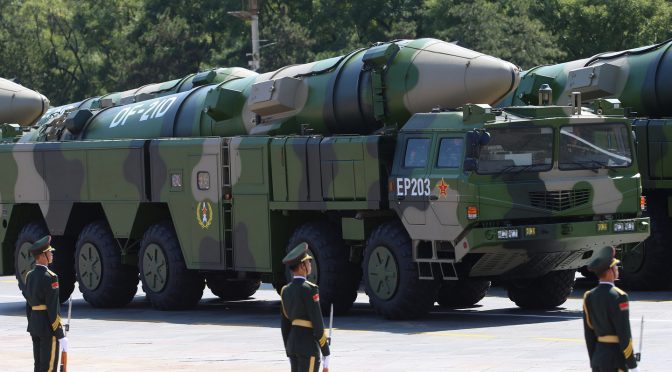
Crouching Tiger begins by setting the stage for the discussion, succinctly but completely outlining the schools of thought on great power politics, the history of China’s interactions with both the United States and the global system at large, and assessing the capabilities of the Chinese military. Navarro deftly characterizes China’s rapid military build-up in their quest for regional hegemony, covering topics from the DF-21 “carrier killer,” to China’s “Underground Great Wall” and truly staggering nuclear stockpile (this will come up again later.) Further, Crouching Tiger addresses China’s Anti-satellite (ASAT) capabilities (demonstrated famously with the destruction of the PRC’s own FY1-C weather satellite in 2007), which leave the United States’ overhead constellations, on which it has become militarily, economically, and comprehensively dependent, at risk.
Moving quickly, Navarro then delves into possible “triggers, trip wires, and flash points” that could ignite a conflict between China, the U.S., and their various allies and defense treaty cosigners. Some of these triggers will be familiar to readers who keep an eye on the news in the South China Sea, while others, such as China’s territorial disputes with India and their possible implications for coming periods of water scarcity, are less well known. In the third section of the book, Surveying the Battlefield, Navarro provides a synopsis of U.S. vulnerabilities and strategies with regard to a notional conflict. Crouching Tiger’s final sections discuss possible “pathways to peace.” In a particularly effective section, Navarro gleefully dismantles the arguments for U.S. isolationism (which seem to grow louder by the day), peace through economic engagement (which provided no guarantee of peace in World War One), and traditional nuclear deterrence a-la USSR-U.S. Cold War relations. Crouching Tiger concludes with Navarro’s own strategies to avoid conflict and ensure peace.
If Navarro can be criticized for anything, it is that Crouching Tiger lands a little on the alarmist side. But perhaps in a nation that has tolerated the squeeze of sequestration, watched its military readiness decline as the U.S. Navy rides out the last of its Reagan-era investments, and where more than one politician on either side of the aisle has promoted isolationism (either directly or by reduced investment in defense) as a sound fiscal and geopolitical policy, a little alarmism may not be a bad thing. Indeed, if Navarro’s goal in publishing Crouching Tiger is to provide a wake up call to his readers about the stark realities and implications of U.S. policy, investment, and presence in the Asia-Pacific, he has done so with considerable aplomb. The text is not lengthy; some scholars of the Asia-Pacific may find that some of Navarro’s arguments lack some context. Despite this, a broad audience will find much to consider in the pages of Crouching Tiger. As such, this book comes highly recommended to readers from the most accomplished geopolitical scholars to high-level policymakers and diplomats. I will add my voice to this chorus.
Note: There is an accompanying film series for Crouching Tiger. Find more details at Crouching Tiger’s website.
Sally DeBoer is the Book Review Coordinator for CIMSEC. She can be reached at books@cimsec.org.
This publication was originally featured on Bharat Shaktiand is republished with permission. It may be read in its original form here.
By Vice Admiral Pradeep Chauhan AVSM & Bar, VSM, IN (Ret.)
Editor-in-Chief’s Note
Part I of this two-part article introduced the geoeconomic and geostrategic imperatives that shape China’s geopolitical drives. It also presented the overarching concept of “reach” as an aid to understanding the international import of China’s military strategy. Read Part I here.
In this second and concluding part of the article series the author explores Chinese strategic intent and its ramifications. The article provides an account of the naval facilities China is promoting or constructing on disputed islands among littoral states of the Indian Ocean; assesses China’s economic linkages with African nations; and projects the growth curve of the Chinese Navy, all of which are important to keep in view while analyzing the trajectory of Chinese geo-strategic intent.
By emphasizing the factor of temporal strategic-surprise (in contrast to spatial surprise), the author offers clues to understanding the links between China’s military strategy and her geopolitical international game-moves as they are being played out within a predominantly maritime paradigm. As in the famous Chinese game of Go—perhaps a more apt analogy than chess—the People’s Republic is putting in place the pieces that will shape her desired geopolitical space. The author explores the spatial and temporal dimensions of the Chinese strategy and the related vulnerabilities of the opposing Indian establishment.
In his 2006 dissertation written at the US Army War College then-Lt. Col Christopher J. Pehrson, USAF, termed the Chinese geostrategy the “String of Pearls.” This expression, first used in January 2005 in a report to U.S. military officials prepared by the U.S. consulting firm of Booz Allen Hamilton, caught the attention of the world’s imagination. Pehrson posited China as a slightly sinister, rising global power, playing a new strategic game, as grandiose in its concept, formulation and execution as the “Great Game” of the 19th century. Despite vehement and frequent denials by Chinese leadership of any such geostrategic machinations designed at the accumulation of enhanced geopolitical and geoeconomic power and influence, the expression rapidly embedded itself into mainstream consciousness.
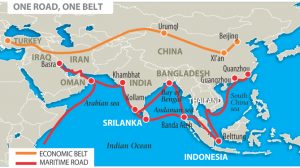
China’s One Road, One Belt economic infrastructure initiative. (Chinausfocus.com)
As a net result, for over a decade, China has chafed under the opprobrium heaped upon it for a concept that (to be fair) it had never once articulated by the state. However, in a brilliant rebranding exercise by Beijing in 2014, the world’s attention is being increasingly drawn away from the negative connotations associated with the phrase String of Pearls and towards the more benign-sounding 21st century Maritime Silk Route Economic Belt, also known as “One Road, One Belt.” This presents an alternative expression, while it nevertheless covers essentially the very same geostrategic maritime game-plays that Colonel Pehrson explained a decade ago. The new expression emphasizes transregional inclusiveness and evokes the romance of a shared pan-Asian history with the implied promise of a reestablishment of the economic prosperity that the Asian continent’s major civilizational and socio-cultural entities, namely China and India, enjoyed until the 18th century.
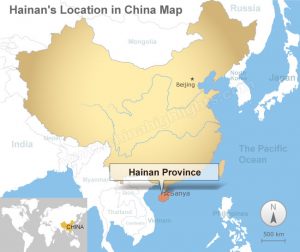
Each “pearl” in the String of Pearls construct—or in more contemporary parlance, each “node” along the Maritime Silk Route—is a link in a chain of Chinese geopolitical and geostrategic influence. For example, Hainan Island, with its recently upgraded military facilities and sheltered submarine base, is a pearl/node.
It is by no means necessary for a line joining these pearls/nodes to encompass mainland China in one of the concentric ripples typified by the Island Chains strategy. In fact, since the Maritime Silk Route is a true maritime construct, it is highly unlikely that the nodes would do so.
The location of Hainana Province, China. (chinahighlights.com)
Other pearls/nodes include the recent creation of artificial islands in the Paracel and Spratly islands incorporating, inter alia, the ongoing construction/upgrade of airstrips on Woody Island—located in the Paracel Islands, some 300 nm east of Vietnam—as also on Mischief Reef and Fiery Cross Reef in the Spratly Islands. Additional pearls/nodes have been obtained through Chinese investments in Cambodia and China’s continuing interest in Thailand’s Isthmus of Kra.
China’s development of major maritime infrastructure abroad—the container terminal in Chittagong, Bangladesh; the Maday crude oil terminal in Myanmar’s Kyakpyu port; the development of ports such as Hambantota in Sri Lanka, Gwadar in Pakistan, Bagamoyo in Tanzania, Beira in Mozambique, Walvis Bay in Namibia, Kribi in Cameroon, the Djibouti Multipurpose Port (DMP), and the offer to even develop Chabahar in Iran (checkmated by a belated but vigorous Indian initiative), along with the successful establishment of a military (naval) base in Djibouti—all constitute yet more pearls/nodes. The development of an atoll in the Seychelles, oil infrastructure projects in Sudan and Angola, and the financing of newly discovered massive gas finds in offshore areas of Mozambique, Tanzania and the Comoros, are similarly recently acquired pearls/nodes. Even Australia yields a pearl/node, as does South Africa, thanks to Chinese strategic investment in mining in general and uranium-mining companies in particular, in both countries.
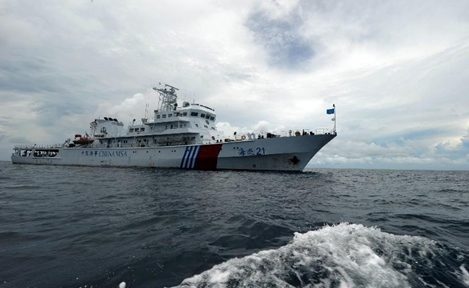
Chinese maritime policing vessel. (SCMP.com)
From an Indian perspective, China’s new strategic maritime-constructs (by whichever name) are simultaneously operative on a number of levels, several of which are predominantly economic in nature and portend nothing more than fierce competition. At the geostrategic level, however, the economy is at its apex and is China’s and India’s greatest strength and greatest vulnerability, at the same time; therefore, the economy is the centerpiece of the policy and strategy of both countries. This is precisely why, as the geographical competition space between India and China coincide in the Indian Ocean, there is a very real possibility of competition transforming into conflict, particularly as the adverse effects of climate change on resources and the available land area becomes increasingly more evident.
“Reach” has both spatial and temporal dimensions. The spatial facets of China’s geopolitical moves are evident, as illustrated in the preceding String of Pearls discussion. It is critical for India’s geopolitical and military analysts to also understand the temporal facets of this construct. The terms short term, medium term and long term are seldom used with any degree of digital precision. A nation tends to keep its collective “eye on the ball” in the short term and, by corollary, tends to assign far less urgency to something that is assigned to the long term. This ill-defined differentiation is how strategic surprise may be achieved in the temporal plane. For instance, in China, the short term generally implies 30 to 50 years. This is an epoch that is far in excess of what in India passes as the long term. Consequently, India fails to pay as close attention to developments in China as she might have were the developments to unfold in a duration corresponding to India’s own short term of 2-5 years. This distinction permits China to achieve strategic surprise, and this is as true of military strategy as it is of grand strategy and geoeconomics.
On the one hand, it should be remembered that these strategic constructs are not only about maritime infrastructure projects, involving the construction of ports, pipelines and airfields, though these developments constitute their most obvious and visibly worrisome manifestation. The strategy is equally about new, renewed or reinvigorated geopolitical and diplomatic ties between the People’s Republic of China and nation states across a very wide geographical swath (including the African littoral and the island nations of both the Indian Ocean and the Pacific Ocean). On the other hand, China’s strategic maritime constructs have some important military spin-offs, which closely align to the furtherance of geostrategic reach. Thus, by developing friendly ports of call (if not bases), facilities and favorable economic dependencies in the various pearls/nodes, the logistics involved in the event of an engagement in maritime power-projection are greatly eased.
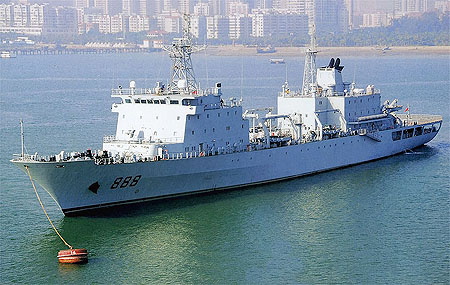
Type 904 (Dayun Class) Transport Ship (globalmil.com)
Supplementing the pearls/nodes are the Chinese Navy’s five impressive stores/ammunition supply ships of the Dayun Class (Type 904) and six underway replenishment tankers of the Qiandaohu Class (Type 903A). In addition, China requires ground control stations to meet her satellite-based needs of real-time surveillance. Unlike the United States, China simply does not have adequate ground control/tracking stations within the Indian Ocean to affect requisite ground control and real-time downlinking of her remote-sensing satellites. This forces her to deploy a number of ships (the Yuanwang Class) for this purpose. These constitute a severe vulnerability that China certainly needs to overcome. One way to do so is to establish infrastructure and acceptability along the IOR island states and along the East African littoral, as China is currently attempting to do.
The principal lack in the Chinese strategy to provide military substance to the country’s geoeconomic and geostrategic reach comes in the form of integral air power through aircraft carriers. China is rapidly learning that while one can buy or build an aircraft carrier in only a couple of years, it takes many more years to develop the human, material, logistic and doctrinal skills required for competent and battle worthy carrier-borne aviation. For nearly a decade now, China has demonstrated her ability to sustain persistent military (naval) presence in the Indian Ocean—albeit in a low threat environment. Combat capability is, of course, quite different from mere presence or even the ability to maintain anti-piracy forces, since the threat posed to China by disparate groups of poorly armed, equipped and led pirates can hardly be equated with that posed by a powerful and competent military adversary in times of conflict.
Despite the impressive growth of the Chinese Navy and the vigor of the Chinese military strategy, China may not, in the immediate present, have the combat capability to deploy for any extended period of time in support of its geoeconomic and geostrategic reach were they to be militarily contested by a major navy. However, as James Holmes points out, if India were to continue to cite shortfalls in current Chinese capability and conclude that it will take the PLA Navy at least fifteen years to station a standing, battle worthy naval squadron in the Indian Ocean, this would lull Indians into underplaying Chinese determination and the speed of that country’s military growth. This would carry the very real consequent possibility of India suffering a massive strategic surprise. Is that something that India can afford?
Vice Admiral Pradeep Chauhan retired as Commandant of the Indian Naval Academy at Ezhimala. He is an alumnus of the prestigious National Defence College.

 influence of emerging naval platforms and technologies in the geostrategic contours of the Indo-Pacific region. It identifies relevant historical precedents, forming the basis for various maritime development and security related projects in the region.