Category Archives: Future Tech

What is coming down the pipe in naval and maritime technology?

The Future of China’s Military Innovation


Forging China

Forging China’s Military Might: A New Framework for Assessing Innovation, edited by Tai Ming Cheung. Johns Hopkins Press, 2014. 304pp. $24.95

Review by Dr. Jeffrey Becker

Can China’s defense industry take the next step in supporting the country’s military modernization? Can it progress beyond a few well-known pockets of excellence in space and missiles to the point where the industry writ-large is capable of truly radical innovation? The CCP leadership clearly recognizes the importance of developing the nation’s defense science and technology industry, and defense industry reforms appear to be an integral part of the larger ongoing military reform process initiated at the 3rd Plenum of the 18th Party Congress in 2013. One need only look at recent Chinese writings on adjustment to weapons and equipment procurement and a growing focus on civil-military integration to see that the current leadership understands the importance of this issue to China’s future status as a military great power.

It is this context that we should view Tai Ming Cheung’s recently released edited volume, Forging China’s Military Might (2014, Johns Hopkins University Press). The results of a 2011 conference examining the Chinese defense economy held at Berkeley’s Institute on Global Conflict and Cooperation, the book tackles the question of how we should view China’s defense industry within a global comparative perspective. While the relatively long time from conference to publication is lamentable, the volume contains many essays which remain highly relevant and cover a range of topics, including analytical models designed to better understand important drivers of innovation, trends in the direction of China’s defense industry development, and detailed case studies examining important organizations within the Chinese military and defense establishment.

The volume is anchored by the theoretical chapter authored by Tai Ming Cheung, Thomas G.  Mahnken, and Andrew L. Ross. The chapter lays out a general model that allows for comparing innovation in national defense industries across countries. The details of the model are far too complex to do justice in the space here, but are certainly worthy of more in-depth examination.  In sum, the model attempts to place national defense innovation on a spectrum ranging from simplistic and duplicative imitation, to disruptive and radical innovation. Where a country falls on this spectrum depends on a number of factors, including the state’s level of technological development, their security situation, and level of global integration. The authors find that most advances in the Chinese defense industry have been more incremental than disruptive to date, a finding likely true in most countries. While this is non-controversial, the chapter also notes that China’s innovative success has been more a function of technological advancements rather than doctrinal reform or organizational change, a point some may argue given the amount of ink spilled over the past twenty years examining PLA reforms in training, organization, and doctrine. 

Of the remaining chapters, two are likely of greatest interest to CIMSEC readers in that they deal directly with issues of concern to the PLA Navy. 

The first is an examination of China’s Military Representative Offices (MROs) by Susan M. Puska et. al. China’s MRO system is the PLA’s attempt to ensure quality at all stages of weapons and equipment production. Like previous studies of this system, the authors find it to be redundant, fragmented, and largely ineffectual. However, the chapter provides useful information on relatively recent (2010-2011) attempts to experiment with changes to the PLAN’s MRO system, with the goal of incorporating them into other MRO systems once they have been deemed successful. 

Like many experiments within the Chinese military and government, reforms to the MRO system appear to have gone nowhere. However, given that the PLA now appears to be undertaking some of the widest ranging and most serious reforms in decades, it will be extremely interesting to see whether they provide an impetus to finally bring the MRO system more in line with the PLA’s current needs and requirements. Added incentive to change how the PLA manages weapons development and procurement has also come from the ongoing anti-corruption campaign, which has already taken down a number of military officials – including those involved in weapons logistics and procurement. 

The second chapter likely to be of greatest interest to CIMSEC readers is the examination of China’s place in the global defense industry by Richard A. Bitzinger et. al. The authors compare and contrast the accomplishments of China’s defense industries in the field of shipbuilding, aviation, and space launch vehicles.  The examination of China’s shipbuilding industry provides some useful detail regarding the sectors’ accomplishments and challenges. Despite the dramatic achievements made over the past two decades, the authors find the continued reliance on foreign technology to be problematic, especially should China need to ramp up production during conflict, when access to needed foreign material and components may be in short supply. The authors conclude that China’s naval shipbuilding has been “remarkable, yet short of impressive,” a more somber assessment which contrasts with some of the more optimistic predictions regarding China’s naval shipbuilding capacity over the near term.   

So what are we to expect from China’s defense industry in the near future? The assessment here is that results are likely to be mixed. Pockets of excellence in areas such as missiles, space and cyber are likely to expand and will continue to improve. Other areas such as aviation – particularly the aero-engine sector – will continue to face challenges. Key for China analysts and those who focus specifically on China’s defense industry will be to identify well in advance those early warning indicators that will allow us to determine the extent to which real change in the industry is occurring, and how to determine how much of an impact it is having on China’s ability to close the defense technology gap. This book helps to advance that conversation by providing a number of ways to look at China defense industry in comparative perspective, which will be of value to anyone seeking to answer these questions for some time to come.

Jeffrey Becker is an analyst in the CNA China Studies Division. Dr. Becker’s published books and monographs include From Peasants to Protesters: Social Ties, Resources, and Migrant Labor Contention in Contemporary China (Lexington Books, 2014), and Behind the Periscope: Leadership in China’s Navy (CNA, 2013). His current research interests include Chinese maritime issues and Chinese foreign policy in the Asia-Pacific. Dr. Becker holds a Ph.D. in political science from the George Washington University, an M.A. in political science from Columbia University, and a B.A. in international relations and Asian studies from Colgate University.

Readers interested in reviewing books for CIMSEC can contact the book review editor at books@cimsec.org.

CIMSEC content is and always will be free; consider a voluntary monthly donation to offset our operational costs. As always, it is your support and patronage that have allowed us to build this community – and we are incredibly grateful.
Select a Donation Option (USD)

Enter Donation Amount (USD)

Inspector Gadgets: Drones in the Hangar

Checking an aircraft for damage can be arduous and meticulous work,  but last week’s issue of The Economist highlights an experimental commercial approach. In simple terms, the Remote Intelligent Survey Equipment for Radiation (RISER) drone is a quadcopter with LIDAR and forms the basis for a system to use lasers to automatically detect damage to airliners.

The obvious naval application for inspector drones would be for ground-, carrier, and surface vessel-based fixed-wing and helicopter units, although the configurations for each aircraft type and location might make some more practical than others. For example it probably makes more sense to consolidate expertise in inspector drones at regional maintenance and readiness centers than to try to outfit a unit in the small helicopter hangar of every destroyer. But there’s always something to be said for an operational capability.

While The Economist notes that the drones are allowed at Luton airport, UK, to “operate only inside hangars, and only when the doors are shut,” similar systems could be used during periods of extended surface ship and submarine maintenance, particularly while in dry dock to check for damage and wear and tear to those vessels’ hulls and systems.

We’ve speculated previously at CIMSEC on the utility of LIDAR-equipped shipboard robots and autonomous systems to engage in damage control, but external hull and airframe inspection drones add a wrinkle and join an ever-growing list of potential (and actualized) uses for drones.

Scott Cheney-Peters is a surface warfare officer in the U.S. Navy Reserve and founder and Chairman of the Center for International Maritime Security (CIMSEC). He is a graduate of Georgetown University and the U.S. Naval War College, a member of the Truman National Security Project, and a CNAS Next-Generation National Security Fellow.

CIMSEC content is and always will be free; consider a voluntary monthly donation to offset our operational costs. As always, it is your support and patronage that have allowed us to build this community – and we are incredibly grateful.
Select a Donation Option (USD)

Enter Donation Amount (USD)

The Role of Swarm Intelligence for Distributed Lethality C2

This article was submitted by guest author Marjorie Greene for CIMSEC’s Distributed Lethality week.  Ms. Greene is a Research Analyst with CNA.  Views expressed are her own.

What will distributed lethality command and control look like?   This article introduces a self-organizing approach that addresses this question.   The increasing vulnerability of centralized command and control systems in network warfare suggests it may be time to take an entirely new approach that builds on the human capacity to interact locally and collectively with one another. Building on the concept of swarm intelligence, the approach suggests that information could be “shared” in a decentralized control system, much as insect colonies share information by constructing paths that represent the evolution of their collective knowledge.

This article builds on a self-organizing system that was developed for military analyses aimed at finding out “who talks to whom, about what, and how effectively” in a wide range of operational situations featuring the involvement of naval forces and commands. In an effort to describe the content of message traffic throughout the chain of command during a crisis, a technique was used to associate messages with each other through their formal references. “Reference-connected sets” were constructed that required no interpretation of the subject matter of the messages and, when further analyzed, were found to uniquely identify events during the crisis. For example, one set that was constructed from crisis-related message traffic found in files at three command headquarters contained 105 messages that dealt with preparation for landing airborne troops. Other sets of messages represented communications related to other events such as providing medical supplies and preparing evacuation lists. The technique therefore provided a “filter” of all messages during the crisis into events that could be analyzed – by computers or humans – without predetermined subject categories. It simply provided a way of quickly locating a message that had the information (as it was expressed in natural language) that was necessary to make a decision [1].

As the leaders of the Surface Navy continue to lay the intellectual groundwork for Distributed Lethality, this may be a good time to re-introduce the concept of creating “paths” to represent the “collective behavior” of decentralized self-organized systems” for control of hunter-killer surface action groups. Technologies could still be developed to centralize the control of multiple SAGs designed to counter adversaries in an A2/AD environment. But swarm intelligence techniques could also be used in which small surface combatants would each act locally on local information, with global control “emerging” from their collective dynamics. Such intelligence has been used in animal cultures to detect and respond to unanticipated environmental changes, including predator presence, resource challenges, and other adverse conditions without a centralized communication and control system. Perhaps a similar approach could be used for decentralized control of Distributed Lethality.

Swarm intelligence builds on behavioral models of animal cultures. For example, the ant routing algorithm tells us that when an ant forages for food, it lays pheromones on a trail from source to destination. When it arrives at its destination, it returns to its source following the same path it came from. If other ants have travelled along the same path, pheromone level is higher. Similarly, if other ants have not travelled along the path, the pheromone level is lower. If every ant tries to choose a trail that has higher pheromone concentration, eventually the pheromones accumulate when multiple ants use the same path and evaporate when no ant passes.

Just as an ant leaves a chemical trace of its movement along a path, an individual surface combatant could send messages to other surface ships that include traces of previous messages by means of “digital pheromones.” One way to do this would be through a simple rule that ensures that all surface ships are kept informed of all previous communications related to the same subject. This is a way to proactively create a reference-connected message set that relates to an event across all surface ships during an offense operation.

In his book, Cybernetics, Norbert Wiener discusses the ant routing algorithm and the concept of self-organizing systems. He does not explicitly define “self-organization” except to suggest it is a process which machines – and, by analogy, humans – learn by adapting to their environment. Now considered to be a fundamental characteristic of complex systems, self-organization refers to the emergence of higher-level properties and behaviors of a system that originate from the collective dynamics of that system’s components but are not found in nor are directly deducible from the lower-level properties of the system. Emergent properties are properties of the whole that are not possessed by any of the individual parts making up that whole. The parts act locally on local information and global order emerges without any need for external control.

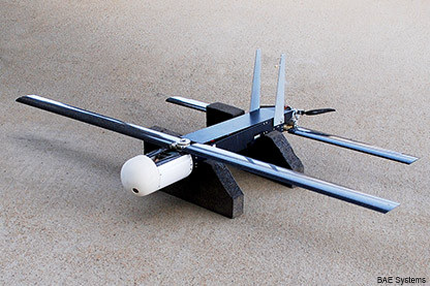
The Office of Naval Research has recently demonstrated a new era in autonomy and unmanned systems for naval operations that has great promise for Distributed Lethality. The LOCUST (Low-Cost UAV Swarming Technology) program utilizes information-sharing

The Coyote UAV, developed by BAE, used by the LOCUST program

between UAVs to enable autonomous collaborative behavior in either defensive or offensive scenarios. In the opinion of this author, this program should be analyzed for its potential application to Distributed Lethality.

Professor Vannevar Bush at MIT was perhaps the first person to come up with a new way of thinking about constructing paths for information-sharing. He suggested that an individual’s personal information storage and selection system could be based on direct connections between documents instead of the usual connections between index terms and documents. These direct connections were to be stored in the form of trails through the literature. Then at any future time the individual himself or one of his friends could retrieve this trail from document to document without the necessity of describing each document with a set of descriptors or tracing it down through a classification tree [2].

The current response to the dilemmas associated with command and control in any distributed operation has led this author to embrace the concept of swarm intelligence. Rather than attempting to interpret the subject matter of information exchanged by entities in confronting an adversary, why not build control systems that simply track information “flows”? Such flows would define the subject matter contained in a naval message without having to classify the information at all.

Any discussion of command and control would be incomplete without including the concept of fuzzy sets, introduced by Professor Lotfi Zadeh at the University of California, Berkeley in 1965. The concept addresses the vagueness that is inherent in most natural language and provides a basis for a qualitative approach to the analysis of command and control in Distributed Lethality. It is currently used in a wide range of domains in which information is incomplete or imprecise and has been extended into many, largely mathematical, constructions and theorems treating inexactness, ambiguity, and uncertainty. This approach to the study of information systems has gained a significant following and now includes major research areas such as pattern recognition, data mining, machine learning algorithms, and visualization, which all build on the theoretical foundations established in information systems theory [3].

Ultimately, the information paths constructed for the control of Distributed Lethality will be a function of organizational relationships and the distribution of information between them. Since a message in a path cannot reference a previous message unless its originator is cognizant of the previous message, the paths in a “reference-connected set” of messages will often reflect the information flows within a Surface Action Group. When paths are joined with other paths, the resulting path often reflects communications across Surface Action Groups. It remains to be determined whether the Surface Navy can use these concepts as it continues to explore the intellectual groundwork for Distributed Lethality. Nevertheless, it is very tempting to speculate that swarm intelligence will play an important role in the future. The most important consideration is that this approach concentrates on the evolution of an event, rather than upon a description of the event. Even if a satisfactory classification scheme could be found for control of hunter-killer Surface Action Groups, the dynamic nature of their operations suggests that predetermined categories would not suffice to describe the complex developments inherent in evolving and potentially changing situations.

Many organizations have supported research and development designed to explore the full benefits of shared information in an environment in which users will be linked through interconnected communications networks. However, in the view of this author, the model of “trails of messages” should be explored again. “Network warfare” will force an increased emphasis on human collaborative networks. Dynamic command and control will be based on communications paths and direct connections between human commanders of distributed surface ships rather than upon technologies that mechanically or electronically select information from a central store. Such an approach would not only prepare for Distributed Lethality, but may improve command and control altogether.

Ms. Greene is a Research Analyst with CNA. Views expressed are her own. 

REFERENCES:

  1. Greene, , “A Reference-Connecting Technique for Automatic Information Classification and Retrieval”, OEG Research Contribution No. 77, Center for Naval Analyses, 1967
  2. Bush, V., “As We May Think”, Atlantic Monthly 176 (1):101-108, 1945
  3. Zadeh, L.,” Fuzzy sets”, Information Control 8, 338-353, 1965
CIMSEC content is and always will be free; consider a voluntary monthly donation to offset our operational costs. As always, it is your support and patronage that have allowed us to build this community – and we are incredibly grateful.

Select a Donation Option (USD)

Enter Donation Amount (USD)

Missing an Opportunity for Innovation: A Conceptual Critique of Distributed Lethality

100 years ago today, in bunkers and boardrooms across Europe, the military and political leaders of a Europe that was being drowned in its own blood were attempting to solve the stagnant enigma of the Western Front. The traditional narrative of the First World War places the inability of military and political figures of the time to adapt to the previously unimaginable efficacy of modern defensive technology deployed on the battlefields of France and Belgium. While the popular narrative of the conflict usually ends with a nod to the tank and aircraft as the great mobilizers of the sclerotic armies, Stephen J. Biddle effectively argues with quantitative data, in his book Military Power, that it was in fact force employment (and the innovative tactics of the German Army) that broke the stalemate in the West and brought mobility back to warfare (see the Michael Offensive). The “modern system” of land warfare was born.

I’m reminded of Biddle’s illustration of the birth of the “modern system” when considering Distributed Lethality, not because I view the US Navy as antiquated as the armies of the old Europe, but because Distributed Lethality seems to be an intelligent effort at bypassing the tough and expensive learning curve associated with fighting the previous war by reorienting existing resources to meet new challenges. Within it appears to be the tacit recognition of the end of the aircraft carrier as the main instrument of maritime power in the types of 21st century A2/AD environments the US Navy is most likely to find itself fighting for dominance. Carriers will continue to be essential for the support of operations during the fight for dominance, and after it has been achieved in the maritime realm, but their time at the center of naval combat, contesting control of the world’s oceans, may well be over. Distributed Lethality is an attempt at defining the Navy’s future operational flexibility in the complex future of highly contested environments that preclude overuse of its most prominent investment.

At the same time, the reorientation of the surface fleet around the concept of increasing the fighting ability of individual craft within the current system may be too simple a concept to fully address the increasing complexity of the modern maritime environment, especially when that environment is seeing a proliferation of the number of actors able to potentially upset the capabilities of today’s Navy, with more advanced and capable anti-ship missiles, underwater sensors, and unmanned technology likely to be on the way. If the US Navy will have to engage in combat with a low to medium tier opponent within the next 17 years (the technology development timeline cited by Admiral Peter Fanta), then Distributed Lethality will be able to easily carry the day in the same way the Navy has been able to do in similar conflicts (maybe even at a lower price point). If the Navy is faced with a much more complex and determined threat (represented by a recent addition to the rank of top tier naval competitors, even just a regional one), then the concept of Distributed Lethality may be little more than a patch on the inadequacies of the contemporary Navy in considering the operational imperatives of facing and neutralizing that particular set of threats. It would seem to me that Distributed Lethality is, in fact, more a response to the emergence of a high tier threat (within a constricted budgetary environment) than a low to mid-tier threat, so its efficacy must be evaluated within this context.

The Navy, in its current state, could be considered the product of post-Cold War dominance (as Vice Admiral Rowden and Rear Admirals Gumataotao and Fanta explain in their Proceedings piece) and the attempts to take advantage of the concepts of network centric warfare and the revolution in military affairs (RMA) of the 1990s. This was done within the technological confines of the time period, and through the budgetary struggles of a US Navy competing for funds and defining itself within the budgetary narrative of the Global War on Terror. Its difficulties are manifest in the Navy After Next’s loss of its key platforms to cancellation and production truncation along with the discussions surrounding how the Navy will take on the A2/AD capabilities of today, let alone the future.

The US Navy now has a tremendous opportunity (in the face of rapidly evolving threats in the Asia-Pacific), that of being able to define itself within confines of its own primary operational environment, without the time and resource constraints of being actively engaged in combat. While the aircraft carrier’s time as the dominant maritime platform may be nearing the precipice of its decline, the rumblings within the military services and think tank sphere seem to point to the rise of Artificial Intelligence (AI), robotics, and the promise of additive manufacturing in the service of US operational and strategic needs, if the effects of their application can be grasped with full appreciation. If the US is to truly begin to push towards achievements that will open up the promise of network centric warfare and increase the ability to disrupt the defensive systems of the adversary (with acceptable costs in terms of equipment, money and lives) then we should be looking for cheaper ways to do that than through the Navy’s existing platforms, whose survivability and ease of replacement is questionable within the context of type of operational environment Andrew F. Krepninevich lays out in his excellent Maritime Competition in a Mature-Precision Strike Regime.

While Distributed Lethality is an important concept that should inform short and medium term planning (within the 17 year range that it takes to develop and deploy a new system), long range planning must begin now that takes into account the potential coming industrial revolution and advancements in AI and robotics that will bring about the full conceptual realization of networked warfare and unmanned systems. Their development could prove to be the real advantage in naval combat that will no longer feature a dominant aircraft carrier platform and will likely be the key to maintaining American maritime primacy in areas that have the potential to be seriously contested. Unlike the armies of 1917-18, the US Navy currently has the (limited) luxury of time and space to experiment. While the accusing finger of Kitchener, a draft notice, or more efficient bureaucracy could slowly make up for operational shortfalls during the Great War (still, at great human and financial cost), today’s strategic, technological and industrial imperatives are more exacting in terms of lost opportunities.

Ryan Kuhns is a master’s student at the University of Kentucky’s Patterson School of Diplomacy and International Commerce. He studies International Security and Commerce, focusing on defense economics, strategy, and the social/political organization of war.

CIMSEC content is and always will be free; consider a voluntary monthly donation to offset our operational costs. As always, it is your support and patronage that have allowed us to build this community – and we are incredibly grateful.
Select a Donation Option (USD)

Enter Donation Amount (USD)